BDV11 bus
terminator,
bootstrap, and
diagnostic ROM
technical manual
EK-BDV11-TM-001
Copyright © 1978 by Digital Equipment Corporation
The materIal in this manual is for informational purposes and is subject to change without notice. Digital Equipment Corporation assumes no respon-sibility for any errors which may appear in this manual.
Printed in U.s.A.
This document was set on DIGITAL's DECset-8000 computerized typesetting system.
The following are trademarks of Digital Equipment Corporation, Maynard, Massachusetts:
DEC DECCOMM DECsyste'm-lO DECSYSTEM·20
DEC tape DEC US DIGITAL MASSBUS
PDP RSTS TYPESET-8 TYPESET·!! UNIBUS
CONTENTS
Page
CHAPTER 1 INTRODUCTION
1.1 MANUAL SCOPE ... ; ... 1-1 1.2 GENERAL DESCRIPTION ... 1-1 1.3 BDVII SPECIFICATIONS ... 1-3 1.4 RELATED PUBLICATIONS ... 1-3
CHAPTER 2 INSTALLATION
2.1 SCOPE ... 2-1 2.2 PRELIMINARY STEP ... 2-1 2.3 INSTALLING THE MODULE IN A BACKPLANE ... 2-1 2.4 MODULE PIN-OUTS AND LOGIC DRAWINGS ... 2-3
CHAPTER 3 OPERATION
3.1 SWITCHES AND INDICATORS ... ); .. 1
3.1.1 POWER OK LED (D6), HALT/ENABLE Switch (SI), RESTART
Switch (S2), and BEVNT L Switch (Section 5 of E21) ... 3-1 3.1.2 Diagnostic/Bootstrap Switches ... 3-1 3.1.3 Diagnostic Light Display ... 3-1 3.2 HARDWARE REGISTERS ... 3-1
CHAPTER 4 TECHNICAL DESCRIPTION
4.1 ADDRESSING ROM ON THE BDVII MODULE ... .4-1 4.2 BDVII BLOCK DIAGRAM ... 4-4 4.3 TRANSCEIVER/SWITCH REGISTER LOGIC ... 4-6 4.4 CONTROL LOGIC ... 4-8 4.5 POWER-UP LOGIC ... 4-12 4.6 ROM ADDRESS SELECTION LOGIC ... 4-12 4.7 SOCKET SELECTION LOGIC ... .4-16 4.8 ROM SOCKETS LOGIC ... 4-19 4.9 BEVNT LOGIC ... 4-19 4.10 DISPLi~'''Y LOG!C ... 4-19 4.11 READ/WRITE REGISTER LOGIC ... .4-23
APPENDIX A ROM SPECIFICATIONS
Figure No. I-I
2-1 3-1 3-2 4-1 4-2 4-3 4-4 4-5
4-6
4-7 4-8 4-9 4-10 4-11 4-12 4-13Table No.
I-I 2-1 3-1 3-2 4-1 4-2 4-3
4-4
4-54-6
4-7 4-8FIGURES
Title Page
BDYII Module ... 1-2 Insertion and Removal of Modules Having Extractor-Type Handles ... 2-2 BDYII Switches and Indicators ... 3-2 Diagnostic Light Display ... 3-2 BDYII Block Diagram ... 4-5 Transceiver and Switch Register Logic, Bits 0-3 ... .4-7 Control Logic ... 4-9 Operation Sequence, DATO Cycle ... 4-11 Power-Up Logic ... 4-13 ROM Address Selection Logic ... .4-14 Address Bit Selection ... 4-15 Socket Selection Logic ... 4-17 Logic Block Diagram, ROM Sockets ... 4-20 System ROM Jumpers ... 4-21 BEVNT Logic ... 4-22 Display Logic/LEDs D I-D4 ... .4-22 Read/Write Register Logic ... 4-23
TABLES
Title Page
1.1 MANUAL SCOPE
CHAPTER 1
INTRODUCTION
The BDVII is an LSI-II bus option that provides both 120-ohm terminations for LSI-II bus signal lines and diagnostic aids that help a user to determine the operating condition of his system. The BDVII module can be equipped with a variety of read-only memories (ROMs) to provide the user with bootstrap and additional diagnostic capabilities; in such a case, a new option designation is assigned, e.g., BDVII-AA.
This manual gives a technical description of only the BDVII module. Each variation of the BDVII is described in a user manual that pertains only to that variation. The reader should be familiar with the LSI-II microcomputer and its peripheral equipment. The necessary information can be obtained from the 1977-1978 Microcomputer Handbook* published by DIGITAL.
1.2 GENERAL DESCRIPTION
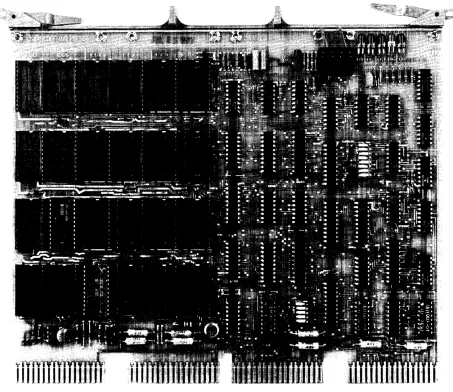
The BDVII logic components are mounted on a 26.7 X 21.6 cm (10.5 X 8.5 in) quad-height printed circuit board (Figure 1-1) that can be inserted in any LSI-II bus quad backplane. Physical space on the module is reserved by DIGITAL for 4K words of ROM; this ROM space contains diagnostic and bootstrap programs for a number of system components. Furthermore, user-available space is fur-nished on the module for 2K words of eraseable, programmable ROM (EPROM) and 16K words of ROM or EPROM. This 18K of user ROM can be executed directly or loaded into ROM for later execution; all ROM is mapped into only 256 words of LSI-II I/O address space.
The BDVl1 contains switches that permit the user to choose diagnostic and bootstrap programs for execution and a diagnostic light display that indicates failures in these programs. In addition, the BDVII module is equipped with a green LED that monitors dc power, two test points for the dc power, a HALT/ENABLE switch that allows the user to force the CPU into the halt mode, and a REST ART switch that enables the user to re-boot the system. All of these controls are edge-mounted. A switch mounted in the interior of the module permits control of the LSIp 11 line-time clock (LTC) function.
*See Paragraph 1.4 for ordering information.
9036·3BW·A0043
[image:7.612.73.526.94.486.2]1.3 BDVll SPECiFiCATiONS
The specifications listed in Table 1-1 are for informational purposes only and are subject to change without notice.
Tabie 1-1 BDVll Specifications Item
Physical Characteristics Length (without handles) Height (without handles) Depth
Electrical Characteristics BDVl1 Module Type Power Requirements
LSI-II Bus Loading Environmental Requirements
Operating Temperature* Operating Humidity
Specification
26.7 cm (10.5 in) 21.6 cm (8.5 in) 1.27 cm (0.5 in)
M8012
+5 Vdc @ 1.6 A (max)
+
12 Vdc @ 0.07 A (max) 2 ac unit loads10-95%, with a maximum wet bulb temperature of 320
C (900
F)
and a minimum dew point of 20
C (360 F)
*
The maximum allowable operating temperature is based on operation at sea level, i.e., at 760 mm Hg (29.92 in Hg); maximum allowable operating temperature must be reduced by a factor of 1.80C/1000 m (1.00 F 11000
ft) for operation at higher altitudes.
1.4 RELATED PUBLICATIONS
Information that is useful to the BDVl1 user can be found in the following DIGITAL publications.
Publication Document Number Remarks
BA I1-N Mounting Box EK~BAI1N-TM-001 In microfiche library; also
Technical Manual available in hard copy
BAI1-N Mounting Box EK-BAIIN-UG-OOI A vailable in hard copy User's Guide
Microcomputer Handbook, EB-07948-53/77 A vailable in hard copy 1977-1978 (2nd Edition)
PD P-l1 Software Handbook EB-08127 -20 /70 A vail able in hard copy
For information concerning microfiche libraries, contact: Digital Equipment Corporation
132 Parker St. Maynard, MA 01754
Attn: Micropublishing Group (PK3-2/T 12)
Hard copy documents can be ordered from: Digital Equipment Corporation 444 Whitney St.
Northboro, MA 01531
2.1 SCOPE
CHAPTER 2
INSTALLATION
This chapter describes the steps to take before installing the BDV11 in a backplane and tells how and where to install the module. Detailed information concerning the installation of LSI-ll system com-ponents can be found in the reference pUblications listed in Paragraph 1.4. Refer to the specific BDVlI-variation user manual for procedures that check for correct system operation after the installa-tion.
2.2 PRELiMiNARY STEP
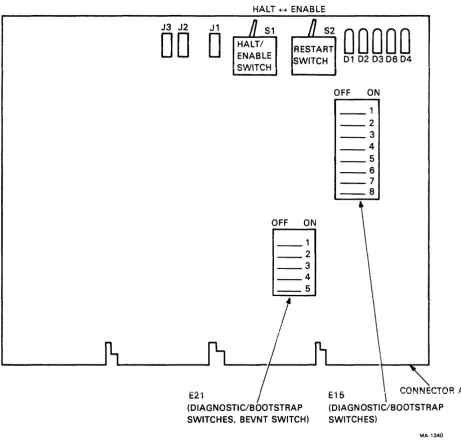
A number of switches on the module must be set before the module is inserted in the backplane. The diagnostic/bootstrap switches are used for maintenance and system configuration; the BEVNT switch is used to select the mode of control of the LSI-II bus BEVNT signal. The location of these switches is shown in Figure 3-1; their operation is described in Paragraphs 3.1.1 and 3.1.2. Ensure that the switches are in the desired positions before installing the module.
2.3 INSTALLING THE MODULE IN A BACKPLANE
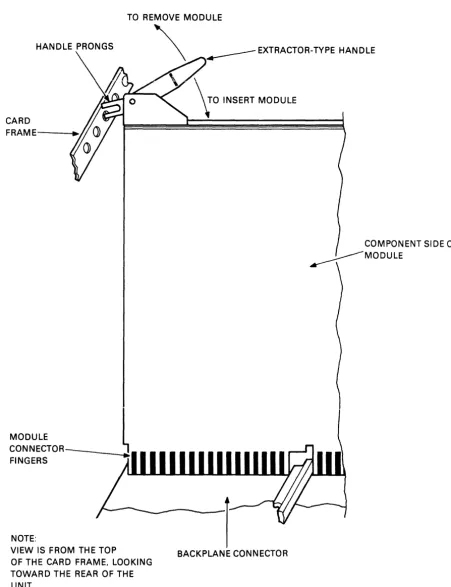
The BDVII can be inserted in any LSI-II quad backplane. In multiple-backplane systems the module must be inserted in the last backplane of the system. When inserting the module, make sure the power is turned off. Connector A of the module is inserted in connector A of the backplane (connector A on the module is the right-most connector when viewing the component side of the module with the connector fingers pointing down; connector A on the backplane is on the left side when viewing the slot side of the backplane). The LSI-II bus signals will appear on module connectors A and B. The BDVII is equipped with metal extractor-type handles that facilitate module insertion and re-moval. When inserting such a module into the backplane, begin by sliding the module, component side up, into the card guides. Slide the module all the way in and just start the module connector fingers into the backplane connectors. Fit the prongs of the handles into the holes in the card frame (Figure 2-1). Press in on both handles simultaneously to fully insert the fingers in the backplane connector. To remove the module, pull both handles out simultaneously until the prongs of the handle are clear of the holes in the card frame. The module fingers will now be nearly free of the backplane connector and
the module can be removed easily.
-CAUTION
The module and/ or the backplane assembly might be damaged if the module is inserted or removed with the power on or if the module is inserted upside down.
CARD
FRAM E--__../
MODULE CONNECTOR-FINGERS
NOTE:
VIEW IS FROM THE TOP
OF THE CARD FRAME. LOOKING TOWARD THE REAR OF THE UNIT.
BACKPLANE CONNECTOR
COMPONENT SIDE OF
~MODULE
MA-1339
[image:11.618.64.515.58.645.2]2.4 l\10DULE PIN-OUTS AND LOGIC DRA\VINGS
The M8012 print set includes logic drawings. Signal names in the iogic drawings have the following form.
SOURCE POLi\RITY
SOURCE indicates the particular sheet of the drawings where the signal originates. SIGNAL NAME is the proper name of the signal; the names used in the drawings are also used in this manual. POLAR-ITY is either H or L to indicate the voltage level of the signal when asserted: H ~ +3 V; L ~ Ground. As an example, the signal SH2 REG L originates on sheet 2 of the drawings and means when REG is true, this signal is at approximately ground level.
LSI-II bus signal lines do not carry a SOURCE indicator. These names represent a bidirectional wire-ORed bus.
As
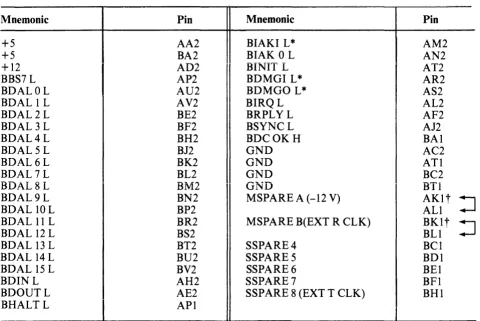
a result, multiple sources for a particular bus signal exist. T-he LSI-II bus signal names begin with a "B" for "bussed." The bus pin-outs for the BDVII are listed in Table 2-1.Table 2-1 BDVll Bus Pin-Outs
Mnemonic Pin
+5 AA2
+5 BA2
+12 AD2
BBS7L AP2
BDALOL AU2
BDALIL AV2
BDAL2L BE2
BDAL3L BF2
BDAL4L BH2
BDAL5L BJ2
BDAL6L BK2
BDAL7L BL2
BDAL8L
BM2
BDAL9L BN2
BDAL 10 L BP2
BDAL II L BR2
BDAL 12 L BS2
BDAL 13 L BT2
BDAL 14 L BU2
BDALI5L BV2
BDINL AH2
BDOUTL AE2
BHALT L API
*
These signals are not bussed; they are daisy-chained. t This jumper is wired on the backplane.2-3
Mnemonic BIAKI L* BIAK 0 L BINIT L BDMGI L* BDMGO L* BIRQL BRPLYL BSYNCL BDCOKH GND GND GND
GND
MSPARE A (-12 V) MSPARE B(EXT R CLK) SSPARE4
SSPARE 5 SSPARE6 SSPARE 7
SSP ARE 8 (EXT T CLK)
[image:12.613.77.557.304.625.2]3.1 SWITCHES AND INDICATORS
CHAPTER 3·
OPERATION
There are two lever switches (S 1 and S2) and five LEDs (D 1-D4 and D6) mounted on the front edge of the BDVll module, and two dip-socket switch units (E15 and E21) mounted on the interior of the module. These components are identified in Figure 3-1 and described in the following paragraphs.
3.1.1 POWER OK LED (D6), HALT /ENABLE Switch (SI), RESTART Switch (S2), and BEVNT L Switch (Section 5 of E21)
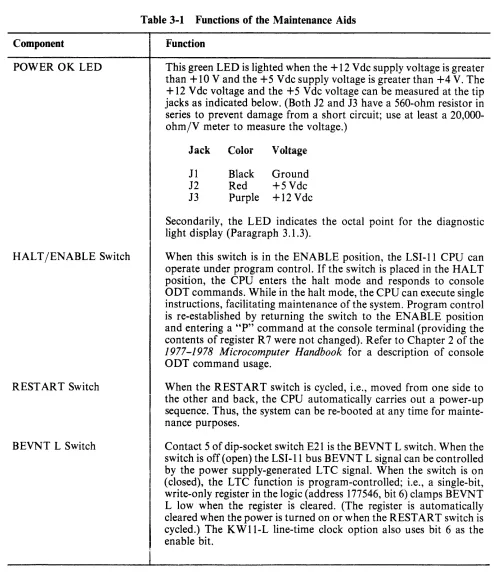
These components are maintenance aids. Table 3-1 describes the function of each component.
3.1.2 Diagnostic/Bootstrap Switches
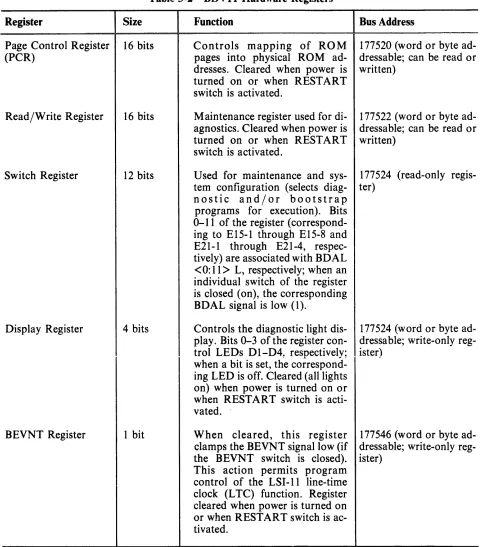
The dip-socket switch units, E15 and E21, are used with BDVll variations. The switches, except switch 5 of E21, allow the user to select diagnostic programs and/or a bootstrap program that run automatically when power is turned on or when the system is re-booted. (Refer to the appropriate user manual for details.) The 12 individual switches comprise the switch register, which can be read at bus address 177524. (Table 3-2 includes a description of this register and its function in the BDVll.)
3.1.3 Diagnostic Light Display
The diagnostic light display is used primarily with BDVll variations. In these applications, the display indicates the area of failure of a dial!nostic or bootstrao. Figure 3-2 illustrates the left front edge of the module (as viewed from the rear ~f the mounting box), ~howing the five LEDs that comprise the display. D6 is the POWER OK LED, which is lighted when the +12 Vdc and +5 Vdc supplies are operating correctly and which indicates the octal point for the display value. Refer to the appropriate user manual for information.
3.2 HARDWARE REGISTERS
HALT +-+ ENABLE
J3 J2 J1 S2
00000
DO
0
HALT/RESTART ENABLE
SWITCH
SWITrH I """ I
OFF ON
_ _ 1 _ _ 2 _ _ 3
_ _ 4
E2i /
(DIAGNOSTIC/BOOTSTRAP SWITCHES. BEVNT SWITCH)
D1D2D3D6D4
OFF ON
--,
_ _ 2 _ _ 3_ _ 4
_ _ 5 _ _ 6 _ _ 7 _ _ 8
Ei5 \
(DIAGNOSTIC/BOOTSTRAP SWITCHES)
[image:14.615.61.523.71.513.2]MA-1340
Figure 3-1 BDVII Switches and Indicators
D4 D6 D3 D2 D1
00000
,
S2
lel
MA-1341
Figure 3-2 Diagnostic Light Display
Component
POWER OK LED
HALT jENABLE Switch
RESTART Switch
BEVNT L Switch
Table 3-1 Functions of the Maintenance Aids Function
This green LED is lighted when the + 12 V dc supply voltage is greater than + 10 V and the + 5 V dc supply voltage is greater than +4 V. The + 12 V dc voltage and the +5 V dc voltage can be measured at the tip jacks as indicated below. (Both J2 and J3 have a 560-ohm resistor in series to prevent damage from a short circuit; use at least a 20,000-ohmjV meter to measure the voltage.)
Jack ,....~1~_
Voltage
,"-,UIUI
Jl Black Ground
J2 Red +5Vdc
J3 Purple +12 Vdc
Secondariiy, the LED indicates the octal point for the diagnostic light display (Paragraph 3.1.3).
When this switch is in the ENABLE position, the LSI-II CPU can operate under program control. If the switch is placed in the HALT position, the CPU enters the halt mode and responds to console ODT commands. While in the halt mode, the CPU can execute single instructions, facilitating maintenance of the system. Program control is re-established by returning the switch to the ENABLE position and entering a "P" command at the console terminal (providing the contents of register R 7 were not changed). Refer to Chapter 2 of the
1977-1978 Microcomputer Handbook for a description of console
ODT command usage.
When the REST ART switch is cycled, i.e., moved from one side to the other and back, the CPU automatically carries out a power-up sequence. Thus, the system can be re-booted at any time for mainte-nance purposes.
[image:15.612.64.558.92.670.2]Register
Page Control Register (PCR)
Read/Write Register
Switch Register
Display Register
BEVNT Register
Table 3-2 BDVll Hardware Registers Size
16 bits
16 bits
12 bits
4 bits
1 bit
Function
Controls mapping of ROM pages into physical ROM ad-dresses. Cleared when power is turned on or when RESTART switch is activated.
Maintenance register used for di-agnostics. Cleared when power is turned on or when REST AR T switch is activated.
Used for maintenance and sys-tem configuration (selects diag-nostic and/or bootstrap
programs for execution). Bits 0-11 of the register (correspond-ing to E15-1 through E15-8 and E21-1 through E21-4, respec-tively) are associated with BDAL <0: 11
>
L, respectively; when an individual switch of the register is closed (on), the corresponding BDAL signal is low (1).Controls the diagnostic light dis-play. Bits 0-3 of the register con-trol LEDs DI-D4~ respectively; when a bit is set, the correspond-ing LED is off. Cleared (all lights on) when power is turned on or when RESTART switch is acti-vated.
When cleared, this register clamps the BEVNT signal low (if the BEVNT switch is closed). This action permits program control of the LSI-II line-time clock (LTC) function. Register cleared when power is turned on or when REST AR T switch is ac-tivated.
3-4
Bus Address
177520 (word or byte ad-dressable; can be read or written)
177522 (word or byte ad-dressable; can be read or written)
177524 (read-only regis-ter)
177524 (word or byte ad-dressa ble; write-only reg-ister)
[image:16.612.51.532.105.652.2]4.1 ADDRESSING ROM ON THE BDVll MODULE
CHAPTER 4
TECHNICAL DESCRIPTION
A block of 256 LSI-II bus addresses is reserved for use in addressing ROM locations on the BDV11 module. This block resides in the upper 4K address bank (28K-32K), which is normally used for peripheral-device addressing, and consists of byte addresses 173000-173776 (512 byte addresses corre-spond to 256 word addresses in the LSI-II addressing scheme).
The BDV11 logic enables all 2048 locations in a selected 2K ROM (or 1024 locations in a lK ROl\1) to be addressed by just these 256 bus addresses. The logic includes a page control register (PCR) at bus address 177520; the contents of this read/write register determine the specific ROM location that is accessed when one of the 256 bus addresses is placed on the BDAL lines. The PCR is loaded with "page" information, i.e., the PCR contents point to one of 16 (or one of 8) 128-word pages in the seiected ROM
06
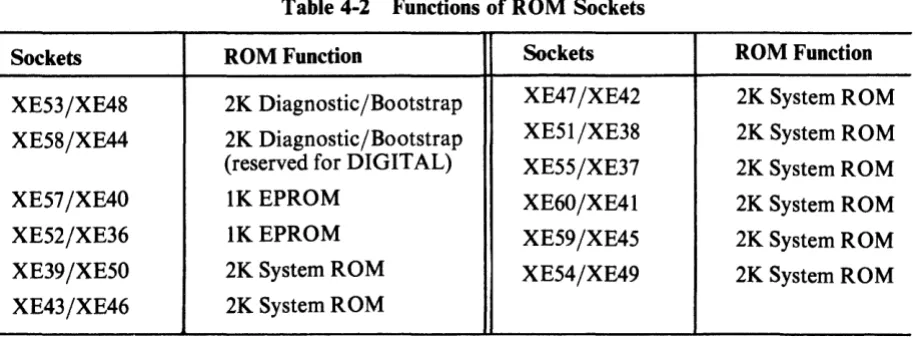
pages X 128 words = 2048 words). To illustrate, if the peR contents represent pages 0 and 1, bus addresses 173000-173776 access ROM locations 0000-0377; if the PCR contents represent pages 10 and 11, bus addresses 173000-173776 access ROM locations 2000-2377. Table 4-1 relates bus addresses, PCR pages, and ROM locations.At the top of each column of PCR pages in Table 4-1 appear two circuit component designations; column 1, for example, is headed by E53/E48. These designations represent the ROMs and EPROMs that one might find on a BDV11 module. For instance, the BDV11-AA is supplied with 2K words of diagnostic ROM. The ROM inserted in socket XE53 supplies the high byte (bits 8-15) of these 2K words, while the ROM inserted in socket XE48 supplies the low byte (bits 0-7). To access the BDV11 diagnostic ROlVi locations, the user must load the peR with the pages in column 1; thus, when 12 and 13, for example, are loaded in the PCR, diagnostic ROM locations 2400-2777 can be addressed by the LSI-II BDAL signals. Another variation of the BDV11 could have 1K-word EPROMs inserted in sockets XE57/XE40 (E57 supplies the high byte, while E40 supplies the low byte). To access these EPROM locations, the user would load the PCR with pages in column 3; thus, with 44 and 45 in the PCR, EPROM locations 1000-1377 are accessible.
Table 4-1 BnVll Bus Addresses/PCR Pages PCRPages
ROM E53/ E58/ E57/ E52/ E54/ E59/ E60/ E55/ E51/ E47/ E43/ E39/ Location Bus Address E48 E44 E40 E36 E49 E45 E41 E37 E38 E42 E46 E50 Accessed
173000-173376
0
20
40
50
200 220 240 260 300 320 340 360 0000-0177
173400-173777
1
21
41
51
201 221
241 261
301
321
341
361 0200-0377
173000-173376
2
22
42
52
202 222 242 262 302 322 342 362 0400-0577
173400-173777
3
23
43
53
203 223 243 263 303 323 343 363 0600-0777
173000-173376
4
24
44
54
204 224 244 264 304 324 344 364 1000-1177
173400-173777
5
25
45
55
205 225 245 265 305 325 345 365 1200-1377
173000-173376
6
26
46
56
206 226 246 266 306 326 346 366 1400-1577
173400-173777
7
27
47
57
207 227 247 267 307 327 347 367 1600-1777
173000-173376 10
30
210 230 250 270 310 330 350 370 2000-2177
173400-173777 11
31
211 231
251
271
311
331
351
371
2200-2377
173000-173376 12
32
212 232 252 272 312 332 352 372 2400-2577
173400-173777 13
33
213 233 253 273 313 333 353 373 2600-2777
173000-173376 14
34
214 234 254 274 314 334 354 374 3000-3177
173400-173777 15
35
215 235 255 275 315 335 355 375 3200-3377
173000-173376 16
36
216 236 256 276 316 336 356 376 3400-3577
173400-173777 17
37
217 237 257 277 317 337 357 377 3600-3777
Table 4-2 Functions of ROM Sockets
Sockets ROM Function Sockets ROM Function
XE53/XE48
2K
Diagnostic/BootstrapXE47/XE42
2K
SystemROM
XE58/XE44
2K
Diagnostic/BootstrapXE51/XE38
2K
SystemROM
(reserved for DIGITAL)
XE55/XE37
2K
SystemROM
XE57/XE40
lKEPROM
XE60/XE41
2K
SystemROM
XE52/XE36
lKEPROM
XE59/XE45
2K
SystemROM
XE39/XE50
2K
SystemROM
XE54/XE49
2K
SystemROM
XE43/XE46
2K
SystemROM
[image:18.613.61.540.85.562.2] [image:18.613.71.531.482.651.2]The PC R is a
16-bit
register comprising two 8-bit bytes. The low byte consists of bits0-7,
while the high byte consists of bits8-15.
When page 6, for instance, is loaded into the low byte of the PCR, bus addresses173000-173376
access the128
ROM locations in the block1400-1577.
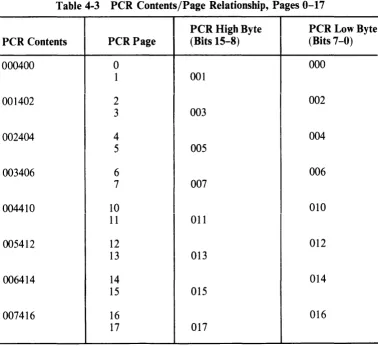
When a bus address falls in this range, the logic considers only the low byte of the PCR. On the other hand, if a bus address is in the range i 73400-i 73777, oniy the high byte of the peR is used to seiect the ROIvl location.Table
4-3
relates the PCR contents to the PCR page for pages0-17.
As an example, if the PCR is loaded with data000400,
the PCR low byte contains data000,
while the high byte contains data001.
The PCR bytes can be loaded separately. To select ROM locations1600-1777,
for instance, one only needs to load the PCR high byte with page7;
thus, the high byte contains007,
while the low byte can contain anything. Table4-4
lists the PCR contents for the remaining peR pages.Table 4-3 PCR Contents/Page Relationship, Pages 0-17
PCR High Byte PCR Low Byte
PCR Contents PCRPage (Bits 15-8) (Bits 7-0)
000400
0
000
1
001
001402
2
002
3
003
002404
4
004
5
005
003406
6
006
7
007
004410
10
010
11
011
005412
12
012
13
013
006414
14
014
15
015
007416
16
016
[image:19.613.127.505.274.620.2]Table 4-4 PCR Contents, Pages 20-57, 200-377
Page Contents Page Contents Page Contents
20,21
010420
240,241
120640
340,341
160740
')') ')1
011422
242,243
121642
342,343
161742
..,w,~J
24,25
012424
244,245
122644
344,345
162744
26,27
013426
246,247
123646
346,347
163746
30,31
014430
250,251
124650
350,351
164750
32,33
015432
252,253
125652
352,353
165752
34,35
016434
254,255
126654
354,355
166754
36,37
017436
256,257
127656
356,357
167756
40,41
020440
260,261
130660
360,361
170760
42,43
021442
262,263
131662
362,363
171762
44,45
022444
264,265
132664
364,365
172764
46,47
023446
266,267
133666
366,367
173766
270,271
134670
370,371
174770
50,51
024450
272,273
135672
372,373
175772
52,53
025452
274,275
136674
374,375
176774
54,55
026454
276,277
137676
376,377
177776
56,57
027456
300,301
140700
200,201
100600
302,303
141702
202,203
101602
304,305
142704
204,205
102604
306,307
143706
206,207
103606
310,311
144710
210,211
104610
312,313
145712
212,213
105612
314,315
146714
214,215
106614
316,317
147716
216,217
107616
320,321
150720
220.221
110620
322.323
151722
222,223
111622
324,325
152724
224,225
112624
326,327
153726
226,227
113626
330,331
154730
230,231
114630
332,333
155732
232,233
115632
334,335
156734
234,235
116634
336,337
157736
236,237
117636
4.2 BDVll BLOCK DIAGRAM
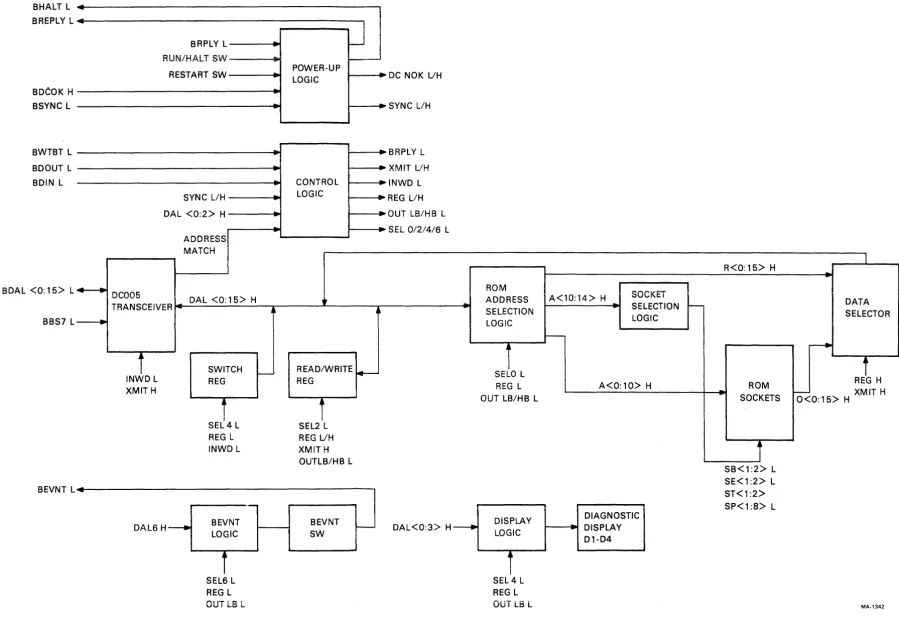
Figure 4-1 shows a block diagram of the BDVl1 logic. The DC005 transceivers monitor the LSI-II bus
BDAL lines. When an address in the upper 4K bank of bus addresses is placed on the BDAL lines, the
transceivers gate the address information onto the BDVll DAL lines.
Ifthe address is one of those
assigned to the BDVll (173000-173777, 177520, 177522, 177524, 177546), the transceivers generate
ADDRESS MATCH signals. These signals cause the control logic to decode the bus address and to
respond to the protocol signals that effect bus data transfers.
[image:20.613.90.517.82.561.2]BHALT L 4 i
BREPLYL.4~---'1
I
BRPLY
L--~~I
~
I
BDCOK H BSYNC L
Rur~;HAL T S\lv
RESTART SW
!j;r'
-, POWER-UP -LOGIC--DC NOK UH
SYNC L/H
BWTBT L
---~:I
BDOUT L
:
::~Y:~
BDIN L
BDAL <0: 15> L 4
BBS7 L
BEVNT L
-SYNC L/H DAL <0:2> H
A n E: cl
~ DCOO5
DAL <0:15> H
-TRANSCEIVER
r-INJO l
XMITH
DAL6 H--.
SWITCH REG
r
SEL4 L REG L INWDLBEVNT LOGIC
r
SEL6 L REG L
OUT La L
-
CONTROL-
LOGIC-
--•
•
I - - READIWRITE
REG
I
SEL2 L REG UH XMITH OUTLB/HB L
BEVNT SW
-..
-•
I+I
-INWD L REG LlH OUT LB/HB L SEL 0/2/4/6 L
DAL<0:3> H
--.
ROM ADDRESS SELECTION LOGICSEt l
REG L OUT LB/HB L
DISPLAY LOGIC
I
SEL4 L REG L
OUT LB L
A<10:14> H _ SOCKET SELECTION LOGIC
I---A<0:10> H
DIAGNOSTIC
..
DISPLAY-01-04
I----R<0:15> H
ROM SOCKETS
i
SB<1:2> L SE<1:2> L ST<l :2> SP<1:S> L~I
DATA SELECTOR
r--+
REt H
-
XMIT H0<0:15> H
[image:21.1229.265.1164.73.690.2]MA-1342
The bus address placed on the BDAL lines can be the address of one of the BDVII registers, or the address of a ROM location. If one of the registers has been addressed, the control logic asserts those signals that are necessary to carry out the operation directed by the protocol signals that follow. For example, if the 16-bit read/write register is addressed, the control logic asserts the signals that permit the register to be either read or written. When the actual transfer of data takes place, the information is gated to or from the register on the DAL lines in response to the protocol signals.
If the bus address is that of a ROM location, the address is loaded into the ROM address selection logic. This logic includes the PCR, which contains page information previously loaded by a writing operation into the PCR. The address selection logic decodes the address and asserts relative address signals (AO H - AIO H) that are applied to all the ROM sockets. Other address signals (AIO H - AI4 H) are applied to the socket selection logic; this logic generates signals that select the particular ROM identified by the PCR page information. This ROM responds to the relative address signals and places the data in the addressed location on the 0<0: 15> H lines. The data is then gated onto the DAL lines by the data selector and placed on the BDAL lines in response to the protocol signals.
The data selector is also used when the PCR is read. When this operation is executed, the peR page information carried on the R <0: 15> L lines is gated onto the DAL lines and from those lines to the bus.
All the foregoing logic blocks are described in detail in the following paragraphs. The power-up logic, the BEVNT logic, and the display logic (all of which are self-descriptive, functionally) are also dis-cussed. For detailed information concerning bus transfer operations, refer to the 1977-1978
Micro-computer Handbook.
[image:22.618.118.463.638.702.2]4.3 TRANSCEIVER/SWITCH REGISTER LOGIC
Figure 4-2 shows the transceiver/switch register logic for bits 0-3. The DCOO5 transceiver is a bidirec-tional buffer between the LSI-II data/address lines, BDAL <0: 15> L, and the BDVII data/address lines, DAL <0:15> H. The transceiver also provides a constant generator (which is used for selecting BDVI1 diagnostic and bootstrap addresses) and comparison circuits for address selection.
The transfer of information between the BDAL lines and the DAL lines is controlled by signals XMIT Hand INWD L, which are generated in the control logic in response to the LSI-II bus protocol signals. XMIT Hand INWD L are related to bus transfer cycles as follows.
INWD L XMIT H Bus Transfer Cycle LO
LO HI HI
LO HI LO HI
No transfer (DAL and BDAL lines open) DATI (DAL-+BDAL)
} DATO/DATOB(BDAL-+DAL)
Information can also be put on the BDAL lines by the transceiver JA V inputs. These three inputs drive three bus lines directly, overriding the XMIT Hand INWD L control signals (JA V3, JA V2, and JA VI are paired with BUS3, BUS2, and BUSI, respectively, in each DCOO5). A high input causes a low to be transmitted on the corresponding bus line, while a low or open input causes an open condition to occur on the bus line. The JAV inputs allow the user to read the contents of the switch register and are related to the BDAL<0:2> L signals as follows.
JA V3 (HI/LO-OR-OPEN) JA V2 (HI/LO.-QR-OPEN) JA VI (HI/LO-OR-OPEN)
BDALOL (LO/OPEN)*
BDALIL
(LO/OPEN)
BDAL2L
(LO/OPEN)
*
When JA V3, for example, is high, BDALO L is low~ when JA V3 is low or open, BDALO L is open.REG L SEL4 L INWD L
BDALO L _ _ _ _ _ 8-{ BDAL1 L _ _ _ _ _ 9-( BDAL2 L _ _ _ _ 1_1-( BDAL3 L _ _ _ _ 1_2-("
BUS3 BUS2 BUS1
19
+SV---~JA3
,..-________ 2---1 JA2
t - - - I JA 1
13
MENB .--_ _ 1_6--1 JA V3
.--_1_S-! JA V2 14
JAV1 XMIT
S
XMiT H
14
1S 16
DCOOS
E19
E15
A3
A2 A1
DAT3 .... 6---DALO H DAT2 7 DAL1 H
DAT1 17 DAL2 H
DATO 18 DAL3 H
MATCHt-3---ADDRESS MATCH
REC 4
I
INWD L
3
2
+SV
[image:23.613.129.509.137.575.2]MA-1343
The JA inputs of the transceiver are part of the comparison circuits. When the signal state at a JA input is the same as that at the corresponding bus line, a match exists. If three matches exist, and if the MENB L signal is low, the MATCH output of the DCOO5 is open-circuited. This open-collector output permits more than one transceiver output to be wire-ANDed, thereby ~Jrming a somposite address match signal. The relation between the JA signals and the BDAL signals, and between MENB L and MATCH H is shown below.
BDALOL BDALIL BDAL2L
JA3 (GROUND/OPEN) LO/HI
JA2 (GROUND/OPEN) LO/HI
JAI (GROUND/OPEN) LO/HI
MENBL J A-BDAL Match MATCHH
HI All 3 match LO
LO All 3 match OPEN
LO One mismatch LO
4.4 CONTROL LOGIC
The control logic (Figure 4-3) includes a DCOO4 protocol chip (E8) and an 82S23 PROM (E9). The PROM monitors LSI-II bus addresses via the DCOO5 transceivers and generates two important sig-nals. One of these, at output DO(I) is asserted (high) when the address of any of the BDVll registers is placed on the bus. The other, at output Dl(l), is also asserted when a register is addressed; further-more, this output is wire-ANDed (at A) with two signals from transceiver E17 (MATCH and DAL12 H) to produce an enabling signal when anyone of the assigned bus addresses (173000-173777) is placed on the BDAL lines.
This enabling signal is applied to the DCOO4 ENB input, allowing this chip to generate signals that select the BDVl1 registers for data transfers (SELO L, SEL2 L, SEL4 L, and SEL6 L). The DCOO4 also generates the protocol signals that permit data transfers to take place. Tables 4-5, 4-6, and 4-7 relate the inputs and outputs of the DCOO4.
As an example of the control logic operation, consider the following description. Figure 4-4 represents the sequence of operations in a DATO bus cycle. Let us assume that we are going to place page information in the BDVll PCR, address 177520. When this address is put on the BDAL lines, PROM E9 asserts outputs DO and Dl, and wire-AND gate A causes the DCOO4 ENB input to go high (be-cause BSYNC L is high, INWD L i~ high and the bus address causes the DCOO5 transceivers to assert MATCH and DAL signals; refer to Table 4-6). When the processor asserts BSYNC L, flip-flop EI0 is set, generating the REG H and REG L signals; in addition, the DCOO4 generates SELO L (Table 4-5), thereby completing the "device-selected" operation in the BDVll (SELO L remains low until BSYNC L is negated). Now the CPU places the PCR page information on the BDAL lines and asserts BDOUT L. As Table 4-7 shows, both the OUTHB Land OUTLB L signals, as well as the BRPLY L, signal, are asserted. (Even though ENB might have gone low when the page information was placed on the BDAL lines, this input was high when BSYNC L was asserted.)
The OUTHB Land 0 UTLB L signals clock the PCR, loading it with the page information on the DAL lines. After the CPU negates the BDOUT L signal, the BDVl1 negates BREPLY L and the CPU terminates the operation by negating BSYNC L.
J;
E17-MATCH---~t:t:J~-4---~
DAL12 H - - - {
BDAL2 L BDAL 1 L
BDALO L
E19 DC005
I
+5V~~--~----~
~----I VECTOR
DAL2 H---( DAL2 DAL1 H - - - ( DALl DALO H---I[ ] DALO
BWTBT L
~
WTBTBDOUT L---· DOUT
BDIN L DIN
BSYNC L---I.
SYNC H
E 14-MATCH - - - - . . . ,
B
E18-MATCH----~
E 1 9 M A T C H
-DC004 E8
ENB
INWD L
SELO L SEL2 L SEL4 L SEL6 L OUT LB L OUT HB L BRPLY L
~----ID
SYNC H C
E10
~---''----REG H
~--REG L
DC NOK L
XMIT L
XMIT H
BREPLY L
[image:25.1229.354.1160.82.657.2]MA-1344
Table 4-5 DCOO4 Select Outputs
Inputs Outputs
BSYNCL END* DDAL2L* BDALIL* SELOL SEL2L SEL4L
L H H H L H H
L H H L H L H
L H L H H H L L H L L H H H
*H and L for these signals indicate the state of the input line at the falling edge of BSYNC.
BSYNCL
L
Table 4-6 DCOO4 Protocol Signals
Inputs Outputs
BSYNCL BDINL ENB* INWDL BREPLYL
H X X H H
L X H H H
L L L L H
L H L L L
*H and L for these signals indicate the state of the input line at the falling edge of BSYNC.
Table 4-7 DCOO4 Byte Signals
Inputs Outputs
BDOUTL ENB* BWTBTL BDALOL* OUTHBL OUTLBL
H X L L
L L L L H
L L H H L
L X L L
H L L L H
L H H L
*H and L for these signals indicate the state of the input line at the falling edge of BSYNC.
4-10
SEL6L
H H H
L
BREPLYL H
[image:26.617.67.519.89.211.2] [image:26.617.140.436.272.398.2] [image:26.617.59.526.473.618.2]CPU
ADDRESS DEVICE/MEMORY
• ASSERT BDALO-15 L WITH ADDRESS AND
• ASSERT BBS7 L (IF ADDRESS IS IN THE 28-32K RANGE)
• ASSERT BWTBT L (WRITE
I"'VI"" 1::1
""I""L~I
BDV11
ASSERT B SYNC L - - - --"DECODE ADDRESS
OUTPUT DATA
•
REMOVE THE ADDRESS FROM~
BDALO-15 LAND NEGATE BBS7 LAND BWTBT L (BV'ITBT L REMAINS ACTIVE IF DATOB CYCLE)
• PLACE DATA ON BDALO-15 L
•
ASSERT BDOUT L - --• STORE "DEVICE SELECTED"
~ OPERATION
~ ~
...--- ...--- ...--- ...--- ~TAKEDATA
• RECEIVE DATA FROM BDAL LINES
TERMINATE OUTPUT
TRANSFER"'-4"--• REMOVE DATA FROM BDALO-15 L AND NEGATE BDOUT L
---
---TERMINATE BUS CYCLE
_ _ _ _ . ASSERT BRPLY L
----
---
- . . OPERATION COMPLETED4---
_ _ _ _ • TERMINATE BRPLY L • NEGATE BSYNC L (AND BWTBT L [image:27.612.86.532.96.643.2]I F A DATOB BUS CYCLE)
Figure 4-4 Operation Sequence, DATa Cycle
4.5 POWER-UP LOGIC
The power-up logic (Figure 4-5) includes the ENABLE/HALT switch and the RESTART switch. In normal operation, the ENABLE/HALT switch is in the ENABLE position. When the switch is placed in the HALT position, inverter E16 causes NAND gate E7A to assert the BHALT L signal. The CPU enters the halt mode and responds to console ODT commands. To resume operation, the user must return the switch to the ENABLE position and enter a "P" command at the console terminal. The REST AR T switch must be cycled to re-boot the system. If the switch is in the position shown in Figure 4-5, cycling the switch lever generates a pulse that is differentiated by capacitor C13. The leading edge of the negative spike is inverted by E13 and causes E7B to negate the BDCOK H signal; thus, DC NOK L is asserted, initializing the BDVII registers. When the negative spike decays, NAND gate E7B is disabled; the reasserted BDCOK H signal causes the CPU to carry out a power-up se-quence and normal operation is resumed. BDCOK H can also be negated by the LSI-II power supply, which negates the BDCOK H signal if the dc voltages fall below specified levels.
The bus BREPL Y L signal is asserted during the protocol routine when E8 asserts BRPL Y. Con-trarily, the bus BSYNC L signal causes SYNC H and SYNC L to be asserted, also during the protocol routine.
4.6 ROM ADDRESS SELECTION LOGIC
The logic shown in Figure 4-6 decodes the 25610 LSI-ll bus addresses and produces the 204810
ad-dresses needed to access ROM locations. Several examples are given here to illustrate how the logic works.
In the first example, assume that we want to address location 0400 in the diagnostic/bootstrap ROMS, which occupy sockets XE53 and XE48. Table 4-1 shows that to address this location we must have page 2 in the PCR; then, bus address 173000 will access location 0400. It is usual (but not necessary) to load the PCR with a pair of pages. Therefore, we will put pages 2 and 3 in the PCR by addressing the PCR at address 177520 and loading it with data 001402; i.e., the PCR low byte contains 002 and the high byte contains 003 (Figure 4-7).
Now, address 173000 is placed on the LSI-II BDAL lines. Bits 1-8 of the address are loaded into the flip-flops, E33 (because the bus addresses differ only in the first 9 bits, BDAL<9: 15> L need not be considered). ROM address bits AO-A6 assume the logic state ofDAL bits 1-7, respectively. The logic looks at DAL8 H to determine which of the PCR bytes will form ROM address bits A 7-A 14. Since DAL8 H is low, the low byte is selected; i.e., E32 gates R <0:3> H to A <7: 10> Hand E34 gates R <4:7> H to A < 11:14> H. Bits AO-AI0 are used to select the ROM location 0400; bits AI1-AI4 are used to select the correct ROM, i.e., the ROMs in sockets XE53 and XE48. (This procedure is ex-plained in the next section.)
Now that the PCR contains pages 2 and 3, any ROM location from 0400 to 0777 can be addressed. Consider location 0600, for example, which is addressed by bus address 173400. Example 2 in Figure 4-7 illustrates the bit selection. Because DAL8 H is high, the high byte of the PCR is selected to form ROM address bits A7-AI4. Bits AO-AI0 select ROM location 0600, while bits All-AI4 again select sockets XE53/XE48.
The same bus address, 173400, can address seven other ROM locations, providing the PCR page number is changed. For example, let us address ROM location 3200. To do this, we must change the PCR high byte from page 3 to page 15. We can do this either by loading 006414 (pages 14 and 15) into the PCR or by loading only the high byte with 015. (This can be done by keeping the LSI-ll bus BWTBT L signal asserted throughout the data transfer cycle; thus, only OUT HB L is asserted and only the PCR high byte is loaded.) Let us load only the high byte, as illustrated in Example 3, Figure 4-7. The high byte again forms bits A7-A14 of the ROM address, and we have location 3200 being addressed.
E8
+5V
h
..-_~ ENABLE
HALT
RESTART
SJ
o+5V I
+5V
BRPLY L
r---,
I~---~---BHALTL
B
C
D
~---~---BDCOKH
~---DCNOKH
DC NOK L
r---~---BREPLYL
r---~---BSYNCL
.---SYNCH
SYNC L
[image:29.1232.410.1162.87.656.2]MA-1346
SH2 REG L SH2 SEL 0 L SH2 OUT HB l
SH2 REG l SH2 SEL 0 l SH2 OUT La l
74lS273 E27 SH2 OAl 15 H~ 08 SH2 OAl 14 H----12. 07 SH2 OAl 13 H--.l.i 06
SH2 OAl 12 H~ D5 peR HI SH2 OAl 11 H~ 04 BYTE SH2 OAl 10 H-.2. D3
SH2 OAl 9 H ~ 02 SH2 OAl 8 H ~ 01
11 ClK ClR
~
74lS27 8 11111
~E3 SH2 OC NOK L
74lS273 E29 SH2 DAl 0 H - 2 01 SH2 DAl 1 H - . ! 02 SH2 OAl 2 H-..2 03
PCR SH2 DAl 3 H
---.!.
D4 lO SH2 DAl 4 H.--..!2
05 BYTE SH2 OAl 5 H--l± 06SH2 OAl 6 H
---22.
07 SH2 OAl 7 H ~ 083 ClK ClR
=t2
74LS27 6 111~
~E3 -, SH2 OC NOK L . /
74lS273
SH2 OAl 8
H~
E33 08 SH2 OHl 7 H~ 07 SH2 OAl 6 H~ D6 SH2 OAl 5 H---2.i
05 SH2 OAl4H~
D4 SH2 DAl 3 H-.!....
D3 SH2 DAl 2 H~
D2 SH2 DAl 1 H---2. D 1ClK CLR
~11
I'
SH2 SYNC H SH2 DC NOK l
R8 19 R7 16 R6 15 R5 12
R4 9 I SH3 Rll H R3 6 SH3 R10 H
I 5
R2 I SH3 R9 H 2
R1 I SH3 R8 H
Rl 2 SH3 RO H R2 5 I SH3 R1 H R3 6 I SH3 R2 H R4 9 SH3 R3 H R5 12
R6 15 R7 16 R8 19
19
R8 ~
R7
~SH3A6
HR6
~SH3
A5 H R5~SH3A4
H R4~SH3
A3 H R3 r-LSH3 A2 H R2~SH3
Al HRl
~SH3
AO HSH3 R15 H SH3R14H SH3R13H
SH3 R12 H
74lS257 74lS257
~
E32 12 13 E34 12B3 ~SH3 Al0 H ' - - B3 F3 r - - SH3 A 14 H
14 14
r - A3 r -A3
10 10
B2
~SH3
A9 H B2 911 11 F2 ~
A2 A2 SH3A13H
6 6
B1
B1
~SH3A8
H 7
5 5 F1 ~
Al Al SH3 A12 H
3
BO 3 BO
2
~SH3A7
H 2 AO FO 4
AO I - -SH3 A 11 H
OUT OUT
CaNT so so CaNT
~15
11 11~15
SH3 R4 H SH3 R5 H SH3 R6 H SH3 R7 H
74lS257 TRUTH TABLE
OUTCONT SO A B F
l L X l
l l H X H
H X l l
H X H H
[image:30.1232.209.1094.73.674.2]MA-1347
Figure 4-6 ROM Address Selection Logic
BIT NUMBER 1514131211109 8 7 6 5 4 3 2 1 0
EXAMPLE 1
peR (001402) 0 0 0 0 0 0 1 0 0 0 0 0 0 0
BDAL L (173000) 0 0 0 0 0 0 0 0 0
DAL <1:8> H 0 0 0 0
O{
A <0:6> H 0 0 0 0 o 0
I
A <7:14> H 0 0 0 0 0 0 1 0
A <0:10> H (0400) 0 0 1 0 0 0 0 0 0 0 0
EXAMPLE 2
peR (001402) 0 0 0 0 0 0 0 0 1 0
BDAL L (173400) 0 1 0 0 0 O. 0 0 0 0
\
01
0DAL <1 :8> H 0 0 0 0 0
:~O
'"
A <0:6> H 0
a
0a a
A <7:14> H 0 0 0 0 0 0 1
A <0: 10> H (0600) 0 0 1 0 0 0 0 0 0 0
EXAMPLE 3 peR
10 0 0 0 1 0 1
I
0 0 0 0 0 0 1 0BDAL L (173400) 0 1 0 0 0 0 0 0 0 0
DAL <1:8> H
01
0 0 0 0 0 0O{
'"
A <0:6> H 0 0 0 0 0 o 0
A <7:14> H 0 0 0 0 0 1
A <0: 1 0> H (3200) 0 0 0 0 0 0 0 0
[image:31.615.130.513.112.654.2]MA·1348
Note that the PCR and the flip-flops are cleared whenever DC NOK Lis asseited; this happens when the REST AR T switch is activated or when the dc voltages drop below reliable operating levels. Also, since the R <0: 15> H signals can be gated onto the DAL<O: 15> H lines, the PCR can be read as well as written.
4.7 SOCKET SELECTION LOGIC
The socket selection logic determines which pair of sockets responds to the ROM address signals (although the ROMs in the sockets actually respond, we will state, for ease of explanation, that the sockets respond). The selection signals SB1 L, SB2 L, SE1 L, SE2 L, and SP1 L through SP8 L are generated by two decoders, E30 and E35 (Figure 4-8). Each selection signal causes two sockets to respond to the address signals; one socket contains the high-byte ROM, the other contains the low-byte ROM. Table 4-8 includes the relationship between the selection signals and the selected sockets. Jumpers are inserted selectively in positions W1-W4 and W9-W12. These jumpers cause the PCR page numbers and the selection signals (and, therefore, the sockets) to be related in definite ways. Earlier, Table 4-1 indicated that PCR pages are assigned to specific ROM sockets. This is true within the confines stated for Table 4-1; i.e., the table applies only to the BDV11 module shipped by DIGITAL. On such a module, jumpers W1-W4 and W9-W12 are arranged as indicated under Group A in Table 4-8. Thus, PCR pages 0-17, for example, cause selection signal SB 1 L to be asserted, and SB 1 L causes sockets XE53 and XE48 to respond to address signals A<0:10> H. Other combinations of jumpers are possible, as indicated by Groups B through G in Table 4-8. Note that each selection signal always selects the same pair of sockets; however, the relation of PCR pages to selected sockets varies with jumper configuration.
Now, in Example 1 in the preceding section, the PCR was loaded with pages 2 and 3 so that bus address 173000 could address location 0400. This location was specified by 11 ROM address bits, AO H - AI0 H. The remaining four ROM address bits, All H - A14 H, are applied to the socket selection logic; here, they determine the ROMs in which location 0400 is addressed. If we assumme that we have a BDVI1-AA, which has the Group A jumper arrangement, sockets XE53 and XE48 should be se-lected; i.e., SB 1 L should be asserted by decoder E30 (Figure 4-8). With a jumper in both W9 and W12, SBI L is asserted when A14 H is low, A12 H is low, and All H is low (AIO Hand AI3 Hare irrelevant). Figure 4-7, Example 1, shows that the three signals are low, as they are for all pages in the 0-17 range. That these signals are low for pages 0-17 is indicated by the entry in the primary address column of Table 4-8; i.e., for addresses in the 0-2K range, address bits All H - A14 H are low. Note that there is correlation between PCR pages and primary addresses throughout Table 4-8.
The jumper configurations in Groups B-G allow a choice of where program execution begins. That is, the user can cause the CPU to execute instructions directly from a system ROM or an EPROM when power is turned on, rather than from the diagnostic/bootstrap ROM. To illustrate, in the preceding example the PCR contained pages 2 and 3; hence, bus address 173000 addressed location 0400 in ROMs E53 and E48. However, if jumpers W1-W4 are arranged as shown in Group F, the same PCR pages, 2 and 3, will cause bus adress 173000 to address location 0400 in ROMs E54 and E49; or, if jumpers W9-W12 are arranged as in Group B, 173000 will address 0400 in E57 and E40.
Note that in both of these examples, one group of four jumpers is not specified; i.e., W9-W12 are not specified in Group F and W1-W4 are not specified in Group B. These unspecified jumpers can have any arrangement as long as there is no conflict in chip selection. To illustrate: If we have the Group F configuration, we want PCR page 0 to cause 173000 to addresss 0000 in XE54/XE49; but, if jumpers W9-W12 are arranged as in Group A or B, PCR page 0 causes two other sockets to respond to the same address. Therefore, either there can be no chips in these other sockets, or the arrangement of W9-W12 must be changed; for instance, there would be no conflict at all ifW9-W12 were arranged as in Group C.
+5V
W3
~~~A
y o l S P 8 Lo 0 Y\ SP7 L
A14 L
A 14 H
---r-j)or---rl'---~
V '
= =W4
A11 H---t~----~~---~
A12H---r-t--~-+---J
W1
A10H---+~-'r-~+---~
W2
o o.---J
A13H---+~~r-~+----~
W12
t--+---~o 0
G28 Y2 SP6 L
74S138 SP5 L
E35
SP4 L
A SP3 L
8 SP2 L
C SP1 L
I
6
I
12B
2G 2YO'----1
. 1 I 1
2A
~~~§SE1
L74LS139 2Y3 SE2 L E30
UIJ~""~
W1~'18
1Y0t=SB1 L~ 1Y1 S82L
I 1Y2
74S138 TRUTH TABLE I
~d _ll_A_~9
__
G _ _ 1_Y...J31II
G-1r-I
G-2 '-1C-r-I B-'---I
A-r--O-UT-LO-W--IL L L YO (SP8 L) 74LS139 TRUTH TA8LE (EACH HALF)
G 8 A OUT LOW
L L H Y1 (SP7 L)
L H L Y2 (SP6 L) L L YO(SB1 L)
H L L H H Y3 (SP5 L) L L H Y1 (S82 L)
H L L Y4 (SP4 L) H L Y2 (SE1 L)
H L H Y5 (SP3 L) H H Y3 (SE2 L)
I
H H L Y6 (SP2 L),
l I
!
I
H ! H H Y7 (SP1 L)l
[image:33.612.87.547.70.700.2]Table 4-8 BnVll Selection Signals/Sockets
!
IpeR
PrimaryI
Selection Addresses SocketsGroup WI W2 W3 W4 W9 WIO WII Wl2 Page Signal (A<O:14>H) Selected
A R I I R I R R I 0-17 SBI L OK-2K XE53/XE48
20-37 SB2 L 2K-4K XE58/XE44
40-47 SEI L 4K-5K XE57/XE40
50-57 SE2 L 5K-6K XE52/XE36
360-377 SPI L 30K-32K XE39/XE50
340-357 SP2 L 28K-30K XE43/XE46
320-337 SP3 L 26K-28K XE47/XE42
300-317 SP4 L 24K-26K XE51/XE38
260-277 SP5 L 22K-24K XE55/XE37
240-257 SP6 L 20K-22K XE60/XE41
220-237 SP7 L 18K-20K XE59/XE45
200-217 SP8 L 16K-18K XE54/XE49
B
*
* * *
I R I R 40-57 SBI L 4K-6K XE53/XE4860-77 SB2 L 6K-8K XE58/XE44
0-7 SEI L OK-IK XE57/XE40
10-17 SE2 L lK-2K XE52/XE36
C
*
*
* *
R I R I 200-217 SBI L 16K-18K Ibid220-237 SB2 L 18K-20K 240-247 SEI L 20K-21K 250-257 SE2 L 21K-22K
D
*
* * *
R I I R 240-257 SBI L 20K-22K Ibid260-277 SB2 L 22K-24K 200-207 SEI L 16K-17K 210-217 SE2 L 17K-18K
E I R I R
*
*
*
*
270-277 SPI L 23K-24K XE39/XE50250-257 SP2 L 21K-22K XE43/XE46
230-237 SP3 L 19K-20K XE47/XE42
210-217 SP4 L 17K-18K XE51/XE48
260-267 SP5 L 22K-23K XE55/XE37
240-247 SP6 L 20K-21K XE60/XE41
220-227 SP7 L 18K-19K XE59/XE45
200-207 SP8 L 16K-17K XE54/XE49
F R I R I
* *
Ptr*
160-177 SPI L 14K-16K Ibid 140-157 SP2 L 12K-14K120-137 SP3 L 10K-12K
100-117 SP4 L 8K-I0K
60-77 SP5 L 6K-8K
40-57 SP6 L 4K-6K
20-37 SP7 L 2K-4K
0-17 SP8 L OK-2K
*See text describing these configurations.
[image:34.612.54.532.73.680.2]Table 4-8 BDVll Selection Signals/Sockets (Cont) Primary
Selection Addresses Sockets Group WI W2 W3 W4 W9 WI0 WIt W12 Page Signal ,. 0 44> w,,, I S
{A< :1 HJ elected
G I R R I
*
* * *
70-77 SP1 L 7K-8K Ibid50-57 SP2 L 5K-6K
30-37 SP3 L 3K-4K
10-17 SP4 L 1K-2K
60-67 SP5 L 6K-7K
40-47 SP6 L 4K-5K
20-27 SP7 L 2K-3K
n ,... ,...,..."" T " " ' Y T .. T T
I
V-I V1\..-l1\..NOTE
R = Removed; I = Inserted
4.8 ROM SOCKETS LOGIC
Figure 4-9 represents the ROM sockets and shows the address signals and enabling signals for each functional group of sockets. The diagnostic/bootstrap ROM sockets (which are selected by signals SB 1 Land SB2 L) are supplied with 11 address bits, since these sockets are reserved for 2K-word ROMs. The EPROM sockets (selected by signals SEI Land SE2 L) are reserved for lK ROMs; therefore, these sockets are supplied with 10 address bits. The system ROM sockets can be occupied by either 2K ROMs or 1 K ROMs; five jumpers on the BDV11 module permit ROMs of either size to be used. Figure 4-10 shows how these five jumpers control the selection signals for the system ROM sockets, and relates the jumpers to the types of ROM that can be used in the BDV11. (If ROMs other than 8316E, 2716, and 2708 are used, they must meet the specifications given in Appendix A.) The output data from the selected memory is applied to data selectors that gate the data onto the DAL
<
0: 15> H lines. These selectors also allow the user to read the contents of the peR,4.9 BEVNT LOGIC
The logic shown in Figure 4-11 permits the user to choose how to control the LTC function. When the BEVNT switch, E21, is open, the bus BEVNT L signal can be controlled by the LTC signal generated in the LSI-II power supply. If the switch is closed, the BEVNT L signal can be program controlled. Program control is effected by the I-bit register, EI0. Address 177546 is placed on the BDAL lines, causing signals SEL6 L and REG L to be asserted by the control logic. When data bit 6 is issued, the OUT LB L signal causes E2 to clock the flip-flop, loading it with the state of DAL6 H. If DAL6 H is high, the flip-flop output turns Q4 off, permitting the LTC signal to assert BEVNT L; but, if DAL6 H is low, Q4 is switched on and clamps BEVNT L low. Note that the register is cleared when the power is turned on or when the system is re-booted.
4.10 DISPLAY LOGIC
The display logic and the diagnostic LEDs, DI-D4, are illustrated in Figure 4-12. Address 177524
_.-•• , . . ~t.-; : ... !:'.,~ k=:~ .. = .-.L..,..-,.1.-=.~ •• ,1., .. ,::.~.,. A,,-d- .... k~-!--" n '1 '"''''''''' ~",-""""A, -!-1,.,,,,, f'!~= f'!r.= ... "f.,..,."f'" """"'''<'.::::t. fh.::::t. .,...::::t."''""'.::::t.,.,t~u.::::t.
1~"UIl" 111 L.£..J U~1110 ,",IV,",l\.,",U "11"'11 UCllCl U l l " V-.J Cl.l,", .l""U,",U, U.l,", .l.l.lP-.l.lVp VIAl.plAl." "'''IA''''' l.U", .l"'~l-''''''''l.lY''''
[image:35.612.82.552.81.305.2]R <0:15> H : Bn
A <0:10> H--~-I""XE53/XE48 0 <0:15> H 0 <0:15> H SB1 L _ _ +--1 .... 'Hi BYTE/LO BYTE)I---.,r----""'""-.. An
74LS57 DATA SELECTORS
(E20) (E23) (E28) (E31 )
OUT
CONT SO
DAL <0:15> H
Fn
-- -- . XE58/XE44 0 <0: 15> H
SB2 L _ _ _ -I: ... (HI BYTE/LO BYTE) REb H
A <0:9> H---r--...
XE57/XE40 0 <0:15> H
XMIT H
)--L
r---SE1 L _ _ -+---I_~(HI BYTE/LO BYTE)
REGH- ~
XMIT H--:=
f
~OUT2 L'---_.-~ XE52/XE36 0 <0: 15> H SE2 L ---+---1"" (HI BYTE/LO BYTE)
~ XE39.XE43.XE47
XE51. XE55. XE60 0 <8: 15> H ST < 1 : 2> ---+---1_" XE59. XE54
SP
<
1 :8> L - (HI BYTE)I
XE50. XE46. XE42I
~
..
XE38.XE37.XE41 0 <0:7> H ___ ""'"" .... XE45. XE49- (LO BYTE)
NOTE:
SEL2
L---ot>--74LS257 lOUT I
CONT SO
I
I
An BnH X X X
L L X
L L H X
H X L
H X H
XE53/X48. XE58/XE44 ARE DIAGNOSTIC ROM SOCKETS (XE58/XE44 RESERVED FOR DIGITAL);
Fn
HI-Z
L
H L H
XE57/XE40. XE52/XE36 ARE EPROM SOCKETS; REMAINING SOCKETS ARE 16K SYSTEM ROM SOCKETS.
[image:36.617.56.523.54.607.2]MA-1350
Figure 4-9 Logic Block Diagram, ROM Sockets
W7
A10 H o 0 ST2
W8 +12 V
I
o 0r
W13 +Sv~~
I
ST1
J
W6
1
CB2 o 0
DB2
r
ROM TYPE JUMPERS INSERTED'
WS W6 W7 W8 W13
27082 R I R I R
2716 R R I R I
8316E3 I R I R R
8316E4 R R I R I
1. !=!!\JSERTED; R=REMOVED
2. CB2 AND DB2 MUST BE SUPPLIED WITH EXTERNAL -SV POWER. 3. CHIP SELECT SIGNALS MUST BE PROGRAMMED AS FOLLOWS:
CS1 CS2 CS3 LOW LOW LOW
4. CHIP SELECT SIGNALS MUST BE PROGRAMMED AS FOLLOWS:
CS1 CS2 CS3 LOW LOW HIGH
[image:37.612.166.455.109.654.2]MA·1351
REG L OUT LB L SEL6 L
REG L OUT LB L SEL4 L
+5V
+5V DAL6 H 0
t - - - - I C
DC NOK L
Figure 4-11 BEVNT Logic
74LS175 E25 R3(1) DAL3 H ----103 R3(0)
R2(1) DAL2 H----tD2 R2(0)
DAL1 H----tD1
DALO H----tDO
R 1 (1)
R1 (0)
RO(1) RO(O) CLK CLR
DC NOK L
-Figure 4-12 Display Logic/LEDs DI-D4
4-22
MA-1352
+5V
D2
01
[image:38.617.98.493.65.634.2]4.11 READ/WRITE REGISTER LOGIC
The read/write register logic is shown in Figure 4-13. The logic includes two 8-bit universal shift registers, 74LS299 integrated circuits, which are used only in the "hold" and "load" modes.
When the register is addressed, the SEL2 L, REG H, and REG L signals are asserted by the control iogic. If the register is being read, the control logic also asserts the XMIT H signal. The asserted OUT2 L signal puts the register into the hold condition; thus, the information on the DAL lines is that held in the register output stages. On the other hand, when the register is to be written, the XMIT H signal is negated and the register is placed in the load condition. Either or both bytes of the register are clocked and the data on the DAL lines is loaded into the output stages of the register. The entire register is cleared when power is turned on or when the system is re-booted.
S/l DAl15 H
OUT2 l SIR DAl8 H
OH' 74lS299
OA' E22 DAL14 H
REG H R5 DAl9 H
XMIT H SO DII
DAL13 H SEl2 l
rfl
S1 ClK "..,. R3 DAL1 0 HR2 pAL 12 H
OUTHB l
~
'\
R1 DAl11 H)
,
I
ClR G1 G2REG l
~
Y
S/l DAl7 H
SIR
DAlO H
OH' 74lS299
OA' E24 DAl6 H
R5~DALI
HSO
S1 R4 DAl5 H
ClK R3 DAl2 H
OUTlB l R2 DAl4 H
R1 DAl3 H
74lS299
ClR G1 G2
ClR S1 SO ClK Rn
l X l X l
l l X X l DC NOK l
H l l X HOLD CONDITION
H H H i
I
LOAD CONDITIONI
[image:39.617.62.533.219.706.2]APPENDIX A
ROM SPECIFICATIONS
This appendix gives specifications of the ROMs recommended for use in BDVII variations. If ROMs other than those listed are used, they must meet the specifications listed here.
2708-TYPE EPROM (IK X 8 ORGANIZATION)
READ OPERATION
DC AND OPERATING CHARACTERISTICS
TA
=
0° C TO 70° C, VCC=
+5 V ±5%, VOO=
+12 V ±5%, VBB[l]=
-5 V ±5%, VSS=
0 V, UNLESS OTHERWISE NOTED.SYMBOL III ILO IOD[3] Iccl3 J ISS[3J
..
_-I V,H
VOL VOHl VOH2 PD NOTES: PARAMETER
ADDRESS AND CHIP SELECT INPUT SINK CURRENT
OUTPUT LEAKAGE CURRENT
VDD SUPPLY CURRENT
VCC SUPPLY CURRENT
VSS SUPPLY CURRENT
.... -. ' "
INPu I LOW VOLTAGE
iNPUT HIGH VOLTAGE
OUTPUT LOW VOLTAGE
OUTPUT HIGH VOLTAGE
OUTPUT HIGH VOLTAGE
POWER DISSI PATION
MIN. MAX. UNIT CONDITIONS
10 J.l.A Y,N
=
5.25V or Y,N=
V,L10 J.l.A VOUT
=
5.5 V, CSIWE=
5 V65 rnA WORST CASE SUPPLY CUR-RENTS:
10 rnA ALL INPUTS HIGH
45 rnA CSIWE
=
5V; TA=
0° C. .
13.0 Vce+11 V
0.45 V 10L
=
1.6 rnA'3.7 V 10H
=
-100 J.l.A2.4 V 10H
=
-1 rnASOO rnW TA
=
70° C1. VSB MUST BE APPLIED PRIOR TO Vee AND VOO. VaB MUST ALSO BE THE LAST POWER SUPPLY SWITCHED OFF.
2. TYPICAL VALUES ARE FOR TA = 25° C AND NOMINAL SUPPLY VOLTAGES.
3. THE TOTAL POWER DISSIPATION OF THE 2704/270S IS SPECIFIED AT SOO rnW, IT IS NOT CALCULATED BY SUMMING THE VARIOUS CURRENTS ODD, ICC, and 'BB) MULTIPLIED BY THEIR RESPECTIVE VOLTAGES SINCE CURRENT PATHS EXIST BETWEEN THE VARIOUS POWER SUPPLIES AND VSS. THE IDD, ICC, AND IBB
CURRE~~TS SHOULD BE USED TO DETERiviiNE PO'vVER SUPPLY CAPACiTy Oi~LY.
I
AC CHARACTERISTICS
TA
=
0° eTO 70° C. VCC=
+5V ±5%, VOD=
+12 V ±5%, VBS=
-5 V ±5% VSS=
OV. UNLESS OTHERWISE NOTED.2708-1 LIMITS 2708 LIMITS
SYMBOL PARAMETER MIN. MAX. MIN MAX. UNITS
tACC ADDRESS TO OUTPUT 350 450 ns
DELAY
tco CHIP SELECT TO 120 120 ns
OUTPUT DELAY
tDF CHIP DESELECT TO 0 120 0 120 ns
OUTPUT FLOAT
tOH ADDRESS TO OUTPUT 0 0 ns
HOLD
CAPACITANCE[1 ]
TA = 25° C, f = 1 MHz
SYMBOL PARAMETER TYP. MAX. UNIT CONDITIONS
C'N INPUT CAPACITANCE 4 6 pF Y,N
=
OVCOUT OUTPUT CAPACITANCE S 12 pF VOUT
=
OVNOTE PIN CONFIGURATION
1. THIS PARAMETER IS PERIODICALLY SAMPLED AND IS NOT 100% TESTED.
AC TEST CONDITIONS:
OUTPUT LOAD: 1 TTL GATE AND CL
=
100 pF INPUT RISE AND FALL TIMES: ~20 nsTIMING MEASUREMENT REFERENCE LEVELS: O.S V AND 2.8 V FOR INPUTS; O.S V and 2.4 V FOR OUTPUTS. INPUT PULSE LEVELS: 0.65 V TO 3.0 V
PIN NAMES
AO-AS
01-0 S
-
_ _ r~ . . . _ADDRESS INPUTS
DATA OUTPUTS/INPUTS
. - '
--.
-
... ...."._. -... -_ .. _-Il,;HIP SELECT/WRITE ENABLE INPUT I
I I
~
.... t
V24Lvcc
1"'\/ I
A6 23 AS
A5 AS!1]
A4 4 VBB
A3 5 CSIWE
A2 6 270S/2704 VDD
\
Al PROGRAM
(LSB) AO 07 (MSB)
(LSS) 00 06
01 05
02 04
VSS 03
NOTE 1: PIN 22 MUST BE CONNECTED TO VSSFOR THE 2704.