358
AN ENERGY EFFICIENT ENHANCED ERROR NODE
REGAINING ALGORITHM FOR A WIRELESS SENSOR
NETWORK
1MRS. M. KARPAGAM, 2DR. N. NAGARAJAN, 3.MS. J. ABIRAMIATHAVI
1Department of ECE, Assistant Professor, SKCET, Coimbatore 2Principal, CIET, Coimbatore
3Department of ECE, P. G., Scholar, Graduate Student IEEE member, SKCET, Coimbatore
E-mail: 1 [email protected] [email protected],[email protected]
ABSTRACT
This paper proposes an enhanced error node regaining algorithm to prolong the lifespan of a wireless sensor network when some of the sensor nodes power down. This algorithm is mainly based on the genetic algorithm. The efficiency of the energy can be enhanced by the sparse or compressive sensing feature. Our results show that compact sensing prolongs the network lifespan and is more useful for wireless sensor networks with a smaller coverage area.
Keywords: Genetic Algorithm (GA), Energy Efficiency, Compressive Sensing, Network Lifetime, Wireless
Sensor Networks (WSN).
1. INTRODUCTION
Latest techniques in micro processing, wireless and battery technology and smart sensors have enriched data processing [3], wireless communication and detection skill. In sensor networks, each sensor node has some degree of wireless computational power to process and transfer the live data to the data collection centre [2]. In general, sensor nodes are assumed to have limited processing power and highly constrained energy resources [5]. A base station have a higher energy budget than the ordinary sensor nodes because the base station performs the final information aggregation and extraction tasks [7].
This paper proposes an enhanced error node regaining (EENR) algorithm for improving the lifespan of the wireless sensor networks. Lifespan of WSN decreases, either because the sensor nodes no longer have sufficient energy or they have reached their threshold. Implementation of an EENR algorithm results in lesser substitutions of sensor nodes. The compact sensing method has been implemented with the EENR algorithm to increase the energy efficiency, network lifetime and also reduces the cost of substituting the sensor nodes.
2. RELATED WORK
The conventional approaches to WSN routing include the grade diffusion (GD) [13] algorithm where the fellow nodes and routing paths of the
sensor nodes are identified , directed diffusion (DD) [9] where the gathered information is transmitted to the sink node only when it has relevant information for the probe signal, Reduce Identical Event Transmission (RIET) [16] Algorithm where the transmission of duplicate information is reduced for a single event and Reduce Identical Composite Event Transmission (RICET) [16] algorithm is an enhanced version of RIET because it handles composite events.
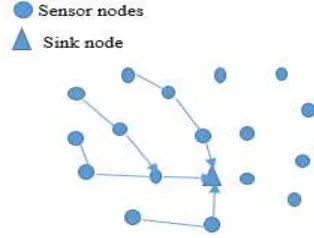
[image:1.612.326.483.574.693.2]Whether the RIET or RICET algorithm is applied, the rank creating suites or involved probe packets must first be broadcast. Then, the sensor nodes transfer the affair information to the sink node, according to the algorithm, when the suitable actions occur. The sensor routing paths are shown in Figure 1.
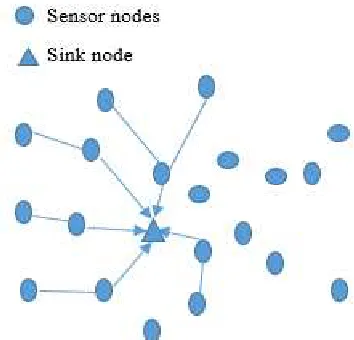
359 The WSN may fail due to a variety of causes, including the following the routing path might experience a disruption, the WSN sensing area might experience a drip, the batteries of some sensor nodes might be depleted, or the nodes wear out after the WSN has been in use for a long time, wireless link may experience failure or congestion may result in degraded performance of the wireless sensor network. In figure 2, the situation in which the outer nodes transfer affair information to the sink node via the inner nodes. The inner nodes thus have to deal with huge amount of data, overwhelming energy at a quicker rate. If all the inner nodes deplete their energy or otherwise stop to function, the affair data can no longer be sent to the sink node, and the WSN will no longer function [1].
Figure 2: WSN routing path when some nodes are not working.
The power consumption of the sensor nodes in WSNs is inevitable. Fault node recovery algorithm is an algorithm to search for and exchange lesser sensor nodes and to reuse the most routing paths [1]. The genetic algorithm (GA) [17], is a stochastic adaptive global search and optimization method established in 1975, based on the concept of natural heredities. The current paper proposes an enhanced error node regaining (EENR) algorithm which is based on reduce identical composite event transmission algorithm combined with the genetic algorithm. The EENR algorithm forms a routing table using the grade diffusion algorithm and exchange the faulty sensor nodes using the genetic algorithm. This algorithm can make use of the same routing path as the faulty node is replaced.
There are many studies on applications of compressive sensing theory on wireless sensor networks. In [7], new models for joint system in
WSN applications is introduced and the welfares of distributed compacted sensing is demonstrated. In [8], several random routing methods for WSNs exploiting compact sense (CS) based measurement techniques are proposed. In [10], the potential of CS based signal acquirement for minimal difficult energy – efficient ECG compression on a wireless body sensor network mote is investigated. The results of this study reveal that CS represents a competitive alternative to digital wavelet transform based ECG compression solutions. In [11], a CS based approach for monitoring environmental information using WSNs is presented.
The proposed methods exploits the compressibility of the signal to reduce the amount of acquired data. In [12], a CS based data collection algorithm for WSNs is proposed. Theoretical analysis of the proposed algorithm shows that it can accurately recover data from a small amount of compressed data. In [14], a decentralized networking scheme that combines the concepts of random channel access and CS to achieve energy and bandwidth efficiency for underwater sensor networks is proposed. The concept of sufficient sensing probability is introduced to compensate for the random packet loss caused by collisions.
Therefore this paper proposes compact sensing incorporated into EENR algorithm which enhances the lifetime of the sensor networks thus reducing sensor node replacement cost. Thus Usage of compact sensing enhances the efficiency of the wireless sensor network.
3. ENHANCED ERROR NODE REGAINING
ALGORITHM
360 In (1), Probe is the sensor node’s probe value. The variable is the number of sensor nodes with the probe value j. The variable is the number of sensor nodes still working at the present time the probe value j. The parameter γ is set by the user and must have a value between 0 and 1. If the number of sensor nodes that function for each probe is less than γ, Bj will become 1, and Ath will
be larger than zero. Then, the algorithm will measure the sensor nodes to replace using the GA.
The parameters are encoded in binary string and serve as the chromosomes for the GA. The elements in the binary strings are adjusted to lessen or exploit the fitness value. The fitness function generates its fitness value, which is composed of multiple variables to be adjusted by the GA. At each iteration of the GA, a prearranged number of individuals will produce fitness values connected with the chromosomes. In general, the GA contains 5 steps.
Step1: Generate the chromosomes with initial gene values
Step2: Calculate the fitness values of each chromosomes using fitness function.
Step3: Selection of best chromosomes from the mating pool
Step4: Apply the genetic operations such as cross-over and mutation.
Step5: Go to step
In this step 1, the GA creates chromosomes and each chromosome is an expected solution. The elements in the genes are either 0 or 1. A 0 means the node should be replaced and a 1 means that the node need not be replaced.
In a network if suppose, 8 sensor nodes are not working and if their node numbers are 4, 8, 12, 16, 20, 24, 78 and 84. Which is represented by Figure 3 a chromosome of length 8 and the gene is either 0 or 1
Figure 3: Chromosome and its gene.
In step 2, the fitness value is calculated according to the fitness function [1]. In the EENR algorithm, the goal is also to reclaim the most routing paths and to change the fewest sensor nodes. The highest fitness value is required because the WSN is looking for the most existing routing paths and the least number of substitution of sensor nodes.
In step 3 the algorithm eradicates the chromosomes with the least fitness values and holds the rest. We use the elitism strategy and keep the half of the chromosomes with better fitness values and put them in the mating pool. The worse chromosomes will be deleted and the new will substitute them after the crossover step [1].
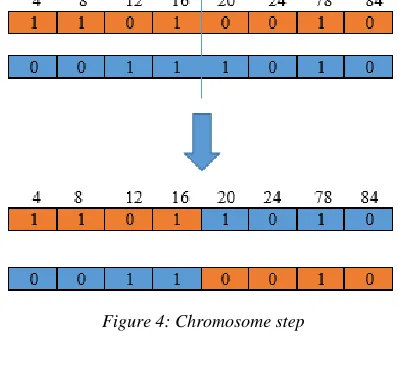
[image:3.612.316.515.278.468.2]In step 4 cross over and mutation is used to modify the single chromosome. Two single chromosomes are selected from the mating pool to produce two new offspring. The rate of choice is made according to the roulette-wheel selection and the fitness value [1]. Figure 4 represents the crossover step.
Figure 4: Chromosome step
Figure 5: Mutation step
Mutation is used to introduce qualities not found in the original chromosome and protects the GA from converging too fast. Here we simply flip a gene randomly in the chromosome as shown in the figure 5.This process is repeated until the optimal chromosome is found.
361
4. COMPACT SENSING THEORY
In traditional signal processing, a sensor acquires the signal at least at its Nyquist rate for proper reconstruction. The acquired discrete signal as one dimensional vector x PM can be represented as a linear combination of basis vectors as
where ψ is the basis matrix with ith column ψi. The
signal x is called L-sparse if only L of the coefficients in transform domain vector s is nonzero. The compressibility of most practical signals is the basic point for transform coding. In transform coding, the full signal x PM is obtained; all transform coefficients are calculated by s=ψTx; the largest L coefficients are located and the rest are deleted. Finally, only the largest L coefficients and their locations are encoded and forwarded.
Although transform coding decreases the amount of data communicated will be mentioned.
1) Although only L<<M coefficients are required, all M measurements, which may be large, are needed to be attained. 2) All the transform coding coefficients are
computed even though only L of them will be used and the rest are deleted.
3) Locations of the coefficients must also be encoded introducing an extra overhead.
The reconstruction in CS is done by solving an optimization problem, is convex and can be solved using linear programming and global optimal solutions can be achieved. The base station consumer more energy than the ordinary sensor nodes. The base station must know the measurement matrix of the WSN to solve the optimization problem [15]. The measurement matrix does not change through the lifetime of the wireless sensors, hence the sensor nodes can be preloaded with this data before deployment. Alternatively, this matrix can be transmitted to the sensor nodes by the base station; however, such data dissemination is not frequent, and thus, does not lead to any significant energy consumption.
5. SIMULATION
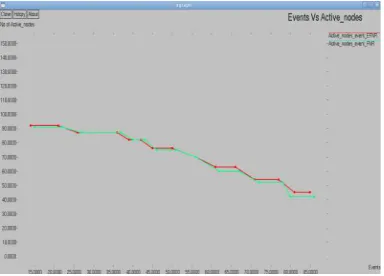
A simulation of the enhanced error node regaining algorithm with the compact sensing was performed and the results are shown below. The simulation was done by using NS-2 simulator. In our analysis the number of sensor nodes taken are 100, one base station and our simulation starts at 36
[image:4.612.313.505.139.277.2]seconds. Here the result is compared with the previous method fault node recovery algorithm (FNR).
[image:4.612.324.522.307.539.2]Figure 6: Events Vs Active nodes
[image:4.612.327.521.594.704.2]Figure 7: Events Vs Packet Loss
Figure 8: Events Vs Average Energy Consumption
362 The results shows that the performance of EENR algorithm is better compared to that of FNR algorithm in terms of power consumption, lifetime of sensor network and substitution of sensor nodes. The amount of packet loss has been significantly reduced in EENR algorithm in comparison with FNR
6. CONCLUSION AND FUTURE WORK
In real time WSNs the sensor nodes use battery power supplies and thus have limited energy resources. In addition to the routing, the optimization of substitution of sensor node is also important.
This paper proposes an enhanced error node regaining algorithm for wireless sensor network which is based on the fault node recovery algorithm combined with the compact sensing method. Therefore the power consumption of the sensor nodes are decreased by using the compact sensing method and at the same time the substitution of faulty nodes are also reduced, Thus enhancing the lifetime of sensor node as well as the reduction in replacement cost of the sensor node.
Further the lifetime of sensor network can be improved by putting some sensor nodes with less residual energy to sleep states. We have also planned to incorporate sink mobility into our network.
REFERENCES
[1] Hong-Chi Shis, Jiun-Huei Ho, Bin-Yih Liao and Jeng-Shyang Pan, “Fault Node Recovery Algorithm for A Wireless Sensor Network”, IEEE SENSORS JOURNAL, Vol. 13, No, 7, July 2013, pp. 2683-2689.
[2] F. C. Chang and H. C. Huang, “A refactoring method for cache-efficient swarm intelligence algorithms”, Inf. Sci., vol.192, no. 1, June 2012, pp. 39-49.
[3] S. Corson and J. Macker, Mobile Ad Hoc Networking (MANET): Routing Protocol Performance Issues and Evaluation Considerations. New York, NY, USA: ACM, 1999.
[4] M. Gen and R. Cheng, Genetic Algorithms and Engineering Design. New York, NY, USA: Wiley, 1997.
[5] W. Heinzelman, A. Chandrakasan and H. Balakrishnan, “An application specific protocol architecture for wireless microsensor networks”,
IEEE Trans. Wireless Commun., vol. 1, no. 4, Oct. 2002, pp. 660-670.
[6] K. Akkaya and M. Younis, “A survey on routing protocols for wireless sensor networks”, Ad Hoc Netw., vol. 3, no. 3, May 2005, pp. 325-349.
[7] D. Baron, M. B. Wakin, M. F. Duarte, S. Sarvotham and R. G. Baraniuk,
“Distributed compressed sensing”, Rice Univ., Dept. Electr. Comput. Eng., Tech. Rep. TREE-0612, 2006.
[8] X. Wang, Z. Zhao, Y. Xia, and H. Zhang, “ Compressed sensing for efficient random routing in multi-hop wireless sensor Network”, Int. J. Commun. Netw. Distrib. Syst., vol. 7, no. 3-4, Sep. 2011, pp. 275-292. [9] C. Intanagonwiwat, R. Govindan, D. Estrin,
J. Heidemann and F. Silva, “Directed diffusion for wireless sensor networking:, IEEE/ACM Trans. Netw., vol. 11, no. 1,Feb. 2003, pp. 2-16,
[10] H. Mamaghanian, N. Khaled, D. Atienza and P. Vandergheynst, “Compressed sensing for
real-time energy-efficient ECG compression on wireless body sensor nodes”, IEEE Trans. Biomed. Eng., vol. 58, no. 9, Sep. 2011, pp. 2456-2466.
[11] W. Chen and I. J. Wassell, “Energy efficient signal acquisition via compressive sensing in wireless sensor networks”, in Proc. Int. Symp. Wireless Pervasive Comput. Feb. 2011, pp. 1-6.
[12] G. Cao, F. Yu and B. Zhang, “Improving network lifetime for wireless sensor network using compressive sensing”, in Proc. IEEE Int. Conf. High Perform. Comput. Commun. (HPCC), Sep. 2011, pp. 448-454.
[13] E. M. Royer and C. K. Toh, “A review of current routing protocols for ad-hoc mobile networks,” IEEE Personal Commun., vol. 6, no. 2, Apr. 1999 pp. 46-55.
[14] F. Fazel, M. Fazel and M. Stojanovic, “Random access compressed sensing for energy-efficient underwater sensor networks”, IEEE J. Sel. Areas Commun., vol. 29, no. 8, Sep. 2011, pp. 1660-1670.
363 [16] Jiun-Huei Ho, Hong-Chi Shih, Bin-Yih Liao
and Jeng-Shyang Pan, “A Reduce Identical Composite Event Transmission Algorithm for Wireless Sensor Networks”, Appl. Math. Inf. Sci. 6 no. 2S pp. 713S-719S (2012).