National Research Center, 12311 Dokki, Cairo, Egypt2
Received 24 September 2009/Returned for modification 29 October 2009/Accepted 21 December 2009
Analysis of 316 outbreaks of gastroenteritis in France from September 2007 through March 2009 showed that genogroup II.4 (GGII.4) noroviruses were predominant and mostly belonged to the 2006b variant. However, the new GGII.4 variants, variant 2008 and the newly discovered Cairo variant from the Middle East, were also detected. The epidemiological survey suggests that these new variants might become the next predominant strains.
Human noroviruses (NoVs) are causative agents of gastro-enteritis worldwide and are increasingly incriminated in out-breaks of gastroenteritis. The molecular typing of NoV is now routinely performed in laboratories involved with surveys of enteric viruses. The recent establishment of networks (e.g., the FBVE and noronet networks) to monitor enteric viruses showed the large predominance of genogroup II.4 (GGII.4) NoVs (11). Over the past 10 years, NoVs and especially GGII.4 variants have increasingly been studied. It has been shown for the first time that GGII.4 NoV variant US95/96 was predom-inant worldwide during the winter of 1995–1996 (8). NoV variant US95/96 was detected from outbreaks for the next 7 years, until 2002, when a new type of GGII.4 strain, the 2002 variant, named Farmington Hills, was detected and became predominant (7). The main feature of this strain was the in-sertion of 1 amino acid in the hypervariable region of the capsid (3). Since 2002, a new GGII.4 variant has become pre-dominant every 2 or 3 years, as shown previously. Indeed, the 2002 variant was replaced in 2004 by the 2004 variant (1), which was then replaced by the 2006a and 2006b variants, which cocirculated in 2006 and 2007 (13). In France, the 2006b variant has been predominant since 2008. Previous studies showed that the heterogeneity of the amino acid sequences among GGII.4 variants was no more than 10%. However, Lindesmith et al. showed that minor changes in the capsid between GGII.4 variants were biologically relevant and corre-sponded to changing patterns in the binding of the glycosac-charides (6).
Moreover, it is worth mentioning that not all GGII.4 vari-ants are circulating throughout the world. For example, the Sakai variants have mostly been detected in Asia. For the
Cairo variants that we recently described (4), it was difficult to predict whether they would circulate locally or worldwide. During the last year, the national French survey network and other laboratories in the world detected emerging GGII.4 iso-lates, called 2008 variants, which might be the new predomi-nant strain. Here we report on the emergence of new GGII.4 isolates, including the 2008 variants, which have been collected and characterized by the French National Reference Center (NRC) for Enteric Viruses.
During a period that included two consecutive winter seasons, from 1 September 2007 through 31 March 2009, 1,422 stool specimens from 316 outbreaks were sent to the NRC for analysis. Sixty-seven percent of the outbreaks were reported during the second winter season (September 2008 through March 2009), thanks to the countrywide improve-ment in the outbreak reporting system. The NoV outbreaks were reported predominantly from nursing homes (n ⫽ 251), but also from hospitals (n⫽21), schools (n⫽22), and adult meetings (n⫽22). RNA was routinely extracted from stool specimens from individuals involved in each outbreak prior to amplification with capsid-specific primers (5). For each outbreak, the PCR products from up to three samples were purified and sequenced for typing, as described previ-ously (4). The presence of at least one virus was detected in 85% of the outbreaks (n⫽268), and 254 of these were NoV related. For 14 NoV-negative outbreaks, rotavirus (n⫽9), astrovirus (n⫽3), sapovirus (n ⫽1), and Aichi virus (n ⫽ 1) were detected by PCR. Twenty-one outbreaks were pos-itive for non-GGII.4 NoVs. The other GGII NoVs belonged to GGII.2 (n⫽2), GGII.6 (n⫽6), and GGIIb/GGII.3 (n⫽ 4). For nine outbreaks, GGI.2 (n ⫽ 2), GGI.3 (n ⫽ 3), GGI.4 (n ⫽ 1), GGI.8 (n ⫽ 2), and GGI.10 (n ⫽ 1) were detected. GGII.4 NoV represented the bulk of the strains (229 outbreaks, 72%) (Fig. 1). GGII.4 NoVs were incrimi-nated in 17 of 24 mixed infections. The predominant 2006b variants were identified in 192 outbreaks, 13 of which were mixed infections. The 2006a accounted for 4.7% (n⫽14) of
* Corresponding author. Mailing address: Centre National de Re´fe ´r-ence des Virus Ente´riques, Laboratoire de Virologie-Se´rologie, Plateau Technique de Biologie, Centre Hospitalier Universitaire de Dijon, 2, Rue Ange´lique Ducoudray, Dijon 21070, France. Phone: 33 3-80-29-31-70. Fax: 33 3-80-29-36-04. E-mail: [email protected].
䌤Published ahead of print on 30 December 2009.
994
on May 16, 2020 by guest
http://jcm.asm.org/
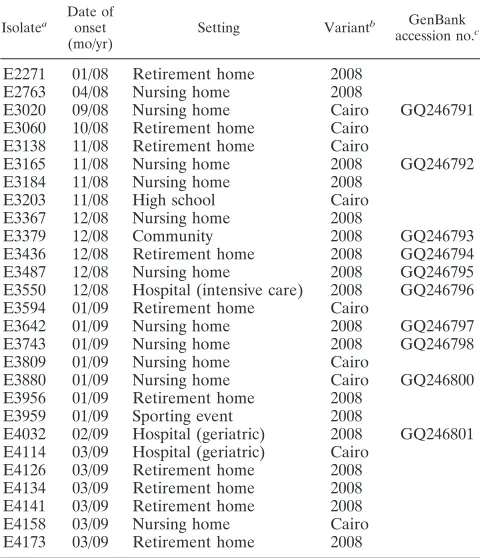
the total number of outbreaks (three outbreaks were mixed infections). For 27 outbreaks, the GGII.4 NoVs were not related to other known GGII.4 subtypes. Preliminary typing based on the first 227 bases of open reading frame 2 (ORF2) showed that 9 and 18 of those outbreaks were caused by NoVs that belonged to the Cairo and 2008 variants, respec-tively (Table 1). Two 2008 variant isolates were documented in January and April 2008, but these variants were mostly
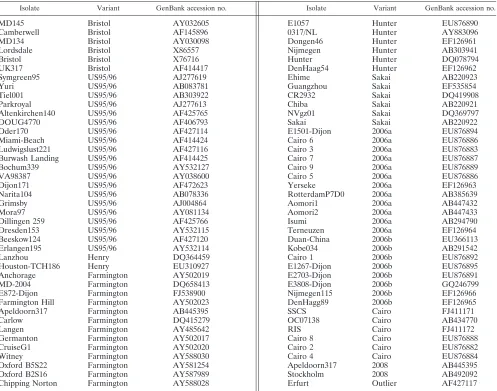
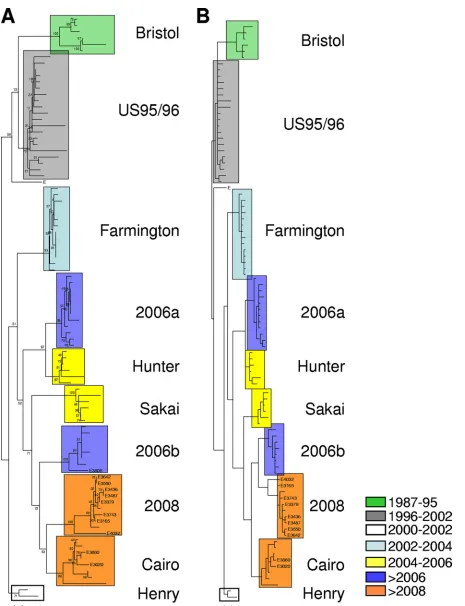
[image:2.585.129.457.67.208.2]detected during the 2008-to-2009 winter season (n ⫽ 16) (Fig. 1). The Cairo variants clearly emerged in France dur-ing the last winter season, with the first outbreak bedur-ing documented in September 2008. A panel of these variants (n ⫽ 10) was selected from the typing results obtained by use of the capsid region to undertake sequence analysis of the entire capsid gene. After RNA extraction, the ORF2-coding sequence was amplified by reverse transcription-PCR before it was cloned into the pGEM-Teasy vector, as de-scribed previously (4). The entire ORF2 sequence was then determined. Eighty-two sequences (Table 2) corresponding to the complete ORF2 from previously described GGII.4 variants and the sequences from this study (Table 1) were analyzed with the MEGA (version 4) package and the Mr-Bayes (version 3.1) program (9, 12). For the latter, the same settings described previously were used (6), except that the amino acid model was set to “mixed.” The amino acid dif-ferences mostly occurred in the P2 domain (data not shown). The residues contributing to the attachment of the H type 1 antigen were conserved for the Cairo and the 2008 variants (data not shown) (2). However, the triplet S396-R397-N398, located at the N-terminal part of the P2 do-main, was shared only by the 2006b, Cairo, and 2008 vari-ants. Similarly, the triplet D376-A377-N378 was found only for the 2008 variants (data not shown). Interestingly, the threonine inserted at position 395 had been replaced by an alanine residue for all but one of the 2008 variants. Further studies will be required to verify whether these amino acid residues correlate with an increased pathogenicity of the new circulating strains. The trees were generated by the neighbor-joining method by use of the MEGA (version 4) program suite (Fig. 2A) and by Bayesian inference of phy-logeny by use of the MrBayes program (Fig. 2B) (9, 12). The topologies of the two trees were similar and showed that the 2008 and the Cairo variants were closely related to the currently predominant 2006b variant (Fig. 2). By combining data from epidemiological surveys with phylogenetic analy-sis, we clearly showed that during the last season, the emerg-ing variant 2008 and Cairo strains were cocirculatemerg-ing with the predominant 2006b variants (Fig. 1 and 2). It is likely that the cocirculation of variants probably occurred very often in the past, and the increasing efficacies of surveillance
FIG. 1. Monthly distribution of GGII.4 variants during the study period (September 2007 through March 2009). The GGII.4 variants are shaded in gray, and the key is indicated on the right.
TABLE 1. The 2008 variants and Cairo variants from this study
Isolatea Date of onset (mo/yr)
Setting Variantb GenBank accession no.c
E2271 01/08 Retirement home 2008 E2763 04/08 Nursing home 2008
E3020 09/08 Nursing home Cairo GQ246791 E3060 10/08 Retirement home Cairo
E3138 11/08 Retirement home Cairo
E3165 11/08 Nursing home 2008 GQ246792 E3184 11/08 Nursing home 2008
E3203 11/08 High school Cairo E3367 12/08 Nursing home 2008
E3379 12/08 Community 2008 GQ246793
E3436 12/08 Retirement home 2008 GQ246794 E3487 12/08 Nursing home 2008 GQ246795 E3550 12/08 Hospital (intensive care) 2008 GQ246796 E3594 01/09 Retirement home Cairo
E3642 01/09 Nursing home 2008 GQ246797 E3743 01/09 Nursing home 2008 GQ246798 E3809 01/09 Nursing home Cairo
E3880 01/09 Nursing home Cairo GQ246800 E3956 01/09 Retirement home 2008
E3959 01/09 Sporting event 2008
E4032 02/09 Hospital (geriatric) 2008 GQ246801 E4114 03/09 Hospital (geriatric) Cairo
E4126 03/09 Retirement home 2008 E4134 03/09 Retirement home 2008 E4141 03/09 Retirement home 2008 E4158 03/09 Nursing home Cairo E4173 03/09 Retirement home 2008
a
Each isolate corresponds to one outbreak. b
Typing of GGII.4 NoV variants was based on phylogenetic analysis of partial nucleotide sequences of the capsid region, as indicated in the Materials and Methods section.
c
Strains for which the complete ORF2 sequence was determined are refer-enced in GenBank. The corresponding plasmid constructs are available upon request.
on May 16, 2020 by guest
http://jcm.asm.org/
[image:2.585.43.283.388.667.2]systems worldwide are contributing to the detection of emerging GGII.4 variants. The results of our phylogenetic analysis suggest that the 2008 and Cairo variants might have derived from the 2006b variants and support the idea that genetic drift is a major force in the evolution of GGII.4, as described previously (6).
Since 2002, the predominant circulating GGII.4 NoVs have contained an extra amino acid, inserted into the hy-pervariable region of the capsid, with ongoing genetic drift being observed for this genotype. For the 2007-to-2008 and 2008-to-2009 winter seasons, the 2006a variant and the pre-dominant 2006b variant were circulating in France. During an epidemiological survey conducted in the conurbation of Cairo, Egypt, in 2006 and 2007, we observed that the 2006a variant strains were predominant. We also detected new GGII.4 variants that we called Cairo variants. At this stage, it was unclear whether these new GGII.4 isolates were re-stricted to the Middle East or could disseminate throughout the world. During the same period, no Cairo variant-like GGII.4 NoV were detected in a large epidemiological
sur-vey that we conducted in Tunisia, where only 2004 variants were found (10). The survey of the GGII.4 strains detected by the NRC showed that the 2008 and Cairo variants emerged in France during the 2008-to-2009 winter season. These data show that NoV GGII.4 strains are circulating within Mediterranean countries. For the Cairo variants, we may also hypothesize that new GGII.4 variants might spread from the Middle East to Europe and the Maghreb. Addi-tional studies will be required to further evaluate the circu-lation of these variants in North Africa. Our data also em-phasize the need for a careful survey of enteric viruses that are not routinely screened for by many clinical laboratories. Plotting of the epidemiological data on the radial tree (Fig. 2) showed that several GGII.4 variants circulated at the same time in the world (e.g., the 2006a, 2006b, 2008, and Cairo variants) and that one type of variant was more often detected locally (e.g., Sakai variants in Asia) or worldwide (e.g., the Farmington Hills variant from 2002 to 2004). Even though the mechanism by which the GGII.4 NoV strains
Oder170 US95/96 AF427114 E1501-Dijon 2006a EU876894
Miami-Beach US95/96 AF414424 Cairo 6 2006a EU876886
Ludwigslust221 US95/96 AF427116 Cairo 3 2006a EU876883
Burwash Landing US95/96 AF414425 Cairo 7 2006a EU876887
Bochum339 US95/96 AY532127 Cairo 9 2006a EU876889
VA98387 US95/96 AY038600 Cairo 5 2006a EU876886
Dijon171 US95/96 AF472623 Yerseke 2006a EF126963
Narita104 US95/96 AB078336 RotterdamP7D0 2006a AB385639
Grimsby US95/96 AJ004864 Aomori1 2006a AB447432
Mora97 US95/96 AY081134 Aomori2 2006a AB447433
Dillingen 259 US95/96 AF425766 Isumi 2006a AB294790
Dresden153 US95/96 AY532115 Terneuzen 2006a EF126964
Beeskow124 US95/96 AF427120 Duan-China 2006b EU366113
Erlangen195 US95/96 AY532114 Kobe034 2006b AB291542
Lanzhou Henry DQ364459 Cairo 1 2006b EU876892
Houston-TCH186 Henry EU310927 E1267-Dijon 2006b EU876895
Anchorage Farmington AY502019 E2703-Dijon 2006b EU876891
MD-2004 Farmington DQ658413 E3808-Dijon 2006b GQ246799
E872-Dijon Farmington FJ538900 Nijmegen115 2006b EF126966
Farmington Hill Farmington AY502023 DenHagg89 2006b EF126965
Apeldoorn317 Farmington AB445395 SSCS Cairo FJ411171
Carlow Farmington DQ415279 OC07138 Cairo AB434770
Langen Farmington AY485642 RIS Cairo FJ411172
Germanton Farmington AY502017 Cairo 8 Cairo EU876888
CruiseG1 Farmington AY502020 Cairo 2 Cairo EU876882
Witney Farmington AY588030 Cairo 4 Cairo EU876884
Oxford B5S22 Farmington AY581254 Apeldoorn317 2008 AB445395
Oxford B2S16 Farmington AY587989 Stockholm 2008 AB492092
Chipping Norton Farmington AY588028 Erfurt Outlier AF427117
on May 16, 2020 by guest
http://jcm.asm.org/
[image:3.585.45.542.80.471.2]FIG. 2. Phylogenetic analysis of the amino acid sequences corresponding to the entire ORF2 of representative GGII.4 NoVs from GenBank (n⫽82) and this study (n⫽10). The isolates sequenced for this study are indicated on the tree. The groups of variants are color coded on the basis of the period of circulation of these strains (e.g., the Cairo and 2008 variants) and/or their predominance (e.g., the Bristol, US95/96, 2002, 2004, 2006b, and Sakai variants). The color code is indicated on the bottom right. E, Erfurt outlier isolate (GenBank accession number AF427117). (A) Neighbor-joining tree constructed with noncorrected distances; (B) Bayesian inference tree constructed with previously described settings (6).
on May 16, 2020 by guest
http://jcm.asm.org/
1.Bull, R. A., E. T. Tu, C. J. McIver, W. D. Rawlinson, and P. A. White.2006. Emergence of a new norovirus genotype II.4 variant associated with global outbreaks of gastroenteritis. J. Clin. Microbiol.44:327–333.
2.Cao, S., Z. Lou, M. Tan, Y. Chen, Y. Liu, Z. Zhang, X. C. Zhang, X. Jiang, X. Li, and Z. Rao.2007. Structural basis for the recognition of blood group trisaccharides by norovirus. J. Virol.81:5949–5957.
3.Dingle, K. E.2004. Mutation in a Lordsdale norovirus epidemic strain as a potential indicator of transmission routes. J. Clin. Microbiol.42:3950–3957. 4.Kamel, A. H., M. A. Ali, H. G. El-Nady, A. de Rougemont, P. Pothier, and G. Belliot.2009. Predominance and circulation of enteric viruses in the region of greater Cairo, Egypt. J. Clin. Microbiol.47:1037–1045.
5.Kojima, S., T. Kageyama, S. Fukushi, F. B. Hoshino, M. Shinohara, K. Uchida, K. Natori, N. Takeda, and K. Katayama.2002. Genogroup-specific PCR primers for detection of Norwalk-like viruses. J. Virol. Methods100:
107–114.
6.Lindesmith, L. C., E. F. Donaldson, A. D. Lobue, J. L. Cannon, D. P. Zheng,
lected from children in Tunisia during a four-year period: detection of the norovirus variant GGII.4 Hunter as early as January 2003. J. Clin. Microbiol.
47:421–429.
11.Siebenga, J. J., H. Vennema, D. P. Zheng, J. Vinje, B. E. Lee, X. L. Pang, E. C. Ho, W. Lim, A. Choudekar, S. Broor, T. Halperin, N. B. Rasool, J. Hewitt, G. E. Greening, M. Jin, Z. J. Duan, Y. Lucero, M. O’Ryan, M. Hoehne, E. Schreier, R. M. Ratcliff, P. A. White, N. Iritani, G. Reuter, and M. Koopmans.2009. Norovirus illness is a global problem: emergence and spread of norovirus GII.4 variants, 2001–2007. J. Infect. Dis.200:802–812. 12.Tamura, K., J. Dudley, M. Nei, and S. Kumar.2007. MEGA4: molecular
evolutionary genetics analysis (MEGA) software version 4.0. Mol. Biol. Evol.
24:1596–1599.
13.Tu, E. T., R. A. Bull, G. E. Greening, J. Hewitt, M. J. Lyon, J. A. Marshall, C. J. McIver, W. D. Rawlinson, and P. A. White.2008. Epidemics of gastro-enteritis during 2006 were associated with the spread of norovirus GII.4 variants 2006a and 2006b. Clin. Infect. Dis.46:413–420.