6
II
February 2018
Stepwise Regression Based Resource Optimized
Routing in Mobile Ad Hoc Networks
M. Ilango1, Dr. A.V. Senthil Kumar2 1
Research Scholar Hindusthan College of Arts and Science Coimbatore 2
DirectorDepartment of MCA Hindusthan College of Arts and Science Coimbatore
Abstract: A mobile ad hoc network (MANETs) is a group of mobile nodes forming an ad hoc network without fixed infrastructure. The optimal path selection in MANETs is a challenging task to improve the routing performance and to optimize the resource utilization. In order to overcome such limitation, Stepwise Regression based Resource Optimized Routing (SR-ROR) Technique is proposed. The main objective of SR-ROR technique is to select the best route path for reliable data packet transmission in MANETs. The SR-ROR is used Stepwise Regression technique to choose the mobile node among the collection of nodes in MANETs for route path selection. The Stepwise Regression technique selects the mobile nodes with higher residual energy, minimum delay, and minimum bandwidth and subsequently removes the lower values nodes during each step for data packet transmission. The Stepwise Regression technique in SR-ROR measures regression coefficient for finding the relationships between mobile nodes in order to perform routing in MANETs. The regression coefficient is determined by considering the residual energy, delay, bandwidth of mobile nodes. By using the measured regression coefficient value, SR-ROR technique chooses the mobile nodes with higher residual energy, minimum delay, and minimum bandwidth for transmitting the data packets in MANETs. This in turn helps for improving the network lifetime and packet delivery ratio in an effective manner. The performance of SR-ROR technique is measured in terms of energy consumption, end to end delay, and packet delivery ratio and network lifetime. The simulations result demonstrates that the SR-ROR technique is able to improve the packet delivery ratio and reduces the energy consumption for routing the data packet in MANETs when compared to state-of-the-art-works.
Keywords: mobile node, route path, data packet, stepwise regression, regression coefficient, residual energy, delay, bandwidth.
I. INTRODUCTION
Mobile ad hoc networks (MANETs) is an infrastructure-free networks constructed by wireless mobile devices with limited battery life. In MANETs, each mobile node contains limited processing speed and power, battery, storage, and communication capabilities. The main significant issue in MANETs is their routing algorithms. Besides, resource optimized routing plays a considerable role in MANETs for improving the routing performance.
An Energy Aware OLSR (Optimized Link State Routing) Protocol called OLSR_EA was designed in [23] to choose the best path by considering energy cost and residual energy of node. The OLSR_EA Protocol improves the packet delivery ratio. But, energy consumption was higher. The multipath optimized link state routing (MP-OLSR) protocol was intended in [8] to determine multiple paths from source to destination and to improve the network lifetime with lower average end to end delay. But, routing decision based on dissimilar types of scalable streams was not considered to achieve the quality of service. destination pair with higher throughput and minimum delay. However, different queuing discipline for analyzing the effect arrival traffic was remained unaddressed. In order to overcome the above mentioned existing issues in MANETs, Stepwise Regression based Resource Optimized Routing (SR-ROR) Technique is introduced. The research objective of SR-ROR Technique is formulated as follows,
A. To achieve resource optimized routing process in MANETs, Stepwise Regression based Resource Optimized Routing (SR-ROR) Technique is designed.
B. To identify the optimal route path in MANETs, Stepwise Regression technique is used in SR-ROR.
C. To select the mobile node for data transmission and to improve packet delivery ratio in MANETs, regression coefficient value is estimated in SR-ROR Technique.
The rest of this paper is organized as follows. Section 2 explains Stepwise Regression based Resource Optimized Routing (SR-ROR) Technique with aid of architecture diagram for optimal path identification. Section 3 and Section 4 presents the experimental section with details performance analysis. Section 5 explains the related works. Finally, Section 6 concludes this paper.
II. RELATED WORKS
A novel mechanism was designed in [6] to select stable and sustainable paths between all pairs of nodes in a network and reducing the average end to end delay. However, the remaining energy of the nodes constituting the path was not considered. The link stability estimation scheme was presented in [5] to estimate the link stability in both stationary and non-stationary scenarios with higher packet delivery rate. Quality of Service (QoS) based Multicast Routing Protocol using Reliable Neighbour nodes Selection (QMRPRNS) scheme was presented in [1] to choose the stable path based on reliability pair factor with higher packet delivery ratio. But, energy utilization was remained unsolved. A neighbor coverage-based probabilistic rebroadcast protocol was intended in [1] for minimizing the number of retransmissions to diminish the routing overhead and improving the routing performance in MANETs. However, reducing redundant rebroadcast performance was not efficient. A novel link-correlation-aware OR scheme was presented in [22] for efficiently improving the routing performance through exploiting the diverse low correlated forwarding links and to reduce number of transmissions. Though, efficient routing is remained unaddressed. A link quality-based cache replacement technique was designed in [7] for MANET that determine the link quality with the support of Received Signal Strength (RSS) value. But, avoiding network collision was not considered. An energy efficient cluster based routing protocol (ECCRP) technique was introduced in [20] to improve the performance of MANETs routing in terms of energy consumption and to lessen the number of transmissions. Though, node mobility, traffic, and transmission range was not considered. A Rebroadcasting Neighbour Coverage protocol (RBNC) was presented in [9] to decreases the high channel contention creating unnecessary request and to lessen routing overhead. But, optimal path selection between the source and destination was remained unaddressed. An adaptive reliable and congestion control routing protocol was designed in [16] to reduce congestion and route errors with the aid of bypass route selection in MANET and to attain higher throughput with lower packet drops and overhead. Though, average end to end delay was remained unaddressed. A novel method was presented in [4] for node mobility prediction in which link stability metrics is used to enhance network throughput.
III. STEPWISE REGRESSION BASED RESOURCE OPTIMIZED ROUTING TECHNIQUE
Let consider the MANETs is the structure of graph ‘ ( , )’ in which ‘ ’ represents the mobile nodes and ‘ ’ is denotes the links
between mobile nodes. The number of mobile nodes in MANETs is characterized as‘ = , , … ∈ that lies
As shown in Figure 1, a Manet’s structure comprises of numerous mobile nodes such asMN , MN , MN , … MN . Here MN want to transmit a data packet to mobile node MN whereas MN is a source node and MN is a destination node and other remaining nodes in are called as intermediate nodes in network. There are many route paths available for transmitting multimedia data content from MN to MN such as MN -MN -MN -MN -MN -MN ,MN -MN -MN -MN , MN -MN -MN -MN , MN -MN
-MN -MN -MN etc. But, we cannot know which route path is optimized resource route path for transmitting data efficiently from source node MN to destination MN . Therefore, A Stepwise Regression based Resource Optimized Routing (SR-ROR) Technique is designed with the objective of selecting the resource optimized path for reliable data packets transmission in MANETs with the optimized resource utilization. The SR-ROR Technique optimizes the resource utilization of mobile nodes in order to efficiently transmit data packets in MANETs by using Stepwise Regression technique. The Stepwise Regression technique determines the regression coefficient value for each mobile node in MANETs. The regression coefficient value is estimated based on residual energy, delay, bandwidth of mobile nodes. With the aid of determined regression coefficient value, SR-ROR Technique selects the mobile nodes with higher residual energy, minimum delay, and minimum bandwidth for transmitting the data packets form the source to destination node in MANETs. This in turn helps for achieving SR-ROR Technique in MANETs. Therefore, SR-ROR Technique to increases the packet delivery ratio with lower delay and reduces the energy consumption of data transmission in MANETs. The overall architecture diagram of SR-ROR Technique for reliable data packets transmission is shown in below
A. Stepwise Regression technique
In SR-ROR, Stepwise Regression technique calculates regression coefficient value for each mobile node in network for selecting the optimal route path. The following diagram shows the process of Stepwise Regression technique for performing the resource optimized routing in MANETs.
\As shown in Figure 3, SR-ROR Technique considers the residual energy, bandwidth and delay time of mobile node for evaluating regression coefficient value. With help of measured regression coefficient value, then SR-ROR Technique selects mobile node with higher residual energy, lower delay, and minimum bandwidth for data packet transmission. Therefore, the SR-ROR Technique optimizes the resource utilization for broadcasting data from the source node to destination in MANETs. This in turn prolongs the network lifetime and packet delivery ratio.
Considering the residual energy is important to choose the mobile nodes with more residual energy for avoiding the path breakdowns while broadcasting the data packets. The residual energy determines the amount of available or remaining energy in the mobile node. Accordingly, the residual energy of mobile node ( ) is estimated by using following mathematical expression,
= −( × (1)
From the equation (1), denotes the number of bytes transmitted whereas is a transmission power (i.e. energy) per byte. Here, indicates an initial residual energy of a mobile node before the route identification process. By using the equation (1), residual energy of a mobile node is determined for route selection. In addition, the bandwidth availability of the mobile node is also considered as essential factor is to be measured for improving the performance of resource optimized routing in MANETs. The bandwidth availability of the mobile node is determined using below mathematical representation,
ℎ = ℎ − ℎ
(2)
From the equation (2), ℎ denotes the raw channel bandwidth and ℎ refers an overall utilized bandwidth for transmitting the data packets. By using the above equation, the mobile node with higher bandwidth availability is selected for optimal path selection. Besides, the delay time of mobile node is measured by using below mathematically formula,
= × + × ℎ
(3)
The SR-ROR used Stepwise Regression Technique for performing resource optimized routing based on three parameters namely residual energy, bandwidth availability and delay time. By measuring these three parameters, the best mobile node in network is selected for data packet transmission in MANETs. The Stepwise Regression Technique computes regression coefficient value (RCV) for each mobile node in network in order to select the best mobile node for routing the data packets which is mathematically formulated as below,
RCV =ℎ ℎ + ℎ +
(4)
From the equation (4), regression coefficient value is determined based on the nodes residual energy, bandwidth availability and delay time between the nodes. The algorithmic process of Stepwise Regression based Resource Optimized Routing is shown in below,
By using the above algorithmic process algorithm 1, SR-ROR Technique chooses the resource optimized route path for data transmission. This improves the packet delivery ratio with minimum energy consumption and improves the network lifetime in MANETs.
IV. SIMULATION SETTING
V. RESULT AND DISCUSSIONS
In this section, the result analysis of SR-ROR Technique is evaluated. The performance of IPDOR Technique is compared against with existing Power Aware Location Aided Routing (PA-LAR) [10],Deterministic Multicast Link Based Energy Optimized Routing (DML-EOR) [11]. The performance of SR-ROR Technique is evaluated along with the metrics such as energy utilization, packet delivery ratio and average end to end delay, routing overhead and bandwidth utilization.
A. Measurement of Energy Consumption
In SR-ROR Technique, the energy consumption is measured using the energy consumed by a single mobile node with respect to the total mobile nodes in MANETs. The energy utilization rate is measured in terms Joules (J) and formulated as,
Consumption = (5)
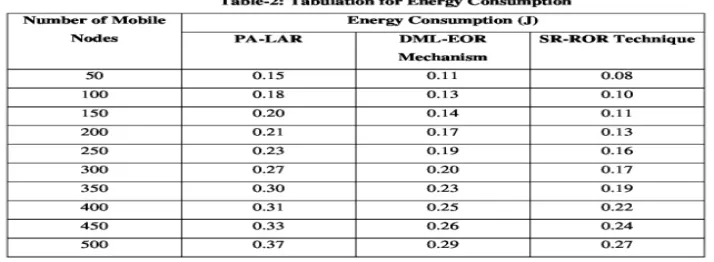
[image:7.612.128.485.303.434.2]From the equation (5), the energy consumption of routing process is obtained. ‘ ’ represents the ratio of energy consumed for single data packet and total energy consumed for all the data packets ‘ ’ in the network. While the energy consumption is lower, more efficient the method is said to be.
Table 2 depicts the measure of energy consumption for data packet transmission based on different number of mobile nodes in the range of 50-100. From the table, it is illustrative that the energy consumption of proposed SR-ROR Technique is lower while compared to existing PA-LAR [10].
[image:7.612.201.415.515.658.2]number of sensor nodes, the energy consumption is also increased using all the three methods. But comparatively energy consumption using proposed SR-ROR Technique is lower. This is because of application of stepwise regression in SR-ROR Technique where it measures regression coefficient value by considering the residual energy of mobile node. Therefore, SR-ROR Technique chooses the mobile node with more residual energy for transmitting the data packets in MANETs. This in turn helps for reducing the energy consumption in an effective manner. As a result, proposed SR-ROR Technique reduces the energy consumption by 36 % when compared to PA-LAR [10] and 17 % when compared to DML-EOR [11] mechanism respectively.
B. Measurement of Average End to End Delay
In SR-ROR Technique, the average end to end delay measures the time consumed for a packet to be transmitted across a network from source to destination. The average end to end delay is measured in terms of milliseconds (ms) and mathematically formulated as,
average end to end delay = Receiving time of packets−sending time of packets
(6)
From the equation (6), the average end to end delay is obtained. While the average end to end delay is lower, the method is said to be more efficient.
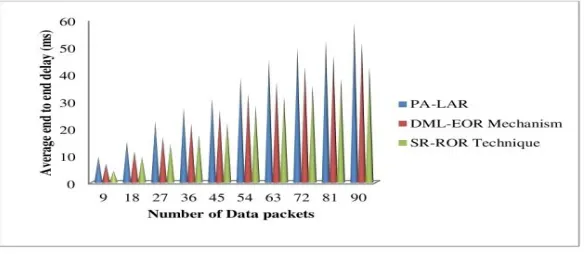
[image:8.612.164.456.498.629.2]The comparative result analysis of average end to end delay based on different number of packets in the range of 9-90 is demonstrated in Table 3. From the table, it is descriptive that the average end to end delay using proposed SR-ROR Technique is lower while compared to existing PA-LAR [10],DML-EOR [11].
it measures regression coefficient value by considering the delay time of the mobile node. Therefore, SR-ROR Technique picks the mobile node with lower delay for transmitting the data packets in MANETs. This is in turn helps for reducing average end to end delay in a significant manner. As a result, proposed SR-ROR Technique reduces the average end to end delay by 33 % when compared to PA-LAR [10] and 19 % when compared to DML-EOR [11] respectively.
C. Measurement of Packet Delivery Ratio
In SR-ROR technique, packet delivery ratio is defined as the ratio of number of data packets received by the destination to the total number of data packets sent. The packet delivery ratio is measured in terms of percentages (%) and formulated as follows,
= ∗100 (7)
From the equation (7), the packet delivery ratio is obtained. While the packet delivery ratio is higher, the method is said to be more efficient.
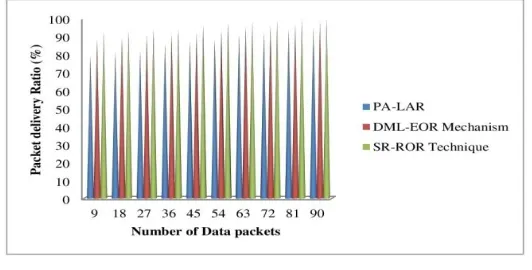
The result of packet delivery ratio based on diverse number of packets in the range of 9-90 is illustrated in Table 4. From the table, it is clear that the packet delivery ratio using proposed SR-ROR Technique is higher as compared to existing PA-LAR [10],DML-EOR [11].
[image:9.612.175.441.471.606.2]transmission in MANETs which resulting in enhanced packet delivery ratio. Thus, proposed SR-ROR Technique improves the packet delivery ratio by 10 % when compared to PA-LAR [10] and 4 % when compared to DML-EOR [11] respectively.
D. Measurement of Network Lifetime
In SR-ROR technique, the lifetime of the network is measured by using the number of mobile nodes in MANETs. The network lifetime is measured in terms of percentage (%) and formulated as,
= ∗100 (8)
From the equation (8), the network lifetime is obtained using the total number of mobile nodes ‘ ’ in the network and routing addressed for the mobile node ‘ ’ in MANETs. While the network lifetime is higher, more efficient the method is said to be.
Figure 7 presents the impact of network lifetime versus diverse number of mobile nodes using three methods. As shown in figure, proposed SR-ROR Technique provides better network lifetime when compared to existing PA-LAR [10],DML-EOR [11]. Besides, while increasing the number of mobile nodes, the network lifetime is improved using all the three methods. But comparatively network lifetime using proposed SR-ROR Technique is higher. This is because of application of stepwise regression in SR-ROR Technique. With the aid of stepwise regression technique, SR-ROR Technique measures regression coefficient value through considering the residual energy of mobile node. Therefore, SR-ROR Technique chooses the mobile node with more residual energy for transmitting the data packets in MANETs. This in turn helps for improving the network lifetime in a significant manner. As a result, proposed SR-ROR Technique improves the network lifetime by 10 % when compared to PA-LAR [10] and 3% when compared to DML-EOR [11] respectively.
VI. CONCLUSION
An effective Stepwise Regression based Resource Optimized Routing (SR-ROR) Technique is developed to select the optimized route path for efficient data packet transmission in MANETs. The main objective of SR-ROR Technique is to achieve resource optimized routing in MANETs. The resource optimized routing is achieved in SR-ROR by using Stepwise Regression techniques. With the application of Stepwise Regression technique, SR-ROR find outs regression coefficient for determining relationships among the mobile nodes in order to routing the data packets in MANETs. The regression coefficient value is estimated through considering the residual energy, delay, bandwidth of mobile nodes. With the aid of measured regression coefficient value, SR-ROR technique selects the mobile nodes with higher residual energy, minimum delay, and minimum bandwidth for broadcasting the packets from the source to destination node in MANETs. This helps for prolonging the network lifetime and packet delivery ratio in an effectual manner. The performance of SR-ROR technique is measured in terms of energy consumption, average end to end delay, packet delivery ratio, and network lifetime and compared with two exiting methods.The simulations results show that SR-ROR technique provides better performance with an improvement of packet delivery ratio and also reduces the energy consumption when compared to state-of-the-art works.
REFERENCES
[1] Ajay Kumar Yadav, SachinTripathi, “QMRPRNS: Design of QoS multicast routing protocol using reliable node selection scheme for MANETs”, Peer-to-Peer Networking and Applications, Springer, Pages 1–13, 2016
[2] Ali Moussaoui, FouziSemchedine, AbdallahBoukerram, “A link-state QoS routing protocol based on link stability for Mobile Ad hoc Networks”, Journal of Network and Computer Applications, Elsevier, Volume 39, Pages 117–125, March 2014
[3] G. Ravi, K.R. Kashwan, “A new routing protocol for energy efficient mobile applications for ad hoc networks”, Computers and Electrical Engineering, Elsevier, Volume 48, Pages 77–85, November 2015
[4] GauravSingal, Vijay Laxmi, M. S. Gaur, Vijay Rao “Moralism: mobility prediction with link stability based multicast routing protocol in MANETs”,Wireless Networks, Springer, Pages 1–17, 2016
[5] Hui Xia, Shoujun Xia, Jia Yu, ZhipingJia, Edwin H.-M. Sha, “Applying link stability estimation mechanism to multicast routing in MANETs”, Journal of Systems Architecture, Elsevier, Volume 60, Pages 467–480, 2014.
[6] Indrani Das, Daya K. Lobiyal, C. P. Katti, “Multipath routing in mobile ad hoc network with probabilistic splitting of traffic”, Wireless Networks, Volume 22, Issue 7, Pages 2287–2298, October 2016
[7] JagadeesanDhanapal and Srinivasa Krishna Srivatsa, “Link quality-based cache replacement technique in mobile ad hoc network”, IET Information Security, Volume 7, Issue 4, December 2013, Pages 277 – 282
[8] Jiazi Yi, AsmaaAdnane, Sylvain David, BenoîtParrein, “Multipath optimized link state routing for mobile ad hoc networks”, Ad Hoc Networks, Elsevier, Volume 9, Pages 28–47, 2011
[9] KarthikaKothandam, J.Sagaya Rani, V. SanthanaMarichamy, “Rebroadcasting Neighbour Coverage Routing Protocol in MANET using MAC layer Design”,International Journal of Computer Applications, Volume 66, Issue 10, Pages 1-8, March 2013
[10] Khushboo Singh, Anubhav Sharma, Nikhil Kumar Singh, “Linear Regression based Energy Aware Location-Aided Routing Protocol for Mobile Ad-hoc Networks”, IEEE 2015 International Conference on Computational Intelligence and Communication Networks (CICN)
[11] M.Ilango, A.V.Senthil Kumar "Deterministic Multicast Link Based Energy Optimized Routing in MANET". 2017 IEEE International Conference on Electrical, Computer and Communication Technologies (ICECCT) V3:1102-1110, Feb 2017
[12] M.Ilango, A.V.Senthil Kumar "Probabilistic and Link Based Energy Efficient Routing in MANET". International Journal of Computer Trends and Technology (IJCTT) V38(1):38-45, August 2016
[13] MitraAhmadi, Mohammad Shojafar, Ahmad Khademzadeh, KambizBadie, Reza Tavoli, “A Hybrid Algorithm for Preserving Energy and Delay Routing in Mobile Ad-Hoc Networks”, Wireless Personal Communications, Springer, Volume 85, Issue 4, Pages 2485–2505, 2015
[14] Prabha R and Ramaraj N, “An improved multipath MANET routing using link estimation and swarm intelligence”, EURASIP Journal on Wireless Communications and Networking, Springer, Volume 173, Pages 1-9, December 201
[17] SenthilKumaranNivetha, RamasamyAsokan, “Energy efficient multiconstrained optimization using hybrid ACO and GA in MANET routing”, Turkish Journal of Electrical Engineering & Computer Sciences, Volume 24, Pages 3698-3713, 2016
[18] SenthilnathanPalaniappan and KalaiarasanChellan, “Energy-efficient stable routing using QoS monitoring agents in MANET”, EURASIP Journal on Wireless Communications and Networking, Springer, Volume 13, Pages 1-11, 2015
[19] Shuai Wang, AnasBasalamah, Song Min Kim, ShuoGuo, YoshitoTobe, and Tian He, “Link-Correlation-Aware Opportunistic Routing in Wireless Networks”, IEEE Transactions on Wireless Communications, Volume 14, Issue1, January 2015, Pages 47-56
[20] SrinivasKanakala, Venugopal Reddy Ananthula, and PrashanthiVempaty, “Energy-Efficient Cluster Based Routing Protocol in Mobile Ad Hoc Networks Using Network Coding”, Journal of Computer Networks and Communications, Volume 2014, Article ID 351020, Pages 1-12, 2014
[21] V. Balaji, V. Duraisamy, “Ant Optimized Link Quality for Ad Hoc on Demand Distance Vector”, Wireless Personal Communications, Springer, Volume 79, Issue 1, Pages 763–771, November 2014
[22] Xin Ming Zhang, En Bo Wang, Jing Jing Xia, Dan Keun Sung, “A Neighbor Coverage-Based Probabilistic Rebroadcast for Reducing Routing Overhead in Mobile Ad Hoc Networks”, IEEE Transactions on Mobile Computing, Volume 12, Issue 3, Pages 424 – 433, March 2013.