An exploration of applied psychologists’ experience of working
with female refugees or asylum seekers that have experienced
sexual violence
Susannah A. Jenner
A thesis submitted in partial fulfilment of the requirements of the School of Psychology, University of East London, Doctorate in Clinical Psychology
iii ABSTRACT
There appear to be specific issues that psychologists need to consider when working with female refugees and asylum seekers that have experienced sexual violence. These include ethical, theoretical and practical concerns regarding psychological models and approaches, dilemmas regarding professional,
personal and political stances, as well as challenges encountered when working with refugees and/or survivors of sexual violence in general. Research regarding applied psychologists‟ experience of working with this client group is limited, but it is important in order for them, and the services they work in, to meet the needs of this vulnerable group. Hence, eight applied psychologists were interviewed and transcripts analysed using Interpretive Phenomenological Analysis. The analysis resulted in the formation of four super-ordinate themes: 1) Impact of the work, 2) Personal and professional identity, 3) Struggles with the tools of the trade and 4) Holding on to a „both/and‟ view. Implications of the findings concerned four areas: 1). politics and ideology of the profession, 2). psychological models and
iv CONTENTS
ABSTRACT ... iii
ACKNOWLEDGEMENTS ... viii
CHAPTER ONE: INTRODUCTION ... 1
BACKGROUND ... 1
Definitions ... 1
Literature search ... 1
Sexual violence and refugee women: Global context ... 2
Sexual violence and refugee women: UK context ... 3
THE GENDERED NATURE OF SEXUAL VIOLENCE AGAINST WOMEN ... 3
Considerations for psychological practice ... 5
EXPERIENCE OF PSYCHOLOGISTS WORKING WITH THIS GROUP ... 7
Professionals‟ experience of working with refugees ... 8
Professionals‟ experience of working with survivors of sexual violence ... 9
Psychological frameworks ... 11
Professional ideology and the political context ... 16
IMPLICATIONS FOR SERVICES ... 18
SUMMARY ... 19
Justification for current research ... 19
Research aims ... 20
CHAPTER TWO: METHOD ... 21
METHODOLOGY ... 21
Interpretative Phenomenological Analysis (IPA) ... 21
v
Ontology and epistemology ... 22
CRITERIA FOR EVALUATING THE RESEARCH ... 24
PROCEDURE ... 26
Participants and recruitment ... 26
Interviews ... 27
Ethical issues ... 28
Transcription ... 29
PROCESS OF ANALYSIS ... 29
RELATIONSHIP TO THE RESEARCH ... 30
CHAPTER THREE: ANALYSIS ... 32
SUPER-ORDINATE THEME ONE: ... 34
IMPACT OF THE WORK... 34
Emotional reactions ... 34
Containment and coping ... 37
SUPER-ORDINATE THEME TWO: ... 40
PERSONAL AND PROFESSIONAL IDENTITY ... 40
Identifying and difference ... 40
Personal, professional and political identity ... 44
SUPER-ORDINATE THEME THREE: ... 49
STRUGGLES WITH THE TOOLS OF THE TRADE ... 49
Struggles with the construct of „trauma‟ and „trauma-focused‟ work ... 49
Struggles with psychological models ... 54
Struggles with the meaning of „talking‟ ... 58
SUPER-ORDINATE THEME FOUR: ... 60
HOLDING ON TO A „BOTH/AND‟ VIEW ... 60
Both expert and non-expert ... 60
vi
CHAPTER FOUR: DISCUSSION ... 70
RESEARCH AIM AND QUESTIONS: THE FINDINGS IN THE CONTEXT OF THE LITERATURE ... 70
Research aim: to explore the experiences of applied psychologists when working with female refugees or asylum seekers who have experienced sexual violence. ... 70
Question one: How do applied psychologists make sense of their experience and what theories, concepts or ideas do they draw on to do this? ... 71
Question two: How do psychologists describe the challenges they experience in this work and how do they respond to these?... 76
Question three: How do psychologists experience dilemmas in this work regarding the relationship between their personal and professional values, beliefs, attitudes and roles, and, how do they reconcile them? ... 79
CRITICAL REVIEW AND REFLECTIONS ... 82
Critical evaluation ... 82
Further reflections ... 86
CLINICAL AND RESEARCH IMPLICATIONS ... 87
The politics and ideology of the profession ... 88
Psychological models and approaches ... 88
Support and supervision ... 90
Service user involvement ... 90
CONCLUSION ... 91
REFERENCES ... 93
APPENDICES ... 108
APPENDIX I: Annotated transcript extracts ... 108
APPENDIX II: Participant information sheet ... 112
APPENDIX III: Interview schedule ... 113
vii
viii ACKNOWLEDGEMENTS
I would like to thank the psychologists who gave their time to participate in this study. I found their reflections on how they thought about their work and
managed the complex challenges of it thought-provoking and inspiring. I would also like to thank my research supervisor, Dr Nimisha Patel, whose teaching initially evoked in me an interest in this topic, and who has provided me with invaluable support and guidance whilst undertaking this work.
Lastly, I would like to thank Joan for her endless words of comfort and
1 CHAPTER ONE: INTRODUCTION BACKGROUND
Definitions
The definition of „sexual violence‟ used in this study is that of the United Nations High Commissioner for Refugees (UNHCR, 1995, p. 4): “all forms of sexual threat, assault, interference and exploitation”. The term „gender-based violence‟ (GBV) can also be useful in the context of this study; the Inter-Agency Standing Committee‟s Guidelines (IASC) for Gender-based Violence Interventions have conceptualised sexual violence as a form of gender-based violence. They define gender-based violence as an “umbrella term for any harmful act that is
perpetrated against a person‟s will, and that is based on socially ascribed (gender) differences between males and females” (IASC, 2005, p. 7).
The term „refugee‟ in this document refers to people at all stages of the asylum process. This includes „asylum seekers‟ (whose claim for refugee status has been submitted to the Home Office, and they are awaiting the decision) and „refugees‟ (accepted as a refugee under the Geneva Convention1
and being granted leave to remain in the UK for four years, after which it is possible to apply for settled status).
The term „applied psychologists‟ or „psychologists‟ refers to clinical and counselling psychologists.
Literature search
Literature was searched for using the EBSCO database for the years 1980 to 2012. Keywords included „sexual violence‟, „sexual torture‟, „rape‟, „sexual
1 The Geneva Convention (1951) defines a refugee as any person who, “owing to
2
assault‟, „trauma‟ and „refugees‟. These were searched for in combination with the terms „professionals‟, „psychologists‟, „therapists‟, „counsellors‟, „clinicians‟, „trauma‟ and „refugees‟ in turn. Papers were selected for inclusion based on their relevance to the topic, i.e. whether they focused on professionals‟ experience of working with the client group of interest and whether they focused specifically on the gendered nature of sexual violence in non-western populations.
Sexual violence and refugee women: Global context
The UNHCR states that, between 2010 and 2011, there were 10 million refugees and 100,000 asylum seekers worldwide, a global problem of “enormous
proportions” (UNHCR, 2011, p. 2). Sexual violence is considered by the UN as one of the “worst global protection challenges due to its scale, prevalence and profound impact” (Refugee Council, 2009, p.4). The Refugee Council (2009, p.4) state that “refugee women are more affected by violence against women than any other women‟s population in the world”; they are particularly at risk of rape or other forms of sexual violence. For example, it is thought that more than 90 per cent of women and girls were victims of sexual violence in Liberia, while three out of four women suffered sexual violence in eastern Congo (Refugee Council, 2009). A UN report states that “the nature of warfare is changing, in ways that increasingly endanger women and girls” (Ward & Marsh, 2006, p. 3).
Although it should not be assumed that all female refugees or asylum seekers have experienced sexual violence, or that males are not victims of sexual violence, the UNHCR report that “the majority of reported cases of sexual
violence among refugees involve female victims and male perpetrators” (UNHCR, 1995, p. 3). Similarly, in a review of worldwide gender-based violence, The
3
suffering sexual violence outside of conflict, largely by being victims of forced marriage, enforced prostitution and trafficking (Hannan, 2004).
Sexual violence and refugee women: UK context
In 2011 there were 25,400 claims for asylum in the United Kingdom (UK), a 12 per cent increase from the previous year (UNHCR, 2011). The overall proportion of refugee women to men in the UK may be “approximately the same or possibly higher” if dependants or those arriving under family reunion rules are taken into consideration (Dumper, 2004, p.20).
It is difficult to obtain accurate data on the number of refugee women in the UK that have experienced sexual violence due to differences in research methods, differences in definitions of sexual violence, interviewer training and skills, and factors that affect women‟s willingness to disclose (Watts & Zimmerman, 2002). Due to the latter factor, it is thought that there is an under-reporting of sexual violence experiences; hence, it is thought that much of the data that does exist is an underestimate. The Refugee Council (2009, p. 4) state that “a substantial proportion of refugee women arriving in the UK can be assumed…to have
survived rape, attempted rape, other sexual violence or sexual exploitation”. The Medical Foundation for the Victims of Torture reported that “rape and sexual violence were prevalent forms of persecution” reported by women clients in 2007 (International Women‟s Day newsletter, 2008).
Psychologists are coming into increasing contact with female refugees or asylum seekers and, considering the statistics outlined above, it is likely that women from this population will have experienced some form of sexual violence.
4
Patel, 2009; Pearce, 2003). For example, in some countries, traditional gender norms that reinforce male superiority and entitlement lead to rape being seen as a right and a reward in armies, as well as an initiation right, a social bonding process and a means of “humiliating male opponents who have failed to protect „their‟ women” (Peel, 2004, p.12; see also Coomaraswamy, 2003; Farwell, 2004; Gratton, 2008; Kelly et al., 2012; Krug et al., 2002;).
Sexual violence is also seen as a way of controlling women and policing their sexuality by instilling fear and belief in their vulnerability; this has been
acknowledged as a factor across societies and belief systems (e.g. Brownmiller, 1975; de Alwis, 2003; Kelleher & McGilloway, 2009). Agger (1992) proposes that, from a young age, girls learn to internalise shame, and to implicitly understand that women are responsible for ensuring that others do not transgress their boundaries. Consequently, it is thought that women are implicitly viewed by themselves and others as being partly to blame for any act of sexual violence committed against them (Anderson & Doherty, 2008). The result of this can be seen in the lack of appropriate redress in many countries (e.g. Amnesty
International, 2006b; Stanko, 2008).
The ideology of „honour‟ and „worth‟ attached to women‟s bodies and their sexuality mean that rape can be used as a method to induce shame and dishonour, not just on individuals but also, by association, on their families and communities. This notion of honour (or dishonour) that can be brought to others by one‟s own behaviour is so prominent in some cultures there is specific
5
2007; Gratton, 2008; Palmary, 2005). This is the case in times of peace, but in conflict these beliefs, and the practice of rape to enforce pregnancy, mean that rape can be used as a weapon of cultural warfare and ethnic cleansing (e.g. in the conflicts in Bosnia-Herzegovina between 1992-1995 and in Rwanda in 1994).
Spiritual beliefs also appear to play a role in the meanings that women attach to sexual violence and their reactions to it. For example, in an exploration of the discourses regarding sexual torture in the Congolese refugee community, rape was understood as “bad luck…because their grandparents were bad people” and if a survivor were to speak publicly about the rape, this might be seen as
questioning God‟s power (Gratton, 2008, p.19). Another powerful discourse was that of „active forgetting‟ or „sealing off‟; for the community and the survivor to attempt to forget the incident, with the apparent function of the survivor being able to remarry and of the community maintaining positive stories. These
discourses seem to play a part in beliefs regarding self-blame and responsibility, and the function of remaining silent about the rape or keeping it a secret,
discussed in more detail below.
Considerations for psychological practice
For refugee women in the UK, some or all of the above factors are likely to be relevant, leading to the need for specific considerations when working with them in a psychological context. Authors have emphasised the importance of holding a political and gendered perspective when attempting to understand problems such as violence against women in the context of mental health and psychology (e.g. Kastrup, 2011; Webster & Dunn, 2005). Patel and Mahtani (2004, p.22) state that the factors outlined above “shape and define the way in which a person presents in a clinical context” and “the meanings that the survivor of rape
attaches to their experiences and the way they make sense of their choices and the future”. It is important that acts of sexual violence against this group of
women are not seen as private acts, but seen within a broader political and socio-cultural context. Blackburn (2010) purports that, in work with female refugees, acknowledging and exploring dominant gender discourses is essential in
6
Similarly, Holzman (1996) emphasises that it is crucial to understand the socio-cultural context of the experience of rape in order to provide effective therapy.
Many authors have reflected on how shame and beliefs about victim responsibility for being raped, and subsequently self-blame, are common psychological reactions to experiences of sexual violence across cultures. Self-blame has been theorised to have the function of defending against shame, and of managing the feelings of unpredictability and loss of control in oneself and others (e.g. Patel & Mahtani, 2004; Vidal & Petrak, 2007). Coomaraswamy
(2003) describes how, in some cultures, the feeling of shame is so pervasive that death is seen as an alternative as it saves both the woman‟s and her
community‟s honour; women are sometimes assaulted and killed as a result. Rejection, ostracism and stigmatisation by a woman‟s family and community, or even threat of further violence and assault, can continue in the UK, with the consequence of limited social support, isolation and feelings of threat or loss (e.g. Andric-Ruzicic, 2003; El Jack, 2003; Freedman, 2007; Patel & Mahtani, 2004). Due to the feelings of shame, fear of rejection, lack of confidence in redress, and internalisation of rape tolerant beliefs, it is thought that women will often hide their experience, or use silence as a way of managing shame and the possible
consequences of this, for herself and her family; “silence can be a culturally specific and a culturally accepted form of communication” (Patel & Mahtani, 2004, p.27).
Considering aspects of gender, culture and politics is a complex process as these factors cannot be viewed as separate from each other. Tamasese (as cited in Blackburn, 2010, p. 20) writes:
As women from subjugated cultures we have tried to point out that gender and culture cannot be separated. Our ways of living as women and as men are always influenced by the symbols, rituals, language and
relationship structures of culture...It means that whenever we are talking about gender, cultural considerations are relevant, as are other
7
Indeed, rather than making sense of experiences of sexual violence in terms of „difference‟, some authors have highlighted the usefulness of the notion of intersectionality: “the relationships among multiple dimensions and modalities of social relationships and subject formations" such as gender, race and class (McCall, 2005, p.1771). Hence, in the current study, it is important to bear in mind the relevance of aspects of identity other than gender and that
abstracting any single dimension of „difference‟ as a focus of concern or intervention is inevitably – conceptually, politically and therapeutically – inadequate. However addressing „intersectionality‟ – that is, the
intersection between and within these various dimensions of difference – offers ways of working towards a more fruitful therapeutic and political practice (Burman, 2004, p.297).
For example, it is important to consider women‟s political as well as gender identity. Agger (1992) describes now, if a woman has taken a political stance and is then viewed as a political opponent, rape is a way of breaking down her
political identity by breaking her personal identity. Hence, a woman‟s political identity is an important factor to consider when thinking about the meaning she attaches to, and her ways of coping with, the experience of sexual violence (Patel & Mahtani, 2004).
EXPERIENCE OF PSYCHOLOGISTS WORKING WITH THIS GROUP
Due to the dearth of literature specifically relating to psychologists‟ experience of working with female refugees that have experienced sexual violence, the
8
Professionals’ experience of working with refugees
Working with refugees and asylum seekers has often been viewed as complex and challenging by psychologists (e.g. Burnett & Peel, 2001; Rees, Blackburn, Lab & Herlihy, 2007). There are a range of reasons for why this may be: for example, cultural differences, language differences and working with interpreters (e.g. Patel, 2009). Other factors include the vast range of difficulties that refugees can experience, such as loss, separation from family members, physical health difficulties, difficulties relating to asylum, poverty, housing, obstacles to
integration, and the existential dilemma of exile and identity (e.g. Mahtani, 2003, Rees et al., 2007; Refugee Council, 2009). The wider context has also been said to present challenges such as limited resources and restrictive policies, hostile media coverage, public resentment and punitive political policies (Mahtani, 2003; Tribe & Patel, 2007).
Holmqvist and Andersen (2003) explored psychotherapists‟ reactions to
undertaking therapy with survivors of political torture using interviews and „feeling checklists‟ as data, and compared this to therapists who had worked with
different client groups. Results indicated that therapists working with torture survivors experienced specific reactions to the work: they felt less enthusiastic and more affected by „self consciousness and anxiety‟. Therapists commented on feelings regarding the meaningfulness of the work and reflected on existential and ethical issues. The authors purported that the reasons for these reactions might include lack of treatment success, clients‟ unwillingness to talk about traumatic experiences, feelings of hopelessness about human nature, and the need to address clients‟ current difficulties. Considering the points outlined above regarding the possible reluctance women may have of talking about their
experience of sexual violence, and the points to be outlined below considering the usefulness of psychological „frameworks‟ for this work, the issues outlined in Holmqvist and Anderson‟s (2003) study also seem particularly pertinent in the context of the current research.
9
which seem to have arisen from misunderstandings between refugee families and therapists, such as differing expectations of therapy, mistrust in services, lack of problem definition, and there being no word for counselling in some cultures. Subsequently, therapists reported feeling de-skilled and inexperienced to the extent that they questioned whether it was appropriate to be doing the work. Differences in problem definition and solution, leading to difficulties with engagement, have also been reported by other authors (Sveaass & Reichelt, 2001). Another difficulty was that the necessity to ensure and support the basic needs of the family (e.g. housing) often meant that therapy was not appropriate.
Consistent with this, Misra, Connolly and Majeed (2006) reported that refugee community representatives stated that the factors affecting the mental health of refugees in a north London borough were not directly under the remit of National Health Service (NHS) professionals. They felt that practical issues such as education, employment, and social inclusion often need to be addressed,
together with providing support such as psychotherapy. Historically, support with these wider systemic issues has not been seen as part of the psychological remit, nor has it been the main focus in training programmes (Rack & Shirley, 1988). Possibly as a consequence of this, psychologists have reported that separating “clinical issues from practical issues” was a concern for them when undertaking work with asylum seekers (Maslin & Shaw, 2006).
Professionals’ experience of working with survivors of sexual violence Studies have indicated that counsellors working with survivors of sexual violence have experienced a variety of challenges and dilemmas. These include:
difficulties regarding the therapeutic relationship (boundaries, setting limits, trust, the length of the process); managing clients‟ emotions about the abuse (e.g. fear, anger, shame); funding, injustice in the legal system, public apathy about
10
Much of the research and theorising in this area has been within the framework of „vicarious trauma‟, the adverse psychological consequences of those
encountering the experience of trauma through work such as psychological therapy (McCann & Pearlman, 1990). For example, research has indicated that counsellors who work with sexual assault survivors report intrusive thoughts or memories, increased arousal, avoidance or numbness, and disruptions in basic cognitive schemas regarding trust in oneself and others, escape or avoidance strategies and beliefs regarding safety (Johnson & Hunter, 1997; Schauben & Frazier, 1995; Wasco & Campbell, 2002). Counsellors‟ sense of safety and worldview has also been shown to be affected by the work (Benatar, 2000). The emotional affects on professionals working with this client group has included negative feelings (i.e. anger, sadness, horror) and „rescue fantasies‟ in relation to their work (Knight, 1997). Research has highlighted the need for further
investigation of supervision, training, teamwork and consultative support needs for professionals that work with this client group (e.g. Chouliara, Hutchison & Karatzias, 2009).
Conversely, there has also been literature highlighting the beneficial aspects of working with „trauma‟, with concepts such as „compassion satisfaction‟ (Figley, 2002), and more recently, „vicarious resilience‟ (Hernández, Gangsei &
Engstrom, 2007). This literature outlines positive changes in perception of the self, life philosophy and relationships, and emphasises features such as
resilience in the client and professional. Wasco and Campbell (2002) undertook a qualitative analysis of rape victim advocates‟ emotional reactions. Although
results showed that advocates experienced anger and fear as a consequence of both individual and environmental cues (e.g. community denial of a problem), some understood their emotional reactions to be a necessary part of their work with rape victims, bringing about motivation and indicators of personal growth. The authors state that “these findings suggest that intense emotional reactions, previously conceptualized within a vicarious trauma framework, may at times serve as resources for women working with rape survivors” (Wasco & Campbell, 2002, p.120). Similarly, other studies indicate that counsellors developed a critical political consciousness of sexual violence in the process of working with
11
intimate partners (e.g. Garrity, 2011; Rath, 2008). Other positive aspects of the work include professionals‟ observing the creativity, strength and resilience of survivors; feeling honoured to take part in the healing process and increased spiritual or existential wellbeing (e.g. Schauben & Frazier, 1995).
Hence, it has been noted that vicarious trauma on its own does not completely capture the experience of working with survivors of sexual violence, and that the benefits experienced by professionals working in this area require further
investigation (e.g. Benatar 2000; Chouliara, 2009; Steed & Downing, 1998). Additionally, it could be argued that the vicarious trauma discourse frames “normal” reactions to the hearing of extreme stories of human distress within a pathologising framework and is therefore stigmatising for professionals, as some argue it is for clients (see Psychological frameworks section below for further discussion regarding the latter point). Furthermore, the above research seems to be somewhat polarised, with a tendency to over-emphasise the pathologising impact of trauma work on professionals or over-emphasise positive aspects and resilience in professionals. Research and theorising regarding how both could co-exist for professionals, and how they may relate to each other, is limited.
Psychological frameworks
The construct of „trauma‟ and the role of „talking therapy‟
The dominant psychological theoretical framework for understanding the
12
1996; Ehlers & Clark, 2000). However, guidelines for PTSD suggest a phase model, and acknowledge that CBT for refugees will only be appropriate in particular circumstances (NICE, 2005).
However, many have criticised the practical and theoretical usefulness of the construct of trauma, and the treatment of CBT in general, and with this client group in particular (e.g. Bracken, 1998; Kagee & Naidoo, 2004; Patel, 2003; Richman, 1998; Summerfield, 2001a, 2001b). Indeed, the way women refugees that have experienced sexual violence make use of silence, discussed above, has interesting implications for how they make use of treatments such as CBT, with its emphasis and value on „talking‟ and self-disclosure as an essential part of treatment (Mahtani, 2003; Patel & Mahtani, 2004). It has been suggested that focusing on individual treatment can “unintentionally corroborate the themes of secrecy and of survivors‟ responsibility for recovery” (Gratton, 2008, p.21). In a study exploring psychotherapists‟ and project workers‟ experiences of working with South Asian women that have experienced sexual violence, “the tension between individualised models of personhood in many psychological therapies and…South Asian communities who hold a more relational view of the person” was apparent for these professionals in their work (Reavey, Ahmed & Majumdar, 2006, p.171). In an attempt to manage these tensions, professionals appeared to translate the women‟s distress into symptoms of mental disorder; interestingly, it seemed that the discourses of diagnosis and mental disorder were used as by professionals a way of managing the cultural differences between clients‟ perspectives and western psychological therapies. However, this approach resulted in some concerning consequences for clients, such as
pathologisation and stigma. Additionally, familial dynamics, gender roles and the significance of ideas about shame and „honour‟ were all highlighted as important issues to consider when working with South Asian women.
13
2001, p.1705) between non-western and western populations respectively, and purport that framing clients‟ experiences as „symptoms‟ and ignoring the
collective aspect of their experience and ways of helping is not appropriate
(Bracken, 1998; Rechtman, 2000; Richman, 1998). In short, a CBT approach with this population has been criticised for not taking account of the differences in understanding and expressions of distress across cultures, and for the limited research demonstrating efficacy (e.g. Ager, 1997; Zur, 1996). Another difficulty with the concept of PTSD and its treatment is that most female refugees are not in a „post-traumatic‟ situation, since they continue to experience a variety of stressors and factors that impact on their wellbeing, as discussed previously. Hence, some authors have stated that supporting refugees is complex and “not simply a question of treating their trauma” (Richman, 1998, p.179). More
specifically, it needs to be considered what approaches or psychological models, if any, address and incorporate the multiple meanings that experiences of sexual violence can have for refugee women, considering the gendered, political and spiritual contexts within which they occur.
Alternative approaches
There is a growing literature describing alternative therapeutic approaches for those working with refugees, such as facilitating community groups and projects and working from a community psychology perspective (e.g. Webster &
Robertson, 2007). Community psychology works from the premise that problems have social causes that interact, that problems should be analysed at the macro as well as micro level, and that preventative work should be emphasised (Orford, 1992). Community psychology allows for an acknowledgement and analysis of the political context, as it promotes social justice and aims to tackle social and service inequalities (Prilleltensky & Nelson, 2009). With regards to refugees, using a community psychology model is conducive to incorporating cultural understandings and meanings of mental health, developing protective factors such as social support and avoiding the stigma associated with mental health services (Webster & Robertson, 2007). Rappaport (1981) advocated that
14
However, there are several potential limitations or difficulties with implementing a community psychology approach which may be encountered when working with women refugees. One is the problematic nature of the notion of „community‟; “the creation of the community with meaning for the people who are involved may have little to do with geographical contiguity of residence or even actual person-to-person contact” (Fernando, 2010). For example, the description of „Asian‟ or „black‟ community does not mean that communities of Asians or blacks exist in reality and that they can act together to address social injustice. Many people that may identify as a member of a black and minority ethnic group, for example, may also identify with others outside this group on different dimensions such as
professions, or role as mother, for example (Yuval-Davis, 1994). This relates to the concept of intersectionality described earlier. It is important to consider the potential political and social meanings of simplifying the boundaries of
“community groups”. For example, dividing communities based on racial, cultural and ethnic boundaries in order for them to be governed has been described as a „colonial strategy‟ (Baumann, 1996, p.29).
15
Using creative mediums such writing, art, drama, dance or crafts as ways of improving psychological wellbeing has also been advocated (Patel & Mahtani, 2007). Hearing the client‟s story as an empowering testimony and the therapist as bearing witness, whilst exploring issues of power and context, has also been suggested as an alternative „talking therapy‟ (Agger & Jenson, 1990; Herman, 1992; Patel & Mahtani, 2004). Similarly, narrative therapy has been suggested as a means of naming and deconstructing, to allow clients to reposition themselves in relation to their experiences and allow an alternative narrative to be revealed (e.g. Rees et al., 2007).
Psychological frameworks: summary
The majority of UK applied psychologists are employed in the NHS, where there is an emphasis on treatments that are demonstrably effective and short in
duration, hence the dominance of models that meet these requirements, such as CBT (Kuipers, 2001). Considering the possible difficulties and tensions in using western methods of therapy with this client group, it is likely that psychologists will encounter dilemmas regarding what theories and approaches to draw on to inform their work, possibly impacting on their feelings regarding competence and confidence. It has been noted that psychologists may find their offers of support to refugees “unacceptable due to their assumption that the intervention should involve therapy focusing on „trauma‟” (Richman 1998, p.179-80). Indeed, Maslin and Shaw (2006) asked a sample of clinical psychologists (both those that had worked with asylum seekers and those that had not) to complete a questionnaire regarding their thoughts on working with this group. The most commonly
encountered issue was that of assessment and treatment, including concern regarding “inadequate therapeutic frameworks for working with this client group” (including the validity of the PTSD construct) and “culturally appropriate”
16
The move towards alternative approaches could present challenges for psychologists as their training and repertoire of professional skills have been historically dominated by „talking therapy‟. Conversely, Smail (1999) argues that what a therapist can offer is primarily comfort, clarification and encouragement, and that s/he has no privileged expertise on distress or healing. Such an
approach explicitly acknowledges the limits of clients‟ power within their environments, as well as the limits of psychologists‟ power to help clients.
Professional ideology and the political context
The professions of applied psychology, and clinical psychology in particular, in an effort to align themselves with disciplines such as psychiatry, and to distance itself from the image of the profession as a „soft science‟, have established
themselves on a scientist-practitioner model, using a positivist framework. This is so their knowledge can be seen as objective and value-free, and hence credible in the eyes of other disciplines and society in general (Pilgrim & Treacher, 1992; Prilleltensky, 1989). Inherent in this framework is the assumption of a stance of neutrality, for example, in the contexts of research (scientific neutrality) and therapy (Fox, Prilleltensky & Austin, 2009). This has led to the development of psychological theory and approaches that have historically neglected a
consideration of political contexts (Fox & Prilleltensky, 1996; Patel, 2011). Related to this, Cox and Kelly (2000) argue that psychologists are socialised to think from an individualistic rather than a socio-political standpoint.
Consistent with this, the diagnosis of PTSD and the model of CBT have been criticised for de-politicising experiences such as sexual violence, as they locate the problem and its solution in the individual, rather than in wider political and socio-cultural systems, such as the gender inequalities described previously (e.g. Bracken 1998; Patel, 2003, 2011; Summerfield 1999). It has been argued that the psychological consequences of sexual violence should instead be seen as
17
As outlined above, the political and gendered context appears to be essential to an understanding of women refugees‟ reactions to, understanding of, and coping with their experience of sexual violence. Indeed, it is likely to be clinically
unhelpful to de-politicise clients‟ experience as this will lead to a limited
psychological understanding. Patel and Mahtani (2004, p.25) describe working with a woman who was raped and beaten with the aim of terrorising “her and her family into ceasing their political activities” and how her aim for therapy was to develop the strength to continue “fighting” politically, rather than reduce
symptoms of PTSD. These authors, amongst others, argue that incorporating these contexts into intervention and viewing rape as a political act is “essential in the therapeutic process” (Patel & Mahtani, 2004, p. 34; see also Agger & Jenson, 1990). Indeed, it is not just within the more explicit legal aspects of the work in which these dilemmas occur; Blackwell (1997, p.97) describes the practice of bearing witness as a “personal and political activity”.
Some have commented on the potential moral and ethical consequences for individual psychologists, and for the discipline as a whole, of taking a scientific or therapeutically neutral stance. The discipline has been accused of “hindering the betterment of social conditions by guarding the interests of the status quo”
18
that what is necessary is for psychologists to be transparent and honest
regarding their moral or political position “in psychologising or de-psychologising misery or distress” (Patel, 2011, p. 253). In the light of this, it is interesting to note that psychologists have reported concerns about becoming involved in the legal processes of their clients and their lack of knowledge about this, as well as ways that this may impact on the therapeutic relationship (Maslin & Shaw, 2006).
It may be anticipated, then, that for psychologists working with female refugees that have experienced sexual violence, tensions and dilemmas may be
experienced between professional stances or frameworks, the reality of what is needed and what occurs in the work, and personal and professional ethics and values. This may be a reason that psychologists have reflected that the work is complex. Prilleltensky (1989, p.797) has asserted that “the persistent refusal of psychologists to elaborate on the role of values in their discipline has been one of the most influential factors interfering with an understanding of psychology in a social context”. Indeed, it has been stated that some psychologists may be reluctant to work in this area as it is seen as “too political” (Patel & Mahtani, 2007).
IMPLICATIONS FOR SERVICES
It seems that the specific issues with working with this client group have a broader impact on service provision. NHS guidelines on working with asylum seekers state that mainstream services have a “statutory responsibility to provide care” for this group (Burnett & Fassil, 2000, p.37). However, there is uncertainty about whether this is being carried out in practice (e.g. Kmietowitz, 2001). Senior (2002) discusses a report in a national newspaper with the headline “NHS
19
Lack of adequate guidelines may exacerbate these issues. NHS guidelines on Meeting the Health Needs of Refugees (Burnett & Fassil, 2000) point out the need to consider the context of torture and to not pathologise natural expressions of grief and distress, but at the same time lists symptoms of PTSD and outlines CBT treatments for this, which, as discussed above, could be considered as de-politicising distress and as ineffective with refugee populations. It seems that there is an acknowledgement of a need to use diagnosis such as PTSD and models such as CBT with caution but at the same there is not an agreed alternative framework for working with this group. A survey undertaken in 2006 showed that sixty nine percent of clinical psychologists were either not aware of any specific policy within their service relating to those working with asylum seekers or stated that there was none (Maslin & Shaw, 2006).Other factors also have an impact on whether an appropriate provision is and can be provided for this group, such as having access to adequate interpreting services (Refugee Council, 2009 p.9). These factors will inevitably have an impact on psychologists‟ experience of working with female refugee survivors of sexual violence, on an organisational as well as individual level.
SUMMARY
Justification for current research
It is clear that there are specific issues for psychologists to consider when working with women refugees that have experienced sexual violence. These include ethical, theoretical and practical concerns regarding psychological models and approaches, dilemmas regarding professional, personal and political
stances, as well as the various other challenges encountered when working with refugees and/or survivors of sexual violence outlined above. In general, research into sexual violence is limited, partial and inadequate and “continues to remain low on the agenda of policy makers, service providers, and funders” (Dartnall, 2008). More specifically, research regarding applied psychologists‟ experience of working with this client group is limited, but it is important in order for them, and the services they work in, to meet the needs of this vulnerable group.
20
as poor or very poor (Summerfield, 2001b). Additionally, it is important services do not perpetuate instances abuse, resulting in „secondary victimisation‟ (e.g. Campbell, 2008). Reavey et al. (2006, p.174) purported that “services and frameworks for understanding sexual abuse are often not „culturally sensitive‟, that is they do not acknowledge the differences in experience and
understandings of women from various diverse communities”.
Research aims
This research will attempt to explore applied psychologists‟ experiences of
working with female refugees that have experienced sexual violence. Much of the previous research investigating professionals‟ experience of working with this group has focused on the emotional impact of the work. This research aims to add to this literature by exploring the dilemmas that psychologists may encounter regarding the ethical, theoretical and practical concerns relating to psychological models and approaches, and their professional, personal and political stances. It is hoped that this will shed light on possible implications for psychological
practice regarding theory and approaches, training and supervision, inform service organisation and guidelines, and subsequently improve services for women refugee survivors of sexual violence.
Hence, the aim of this research is to explore the experiences of applied
psychologists when working with female refugees or asylum seekers that have experienced sexual violence.
More specifically, the research questions are:
How do applied psychologists make sense of their experience and what theories, concepts or ideas do they draw on to do this?
How do psychologists describe the challenges they experience in this work and how do they respond to these?
How do psychologists experience dilemmas in this work regarding the
21 CHAPTER TWO: METHOD
METHODOLOGY
Interpretative Phenomenological Analysis (IPA)
Considering the limited nature of existing research on the area of this study, an exploratory approach, and hence a qualitative methodology, was thought most appropriate. IPA was chosen as a method of analysis as it is a means to “explore in detail how participants are making sense of their personal and social world” (Smith & Osborn, 2008, p.53). This was in keeping with the aim of exploring psychologists‟ experience of their work with women refugees that have experienced sexual violence and how they make sense of this. Other methodologies were considered, such as Grounded Theory and Discourse Analysis. Grounded Theory was not chosen as a methodology because the aim of the research was not to propose a theory of how applied psychologists do this work. Discourse Analysis was not chosen because the primary aim was not to examine how language is used, or explore discourses between people, in this context.
IPA: Theoretical underpinnings
Three important influences on the development of IPA have been
phenomenology, hermeneutics and ideography. Regarding phenomenology, the philosopher Hussurl (as cited in Smith, Flowers & Larkin, 2009) was concerned with how we can come to know the content of a person‟s experience by an attentive and systematic examination of consciousness. He argued that this can be achieved through suspending our assumptions („bracketing off‟ culture, context, history, etc) in order to get at the essential and particular features of a phenomenon as a person experiences it. Later, Heidegger (1962, 1927)
22
also with how a person makes sense of this experience regarding the meanings that they impress upon it.
The concept of hermeneutics is important here: the theory and practice of interpretation. Heidegger (1962, 1927) suggests that the listener or analyst inevitably bring their preconceptions and prior assumptions to the encounter, or to the text, and that they should ensure that they are aware of these
preconceptions or assumptions. Hence, reflective practice on the part of the researcher is important during the process of data analysis in an IPA study. The process of IPA is not linear but circular in that “to understand any given part, you look at the whole; to understand the whole you look the parts” (Smith et al., 2009, p.28). The „whole‟ in this case is the researcher and his or her history, values, assumptions, etc and „the part‟ is the encounter with the participant. Hence, the analyst shifts between different ways of thinking about and viewing the data. However, IPA also entails a „double hermeneutic‟ in that the researcher is making sense of the participant, who in turn is making sense of the phenomenon in question.
Ideography is a focus on the particular, rather than the general or universal. With regards to IPA, this is reflected in the detail and depth of analysis that is required, as well as the aim to understand how a particular phenomenon has been
understood by a particular person, in a particular context. Ontology and epistemology
Interpretative phenomenology represents an epistemological position in itself and my ontological and epistemological stance could be said to be one of
„interpretative phenomenology‟, outlined by Harper (2012). With IPA “we are assuming that our data…can tell us something about people‟s involvement in and orientation towards the world, and/or about how they make sense of this” (Smith et al., 2009, p.46). The phenomenological element of this epistemological
23
Although it is assumed within this stance that there is some association between what a person says and their subjective experience, the interpretative element of this approach means that the data is not considered by the researcher as a direct reflection of events that the participant has experienced; the same event can be experienced in different ways by different people because of the meanings that people attribute to it. It is assumed that the meaning and sense making that participants carry out when telling of their experience is influenced by their social, cultural and theoretical context. Hence, it is necessary to consider the
participant‟s context (such as social, political and historical factors) and that they are already “immersed in a linguistic, relational, cultural and physical world” (Larkin & Thompson, 2012, p.102). This is consistent with Heidegger‟s view, described above, and could also be said to be consistent with the epistemological position of „contextual constructivism‟ outlined by Madill, Jordan and Shirley (2000); that knowledge is contextual and standpoint-dependent. Subsequently, the meaning and sense-making the researcher carries out of the data is
influenced by their context: their preconceptions, values, beliefs and assumptions (the „double hermeneutic‟ described above). As summarised by Larkin and
Thompson (2012, p.103) “researchers do not access experience directly from these accounts, but through a process of intersubjective meaning making”. Hence, this epistemological stance sits between the realist and relativist ends of the spectrum of epistemological positions.
24
these claims and to have expressed these feelings and concerns in this particular situation” (Larkin et al., 2006, p.104). This means that, as long as the data and experiential account remains central and contextualised, then “IPA researchers can make cautious inferences about discursive, affective and cognitive
phenomena” (Smith, as cited in Larkin et al., 2006, p.114). At this level of interpretation, the researcher may also be informed by existing theories
(something which distinguishes IPA from grounded theory) and by the research question and aims themselves, although it is important for the researcher to be reflexive regarding these influences. These different levels of interpretation were applied during the analysis of the current study.
CRITERIA FOR EVALUATING THE RESEARCH
It is understood that qualitative researchers, like quantitative researchers, need to defend the scientific value of their work and its contribution to knowledge (Willig, 2008; Yardley, 2000). However, due to the subjective nature of the processes involved in qualitative research, it is recognised that the criteria traditionally used to evaluate quantitative research (such as objectivity, validity and reliability) cannot be meaningfully applied to the evaluation of qualitative research (e.g. Willig, 2008). Although a variety of evaluation criteria have been proposed for qualitative studies, there are no universally agreed guidelines. The guidelines used in the evaluation of this study are those of Elliot, Fischer and Rennie (1999) as these are located within a phenomenological-hermeneutic tradition and hence are consistent with the epistemological position of IPA (Willig, 2008). These criteria, and the attempts that have been made to meet them, are listed below:
Owning one’s perspective: requires the researcher to disclose their own assumptions/values to allow the reader to interpret the analysis and consider their own alternative interpretations.
25
Situating the sample: requires the researcher to describe
participants’ and their life circumstances in enough detail to allow the reader to assess the relevance and applicability of the results. Participants‟ gender, ethnicity and professional experience are described below under Participants and recruitment
Grounding in examples: requires the researcher to demonstrate, to the reader, the analytic procedures used and the understandings generated by providing clear examples from the data.
Quotes are used throughout the Analysis chapter to demonstrate themes. Examples of annotated transcriptions are presented in Appendix I in order to demonstrate different types of analytic comments made.
Providing credibility checks: this can be done through referring to others’ (colleagues, participants) interpretations of the data. The analytic process was supervised by a researcher who reviewed the themes that were generated at different stages, suggesting ways of developing the original analysis. However, the possible limitations of meeting this criterion are outlined in the Discussion chapter.
Coherence: requires the researcher to present a coherent and integrated analysis, whilst maintaining nuances in the data.
The themes are organised in the form of super-ordinate and relevant sub-themes, in a way that is hoped to reflect coherence. Additionally, many themes relate to each other and overlap in several ways, which is a reflection of how certain concepts interacted with each other in
participants‟ accounts. It is stated in the narrative of the Analysis where this happens, and these connections are also reflected on in the
Discussion.
Accomplishing general versus specific research tasks: being clear about the research tasks.
The research question states the specific phenomenon under
26
Resonating with readers: the researcher is required to present the material with the aim of stimulating resonance in the reader and to increase their understanding and appreciation of the subject It is hoped that relevant literature and findings have been presented in such as way as to reflect the complexity of the topic, and to encourage and stimulate interest in the reader.
PROCEDURE
Participants and recruitment
Eight psychologists participated in the study, six women and two men. Smith et al. (2009) state that a sample size of between four and ten is adequate for a study such as this, it is thought more than this would make it difficult to maintain the ideographic stance of IPA and “keep in mind” each individual participant. Regarding ethnicity, five participants described themselves as white British, one as white European, one as black British, and one as South Asian. All participants had experience of working with several female refugees or asylum seekers that had experienced sexual violence. Seven were qualified clinical psychologists and one was a qualified counselling psychologist. The participants had worked in various clinical settings across London, including the National Health Service and charity organisations. These were specialist services with the remit of supporting and treating refugees or asylum seekers in the case of seven participants, and a service with the remit of supporting any adult who had survived sexual assault in the case of one participant. The participants were currently working at these services or had worked at these services in the past. The participants adopted a range of psychological approaches and models in their work, which are
27
Table 1: Summary of the main therapeutic approaches adopted by participants Participant Main therapeutic approach/s or
model/s used
Amita Human rights approach/systemic
Amy CBT
Anne CBT/systemic
Faraa Human rights approach/systemic
Jack CBT/systemic
Marie Community psychology/systemic
Paul CBT
Sarah CBT/systemic, used human rights
approach in past
Contacts for potential participants were gathered from colleagues and from non-statutory groups or organisations on the internet (e.g. a support group for
psychologists working with refugees). Potential participants were contacted via email and phone and invited to take part in the study. Those that expressed an interest were then sent the Participant Information Sheet (see Appendix II) via email and invited to contact the researcher with any queries. Dates and location of interviews were then arranged via email or phone. Interviews took place in the participant‟s home or at their workplace and lasted between 40 and 90 minutes. Interviews
One-to-one interviews were conducted in order to gain a rich and detailed account of participants‟ experiences, consistent with the aims of IPA.
Semi-structured interviews were conducted, allowing for the flexibility to follow up ideas or concepts that may not be addressed in the interview schedule but that were relevant to the research question, as they arose. This was to allow for the possibility of participants to developing and expressing their ideas flexibly, with the aim that this would result in more thorough and detailed data.
28
responses later on in the interview, as suggested in Smith et al. (2009). This was to allow for a rapport to be developed between interviewer and interviewee, and hence for the interviewee to feel comfortable and to be able to share as much of their experience as possible.
Areas covered in the schedule included: career history and progression, the participant‟s view of their role and the aims of the work, factors that influenced psychologists in the work, challenges (e.g. conflicts or dilemmas) psychologists encountered in the work and how they managed these, and the impact of the work on their personal and professional life. The interview schedule was developed through discussion with the research supervisor and was slightly revised after consideration of the reflections from the first interview.
Before commencing the interview, I outlined the content of the participant information sheet and consent form with participants and allowed time and opportunity for any questions (see Appendix IV for a copy of the consent form). I explained issues regarding consent, and confidentiality that are outlined on the consent form.
Ethical issues
Full ethical approval was obtained from the University of East London Ethics Committee (see Appendix V). All participants gave written consent to take part and for interviews to be audio-recorded, transcribed and quoted anonymously. Anonymity was assured by assigning each participant a code. These codes, as well as the consent forms, were kept in a locked cabinet, separate to the digital records, transcribed materials and demographic details. All electronic files (e.g. files of transcripts and audio-recordings) were password protected.
29
support. However, none of the participants did become emotionally distressed during the interview and so this was not necessary.
Transcription
All interviews were transcribed verbatim from the audio-recordings. The
researcher transcribed all interviews using conventions described by Banister et al. (1994; see Appendix VI). All identifiable material contained in the transcripts were anonymised by deleting or editing it, including any client information that the participant referred to.
PROCESS OF ANALYSIS
Recommendations for the process of analysis described by Smith et al. (2009) were followed. This process involved moving from the particular to the shared; in other words, close analysis of each transcript in turn, followed by an analysis of shared themes across transcripts. Another important process involved moving from a descriptive to a more interpretative analysis of the transcripts. Throughout the analysis, a focus was kept on understanding the participant‟s perspective and meaning making, in their personal life context, as well as the context of the
interview. This is consistent with the interpretative approach proposed by Heidegger, outlined above, as well as the epistemological position which assumes that, to some extent, understandings and meaning are constructed within a particular context, and influenced by factors such as history, culture, politics, etc.
The initial stages described here were initially undertaken for one transcript, and then the others in turn. Whilst transcribing the data, initial note-taking was made of any salient observations that I had, which may have involved my
preconceptions or assumptions as it was appropriate to be aware of these and how they may have influenced the process.
Next, a close and active reading and re-reading of the transcripts was
30
comments focused on the content of the transcript, linguistic comments focused on reflections about the way the participant had used language, or non-verbal utterances, and conceptual comments focused on ideas reflecting a more
abstract understanding of the participant‟s experience (the latter was considered to be part of a more interpretative process of analysis). I drew on theoretical knowledge at this point, alongside the developing understanding of participants‟ perspectives and experiences, although I always ensured that the comments were grounded in the data. At this stage, many alternative possible meanings and understandings were considered rather than there being an attempt to establish or „pin down‟ set ideas. The above process was then repeated for subsequent transcripts.
The connections between, and patterns across, the notes on each transcript were then explored and organised into emergent themes. This process was then
undertaken with the notes across the transcripts. This involved creating a word or statement that captured what was important in a range of comments within and across transcripts. However, I was also influenced by the whole texts, not just the individual sections; a manifestation of the hermeneutic circle. As described by Smith et al. (2009, p.92), the aim was for these themes to “contain enough
particularity to be grounded and enough abstraction to be conceptual”, combining an accurate reflection of participants‟ experiences with my interpretation. This resulted in a list of emerging themes, with references to where the theme occurred in the data.
The next stage involved outlining or mapping out how I understood the emerging themes as fitting together in order to create „super-ordinate‟ themes. Themes were typed out and then „moved around‟ in order to „see‟ connections and relations between them. This resulted in a table of sub-ordinate themes and super-ordinate themes.
RELATIONSHIP TO THE RESEARCH
31
32 CHAPTER THREE: ANALYSIS
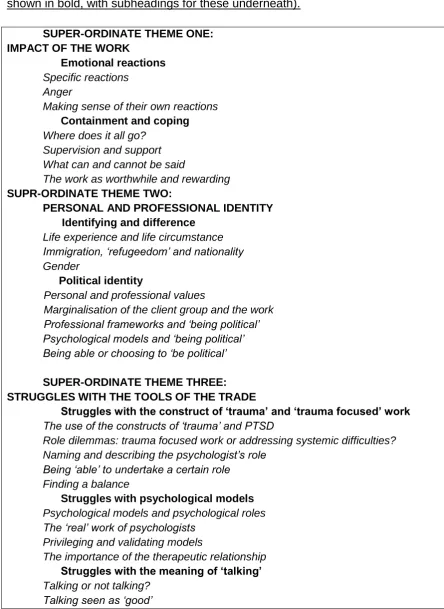
The results of the analysis of the interviews comprise four super-ordinate themes, each made up of two to three sub-ordinate themes, summarised in Table 1
below, along with sub-headings for these themes.
Super-ordinate theme one, Impact of the work includes discussion of the
emotional reactions that the participants had in response to undertaking the work and how these were managed. Processes of identifying with or feeling different from clients appeared to be related to these emotional reactions. Super-ordinate theme two, Personal and professional identity, includes dilemmas regarding the relationship between participants‟ personal values and their professional role. A variety of factors seemed to culminate in the work being viewed as complex, „different‟ and challenging. Super-ordinate theme three, Struggles with the tools of the trade, outlines how the various tools psychologists use, such as the construct of „trauma‟ and psychological models, may contribute to these
challenges. Super-ordinate theme four, Holding on to a „both/and‟ view, details the recurring themes of holding in mind polarised positions, with regard to viewing the self (as the therapist) or the client as an expert and/or non-expert, and with regards to viewing clients as resilient and/or vulnerable.
33
Table 2: Super-ordinate and sub-ordinate themes (sub-ordinate themes are shown in bold, with subheadings for these underneath).
SUPER-ORDINATE THEME ONE: IMPACT OF THE WORK
Emotional reactions Specific reactions
Anger
Making sense of their own reactions Containment and coping Where does it all go?
Supervision and support What can and cannot be said
The work as worthwhile and rewarding SUPR-ORDINATE THEME TWO:
PERSONAL AND PROFESSIONAL IDENTITY Identifying and difference
Life experience and life circumstance Immigration, „refugeedom‟ and nationality Gender
Political identity
Personal and professional values
Marginalisation of the client group and the work Professional frameworks and „being political‟
Psychological models and „being political‟ Being able or choosing to „be political‟
SUPER-ORDINATE THEME THREE:
STRUGGLES WITH THE TOOLS OF THE TRADE
Struggles with the construct of ‘trauma’ and ‘trauma focused’ work The use of the constructs of „trauma‟ and PTSD
Role dilemmas: trauma focused work or addressing systemic difficulties? Naming and describing the psychologist‟s role
Being „able‟ to undertake a certain role Finding a balance
Struggles with psychological models Psychological models and psychological roles The „real‟ work of psychologists
Privileging and validating models
The importance of the therapeutic relationship Struggles with the meaning of ‘talking’ Talking or not talking?
34 Talking and power
SUPER-ORDINATE THEME FOUR: HOLDING ON TO A ‘BOTH/AND’ VIEW
Both/and expert and non-expert „Schooled‟ to be experts
The „rescuing‟ impulse
Whose meaning is privileged? Collaboration and empowerment
Both/and resilient and vulnerable Inspired and celebrating
Oppressed or empowered?
The best and the worst of „human nature‟
SUPER-ORDINATE THEME ONE: IMPACT OF THE WORK
This super-ordinate theme includes the impact that the work appeared to have on participants, such as the emotional reactions described by participants in
response to undertaking the work and how these were managed. This super-ordinate theme relates to super-super-ordinate theme two, Personal and professional identity, in various ways. For example, the emotional reactions participants experienced relate to aspects of their personal and professional identity; whether and why participants sometimes felt anger or guilt appeared to be related to their gender or cultural identity.
Emotional reactions Specific reactions
35
some of the stories are horrific…I think there is something about that where it‟s quite hard to be able to hear those things and not be
horrified and not be shocked and not be completely overwhelmed
(Amy, 260-266)
when there‟s a sexual element to any of the torture, or any of the violence, there‟s something particular that gets evoked in me that‟s
really, really, um, hard to understand, to process, to, kind of, make sense of. I don‟t know where it comes from (Amita, 737-739)
Some participants spoke of the complexity of the work leading to the experience of feeling overwhelmed and incompetent:
I can‟t cope with this, it‟s too much, it‟s too overwhelming, I feel awful, I feel like I, not only, I feel it‟s a combination of feeling like the stuff that you‟re dealing with is overwhelming but also feeling like you don‟t
really have enough skills or resources or capability or, you know,
whatever it is, to be able to do anything. (Amy, 25:544-549)
Anger
Anger appeared to be a common emotion aroused in participants. Often, this anger was not just directed at the individual perpetrators of sexual violence but at the wider gender inequalities that surround sexual violence (this was true of both the male and female participants) and the current systems that were perpetuating clients‟ distress, such as the process of gaining asylum status via the UK Home Office. For both male and female participants, anger and a negative attitude towards males in general, as a group, was something that was spoken about. Some participants reflected that it was important to be aware of this attitude and “keep on eye” on it (Amy, 346) to ensure that their views remained balanced and not polarised:
this is outrageous, you know this should not be happening to all these women, they shouldn‟t end up feeling, having to carry all this shit (I:
hmm) because, because they happen to be in a war and victims of this kind of abuse, you know (I: hmm), so I don‟t know what you do, but
36
very often that, um, fury and anger is focused on people‟s current situations…you can‟t deny the enormity of what people have been
through, um, prior to coming here, but I think where it becomes the
kind of focus of so much anger amongst us as workers is where you
just see people being unnecessarily re-traumatised by the system that‟s supposedly (I: hmm), um, bringing safety to them (Marie,
24:769-770; 777-781).
it makes you think about your own gender it…your own group, um, and what utter bastards they can be…that makes me angry sometimes
(Jack, 500-501; 505)
Interestingly, a way of coping with anger seemed to be to use it as a motivating force to continue the work and to participate in political or social action to instigate change on a wider level:
it‟s just infuriating, (I: yeah)…but then you just think, okay, well what can be done to highlight it…you can work with agencies, or you can talk, sometimes on the radio… it‟s working with legal organisations and
charities, this is an example of how you can potentially promote
change on a wider scale which keeps me sane when working with
people on an individual basis (Paul, 252-260)
Making sense of their own reactions
Participants also talked about how they made sense of their emotions and their ways of coping. Unsurprisingly, given that they were psychologists, participants made use of psychological theories and constructs to do this. These theories and constructs included those of „trauma‟ and „vicarious traumatisation‟, symptoms of PTSD, CBT and „defences‟. However, most participants also spoke in a way that reflected their desire to normalise their reactions, and not pathologise them. This relates to the theme of containment and the need for others, such as supervisors, to not pathologise their reactions either (see below under Coping and