item and our policy information available from the repository home page for further information.
Author(s): Ichimura, Maki; Jahankhani, Hamid; Arunachalam, Subramaniam Title:Training for successful lean manufacturing implementation
Year of publication: 2006
Citation: Ichimura, M.; Jahankhani, H.; Arunachalam, S. (2006) ‘Training for successful lean manufacturing implementation’Proceedings of Advances in
Computing and Technology, (AC&T) The School of Computing and Technology 1st Annual Conference, University of East London, pp.167-172
Link to published version:
TRAINING FOR SUCCESSFUL LEAN MANUFACTURING
IMPLEMENTATION
Maki Ichimura, Hamid Jahankhani and Subramaniam Arunachalam
Design and Manufacturing Research Group
{M.Ichimura, Hamid.Jahankhani, S.Arunachalam}@uel.ac.uk
Abstract: Implementing lean manufacturing is a complex and everlasting task. The workers involving in production processes are the pivot of the lean manufacturing implementation. Training is known as a vehicle to assist the implementation process. Despite awareness of the training importance, so far, a little is available to assist to organise an efficient training. This paper summarises the overview of lean manufacturing and discuss the importance of human resource within lean implementation process. It then proposes a training framework for production workers in lean environment.
1. Introduction
Manufacturing enterprises are facing increased worldwide competition. Companies have to meet the rapidly changing customers’ demand and market requirements as quickly as possible without decreasing its productivity or even with increasing productivity. As the answer to manufacturing challenges, many different manufacturing processes were introduced in academic and practice. Lean Manufacturing (LM) has been one of the central issues of manufacturing enterprises since Toyota has magnificently improved its manufacturing performance through Toyota Production System (TPS). Development of worker training model still remains as a disputable issue within LM since very little training-related research exist within engineering. This paper first reviews the history of LM, and then discusses the worker side of LM. Finally, it proposes a training model for production workers in lean environment.
2. Overview of Lean Manufacturing
–
elimination of all kinds of waste
The concept of Lean can be tracked back to 1903 when Henry Ford first produced his
automobile. In the first Ford production system, every parts and every car was built one by one at a time by skilled craftsmen and skilled fitters by hand. As the result of depending on skilled craftsmen, mass production was difficult. In order to achieve mass production, Ford 1) introduced a more precise measurement system for parts production, 2) simplified the car model, 3) decreased the number of tasks per labour, and 4) introduced the assembly line. This production method called continuous-flow
manufacturing has achieved mass
production of the affordable Model T. (Ehrlich, 2002)
transportation, 4) Waste of processing itself, 5) Waste of inventory, 6) Waste of movement of operators and 7) Waste of making defective products.
3. Human side of Lean
3.1 Requirements of Workers I ) Flexibility and Multi-skilled
Flexibility has been paid a huge attention in recent manufacturing environment. The employees are required to be capable of adapting to the complexity of unexpected changes in work environments, customer orders, product development and rapid pace of technology and keeping the same level of performance quality without halting production or reducing productivity.
LM requires fairly high level of flexibility in workers. The flexibility required in lean environment can be only achieved through developing multi-skilled workers.
II ) Team Work and Flexibility
LM is completely based on the team work thereof considered as the heart of LM. Each worker has to be able to carry out all the others’ tasks in the group (cross-training). Team working provides a chance to communicate with other workers and give suggestions in the group – kaizen circle. However, Parker et al. gives some case examples failure of work team activities in their article; e.g. only the supervisors attend the meeting and/or meet only a few minutes to hear supervisor’s exhortations. Another controversial issue on team working is a driving force of a team, i.e. team leader. The team leaders are responsible for process improvement, the allocation of work amongst the team and the setting of work pace, as well as training and the settling of grievances. (Delbridge, 2005) For shop floor workers, the team leader is the most closest and reliable person to who the workers can
talk without bias. (Kaneda, 2004) Consequently, the leadership is a pivotal skill in shop floor under lean production.
III ) High Motivation
Motivation is a key vehicle to make workable lean manufacturing. Lean Production is “fragile” which relies on the contributions of skilled and motivated workers in order to make achievable LM philosophies. (MacDuffie, 1995) In other words, if the workers deny their attention at spotting problems and their skill at solving them, the whole idea of LM will fail. LM is an enduring journey. Consequently, the workers are required to be highly motivated and managers and team leaders are required to at least eliminate the sources which de-motivate the workers.
3.2 Problems within workers in lean environment
I) Uptight working environment
In spite of the advantages, LM has been criticised in context of working conditions. Cutting non-value-added activities and eliminating buffers are continually increasing workers’ pressures. Parker et al. criticised LM as “management by stress.” Hence, it is important not to consider LM just as a series of mechanistic techniques. Motivation, empowerment and respect for workers are the key aspect for long-term preservation of LM. (Hines et al., 2004)
company performance or even negative impact might occur. As for this solution, workforce training has being argued as an important driving force of LM.
4. Make Lean Manufacturing Work
Even though LM theories and philosophies bring a lot of good ideas, it has also some weaknesses that suggest us not to be too optimistic and not to consider as a panacea for everything that troubles the production process.
4.1 High quality of training
In the past, the companies did not have knowledge or skills of worker training in organizing and upgrading their skills. As a result, organizations failed to transfer to competitive contemporary companies owing to their mismanagement of workforce. Recently, some researches confirmed that worker training is essential in achieving higher productivity, better performance, improved quality, technology application and techniques adaptation. (Pennathur et al., 2003, Tennant et al., 2002) Training can also build royalty to the company, improve worker moral and develop motivation. It has been shown that quality of training provided to the employees will significantly affect efficiency and productivity. (Pennathur et al., 2003, Riding et al., 2002) However, only little research suggests a strategic training framework or programme for line operator in manufacturing environment. (Pennathur et al., 2003) Companies develop training programmes themselves with own proficiency. (Mitel et al., 2004)
Many proponents of LM give heavy attention on training. When a manufacturing company introduce LM at operational level, training is the backbone of the implementation process. Unfortunately, there are still many UK companies which do
not have an extensive understanding of training endeavour even though they have noticed the importance of training. Without substantial understanding of training strive, such whole training process seems merely waste of resources, time and money.
It is obvious that training is an inevitable issue for any manufacturing companies to maintain their competitiveness and matter-of-course it is the fundamental of LM implementation process. Moreover training itself is a comprehensive subject and should be considered as one of the business strategies thus organising a strategic training is a complicated process. To make LM work, the firm has to take the initiative a strategic training program in applying the LM.
4.2 Full support from top management and trusting relationship
LM requires new type of relationship between management and workers. Workers must be considered resources with the potential to contribute to improvement and lean implementation. Implementing LM is a long journey and takes time to see the benefit.
Especially, it might take longer time to gain the benefit financially than lead-time improvement or any other improvements in shop floor. However, it is important to seek long-term benefits but not an immediate profit.
often recognised as one of the Japanese company culture.
5. New Approach to train workers
in lean environment
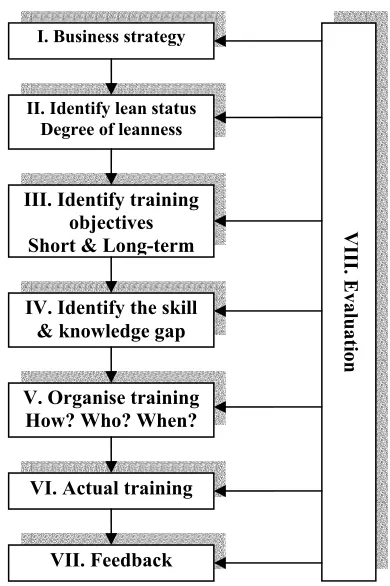
As discussed earlier, a strategic training programme is utmost importance issue in LM implementation process. Yet, there is no one set of rules that give the way to organise a strategic training for workers in lean environment. Even though there are some different training approaches and strategies available, every author presents different views based on their research, knowledge, understanding and experiences. Hence, training for workers in lean environment needs to have a solid theoretical framework which could provide a basis practices to work on even though recommendations by theorists and researchers sound logical and valid. Figure 1 illustrates the new training model.
I ) Business strategy
Process of planning is the most important phase in order to carry out an effective training. It is important to make clear “who we are,” “where we are (among the competitors, in the market, etc.),” “where we want to go and until when,” “what the customers’ needs are,” and organisations’ objectives and aims of business. Those views should be neither too ambitious nor too modest as they could worsen the current competitiveness.
II ) Identify degree of leanness
It is important to identify the degree of leanness in both production system and individuals; which LM philosophies or techniques have applied, to where, and to whom. Every company has its own application process and scale of leanness;
[image:5.595.312.507.198.491.2]however, degree of leanness has to be judged strictly impartially. This assessment aims at expanding proficiency of training programme and preventing from wasting the resource, time and money involving in training.
Figure 1: A proposed morel for training
III ) Identify training objectives and aims Training objectives and aims are the results that organisations want to achieve and are related to business strategy. The objectives and aims have to be realistic, meaningful, specific, and achievable. They can be divided into short-term and long-term depending upon the time scale or business priority. Furthermore, if the production workers can involve into this stage, it can be foreseen the benefits for the firm since the workforces may have better propositions for training programme and might feel they are
VIII. Evalu
ati
on
II. Identify lean status Degree of leanness
III. Identify training objectives Short & Long-term
IV. Identify the skill & knowledge gap
V. Organise training How? Who? When?
VI. Actual training
considered as an important part of the training.
IV ) Identify the skill and knowledge gap After objectives and aims are set, locating skill and knowledge gap between present status and future requirement is vital. Evaluation of the current skill and knowledge should be neither overestimated nor underestimated; otherwise the training will not make any meaningful contribute to both workers and organisations.
V ) Organise training
This is the phase at which detail training plans are organised. There are some questions to be answered in this stage such as;
1) Who is the most suitable worker for training?
2) Who will be the trainer?
3) When is the best time to carry out the training?
4) Which training method is the most
suitable?
5) What kind of material or equipment will be used?
6) Where will be the training take
place?
In order to carry out the most effective training, these elements need to be systematically and deliberately encapsulated in training strategies and/or policies adapted by organisations.
VI ) Actual training
This is the actual implementation phase where chosen training methods take place. It is important to encourage the participants in order to make the training activities more rewarding for themselves and organisations. After all, this stage becomes the most critical phase of the whole training programme since it determines the success
of training even though the training plan is well organised.
VII ) Feedback
This is the stage where suggestions and opinions are collected from trainees. It is an invaluable step in order to not only see the result of training but also make next training initiatives more effective and productive.
VIII ) Evaluation
It is a backbone of whole training agendas as it can perform as a tool to identify if the training programme has been carried out efficiently and improve training programme for future training. If the training progress seems going out of the way according to the evaluation, it enables the firm to rectify without wasting further time, money and resources.
7. Conclusions
programme but also ensures the efficiency of training by implementing evaluation process concurrently. Further research is required to validate the proposed training framework.
8. References
Delbridge, R. (2005) “Workers under Lean Manufacturing” in Holman, et al. ed., The Essentials of the New Workplace: a guide to the human impact of modern working practices, John Wiley & Sons Ltd, UK
Ehrlich, B. G. (2002) Transactional Six Sigma and Lean Servicing: Leveraging Manufacturing Concepts to Achieve World-Class Service, St. Lucie Press
Genaidy, A. M. and Karwowski, W. (2003) “Human Performance in Lean Production Environment: Critical Assessment and Research Framework,” Human Factors and Ergonomics in Manufacturing, Vol. 13 (4), pp317-330
Hines, P., Holweg, M. and Rich, N. (2004) “Learning to evolve: A review of contemporary lean thinking,” International Journal of Operations & Production Management, Vol. 24, No. 10, pp994-1011
Kaneda, H. (2004) Toyota-shiki Katsu Genba Ryoku (Toyota way – Winning shop floor) (in Japanese) Toppan Print
MacDuffie J. P. (1995) “Workers’ Roles in Lean Production: The Implications for Worker Representation” in Babson, S. ed.,
Lean Work: Empowerment and Exploitation in the Global Auto Industry, Detroit, Mich: Wayne State University
Mitel, A. and Pennathur, A. (2004) “Advanced technologies and human in manufacturing workplaces: an
interdependent relationship,” International Journal of Industrial Ergonomics, vol. 33, pp295-313
Parker, M. and Slaughter, J. (1995) “Unions and Management by Stress” in Babson, S. ed., Lean Work: Empowerment and Exploitation in the Global Auto Industry
Detroit, Mich: Wayne State University
Pennathur, A. and Mital, A. (2003) “Worker mobility and training in advanced manufacturing”, International Journal of Industrial Ergonomics, Volume 32, Issue 6, Pages 363-388
Riding, R. and Mortimer, J. (2002) “A study of the on-the-job training of production line operatives in manufacturing companies,”
International Journal of Training and Development, 4: 2, pp111-123
Tennant, C., Boonkrong, M., and Roberts, P. A. B. (2002) “The design of a training programme measurement model,” Journal of European Industrial Training, Vol. 26, No. 5, pp230-240