Energy-efficient Dynamic Clustering Protocol for
Wireless Sensor Networks
K. Padmanabhan
Asst.Professor
Department of Computer Applications Muthayammal Engineering College, Rasipuram,
Tamilnadu, India.
Dr. P. Kamalakkannan
Department of Computer Science Govt. Arts College (Autonomous), Salem
Tamilnadu, India.
ABSTRACT
Recent developments in the sensor networks have made the researchers to find the energy efficient routing protocols. Sensor nodes are normally energy constrained and cannot be replaced in most cases. The need for energy efficiency in wireless sensor network is increasing considerably. This article proposed a new model to reduce the energy consumption by the sensor nodes. Our proposed model Energy Efficient Dynamic Clustering Protocol (EEDCP) distributes the energy consumption evenly among all sensor nodes to increase the life-time of the network. The simulation results show that the EEDCP outperforms its counterparts.
Keywords
Energy-efficiency,CELRP,LEACH,EEDCP,Residual Energy, Wireless Sensor network.
1.
INTRODUCTION
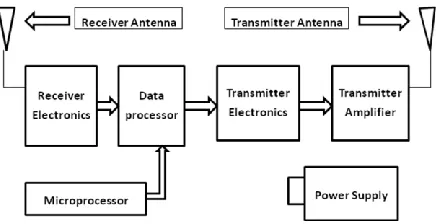
The developments in the Micro-Electro Mechanical Systems (MEMS) have made the development of cost and low-power wireless sensor nodes [1]. The size and cost of the sensor nodes enable them to be deployed in large number of applications. The sensor can be used in the applications such as patient health monitoring, military, monitoring disaster areas, managing inventory, etc. sensor nodes are fixed with an onboard processor. The sensor nodes consist of sensing unit, power unit, and processing unit. The sensing unit composed of a sensor and an ADC (Analog to Digital Convertor). This unit senses the environment. The analog data sensed by sensor node is converted to digital by ADC. The processing unit, composed of a small processor and low-volume memory, aggregates the received data. The power unit consists of batteries provides energy for sensing unit and also processing unit [2]. The life-time of the sensors can be 100 – 120 hours in the active node. A sensor network life-time is normally expected to last few months to one year without recharging. A common method to reduce the energy consumption is to make some sensors in the sleep mode and let the others in the active mode. When a sensor is in the sleep mode, it is shut down except that a low-power timer is on to wake up the sensor at a later time [3]. The sensing ability can be affected by how the sensors are initially deployed. Several placement mechanisms are used. They assume that the sensors are randomly and uniformly distributed over the sensing area. The sensors are deployed in an unattended areas, and the batteries are nor rechargeable most of the time. So the sensors are energy restricted. If the energy of a sensor node drained out, it will not perform the desired task. Energy saving is the key factor in designing a sensor network [4]. To reduce the energy
[image:1.595.318.537.521.633.2]consumption various techniques have been followed by the researchers. The sensor nodes are sensing data from the environment where they are deployed and send it to the Base Station which may be located far from the nodes. The sensors send the aggregated data to the sink either directly or multi-hop transmission. The energy is consumed in different levels when the transmission and reception. The energy consumption in transmission is more than the energy consumed for reception. The transmitters have the capacity to change their transmission power [5, 6]. In case of single hop transmission, the sensors send the data directly to the sink base station. The nodes which are farther away from the base station have to spent more energy than the nodes which are nearer to the base station. The clustering approach is used to reduce the energy consumption. In the traditional clustering technique, the cluster-head nodes are fixed [7, 8, and 9]. The nodes in the clusters send their data to the base station through the cluster-heads. The cluster head node transmits the aggregated data received from the member nodes. So the distance to be transmitted is reduced. But the node which is transmitting data to the base station will drain out its energy quickly. To avoid the quick drain of energy, the cluster-head nodes should be changed randomly. The modern clustering approaches facilitate the change of cluster-heads for each and every round. The cluster-head nodes can be self elected or elected based on certain factors, such as threshold value, residual energy, coverage efficiency, etc.
Fig.1. General Sensor Node Architecture
described. Section 3 describes the proposed system model. Simulation results are shown in Section 4. Finally, we provide concluding remarks in Section 5.
2. RELATED WORKS
The application of conventional clustering to wireless sensor networks does not improve network lifetime since the conventional clustering scheme assumes the cluster heads to be fixed, and thus requires them to be high-energy nodes. To alleviate this deficiency, an adaptive clustering scheme called Low-Energy Adaptive Clustering Hierarchy (LEACH) is proposed in [3] that employ the technique of randomly rotating the role of a cluster head among all the nodes in the network. The operation of LEACH is organized in rounds where each round consists of a setup phase and a transmission phase. During the setup phase, the nodes organize themselves into clusters with one node serving as the cluster head in each cluster. The decision to become a cluster head is made locally within each node, and a predetermined percentage of the nodes serve as local cluster heads in each round, on average. During the transmission phase, the self-elected cluster heads collect data from nodes within their respective clusters and apply data fusion before forwarding them directly to the base station. At the end of a given round, a new set of nodes becomes cluster heads for the subsequent round. Furthermore, the duration of the transmission phase is set much larger than that of the setup phase in order to offset the overhead due to cluster formation. Thus, LEACH provides a good model where localized algorithms and data aggregation can be performed within randomly self-elected cluster heads, which help reduce information overload and provide a reliable set of data to the end user. It has been shown that LEACH provides significant energy savings and prolonged network lifetime over fixed clustering and other conventional schemes discussed above [3].
( )
1
1
mod
p
T n
p
r
p
, n
G = 0Where p is the percentage of nodes that can become CHs, r is the current round and G is the set of nodes that have not served as cluster head in the past 1/p rounds [7]. As long as optimal energy consumption is concerned, it is not desirable to select a cluster head node randomly and construct clusters. However, repeating round can improve the total energy dissipation and performance in the sensor network. There are some problems with the LEACH protocol. The main problem is the residual energy of a node is not considered for cluster formation. The nodes are started with the same initial energy. The cluster-heads are randomly selected rotationally. The proposed protocol selects the cluster-heads based on their residual energy.
A Cluster Based Energy Efficient Location Routing Protocol (CELRP) is one of the clustering approaches used to minimize the energy dissipation. This routing protocol provides balance in the energy consumption and prolongs network life-span of the sensor node for the efficiency of energy. This method reduces the number of energy dissipation by each node because each node does not transmit data directly to the Base Station. The new protocol organizes clusters with the presence of the Cluster Head (CH) that is chosen by the BS as LEACH does. In addition, it also applied the Greedy algorithm to chain
the Cluster heads and used multi-hop transmission data from the node to another node before it is sent to the Cluster Heads [11]. The process of transmission begins when all member nodes in each cluster transmits its data to the CHs with maximum of two hops, then all the CHs sends their data to its’ Cluster Head (CH) Leader Node along the chain, and finally the CH Leader Node transfers the collected data to the BS. The CH Leader Node is not statically selected but is dynamically decided in the order of the remaining amount of energy to avoid one particular node to die earlier than the others. From there, the CELRP basically organizes clusters using the same principals and mechanism as the LEACH. In this article we propose another clustering-based routing protocol called Energy efficient Dynamic Clustering Protocol, which utilizes a high-energy base station to set up clusters and routing paths, perform randomized rotation of cluster heads, and carry out other energy-intensive tasks. The key ideas in EEDCP are the formation of balanced clusters where each cluster head serves an approximately equal number of member nodes to avoid cluster head overload, uniform placement of cluster heads throughout the whole sensor field, and utilization of cluster-head-to-cluster head (CH-to-CH) routing to transfer the data to the base station. EEDCP yields an improved system lifetime and better energy savings over the abovementioned clustering-based routing protocols.
3. PROPOSED SYSTEM
The most important element in the sensor network is the life-time of the sensor nodes. In sensor networks, once a node starts to die then the whole network is considered to be dead since the first node would trigger all the others nodes to die shortly after. An energy efficient dynamic clustering protocol (EEDCP) provides the balanced energy consumption and prolongs network life-span of the sensor node for the efficiency of energy. We focus on the fact that it is scarce all sensor nodes have their own position information. In addition, because the number of sensor nodes is large, there are many overheads that all sensor nodes pass their own information simultaneously to the base station every setup phase. The proposed protocol uses random cluster head decision paradigm of LEACH. For cluster heads decision, it instead uses total remaining energy of sensor networks and each sensor node. Moreover, in the proposed protocol, the base station instead of sensor nodes broadcasts information to sensor networks for cluster construction in the cluster construction phase. Sensor nodes transmit it together with sensing data, so we can keep away from overhead originated by sending setup information of sensor nodes to the base station directly in the cluster construction phase. In addition, the proposed protocol can select the suitable number of cluster heads by the base station according to change of sensor networks, and this information is used to construct clusters in the cluster construction phase.
3.1 The Network Model
The proposed protocol assumes the following properties. The sensor nodes are energy constrained with a
uniform initial energy allocation.
The sink located very far from the cluster-heads.
All the sensor nodes are stationary with limited energy.
All the sensor nodes are equipped with power control capabilities to vary their transmitting power.
The proposed protocol can change the desirable number of cluster heads according to change of sensor networks. It decides cluster heads based on remaining energy level of each sensor node and sensor networks, and changed number of cluster heads. In the proposed protocol, sensor nodes send energy information to the base station in the in the data communication phase.
3.2 Energy Model
Energy model of the proposed protocol is based on the energy model of LEACH and it is here briefly summarized [6]. Energy consumption has two parts: receiving and transmitting message. In transmission, it needs additional energy to amplify signal according to the distance of destination. Energy is consumed by the radio to transmit a k-bit message over distance d as follows:
2
4
( , )
( )
( , )
(1)
*
* *
*
* *
Tx Tx elec Tx amp
elec friss amp crossover
elec friss amp crossover
E
k d
E
k
E
k d
E
k
k d
if
d
d
E
k
k d
if
d
d
In addition, exhausted energy is given by
( , )
( )
*
(2)
Rx Rx elec elec
E
k d
E
k
E
k
Where elec, friss-amp and two-way-amp are identical to those of LEACH.
3.3 Cluster Construction Phase
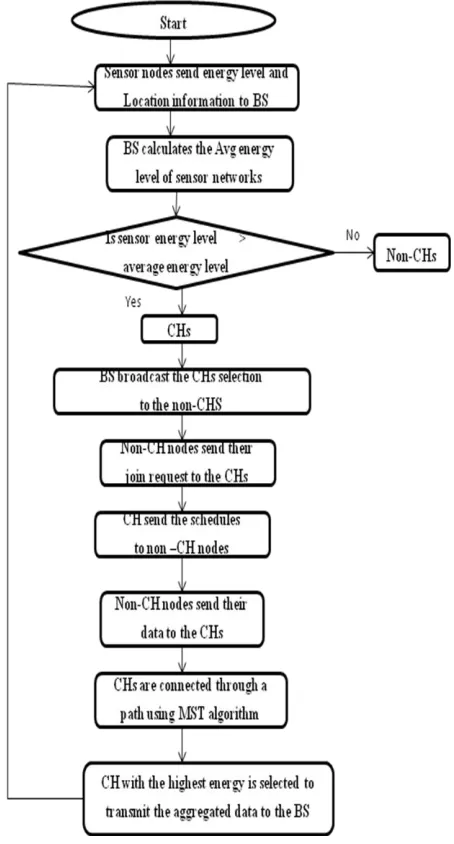
In the cluster construction phase, all the sensor nodes send their location and energy information to the base station. The Base station calculates the average energy level for the network. The sensor nodes which have energy level more than the average energy level will become cluster heads. Then the Base Station broadcasts the cluster-head selection information to the non-cluster head nodes. The base station forms the clusters based on the location information sent by the sensor nodes. The cluster heads will have balanced cluster size. The non-cluster head nodes send their join request to the cluster head. Then the cluster head send the schedules to the non-cluster head nodes. The schedule follows the TDMA slots. It is to avoid the collision on data transmission. At the end of every round, the nodes send their location and energy information to the base station for the next cluster head selection.
3.4 Data Communication Phase
In the data communication phase, each sensor node transmits the sensed data to its own cluster head according to TDMA slot. The nodes which are not transmitting the data turn off their radio and goes into sleep mode. They will wake-up only when their turn to transmit the data. Cluster heads gather data from sensor nodes and do aggregation, fusion and compression. The cluster head nodes are connected through a path based on the minimum spanning tree algorithm. The cluster head which has more energy level than the other cluster head nodes will collect the data from other cluster heads and transmit the entire data to the base station. The energy level is evenly balanced in this approach. The base station passes raw data out through the Internet or cellular
[image:3.595.313.540.170.592.2]networks, and it stores energy level information of each sensor node to use for the next cluster construction phase. Now, the base station can calculate total energy level of sensor networks and know the number of sensor nodes in sensor networks by using data that cluster heads sent. The base station can use various kinds of algorithms to calculate the suitable number of cluster heads considering size of sensor networks and number of sensor nodes.
Fig.2 Flow chart for proposed protocol
Instead of all the cluster-heads sending the aggregated to the sink, one cluster-head collects, aggregates, and transmit the data the base station. Many research works proved that the transmission will consume more power than the sensing and reception. This approach will reduce the battery usage and saves extend the life time of network.
4. EXPERIMENTAL RESULTS
consider several random network configurations with 100 nodes where each node is assigned an initial energy of 1J. Furthermore, the number of data frames transmitted for each round is set at 40; the data message size for all simulations is fixed at 500 bytes, of which 25 bytes represent the length of the packet header.
Table 1. Simulation parameters
[image:4.595.316.541.69.244.2]In the first experiment, we simulate 100 m × 100 m network topologies with the BS located at least 100 m away from the nearest node. The improvement gained through EEDCP is exemplified by the total number of living nodes graph in Fig. 3. This plot shows the number of nodes that remain alive over the number of rounds of activity for the 100 m × 100 m network scenario. With EEDCP, all the nodes remain alive for 215 rounds, while the corresponding numbers for CELRP and LEACH are 200 and 165 respectively. Furthermore, if system lifetime is defined as the number of rounds for which 75 percent of the nodes remain alive; EEDCP outperforms that of CELRP by 15 percent. A 40 percent improvement in system lifetime is observed for EEDCP over LEACH.
Fig.3. A comparison of total number of living nodes in each round
[image:4.595.53.280.153.290.2]Next we analyze the distance of the base station from the nearest nodes. For this experiment, we again simulated 100 m × 100 m network topologies where each node begins with an initial energy of 1J. Figure 4 shows the total number of rounds until the first node die during different base station locations. The plot clearly illustrates the effectiveness of EEDCP in serving significantly more rounds than its counterparts. EEDCP serves more by factors of 10 and 40 percent over CELRP and LEACH respectively.
Fig.4.Network life-time in different BS locations
The final simulation shows that the number of data messages delivered in EEDCP is more than the others. In EEDCP model, more than 60 nodes are alive than the 55 nodes alive in the CELRP and 50 nodes alive in the LEACH model. The result shows that the data messages delivered in EEDCP is 10 percent more than the CELRP and 35 percent more than that of LEACH. The EEDCP model increases the life-time of the sensor networks.
Fig.5. Total number of bits delivered with respect to the alive nodes
5. CONCLUSION
In this paper, we propose an energy efficient routing protocol, EEDCP that utilizes the services of high-energy base station to perform most energy-intensive tasks. By using the base station, the sensor nodes are relieved of performing cluster setup, cluster head selection, routing path formation. Performance of the proposed EEDCP protocol is assessed by simulation and compared to other clustering-based protocols CELRP and LEACH. The simulation results show that EEDCP outperforms its comparatives by uniformly placing cluster heads throughout the whole sensor field, performing balanced clustering, and using a CH-to-CH routing scheme to transfer fused data to the base station. It is also observed that the performance gain of EEDCP over its counterparts increases with the area of the sensor field. Therefore, it is concluded that EEDCP provides an energy efficient routing scheme suitable for a vast range of sensing applications.
Parameters Value
Simulation Area 100x100
Number of sensor nodes 100
Sink node location 100m, 150m
Initial energy 0.1 J
Energy of data aggregation 5nJ/bit
[image:4.595.314.541.363.541.2] [image:4.595.55.279.446.590.2]6. REFERENCES
[1] Clare, Pottie, and Agre. “Self-Organizing Distributed SensorNetworks”, In SPIE Conference on Unattended Ground Sensor Technologies and Applications, pages 229–237, Apr.1999.
[2] Ian F.Akiyildiz, Weilian Zu, “a survey on sensor networks”, IEEE communications magazine, August, 2002.
[3] Lan Wang and Yang Xiao, “a survey of energy efficient scheduling mechanisms in sensor networks”, Springer, May 2006.
[4] Siva D. Muruganathan, Daniel C. F. Ma, Rolly I. Bhasin, And Abraham O. Fapojuwo, “A Centralized Energy-Efficient Routing Protocol for Wireless Sensor Networks”, IEEE Radio communications, 2005.
[5] Giljae Lee, Jonguk Kong, Minsun Lee, and Okhwan Byeon “a cluster-based energy aware routing protocol for sensor networks”, proceedings of the 17th IASTED international conference on parallel and distributed computing and systems, nov 14-16, 200, USA.
[6] Ming Zhang Suoping Wang, “An Energy Efficient Dynamic Clustering Protocol based on Weight in Wireless Sensor Networks”, journal of networks, vol. 6, no. 7, July 2011
[7] taewook kang, jangkyu yun, hoseung lee, icksoo lee, hyunsook kim, byunghwa lee, byeongjik lee, kijun han, “A Clustering Method for Energy Efficient Routing in Wireless Sensor Networks”, Proceedings of the 6th WSEAS Int. Conf. on Electronics, Hardware, Wireless and Optical Communications, Corfu Island, Greece, February 16-19, 2007
[8] W.B.Heinzelman, A..p.Chandrakasan, and Hari Balakrishnan, “an application specific protocol architecture for wireless microsensor networks”, IEEE communications, 2002.
[9] Jannatul Ferdous, Mst. Jannatul Ferdous, and Tanay Dey, “A Comprehensive Analysis of CBCDACP in Wireless Sensor Networks”, journal of communications, vol. 5, no. 8, august 2010
[10] Changle Li *, Hanxiao Zhang, Binbin Hao and Jiandong Li, “A Survey on Routing Protocols for Large-Scale Wireless Sensor Networks”,Sensors 2011, 11, 3498-3526; doi:10.3390/s110403498