Comparative Analysis of Video Streaming Services in
H.323 Application layered protocol coexisting of WLAN
with Wireless Broadband Standard networks
K. Sakthisudhan
Assistant Professor Bannari Amman Inst of Tech
Erode,India
P.Thangaraj
Professor &Head Bannari Amman Inst of Tech
Erode,India
C.Marimuthu
Professor
Bannari Amman Inst of Tech Erode,India
ABSTRACT
Intellectual mobile terminals (or users) of next generation wireless networks are expected to initiate/Establish voice over IP (VoIP) calls using session set-up protocols like H.323 or SIP (Session Initialized Protocols). To provide quality metrics of video conferences, telemedicine and other voice over broadband telephony (VoBB) applications. In this work, we analyse the performance of the H.323 call setup procedure over the wireless link. We used to call modes of operation over heterogeneous networks. The proposed model application layers in the RTP Control Protocol and Real-Time Transport Control Protocol (RTCP) protocols used in two different modes of call established. Initiate services through VoIP used for H.323 control packets. Our analytical model provides that the VoIP call set-up performance, jitter and delay in peer to peer networks. Moreover, the call setup performance can be improved significantly using the robust in application link layer such as RTP/RCTP with a comparison of heterogeneous network proposed in our paper. The analytical results were validated by our experimental measurements
Keywords
VoIP, RTCP, SIP, multimedia, Strict Priority Scheduler, ISAKMP
1.
INTRODUCTION
Fourth coming world increasing demand by users for ubiquitous access to wireless services has led to the deployment of many wireless access technologies. Wireless access technologies such as WLAN, GPRS, EDGE, 3G, and Wi-Max all offer differing levels of quality, range and bandwidth. In the future there will be more multimedia devices which can access multiple radio access networks. Moreover in the future we will see greater overlap between the coverage provided by the differing access technologies. In this research work implementation of Voice over Internetworking Protocol (VoIP) and IP Multimedia Subsystem services (IMS) over the much sought after wireless standard WiMAX (802.16) Wifi (802.11. b). The multimedia transmission over wireless in the soft switching technique for compatible with WiMAX. The one of the signalling protocol is VoIP has opened a new indoor / outdoor for telephony bringing forward immense possibilities. The basic reason for the popularity of VoIP is the cost which is very low as compared to the conventional telephony services. The concept of the transmission of voice over data stream makes it possible to have VoIP transmitted and received using anything that uses IP - laptops, PC's, WiFi enabled handsets etc.. In this VoIP uses Internet Protocol for transmission of voice as
packets over IP networks. The process involves digitization of voice, the isolation of unwanted noise signals and then the compression of the voice signal using compression algorithms/codecs. After the compression the voice is packetized to send over an IP network, each packet needs a destination address and sequence number and data for error checking. The signalling protocols are added at this stage to achieve these requirements along with the other call management requirements. When a voice packet arrives at the destination, the sequence number enables the packets to be placed in order and then the decompression algorithms are applied to recover the data from the packets. Here the synchronization and delay management needs to be taken care of tomake sure that there is proper spacing. Jitter buffer is used to store the packets arriving out of order through different routes, to wait for the packets arriving late. H. 323 is the ITU-T standard for packet based multimedia conferencing services based on VoIP. This standard is interoperable and has both point to point and multipoint capabilities it offers specifications for call control, channel setup, codes for the transmission of Real time video and voice over the networks and this standard collaborate with RTP/RTCP layered protocol used for real time audio and video streaming.
1.1 Real Time Multimedia Services On The
Internet
specific transmission control mechanisms integrated within the application.
1.2 Issues In Designing An Ieee 802.11. B
Wireless Local Area Networks (WLANs) are increasingly making their way into residential, commercial, industrial and public areas. WAN issues usually result from high latency, packet loss, jitter, or temporary loss of the Internet connection and can result in everything from delayed voice to dropped calls. These are the problems that you face with your connection from the modem out to the internet. They can be the result of poor signal levels with your ISP's (Internet Service Provider ) connection or unusual high delay and jitter occurring from routers and/or network congestion. The two main problems encountered when VoIP is used over WiFi are i) The system capacity for voice can be quite low for WLAN. ii) VoIP traffic and traditional data traffic such as Web traffic, emails etc. Can mingle with each other thereby bringing down VoIP performance.These problems exist mainly due to the following reasons
:
a) There is large per-packet overhead imposed by WiFi for each VoIP packet – for both protocol headers and WiFi contention.
b) Design of 802.11 protocols is such that it allows clients to access the channel in a distributed manner which causes a contention for the network which is particularly evident in the case of VoIP due to the real-time nature of the traffic. c) Delays between the time that you speak and when the other side hears your words, (and vice versa).
d) The network related causes of poor quality VoIP as described by the symptoms above, can be broken down into three main categories are packet loss, jitter, and latency Hence in the case of VoIP over WLAN the perceived throughput and real throughput have a large difference. Even though it does seem as an attractive alternative to Streaming technology it has several drawbacks as we shall further investigate in section III of this paper.
1.3 Issues In Designing An Ieee 802.16. E
WiMax is provided the missing link for the “last mile” connection in Wireless Metropolitan Area Networks (WMAN). It represents a serious alternative to the wired network, such as DSL andcable modem. Besides Quality of Service (QoS) support,the IEEE 802.16 standard is currently offering a nominaldata rate up to 100 Mega Bit Per Second (Mbps), and a covering area around 50 kilometres. Thus, a deployment of multimedia services such as Voice over IP (VoIP), Video on Demand (VoD) and video conferencing is now possible, WiMAX modems do exist on the market, that could be used as air interface devices, but due to their bulk and due to the fact that they require to be powered, they become a hindrance to mobility. PCMCIA (Personal Computer Memory Card International Association) modems are handy but the PCMCIA technology is gradually taking the leave from laptop computers. Mainly concerning QoS support, the 802.16 standard proposes to classify, at the MAC layer, the applications according to their QoS service requirement (real time applications with stringent delay requirement, best effort applications with minimum guaranteed bandwidth) as well as their packet arrival of pattern (fixed / variable data packets at periodic / aperiodic intervals). For this aim, the initial standard Proposes four classes of traffic, and the 802.16e [14] amendment adds another class:a) Real-time polling service (RTPS): supports real time services with variable size data on a periodic basis, such as MPEG and VoIP with silence suppression.
b) Non Real-Time Polling service (nrtPS): supports non real-time services that require variable size data bursts on a regular basis, such as File Transport Protocol (FTP) service.
c) Best effort (BE): for applications that do not require QoS such as Hyper Text Transfer Protocol (HTTP).
d) In wireless link environmental, WiMAX performance is affected by terrain, climate and buildings. For instance, if there are a lot of buildings between your receiving device and the antenna, you might have some reception problems.
1.4
Strict Priority Scheduler
The real-time traffic occupies a significant percentage of the available bandwidth and Internet must evolve to support the new applications. Such as VoD (Video on Demand), VoIP (Voice over IP), VTC (Video-Teleconferencing), interactive games, distributed virtual collaboration, remote classrooms, grid computing, etc.,The best effort delivery is unacceptable, since in case of a congestion the Quality of Service (QoS) and Quality of Experience (QoE) declines to an unsatisfactory level. The main contribution of this paper is the strict priority scheduler designed to provide the minimum guaranteed transmission rate for all active flows with the respect to their priorities and to provide a fair share of the additional bandwidth. The scheduler also rejects flows, for which the minimum rate requirements exceed the available bandwidth. The proposed solution is applicable for the WiFi wireless network, to accomplish QoS along the path.
The Strict Priority Scheduler is the default scheduling discipline in QualNet. It services the highest priority queue until it is empty, and then moves to the next highest priority queue, and so on. It is possible that if there is enough high priority traffic, the lower priorities could be completely frozen out. We can configure only one node at the first scheduler level as strict priority. If any node or queue above the strict-priority node has packets, it is scheduled next. If multiple queues above the strict-priority node have packets, the HRR algorithm (Hierarchical Round Robin) selects which strict-priority queue is scheduled next. One strict strict-priority traffic-class group is called the auto-strict-priority group. The scheduler nodes and queues in the auto-strict-priority group receives strict-priority scheduling.
1.5 ISAKMP Protocol
2.
RELATED WORKS
There are many papers proposed in VOIP based video streaming technology with H.323/SIP protocols. The authors are mainly concerned with routing protocol based transmission in order to achieve high robustness and capacity of voice transmission over IP networks various methodologies have been implemented and verified they proceed.
[1] jengfarn lee et al proposed in challenges in practical Quality of metric WLAN over VoIP networks the quality of metric values average delay against with uplink and downlink transmission over IP networks.[2] Jae-Woo So et al investigated the OFDM (Orthogonal Frequency division multiplexing) system VoIP based up/down link signalling overhead information streaming over IEEE 802.16. e networks. [3] Castro, M.A.V et al investigated video streaming under temperate and tropical propagation conditions based on DVB-S2/RCS and WiMax standards.[4] Rahmatullah, M.M et al proposed three level multi parallelism video call transmitted over VoIP.[5] Rangel V et al examined the performance analysed for digital video broadcasting (DVB) /Digital Audio-Visual Council (DAVIC) cable television protocol for the delivery of low rate isochronous streams for a cable population of up to 700 nodes and data rate up to 128 Kbps suitable for compressed/uncompressed voice, video delivery ofsupplementary services. [6] Carmona, J.V.C et al proposed analysis of VoIP over streaming video often high data rate delivery through a residential indoor power line communication (PLC ) network. [7] Jianxin Liao et al proposed to provide real time voice transmission over lossy networks for introducing new SCTP transport layer protocol in wireless networks [8] Sajal K. Das et al examined call initialized setup/call setup delay and call establishment between mobile subscribers and also achieved guarantee service over H.323/SIP protocol. [9]An Chan et al proposed indoor/outdoor WLAN coexists streaming services over VoIP with different data rates.[10]Wei Wang et al investigated two major problems of low VoIP capacity in WLAN and unacceptable VoIP performance in the presence of coexisting video traffic from different user application. With each video stream requiring less than 10Kbps and IEEE 802.11.b requiring at 11Mbps support more than 500 no of VoIP sessions.[11] Nilanjan Banerjee et al examined in the undesirable delay and packet loss coexisting with heterogeneous IP based network and also achieved good quality of services in application layered SIP protocol.
3.SIMULATION RESULTS
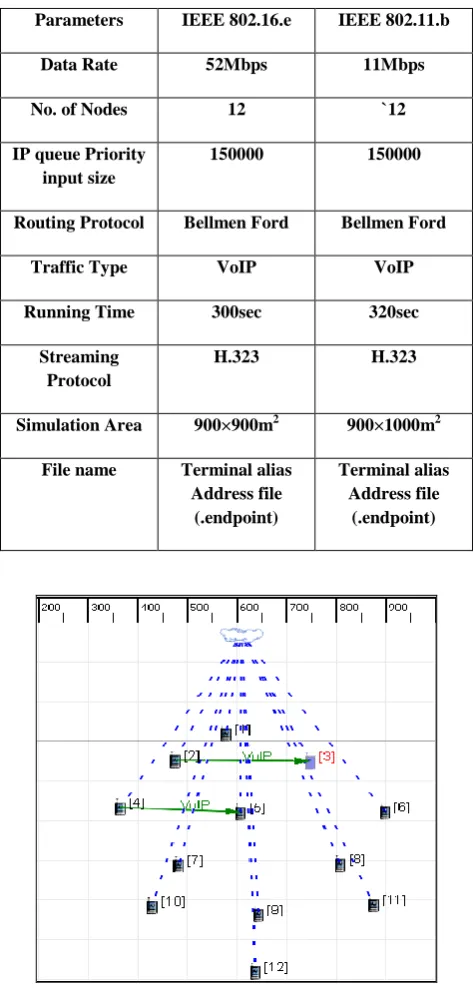
[image:3.595.310.547.90.586.2]We use qualnet simulator as our performance analysis platforms. Various evaluation parameters include the time between 1st and last packet, no of packets, Average packet size, and throughput of the simulated scenario. The simulation parameters are summarized in table1. We designed the infrastructure networks Setup containing 12 no of nodes. We are compiling the all nodes with video traffic in VoIP transmission between the source and destination nodes. Our work combines with demonstrated an IEEE 802.16. e and IEEE 802.11. b networks. The qualities of metrics are analysed in the video established between two different VoIP users. . Video traffic applies between 2/3 and 4/5 respectively. The two applications layered protocols are used in VoIP services RTP/RTCP. . We analysed average jitter, end to end delay, RTT, VoIP initializes, establishment, receiver parameter are taken into the above application layered protocols
Table 1. Parameters for simulation evaluation
Parameters IEEE 802.16.e IEEE 802.11.b
Data Rate 52Mbps 11Mbps
No. of Nodes 12 `12
IP queue Priority input size
150000 150000
Routing Protocol Bellmen Ford Bellmen Ford
Traffic Type VoIP VoIP
Running Time 300sec 320sec
Streaming Protocol
H.323 H.323
Simulation Area 900×900m2 900×1000m2
File name Terminal alias
Address file (.endpoint)
Terminal alias Address file
(.endpoint)
Fig 1: Example for Snapshot Qualnet simulator plot for H.323 video transmission both of an IEEE 802.16.e and
IEEE 802.11.b
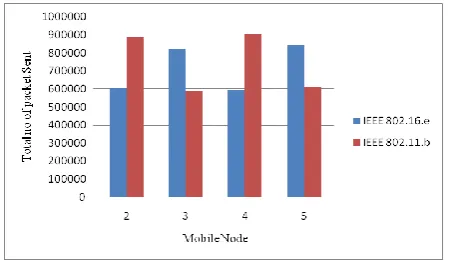
Fig 2 Number of Mobile nodes corresponding with packet transmission over VoIP (RTCP)
Fig 3 Number of Mobile nodes corresponding with packet received over VoIP
[image:4.595.55.278.235.398.2]From figure 2 and 3 the video transmission packets lost occurred in mobile nodes session average jitter arasied in the application layer. In figure 5 represents RRT video packets are travelling along destination node for speed test and back. IEEE 802.16. e radio link is less than IEEE 802.11. b radio networks. In order to achieve 3×10⁻⁶ in IEEE 802.11. b radio links.
Fig 4 Number of Mobile nodes corresponding with session average RRT over VoIP (RTCP)
From this figure 4-7 shown as RTP session is established of each multimedia stream. A session consists of an IP address with a pair of ports for RTP and RTCP. For video streams will have a separate RTP session, enabling a receiver to deselect a particular stream. The ports which form a session are
[image:4.595.314.538.410.536.2]negotiated using other protocols such as RTSP- (Real time streaming protocol) and Session Initiation protocol using the session description protocol in the setup method. According to the specification, an RTP port should be even and the RTCP port is the next higher odd port number. RTP and RTCP typically use unprivileged UDP ports (1024 to 65535) but may use other transport protocols (most notably, SCTP (streaming control transmission protocol and DCCP Datagram Congestion Control Protocol) as well, as the protocol design is transport independent. In the IEEE 802.11.b protocol occupied session constant average delay is 0.43×10⁻⁶ and average jitter also obtained constant is 0.07 in VoIP transmission services.
Fig 5 Number of Mobile nodes corresponding with session average Jitter in RTP Protocol over VoIP
Fig 6 Number of Mobile nodes corresponding with session average delay in RTP Protocol over VoIP
[image:4.595.62.273.520.662.2] [image:4.595.314.540.589.719.2]Fig 8 Number of Mobile nodes corresponding with Average Jitter over the VoIP Initiator scheme
[image:5.595.315.553.130.295.2]In this below figure 8-9 shown as average delay and jitter with VoIP initiator video streams over IP based transmission. We are assigning the video calls in the nodes 2 and 4 and also establishes same source nodes. Jitter can be described in terms of time variation in periodic signals in VoIP services at the same time qualified in all time varying signals e.g. RMS, Peak to peak displacement. Jitter can be expressed in terms of spectral density (frequency content)
Fig 9 Number of Mobile nodes corresponding with Average end to end Delay over VoIP Initiator scheme
Table II. Different network standard with VoIP initializer
Standards Total
no of
packets
Avg.Delay Min one
way delay VoIP TX
Total no of received packets
IEEE 802.16.e
3507 0.317583 0.08 3477
3565 0444226 0.0816 3156
IEEE 802.11.b
5160 0.0426133 0.0426133 5158
5266 0.426116 0.426116 5265
The above table II mentioned VoIP initializes the mobile nodes then archived packet transmission to respective receiver. Video packets are congestion delays in the one way transmission to VoIP receiver nodes.
[image:5.595.313.562.322.495.2]Fig 10 Number of Mobile nodes corresponding with Average Jitter over the VoIP receiver scheme
Fig 11 Number of Mobile nodes corresponding to Average delay over the VoIP receiver scheme
[image:5.595.53.281.369.522.2]In this figure 12-13 shown as average delay and jitter with a VoIP receiver over IP based transmission. We are assigning the video calls in the nodes 3 and 5 and also establishes same destination nodes
Table III. Different network standard with VoIP Receiver
IEEE Standar
ds
Total No of packets
sent
Average delay
MIN one way delay
VoIP initiator
Total No of packets
recevied
IEEE 802.16.e
4767 0.0188146 0.188146 3477
4914 0.439119 0.43919 3156
IEEE 802.11.b
3435 0.0427936 0.06 3125
[image:5.595.51.565.589.755.2]The above table mentioned VoIP receive the mobile nodes then archived packet transmission to respective destination by SIP application layered protocol. Video packets are congestion delays in the one way transmission to VoIP destination nodes.
Fig 12 Number of mobile nodes corresponding with quene packets (Strict Priority Scheduler)
Fig 13 Number of mobile nodes corresponding with dequene packets (Strict Priority Scheduler)
[image:6.595.55.286.139.288.2]In the above two figure 12-13 represented as the real time packet transmission over the scheduling round robin algorithm. In order to obtain the minimum guaranteed transmission rate for all active flows with the respect to their priorities and to provide a fair share of the additional bandwidth.
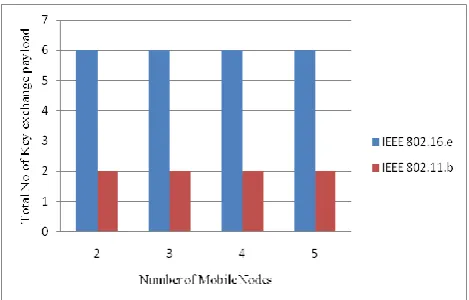
[image:6.595.53.282.322.481.2]Fig 14 Number of nodes corresponding with key exchange Payload in ISAKMP protocol
Fig 15 Number of nodes corresponding to IP Delivers TTL sum of packets sent in ISAKMP protocol
In the above figure 14-15 the number of mobile nodes represented as initialized cipher key phase factor with user specified delay after phase one completed. It is also possible to start phase two in authentication when some data packet comes at ISAKMP server and it doesn’t find any IPSec SA for that packet's source and destination networks. The ISAKMP protocol for creating cookies, generating keys and nonce is being simulated by some simple stub functions. The severs nodes established Security Associations (SA) in the wireless links are bidirectional, that is same SA is used for both inbound and outbound packets.
3.
CONCLUSION
We experimentally investigated application layered protocols to compare the quality of VoIP over peer to peer network video conservation. The RTP, RTCP, VoIP Initiator, VoIP receiver, SIP analysed video traffic from source to destination node. RTT In this establishment of video streaming transmission Wimax is better suited to VoIP than WiFi. The ISAKMP protocol brings new services like authentication and authorization mechanisms based on attribute certificates. This flexibility is what is needed now for the future growth of Internet services. Currently an experimental implementation of ISAKMP in VoIP is in progress.
4.
FUTURE ENHANCEMENT OF
WORK
We will discuss security issues and challenges with radio links over VoIP particularly MANET transmission. The analysed and comparison of application layered protocol H.323 and SIP protocols with respect to security attacks then work will extend for mobility nodes in VMANET architecture.
5.
REFERENCES
[1] Jengfarn lee,wanjiun Liao “A Practical QoS Solution to Voice over IP in IEEE 802.11 WLANs” IEEE Communications PP 111-117 April 2009
[image:6.595.54.289.571.721.2][3] Castro, M.A.V.; Fernandez, D.P “VoIP cross-layer load control for hybrid satellite-WiMAX networks” Issue 3,PP 32-39 june 2008
[4] Rahmatullah, M.M.; Khan, S.A.; Jamal, H “Carrier Class High Density VoIP Media Gateway using Hardware Software Distributed Architecture” consumer electronics, IEEE transaction on Vol 53issue 4 PP1513-1520. [5] Rangel, V, Edwards, R.M, Tzerefos, P,Schunke, K.-D
“Delivery of low rate isochronous streams over the digital video broadcasting/Digital Audio-Visual Council cable television protocol ” Broadcasting, IEEE Trans on vol 48 issue 4 PP 307-316.
[6] Carmona J.V.C, Pelaes, E.G, Belem, Brazil “Analysis and Performance of Traffic of Voice and Video in Network Indoor PLC” Latin America IEEE Transactions on vol 10, PP 1268-1273
[7] Jianxin Liao, Jingyu Wang, Xiaomin Zhu “A multi-path mechanism for reliable VoIP transmission over wireless networks” ACM Journal Computer Networks: The International Journal of Computer and Telecommunications Networking vol 5 issue13 2008.
[8] Sajal K. Das, Kalyan Basu,“Performance Optimization of VoIP Calls over Wireless Links Using H.323 Protocol” IEEE Transactions on computers, vol. 52, no. 6, PP 742- 752 JUNE 2003.
[9] An Chan, Soung Chang Liew, “Performance of VoIP over Multiple Co-Located IEEE 802.11 Wireless LANs” IEEE Transactions On Mobile Computing, Vol. 8, No. 8,PP 1063-1079 AUG 2009.
[10]Wei Wang, Soung Chang Liew, Victor O. K. Li, “Solutions to Performance Problems in VoIP Over a 802.11 Wireless LAN” IEEE Transactions On Vehicular Technology, Vol. 54, NO. 1, PP 366-384 JANUARY 2005.
[11] Nilanjan Banerjee, Arup Acharya, Sajal K. Das “Seamless SIP-Based Mobility for Multimedia Applications” IEEE Transactions networks PP 6-13 march 2006