An Approach for Improving Performance of Back off
Algorithm
Swati Bhagoria
W.U Khan
Computer Engineering Department Computer Engineering Department
Shri G.S. Institute of Technology Shri G.S. Institute of Technology
and Science Indore and Science Indore
ABSTRACT
In the field of wireless networks one of the arduous assignments is to design an efficient MAC scheme. The key aspect in the design of any contention-based medium access control (MAC) protocol is the mechanism to measure and resolve simultaneous contention because of dynamic topology IEEE 802.11 suffers from high collision rate which affects the performance of WLAN to overcome this many back off schemes have been proposed. IEEE 802.11, which provides technical specifications for wireless interfaces, uses DCF (Distributed Coordinated Function) as the MAC scheme. DCF uses BEB (Binary Exponential Back off) algorithm for Contention resolution among the stations.it performed well at the beginning but researchers found that DCF’s main limitation is as the number of stations increases, number of collisions also increases to a great extent. Increased collision rate has affected other performance metrics such as decreased throughput. This has led to the DCF’s performance degradation hence a back off scheme is needed to improve the performance of the network. it is found that to improve the performance of a MAC protocol, the back off algorithm play an important role. Hence, we have modified a BEB algorithm suitable for a MANET. The entire enhancement done to this algorithm is studied in depth. In this paper we discuss about the Sensing Back off algorithm which has been integrated with MAC protocol this algorithm greatly reduces the end to end delay and collision rate the important factor here is the proposed algorithm simulated at different data rate.
Keywords
MAC schemes, contention resolution, back off algorithm, collision rate.
1.
INTRODUCTION
In the last few years WLAN has become ubiquitous due to its advantages such as flexibility, communication without previous planning [1]. WLAN has two variants, one is infrastructure based in which all the wireless devices communicate with each other using a centralized administration or access point (AP), and the other one is ad hoc mode in which there is no Access Point [2]. MANET can be useful in a situation when there is no enough time to configure a wired network nodes can directly communicate with the ones which fall within their radio range. If the receiver node is not within the sender’s range, then other nodes act as router to transmit the data. One major characteristic of WLAN is the nodes are mobile and also medium sharing. The channel or the medium through which nodessend and receiveeach other’s data is shared between all the nodes. Due to this sharing their
occurs the problem of resolving the contention among stations chance of transmit data to other station or receiving data from other station. This contention resolution is the functioning of the MAC protocol. The characteristics of the wireless medium are completely different from those of the wired medium, collision can be quickly detected during the course of transmission in wired network such as collision detection used the Ethernet and since ad hoc wireless networks need to address unique issues such as mobility of node, limited bandwidth, hidden and exposed terminal problems etc that are not applicable to wired networks, a different set of protocols is required for controlling access to the shared medium in such networks. Hence while designing any medium access control (MAC) scheme many issues have to be kept in mind. Some such issues are risk of collision, throughput, delay and fairness [3]. These are known as performance measures of a MAC protocol. The MAC scheme in the IEEE 802.11 standard that is most widely used is the DCF. In addition, DCF can be used in the ad hoc mode. DCF proved to be a failure for large size networks, hence new MAC protocols have been proposed by various researchers. These MAC schemes have various positive points and negative points which we will see in the upcoming sections. In this paper, we present back off algorithm proposed by various researchers and what are their pitfalls which overcome by the next scheme.
Remaining sections summarized as follows. Section 2 briefly describes the IEEE 802.11 standard DCF protocol. Section 3 presents the various Back off schemes. Section 4 describe the proposed algorithm i.e. SBA. Section 5 presents implementation of Sensing Back off Algorithm .Section 6 shows performance analysis of proposed algorithm with existing back off algorithm .Section 7 measures fairness and Section 8 concludes this paper.
2. PRELIMINARIES
In this section we give a comprehensive view of IEEE 802.11 DCF MAC protocol. DCF is standard proprietary MAC protocol. It employ carrier sense multiple access with collision avoidance (CSMA/CA) with BEB algorithm.
2.1
IEEE802.11 DCF Standard
which it enters the contention phase. Here contention window (CW) is initialized to CWmin. Then, the station sets a back off timer to a value uniformly chosen from [0, CW]. The station reduces its backoff timer by one slot time after an idle time slot. If the medium is found to be busy, the station freezes its backoff timer and resumes it after detecting the medium to be idle for another DIFS time. When timer expires, the station transmits its packet. After the packet is successfully received by the receiver, it waits for a period of SIFS and then sends an ACK to sender to signal the successful reception of packet if maximum transmission failure limit is reached then packet transmission will be aborted [10]. This two-way handshaking technique for packet transmission described above is called basic access mechanism which is shown in fig. 1.
[image:2.595.82.286.242.327.2]
Fig. 1. DCF
DCF functioning well at the beginning when the numbers of stations were less, but with the increasing demands of wireless networks DCF’s performance appears to degrade. Following are the pitfalls of DCF and the reasons for them:
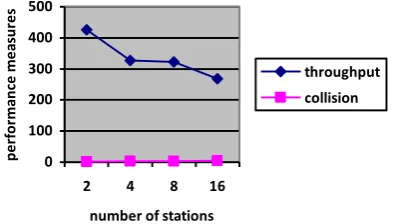
(i) The DCF scheme performs well for transmitting best-effort packets in small-size networks [11]. But, as the number of active stations grows high, the performance degraded. Before that DCF doesn’t suffer from this problem, but now as more use wireless connections, this has become a constraint. The main reason for degrading performance is heavily increased collision rate due to more number of stations as shown in fig.2.
(ii) The above constraint results fallen apart in network throughput as shown in fig.2.
(iii) Third constraint of DCF is that it results in large delay with heavy traffic load.
0 100 200 300 400 500
2 4 8 16
number of stations
p
e
rf
o
rma
n
ce
me
as
u
re
s
throughput collision
Fig.2. Average no. of collisions and average throughput in DCF at 11 Mbps
In the above figure as the number of stations is getting doubled average number of collisions is also increases. Similarly, average throughput is falling down with the
number of stations. Thus the IEEE 802.11 standard’s DCF is not suitable to be used for resolving contentions as the network size grows.
3.
VARIOUS
BACKOFF
ALGORITHMS
After DCF, to overcome its limitations mainly high collision rate, many MAC schemes have been proposed some of which are based on contention window (CW) like DCF:
3.1
Binary
Exponential
Back
off
Algorithm
Although BEB is widely used in many contention based MAC protocols for its simplicity and good performance is proposed in, it suffers from both fairness and efficiency. In BEB each station resets its CW size to the minimum value after a successful transmission, and doubles its CW after a failed transmission. Therefore, it might be quite likely that a node that has gained the channel and transmitted successfully will gain the channel in the following channel contention. The worst-case scenario is that one node monopolizes the channel while other nodes are completely denied channel access. The BEB mechanism tends to favor the last successful transmitter and other nodes do not change their back off intervals. On the other hand, BEB is also diagnosed with low efficiency when there are many active nodes and hence severe contention for the channel. Analysis has shown that after reaching its peak, the aggregate throughput decreases along with input traffic; also, the aggregate throughput decreases with the number
of active stations under saturated status
.
The BEBoperation can be summarized by the following set of equations
(i) With increase in the traffic load, the number of contenders is increasing causing more interference and throughput performance degraded.
3.2 A multiplicative increase and linear
decrease
[image:2.595.92.289.567.679.2]mechanism, but it also introduces a new problem, namely, the back off interval migration problem. The MILD operation can be summarized by the following set of equations.
Where xpacket is the back off interval value included in the
overheard packet
4. PROPOSED SENSING BACK OFF
ALGORITHM
In SBA back off mechanism, nodes sensing successful packet transmissions decrease their back off intervals by α .the transmitter and receiver of each successful transmission should multiply their back off interval by θ all active nodes sensing successful transmission are required to decrease their back off interval by β and transmission time is given by γ is proposed in [5]. Compared with BEB mechanism this “sensing “mechanism provides much better fairness performance. It also avoids the back off interval migration problem of MILD mechanism [5], since the copy mechanism is not used. When its parameters are optimized, the SBA mechanism operates at, or close to. The optimum operation point of back off interval, supporting maximum channel throughput with fair access to active node on a shared channel. Furthermore, the operation of the SBA mechanism does not require the knowledge of thenumber of active nodes in a network .performance comparison of DCF and SBA is shown in Fig.3. The SBA operation can be summarized by the following set of equations
x←min (α.x ,Bmax) upon failed transmission at sender
x←max(x-β.γ,Bmin) upon sensing successful packet at
neighbours
x←max(θ.x,Bmin) upon successful transmission at sender
and reciever
5. IMPLEMENTATION OF SBA
Increment factor is alpha = 1.2 i.e. CW = CW*1.2
Decrement factor is by one step i.e. CW = CW - 1 CW will be made and back off slots will be chosen from CW
Step0: set CW to initial value
Step1: calculate number of back off slots from CW
Step2: while back off time is not equal to 0 do
for each time slot
if channel is idle then BO = BO – 1
if channel is idle for more than DIFS then
send the packet
if transmission of packet is successful at sender and receiver
then decrement size of CW by a decrement factor
CW = CW*theta
where theta is less than 1, theta = 0.93
elseif node senses successful transmission at neighbors
then decrement size of CW by a decrement factor
CW = CW – beta*gamma
where beta = 0.8
where gamma is transmission time of a packet
elseif transmission is unsuccessful and collision occurs
then increment CW size by an increment factor of the BO algorithm employed
CW = CW*alpha
where Alpha =1.2
[image:3.595.343.525.511.692.2]stop
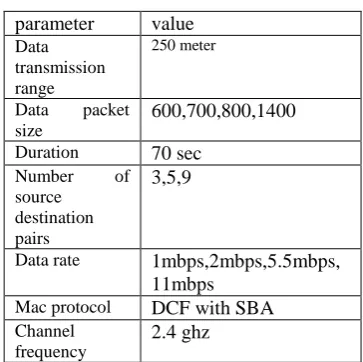
Table I: Simulation Parameter
parameter value
Data transmission range
250 meter
Data packet size
600,700,800,1400
Duration 70 sec
Number of source
destination pairs
3,5,9
Data rate 1mbps,2mbps,5.5mbps, 11mbps
Mac protocol DCF with SBA
Channel frequency
6.
PERFORMANCE ANALYSIS
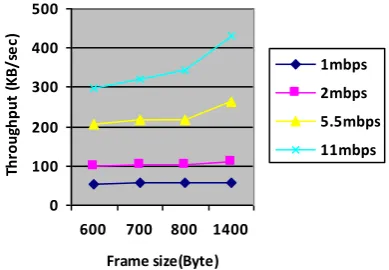
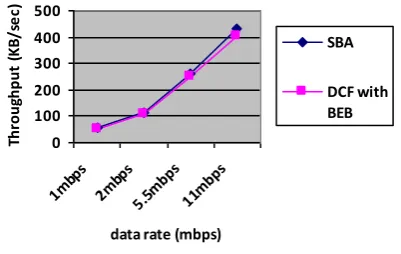
[image:4.595.341.536.88.223.2]In this section, we present the simulation results of the SBA. The simulation is performed using NCTuns [12] the standard MAC protocol has been changed to implement the modified back off algorithm. simulations are performed on a Linux platform using NCTuns [12].In Table I simulation parameter shown where as in Table II physical layer characteristics is shown .Our experiments show that the performance of the SBA is significantly improved when compared with other Algorithm .Fig:3 this graph reveals that with increase in frame size throughput will also increase simulation duration is 70 sec is being considered at 11 mbps data rate throughput is achieved up to the optimum .In Fig:4 the graph is plotted between collision rate and different data rates. With different frame size it has been observed with increase in frame size collision rate decreases.Fig: 5 the performance delay of SBA with 11mbps data rate as shown in graph, increase in data rate leads to minimize delay In Fig:6 this graph plot between SBA and DCF Concluded from the fairness measurement as number of stations effects the fairness where as less number of station give higher fairness.On observation we come to know that SBA give the optimum throughput rather than other back off schemes. In Fig: 7 shows throughput performance of SBA is much better as compared to DCF
Table II Physical layer characteristics IEEE802.11b
characteristics value comments
aSlotTime 20µs Slot time
aSIFSTime 10µs Sifs Time
aDIFSTime 50µs DIFS=SIFS+2*Slot
aCWmin 31 Min contention
window size
aCWmax 1024 Max contention
window size
0 100 200 300 400 500
600 700 800 1400
Frame size(Byte)
Th
ro
u
gh
p
u
t
(KB
/s
e
c)
1mbps
2mbps
5.5mbps
11mbps
Fig:3 Frame size vs Throughput at different data rate
0 1 2 3 4 5
600 700 800 1400
Frame size (Bytes)
col
lis
ion rat
e 1mbps
[image:4.595.342.538.278.370.2]2mbps 5.5mbps 11mbps
Fig:4 Average No. of collision with different data rates with different frame size
0 0.1 0.2 0.3 0.4 0.5
1MBPS 2MBPS 5.5MBPS 11MBPS
data rate (mbps)
av
e
ra
ge
d
e
la
y
(m
se
c)
SBA
Line 2
[image:4.595.94.276.430.588.2]Line 3
Fig:5 Delay performance of SBA at 11mbps
0 0.2 0.4 0.6
2 4 8
number of stations
fa
ir
n
e
ss
i
n
d
e
x
SBA
[image:4.595.340.579.453.568.2]DCF
[image:4.595.348.517.631.710.2]0 100 200 300 400 500
1mbp s
2mbp s
5.5m bps
11m bps
data rate (mbps)
Th
ro
u
gh
p
u
t
(KB
/s
e
c)
SBA
[image:5.595.90.291.87.214.2]DCF with BEB
Fig.7 shows the throughput performance
7. FAIRNESS INDEX
In this section, we evaluate the fairness performance of of SBA and DCF. We use Jain’s fairness index [8] [9] for this measurement. To evaluate this index, we consider the number of active stations to be n, and the proportions of the transmitted frames with respect to the total number of successfully transmitted frames by each station is given by x1; x2; . . . ; xn, respectively. The Jain’s index is then given by the following:
Index value ranges from 0 to1 .closer to zero mean low fairness among nodes. While a value approaches 1 designated a high fairness. we analyze there are some factors that affects the fairness that is the number of stations.
8. CONCLUSION
Observing the increase in the demand of wireless networks, a protocol is needed which resolves the contention with low collision rate and maximize throughput with minimum delay. IEEE 802.11 MAC protocol that is DCF resolves the contention efficiently for smaller networks, but as the network size grows, the above mentioned performance measures degrades. Hence new back off algorithm is proposed which has gained improvement over these performance measures as compared to the previous scheme DCF. .. By stating this, we found SBA outstanding performance over DCF when it is optimized with multi data rate we got optimum and feasible result this proposed algorithm employs a contention window control mechanism to mitigate
intensive collision in a heavily congested environment and also alleviate fairness problem and provide good Quality of service hence improve the performance of network.
9. ACKNOWLEGEMENT
Our thanks to the Shri Govind ram seksaria institute of technology and science experts who have contributed towards development of the paper
10. REFERENCES
[1]Jochen Schiller, Mobile Communications, Pearson Education
[2]Tanen baum A.S computer networks 4th edn
prentice-hall redwood city,CA(2003)..
[3]Chaudet, C., Dhoutaut,D., Guerin-Lassous,I:Performance Issues with IEEE802.11 in Adhoc Networking.IEEE Communications Magazine 43(7),110-116(2005).
[4] IEEE 802.11 Working Group, "Part 11: Wireless LAN Medium Access Control (MAC) and Physical Layer (PHY)Specifications," ANSVIEEE Std. 802.11 (1999).
[5]. Hongi WU, Yi Pan”Medium Access Control in Wireless Network, Nova publishers
[6] V.Bhargavan, A.Demers, S.Shenker,and L.Zhang,”MACAW:a media access protocol for
wireless LANs,”in Proc.ACM
SIGCOMM’94,1994,PP.212-225.
[7] S.XU and T.saadawi”Does the IEEE802.11 MAC protocol work well in multihop wireless adhoc network”IEEE Commun Mag vol.39
[8] R. Jain, the Art of Computer Systems Performance Analysis. John Wiley & Sons, 1991.
[9] Jain,R.,Durresi,A.,Babic,G:Throughput Fairness Index:An Explanation.In ATM forum document number:ATM forum/990045.
[10] IEEE Standard for Wireless LAN Medium Access Control MAC) and Physical Layer (PHY) specifications, ISO/IEC8802-11: 1999(E), August 1999.
[11]Z.Abhichar and J.M chang “CONTI constant-Time contention Resolution for WLAN
[12]Shie-Yuan Wang, Chih-Liang Chou, and Chih-Che Lin ,” The GUI User Manual for the NCTUns 6.0 Network Simulator and Emulator