An Efficient Approximation Algorithm for Max-Cut
Abdullah Malaise
Al-Ghamdi
Deptt of IS, FCIT King Abdul Aziz University,
Jeddah, Saudi Arabia
Pawan Kumar Patel
Deptt of CSE
Indian Institute of Technology, Kanpur, India
Kunal Gupta
Higher College of Technology, Muscat,
Oman
ABSTRACT
Significant research effort has been devoted in the study of approximation algorithms for NP-hard problems. Ap-proximation algorithm for Max-Cut problem with performance guarantee of 0.87856 is long known. In this work we study balanced Max-Cut problem. We give a balancing factor β for given α such that the approximate solution is at least 0.87856 times the optimal α-balanced cut and it is itself β-balanced.
General Terms
Approximation Algorithms.
Keywords
Approximation algorithm, Balancing factor in Max-Cut, Graphs Partitioning.
1.
INTRODUCTION
The paper will work on solving the NP-hard problem, namely the MAX-CUT problem. Good approximation algorithms are known in the literature for this problem. The objective is to adopt an existing approximation algorithm for Max-Cut for a variant of this problem.
A. Max-Cut of undirected edge-weighted graphs
Max-Cut of an undirected edge weighted graph seeks to partition the graph into two sets of vertices so
that the sum of the weights of the edges joining these two sets is maximized.
Several approaches are known for this problem which have different objectives and/or technique:
• Whether an exact solution is desired, an approximation with a performance guarantee is sought or simply a good heuristic method is required.
• Some methods work with the input graph while others reduce the problem to other problem and then solve it.
1) Exact Methods: The naive approach to an exact solution for the Max-Cut problem enumerates the 2n possible cuts of graph, calculates the weight of each cut and note the maximum weight cut, where n is number of vertices in graph.
A heuristic approach can be developed based on the enu-meration technique. In order to compute a close to optimum cut(S, ), we proceed to build S one vertex at a time. We
traverse the binary decision tree in which the two branches denote the two options: to include or exclude a given vertex. Aheuristic function is evaluated based on the current state to decide which branch to traverse. Such heuristics functions are of two-types: upper bound based and lower bound based. In the former case if the currently known weight is greater then the upper bound for a branch, then that branch is abandoned. In the latter case if the currently known weight is lower than the lower bound of a branch, then that branch is pursued and the current value of the weight is updated. Examples of this approach and a variety of bounds used to limit the search in this way are found in [1], [2].
Another approach involves decomposing the problem into some subproblems. In this approach the problem is solved by removing vertices of lower degree. The characteristics of the rest of the vertices are suitably modified to account for the removed vertices. Subsequently enumeration technique is applied to the smaller graph. Gramm et.al. [3] showed that this approach helps reduce the time complexity to
poly(m).2m/3, where m is the number of edges.
2) Approximation methods with performance guarantee:Relaxing the requirement for an exact solution leads to the study of p-approximation algorithms, or polynomial time algorithms that provide a solution that is at least p times the optimal value of a maximizing problem. The constant p is called the performance guarantee of the algorithm.
Sahni and Gonzales [4] presented a 0.5-approximation algorithm for the max cut problem. Their algorithm iterates through the vertices and assigns each vertex to maximize the partial cut that has resulted from the assignment of the preceding vertices.
Goemans and Williamson [5] were the first to apply semidefinite programming to the solution of Max-Cut problem. Algorithm proposed by Geomans and Williamson that has the performance factor p = 0.878 for the problem. Their algorithm uses a randomized rounding of the solution to a non-linear relaxation of the Max-Cut.
conjunctive normal form each containing at most two literals and asks for the maximum number of clause that can be simultaneously satisfied.
Alber, Gramm and Niedermeier [6] have observed that Max-Cut problem is theoretically equivalent to the Max-2-Sat problem, in practice, random Max-Cut problems reformulated as Max-2-Sat problems are generally harder to solve than random Max-2-Sat problems owing to the special structure of the transformed problem.
4) The variant of Max-Cut: In this thesis we study the variant of the Max-Cut problem where the ratio of the two vertex sets of the cut have a bounded ratio. In this version we are given a parameter 0 < α < 0.5 such that α < mm{ |S| / | | , | | / |S| }
2.
Goemans and Williamson’s solution of
MaxCut
Goemans and Williamson gave a randomized approximation algorithm [5] for the Maximum cut problem (MaxCut) and proved that their algorithm gives a cut of size at least 0.875856 times the optimal value. They used vector relaxation and semi-definite programming to solve a quadratic program. They pioneered this technique which was later used in many approximation algorithms. They used randomized rounding technique to compute an integral approximation.
MaxCut of a undirected edge-weighted graph G = (V, E) is defined as to find a set of vertices S such that the sum of the edges between the vertices of S and maximum. The set of edges between the vertices of S and are called a cut. The problem is known to NP-hard.
Goemans and Willaimson’s algorithm computes a cut with expected weight equal to (γ - ϵ) times the optimal cut weight where
and e is any positive scalar. The corresponding semidefinite program can be solved in time polynomial in n (number of vertices) and log l/ ϵ using ellipsoid algorithm [7].
A. The Randomized Approximation algorithm for MaxCut
Given undirected edge-weighted graph with verices x1,..., xn
and nonnegative weights wij = wjifor each edge (i,j) E the
formulation of the problem by the integer quadratic program is as follows.
Maximize
Subject to
Here yi is the indicator variable for vertex xi which is
constrained to either +1 or — 1, indicating whether xi is in S
or in . Solving this integer quadratic program is NP-hard so we consider the relaxation of the scalar variables yito vectors
vi in an n-dimensional vector space. The products yiyj are
replaced by the inner-product vi . vj.
Maximize
Subject to
vi.vi = 1, vi
ϵ
V.Observe that if the solution vectors are restricted to a 1-dimensional subspace, then the vector-program reduces to the original quadratic program. Hence the optimal value of the objective function in the vector program is an upper bound for the optimal value of the original program.
A vector program can be converted to a semi-definite program and can be solved to an arbitrary accuracy ϵ in time polynomial in n2 and log(l/ ϵ). The optimal solution vectors
a1,..., ancan not directly be used to approximate the values for
yi’s. Goemans and Willamson used a randomized technique to
“round” these vectors to a suitable integer in the set {1,-1}. The corresponding semi-definite program is as follows.
Maximize
Subject to
Let θi j denote the angle between the unit vectors ai and aj.
The contribution of ai. ajto the object function increases as
the angle approaches π. Hence we would like to place xi and xj
in different sets of the cut if θi jis large. In the randomized
rounding a random vector r is selected with equal probability in every direction. Then in the approximation solution of the quadratic program yi is set to 1 if and only if ai . r ≥ 0. We
repeat this randomized algorithm a certain number of times to improve the probability of getting a large cut.
B. Analysis of Algorithm
In this section we will show that cut computed by the above algorithm is at least 87.856 percent of the maximum cut in the graph with probability at least 1 — 1/e.
Lemma 1: Let the solution of the vector program be vi = aifor
θi j /π where θi j is the angle between ai and aj.
Proof: Project the randomly generated vector r on the plane formed by aiand aj. The two vertices will be separated if and
only if the projection passes through the arc between aiand aj
or that between -aiand -aj. Since r is uniformly chosen, the
probability of the projection intersecting one of the arcs is
2θij/2π. ■
Lemma 2: Let W be the weight of the cut computed by one run of the above algorithm. Then E[W]>γOptv, where Optvis
the optimal value of the objective function in the vector program and γ = (2/Π)min0 ≤ θπ θ/(1 - cos θ).
Proof: By the definition of γ, for any 0 ≤θ≤π, θ/π ≥γ(1 —cos θ)/2. Using the result of Lemma 1 we have E[W] = ∑i < j wijPr
(xi and xj are separated) = ∑i < j wijθij / π ≥ γ∑i < j (1/2)wij
(1-cosθij) = γOptv . ■
The optimal value after relaxation optvis upper bound of the
MaxCut optmc. So we conclude that E[W] > γ•optv ≥ γ•optmc.
Theorem 1: [5] There is a randomized approximation algo-rithm for MaxCut which, with high probability, achieves an approximation factor of at least γ > 0.87856.
Proof: Let T denotes the sum of the weights of all edges in graph, define a parameter a such that E[W] = aT. Let p
denote Pr[W < (1 — ϵ)aT]. Hence E[W] = aT ≤ p(1 — ϵ)aT + (1 — p)T for any ϵ > 0. Therefore, p ≤ (1 — a)/(l — a + aϵ).
The unfriendly partition of the graph vertices shows that T/2 ≤
optmc.
Hence
T ≥ E[W] = aT ≥ γoptv ≥ γoptmc ≥ γT/2.
Therefore, 1 ≥ a ≥ γ/2. Plugging the lower bound for a in the inequality for p we get p ≤ 1 — (eγ/2)/(1 — (1 — ϵ)γ/2) = 1 — c, where c = (ϵγ/2)/(1 — (1 — ϵ)γ/2). If W’ is the best MaxCut after running the algorithm 1/c times, then Pr[W’ ≥
(1 — ϵ)aT] ≥ 1 — (1 — c )1 / c ≥ 1 — 1/e. ■
3.
EXTENDING THE SOLUTION TO
BALANCED MAXCUT
Given a parameter 0 ≤ α ≤0.5, an α-cut is a cut (V1,V\V1) such that α| V | ≤ | Vi | ≤ (1 — α) | V |. The Balanced Max Cut (BMC) problem is to find the maximum α-cut, for a given α.
In this section we describe a suitable modification to Goemans and Williamson’s randomized approximation algo-rithm to approximate a BMC.This algoalgo-rithm computes a β-cut which is at least 0.87856 of the maximum α-cut where β ≤ α. In particular we show that the proposed algorithm computes a 0.325-balanced cut which is 0.87856 approximation of the maximum bisection-cut (0.5-balanced cut).
Continuing with the Goemans and Williamson formulation, we use variables yito define the cut where yi=1 if the vertex xi
belongs to the first set and yi = — 1 otherwise. Then we have
the following characterization for α-balanced cut.
Lemma 3: Acut is a-balanced cut iff ∑ij yiyj ≤ n2(l — 2α)2.
Proof: Let the cut be (V1, V \ V) where | v1| = n1 ≤ | V \ V1| =
n — n1
so,
If the cut is a-balanced then,
Conversely if n2(l — 2n1/n)2 ≤ n2(l — 2α)2 then, (n1/n)2 — n1/n ≤ α2 — α,
So,
So in any a-balanced cut ∑i j yiyj ≤ n
2
(l — 2α)2. This condition captures the balancing requirement. Adding it to the original conditions in the quadratic program proposed by Geomens Williamson we get the following program.
Maximize
Subject to
Maximize
Subject to
where viare vectors in
ℝ
n. The semidefinite program to solve this vector program is as follows.
Maximize C • Y
subject to Di • Y = di, 1 ≤ i ≤ n,
0 ≤ D0•Y ≤ n2(1 — 2α)2 ,
Here the operator • denotes Hadamard product. The D0 is the
nxn matrix, in which all entries is 1 and Diis also nxn matrix
where (i, i) -entry is 1 and remaining entries are zero. C is the weight matrix o f nxn where (i, j)-entry is —wij.
We use the randomized relaxation technique proposed by Goemens and Williamson to compute an approximate solution for the balanced MaxCut problem.
A. Analysis of Algorithm
Suppose after randomized relaxation the computed values of
yiare . Suppose the resulting cut is β-balanced and let
denote the expected value of β. Then E[ ∑ i j ] = n2 (1-2
)2
Let θijdenote the angle between the vectors viand vj. Then the
probability of xi and xjgetting separated is θij/π.
Pγ[xiand xjare separated] = Pγ[ = —1] =
So the expected value of is E[ ] = 1 —
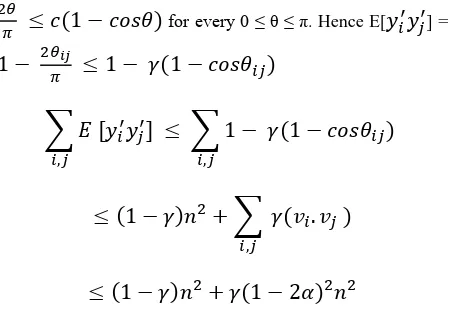
viand vjare unit vectors so the internal product of these two
vectors is vi.vj = cosθij. By definition of γ we have
for every 0 ≤ θ ≤ π.Hence E[ ] =
From the definition of
we have n2(1 —2
)2 ≤ (1 —γ)n2 + γ(1 — 2α)2
.n2. Simplifying this inequality we get
In particular, if α = 0.5, then
=
0.325. The analysis for the expected size of the cut computed by this algorithm remains same as in unbalanced case. Hence the expected size of the computed cut is greater than or equal to γ times the maximum feasible cut. Due to the additional condition all feasible cuts are α-cuts. Hence this algorithm computes a cut which is at least 0.87856 times the maximum α-cut.B. Experimental Results
[image:4.595.317.543.72.227.2]We performed some experiments on small graphs with various values of α. Following table gives the optimal α-cut, computed cut and the balance of the computed cut b.
Table 1. Result Table
Number of
vertices
Α b Optimal α-cut Computed
cut
10 .2
.3 .4 .5
.3 .5 .5 .5
1287 1490 1514 1514
1041 1381 1512 1514
12 .2
.3 .4 .5
.416 .416 .416 .416
2341 2263 2393 2359
14 .2 .3 .4 .5
.428 .428 .428 .428
2967 2967 2793 3015
2072 2783 3015 3052
16 .2
.3 .4 .5
.5 .437 .5 .5
4110 4004 4110 4110
3049 3466 4004 4110
18 .2
.3 .4 .5
.444 .444 .388 .5
4696 4501 4643 4593
3342 4308 4696 4638
20 .2
.3 .4 .5
.5 .5 .5 .45
5955 5878 5847 5724
3880 4989 5669 5955
4.
CONCLUSION
In this work we revisited the Williamson and Geomans’ algorithm for MAX-CUT problem that used semidefinite programming to give a performance guarantee of .878. We presented a modification of their algorithm in which for a
given α, we compute a cut which is at leats 0.87856 of the optimum α-balanced cut and itself is a
balance cut.
5.
REFERENCES
[1] H. Shen and H. Zhang, “Improving exact algorithms for max-2-sat,” Annals of Mathematics and Artificial Intelligence, vol. 44, April 2004.
[2] “Study of lower bound functions for max-2-sat,” American Association for Artificial Intelligence, April 2004.
[3] J. Gramm, E. A. Hirsch, R. Niedermeier, and P. Rossmanith, “New worst-case upper bounds for max-2-sat with application to max-cut,” ECCC, 2000.
[4] S. Sahni and T. Gonzalez, “P-complete approximation problems,” Journal of The ACM, pp. 555–565, 1976. [5] M. X. Goemans and D. Williamson, “Improved
approximation algorithms for maximum cut and satisfiability problems using semidefinite programming,” Journal of the ACM, vol. 42, pp. 1115–1145, 1995. [6] J. Alber, J. Gramm, and R. Niedermeier, “Faster exact
algorithms for hard problems: A parameterized point of view,” Discrete Mathematics, vol. 229, pp. 3–27, 2000. [7] M. Grtschel, L. Lovsz, and A. Schrijver, “The ellipsoid