Munich Personal RePEc Archive
Implementation of environmental
management systems standards:
important factors in corporate
decision-making
Halkos, George
University of Thessaly, Department of Economics
2001
Implementation of environmental management systems
standards: important factors in corporate decision-making
By
Konstantinos I. Evangelinos & George E. Halkos
Department of Environment Department of Economics University of the Aegean University of Thessaly
Abstract
While Environmental Management Systems Standards (EMSS) have been advocated by policy makers and consultants on the basis of a number of benefits associated with their implementation some companies are reluctant to implement them. This paper tests four hypotheses with regard to the significance of a number of factors in a company's decision to implement EMSS. Specifically, it assesses whether a company would be more likely to implement EMSS if its management has a positive perception of environmental issues; if there are pressures on the company to improve its environmental performance; if opportunities arise through its environmental activities; and if it operates in sensitive environmental conditions. For this purpose, Greek companies in the process of EMSS implementation were surveyed and their responses compared with companies that had not decided up to that point to implement the standards. Specific aspects of the hypotheses posed were supported and confirmed a range of factors that are important in a company's decision to implement EMSS.
Key words: ISO 14001, EMAS, Greek industry, decision-making.
An earlier version of this paper has been presented as:
Introduction
An increasing number of companies are implementing EMAS and ISO14001
while a variety of benefits have reportedly been associated with their implementation
(Goodchild, 1998; Evangelinos and Blaza, 1999). However, while there is a number
of companies successfully implementing the standards the overall uptake of the
standards as a percentage of companies in the whole of industry is below 1%.
(European Foundation, 2001). Also, it is widely acknowledged (e.g. Arora and Cason,
1996; Rivera-Camino, 2001; Steger, 2000) that little has been done to investigate the
factors that may affect the decision to implement Environmental Management
Systems Standards (EMSS)1. Arora and Cason (1996) note that economists have
mostly focused on the costs of environmental regulation ignoring the benefits that
companies can get from improving their environmental performance. They suggest
that several stakeholders such as consumers, NGOs, employees and the media
increasingly put pressure on companies to be more environmentally aware.
Rivera-Camino (2001) notes that very little has been written about the variables associated
with the implementation of EMSS. He also suggests that unlike the US, which has
produced most of the literature on EMSS, Europe is lacking in scientific information.
Therefore, there is a lack of understanding of the factors affecting companies
in their decision to undertake voluntarily action with regards to environmental issues
generally and specifically to implementing EMSS. However, if policy makers are to
influence companies to adopt a voluntary stance towards environmental issues they
require a clear understanding of the various factors that may affect a company's
decision to implement EMSS.
The purpose of this study is to assess whether a number of factors are
important in a company's decision to implement EMSS. Specifically, it tests the
relationship between the adoption of a voluntary initiative such as EMSS
implementation and the following factors:
a) Management perception of environmental issues.
b) The pressure on a company to improve its environmental performance defined as
the pressures from final and intermediate customers, local communities,
legislation, non-governmental organisations (NGOs) and the general public.
c) The potential opportunities of a company’s activities with regards to
environmental issues, such as energy and raw material efficiency, waste
minimisation, increased management efficiency, better company image and
relations with local communities, competitive advantage, easier access to financial
markets, lower insurance premiums, better legal compliance and environmental
protection.
d) The potential influence of sensitive environmental surroundings in which the
company operates.
Data collected from two groups of Greek companies: those currently
implementing EMSS, and those that are not implementing the standards.
Next, an overview of EMSS is provided and the discussion supporting each of the
hypotheses is presented. The design of the empirical study is justified, followed by a
discussion of the results and some concluding remarks.
EMSS and important factors for their implementation
Environmental Management Systems (EMS) have been implemented by
the ever increasing importance of a number of environmental issues. EMS can help an
organisation to control the impact of its activities, products and services on the
environment by offering a structured approach to dealing with environmental issues.
During the 1990s efforts were made in order to formalise and standardise the
procedures prescribing an Environmental Management System which resulted in
Eco-Management and Auditing Scheme (EMAS) promoted by EU and the ISO 14001
promoted by the International Standardisation Organisation.
EMSS certification ensures that a company has in place the systems and
procedures that are described by each Standard. They are not themselves a guarantee
of an actual environmental improvement (Klaver and Jonker, 1998). For an effective
implementation of EMSS a company should develop capabilities and support
mechanisms to achieve its environmental policy objectives and targets (Sayre, 1996).
Also a meaningful implementation of the standards requires commitment from the top
level of management to improve environmental performance.
The provisions of EMAS helps the company to (Schalteggar and Burrit, 2000;
Schalteggar et al 1996):
1. Formulate an environmental policy.
2. Conduct an environmental review.
3. Introduce an environmental programme and an environmental management
system.
4. Conduct periodical environmental audits.
5. Produce an environmental statement.
The requirement of EMAS for an externally verified statement that has to be made
The effect of EMSS implementation can be variable depending on the
company that adopts them. For example the implementation of EMSS in a heavy
polluting industry requires considerable effort and resources and is followed by
significant impacts on several sectors of the organisation. On the other hand, less or
non-polluting sectors have to devote fewer resources and face fewer, if any,
implications from EMSS implementation. Thus, there are a number of factors that
directly or indirectly influence the intensity (and the perception) of costs and benefits
of EMSS implementation; such factors can be crucial for the decision to adopt these
management tools. These may be related to company characteristics such as the size
of the organisation, the industrial sector in which it operates, its experience on other
management systems and the management perception of environmental issues or may
be related to factors external to the company such as the pressures the company
experience from various stakeholders to improve its environmental performance and
the opportunities that a company faces from its activities related to environmental
issues.
Below, key issues from the literature review are identified, leading to the
proposition of a number of hypotheses on the importance of a number of factors in
companies’ decision to adopt EMSS. Generally though, management perception on
environmental issues has been the focal point in a number of different studies (e.g.
Lindell and Kargozoglu, 2001; Goodchild, 1998; Steger, 2000). The pressure from a
number of stakeholders/ issues and primarily from legislation on companies to
improve their environmental performance has been documented as an important factor
in companies’ decision to undertake environmental measures (Business in the
Environment, 1998). Also, opportunities from increased efficiency of internal
be proactive on environmental issues (Diller, 1997; Grimshaw et al, 1998) The local
environmental conditions within which companies’ operate have not been examined
before but the following analysis suggests that it could potentially play and important
role.
The examination of the above-mentioned factors specifically in the context of
EMSS aims to highlight the important factors in the decision to implement the
standards. This in turn would provide policy makers with useful insights on the
‘pressure points’ that should be influenced in order to increase the uptake of the
standards. This would be particularly important for Greek environmental policy,
described as normative, rigid and legalistic as well as for the awareness of
stakeholders which while increasing, is still at a low level (Getimis and
Giannakourou, 2001).
The approach to this research is also innovative in that it compares companies that
have implemented EMSS with those that have not. Steger (2000) stresses that only
very few studies have looked at companies that lack EMS altogether.
Management Perception
There are indications that positive management perception of environmental
issues could be of great importance in the decision to pursue EMSS implementation.
A number of reasons could deter a manager from implementing EMSS. Firstly, the
voluntary character of the initiative combined with possible relations of mistrust with
regulators and administrators in the past (due to a long history of command and
control regulation) could cause reluctance to adopt any of the schemes. Similarly, a
implementation would not be encouraged if management treated environmental
considerations as a threat rather than an opportunity.
The cost of implementation, particularly when it is excessive (or is perceived
as such), is certainly an important factor for every manager to consider2. In this case a
profit maximising organisation is not likely to implement a voluntary scheme unless
the government or other agencies support it financially. Alternatively, the benefits can
outweigh the costs but sometimes their significance may be overlooked. Specifically,
while most costs are payable immediately, most benefits would not be realised until a
certain period after the implementation (Steger, 2000). Furthermore, since some of
these benefits are of a preventative nature and intangible, they may be underestimated.
This is due to the fact that companies' accountancy systems do not make provision for
the inclusion of these preventative benefits and thus they cannot be entered on the
books and be offset against some of the costs of EMSS implementation3.
Additionally, managers may fail to appreciate the full extent of the effects
following EMSS implementation. Goodchild (1998) found that the perceived benefits
that had driven companies to certification and those actually experienced during the
first year of implementation were different. This gap between the expectations and the
results could cause frustration for those companies currently implementing the
standards and seeing their expectations unfulfilled, while also making other
companies reluctant to proceed.
All the issues presented above could deter managers from implementing a
standard that could otherwise be beneficial both for their company and the
environment. However, a positive perception of management towards environmental
2 In many instances EMSS can be more costly than the potential benefits.
3 Here benefits include a reduced risk both for liabilities and to the environment, organisational
issues could overcome these problems and facilitate a decision to voluntarily deal
with environmental issues.
In conclusion, the first hypothesis to be tested (H1) is that the management of
companies implementing the standards have a more positive perception towards
environmental issues, than companies not implementing the standards.
Pressure on companies
Companies are under increasing pressure by various stakeholders in order to
improve their environmental performance. While different companies seem to be
subjected to different kinds of pressures, responding to that pressure can be a matter
of survival for the companies in question. For example, a company experiencing
problems with local communities would have to take steps in order to improve its
environmental performance as well as towards communicating these improvements to
the local community. That would allow the company to obtain what is called as a
'social licence to operate' or in other words, the approval of its conduct by the local
community.
Similarly, companies increasingly require their supply chain customers to
regulate and monitor their own environmental conduct. Kloepfer (1997) and Voien
(1998) claim that there are indications that EMSS implementation may become a way
for suppliers to diffuse the pressure from their customers. Non Government
Organisations NGOs increasingly demand better environmental performance. Under
mounting pressure to modify their practices, some companies may use a voluntary
tool, through which they will show their commitment to continuing environmental
continue and therefore implementing EMSS may be used by proactive companies
with a long-term vision who want to ensure that they are prepared for the future.
To summarize, the second hypothesis (H2) to be tested is that companies
implementing the standards are under more pressure from a number of
stakeholders/issues to improve their environmental performance compared with those
companies currently not undergoing this process.
Opportunities
Porter and van der Linde (1995) suggest that companies' activities with regard
to environmental issues may result in the introduction of innovative approaches which
could help in the reduction of energy and raw material usage and in waste
minimisation, thus achieving both environmental and business benefits. On the other
hand, Wally and Whitehead (1994) claim that these so called win-win strategies could
only be the exception rather than the rule. Whether many or few though, there are
indications that the ‘plan, do, check, rethink’ approach of EMSS as well as
involvement of all personnel from the top down is ideal for the sparking of innovative
win-win strategies4. Thus, companies foreseeing opportunities for their company in
this area may be more prone to implement the EMSS.
Amongst the most important opportunities arising from companies’ activities
with regard to environmental issues is the creation of a green profile; such a profile
could appeal to both internal and external stakeholders. The former refers to
employees whereas the latter includes customers, local communities, shareholders,
regulatory bodies, financial institutions and insurers. Public surveys demonstrate a
demand for green products (ENDS 1998). However it is not clear whether these
opportunities would make companies keener to implement EMSS.
Legal compliance is at the top of managers' agendas. In a survey on 'Green
Business Clubs' legal compliance issues were the most significant among those issues
for which companies sought practical help (Business in the Environment, 1998). It is
also a milestone requirement of ISO14001 and EMAS systems, which guarantee the
level of environmental improvement required by legislation. In fact, EMSS are
designed to help companies to proceed beyond compliance with appropriate laws. To
this extent, they reduce the possibility of non-compliance as well as the risk of
liabilities (Diamond, 1997).
This discussion leads to the third hypothesis (H3) which will test whether
companies deciding to implement the standards experience more important
opportunities due to their activities with respect to the environment compared to
companies that have not decided to implement the standards.
Local environmental conditions
It was previously mentioned that a company can be subjected to pressure from
local communities with regard to its environmental performance. Thus, when a
company operates close to an urban zone and is considered as a polluter, there is a
possibility that local communities will react negatively to its operation. That could be
especially true if there are indications or evidence that the company is breaching
environmental regulations. However, even in those cases that there is no breach of
environmental regulation a company would have to earn the trust of the local
community that it is environmentally responsible.
Similarly, when a company operates close to an area of sensitive
environmental conditions, it may be subjected to special regulatory requirements and
restrictions with regard to its operations. Indeed, there is specific Greek and EU
regulation5 governing the provisions for a company applying for permission to
operate or to expand. This regulation may also ban specific activities when the nature
and impact of the operations would be incompatible with the surrounding
environmental conditions. Additionally, and apart from the regulators, a company's
operations may be under scrutiny by NGOs, the media and others.
In each of these cases where a company is operating in sensitive
environmental conditions (whether an urban zone or an area of special natural beauty)
it may decide to diffuse any pressure or the potential for conflict with regard to its
operations. The company may achieve this by showing its commitment towards
environmental issues through the implementation of a voluntary standard such as
EMSS. This could help the company in question to further regulate its environmental
impacts and communicate these improvements to relevant stakeholders.
The fourth hypothesis (H4) will test whether companies deciding to implement
EMSS are more likely to operate in what they would consider as sensitive
environmental conditions compared to companies that have not decided to implement
EMSS.
resulted in process innovation with both environmental and economic benefits.
5 The EU regulation 85/337/EEC later modified to 97/11/EC provided the basis for the national
Empirical Application: The case of Greece
In order to test the above-mentioned hypotheses, two groups of companies
were surveyed6. The first group of companies was quite straightforward to select. A
joint project of the EU and the Greek Ministry of Development taking place at the
time was the first attempt to promote EMSS implementation widely and all companies
participating to this project were targeted. This group consisted of 101 companies and
received a questionnaire during March 2000. By the end of June, 84 responses had
been received.
The selection of the second group of companies was not so clear-cut and a
number of different options were considered at the time. In order to conduct an
accurate comparison it was thought very important to target companies that while not
yet having decided to certify to an EMSS nevertheless were closely involved in
environmental issues. Thus, the second group surveyed consisted of those companies
that in the latest census of Greek industry (held by the Greek National Statistical
Service) had conducted environmental expenditures (capital or current). This is not to
claim that companies that had not conducted environmental expenditure could not
implement the Standards in a way that could make both business and environmental
sense. However, companies would normally conduct environmental expenditures
either because it is required by law or because they are proactive7. By incorporating
the criterion of environmental expenditures all Greek industry with a significant
environmental impact, as defined by current environmental legislation, was targeted.
The selection of these two groups allowed to compare the whole of the Greek industry
that had decided to implement the standards with those that had not come to such a
6 The methodology used for the data analyses is based on similar comparative studies such as Lindell
and Karagozoglu (2001) and Montabon et. al. (2000)
7 In the cases where companies were proactive it would be interesting to investigate and identify why
decision. The second group consisted of 392 companies and more than 50% replied to
this survey which was also conducted during the spring and summer of 2000.
While it is inevitable that non-response bias will exist, the high response rate
ensures that it will be kept to a minimum. In order to avoid any bias associated with
the design of the questionnaire, the questions for the hypotheses testing were worded
and sequenced in exactly the same way in the two questionnaires used. Both groups
surveyed cover the main industrial activities in Greece. Specifically, the group of
companies surveyed that were perceived as implementing the standards were drawn
mainly from the following industries: food and beverages 19%, production of metallic
products 17%, production of chemicals 15%, production of non metal products 6%,
textile industry 6%, production of furniture 3%, production of equipment 2% and
others. Similarly, the group of companies surveyed that was not implementing the
standards came from the following industrial sectors: food and beverages 34%,
production of chemicals 11%, production of non-metal products 13%, textile industry
6%, production of furniture 3% and others.
Results and Discussion
The first set of questions of the survey aimed to identify the company's view
on a number of key issues with respect to the environment. The respondent was asked
to state the company's agreement or disagreement with a number of statements. The
statements were chosen so as to provide indications of management perception of the
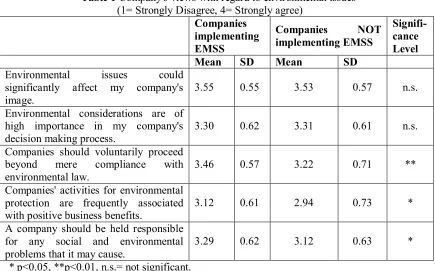
environment. The results are outlined in the following table8:
8 Due to unknown population variances independent sample t-test was used to obtain the results of the
Table 1 Company's views with regard to environmental issues (1= Strongly Disagree, 4= Strongly agree)
Companies implementing EMSS
Companies NOT implementing EMSS
Signifi-cance Level
Mean SD Mean SD
Environmental issues could significantly affect my company's
image. 3.55 0.55 3.53 0.57 n.s.
Environmental considerations are of high importance in my company's
decision making process. 3.30 0.62 3.31 0.61 n.s. Companies should voluntarily proceed
beyond mere compliance with
environmental law. 3.46 0.57 3.22 0.71 ** Companies' activities for environmental
protection are frequently associated
with positive business benefits. 3.12 0.61 2.94 0.73 * A company should be held responsible
for any social and environmental
problems that it may cause. 3.29 0.62 3.12 0.63 * * p<0.05, **p<0.01, n.s.= not significant.
No statistically significant differences were identified for the two first
statements. Thus, there was not enough evidence to support the hypothesis that
managers implementing the standards agree more strongly with the statement that
environment issues could affect their company image. Similarly, there were no
differences detected in the statement that environmental considerations are of high
importance in their company's decision-making process.
However, there were statistically significant differences which supported the
hypothesis that companies implementing the standards agreed more strongly with the
statement that 'companies should voluntarily proceed beyond mere compliance with
environmental law'. While it could be maintained that such a finding should not come
as a surprise, and it should be self-evident since both ISO14001 and EMAS require
companies to proceed beyond mere compliance with environmental law, we believe
that this is an important finding. That is because companies could choose to
the standard requiring continual improvement beyond compliance with environmental
law. There has been significant debate over the possibility of the standards to be
abused since companies set their own objectives of continual improvement which
could be significantly low (Klaver and Jonker, 1998; Burdick, 1997). These findings
suggest that Greek companies implementing the standards believe that companies
should proceed beyond mere legal compliance. (This belief is stronger compared to
companies that are not implementing the standards.) While there is no measure as to
how much beyond legal compliance the companies would proceed, since the
statement was made irrespective of their involvement with the standards, we have no
reason to believe that it is not genuine and significant.
Another statement where statistically significant differences between
companies implementing and not implementing the standards were identified, was in
the belief with regards to win-win strategies. Specifically, companies implementing
the standards were found to more strongly believe that environmental protection
activities are frequently associated with positive business benefits.
As far as the last statement is concerned, the answers of companies
implementing the standards indicate that these managers believe more strongly in the
environmental and social responsibilities of their company. This is in line with
companies' answers with regard to whether companies should proceed beyond mere
compliance with environmental law, although the last statement refers to social
factors as well. To this end, there are indications that companies implementing the
standards would probably be more sustainable in that they are more willing to
undertake responsibility for the social as well as environmental consequences of their
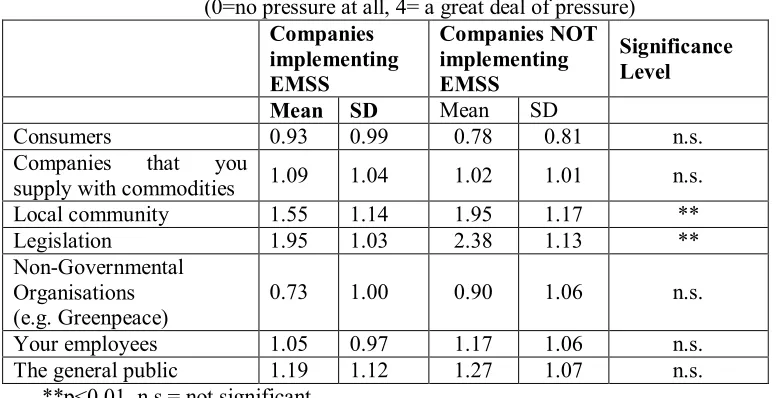
The second set of questions intended to identify whether companies
implementing EMSS are under more pressure to improve their environmental
performance compared to companies that do not. It also intended to highlight the
stakeholders or issues that exercise the greatest pressure: consumers, companies that
buy intermediate products, the local community, legislation, Non-Governmental
Organisations, employees and the general public. Different statements describing the
pressure a company has sustained from stakeholders are given starting from 'A great
deal of pressure' up to 'No pressure at all'.
Table 2 Pressure on company to improve its environmental performance (0=no pressure at all, 4= a great deal of pressure)
Companies implementing EMSS
Companies NOT implementing EMSS
Significance Level Mean SD Mean SD
Consumers 0.93 0.99 0.78 0.81 n.s. Companies that you
supply with commodities 1.09 1.04 1.02 1.01 n.s. Local community 1.55 1.14 1.95 1.17 ** Legislation 1.95 1.03 2.38 1.13 ** Non-Governmental
Organisations
(e.g. Greenpeace) 0.73 1.00 0.90 1.06 n.s. Your employees 1.05 0.97 1.17 1.06 n.s. The general public 1.19 1.12 1.27 1.07 n.s.
**p<0.01, n.s.= not significant
The two areas where companies' answers differed significantly were
legislation and local communities. Quite surprisingly though, in both these areas
companies that were not in the process of EMSS implementation reported being under
the highest pressure. This is a very interesting finding, contradicting the hypothesis
that companies implementing the standards are likely to be under more pressure
compared with companies that do not. The implications of this finding are more
interesting when considering that companies that have decided to implement the
[image:17.595.105.493.321.520.2]the standards had helped companies to deal with any pressure experienced and would
explain why they experienced less pressure than other companies. However since this
is not the case, one possible explanation is that there is a different mindset between
companies which are implementing the standards and those which are not, in that the
former do not perceive the requirements of law and of local communities as pressure.
Such an explanation is also in line with the fact that companies implementing the
standards agreed more strongly with the statement that they should voluntarily
proceed beyond legal compliance. In fact they may have already done so or if not,
they are probably planning to do so. If a company has proceeded beyond legal
compliance or has such plans, the current standard of legal requirements is unlikely to
be considered too high or as exerting too much pressure.
Similarly, since companies implementing the standards agreed more strongly
with the statement that companies should be held responsible for any social and
environmental problems that they may cause, they are more likely to have established
better relations with local communities than other companies. Their higher level of
responsibility seems to be associated with lower levels of pressure from local
communities.
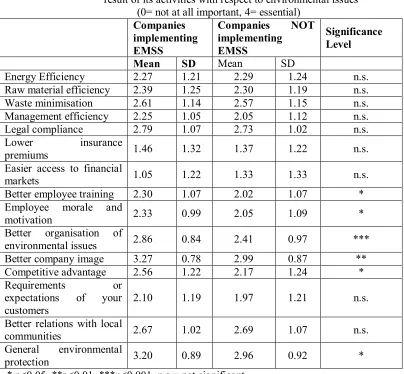
The third set of questions aimed to assess the importance of opportunities
arising for companies as a result of their environmental activities. The questionnaire
listed a range of possible opportunities for companies, which were to be ranked on a
scale from 'essential' to 'not at all important'. The areas listed are as follows:
- energy efficiency, - raw material efficiency, - waste minimisation,
- increased employee morale and motivation, - better organisation of environmental issues, - better company image,
- competitive advantage,
[image:19.595.97.501.201.575.2]- meeting of customers' requirements/expectations, - better relations with local communities and - environmental protection
Table 3 Importance of opportunities arising for the company as a result of its activities with respect to environmental issues
(0= not at all important, 4= essential)
Companies implementing EMSS
Companies NOT implementing EMSS
Significance Level
Mean SD Mean SD
Energy Efficiency 2.27 1.21 2.29 1.24 n.s. Raw material efficiency 2.39 1.25 2.30 1.19 n.s. Waste minimisation 2.61 1.14 2.57 1.15 n.s. Management efficiency 2.25 1.05 2.05 1.12 n.s. Legal compliance 2.79 1.07 2.73 1.02 n.s. Lower insurance
premiums 1.46 1.32 1.37 1.22 n.s. Easier access to financial
markets 1.05 1.22 1.33 1.33 n.s. Better employee training 2.30 1.07 2.02 1.07 * Employee morale and
motivation 2.33 0.99 2.05 1.09 * Better organisation of
environmental issues 2.86 0.84 2.41 0.97 *** Better company image 3.27 0.78 2.99 0.87 ** Competitive advantage 2.56 1.22 2.17 1.24 * Requirements or
expectations of your
customers 2.10 1.19 1.97 1.21 n.s. Better relations with local
communities 2.67 1.02 2.69 1.07 n.s. General environmental
protection 3.20 0.89 2.96 0.92 * * p<0.05, **p<0.01, ***p<0.001, n.s.= not significant
Significant differences were identified for the areas of better employee
training, better organisation of environmental issues, better company image,
competitive advantage and general environmental protection. Specifically, companies
that implement the standards report experiencing more important opportunities in
considered the impact of their environmental activities on their image, their
competitive advantage and the general environmental performance to be amongst the
most significant opportunities presented.
As was previously discussed, companies not implementing the standards were
found to be under more pressure to improve their environmental performance from
legislation and local communities compared to companies implementing the
standards. However, no significant differences were found with regard to companies'
answers in these areas (legal compliance and relations with local communities) about
the opportunities likely to be experienced as a result of their activities with regards to
the environment. This indicates the existence of a different mindset between
companies which implement the standards and take voluntarily action with regard to
environmental issues compared to non implementing companies which do not take
voluntary action. The latter seem to be subjected to greater pressure by legislation and
local communities without being able to recognise any opportunities for their
company in these areas. In a sense, the calls of legislation and local communities for
better performance are depicted as a potential cost or something to be resisted rather
than as a potential benefit or opportunity.
The fourth set of questions asked companies to indicate the sensitivity of the
environmental conditions within which their company operates in a range of answers
between 'very sensitive' to 'not sensitive at all'. Of those companies implementing
EMSS, 40% answered 'sensitive' and another 14% answered 'very sensitive'. When
these companies were asked how important the local environmental conditions were
in their decision to implement the standards, 44% answered that they considered it as
companies replied that it was not very important (36%) and not important at all
(12%).
Companies that were not implementing the standards gave similar pattern of
answers with regards to the sensitivity of the environmental conditions in the area
within which they operate. Specifically 36% answered that they were operating in
'sensitive' environmental conditions and another 22% in very sensitive environmental
conditions. Overall, there were not enough evidence to support the hypothesis that
companies operating in what they would consider as sensitive environmental
conditions would be more likely to implement EMSS. However, since more than 50%
of the companies implementing EMSS considered it to be an important or very
important factor, this indicates that it is a significant factor although not critical in
companies’ decisions. Thus, a possible explanation could be that the companies
would not implement the standards only on the basis of their assessment of the local
environmental conditions but this factor may be more significant when it is
considered in combination with other significant factors previously discussed.
Conclusions
This paper tests four hypotheses with regard to the significance of a number of
factors in a company's decision to implement EMSS. Specific aspects of the
hypotheses posed were supported and confirmed a range of factors that are important
in a company's decision to implement EMSS. Specifically, managers implementing
the standards, compared with those that were not, believed more firmly that
companies should proceed beyond mere compliance with environmental law, that
business benefits are frequently associated with environmental ones and that
companies should be held responsible for any social and environmental problems that
normally claim to be under less pressure from law and local communities. Lastly,
these companies would recognise more opportunities, (such as for a greener image
and a competitive advantage) arising from their activities with regard to
environmental issues.
Overall, there are strong indications that companies implementing the
standards have a different mindset with regard to environmental issues. In other
words, they are more likely to treat environmental issues as opportunities rather than
as threats to their business. Similarly, they recognise the environmental
responsibilities for their companies while being willing to deal with them in a
strategic and proactive way. On the other hand, companies that have not decided as
yet to implement EMSS perceive their environmental responsibilities as pressure and
a potential threat to their business while their response is reactive and only short-term.
The implications of these findings are important since policy makers will be
provided with better insights into those factors critical in a company's decision to
implement EMSS. Should they decide to promote the standards they could include
these factors within their decision making process.
These results are representative of Greek industry and would be of particular
interest to identify whether similar findings may be applicable in different EU
countries as well. That could result from the fact that the regulatory framework, as
well as the market conditions, are increasingly becoming level within the EU.
However further research would be required to confirm these claims and these
findings could form the baseline in designing such research.
References
Arora S, Cason T. 1996 Why Do Firms Volunteer to Exceed Environmental Regulation? Understanding Participation in EPA’s 33/50 Program, Land Economics, 4: 413-432
Burdick D, 1997 Industry Cases and Practices: A Recent Survey of Benchmarking Corporate Perceptions of ISO14000 Benefits. In Moving Ahead with ISO14000
Marcus P, Willig J (eds). Wiley
Business in the Environment 1998 Green Clubs surveyed. Business in the Environment Issue 12, Summer
Diamond C. 1997 Industry Cases and Practices: Voluntary Environmental Management System Standards. In Moving Ahead with ISO14000 Marcus P, Willig J (eds). Wiley
Diller M J. 1997 ISO 14001 Certified: To Be or Not to Be…, Chemical Engineering Progress, 11: 36-9
ENDS. 1998 Market advantages for ethical businesses. ENDS report 276
Evangelinos IK, Blaza A. 1999 Environmental Management Systems Standards- Achieving Greater Credibility Through Greater Visibility of their Outputs. Conference Proceedings. 6th International Conference of Environmental Science and
Technology, Samos, Greece.
European Foundation 2001 Design for Sustainable Development: The success factors,
European Foundation for the Improvement of Living Conditions, Luxembourg
Getimis P, Giannakourou G. 2001 The Development of Environmental Policy in Greece, In eds. Heinelt, H Malek, T Smith, R and Toller, A E European Union Environment Policy and New Forms of Governance, Ashgate Publishing, Aldershot
Goodchild E. 1998 The Business Benefits of EMS Approaches Conference Proceedings. The Eco-Management and Auditing Conference, July 2nd and 3rd University of Sheffield, UK
Grimshaw C, Howard M, Willmott M. 1998 The Responsible Organisation. The roles and responsibilities of the Big Citizens of the 21st Century. The future foundation. A
report commissioned by BT
Klaver J, Jonker J. 1998 The significance of recent EMS standards as an impetus for improvement. Eco-Management and Auditing 5: 1-5
Kloepfer R. 1997 Will the Real ISO 14001 please stand up. Civil Engineering. 67, 11: 45-47
Montabon F, Melnyk S, Sroufe R, Calantone R. 2000 ISO14000: Assessing Its Perceived Impact on Corporate Performance. The Journal of Supply Chain Management. Spring 2000
Porter M, van der Linde C. 1995 Green and Competitive: Ending the Salemate.
Harvard business review. Sept- Oct: 120-134
Rivera-Camino J. 2001 What motivates European Firms to Adopt Environmental Management Systems? Eco-Management and Auditing 8: 134-143
Sayre, D 1996 Inside ISO 14000: The Competitive Advantage of Environmental Management, St Lucie Press
Schalteggar S, Burrit R. 2000 Contemporary Environmental Accounting: Issues, Concepts nand Prctice, Greenleaf Publishing
Schalteggar S, Kaspar M, Hindrichsen H. 1996 Corporate Environmental Accounting, Wiley
Steger U. 2000 Environmental Management Systems: Empirical Evidence and Further Perspectives. European Management Journal:18, 1: 23-37
Thorsen N. 1997 Cleaner production through environmental management of process innovations. In Environmental Management Systems and Cleaner Production. Hillary R. (ed) Wiley
Voien S, 1998 Environmental Management with ISO14000. EPRI Journal March -April