Munich Personal RePEc Archive
The Nominal Exchange Rate Implication
of VAT Harmonization in EEC
Dai, Meixing
University of Strasbourg, BETA-Theme, France
September 1995
Online at
https://mpra.ub.uni-muenchen.de/13860/
The Nominal Exchange Rate Implication of VAT
Harmonization in EEC
DAI Meixing
*June 1996
Abstract: This paper examines, in a one-good two-country Cournot competition model, the implication of European VAT reform on the nominal exchange rate parities which will be pegged in the third stage of monetary union. As result of the reform, the deutchmark needs to be reevaluated so as to prevent generating systematic external disequilibrium of some other European countries, which is inconsistent with pegging nominal exchange parities of European currencies.
JEL Classification N°: F31
Key words: nominal exchange rate parities, value-added-tax reform, monetary union
I Introduction
Same good can be taxed in different countries at very different value-added-tax (VAT) rates. In
the countries of the European Economic Community (EEC), we have observed large diversity
in the VAT rates and significant changes have been made. Further modification of them is
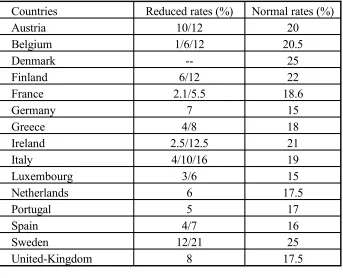
waited in the near future. As we can see from the table 1, actual European normal rates vary
from 15% to 25%.
In France, normal rate came down from 23% (surcharged rate being 33.33%) in 1970’s
to 18,6% actually. French government is now planning to increase it to 20%. Italian reduced
rates 9% and 13% have been respectively increased to 10% and 16% in March 1995. The
government of United-Kingdom has introduced in January 1995 a VAT of 8% instead of 0%
for energy products.
The European Commission is preparing a reform which will harmonize the VAT in EEC
countries. As result of this coming reform, new rates will be between 15% and 20%.
The implication of VAT reform for the EMU is very important. In the third stage of
transition to European unique money, it is required, according to some proposition, to peg
nominal exchange rates of member countries to some fixed official parities. Our beginning
point is that the VAT reform may be inconsistent with the exigency of the Maastricht treaty
which requires stability of nominal exchange parities, convergence of inflation rates and
satisfaction of other criteria by member countries during this third stage.
For the purpose of our study, we use a monetary extension (Dai, 1995) of the Cournot
competition model proposed by Brander and Krugman (1983). Our objective is to give out
clearly VAT reform incidences on nominal exchange rates. For not to complicate the issue, this
one-good-two-country model is suitable. Of course, the nominal exchange rates are influenced
by many factors. It may in particular be influenced by irrational speculation, changes of real
exchange terms induced by these in the taste of consumers and the adopted technology package
We demonstrate clearly the European VAT reform will change significantly the nominal
exchange rates, i.e. the VAT reform is not neutral for the process of the European Monetary
Union. Further implication for the purchasing power parity (PPP) literature is that we might
test econometrically the influence of the VAT reforms in the past periods over the nominal
exchange rates. Certainly, it will not explain totally the empirical deviation of the nominal
exchange rates from its PPP rates1, but it may be an important explication
.
Countries Reduced rates (%) Normal rates (%)
Austria 10/12 20
Belgium 1/6/12 20.5
Denmark -- 25
Finland 6/12 22
France 2.1/5.5 18.6
Germany 7 15
Greece 4/8 18
Ireland 2.5/12.5 21
Italy 4/10/16 19
Luxembourg 3/6 15
Netherlands 6 17.5
Portugal 5 17
Spain 4/7 16
Sweden 12/21 25
[image:4.595.142.485.254.532.2]United-Kingdom 8 17.5
Table 1. The VAT rates in EEC (March 1995)
Source: Investir N°1115, Paris
II. The Model
Let us assume there are two qualitatively identical countries, one ‘‘domestic’’ and one
‘‘foreign’’ and each country has one representative household and one firm producing the
same good as does its foreign rival. The government of each country spends its revenues
(which may come from different kinds of taxes or emission of money) only on the national
1 See Dornbusch (1987a) for a survey of theoretical and empirical issues about PPP. For a recent survey of
market. The money is only held by national residents in each country, so there is no problem of
competition between good and bad currencies.
A. The Problem of Household
It is assumed that the domestic representative household has the following preference
function2:
C M
P c
c
−
1
, (1)
where C, M, P, c represent respectively the real consumption, the nominal quantity of money to
be held by the household for future transactions, the price level of the unique good on the
domestic market and a constant parameter.
The household supplies a fixed quantity of labor, noted N, which is the only factor of
production. The household’s budget constraint is:
PC+ M ≤WN + +Π M−1 −T, (2)
where W N, ,Π ,M−1,T are respectively the rigid nominal wage3, the level of employment
for N ≤ N, the nominal profits, the initial nominal money balances and the lump-sum tax
levied by the government4.
In assuming that the household optimizes its utility function given out in (1) under the
constraint (2), we can get the following demand functions:
M = −(1 c WN)( + +Π M−1 −T), (3)
PC=c WN( + +Π M−1 −T). (4)
2 An interesting extension may be to adopt, rather than this Cobb-Douglas utility function, a more general utility
function.
3 We do not give explicitly the reason of rigidity of the nominal wage. One can refer to Stiglitz (1986) for a
discussion. In their two-country model, Fender and Yip (1994) based the nominal rigidity of wage on the nominal unemployment benefit rigidity.
As the supply of money is perfectly controlled by the central bank under the floating
exchange rate regime, by the equation (3) and the equilibrium condition on the domestic
money market, the nominal revenue of the household during the current period is given by:
WN M T M
c
+ +Π −1 − = −
1 , (5)
which is considered, by the domestic and foreign firms, as given.
Using the asterisks to denote the foreign corresponding variables5 and assuming that the
foreign household has identical preference function and behavior, we can obtain:
M* = −(1 c*)(W N* * +Π* + M−*1 −T*), (6)
P C* * =c W N*( * * +Π* + M−*1 −T*). (7)
The equilibrium condition on the foreign money market implies that the foreign nominal
revenue is given by
W N M T M
c
* * * * *
* * ,
+Π + −1 − = −
1 (8)
which is considered similarly to be given for the firms.
B. The Firm’s Behavior
To simplify the model, we do not introduce transport costs incurred in exporting goods
from one country to the other, and we assume that there is neither trade barriers to international
trade nor constraints of full employment or other economic and policy constraints. The basic
idea is that each firm regards the other country as a separate market. Consequently, it chooses
the profit-maximizing quantity for each country separately. In considering that the other firm
will hold fixed the quantity of its output sold in both countries, each firm has then a Cournot
perception.
The domestic firm will sell a quantity x at price P on the domestic market and a quantity
x* at price P*on the foreign market. The foreign firm will sell a quantity y at price P on the
domestic market and a quantity y* at price P*on the foreign market. They have respectively
an increasing return technology of production of the type:6
x+ x* =N − N,
y+ y* = N* − N*,
with respectively a minimum of labor N, N*necessary in beginning the period production in
each country. We assume in this paper, that there is no free entry and exit7. The fact that the
domestic firm is totally owned by the domestic residents, and the absence of non-monetary
assets imply that there is no problem of international investment in pursuing higher profits.
The value-added tax rate is respectively θ , θ* on the domestic and foreign markets. The
domestic and foreign firms maximize respectively their nominal profit function8 measured
respectively in domestic and foreign currency:
Π = P(1−θ)x+EP*(1−θ*)x* −W x( +x* +N), (9)
Π* ( ) * * * * * *
( ) ( ).
= P − y + − − + +
E P y W y y N
1
1
θ
θ (10)
where E is the nominal exchange rate of foreign currency in terms of domestic currency. It is
given for firms9. Given the domestic government nominal spending G, the domestic central
bank supply of money, and the quantity of good sold by the foreign firm, y, the domestic firm
will perceive the following objective demand curve on the domestic market:
P G c WN M T
x y
= −
+ −
+ ( +Π+ 1 )
, (11)
6 This assumption is introduced to justify the Cournot competition.
7 We can introduce the free entry and exit as Huw D. Dixon does (1994). But the main conclusion will not be very
different.
8 The nominal profits maximization is adopted by d’Apremont , Dos Santos and Gérard-Varet (1989), Dixon
(1994) and other authors. It may be justified by the presence of exogeneously given nominal variables such as wage, public spending and lump-sum tax etc..
9
taking into account (5), it can be written as:
P
x y
= Ω+ , with P P
x y y x ' ' ( ) , = = − + Ω
2 Ω = +G −
cM c
1 . (12)
Similarly, the objective demand for its product on the foreign market can be written as:
P x y * * * * , = + Ω
with P P
x y
y* x*
*' *' * * * ( ) , = = − + Ω 2 Ω * * * * * = + −
G c M
c
1 . (13)
Each firm maximizes its nominal profits with respect to its own quantity decisions in
assuming the quantity decisions of the other as given. This yields the following first-order
conditions:
Πx Px x P W
' = '(1−θ) + (1−θ)− =0, (14)
Πx* EPx* x EP W
' *' * * * *
( ) ( ) ,
= 1−θ + 1−θ − =0 (15)
Πy y P y E P E W *' ' * ( ) ( ) ,
= 1−θ + 1−θ − =0 (16)
Πy* Py* y P W
*' = *'(1−θ*) * + *(1−θ*)− * =0.
(17)
It is easy to verify that the second-order conditions of optimality are satisfied for the firms’
problems.
III. VAT Rates Reform and Nominal Exchange Rate Parity: Implication for European
Monetary Union
We can complete the model with the balance of payment equation under the floating
exchange rate regime. Under the assumption of no capital and labor movement, the balance of
payments, identical to the trade balance, must be in equilibrium:
In using the partial derivatives of prices in (12) and (13), and the trade balance
equilibrium relation (18), form the first-order conditions, the reaction functions of the firms
can be deduced as:
y− x y
− + =
α θ
1 0
2
( ) , (19)
yy* − (x y x)( * y*)x* ,
− + + =
α θ
1 0 (20)
xx* − * (x y x)( * y*)y ,
− + + =
β θ
1 0 (21)
x* − * (x* y*)
− + =
β θ
1 0
2 (22)
to simplify notations, we use α =W β =W
Ω, Ω
* * .
The equations (12-18) constitute the complete model. Before we discuss the implication
of the European VAT reform, we indicate that when the VAT rates are zero, the absolute
purchasing power parity (PPP) is verified in the simple model with EP
P
*
=1. The nominal
exchange rate is determined by the following formula10:
E W
W
= Ω
Ω* * . (23)
From this formula, one can see easily that there is no one-to-one relation between the
money growth rate, inflation rate and exchange rate variation. This is due to the presence of
sticky wages and that public spending is fixed in nominal terms. Money is not neutral in this
model, and fiscal policies can also influence exchange parity. However, the absolute and
relative PPP is verified.
The model with value-added taxes has a unique non trivial solution satisfying the
restrictions 0< x* <1− *
θ
β , 0
1
< <y −θ
α , x>0, y* >0, and compatible with the firms’
reaction functions and the trade balance equilibrium. As x* = y, a modified absolute PPP is
verified, i.e. EP
P y x * * * ( ) ( ) . 1 1 1 − − = = θ
θ Or equivalently, we have
EP P * * . = − − 1 1 θ
θ (24)
If the value-added tax rates are the same in the two countries, the absolute PPP is
verified. If the value-added tax rates are unchanged, the relative PPP is expected to be true.
An intuitive explanation is that firms are interested in (taxes deduced) net prices
measured in same currency. As there is no other constraint limiting arbitrage (entry barriers
combining with macroeconomic asymmetry11), they will make the best quantity decisions so
that the net prices in the same currency are equal in the two countries. In other word, each firm
will try to exploit the higher price in one country until the law of one (net) price12 is applied
and no more profits can be earned in lowing price.
With VAT, the nominal exchange rate can be given as:
E W W = − − Ω Ω ( ) ( ) * * * 1 1 θ
θ . (25)
From (25), if it is admitted that only the domestic VAT rate adjusts, the exchange rate
will vary according to:
∆ ∆ E E ≈ − − 1
2 1( θ) θ . (26)
11
The macroeconomic asymetry is refered to the different nominal wage/agregated nominal demand. Entry barriers can be import or export taxes and transport costs. See Dai (1995) for details.
In the case of Germany, the VAT rate is originally at 15%. If it is increased to 20%, the
deutchmark will need a reevaluation of about 3% vis-à-vis the currency of another country
whose VAT rate is already at 20%. Otherwise, the foreign country must devaluate its currency
in order to prevent the resulting external disequilibrium which can incite speculative attacks. In
the case of Sweden or Denmark, its VAT rate must be reduced to 20%, as the German VAT
rate is increased to 20%, the reevaluation of deutchmark will be about two times as important
as in the precedent case, i.e. approximately 6%.
The effort needed to manage pegged nominal exchange parity may be quite high in terms
of welfare if VAT reform is taking place during the third stage of EMU. Its importance depends
of course the macroeconomic policies used. As the European governments pursue an objective
of inflation rate as required by the convergence criteria of Maastricht treaty, the costs may be
much higher and quickly doubled. That is easy to see. Assume that domestic and foreign prices
are unchanged, i.e. P and P* are constants, from (24), we have:
∆
∆ ∆
E E ≈
−
− + −
1 1
1 1
( ) ( *)
*
θ θ θ θ , (27)
The equilibrating reevaluation of deutchmark will be respectively 6% and 12% in the two
cases considered above.
IV Conclusion
A two-country macroeconomic monetary model with Cournot competition is used here
in order to show the nominal exchange rate implication of the harmonization of VAT rates in
EEC. The result is that major modification of VAT rates in EEC has important influence on
exchange rate parities of European currencies. Policy implication is that the European VAT
reform must be taken before or after the third stage of EMU, otherwise other macroeconomic
disequilibrium is accentuated and speculative attacks are imminent as a consequence of the
VAT reform. The costs of these macroeconomic policies may be very high, and they might
provoke very strong public anti-Maastricht opinions in some EEC countries.
The above interpretation is meanwhile limited as the model is atemporal, without capital
and international capital market, without non-traded goods, and the imperfect competition
introduced is very simple. An extensive welfare analysis is needed in the case where VAT
reform is taking place during the third stage of EMU and macroeconomic policies are taken to
manage the pegged nominal exchange parities between currencies of EEC member countries.
More theoretical and empirical works are necessary to understand the full implication of past
and coming VAT reforms.
Appendix: The Solution of the Model
The reduced model is as follows:
y− x y
− + =
α θ
1 0
2
( ) , (A.1)
yy* − (x y x)( * y*)x* ,
− + + =
α θ
1 0 (A.2)
xx* − * (x y x)( * y*)y ,
− + + =
β θ
1 0 (A.3)
x* − * (x* y*) ,
− + =
β θ
1 0
2 (A.4)
EP*(1−θ*)x* = P(1−θ) .y (A.5)
Note u= v
− = −
α θ
β θ
1 , 1 * , the manipulation of (A.1) and (A.2) gives the following equations:
x y
u y
= − , (A.6)
y x
v x
* *
*
In substituting (A.6) and (A.7) into (A.2) and (A.3), we can obtain:
y x
v x u
y u x v x ( ) * * * *
− − =0, (A.8)
x y
u y v
y u x v y * *
( − )− =0. (A.9)
we can get after simplification:
y
v x
u
v x
( 1 − *)− * =0, (A.10)
x
u y
v
u y
*
( 1 − )− =0. (A.11)
In using (A.10), it follows:
y u v x v x = − * * .
1 (A.12)
In substituting it into the equation (A.11), we obtain:
x u u v x v x v u u v x v x * * * * * 1
1 1 0
2 − − − − = .
With the following transformations:
(1− v x*)2 − −(1 v x*)ux* −u v x x* * =0,
and,
1 2− v x* +vx*−ux*+ux* v x* −u v x x* * =0,
one gets:
(v−u x) *−2 v x* + =1 0,
x v v v u v u v u v u * ( )
= 2 ± 4−−4 +4 = ±− 2
i.e.
x v u
v u v u v u
x v u
v u v u v u
1
2
2 2 2
2
2
2 2 2
1 1 * * ( ) ( ) ( ) ( ) ( ) ( ) ( ) ( ) = , = = , + + − = − − + − +
Using (A.6), (A.7) and (A.12), we can check easily the only good solution is
x y
u v
x v
u u v
y u
v u v
* * ( ) , ( ) , ( ) . = = + = + = + 1 2 2 2
The vector ( ,x x*, ,y y*)=( , , , )0 0 0 0 is also a solution of the model, but it is trivial compared to
the reality of the world economy. In using equations (12-13) and (18), and the above results,
the nominal exchange rate is given by:
E W W = − − Ω Ω ( ) ( ) * * * 1 1 θ θ .
When the VAT rates are zero, i.e. θ θ= * =
0, the non trivial solution is:
x* y
( ) , = = + 1 2 α β x= + β
α α( β )2 ,
y*
( ) .
=
+ α
β α β 2
E W W
= Ω
Ω* * .
References
D’Aspremont Claude, Rodolphe Dos Santos Ferreira and Louis-André Gérard-Varet, 1989, Unemployment in an extended Cournot oligopoly model, Oxford Economics Papers 41, 490-505.
Brander, J. A., 1981, Intra-industry Trade in Identical Commodities, Journal of International Economics 11, 1-14.
Brander, J. A., and P. R. Krugman, 1983, A ‘Reciprocal Dumping’ Model of International Trade, Journal of International Economics 15, 313-321.
Dai, M., 1995, Reexamination of the Purchasing Power Parity (PPP) under Reciprocal Dumping, Working Paper du BETA N°9501, Université Louis Pasteur, Strasbourg, France. Dixon Huw D., 1994, Imperfect Competition and Open Economy Macroeconomics, in eds.
Von der Ploeg ‘‘Handbook of International Economics’’, Blackwell, USA.
Dornbusch, 1987a, Purchasing Power Parity, in eds. John Eatwell, Murray Milgate, Peter Newman, ‘‘The New Palgrave: A Dictionary of Economics’’, The Macmillan Press Limited. Dornbusch, Rudiger, 1987b, Exchange Rates and Prices, American Economic Review 77I,
93-106.
Fender John, Chong K. Yip, 1994, Open economy macroeconomics under imperfect competition: A two-country model, Journal of International Economics 37, 49-63.
Froot and Rogoff, 1994, Perspectives on PPP and Long-Run Real Exchange Rates, NBER Working Paper No.4952, USA.
Helpman, E., 1982, Increasing Returns, Imperfect Markets, and Trade Theory , Discussion Paper, Tel Aviv University.