New Optimized Network Selection Decision In
Heterogeneous Wireless Networks
Mohamed Lahby, Leghris Cherkaoui, Abdellah Adib
Department of Computer Science, LIM Lab.Faculty of Sciences and Technology of Mohammedia B.P. 146 Mohammedia, Morocco
ABSTRACT
The expected growth in radio access technologies (RAT’s) such as wireless technologies (802.11a, 802.11b, 802.15, 802.16, etc.) and cellular networks (GPRS, UMTS, HSDPA, LTE, etc.) requires ef-ficient vertical handoff algorithm. Variety of vertical handoff algo-rithms (VHA) have been proposed to help the user to select dynam-ically the best access network (BAN) in terms of quality of service. The objective of this paper is to provide an optimized network se-lection decision that allow mobile users to choose the BAN with seamless manner and to exploit a minimum of criteria for all traffic classes namely: background conversational, interactive and stream-ing. Our optimized algorithm combines two multi attribute decision making (MADM) methods such as analytic network process (ANP) method to weigh the criteria, and the novel method based on maha-lanobis distance (NMMD) to rank the alternatives.
Keywords:
Heterogeneous Wireless Networks, Network Selection, IEEE 802.21, Multi Attribute Decision Making, Criticality Analysis
1. INTRODUCTION
With the expected growth in radio access technologies (RAT’s) such as wireless technologies (802.11a, 802.11b, 802.15, 802.16, etc.) and cellular networks (GPRS, UMTS, HSDPA, LTE, etc.) two issues are involved. The first issue is how to ensure ubiqui-tous access for the end users, under the principle “Always Best Connected” (ABC) [1] and the second issue is how to select the most suitable network in terms of quality of service. To deal with these issues the network selection decision [2] is intended to keep the connection when the terminal mobile transfers call from one base station (BS) or point of attachment (AP) which is based on one of RAT’s to another base station which based on different RAT’s.
The network selection problem is heterogeneous wireless net-works is complex problem mapped in NP-Hard problem [3], hence it is desirable to use a heuristic algorithm in order to achieve an optimal network selection which can satisfy better trade-off between network conditions, requirements of applica-tions and users preferences.
The network selection depends on multiple handover metrics, from terminal side: battery, velocity, life user preferences, and from the network side: provider’s profile, current QoS parame-ters.
Three issues dominate the network selection which are a) select-ing the appropriate handover metrics, b) identification the most algorithm that exploits these metrics and c) determination the ap-propriate weighting algorithms that allow to weigh each criterion for each traffic classes.
The rest of this paper is organized as follows. Section 2 presents
review of related work concerning these three issues. Section 3 describes Multi Attribute Decision Making methods (MADM). Section 4 presents our optimized network selection algorithm. In section 5, nmerical result and discussion are provided to show the effectiveness of the optimized network selection algorithm. Section 6 concludes this paper.
2. RELATED WORK
Several decision algorithms based on multi attribute decision making (MADM) have been proposed and developed exhaus-tively in the literature to solve the network selection problem. The MADM includes many methods such as analytic hierarchy process (AHP), simple additive weighting (SAW), multiplicative exponential weighting (MEW), grey relational analysis (GRA), and technique for order preference by similarity to ideal solu-tion (TOPSIS). In [4], [5], [6], and [7] the network selecsolu-tion algorithm is based on Analytic Hierarchy Process (AHP) and Gray Relation Analysis (GRA) two MADM methods. The AHP method is used to determine weights for each criterion and GRA method is applied to rank the alternatives. In [8], [9] and [10], the network selection algorithm combines two MADM methods AHP and TOPSIS. The AHP method is used to get weights of the criteria and TOPSIS method is applied to determine the ranking of access network.
In addition, there are several methods used to assign weights for the criteria such as as analytic hierarchy process (AHP), fuzzy analytic hierarchy process (FAHP), analytic network pro-cess (ANP), fuzzy analytic network propro-cess (FANP) and random weighting. Determining the most suitable weights for different criteria for each traffic classes is one of the main problems in the network selection decision. In [11] five weighting algorithms namely AHP, FAHP, ANP, FANP and RW are studied and com-pared for all four traffic classes namely,conversational, stream-ing, interactive and background.
In addition due to the variety of vertical handoff algorithms (VHA) some evaluation models for VHA have proposed in the literature, in [12] the authors compare the performance of five VHA, namely SAW, MEW, TOPSIS, GRA, and UA (Abique’s Algoritm). Each VHA method used the AHP method to get weights of the criteria and the fuzzy logic is applied to build the evaluation scale and compare different handover metrics. Two traffic classes were considered conversational and stream-ing. Each traffic class was associated with six handover metrics namely available bandwidth, bit error rate, delay, security and monetary costs.
namely handoff dropping and call blocking probability. In addi-tion the sensitivity analysis for four traffic classes are presented as follows: the background traffic is sensitive to the ABW, the interactive traffic is sensitive to BER, the conversational traffic and the streaming traffic are sensitive to the NW.
In [14], the author compare the performance of seven VHA based on MADM methods which are SAW, MEW, TOPSIS, ELEC-TRE, VIKOR, GRA and WMC (weighted markov chain). The performance evaluation is focused on four parameters of QoS namely packet delay, packet jitter, the available bandwidth and the total bandwidth. Two different applications were considered: voice and data connections. Each traffic application was asso-ciated with six attributes: available bandwidth, total bandwidth, packet delay, packet jitter, packet loss and cost per byte. In [15] and [16] the authors have proposed a new evaluation model for VHA based on multi criteria evaluation and critical-ity analysis. In one hand the proposed model in [15] allows to evaluate the performance of VHA methods by using the mea-sured values of three parameters namely number of handoffs, handoff delay and computational complexity. In the other hand the proposed evaluation model in [16] is used to evaluate the performance of five MADM methods namely SAW, MEW, TOP-SIS, ELECTRE, and VIKOR. For each MADM method we ana-lyze the performance of five parameters namely available band-width, delay, jitter, packet loss and cost ber byte. However, one of the major limitations of this model is the lack of a weight-ing algorithm which can be used to assign a relative weight to each handover metric by considering each traffic classes. To ad-dress this issue, in [17] the authors have proposed an enhanced evaluation model based on MADM methods and criticality anal-ysis. The enhanced evaluation model is used to evaluate three vertical handover algorithms based on MADM methods namely TOPSIS, GRA and DIA. According to the simulation results, the GRA method is most appropriate network selection algorithm for all traffic classes namely: background, conversational, inter-active and streaming.
In [18], the authors present some researches that have been pub-lished concerning the requirements of vertical handover algo-rithms in heterogeneous wireless networks. The requirements represent the performance metrics which should be used in the network selection decision and which can influence directly the performance of the vertical handover decision. The require-ments include ten parameters such as bandwidth, handoff la-tency, power consumption, network cost, user preferences, net-work throughput, netnet-work load balancing, netnet-work security re-ceived signal strength and velocity. According of this work, there is no vertical handoff algorithm that satisfies all the require-ments, although all vertical handoff algorithms satisfy at least five performance metrics.
However, one of the major weakness of this survey work is that the evaluation of which criteria should be used is not being done on the basis of performance of the algorithms which exploit these criteria. In addition we have three other weaknesses related to all vertical handoff algorithms. The first weakness is related to all vertical handoff algorithms which use the same criteria for each traffic classes, however the metrics should be determined bu the service offered by the network. For example to deliver stream-ing traffic, the identification of criteria based QoS must not only satisfy streaming traffic in terms of reduced end to end delay but must also takes into consideration low bit error rate which is not necessary to deliver background traffic. In a second hand, the weakness is about the majority of the vertical handoff algorithms which introduce redundant criterion due to correlation between theme. The use of unique selection of handover metrics is very important to reduce the computation time in the terminal dur-ing the execution of the vertical handover algorithm, therefore, this will minimize the handover latency. The last weakness con-sider that there is no performance evaluation models which can be used to identify the most appropriate criteria which should be
taken into consideration for the vertical handover mechanism. To cope with these weaknesses, this paper proposes an optimized network selection algorithm which contains two components. The first component is an efficient vertical handoff algorithm which is used to select the best access network. The second com-ponent is the enhancement of the evaluation model proposed in [18] which is applied to identify the criteria based QoS which should be used in the vertical handover algorithm.
3. MULTI ATTRIBUTE DECISION MAKING
3.1 ANP
The Analytic network Process (ANP) is a MADM method, pro-posed by Saaty [19], which extends the AHP approach to prob-lems with dependence and feed beck within clusters (inner de-pendence) and between clusters (outer dede-pendence).
The ANP approach is based on six steps:
(1) Model construction: A problem is decomposed into a net-work in which nodes corresponds to components. The ele-ments in a component can interact with some or all of the elements of another component. Also, relationships among elements in the same component can exist. These relation-ships are represented by arcs with directions.
(2) Construct of the pairwise comparisons: To establish a deci-sion, ANP builds the pairwise matrix comparison such as
A=
x11 x12 . . . x1n x21 x22 . . . x2n
..
. ... ... . .. ... xn1 xn2 . . . xnn
where xji=
1 ifi=j;
1
xij ifi#j.
(1) Elementsxijare obtained from the table 1, it contains 1-9 preference scales.
Table 1. Saaty’s scale for pairwise comparison
Saaty’s scale The relative importance of the two sub-elements
1 Equally important
3 Moderately important with one over another
5 Strongly important
7 Very strongly important
9 Extremely important
2,4,6,8 Intermediate values
(3) Construct the normalized decision matrix: Anorm is the normalized matrix of A(1), where A(xij) is given by, Anorm(aij)such:
aij= xij
Pn i=1xij
(2)
(4) Calculating the weights of criterion: The weights of the de-cision factor i can be calculated by
Wi=
Pn
j=1aij n and
n
X
j=1
Wi= 1 (3)
With n is the number of the compared elements.
(5) Calculating the coherence ratio (CR): To test consistency of a pairwise comparison, a consistency ratio (CR) can be introduced with consistency index (CI) and random index (RI).
Let define consistency index CI
CI=λmax−n
Table 2. Value of random consistency index RI
criteria 3 4 5 6 7 8 9 10
RI 0.58 0.90 1.12 1.24 1.32 1.41 1.45 1.49
Also, we need to calculate theλmax by the following for-mula:
λmax=
Pn i=1bi
n such bi=
Pn
j=1Wi∗aij Wi
(5)
We calculate the coherence ratio CR by the following for-mula:
CR=CI
RI (6)
The various values of RI are shown in table 2. If the CR is less than 0.1, the pairwise comparison is considered accept-able.
(6) Construct the super-matrix formation: The local priority vectors are entered into the appropriate columns of a super-matrix, which is a partitioned matrix where each segment represents a relationship between two components.
3.2 Novel Method based on Mahalanobis Distance
The novel method based on mahalanobis distance (NMMD), al-gorithm belonging to the MADM category, that we developed [20] to select dynamically the best network interface. This algo-rithm is based on mahalanobis distance which takes into account the correlation between variables by which different patterns can be identified and analyzed. The mahalanobis distance between an individual x and a population’s multivariate mean u is com-puted by:
DM(x) = (x−u) T
∗S−1∗(x−u) (7)
WhereS−1is the inverse covariance matrix
The NMMD based network selection consists of the following steps:
(1) Construct of the decision matrix: the decision matrix is ex-pressed as
D=
d11 d12 . . . d1n d21 d22 . . . d2n
..
. ... ... . .. ... dn1 dn2 . . . dnn
(8)
Wheredijis the rating of the alternativeAiwith respect to the criterionCj
(2) Construct the normalized decision matrix: each elementrij is obtained by Max method normalization.
—For benefit attribute, the normalized value ofrijis com-puted as:
rij= dij dmax
j
(9)
wheredmax
j is the maximum performance rating among alternatives for attributeCj(j=1,...,m), anddijis the ac-tual parameter value of a given network.
—For cost attribute, the normalized value ofrijis computed as:
rij= dmin
j dij
(10)
wheredmin
j is the minimum performance rating among alternatives for attributeCj(j=1,...,m), anddijis the ac-tual parameter value of a given network.
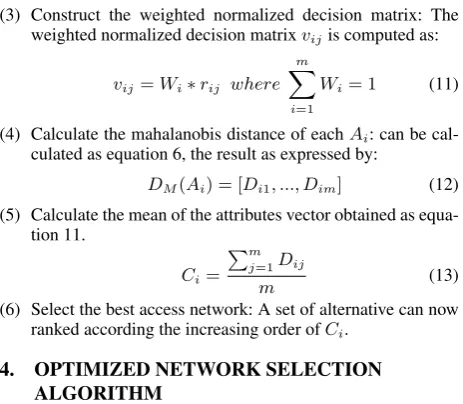
(3) Construct the weighted normalized decision matrix: The weighted normalized decision matrixvijis computed as:
vij=Wi∗rij where m
X
i=1
Wi= 1 (11)
(4) Calculate the mahalanobis distance of eachAi: can be cal-culated as equation 6, the result as expressed by:
DM(Ai) = [Di1, ..., Dim] (12)
(5) Calculate the mean of the attributes vector obtained as equa-tion 11.
Ci=
Pm j=1Dij
m (13)
(6) Select the best access network: A set of alternative can now ranked according the increasing order ofCi.
4. OPTIMIZED NETWORK SELECTION
ALGORITHM
In order to identify the suitable QoS parameters which should be used for vertical handover algorithm, we proposes an optimized network selection algorithm. This one has two components listed below: the first component is an efficient vertical handoff algo-rithm and the second component is the enhancement of the eval-uation model for VHA.
4.1 The Proposed Vertical Handover Algorithm
The vertical handover algorithm combines two MADM methods such as ANP and NMMD. The algorithm assumes wireless over-lay networks which entails three heterogeneous networks such as UMTS, WLAN and WIMAX. The six parameters associated to the three networks are: Cost per Byte (CB), Security (S), Avail-able Bandwidth (AB), Packet Delay (D), Packet Jitter (J) and Packet Loss (L). In the one hand, IEEE 802.21 framework [21] is used in order to collect the QoS parameters such as AB, D, J, and L of the available networks. However, IEEE 802.21 is well known as Media Independent Handover, which designed to support seamless handover among heterogeneous wireless net-works. Fig. 1 exhibits the three levels ANP hierarchy for network selection problem. The level 1 includes three criteria QoS, secu-rity and cost, the level 2 includes four QoS parameters such as AB, D, J and L and the level 3 includes three available networks UTMS, WIFI and WIMAX.
Our vertical handover algorithm consists of the four following steps:
(1) Assign weights to level-1: the ANP method is used to get a weight of the decision criteria of level 1.
(2) Assign weights to level-2: the ANP method is used to get a weight of the decision criteria of level 2.
(3) Assign weights to level-3: the weight vector of each avail-able network is calculated by multiplication of the weight vector obtained in level 1 with the weight vector obtained in level 2.
(4) Select the best access network: the method NMMD is ap-plied to rank the the available networks and select the ac-cess network that has the highest value ofC∗
j(see the steps of NMMD method).
4.2 The Enhancement of The Evaluation Model
Fig. 1. The three level ANP hierarchy for network selection problem
(1) Identification of the evaluation parameters: the evaluation parameters represent the indicators that influence the perfor-mance of vertical handover algorithm and allow to compare between theme. In this study we use two evaluation param-eters namely ranking abnormality and number of hanoffs. The ranking abnormality means that the ranking of candi-date networks change when low ranking alternatives are re-moved from the candidate list, which can make the hanover vertical algorithm inefficient. The number of handoffs repre-sents the number of network handoffs that the terminal mo-bile have performed for a given time period.
(2) Construct the evaluation matrix: the evaluation matrix is the decision matrix that represents the evaluation of each ver-tical hanover algorithmAlgiwith respect to the evaluation parameterPj. The evaluation matrix is expressed as:
EM =
v11 v12 . . . v1m v21 v22 . . . v2m
..
. ... ... . .. ... vn1 vn2 . . . vnm
(14)
Wherevijis the measured value of the vertical handover al-gorithmAlgiwith respect to the evaluation parameterPj. Thevijis obtained from simulating vertical handover algo-rithm by using MATLAB.
(3) Construct the normalized evaluation matrix: in order to con-trol the magnitude of evaluation parameters and to prevent that some of the evaluation parameters can dominate oth-ers, we calculate the normalized evaluation matrix by Max method normalization. Each element dij is computed as equation 8 and 9.
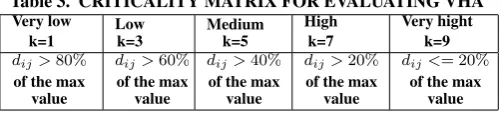
(4) Construct the criticality matrix: according to valuation scale defined in table 3, we analyse the evaluation matrix obtained in second step. the criticality matrixcijis computed as:
cij=k (15)
Where k is obtained from table 3 according to the value of dij
(5) Construct the weighted criticality matrix: we apply the ANP method to weigh each evaluation parameter, the weighted criticality matrixtijis computed as:
tij=wi∗cij where m
X
i=1
wi= 1 (16)
(6) Calculation of the criticality index: the criticality index of each vertical handover algorithmAlgican be calculated as:
CIi= 100∗( m
X
j=1
tij)/n where i= 1, ..., n (17)
n is the maximum valuation level of all parameters. (7) Ranking: A set of vertical handover algorithms can be
[image:4.595.305.556.152.210.2]ranked according to the decreasing order ofCI∗ i.
Table 3. CRITICALITY MATRIX FOR EVALUATING VHA
Very low k=1
Low k=3
Medium k=5
High k=7
Very hight k=9
dij>80%
of the max value
dij>60%
of the max value
dij>40%
of the max value
dij>20%
of the max value
dij<= 20%
of the max value
5. NUMERICAL RESULT AND DISCUSSION
In this section we show the effectiveness of our enhancement evaluation model in reducing of number of criteria that requires for vertical handover algorithm, we propose the results of study case which based on two steps. The first step we present the per-formance results of three algorithms namely:
—Alg1: for this algorithm, the vertical handover algorithm is based on ANP and NMMD, the criteria used in this algorithm are cost per byte, available bandwidth, security, packet delay. —Alg2: for this algorithm, the vertical handover algorithm is
based on ANP and NMMD, the criteria used in this algorithm are cost per byte, available bandwidth, security, packet delay and packet loss.
—Alg3: for this algorithm, the vertical handover algorithm is based on ANP and NMMD, the criteria used in this algorithm are cost per byte, available bandwidth, security, packet delay, packet jitter and packet loss.
We perform four simulations for four traffic classes [22] namely background, conversational, interactive and streaming by using MATLAB in order to select the suitable vertical handover which should be used. The three algorithms were run in 100 vertical handoff decision points in order to provide the values for aver-age of two performance evaluation namely ranking abnormality and number of handoffs. During the simulation, the measures of every criterion for candidate networks are randomly varied ac-cording to the ranges shown in table 4.
In The second step, we apply the enhancement of the evaluation model to evaluate and analyze the results of the performance of these algorithms in order to select the best of theme.
Table 4. Attribute value for the candidate networks
criteria network
CB
(%)
S
(%)
AB
(mbps)
D
(ms)
J
(ms)
L (per106)
UMTS 60 70 0.1-2 25-50 5-10 20-80
WLAN 10 50 1-11 100-150 10-20 20-80
WIMAX 50 60 1-60 60-100 3-10 20-80
5.1 The Simulation 1
In this simulation, the traffic analyzed is background traffic, ta-ble 5 shows the analytical results of three algorithms Alg1, Alg2 and Alg3. For each vertical handover algorithm we provided the values for average of two performance evaluation ranking abnor-mality and number of handoffs.
Based on the Table 3, we analyze the evaluation matrix obtained in the Table 5. The results of the analysis between the Table 3 and the Table 5 are shown in the Table 6.
[image:4.595.304.555.565.624.2]Table 5. Measures for ranking abnormality and number of handoffs
MADM Algorithms
Ranking abnormality
(%)
Number of handoffs
(%)
Alg1 16 40
Alg2 21 48
Alg3 33 52
Table 6. The criticality matrix
MADM
Algorithms Ranking abnormality Number of handoffs
Alg1 5 3
Alg2 3 1
Alg3 1 1
Table 7. Comparison matrix and weighting vector of background traffic
Evaluation Parameters
Ranking abnormality
Number
of handoffs Weights Ranking
abnormality 1 1 0.5
Number
of handoffs 1 1 0.5
associated weights of each performance parameters for back-ground traffic.
Table 8 shows the scores and the criticality index of the all algo-rithms analyzed for background traffic. We notice that Alg1 has the highest score, which means that this algorithms has the best performance than Alg2 and Alg3.
[image:5.595.52.287.104.344.2]So for background traffic, it is desirable to use Alg1 algorithm in order to select the best access network, we notice that this algo-rithm exploits only four criteria namely cost per byte, available bandwidth, security, packet delay.
Table 8. Evaluation of VHA for background traffic
MADM Algorithms
Ranking abnormality
Number of handoffs
Criticality index
Alg1 5 3 57.14
Alg2 3 1 28.57
Alg3 1 1 14.29
5.2 The Simulation 2
[image:5.595.325.535.234.301.2] [image:5.595.329.529.412.469.2]In this simulation, the traffic analyzed is conversational traffic, table 9 shows the analytical results of three algorithms Alg1, Alg2 and Alg3. For each vertical handover algorithm we pro-vided the values for average of two performance evaluation rank-ing abnormality and number of handoffs.
Table 9. Measures for ranking abnormality and number of handoffs
MADM Algorithms
Ranking abnormality
(%)
Number of handoffs
(%)
Alg1 14 33
Alg2 21 46
Alg3 29 52
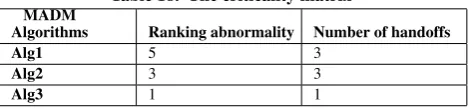
Based on the Table 3, we analyze the evaluation matrix obtained in the Table 9. The results of the analysis between the Table 3 and the Table 9 are shown in the Table 10.
Before evaluating the performance parameters of each algorithm in order to choose the best vertical handover algorithm between
Table 10. The criticality matrix
MADM
Algorithms Ranking abnormality Number of handoffs
Alg1 5 3
Alg2 3 1
Alg3 1 1
themes, we use the ANP method to calculate the weights of rank-ing abnormality and number of handoffs. Table XI presents the associated weights of each performance parameters for conver-sational traffic.
Table 11. Comparison matrix and weighting vector of conversational traffic
Evaluation Parameters
Ranking abnormality
Number
of handoffs Weights Ranking
abnormality 1 1/3 0.250
Number
of handoffs 3 1 0.750
Table 12 shows the scores and the criticality index of the all al-gorithms analyzed for conversational traffic. We notice that Alg1 has the highest score, which means that this algorithms has the best performance than Alg2 and Alg3.
So for conversational traffic, it is desirable to use Alg1 algorithm in order to select the best access network.
Table 12. Evaluation of VHA for conversational traffic
MADM Algorithms
Ranking abnormality
Number of handoffs
Criticality index
Alg1 5 3 70.00
Alg2 3 1 30.00
Alg3 1 1 20.00
5.3 The Simulation 3
In this simulation, the traffic analyzed is interactive traffic, table 13 shows the analytical results of three algorithms Alg1, Alg2 and Alg3. For each vertical handover algorithm we provided the values for average of two performance evaluation ranking abnor-mality and number of handoffs.
Table 13. Measures for ranking abnormality and number of handoffs
MADM Algorithms
Ranking abnormality
(%)
Number of handoffs
(%)
Alg1 32 60
Alg2 28 72
Alg3 38 80
[image:5.595.74.270.478.533.2]Based on the Table 3, we analyze the evaluation matrix obtained in the Table 13. The results of the analysis between the Table 3 and the Table 13 are shown in the Table 14.
Table 14. The criticality matrix
MADM
Algorithms Ranking abnormality Number of handoffs
Alg1 1 3
Alg2 3 1
[image:5.595.312.547.598.653.2] [image:5.595.52.287.660.714.2] [image:5.595.313.548.720.776.2]Before evaluating the performance parameters of each algorithm in order to choose the best vertical handover algorithm between themes, we use the ANP method to calculate the weights of rank-ing abnormality and number of handoffs. Table 15 presents the associated weights of each performance parameters for interac-tive traffic.
Table 15. Comparison matrix and weighting vector of interactive traffic
Evaluation Parameters
Ranking abnormality
Number
of handoffs Weights Ranking
abnormality 1 1/5 0.167
Number
of handoffs 5 1 0.833
Table 16 shows the scores and the criticality index of the all al-gorithms analyzed for interactive traffic. We notice that Alg1 has the highest score, which means that this algorithms has the best performance than Alg2 and Alg3.
[image:6.595.329.529.275.330.2]So for interactive traffic, it is desirable to use Alg1 algorithm in order to select the best access network.
Table 16. Evaluation of VHA for interactive traffic
MADM Algorithms
Ranking abnormality
Number of handoffs
Criticality index
Alg1 1 3 53.33
Alg2 3 1 26.66
Alg3 1 1 20.00
5.4 The Simulation 4
[image:6.595.72.268.338.398.2]In this simulation, the traffic analyzed is streaming traffic, table 17 shows the analytical results of three algorithms Alg1, Alg2 and Alg3. For each vertical handover algorithm we provided the values for average of two performance evaluation ranking abnor-mality and number of handoffs.
Table 17. Measures for ranking abnormality and number of handoffs
MADM Algorithms
Ranking abnormality
(%)
Number of handoffs
(%)
Alg1 20 35
Alg2 26 43
Alg3 36 54
[image:6.595.52.288.526.581.2]Based on the Table 3, we analyze the evaluation matrix obtained in the Table 17. The results of the analysis between the Table 3 and the Table 17 are shown in the Table 18.
Table 18. The criticality matrix
MADM
Algorithms Ranking abnormality Number of handoffs
Alg1 5 3
Alg2 3 3
Alg3 1 1
Before evaluating the performance parameters of each algorithm in order to choose the best vertical handover algorithm between themes, we use the ANP method to calculate the weights of rank-ing abnormality and number of handoffs. Table 19 presents the associated weights of each performance parameters for stream-ing traffic.
Table 19. Comparison matrix and weighting vector of streaming traffic
Evaluation Parameters
Ranking abnormality
Number
of handoffs Weights Ranking
abnormality 1 1/7 0.125
Number
of handoffs 7 1 0.875
Table 20 shows the scores and the criticality index of the all al-gorithms analyzed for streaming traffic. We notice that Alg1 has the highest score, which means that this algorithms has the best performance than Alg2 and Alg3.
So for streaming traffic, it is desirable to use Alg1 algorithm in order to select the best access network.
Table 20. Evaluation of VHA for streaming traffic
MADM Algorithms
Ranking abnormality
Number of handoffs
Criticality index
Alg1 5 3 65.00
Alg2 3 3 60.00
Alg3 1 1 20.00
6. CONCLUSION
In this work, we have proposed a new optimized network selec-tion algorithm which allows to select the most appropriate cri-teria which should be used for vertical handover decision. The simulation results show that, our method based on Alg1 can re-duce the handover metrics for all traffic classes namely: back-ground conversational, interactive and streaming.
So we deduce that due to correlation between the three criteria packet delay, packet jitter and packet loss our optimized network selection algorithm eliminates packet jitter and packet loss. The reducing of the criteria is very important to minimize the com-putation time during the execution of the vertical handover.
7. REFERENCES
[1] E. Gustafsson and A. Jonsson, “Always best con-nected”, IEEE Wireless Communications Magazine, vol.10, no.1,pp.49-55, Feb. 2003.
[2] H. Wang, R. Katz, J. Giese“Policy-enabled handoffs across heterogeneous wireless networks”, Second IEEE Worshop on Mobile Computing systems and Applications, WMCSA. pp. 51-60, February 1999.
[3] Gazis, V.; Houssos, N.; Alonistioti, N.; Merakos, L.,“On the complexity of Always Best Connected in 4G mobile net-works”, Vehicular Technology Conference, VTC IEEE 58th, pp. 2312- 2316 Vol.4, Oct. 2003.
[4] N. Joe, W. Kim, S. Hong, “A Network Selection Algo-rithm considering Power Consumption in Hybrid Wireless Networks”, in Proc. IEEE ICCCN 2007, Honolulu, USA, pp.1240-1243, Aug. 2007.
[5] J. Fu, J. Wu, J. Zhang, L. Ping, and Z. Li,“ Novel AHP and GRA Based Handover Decision Mechanism in Hetero-geneous Wireless Networks”, in Proc. CICLing (2), pp.213-220, 2010.
[image:6.595.53.288.648.702.2][7] Husza k, A. Imre, S. “Eliminating Rank Reversal Phe-nomenon in GRA-Based Network Selection Method ”, In-ternational Communications Conference (ICC2010) in Cape Town, South Africa, pp.1-6, May 2010.
[8] M. Lahby, C. Leghris. and A. Adib.“A Hybrid Approach for Network Selection in Heterogeneous Multi-Access Envi-ronments”, In the Proceedings of the 4th IFIP International Conference on New Technologies, Mobility and Security (NTMS), pp.1-5, Paris France, Feb 2011.
[9] A. Sgora, D. Vergados, P. Chatzimisios. “An access net-work selection algorithm for heterogeneous wireless en-vironments”, iscc, pp.890-892, The IEEE symposium on Computers and Communications, 2010.
[10] F. Bari and V. Leung,“Multi-attribute network selection by iterative TOPSIS for heterogeneous wireless access”, 4th IEEE Consumer Communications and Networking Confer-ence, pp.808-812, January 2007.
[11] M. Lahby, C. Leghris. and A. Adib.“A Survey and Com-parison Study on Weighting Algorithms for Access Network Selection”, In the Proceedings of the 9th Annual Confer-ence on Wireless On-Demand Network Systems and Ser-vices (WONS) Italy, pp.35-38, January 2012.
[12] I. Lassoued, J. Bonnis, Z. Hamouda and A. Belghith.“A methodology for evaluation vertical handoff decision mech-anisms”, In Seventh International Conference on Network-ing (ICN2008), pp.377 - 384, April 2008.
[13] R. Babu, H.S, Sekhar, G.N, Satyanarayana, P.S. “Perfor-mance Evaluation of Vertical Handoff in Wireless Data Net-works”, in 4th International Conference on Wireless Com-munications, Networking and Mobile Computing, (WiCOM 08), pp. 1-4, Oct. 2008.
[14] D Martinez- Morales, V.P.rico, E.Steven. “Performance comparison between MADM algorithms for vertical handoff in 4G networks”, in 7th International Conference on
Electri-cal Engineering Computing Science and Automatic Control, pp. 309-314, Septembre 2010.
[15] Escobar, L , et al, “Performance evaluation of Vertical Handoff Algorithms”, in 6th IEEE Iternational Workshop on Performance and Managemenet of Wireless and Mobile Net-works, p. 851-854, Oct 2010.
[16] Escobar, L , Navarro, A, Arteaga, A, Guerrero, F., and Salazar, C,“Vertical Handoff Algorithms A new approach for performance evaluation”, in IEEE Globecom Worshop on Ubiquitous Computing and Networks, pp. 1724 - 1728, Dec. 2010.
[17] M. Lahby, C. Leghris. and A. Adib.“An Enhanced Evalu-ation Model For Vertical Handover Algorithm In Heteroge-neous Networks”, In International Journal of Computer Sci-ence Issues (IJCSI), Vol. 9, Issue 3, No 2, pp.254-259, May 2012.
[18] M. Gondara, S. Kadam.“Requirements of Vertical Handoff Mechanism in 4G Wireless Networks”, In International Jour-nal of Wireless and Mobile Networks (IJWMN), Vol. 3, No. 2, pp.18-27, April 2011.
[19] J. Lee, and S. Kim,“Using Analytic Network Process and Goal Programming for Interdependent Information System Project Selection ”, Computers and Operation Research, Volume 27, Number 4, Page 367-382, April 2000.
[20] M. Lahby, C. Leghris. and A. Adib.“New multi access se-lection method based on Mahalanobis distance”, Applied Mathematical Sciences, Vol. 6, no. 53-56, pp. 2745-2760, May 2012.
[21] G. Lampropoulos, K. Salkintzis and N. Passas,“Media In-dependent Handover for Seamless Service Provi-sion in Het-erogeneous Networks”, IEEE Communica-tions Magazine, Vol. 46, No. 1, pp. 64-71, 2008.