© 2018, IRJET | Impact Factor value: 6.171 | ISO 9001:2008 Certified Journal | Page 2670
Experimental Investigation on Utilization of Crumb Rubber Waste in
Tile Manufacturing
Resmi G
1, Prasobh P
2, Ranjini R.Krishnan C
3, Sarath J
41
Professor, Department of Civil Engineering, N.S.S. College of Engineering, Palakkad, Kerala
2,3,4B.Tech Student, Department of Civil Engineering, N.S.S. College of Engineering, Palakkad, Kerala
---***---Abstract
– This paper presents the results from an experimental investigation carried out to assess the performance of roofing and flooring tiles with different proportions of crumb rubber as a fine aggregate replacement. The tests conducted include breaking load, water absorption, permeability and thermal conductivity in accordance with the specific standards. Research into the use of waste by-products in construction industry has been increasing over the past years. The present work assesses the suitability of crumb rubber to replace different percentages such as, 2, 4 and 5% of fine aggregates in roofing and flooring tiles.Key Words
:
Crumb rubber, Fine aggregate, Cement1. INTRODUCTION
The need to incorporate recycled materials such as rubber in building products is becoming more important than ever before. Natural sand has been conventional fine aggregate in production for many decades. However there has been extensive research into alternative materials suitable to replace sand in concrete, mortar, etc. The need to find replacement for sand from the fact that in most part of the world, there is growing concern about the depletion of sand deposits, environmental and socio-economic threats associated with extraction of sand from river banks, coastal areas and farm lands.
Waste rubber can be used as a part of fine aggregate, coarse aggregate or both aggregates. The use of rubber in concrete or mortar mixes creates landfill avoidance and decreases the depletion of virgin raw materials [11]. Crumb rubber is the name given to any material derived by reducing scrap tires or other rubber into uniform granules with the inherent reinforcing materials such as steel and fiber removed along with any other type of inert contaminants such as dust, glass or rock. Crumb rubber is manufactured from two primary feed stocks: tire buffing, a byproduct of tire retreading and scrap tire rubber.
This paper presents the use of crumb rubber in roofing and flooring tiles as a fine aggregate replacement which ultimately lead to reduction in landfill deposits and utilization of a waste by-product as a useful product.
2. MATERIALS
Details of the materials used for the preparation of roofing and flooring tiles are as below:
2.1 Cement
[image:1.595.308.559.438.536.2]Ordinary Portland Cement (43 grade) was used for the study. The properties are found out as per IS 8112:1989[16] and are summarized in Table-1.
Table-1: Properties of cement
Standard
consistency (%) Compressive strength at 7 days Compressive strength at 28 days
34 33.8MPa 42.7MPa
2.2 Fine aggregate
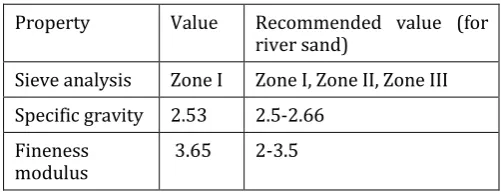
Manufactured sand was used as fine aggregate. The properties are found out as per IS 2386:1963 Part I, III [17] and are given in Table-2.
Table-2: Properties of fine aggregate
Property Value Recommended value (for river sand)
Sieve analysis Zone I Zone I, Zone II, Zone III Specific gravity 2.53 2.5-2.66
Fineness
modulus 3.65 2-3.5
2.3 Crumb rubber
Crumb rubber produced from grinding process and having size less than 1mm was used for the study. Fig -1 shows the photo of crumb rubber. The properties of crumb rubber are given in Table-3.
[image:1.595.315.552.618.753.2]© 2018, IRJET | Impact Factor value: 6.171 | ISO 9001:2008 Certified Journal | Page 2671 Table-3: Properties of crumb rubber
Specific gravity, gm/ml 0.855-0.88 Hardness, Shore A Durometer 30A to 95A Tensile strength, MPa 7 to 21 Elongation, % 100 to 600 Compression Set B, % 20 to 60 Useful Temperature Range, ˚C -50˚ to +160˚ Tear Resistance Fair to Good Abrasion Resistance Good to Excellent
Resilience Fair to Good
Electrical properties Excellent
3. METHODOLOGY
3.1 Mix proportions
A mix proportion of 1:4 was selected for the study. Mortar cubes were prepared with 1, 2, 3, and 5% replacement of fine aggregate with crumb rubber keeping w/c ratio as 0.6.
3.2 Casting of tiles
3.2.1 Roofing tiles
The roofing tiles were prepared using Italian imported mould of size 420mmx330mm by a machine working under extrusion process. The specimens were prepared with replacements of fine aggregate with 2, 4 and 5% crumb rubber. The prepared mix was delivered into the extrusion head and it is extruded between the pallets and roller. The tiles were placed in heated chambers for curing.
Fig-2: Roofing tile
3.2.2 Flooring tiles
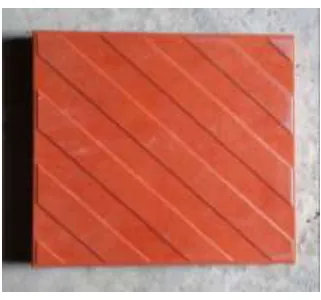
The flooring tiles were prepared in two layers. Top layer is a mixture of cement, coarse aggregate (6mm), coloured pigment, crumb rubber and water. Bottom layer is a mixture of cement, fine aggregate and coarse aggregate (6mm and 12mm). Size of the mould was 300mmx 300mm. After placing and compacted the top layer, bottom layer were laid
over it and compacted by vibration. The specimens were prepared with replacements of 2, 4 and 5%.
Fig-3: Flooring tile
3.3 Tests on roofing tiles
Strength parameters were tested as per IS 654:1992[14]. The following tests were conducted:
3.3.1 Water absorption
The specimens were dried in an oven at a temperature of about 105-110˚C. The dry weights were taken after atmospheric cooling and then immersed in water at room temperature for 24 hours and then weighed.
3.3.2 Breaking load
The breaking load was found out as per IS 6564:1992[14]. The specimens are loaded at a uniform rate of 450 to 500N/min perpendicular to the span.
3.3.3 Permeability
The test was conducted in a rectangular trough which is open at bottom, the dimensions at bottom being equal to the size of the Mangalore Pattern tile. The tile shall be fitted at the bottom of the trough and the space between the tile and the sides of the trough plugged water-tight with a suitable material like wax, bitumen, etc. Water was poured into the mould so that stands over the lowest tile surface to a height of 5cm. The water in the trough is allowed to stand for a period of 6 hours. The bottom of the tile is carefully examined to see whether the water has seeped through the tile.
3.3.4 Thermal conductivity
The tiles are exposed to sunlight by keeping them on the rods which are suitably arranged over two supports. The temperatures at top and bottom surface of tiles were noted using a digital thermometer at 1 hour interval from 10am to 4pm.
3.4 Tests on flooring tiles
[image:2.595.353.514.109.259.2] [image:2.595.38.287.507.648.2]© 2018, IRJET | Impact Factor value: 6.171 | ISO 9001:2008 Certified Journal | Page 2672 3.4.1 Water absorption
Test specimens are immersed in water for 24 hours, then taken out and wiped dry. Each tile shall be weighed immediately after saturation and wiping. The tile shall then be oven dried at a temperature of 65±1˚C for a period of 24 hours, cooled to room temperature and reweighed.
3.4.2 Wet transverse strength
The specimens are placed horizontally on two parallel steel supports, with wearing surface upwards and its sides parallel to the supports. The specimens are loaded at a uniform rate not exceeding 2000 N/min, until the tile breaks. The breaking load of tile is noted. The wet transverse strength is calculated as per IS 1237:2017[15].
4. RESULTS AND DISCUSSION
4.1 Roofing tiles
Major test results are comprehended below. Specimen with X% replacement of fine aggregate with crumb rubber is referred as CR0X, while control specimen with no replacement of fine aggregate is denoted by CR00.
4.1.1 Water absorption
Table-4 and Chart-1 show the average water absorption results. Increased water absorption was observed with the addition of crumb rubber. As per IS 654:1992[14], the water absorption should not be more than 18% (for class AA) and 20% (for class A) of its weight. The obtained values satisfy this recommendation.
Table-4: Water absorption
Specimen Average water absorption (%) CR00 9.30
CR02 10.59 CR04 11.25 CR05 13.54
Chart-1: Water absorption results
4.1.2 Breaking load
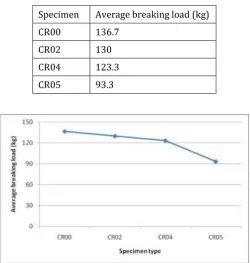
[image:3.595.309.560.184.448.2]Table-5 and Chart-2 show the variation in the average breaking loads of the roofing tiles with the addition of different proportions of crumb rubber. As the amount of crumb rubber increases there is a corresponding decrease in breaking load.
Table-5: Breaking load
Specimen Average breaking load (kg) CR00 136.7
CR02 130
CR04 123.3
CR05 93.3
Chart-2: Breaking load results
4.1.3 Permeability
The specimens were kept in the form of a trough and water was allowed to stand in it for 6 hours with 5cm height. Bottom of tiles were examined for dampness. Six specimens were tested for permeability and none of them showed dampness at bottom.
4.1.4 Thermal conductivity
[image:3.595.37.554.484.771.2]Table-6 and Chart-3 show the thermal conductivity results. As the amount of crumb rubber increases the temperature difference between top and bottom surfaces of tiles also increases. It highlights the fact that the thermal conductivity decreases when crumb rubber is added.
Table-6: Difference in temperature
Time CR00 CR02 CR04 CR05
© 2018, IRJET | Impact Factor value: 6.171 | ISO 9001:2008 Certified Journal | Page 2673 2.00pm 3.50 3.63 2.83 6.00
3.00pm 2.30 2.43 5.40 2.77 4.00pm 1.44 1.97 2.98 3.90
Chart-3: Thermal conductivity results
4.2 Flooring tiles
4.2.1 Water absorption
[image:4.595.36.288.75.306.2]Table-7 and Chart-4 show the average water absorption results. There is an increase in water absorption with the addition of crumb rubber. As per IS 1237:2012[15], the average percentage of water absorption shall not exceed 10%. The obtained results satisfy this recommendation.
Table-7: Water absorption
Specimen Average water absorption (%)
CR00 2.41
CR02 3.91
CR04 4.49
CR05 5.35
Chart-4: Water absorption results
4.2.2 Wet transverse strength
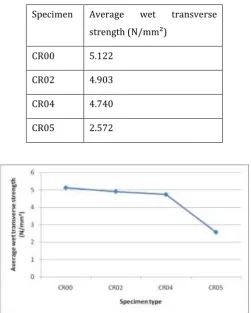
[image:4.595.309.561.214.528.2]Table-8 and Chart-5 show the average wet transverse strength results. There is a decreasing trend in the result with the addition of crumb rubber. As per IS 1237:2012[15], the average wet transverse strength shall not be less than 3N/mm². The results show that the wet transverse strength of specimens with replacements up to 4% satisfies this recommendation.
Table-8: Wet transverse strength
Specimen Average wet transverse strength (N/mm²)
CR00 5.122
CR02 4.903
CR04 4.740
CR05 2.572
Chart-5: Wet transverse strength results
5. CONCLUSIONS
On the basis of the present study, the following conclusions are drawn:
Both roofing and flooring tiles satisfied IS recommendations for test on Water absorption. None of the tiles showed dampness at bottom when tested for permeability. Test on thermal conductivity was found to decrease when crumb rubber was added. The breaking load and wet transverse strength were found to decrease with the addition of crumb rubber, but the results obtained satisfied the IS recommendations.
[image:4.595.34.291.471.743.2]© 2018, IRJET | Impact Factor value: 6.171 | ISO 9001:2008 Certified Journal | Page 2674 unless the materials collected can be put to good use. Based
on the present study it can be concluded that, crumb rubber waste definitely have some beneficial attributes and replacement of fine aggregate in tile manufacturing can be considered as one among them.
REFERENCES
[1] Arichandran.M, Harikrishna S.M.K., Mr. K Mahadevan. M.E, Stabilisation of soft soil using shredded rubber and Industrial waste, SSRG International Journal of Civil Engineering (ICRTCETM-2017)-Special Issue-April 2017.
[2] Davide Lo Presti, Recycled Tire Rubber Bituminous for road asphalt mixture, Construction and Building Materials, Volume 49, December 2013, Pages 863-881.
[3] Echoing Sustainability in MENA.
[4] Fadiel, Ashraf, Al Rifaie, Fouad, Taher, Abu-Lebdeh, Fini, Ellie, Use of crumb rubber to improve thermal efficiency of cement based materials, American Journal of Applied sciences,7(1) 2014 ,1-11.
[5] Green, Mark M, Wittcoff, Harold A, Organic Chemistry Principles and Industrial Practice, Weinheim, Wiley. July 2013,ISBN 978-3-527-30289-5.
[6] Louie, Douglas K Elastomers, Handbook of sulphuric acid manufacturing. RichmondHil, Canada: DKL Engineering, Inc. pp.16–116. ISBN 978-0-9738992-0-7.
[7] Niall Homles, Alex Browne, Christopher Montague, Acoustic properties of concrete panels with crumb rubber as a fine aggregate replacement, Construction and Building Material 73(2014) 195-204.
[8] Olga Frolova, Brigita Salaiova Analysis of Road Cover Roughness on Control Road Section with Crumb Tire Rubber, Structural and Physical Aspects of Construction Engineering, Procedia Engineering 190 (2017) 589-596.
[9] Ravishankar P, Treatise on EPDM". Rubber Chemistry and Technology, 85, 2012, pp. 327–349.
[10]
Taha,M.M.El-A.S.,AbdEl-Wahab,Mm.a.,Abdel-Hameed,M.E,,Mechanical,fracture,and microstructural investigations of rubber concrete, Matter.Civil.Eng.ASCE (2008), 640-649.
[11] Trilok Gupta, Sandeep Chaudhary, Ravi K. Sharma, Assessment of mechanical and durability properties of concrete containing waste rubber tire as fine aggregate, Construction and Building Materials 73 (2014) 562-574.
[12] WangHerYungaLeeHsienHuab-Durability properties of waste tire, Construction and Building-Materials Volume 41, April 2013, 665-672.
[13] IS 2250:1981 Code of Practice for Preparation and Use of Masonry Mortars.
[14] IS 654:1992 Test on Mangalore Pattern Tiles.
[15] Is 1237:2017 Cement Concrete Flooring Tiles-Specifications.
[16] IS 8112:1989.
[17] IS 2386:1963 Part I, III.