http://dx.doi.org/10.4236/ojped.2014.43026
Overview of Intervention Programs for
Parents of Young Children (0 - 6)
Merav Goldblatt, Rivka Yahav, Tsameret Ricon
Faculty of Social Welfare & Health Sciences, University of Haifa, Haifa, Israel Email: [email protected]
Received 8 June 2014; revised 5 July 2014; accepted 1 August 2014
Copyright © 2014 by authors and Scientific Research Publishing Inc.
This work is licensed under the Creative Commons Attribution International License (CC BY). http://creativecommons.org/licenses/by/4.0/
Abstract
In most of the world’s societies and cultures, the biological mother and father bear primary re-sponsibility to care for their child’s needs and to guide him or her through the process of entry in-to society [1]. The parent serves, for the most part, as the significant figure with the greatest amount of influence over the child’s life. Through his parent, the child learns the skills necessary to experience the world and function in it, whether the skills are in relation to survival needs such as eating, washing and mobility or developmental and social needs such as forming social rela-tionships and developing the capacity to think and learn through play and supervision [2]. Thus the parent plays a critical but complex role in the development of his or her child, a role that re-quires development of a wide range of new behavioral, communicational, cognitive and emotional skills and capabilities in order to understand and cope with the challenges of child-rearing. Simi-larly, parenting styles and characteristics are influenced by a number of variables: The parent, the child, the interaction between them, and environmental variables such as culture, socio-economic status, and the existing family unit [2]. When children who suffer from behavioral difficulties do not receive the parental care they need, there is reasonable cause for concern that difficulties will develop in adulthood in a range of life areas that will have an impact on their lives and well-being and on their ability to adapt to society and contribute to it [3]. Accordingly, over the past 50 years parent-training programs have been developed to strengthen parents through learning and pro-viding tools of experience and developmental knowledge, for the purpose of promoting the child’s sense of wellbeing and quality of life [2][4]. Objective: The purpose of this review is to provide an overview of evidence-based interventions for parents of young children (0 - 6), programs that are currently active in Israel and in the world, and to explicate the significant characteristics common to them that contribute to their effectiveness and success.
Keywords
1. Introduction
Raising a child in a nurturing and enriching environment while providing warmth, love and encouragement, in secure boundaries, is one of the parent’s main functions [5]. When children who suffer from various difficulties do not receive the parental care they need, there is a reasonable cause for concern that difficulties will develop in adulthood in a range of life areas that will have an impact on their lives and well-being and on their ability to adapt to society and contribute to it [6]. Accordingly, over the past 50 years parent training programs have been developed to strengthen parents through learning and providing tools of experience and developmental know-ledge, for the purpose of promoting the child’s sense of wellbeing and quality of life [2][4].
The purpose of this document is to provide an overview of evidence-based interventions currently active in Israel and in the world for parents of young children (0 - 6), and to explicate the significant common characteris-tics that contribute to their effectiveness and success.
1.1. Parent’s Role and Early Detection
In most of the world’s societies and cultures, the biological mother and father bear primary responsibility to care for their child’s needs and to guide him or her through the process of his entry into society [1]. The parent serves, for the most part, as the most significant and influential figure in the life of the child. The parent is also a me-dium for the child to learn problem-solving skills, as their lives together with the inevitable problems along the way provide endless opportunities for learning [2][5].
The motor, cognitive, emotional and social development of children aged 0 - 6 influences and shapes their later lives [5]. Parenting itself is a necessary component in child development in all area of life. Through his parent the child learns the skills necessary to experience the world and function in it, whether the skills are in relation to survival needs such as eating, washing and mobility or developmental and social needs such as form-ing social relationships and developform-ing the capacity to think and learn through play and supervision [2]. Good parenting has been found to be a predictor of positive social, behavioral, emotional and academic adjustment. In contrast, problematic parenting has been found to be a predictor of antisocial behavior and functional difficulties later on in life [7]. Thus the parent plays a critical but complex role in the development of his or her child, a role that requires development of a wide range of new behavioral, communicational, cognitive and emotional skills and capabilities in order to understand and cope with the challenges of child-rearing. Similarly, parenting styles and characteristics are influenced by a number of variables: The parent, the child, the interaction between them, and environmental variables such as culture, socio-economic status, and the existing family unit [2].
Parenting requires one to develop new skills in order to understand and cope with raising the child. For exam-ple, behavioral problems that disturb daily routines and include aggression, resistance and disobedience are reg-ularly seen among children [8]. When children who suffer from these behavioral difficulties do not receive the required care there is reasonable cause for concern that difficulties will arise in adulthood in a range of life areas: learning, work, interpersonal relations, addictions (alcohol, drugs), as well as development of emotional difficul-ties and psychiatric diagnoses [9][10]. In addition, one of the significant findings in longitudinal studies that examine antisocial and criminal behavior is that chronically antisocial behaviors that appear early in life usually lead to criminal behavior and lives of crime later on. In light of this, it is extremely important that policies for intervention and prevention should start in early childhood [3]. Early investment, in early childhood, empowers the child in the family context, increases the chances of successful integration in educational, social, and com-munity frameworks, and prevents the need for intervention at later stages [2].
1.2. Parent Training Programs
Identification of the significant effect of parental behavior during early stages of life upon child development and behavior precipitated the need to develop modes of therapeutic work with parents [4][5]). Therapeutic work with parents exists in a number of forms and models, including a number of types of intervention in which the parent is not the main focus, with therapy defined as “with” the parent (Parental therapy/guidance), and inter-ventions in which therapeutic work focuses on the parent himself (Parenthood Therapy) [11]. Three types of common interventions with parents can be identified:
2) Parental guidance—The emphasis is upon changing patterns of parenting, with or without child therapy. This is a psycho-educational intervention that includes teaching models of child development as a basis for un-derstanding the child’s needs, and advice on effective parenting derived from both cognitive and dynamic schools of thought.
3) Therapeutic interventions with parents in the context of dyadic (relational) therapy or parent-child thera-py—This intervention can sometimes have significant and deep, though indirect impact on parenting.
In this document we will focus on intervention programs with the parent (mostly 2 and 3 above). Beginning in the 1960’s a number of research groups began to develop parent training programs which by now have a broad base of research [2]. This relates to programs that strengthen parenting through learning and provision of tools of experience and developmental knowledge [11], with the ultimate goal of promoting the child and parent’s sense of wellbeing and quality of life [2][4][12].
The parent training programs developed over the years are many and diverse. The programs differ with regard to the models and methodologies that underlie them, so that while the emphasis in some of the programs is sole-ly on didactic learning (technical transfer of structured knowledge via a lecture or watching a movie), others place an emphasis on learning through doing, where the parent learns skills by practicing with the child and the therapist in the clinic and in a natural setting [4][13][14]. Similarly, programs are characterized by a diverse range of content (developmental knowledge about the child, parental sense of agency, communication skills, strategies of behavioral management and more); turn to different target populations (special and regular popula-tions); and include different settings (clinic, home visits, parent groups, and individual therapy). The programs also expanded to include not only behavioral problems but also to relate to and improve the child’s cognitive development, anxieties, and general health [12].
1.3. Training Programs Characteristics
Despite the existing difference and diversity, training programs for parents include similar characteristics, with the most important being: 1) evaluating the problems and difficulties that the parents are facing; 2) training the parent to use new coping skills; 3) practicing use of these skills with the child; 4) feedback on implementation of the skills [15]. In most of the programs the primary work of the therapist with the parent(s) is identifying and interpreting the child’s behavior and developing the skills required for coping accordingly.
The parents experience different techniques of role play, group or individual discussion, watching training movies and getting feedback in order to actively practice the use of strategies vis a vis the child. Many programs include homework in order to improve the likelihood of generalization and transfer of the knowledge and expe-rience gained in the clinic under controlled conditions, to the dynamic environment in the home [2][8]. 1.4. Parent Training in the Light of Research
On the whole it seems that programs led by therapists have proven to be effective in promoting positive change in the behavior of both child and parent, in the communication between them, and in improving the self-image of the parent [2][8][12][16]. Studies that examined the effectiveness of programs over time showed that the in-fluence of these programs is maintained over time and can contribute to lessening the child’s behavioral difficul-ties and antisocial and criminal behavior in his later life and in all areas of life [3].
2. Intervention Programs
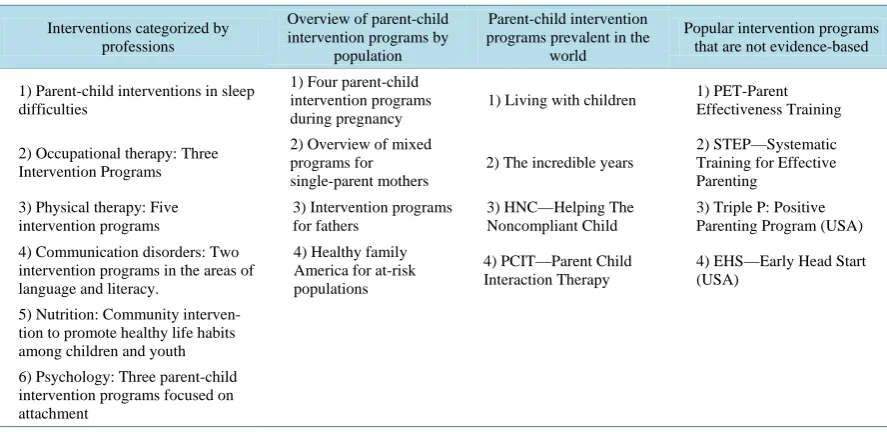
Intervention programs can be divided into three main sections: 1) Interventions type; 2) Intervention categorized by professions (nursing, occupational therapy, nutrition, communication disorders and psychology); 3) Interven-tion directed to specific type of populaInterven-tions. IntervenInterven-tions for parents are surveyed with regard to the back-ground, rationale and goals, in addition to a description of the process and effectiveness. In reviewing the cur-rent research we will address whole sections. We will also review two additional categories: Pacur-rent-child inter-vention programs prevalent in the world and popular interinter-vention programs that are not evidence-based. A summary of the categorized intervention programs is added in Table 1.
2.1. Interventions Categorized by Professions Parent-Child Interventions in Sleep Difficulties
Table 1. List of the categorized intervention programs.
Interventions categorized by professions
Overview of parent-child intervention programs by
population
Parent-child intervention programs prevalent in the
world
Popular intervention programs that are not evidence-based
1) Parent-child interventions in sleep difficulties
1) Four parent-child intervention programs during pregnancy
1) Living with children 1) PET-Parent Effectiveness Training
2) Occupational therapy: Three Intervention Programs
2) Overview of mixed programs for single-parent mothers
2) The incredible years
2) STEP—Systematic Training for Effective Parenting
3) Physical therapy: Five intervention programs
3) Intervention programs for fathers
3) HNC—Helping The Noncompliant Child
3) Triple P: Positive Parenting Program (USA)
4) Communication disorders: Two intervention programs in the areas of language and literacy.
4) Healthy family America for at-risk populations
4) PCIT—Parent Child Interaction Therapy
4) EHS—Early Head Start (USA)
5) Nutrition: Community interven-tion to promote healthy life habits among children and youth
6) Psychology: Three parent-child intervention programs focused on attachment
velopment of the nervous systems, growth, motor development, behavioral and emotional regulation, and cogni-tive functioning [17]-[21]. Sleep disturbances at a young age are among the most common complaints presented by parents to pediatricians and other professionals, at a rate of 20% - 30% [22]. These complaints include diffi-culties falling asleep and waking up during the night, called in professional language “childhood behavioral in-somnia” [23].
Sleep difficulties are a product of the interaction between parents and children and therefore any therapeutic intervention needs to be directed at changing the behaviors of parents and children. Since many parents have mistaken perceptions and lack knowledge about proper sleep patterns and habits among children, and this ex-presses itself in over-involvement and in difficulties in setting clear limits regarding sleep, interventions rely upon a cognitive-behavioral approach. The behavioral component is designed to extinguish the positive condi-tioning that was created when at the time parents, when putting their child to sleep, are busy trying to calm the child (for example: rocking the carriage, driving in a car, or falling asleep in the parent’s bed) instead of allow-ing him to develop mechanisms for self-calmallow-ing and the ability to fall asleep on his own.
Treatment of sleep disturbances at a young age is important not only from a developmental perspective [21]. Sleep disturbances tend to be maintained for years [24], and they have a significant impact on the emotional wellbeing and quality of life of the parents [25].
There is a great deal of evidence in the scientific literature about the effectiveness of parenting interventions for treating or preventing sleep disturbances among young children (0 - 6) [26]-[28]. These interventions include psycho-educational counseling to parents, behavioral extinction (full or gradual), and building a sleep routine. Cognitive Behavioral Therapy for Insomnia (CBT-I) is today considered the treatment of choice for insomnia among adults [29], and its long-term effectiveness is even greater than medication therapies [30]. This treatment has been found effective also for behavioral insomnia among children, with a success rate of 94% in reducing problems of falling asleep and wakening during the night, and 82% in follow-ups over periods of 3 - 6 months
[31]. The physiological factors in early childhood sleep disorders are clear, including breathing disorders in sleep, asthma and disturbances in the digestive system. Treatments can be provided before or in parallel to cog-nitive-behavioral treatment.
often increases parental compliance.
Extinction of the positive conditioning that developed when parents were involved in calming the child during the night, by gradually decreasing parental involvement. According to this method, in the course of putting the child to bed, the parent gives the child a clear message that he is not alone, but that he must fall asleep on his own. The parent leaves the child in the bed and comes for a brief visit at fixed intervals (typically every 5 mi-nutes), until the child falls asleep. This process lasts for a number of days until the child learns to fall asleep on his own without crying or protest. During visits the child should not be taken out of the bed, and the visit should be kept brief (one minute or less). In addition, parents should be helped to establish a fixed sleep routine every night and to be consistent with it over time. It should be taken into account that the child will express protest during the course of this process, and many parents will have difficulty coping with this resistance and main-taining the changes, fearing that they may be causing their child harm.
This treatment is found to be effective in many studies and to this day no negative effects have been reported regarding the behavioral method [21].
2.2. Occupational Therapy: Three Intervention Programs
Background: In recent decades pediatric occupational therapists have developed early intervention programs designed to improve parents’ sense of competence, based on relationships of partnership with families and with an emphasis on the interaction between the parent and child [32]-[33].
Rationale and goals: In most of the early intervention programs the occupational therapists place an empha-sis upon parent participation in play activities in order to teach them about the needs of the child and about their own needs as parents [34]. It is important to note that some of these intervention programs are in the consulta-tion model of the occupaconsulta-tional therapist and some include a model of direct intervenconsulta-tion, even though no signif-icant difference has been found in the effectiveness of either model [35]. The professional literature shows that the therapist’s focus on strengthening the parent-child interaction and improving their attachment patterns leads to an improvement in additional developmental components, such as the child’s cognitive development over the years [36]. Similarly an emphasis is placed in the interventions on the relationship between improved parental sensitivity to “signs” that the child transmits and an improvement in the level of “playfulness” and motivation of the child, the degree of the child’s independence and inquiry, and his capacity for social interaction [37].
Modes of intervention:
1) A prevention program held for mothers of typical babies in lower socioeconomic neighborhoods in Jerusa-lem [33].
In this program mothers held meetings once every other month with an occupational therapist in the Tipot Halav, during the course of the child’s first year. These meetings included providing information and modeling for the mother about sensory-motor, language and cognitive activities.
Effectiveness of the intervention: In a study of the effects of the program after about two years it was found that the mothers in the intervention group had more knowledge about child development, improved perceptions of their ability to contribute their child’s wellbeing and development, and better implementation of develop-mental knowledge compared to a control group.
2) An early intervention program for mothers of typical young children (ages 2.5 - 3 years) [34] that was im-plemented in Australia.
The goal of this intervention program was to encourage mother-child interaction by means of play and to ex-pand the mother’s knowledge about child development. The intervention took place over the course of ten weekly meetings and was based on the activity of preparing a game or demonstrating games. In the program the following outcome measurements were taken before the intervention, at its conclusion, and after one and a half years: The way the mother relates to causality with regard to the child’s behavior, the extent of parental tension, the mother’s self-image as an educator, the child’s temperament and behavior.
Effectiveness of the intervention: While no change was found in the quantitative outcome measures between the intervention group and the control group, participants were found to be satisfied with the intervention pro-gram, and they reported that they implemented the knowledge they had gained in initiating playgroups of moth-ers in the community.
Mothers were given support and provided with various strategies for improving family time management (es-tablishing family rules, delegating responsibility, managing time demands and more) [38].
Effectiveness of the intervention: Focus groups were held in which mothers reported on feelings of personal empowerment, wellbeing with regard to child care and the learning of strategies for coping with daily tasks and the burdensome routine [39].
Additional important principles for successful intervention:
• Focus on the parent-child interaction as a “therapeutic tool, evaluating the parents’ perceptions and values, providing the parent with positive reinforcement and including him in the therapeutic process” [40]. Moreo-ver, in terms of the strategies occupational therapists use during early interventions, it was found that the most effective strategies are creating joint interaction of the therapist with the parent and child, and taking advantage of the learning opportunities that present themselves during the course of the interaction [41]. • Occupational therapist’s relating to the management of the mothers’ time while designing early interventions
[42][43]. This in order that the interventions will fit in with family routines, will not place a burden on the already overburdened mothers of young children, and will contribute to the mother’s quality of life and to the wellbeing of the family [44].
• Understanding the home environment and the objects in it in order to integrate intervention goals with the family routine and daily play situations [45]. In a study that examined the way in which mothers managed the home environment in order to encourage developmental play of typical babies aged 1 - 18 months [46] it was found that mothers had different strategies for managing play objects in the house and for organizing and maintaining the home environment so that it would support the infant’s development.
2.3. Physical Therapy: Five Intervention Programs
Background: Around the 1980’s professionals began to get a deep appreciation of the importance of early intervention programs, especially during early childhood. Most of the intervention programs in the field of physical therapy are hands-on programs, in other words the treatment is mostly performed by skilled physical therapists.
Rationale and goals: In the last decade there is an increased appreciation of the role and importance of the parent in treatment, and it subsequently has received a central place in research studies. Involving parents in treatment itself, whether as assistants to the therapist or as providers of treatment themselves, improves the par-ent’s understanding and ability to help his child on both the motor and mental levels, promotes the child’s de-velopment and achievement of dede-velopmental milestones, and helps the parents to create a safe environment adapted to their child [47].
Modes of intervention:
Studies chosen for the survey are examples of studies in which physical therapy counseling to parents, wheth-er of children at risk or children with developmental disordwheth-ers, is a core program component:
1) The effectiveness of mother-child counseling relative to learning the technique of NDT therapy, for moth-ers whose babies have been diagnosed with CP at the age of 8 - 32 months [48] (USA).
In the context of the intervention mothers in the experimental group were supervised by a physical therapist, and taught how to improve the mother-baby interaction with an emphasis on adjusted positioning, while mothers in the control group received NDT therapy and were supervised in only one technique in accordance with the baby’s needs.
Effectiveness of the intervention: Outcomes showed significant success in changing the behavior of the mother and baby in the experimental group-mothers were more engaged in positive initiative/coaching and in face-to-face response, than mothers in the control group. In addition, babies in the experimental group respond-ed better to their mothers. This change in the behaviors of mothers and babies is considerrespond-ed significant to the child’s independent development in the rest of his life.
2) An intervention program for improving the motor abilities of premature infants [49] (Thailand).
the therapists were asked to demonstrate the exercises and everything was documented on video.
Effectiveness of the intervention: While there was a significant improvement in the TIPM results in the ex-perimental group in a measurement at 4 months of age, no difference was found between groups.
3) Counseling of new mothers with the goal of lessening the risk for postpartum depression, which is a risk factor for the baby’s motor and emotional development [50] (Australia).
The intervention program lasted eight weeks and included an hour of joint physical activity for mothers and babies and a half hour lesson on healthy living. The intervention began in the 6 th - 10th week after birth.
Effectiveness of the intervention: Researchers found a significant improvement in the rating of well-being and a decreased level of depression in the experimental group in comparison to the control group. This study shows that routine use of a program of exercise and healthy lifestyle education can reduce long-term problems such as postpartum depression.
4) An early intervention program called COPCA (Coping with and Caring for Infants with special needs) is focused on the family of a baby with CP in comparison with physical therapy using the NDT method [51] (Hol-land).
The study was performed with two groups, one of traditional physical therapy in accordance with the NDT, and the second with COPCA. Treatment was provided by licensed physical therapists once a week over the pe-riod of a year in the family’s home.
Effectiveness of the intervention: Outcomes were not provided, but the researchers assume that COPCA will have positive outcomes because the program provides parents with positive strategies for coping with different situations, and consequently it should lead to better results on the child’s motor and cognitive tests.
5) A para-professional home-visiting program for an at-risk, low socioeconomic population [52] (USA). The program accompanies first-time parents, beginning during pregnancy, in the home. The goals of the pro-gram are to promote pregnancy health, child development, and mother’s wellbeing. Home visits continued until the age of two, becoming more frequent as pregnancy advanced, and after birth visits were once a week and then every other week.
Effectiveness of the intervention: The study found lower percentages of child abuse, fewer immediate preg-nancies, a higher quality of mother-child interaction, less behavioral problems among the children, and better language development among the research population.
2.4. Communication Disorders: Two Intervention Programs in the Areas of Language and Literacy
Background: Many studies show that language development, like the early signs of literacy, takes place long before the child meets the formal educational settings such as the daycare center, pre-school setting and school. Already in the first year of life, even before the appearance of the first words, there is a rich and complex com-munication between the baby and parent. Watching, making noises and use of gestures are the means at the ba-by’s disposal, and their integration makes possible the development of reciprocal relations and communication with the environment [53]. In different studies it has been found that daily reading of stories and a reading style in which parents talk about the story and respond to the child’s comments and questions, support the child’s de-velopment of language, contribute to expanding his vocabulary and assist in improving his ability to understand and to express himself [53][54]. It has also been found that reading stories encourages the child’s awareness of the role and use of written language (Concept about Print) and awakens a positive attitude toward story reading
[55]. Socio-interactive theories that seek to explain the process of language acquisition emphasize the impor-tance of social support and contextual framing in the process of language development thereby highlighting the importance of reading stories in general and more specifically as part of an intervention program for children with language difficulties.
Ministry of Industry and Commerce, are mostly exposed to philanthropic intervention programs (for example of the Caring Commission of UJA-Federation of New York). From among the variety of programs offered throughout the world (and whose documentation can be found in the literature) that deal with support of families in need, the focus will be on those that meet the following criteria: Programs built on the basis of collection of longitudinal data on a wide range of measures in the home and in educational frameworks, data taken from a representative sample that makes possible conclusions and generalizations, programs that examined their effec-tiveness with methods of Evidence Based Practice, those that clearly formulate the theoretical rationale under-lying program design, and provide a detailed and comprehensive description of how it is carried out. The two programs that will be presented below begin with the assumption, proven in many studies, that development of linguistic capacity, the quality of verbal interaction between the child and his parents, and the nurturing of emergent literacy in pre-school years, are all strong predictors of school success [58][59].
Modes of intervention:
1) The parent-child home program (USA) [60].
(http://www.cebc4cw.org/program/the-parent-child-home-program/detailed).
The target population is poor families, single-parent families, young parents, or immigrants. The program serves children aged 2 - 4 years, and places an emphasis upon the quality of linguistic interaction and communi-cation between parents and children, on social and emotional development, and on nurturing emergent literacy as preparation for school. Work with families takes place in the home environment and the parents are exposed to a model of enriching interaction with the child. The goal of the intervention is to enhance the quality and quantity of verbal interactions, strengthening the parent’s sense of self as a parent, developing language and li-teracy skills and increasing the child’s social behavior. The program last for two years and the facilitators visit the family’s home twice a week. Families receive books and toys that enrich the literacy environment in the home. The program does not offer the family activities beyond the time in which the facilitator is in the family’s home. Facilitators undergo a sixteen-hour preparatory workshop and meet weekly in learning and support group (a detailed guide can be purchased with full details and recommendations for program implementation).
2) Home instruction for parents of preschool youngsters [61].
(http://www.cebc4cw.org/program/home-instruction-for-parents-of-preschool-youngsters/detailed).
This program is intended for children from birth to 5 years of age in families living in poverty whose home environments put them at high risk for developmental delay. The goal of the program is to foster language abili-ty and emergent literacy in preparation for school. Program facilitators go into the family home but do not make direct contact with the children, rather they do role playing with the parents with regard to proposed activities and to how to establish communication with the child. Together with entry into the home the program also offers group meetings for parents in order to create a supportive and enriching parent group. The program last for three years but the frequency of meetings is not documented. In this program the families receive books and work books for activities with the children beyond the meetings with the facilitator (a guide can be purchased with all of the details and recommendations for program implementation).
2.5. Nutrition: Community intervention to Promote Healthy Life Habits among Children and Youth
Background: The project is intended to establish a community health promotion program in lower socio- economic neighborhoods in Haifa. The need for such a program is clear in light of the evidence that lifestyle in early life has implications for development of chronic illnesses, such as heart disease and diabetes, at a later age, as well as implications for social functioning and quality of life during childhood and adulthood. Improving the quality of nutrition and level of activity among children is particularly important in light of the increase in rates of obesity, primarily in the lower socio-economic strata. It is important to emphasize that weight loss among children is not one of the program’s goals. Instead the aim is to help parents and their children to adopt healthier lifestyles.
the opposite to what actually happens in an environment in which there is an abundance of processed foods loaded with calories and an encouragement of a sedentary lifestyle [62].
Intervention processes: Behavioral therapy is considered the first line of treatment for child and adolescent obesity. Behavioral therapy includes teaching parents and children about goal setting, preventing relapse, prob-lem solving and managing the surrounding environment such that it will encourage good nutrition and physical activity. All of the programs that involve young children the parents are also involved, since it is they that most-ly control their child’s nutrition. Findings from different programs show that an effective program needs to focus on instructions for parents designed to foster eating patterns and food choices that are suitable to a healthy diet. Instruction to parents needs to include an explanation of how children develop eating habits in the family con-text. Practical instruction for parents includes tools for fostering choice of healthy foods and encouraging child-ren to accept new food. Similarly, pachild-rents should be provided with information that is practical and easily un-derstood about the size of portions appropriate for children, and suggestions about the timing and frequency of meals and stacks [63].
The program “Tailor-made for me” of the Israel Ministry of Education (www.tafuralay.co.il) is implemented both in pre-school settings and schools in Israel. The advantage of the program is that it is adapted to the Israeli population and its effectiveness has been demonstrated through research [62][63]. The nutritional intervention was planned especially to improve knowledge about nutrition and includes learning topics through lectures and discussions. All of the sessions are led by pre-school teachers and are adapted to their level. In addition, the children bring their parents monthly information sheets that discuss various issues related to nutrition. The children are encouraged to share their nutritional information with their parents, and the parents are asked to discuss the issue with their children.
The primary goals are promoting healthy eating habits, an active lifestyle among the children and their parents, and developing a program for preventing child obesity. The program has additional more specific goals such as encouraging nursing and eating breakfast, limiting “television time”, and more.
2.6. Psychology: Three Parent-Child Intervention Programs Focused on Attachment
Background: An important aspect of parenting is helping the child by providing appropriate responses and creating safe attachment, to develop his internal regulatory systems in a manner appropriate to the requirements of the environment [64]. The mother’s state of attachment during pregnancy is found to be related to the quality and degree of the infant’s level of security in attachment [65].
Difficulty in internal regulation occurs when the parent has difficulty providing appropriate care and can be expressed on the emotional, behavioral and physiological levels. Children whose needs were not met are at a high level of risk to develop difficulties in the long term that are related to problems in emotional and behavioral self-regulation such as a tendency to use addictive substances and criminal behavior. Thus parents need to pro-vide the child with a same, predictable and controllable environment that supports the child in his development of self-regulatory skills [66]. Similarly, studies show that the mother’s capacity to reflect on her functioning is a central component in her ability to transmit and create attachment to the child [65]. These findings support the building of interventions that give tools for reflective functioning, thereby encouraging creation of secure at-tachment between mother and child.
1) Attachment and bio-behavioral catch-up intervention (ABC) [67] (USA).
Rationale and intervention goals: In order to narrow biological, behavioral and emotional gaps related to the child’s primary relational systems (attachment), an intervention program was designed that focused upon coun-seling the parent on how to develop his capacities to provide adapted responses and a secure environment. This program focused on a population of toddlers in foster families in order to examine the extent to which it is poss-ible to rehabilitate disturbances in the child’s primary attachments with his main caretakers. An additional as-sumption underlying the study was that early intervention would have more significant and extensive impact than interventions done in later years.
intervention program has an organized guidebook, with topics divided over ten weekly meetings, held in the family’s home by a professional therapist, and activities are adapted to a range of ages. Meetings are active and include hands-on counseling together with the child, joint discussions. Sessions are filmed so that they can later be jointly analyzed.
Intervention Effectiveness: A random controlled experiment (RCT) performed with 60 children to evaluate the program found positive outcomes showing that performance of a formal time-limited program promoted the development of self-regulatory capacity among children in foster care. In the experimental group that partici-pated in the program the children produced more appropriate levels of cortizol in comparison to the control group. In addition, parents of children in the experimental group reported fewer behavioral problems.
2) The Circle of Security Intervention (COS) [68] (USA).
Rationale and intervention goals: There is a great deal of evidence that the quality of attachment between the parent and child in the first years of life has an important impact on his development and on his becoming an independent adult. Insecure attachment is found in the literature to be a risk factor for development of psycho-pathology later in life.
Accordingly the goal of the program is to counsel the parent on how to be more attentive to the child and to himself in order to develop secure attachment. In addition, an emphasis is placed on self-evaluation of the par-ent-child attachment existing prior to performance of the intervention, so that the therapist can know what the child has learned about how to participate in a relationship with the parent and direct the intervention to his unique needs.
The course of intervention: The program is comprised of a set protocol including 20 weekly group meetings (5 - 6 parents) an hour and a quarter each. Meetings include therapeutic and educational components, and are led by a licensed psychotherapist. The protocols are based on attachment theory and are appropriate for both inter-vention and preinter-vention. The program has five key components: a) Establishing the group as a safe space in which the parent can reflect upon his relationship with his child; b) Improving the parent’s ability to provide his child with adapted and sensitive responses by learning about the child’s basic attachment needs; c) Improving the parent’s ability to interpret manifest and latent signs that the child exhibits to make its needs known; d) In-creasing the parent’s ability to feel empathy through use of reflections on the child’s and parent’s behaviors; e) Increasing the parent’s ability to understand how his own developmental history affects his current abilities as a parent.
The first meetings are devoted to educational and didactic aspects of the issue of attachment. During the fol-lowing meetings the therapist, folfol-lowing a set protocol, focuses on each parent and generates active discussions on each topic through the use of short video films.
Intervention effectiveness: A longitudinal study with measurements before and after the intervention ex-amined whether parents and children from at-risk populations who participated in the program transitioned be-tween types of parent-child attachment. Findings of the study were positive and showed that the program could help to reduce characteristics of insecure attachment for young children. About 70% of the children categorized as belonging to the “disorganized” type of insecure attachment were categorized following the intervention as belonging to the secure attachment group. The researchers attributed this change to the contribution of the pro-gram to the parent’s ability to identify and reflect upon his own defensive strategies that previously had pre-vented him from responding sensitively and appropriately to the child’s needs.
3) Video feedback intervention to promote positive parenting (VIPP) [69].
Rationale and intervention goals: The parent’s mental representation of the characteristics of attachment and his behavior toward the child are influenced by his own internal representations of attachment and affect the quality of attachment with the child. The goal of the intervention is to strengthen and encourage the parent’s sensitive and adapted response to the child’s signs by filming the parent and child and giving feedback (the par-ent in a sense serves as his own model).
Course of intervention: This program is based on attachment theory and includes a set protocol in which the parent-child dyad is filmed in their home, and later watches the videos together with the therapist. During inter-vention meetings, held with a psychologist once a month for an hour and a half, the parent is given feedback and support when they show positive responses to the child.
research sample following the intervention.
3. Overview of Parent-Child Intervention Programs by Population
3.1. Four Parent-Child Intervention Programs during PregnancyBackground: Stress and negative mood during pregnancy are risk factors for the baby’s development, for the mother’s mood after birth, and for development of secure attachment between the parents and the baby. Rele-vant studies have found effects on low birth weight, early birth and difficulties during birth, low APGAR scores, difficulties in varying facial expressions in accordance with stimuli and more [70]-[72]. In addition the literature shows that the mother’s psychopathology before and during pregnancy increases the risk that the child will de-velop emotional difficulties and difficulties in self-regulation [73]. Hence there is a need for an appropriate in-tervention with expecting parents during pregnancy and following birth in order to help them establish the foundations that will continue to serve the parents, the child, and the family unit.
3.1.1. Psychodynamically Oriented Intervention [74] (USA)
Rationale and goals: Psychodynamic interventions directed at treating the person’s different conflicting re-presentations have a significant advantage as preventive treatment for women with affective disorders during pregnancy, which may be triggered by distorted or unadjusted internal representations. The assumptions under-lying the intervention are that it is important to reach an understanding of the mother’s inner world in order to later have an impact of the process of the child’s growth and development [74].
Course of intervention: Individual therapy done by a trained psychodynamic therapist. Therapy dwells on the woman, her personal history and her experience of pregnancy. This process expands the psychological space in which the imaginary baby can grow and become distinguished from problematic representations that were the product of the mother’s early painful or unsatisfying experiences with her own mother [74].
Intervention effectiveness: No evidence is provided as to the effectiveness of the intervention.
3.1.2. Mindful Motherhood Intervention [75]
Rationale and goals: Literature shows that the experience of stress and strain during pregnancy has a direct impact upon birth and child development. The Mindfulness Method is a means for developing the capacity for observation that can bring about a change in mental or physiological state [76].
Intervention course: Intervention meetings are weekly over a period of eight weeks and are held in a group of 12 - 20 women for two hours at a time. Meetings are facilitated by a clinical psychologist with specialized training in the method, and they include three main methodologies for observing emotions and thoughts: 1) Learning and practicing breathing techniques; 2) Using guided meditation and yoga exercises; 3) Using and un-derstanding psychological concepts such as acceptance.
Program meetings include lectures, discussions and practical exercises such as awareness of the developing fetus, discussion of anxieties about birth, calming walks, and more. In addition participants are given a disc with guided meditation and reading material to supplement what they learn in the meetings.
Intervention effectiveness: In a random controlled pre- and post-intervention pilot study done with 31 wom-en it was found that use of this intervwom-ention program during pregnancy reduced negative mood, anxiety, and de-pressive feelings. In addition it was found that the intervention helped to improve and raise the mood of partici-pants. The effects on the period following birth and on the baby’s subsequent development were not studied.
3.1.3. Family Foundations (FF) [76] (USA)
Rationale and goals: During and following pregnancy many changes take place in the composition and management of the family unit. A central aspect of family life is the way in which the parents work together and support one another in coping with conflicts that arise around the raising of the child. The main goal of the pro-gram is to strengthen this cooperation and to accompany the changes that the parents undergo during pregnancy and after the birth, by encouraging support and coordination in the relationship [76].
like sharing the burden and providing appropriate stimuli to the child. The program is comprised of a series of eight meetings, before and after birth, for both parents. Each group is made up 6 - 10 couples, and is facilitated by a male and female team of therapists who have undergone special training.
Intervention effectiveness: A random controlled study on 169 couples during the period of a first pregnancy found positive outcomes—a significant improvement in the level of cooperation between members of the couple, a decrease in the level of the mother’s depression, the couple’s anxiety, and the stress regarding the parent-child relationship. The study also showed an increase in the child’s self-regulation and quality of sleep. A higher im-pact was found among the low socio-economic population. The researchers conclude that the cooperation pro-gram can have a positive impact especially for at-risk families.
Additional factors recommended when planning and designing intervention programs for the period of pregnancy:
• A planned approach including treatment of a number of parenting components has the greatest impact [76]; • A continuum of at least 11 meetings over 3 months, and supportive and sensitive accompaniment of staff
operating the program [77].
3.2. Overview of Mixed Programs for Single-Parent Mothers
Background: There are four known studies that examined the effects of intervention programs for single- parent mothers of children with behavioral problems and children diagnosed with ADHD. Among these, the on-ly study that included a Clinical Controlled Trial was performed by Chacko et al., (2009) [78].
Intervention course: A behavioral program for single-parent mothers of children aged 5 - 12 diagnosed with Attention Deficit Hyperactivity Disorder (ADHD).
Intervention effectiveness: Study findings showed a significant reduction in dimensions of oppositional be-havior and mother’s stress level, and improved parent-child interaction and parental bebe-havior. However a sig-nificant difference was not found between the experimental group and the control group with regard to dimen-sions related to symptoms of ADHD in the children and of depression in the mother.
3.3. Intervention Programs for Fathers
Background: In the past a greater emphasis was placed on the role of the mother in the process of the child’s emotional development, but research today recognizes the importance of the father and even claims that under certain circumstances growing up without a father figure is associated with emotional difficulties in the child
[79].
Intervention course: A meta-analysis of 26 studies analyzed the effect of father involvement in parent train-ing programs on program success, and whether the father and mother benefit equally from the program [80].
Intervention effectiveness: The analysis found that studies that included programs in which the father was involved found better outcomes for child behavior and parental conduct that programs that did not include fa-thers. However there was no difference in the findings of the programs with regard to change in the parent’s perception of parenting. In comparison with the mothers, fathers were less likely to implement what they prac-ticed, and reported less on the child’s achievements as a result of participation in the program. The researchers conclude that there is a need to involve fathers in parent intervention programs because this increases the like-lihood of program success, and recommend further research to learn how to adapt the programs to meet the par-ticular needs of fathers [81].
3.4. Healthy Family America for At-Risk Populations [82] (from the Program Web-Site http://www.healthyfamiliesamerica.org/home/index.shtml)
Target population: Families with children from birth to age 3 - 5 who live in poverty in the United States, and whose children are at risk of abuse and neglect.
The program is also suitable for families with histories of trauma, domestic violence, mental health or sub-stance abuse.
attachment between the parent and child. An additional emphasis is on providing families with culturally sensi-tive services.
Intervention course: HFA services are provided on a voluntary basis and begin during pregnancy. The pro-gram offers two primary components-evaluations that determine whether the family is likely to benefit from participation in the program, and weekly home visits to the target population. The program is intensive and long- term (3 to 5 years after the baby’s birth). In addition, it provides the family and child with psychological testing and initial screening, support groups, parent training, and groups focused on father involvement. Service pro-viders in the program undergo special training, but are not required to have any academic or therapeutic back-ground.
Intervention effectiveness: Surveys of more than 15 evaluation studies of HFA in 12 states showed the fol-lowing results: A reduction in poor treatment of children, improved parental care, a decline in premature and low-weight babies, improved parent-child interactions and school preparedness, decreased dependence upon welfare services, greater accessibility to health services and higher rates of vaccinations.
4. Parent-Child Intervention Programs Prevalent in the World
This section will survey evidence-based intervention programs.1) Living with Children was the first parent training program developed by a group of researchers, led by Ge-rald Patterson of the Oregon Research Center in the United States [83].
Target population: Children between the ages of 3 - 14 who were referred due to behavior problems. Treatment setting: Clinic, individual therapy opposite a single family.
Tools: Therapist guidebook: “A social learning approach to family intervention”. The guidebook includes a pre-treatment interview with the parent, a questionnaire evaluating the parent’s perception of the quality and frequency of his child’s behavior, forms guiding the therapist in making telephone calls with parents and forms for the therapist.
The guidebook for parents: “Living with Children” that includes basic concepts and strategies for learning and behavioral management for the parent to learn on his own.
Length of program: An initial meeting of an hour and a half for gathering information and then 6 - 10 brief observations of 25 minutes in the home over a period of two weeks.
Program content: At the core of the program is the guidebook for parents that deal with how children and parents can learn and emphasizes how behavior can be changed through the use of positive reinforcement. The parent learns to perceive himself as the agent of these changes. The therapist teaches the parent to identify spe-cific behaviors that are his targets and then how to build a plan of positive reinforcements (making eye contact, empowerment) and negative reinforcements to cope with this behavior. The plan usually includes a profit and loss table of points for behavior that took place or not, and the goal is that with time the points will themselves become a reward. The parent learns to use the “time out” technique in which the child is isolated from friends and from activities that he enjoys.
Mode of program delivery: Individual meetings with the parent, during which he is tested on the guidebook. In therapy meetings the therapist uses pre-structured scenarios and role plays in order to teach the parent how to build a behavioral plan with his child.
Unique program characteristics: Emphasis on the theoretical learning of behavioral theories in order to de-velop the capacity to perform transfer and independent building of a behavioral management plan for the child. In addition the program places an emphasis on observations and documentation of the child’s behaviors by the parent, and uses a point system as a central tool for changing the child’s behavior.
Research support: The program was researched in many controlled studies since 1976 that found that the program produces a significant decrease in undesired behaviors relative to control groups. Follow-up studies show maintenance of program outcomes a year after its completion [2].
Impressions and recommendations: The program is concrete, clear, accessible and detailed. As such, how-ever, it narrows the therapist’s therapeutic possibilities. It is appropriate for families that can experience a close connection and are capable of understanding the theoretical materials upon which the program is based.
2) The Incredible Years—the program was developed in 1984 by Carolyn Webster Stratton from the Wash-ington University, USA [84][85].
Therapeutic process: Parent groups in the clinic, without children. Program materials: Can be purchased on the internet.
• Therapist guidebook including questions for guiding parents.
• Training videos, in a variety of languages and including more than 250 video clips of a variety of situations from a parent’s day to day life, with guidance on how to behave and how not to behave.
• Guidebook for group leaders.
• Guidebook for parents including the contents of the entire basic program.
Length of program: About 10 - 14 weeks. Parents meet weekly in groups of 8 - 12 people for training meet-ings lasting about two hours.
Program contents: The program focuses first on teaching the parent how to play with his child in a way that the child leads in order to strengthen the relationship between them. The parent is instructed to use a behavioral points plan to encourage desirable behavior and to use the “time out” technique to cope with unwanted beha-viors. In addition the parent is guided to teach his child a process of problem solving, and learns to use self-reg- ulation strategies such as relaxation techniques for stopping negative thoughts and improving communication skills.
Means of program delivery: The therapist serves as an aid for the parent while he develops new attitudes, shares experiences and discusses problems and ways to resolve them. The group format and watching the video clips with a variety of common situations are used for this purpose. After watching videos role plays are done and homework is given out that encourages use of the learned skills in the natural environment.
Unique aspects of the program: Particular emphasis is placed on a participatory approach on the assumption that the therapist will help the parent bring to fruition his knowledge and abilities. In addition the program relies a great deal upon video clips and learning through role playing among parents, without the child being present. The program differs from other programs in its high costs and requirements for special training. A collection of the various books and the training workshops for therapists cost between $1300 and $1700.
Research support: Over the last 20 years many controlled and peer-reviewed studies have been performed (on different populations from a range of ethnic backgrounds). These studies showed that the program improves parent-child interactions and reduces children’s violent behavior and parental rigidity. Studies are currently be-ing performed to examine the program’s effectiveness as a prevention program and initial findbe-ings show a posi-tive impact on posiposi-tive parental behaviors, but results are weaker in relation to the child’s behavior [2].
Impression and recommendations: This program is evidence-based and provides accessible information supporting implementation by both therapists and parents. It has a significant advantage for therapists in that the video clips concretize the learning and facilitate communication between therapist and parent. The parent bene-fits from the group format which is less threatening while at the same time providing significant social support. The program’s main limitation is its high cost.
3) HNC—Helping the Noncompliant Child
This program was developed during the 1980’s by the researchers Rex Forehand and Robert McMahon from George Washington University in the United States.
Target population: Children ages 3 - 8 with inappropriate behavior a lack of compliance with parental de-mands.
Treatment process: Intensive parent-child sessions in the clinic. Program materials:
• Therapist handbook (Helping the noncompliant Child: Family based treatment for oppositional behavior, 2003) that provides guidelines for performing an initial evaluation, observations of structured and free par-ent-child play, and session management. Reading the book alone is not enough in order to put the model into practice, as experience and developmental knowledge are required.
• Researchers developed an instrument for evaluating parents’ knowledge about behavioral principles that has been found to be sensitive to the program’s intervention, and its use is recommended.
• Self-help book for the parent (Parenting the Strong Willed Child).
Program duration: 12 weeks not including the evaluation process (interview and initial observations), with an average number of 10 weekly sessions of 60 - 90 minutes.
Phase 2—In this phase the parent learns how to guide the child. He learns how to give clear positive instruc-tions, how to reinforce the following of instrucinstruc-tions, and how to use the “time out” technique when instructions are not followed.
In the end there are therapy sessions for practicing transference of the skills beyond the home environment. Means of program delivery: The skills learned in the two phases are adopted in small steps, at the parent’s pace, but there are criteria which the parent needs to meet with regard to each skill, and this enables the therapist to monitor the parent’s progress and his readiness to move on to the next phase. The therapist uses role playing and feedback, and also shares the program components with the child.
Unique characteristics of the program: The child’s level of participation in therapy sessions, the active role provided him and the rigid structure whereby the therapist decides when the parent moves from one phase to the next are unique to this program. A unique aspect of the program handbook is its extensive and detailed discus-sion on theory.
Research support: Controlled studies performed during the 1970’s showed positive outcomes of behavioral change and maintenance of desired child and parent behavior. There were also positive findings of program ge-neralization as well as an improvement in parents’ perceptions of their child. Follow up studies performed about ten years after program end showed maintenance of the acquired habits and skills. Studies are currently being performed to examine the program’s effectiveness as a prevention program with at-risk populations, and there are positive findings that support its use as a community-based prevention program [2].
Impression and recommendations: The program is composed of different components that have been stu-died in depth and found effective. The guidebook provides a great deal of background information but less spe-cific practice guidelines, so the program is oriented to therapists with basic knowledge and experience in therapy based on behaviorist principles.
4) PCIT—Parent Child Interaction Therapy.
The program was developed in the 1980’s by Sheila Eyberg from Oregon University, USA.
Target population: Children aged 2 - 8 displaying behavioral difficulties. The guidebook claims that the pro-gram can also help children with anxiety, low self-esteem, developmental difficulties related to intellectual dis-abilities, abuse, neglect, divorce and adoption.
Treatment course: Individual clinic-based format, usually together with the child. Program materials:
• Therapist guidebook (“Parent Child Interaction Therapy”) containing information about the program and detailed guidelines how to manage the evaluation process and the therapy sessions. The guidebook includes standardized scales for performing the evaluation, one of which was developed by the program.
• The program relies mostly on a training technique in which the therapist observes the parent and child through a one-way mirror, and gives the parent instructions through an earphone.
Program length: Between 8 - 14 weeks of weekly meetings lasting 90 minutes.
Program content: The program begins with an evaluation that includes observations of free and structured parent-child play. In the first phase, sessions are held only with the parents, who learn techniques for letting the child lead in free play. Through discussion, role plays and home exercises the parent is taught how to describe appropriate behavior, to imitate play and to give praise and reinforcements in the course of play. The condition for moving on to the next stage is an observation of the parent and the child in which the therapist evaluates ac-cording to pre-established criteria whether the parent has acquired the skills.
In the second phase the parent learns through practice in the clinic and at home-basic strategies for coping with the child’s oppositional behavior: The parent is guided to gradually mediate and to break down instructions into small steps, first with simple play instructions, and later in real life situations.
Program delivery: Each session in a given phase has a chapter in the handbook with guidelines on how to teach the parent and a chapter with guidelines how to train the parent in real-time when he is practicing with the child. There is a structured and detailed protocol on how to use the “time out” technique and how to prepare a graph of parental progress for purposes of monitoring.
obedience at home.
Research support: The first controlled experiment evaluating the program found significant positive effects from the use of the two program phases upon the behavior of both child and parent, in contrast to didactic pa-renting groups or groups that received no intervention. Studies over the past 20 years that evaluated the program found additional positive results, including generalization of the improvement in skills to the learning environ-ment (school) and its maintenance after conclusion of treatenviron-ment [86].
Impression and recommendations: The program includes considerable detail on how and what to teach, making it ideal for the beginning therapist, but the observations and evaluations in the second program phase are not sufficiently uniform or clear.
Popular Intervention Programs That Are Not Evidence-Based
A number of programs that lack firm research support are nonetheless broadly implemented. The main ones are discussed below:
1) PET—Parent Effectiveness Training.
Target population: Children of all ages; Treatment setting-Provided by trained facilitators in either individual or group formats; Children over the age of 12 can participate in groups with the parents.
Program materials: Program materials can be purchased on the internet, including: Guidebook, audio-cas- settes, and a basic course for parents and facilitators on how to transmit the program. It is also possible to un-dergo training workshops in order to become an authorized trainer in the program.
Program duration: Eight weeks during which the parents meet once a week in groups of 8 - 16, for three hours at a time.
Program content: At the heart of the program is the practicing of the “active listening” technique designed to create a warm and accepting relationship between the parent and child. The parent is taught to help the child find appropriate solutions to his needs, rather than to provide them himself. He learns to refrain from giving instruc-tion, advice, or criticism, and instead to focus on active listening in which he reflects back to the child what he thinks the child is trying to express or do. In addition, the program suggests to the parent that he accommodate the environment in some ways, for instance by finding things for the child to do.
Means of program delivery: One needs to participate in a workshop that includes training.
Unique characteristics of the program: The theory that underlies the program is unique in that it gives equal space to the child vis a vis the parent, and encourages active listening and the child’s independent finding of so-lutions. This is the only program in which there is no limitation on the age of participating children, including babies, and in which length of weekly meetings is three hours.
Research support: A meta-analysis performed during the 1990’s and in 2001 found that the program had a positive influence on the parent’s self-image, but this effect was not statistically significant. In recent years there has been no research support for the program, and it is problematic to compare the different studies that used different research methods. Shriver & Allen (2008) [2] recommend the program’s continued evaluation.
Impression and recommendation: The program can be suitable for a parent interested in developing in the direction of allowing more space, listening and containing, and less in the use of control and limits. The program does not encourage allowing the child to do whatever he wants, and uses environmental adjustments in order to prevent undesirable behaviors. It can support a therapist in promoting positive change in the parent’s self image, and there is partial research support for this, but there is no evidence regarding its ability to produce change in the child himself.
2) STEP—Systematic Training for Effective Parenting.
Target population: Primarily for ages 6 - 12 but there are also programs for ages 0 - 6 and adolescents. The program is for the general population and not for parents of children with special behavioral difficulties.
Treatment setting: Parent group without children. No recommendation is made as to the number of partici-pants in a group.
Program materials: Guidebook for therapists (Leaders’ Resource Guide) that includes detailed instructions how to lead each meeting, and videos and training books for parents.
Program duration: Recommends 7 weekly meetings lasting 1 - 2 hours.
listen-ing, “I statements”, and encouraging a democratic family environment.
Program delivery: The user’s guide includes detailed and extensive instructions as to how to manage the meeting with the parent, and the parent guidebook includes illustrations of possible scenarios, and suggestions for parents and children in similar situations.
Unique program aspects: The program emphasizes relating to the child as a small and equal adult with equal rights, but also encourages the parent to build behavioral tables and objectives.
Research support: An extensive evaluation was carried out on the program but it did not apply evi-dence-based methodologies. Some of the studies that met evievi-dence-based methodological criteria found positive outcomes for parental self-image, and increased trust in the parent-child relationship. But other studies done in parallel did not find significant improvement [2].
Impression and recommendations: The program can be suitable when a therapist wants to encourage a par-ent to control the child less and to be more accepting and supportive. A significant advantage for the therapist is the guidebook that provides detailed guidelines. However, the assumption underlying the program that the child should be related to as a small adult with equal rights, is subject to controversy in light of developmental re-search that claims that the child should be related to in age-appropriate ways. In addition the program is oriented only toward the normal population, and does not offer a solution for coping with children with significant beha-vioral problems.
3) Triple P—Positive Parenting Program (USA).
The program is designed to prevent acute emotional and behavioral situations for children by strengthening their parents’ knowledge, skills and confidence.
Target population: Ages 0 - 16, for both regular and at-risk populations. Treatment setting: Individual or group sessions or self-learning by parent.
Program materials: Therapist guidebook that can be purchased on the program’s website, aid and assistance through training material on the site and enrichment workshops for therapists.
Program duration: 8 - 10 meetings of one to one and a half hours.
Program content: Emphasis is placed on the parent’s development of skills. The program includes five dif-ferent levels of intervention: Information, selective intervention, focused parent training (up to four sessions for parents of children with minor behavior problems), expanded parent training (8 - 10 meetings alone/group/self- training).
Program delivery: A variety of media are used, from telephone consultations till family interventions. The therapist uses an active therapy approach that includes modeling, watching videos, role playing, practice, and homework.
Research support: A meta-analysis of 24 relevant studies performed in 2007 for interventions for 3 - 12 year olds concluded that the various interventions have a positive effect, depending on the length and type of inter-vention [2].
Impression and recommendations: The program is intended for families with children of a broad range of ages, from pre-school to high school. It is flexible and can be adapted to normative or high-risk populations. The program encourages the reduction of risk factors for children’s developing behavioral and emotional problems by increasing knowledge, skills, and self-confidence of parents.
4) EHS—Early Head Start (USA).
Program description: A community program developed and financed by the United States federal government. The program began operating in 1995 and as of 2010 there are about 1008 programs implemented in states throughout the USA, in Columbia, Puerto Rico and the Virgin Islands, with services being provided to over 133,000 children under the age of three. The program focuses on promoting the development of infants and tod-dlers by strengthening the family, promoting parenting abilities among pregnant women and improving family functioning [87].
Target population: pregnant women and families with children up to the age of 3. Treatment setting: Services are provided in child development centers and in home visits.
Program materials: No materials are specified but a great deal of educational and counseling information is available of the program’s web-site (http://www.ehsnrc.org).
Program duration: Provided in the community until age 3 without limitation. Average family participation in the program is 20 - 23 months, with the child receiving an average of 1391 hours of care in the centers.