http://dx.doi.org/10.4236/jsemat.2015.54019
How to cite this paper: El-Barbary, A.A., Eid, Kh.M., Kamel, M.A., Taha, H.O. and Ismail, G.H. (2015) Adsorption of CO, CO2, NO and NO2 on Carbon Boron Nitride Hetero Junction: DFT Study. Journal of Surface Engineered Materials and Advanced Technology, 5, 169-176. http://dx.doi.org/10.4236/jsemat.2015.54019
Adsorption of CO, CO
2
, NO and NO
2
on
Carbon Boron Nitride Hetero Junction:
DFT Study
A. A. El-Barbary
1,2*, Kh. M. Eid
1,3, M. A. Kamel
1, H. O. Taha
1, G. H. Ismail
1,2 1Physics Department, Faculty of Education, Ain Shams University, Cairo, Egypt 2Physics Department, Faculty of Science, Jazan University, Jazan, KSA3Bukairiayh for Science, Qassim University, Qassim, KSA
Email: *[email protected]
Received 26 May 2015; accepted 13 July 2015; published 16 July 2015
Copyright © 2015 by authors and Scientific Research Publishing Inc.
This work is licensed under the Creative Commons Attribution International License (CC BY).
http://creativecommons.org/licenses/by/4.0/
Abstract
The adsorption of CO, CO2, NO and CO2 gas molecules on different diameters and chiralities of car-bon nanotube-boron nitride nanotube (CNT-BNNT) heterojunctions is investigated, applying the density functional theory and using basis set 6 - 31 g (d,p). The energetic, electronic properties and surface reactivity have been discussed. We found that the best CNT-BNNT heterojunctions for adsorbing the CO, NO, CO2 and NO2 gas molecules is (5,0) CNT-BNNT heterojunction through form-ing C-N bonds with adsorption energy of −0.26, −0.41 eV, −0.33 and −0.63 eV, respectively. Also, the adsorption of CO, NO, CO2 and NO2 gas molecules on (5,5) and (6,6) CNT-BNNT heterojunctions does not affect the electronic character of the CNT-BNNT heterojunctions, however the adsorption of NO and NO2 gas molecules on (5,0) and (9,0)CNT-BNNT heterojunctions in case of forming C-B bonds increases the band gaps to 1.21 eV and 1.52 eV, respectively. In addition, it is reported that the values of dipole moment for armchair (5,5) and (6,6) CNT-BNNT heterojunctions are not affected by gas adsorption. Also, for the zig-zag (5,0) and (9,0) CNT-BNNT heterojunctions, the values of dipole moment increase through forming C-N bonds and decrease through forming C-B bonds. In addition, it is reported that the highest dipole moment is obtained for (9,0) CNT-BNNT heterojunctions. There- fore, the zig-zag CNT-BNNT heterojunctions can be selected as good candidate for gas sensors.
Keywords
CNT-BNNT Heterojunctions, DFT, Gas Sensors
molten metals, and have higher oxidation resistance than CNTs [16] [17]. By joining two NTs with same di-ameter and different materials, the heterojunction can be obtained [11] [18]. The combined advantages of CNTs and BNNTs make their structures are ideal components for applications requiring high strength, chemical stabil-ity, high-temperature resistance or electrical insulation, such as nanocables [19] [20]. The CNT-BNNT hetero-junctions have investigated due to their unique electronic properties which can be controlled by adjusting the atomic composition and joint configurations [21]-[23]. Using, ab initio and semi-empirical approaches, the elec-tronic properties of the CNT-BNNT heterojunctions have been studied [24]-[26].
In this paper, the adsorption of CO, NO, CO2 and NO2 gas molecules on the surfaces of the heterojunctions with the same diameters and different chiralities for (5,0), (9,0), (5,5) and (6,6) CNT-BNNTs is studied, using the density functional theory and basis set 6 - 31 g (d,p). Also, the electronic properties and surface reactivity of CNT-BNNT heterojunctions have been discussed.
2. Computational Methods
The density functional theory as implemented within G03W package [27]-[33], using B3LYP exchange-func- tional and applying basis set 6 - 31 g (d,p) are performed. All CNT-BNNT heterojunctions of (5,0) and (9,0), (5,5) and (6,6) are fully optimized with spin average as well as the adsorption of CO, CO2, NO and NO2 gas molecules. The adsorption energies of gas molecules on CNT-BNNT heterojunctions (Eads) [34] are calculated from the following relations:
( )
ads heterojunction+gas molecule heterojunction gas molecules
E =E −E − E
where E(heterojunction+gas molecule) is the total energy of nanotube and gas molecules, Eheterojunction is the energy of the CNT-BNNT heterojunction, and Egas molecules is the energy of gas molecules.
3. Results and Discussion
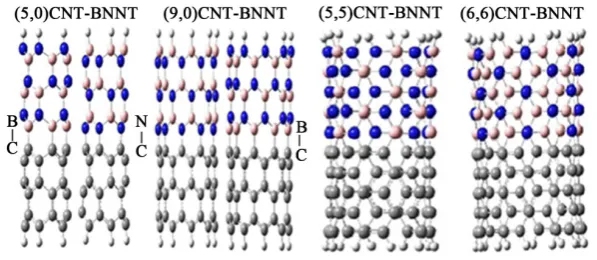
[image:2.595.88.540.617.719.2]We will investigate the adsorption of gas molecules, CO, CO2, NO and NO2 on the vacant site (above a center of a hexagon ring) of CNT-BNNT heterojunctions with different charilities and diameters (5,0) CNT-BNNT, (9,0) CNT-BNNT, (5,5) CNT-BNNT and (6,6) CNT-BNNT as shown in Figure 1 and Table 1. For zig-zag (5,0) CNT-BNNT and (9,0) CNT-BNNT heterojunctions have two ways of joining, first through forming C-B bonds and second through forming C-N bonds, see Figure 1. However, the (5,5) CNT-BNNT and (6,6) CNT-BNNT are joined through one way.
Table 1. The configuration structures of the studied CNT-BNNT heterojunctions.
System Configuration Structures
(5,0) CNT-BNNT C30B15N15H10 C30N15B15H10
(9,0) CNT-BNNT C54B27N27H18 C54N27B27H18
(5,5) CNT-BNNT C50B25N25H20
Figure 1. The fully optimized structures of (5,0), (9,0), (5,5) and (6,6) CNT-BNNT heterojunctions. Carbon atoms (gray), Nitrogen atoms (blue), Boron atom (pink) and hydrogen atoms (white).
3.1. Adsorption of CO, CO
2, NO and NO
2Gas Molecules on CNT-BNNT Heterojunctions
We have adsorbed CO, NO, CO2 and NO2 gas molecules vertically on the vacant site (above a center of a hex-agon ring) of (5,0), (9,0), (5,5) and (6,6) CNT-BNNT heterojunctions. The calculated adsorption energies of CO, NO, CO2 and NO2 are listed in Table 2. It is found that the best CNT-BNNT heterojunction for adsorbing the CO, NO, CO2 and NO2 gas molecules is (5,0) CNT-BNNT through forming C-N bonds with adsorption energy of −0.26 eV, −0.41 eV, −0.33 eV and −0.63 eV, respectively. Therefore, the (5,0) CNT-BNNT is considered to be the best heterojunction for adsorbing CO, NO, CO2 and NO2 gas molecules.
3.2. Energy Gaps of Adsorbed CO, CO
2, NO and NO
2Gas Molecules on
CNT-BNNT Heterojunctions
From Table 3, it is found that the adsorption of CO, NO, CO2 and NO2 gas molecules on (5,0), (5,5), (6,6) CNT-BNNT heterojunctions does not affect the electronic character of the CNT-BNNT heterojunctions, howev-er the adsorption of NO and NO2 gas molecules on (5,0) and (9,0) CNT-BNNT heterojunctions in case of form-ing C-B bonds is increased to 1.21 eV and 1.36 eV, respectively.
3.3. HOMO-LUMO Orbitals of Adsorbing CO, CO
2, NO and NO
2Gas Molecules on
CNT-BNNT Heterojunctions
Figure 2. HOMO and LUMO molecular orbitals of adsorbing CO and CO2 gas molecules on the (5,0), (9,0), (5,5)
and (6,6) CNT-BNNT heterojunctions. Energies of HOMO and LUMO are listed above the molecular orbitals and are given by eV.
Table 2. The calculated adsorption energies (Eads)of CO, NO, CO2 and NO2 above a vacant site of (5,0), (9,0), (5,5) and (6,6)
CNT-BNNT heterojunctions. All energies are given by eV.
CO NO CO2 NO2
Heterojunctions C-N C-B C-N C-B C-N C-B C-N C-B
(5,0) CNT-BNNT −0.26 −0.20 −0.41 −0.33 −0.33 −0.22 −0.63 −0.60
(9,0) CNT-BNNT −0.15 −0.05 −0.24 −0.12 −0.22 −0.25 −1.58 −0.40
(5,5) CNT-BNNT −0.15 −0.18 −0.20 −0.24
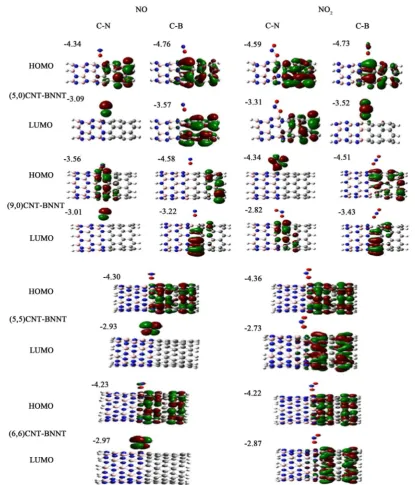
[image:4.595.92.538.641.722.2]Figure 3. HOMO and LUMO molecular orbitals of adsorbing NO and NO2 gas molecules on the (5,0), (9,0), (5,5)
and (6,6) CNT-BNNT heterojunctions. Energies of HOMO and LUMO are listed above the molecular orbitals and are given by eV.
3.4. The Reactivity of CNT-BNNT Heterojunction Surfaces before and after
Adsorbing Gas Molecules
vacant site of (5,0), (9,0), (5,5) and (6,6) CNT-BNNT heterojunctions. All dipole moments are given by Debye.
CNT-BNNT CO NO CO2 NO2
Heterojunctions C-N C-B C-N C-B C-N C-B C-N C-B C-N C-B
(5,0) CNT-BNNT 0.67 2.00 1.53 1.66 2.45 0.71 2.28 1.69 5.35 1.84
(9,0) CNT-BNNT 12.47 0.52 12.06 0.67 11.1 0.78 12.61 0.95 11.83 7.52
(5,5) CNT-BNNT 1.92 1.97 1.83 2.16 2.03
(6,6) CNT-BNNT 2.59 2.61 2.21 2.86 3.05
calculated and is listed in Table 4. The dipole moments of (5,5) and (6,6) CNT-BNNT heterojunctions are found to be 1.92 Debye and 2.59 Debye, respectively. The dipole moments of (5,0) and (9,0) CNT-BNNT heterojunc-tions through forming C-N bonds are found to be 0.67 Debye and 12.47 Debye and through forming C-B bonds are 2.0 Debye and 0.52 Debye, respectively.
Comparing the dipole moments of the CNT-BNNT heterojunctions with ones that the CO, CO2, NO and NO2 gas molecules are adsorbed, it is clear that the values of dipole moment do not change for armchair (5,5) and (6,6) CNT-BNNT heterojunctions. Also, for the zig-zag (5,0) and (9,0) CNT-BNNT heterojunctions, the values of dipole moment increase through forming C-N bonds and decrease through forming C-B bonds, see Table 4. Finally, one can report that the highest dipole moment is for (9,0) CNT-BNNT heterojunctions through forming C-N bonds.
4. Conclusion
The gas sensing behavior of CNT-BNNT heterojunctions, considering a range of different diameters and chirali-ties is reported. The adsorption of CO, CO2, NO, and NO2 gas molecules on the (5,0), (9,0), (5,5) and (6,6) CNT-BNNTs are studied using B3LYP/6-31 g(d, p). It is found that the best CNT-BNNT heterojunction for ad-sorbing the CO, NO, CO2 and NO2 gas molecules is (5,0) CNT-BNNT heterojunctions with adsorption energy of −0.26, −0.41 eV, −0.33 eV and −0.63 eV, respectively. It is reported that the adsorption of CO, NO, CO2 and NO2 gas molecules on (5,5) and (6,6) CNT-BNNT heterojunctions does not affect the electronic character of the CNT-BNNT heterojunctions, however the adsorption of NO and NO2 gas molecules on (5,0) and (9,0) CNT- BNNT heterojunctions in case of forming C-B bonds increases the band gaps to 1.21 eV and 1.52 eV, respec-tively. Also, it is noticed that the highest dipole moment is for (9,0) CNT-BNNT heterojunctions through form-ing C-N bonds.
References
[1] Ju, D., Xu, H., Xu, Q., Gong, H., Qiu, Z., Guo, J., Zhang, J. and Cao, B. (2015) High Triethylamine-Sensing Properties of NiO/SnO2 Hollow Sphere P-N Heterojunction Sensors. Sensors and Actuators B: Chemical, 215, 39-44.
http://dx.doi.org/10.1016/j.snb.2015.03.015
[2] Hu, Y., Zhou, X., Han, Q., Cao, Q. and Huan, Y. (2003) Sensing Properties of CuO-ZnO Heterojunction Gas Sensors. Materials Science and Engineering: B, 99, 41-43. http://dx.doi.org/10.1016/S0921-5107(02)00446-4
[image:6.595.93.538.111.190.2] [image:6.595.90.539.227.329.2]Chem-ical, 181, 417-423. http://dx.doi.org/10.1016/j.snb.2013.01.056
[4] Feng, C., Li, X., Ma, J., Sun, Y., Wang, C., Sun, P., Zheng, J. and Lu, G. (2015) Facile Synthesis and Gas Sensing Properties of In2O3-WO3 Heterojunction Nanofibers. Sensors and Actuators B: Chemical, 209, 622-629.
http://dx.doi.org/10.1016/j.snb.2014.12.019
[5] Ling, Z. and Leach, C. (2004) The Effect of Relative Humidity on the NO2 Sensitivity of a SnO2/WO3 Heterojunction
Gas Sensor. Sensors and Actuators B: Chemical, 102, 102-106. http://dx.doi.org/10.1016/j.snb.2004.02.017
[6] Gui, Y., Dong, F., Zhang, Y., Zhang, Y. and Tia, J. (2013) Preparation and Gas Sensitivity of WO3 Hollow
Micro-spheres and SnO2 Doped Heterojunction Sensors. Materials Science in Semiconductor Processing, 16, 1531-1537.
http://dx.doi.org/10.1016/j.mssp.2013.05.012
[7] Zhang, Y., Gu, H., Suenaga, K. and Iijima, S. (1997) Heterogeneous Growth of B-C-N Nanotubes by Laser Ablation. Chemical Physics Letters, 279, 264. http://dx.doi.org/10.1016/S0009-2614(97)01048-8
[8] Suenaga, K., Colliex, C., Demoncy, N., Loiseau, A., Pascard, H. and Willaime, F. (1997) Synthesis of nanoparticles and nanotubes with well-separated layers of boron nitride and carbon. Science, 278, 653.
http://dx.doi.org/10.1126/science.278.5338.653
[9] Liu, H.X., Zhang, H.M., Song, J.X. and Yong, Z.Z. (2010) Electronic transport properties of an (8, 0) carbon/boron ni-tride nanotube heterojunction. Chiniese Physics B, 19, 037104. http://dx.doi.org/10.1088/1674-1056/19/3/037104
[10] Iijima, S. (1991) Helical Microtubules of Graphitic Carbon. Nature, 354, 56. http://dx.doi.org/10.1038/354056a0
[11] Saito, R., Dresselhaus, G. and Dresselhaus, M.S. (1998) Physical Properties of Carbon Nanotubes. Imperial College Press, London.
[12] Zhao, P., Wang, P.J., Zhang, Z., Fang, C.F., Wang, Y.M., Zhai, Y.X. and Liu, D.S. (2009) Electronic Transport Prop-erties of DTE-Based Molecular Switch with SWCNT Electrodes: Effect of Chirality. Solid State Communications, 149, 928-931. http://dx.doi.org/10.1016/j.ssc.2009.03.027
[13] Zhao, P., Wang, P.J., Zhang, Z. and Liu, D.S. (2010) Negative Differential Resistance in a Carbon Nanotube-Based Molecular Junction. Physics Letters A, 374, 1167-1171. http://dx.doi.org/10.1016/j.physleta.2009.12.047
[14] Blase, X., Rubio, A., Louie, S.G. and Cohen, M.L. (1994) Stability and Band Gap Constancy of Boron Nitride Nano-tubes. Europhysics Letters (EPL), 28, 335-340. http://dx.doi.org/10.1209/0295-5075/28/5/007
[15] Rubio, A., Corkill, J.L. and Cohen, M.L. (1994) Theory of Graphitic Boron Nitride Nanotube. Physical Review B, 49, 5081-5084. http://dx.doi.org/10.1103/PhysRevB.49.5081
[16] Chernozatonskii, L.A., Galpern, E.G., Stankevich, I.V. and Shimkus, Y.K. (1999) Nanotube C-BN Heterostructures: Electronic Properties. Carbon, 37, 117-121. http://dx.doi.org/10.1016/S0008-6223(98)00194-8
[17] Golberg, D., Bando, Y., Mitome, M., Kurashima, K., Grobert, N., Reyes-Reyes, M., Terrones, H. and Terrones, M. (2002) Nanocomposites: Synthesis and Elemental Mapping of Aligned B-C-N Nanotubes. Chemical Physics Letters, 360, 1-7. http://dx.doi.org/10.1016/S0009-2614(02)00783-2
[18] Lambin, Ph., Fonseca, A., Vigneron, J.P., Nagy, J.B. and Lucas, A.A. (1995) Structural and Electronic Properties of Bent Carbon Nanotubes. Chemical Physics Letters, 245, 85-89. http://dx.doi.org/10.1016/0009-2614(95)00961-3
[19] Zhang, Z.H., Guo, W.L. and Tai, G. (2007) Coaxial Nanotubes: Carbon Nanotubes Sheathed with Boron Nitride Na-notubes. Applied Physics Letters, 90, Article ID: 133103. http://dx.doi.org/10.1063/1.2714997
[20] Enyashin, A.N. and Ivanovskii, A.L. (2005) Mechanical and Electronic Properties of a C/BN Nanocable under Tensile Deformation. Nanotechnology, 16, 1304-1310. http://dx.doi.org/10.1088/0957-4484/16/8/054
[21] Kawaguchi, M. (1997) B/C/N Materials Based on the Graphite Network. Advanced Materials, 9, 615-625.
http://dx.doi.org/10.1002/adma.19970090805
[22] Azevedo, S., de Paiva, R. and Kaschny, J.R. (2006) Stability and Electronic Structure of BxNyCz Nanotubes. Journal of
Physics: Condensed Matter, 18, 10871-10879. http://dx.doi.org/10.1088/0953-8984/18/48/014
[23] Kim, S.Y., Park, J., Choi, H.C., Ahn, J.P., Hou, J.Q. and Kang, H.S. (2007) X-Ray Photoelectron Spectroscopy and First Principles Calculation of BCN Nanotubes. Journal of the American Chemical Society, 129, 1705-1716.
http://dx.doi.org/10.1021/ja067592r
[24] Blase, X., Charlier, J.-C., De Vita, A. and Car, R. (1997) Theory of Composite BxCyNz Nanotube Heterojunctions.
Ap-plied Physics Letters, 70, 197. http://dx.doi.org/10.1063/1.118354
[25] Liu, H.X., Zhang, H.M., Song, J.X. and Yong, Z.Z. (2010) Electronic Transport Properties of an (8, 0) Carbon/Boron Nitride Nanotube Heterojunction. Chinese Physics B, 19, Article ID: 037104.
http://dx.doi.org/10.1088/1674-1056/19/3/037104
[29] El-Barbary, A.A., Eid, Kh.M., Kamel, M.A. and Hassan, M.M. (2013) Band Gap Engineering in Short Heteronanotube Segments via Monovacancy Defects. Computational Materials Science, 69, 87-94.
http://dx.doi.org/10.1016/j.commatsci.2012.10.035
[30] EL-Barbary, A.A., Ismail, G.H. and Babeer, A.M. (2013) Effect of Monovacancy Defects on Adsorbing of CO, CO2,
NO and NO2 on Carbon Nanotubes: First Principle Calculations. Journal of Surface Engineered Materials and
Ad-vanced Technology, 3, 287-294. http://dx.doi.org/10.4236/jsemat.2013.34039
[31] Hindi, A. and EL-Barbary, A.A. (2015) Hydrogen Binding Energy of Halogenated C40 Cage: An Intermediate between
Physisorption and Chemisorption. Journal of Molecular Structure, 1080, 169-175.
http://dx.doi.org/10.1016/j.molstruc.2014.09.034
[32] EL-Barbary, A.A. (2015) 1H and 13C NMR Chemical Shift Investigations of Hydrogenated Small Fullerene Cages Cn,
CnH, CnHn and CnHn+1: n = 20, 40, 58, 60. Journal of Molecular Structure, 1097, 76-86.
http://dx.doi.org/10.1016/j.molstruc.2015.05.015
[33] E EL-Barbary, A.A., Eid, Kh.M., Kamel, M.A., Osman, H.M. and Ismail, G.H. (2014) Effect of Tubular Chiralities and Diameters of Single Carbon Nanotubes on Gas Sensing Behavior: A DFT Analysis. Journal of Surface Engineered Materials and Advanced Technology, 4, 66-74. http://dx.doi.org/10.4236/jsemat.2014.42010
[34] Chang, H., Lee, J.D., Lee, S.M. and Lee, Y.H. (2001) Adsorption of NH3 and NO2 Molecules on Carbon Nanotubes.