2018 International Conference on Information, Electronic and Communication Engineering (IECE 2018) ISBN: 978-1-60595-585-8
Resident Program Applied in a Test System Chinesization
Xia FANG
*, Li-na WANG and Jie ZHANG
Naval Aeronautical University, Yantai 264001 China
*Corresponding author
Keyword: Chinesization, Terminate and stay resident, Test system, Missile.
Abstract.This paper focus on a real-time mechanism of Chinesization for a particular missile test system based on memory-resident program TSR. This work aims at resolving problems brought by an alien test system of a missile. By analyzing systematic features of the test system, a real-time Chinesization scheme is introduced, which improves the rapidity and dependability of missile test and enhances further guarantee of technical preparation for missile system.
Introduction
Memory-resident program TSR (Terminate and Stay Resident),as a special application[1], is often used during software development, which is usually loaded into memory and reside there and activated again into running state under certain condition. The core feature of resident program is that it will be reactivated by users or system for some mechanisms to complete corresponding function and then return control to original interrupted program. Early application of resident program is in allusion to the limit of single task under DOS. The resident program can be selectively activated to complete additional function which the original program does not have by interrupting the running original program. Because of running in the background, resident program is particularly suitable for background operation, pop-up windows, hotkeys and so on, which is used more and more widely and deeply.
According to the Chinesization of test system of a certain missile [2] from abroad, by means of systemic analysis of the test system both from software and hardware perspective, this paper presents a real-time Chinesization scheme based on resident program. This work resolves the language barrier to test staff and improves work efficiency so that giving full play to the operational performance of the weaponry.
Analysis of Chinesization Technology
Chinesization, broadly called localization refers to the process of conversion of language-related modules in software such as text, menu, dialogue boxes, buttons etc., from foreign language to Chinese without affecting original functions, by certain technical means.
The basic approach of localization is finding foreign language related information in the software needed to be converted firstly, exacting the above information and translating it into Chinese which is used to replace the former foreign information and show in the software during running time. According to different objects and methods of localization, technologies of localization are mainly divided into three types as follows.
Modifying the Binary Code
language leads to problems such as different coding length and forms, which causes inaccurate localization results.
Modifying Resource Files
This method is mainly for software on the Windows platforms. Windows platform software are mostly developed by current high-level programming languages, including special resource files which contains images, text, strings and are read by special interfaces. The resource files usually accord with common international standards, which can be read and modified by compiler software such as Visual C++, Borland C++, to translate foreign language to Chinese. This work requires well familiar with structures, format and information composition of the resource files, and brings much more difficulty to substantial work [4].
Real-time Plug-in for Localization
This method is also mainly for software on the Windows platforms. Windows operating systems are based on massaging between different programs and HOOK in Windows operating system can intercept messages between system and applications. The message about display of programs can be intercepted by HOOK and translated into Chinese meanwhile [5], and then passed to applications or system to complete showing normally, so as to achieve purpose of localization. This method makes real-time localization while the application is running, compared to the above two methods. The mainstream plugins for localization mostly adopt the real-time method, which yet can mostly only be used on the Windows platform and in English application. Thus this approach is not effective in applications on other system platform especially in applications for weaponry which have a mass of terminologies.
Background of Application
Many missiles of our country are from abroad at present, which are developed by foreign countries both for hardware and software in foreign language of original countries. The test system of the missile system is one of the most important modules, which is mainly used to check out the missile by computer automatically to test whether the technical parameters and tactical performance of the missile is in normal state to meet the combat need or not, especially before loading to the ship or after repair. The test of the missile is the essential step in the process of technical preparation of the missile system that directly determines the reliability and validity of the missile battle effective.
A certain type missile is imported from Russia, which has Russian interface for the test system. In practical application the Russian interface brings difficulty to not only the site operation but also the parameters recording, as well as operational errors because of language puzzles, which affects the normal performance of the missile and indeed leads to unpredictable consequences. Therefore, operators of the test system need pre-employment training of Russia in order to operate the Russian test system masterly for functional testing, failure analysis and trouble exclusion, which increases the difficulty, cost and time of training. Although all the above make out the urgent needs of the Chinesization for the software modules in weaponry imported from aboard, because of the sensitiveness in military especially in weaponry, countries keep the Chinesization for weaponry secret and non-communication exists among countries.
Schematic Design
Formulation of the Chinesization Scheme
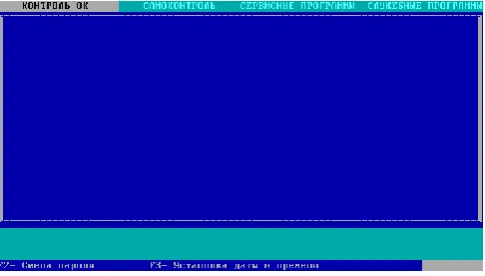
[image:3.595.177.420.124.262.2]Russian in the test system mainly appear in help files and user interface, such as the main interface of the system when it starts, which is shown in Figure 1 .
Figure 1. Main interface of the test system.
The whole process of Chinesization carry out along the flow as follows, by comparing and analyzing the existing technology of Chinesization combined with the characteristic of MS-DOS.
First of all, encoding method of Russian character is recognized according to character encoding theory, and mapping relationship between every Russian item and corresponding Chinese item is established.
Then, a memory resident program is added into the test system running on Chinese MS-DOS platform, and when any text item is needed to be displayed Russian strings will be converted into Chinese strings by the mapping relationship mentioned above when something is needed to display on the computer screen. This way minimizes the risk of the test system by converting the interface from Russian to Chinese without modifying the original executable file of the test system.
Establishment of the Development Environment
Because of the host dependence of the test system, the test system can run on any standard MS-DOS platform, thus VMware, a virtual machine software that can stimulate the hardware environment of PC to run operating system, is used to establish a virtual running platform to stimulate the platform of the test system in order to run the test system conveniently. A standard MS-DOS system is installed in the VMware to import the relevant documents of the test system.
The test system runs on a GETAC 770 computer in the actual missile system, thus, besides the virtual software environment established in VMware at the early of system analysis, a real hardware environment on GETAC is also built at the post implementation stage.
Key Steps
Build Character Code Set
Character set is a collection of characters. All Russian characters builds the Russian Character Set. Character Encoding is applied to transfer binary data to characters, which is used in computer inside. Coding criterion is a corresponding relationship between internal code recognized by computer and character recognized by human. DOS operating system only shows characters in ASCII (American Standard Code for Information Interchange) which does not include Russian characters. So an extended ASCII is adopted to display ASCII by a plugin in order to display Russian characters.
Russian character set used in the test program is determined eventually, and the coding rule of the Russian characters is also gained.
Build Mapping Dictionary
Mapping dictionary should include all the characters displayed on the screen during the test program running time, as well as codings, the completeness of which determines the Chinesization result. Consequently, the establishment of the mapping dictionary is the kernel problem. After investigation during the preliminary research and analysis about the structure of source program and the testing system, this conclusion is obtained that the displayed strings come from data segments in the program during the sunning process. The data segments conclude several necessary variables and strings which will be displayed. So firstly all the running flows should be tested to find all the strings that will be displayed, and secondly IDA pro as well as Ultra Edit can be used to find all the data segments in the source program to find strings. The mapping dictionary can be built by these two methods and improved by the TSR subsequently.
Design of the Real-time Chinesization Resident Program
The 10H interrupt handler in MS-DOS operating system will be called when text item is displayed. The character codes of the text items are written into the display buffer storage to search in the Chinese storage and finally showed on the screen. In order to ensure the integrality of the test program without modification, the scheme adopts TSR to achieve Chinesization during the running of the test program as showed in Figure 2.
TSR initializati
on and waiting for
activation
activate the TSR Trigger the 10th
interruption real-time Chinesization mapping dictionary release control
improve mapping dictionary
1.suspend the 10th interruption 2.gain Russian display information3.replace with Chinese display information
[image:4.595.110.486.380.505.2]start-up
Figure 2. The flow of the TSR.
Load and Initialization of the Resident Program
The file named Autoexec.bat in the test system is modified to make the resident program in the file named Trans.com to start with the test system. The resident program completes the preparation of the Chinesization including load in the Chinese and Russian mapping dictionary, load in interrupt monitoring module to stand by monitoring the interrupt whether the int 10 interrupt is called or not.
The Activation of Resident Program
The resident program will be activated when the system calls the 10H interrupt [6], which takes the length of the string to be shown in parameters register CX and the address of the string to be shown in parameters register BP from the 10H interrupt handlers. According to the information above the resident program can get the code of Russian strings and then change it into Chinese code based on the mapping dictionary by matching algorithm. In the end the Chinese codes take place of the Russian code by written into the original address in register BP.
The Exit Mechanism of the Resident Program
The control is returned from the resident program back to the 10H interrupt handler to complete the subsequent process of the display after the Russian string is replaced by Chinese.
the dictionary, otherwise a hints will show to the user that the string does not exist in the dictionary, and the unfound Russian string can be added into the dictionary as well as the corresponding Chinese string. This way can be used repeatedly again and again to find as many unknown strings as possible by running all the possible functional flows to perfect the mapping dictionary until no hints shows.
Summary
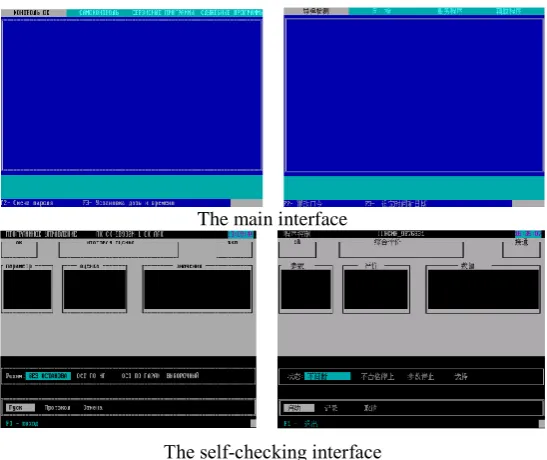
After the Chinesization, the test system ran under simulation environment firstly, and carried on real environment then to test the result of Chinesization for subsequent redaction and improvement to guarantee the test system runs safely, effectively and stably. The above test proves that the test system can be carried on normally under simulation environment. The main interface and self-checking interface both in Chinese and Russian shown in Figure 3.
The main interface
[image:5.595.161.435.249.479.2]
The self-checking interface
Figure 3. The main interface and self-checking interface both in Chinese and Russian.
The result of this study contributes a lot to expand development of existing equipment, improve combat support ability for troops, which has popular usefulness with broad prospects that means a lot to our army building economic sense and military significance for our country. The current research on Chinesization only points at the test system of a certain type of missile, which is too special to apply to other equipment imported from abroad. There is still some further work to do including extending map dictionary, modifying the batch file and so on. Furthermore, application for other system that is different from the DOS in mechanism may need overall adjustment of the existing idea for Chinesization.
References
[1] Zhang Shusen, Ling Xiang. Method and design of interface chinesization of foreign equipment[J]. Electronic Measurement Technology. 2017(3):68-71.
[2] Wang Jia-hua, Cheng Shun-shun. Research on Qt-Based Software Interface Technology of Chinese Localization[J]. Computer Technology and Development.2011(3):146-149.
[3] Li Shun-fen, Han Xiu-ling, etc. The Research and implementation of Qtopia’s chinesization[J]. Microcomputer Information.2010(35):72-74.
[5] Xu Zhi-yue. Design for missile test system based on VI[J]. Computer Engineering and Applications. 2007(16):225-227.