R E S E A R C H
Open Access
Eigenvalues of the resistance-distance
matrix of complete multipartite graphs
Kinkar Chandra Das
1and Yujun Yang
2**Correspondence: [email protected] 2School of Mathematics and Information Science, Yantai University, Yantai, 264005, P.R. China Full list of author information is available at the end of the article
Abstract
LetG= (V,E) be a simple graph. The resistance distance betweeni,j∈V, denoted by rij, is defined as the net effective resistance between nodesiandjin the
corresponding electrical network constructed fromGby replacing each edge ofG with a resistor of 1 Ohm. The resistance-distance matrix ofG, denoted byR(G), is a |V| × |V|matrix whose diagonal entries are 0 and fori=j, whoseij-entry isrij. In this paper, we determine the eigenvalues of the resistance-distance matrix of complete multipartite graphs. Also, we give some lower and upper bounds on the largest eigenvalue of the resistance-distance matrix of complete multipartite graphs. Moreover, we obtain a lower bound on the second largest eigenvalue of the resistance-distance matrix of complete multipartite graphs.
Keywords: resistance distance; resistance-distance matrix; largest
resistance-distance eigenvalue; second largest resistance-distance eigenvalue
1 Introduction
Throughout the paper we consider only simple graphs, that is, graphs without loops and multi-edges. LetG= (V,E) be a connected graph with a vertex setV={, , . . . ,n}and an edge setE=E(G). The resistance distance [] between any two verticesiandj, denoted byrij, is defined as the net effective resistance between nodesiandjin the corresponding electrical network constructed fromGby replacing each edge with a resistor of Ohm. The resistance-distance matrix ofG, denoted byR(G), is a|V|×|V|matrix whose diagonal entries are and fori=j, whoseij-entry isrij. Letρ≥ρ≥ · · · ≥ρndenote the eigenvalues ofR(G). They are usually called the resistance-distance eigenvalues ofG. In recent years, much study has been done on resistance distances. For more information, the readers are referred to most recent papers [–] and the references therein. In this paper, we study the resistance-distance matrix of complete multipartite graphs. The paper is organized as follows. In Section , we compute resistance distances in complete multipartite graphs. In Section , we determine the eigenvalues of the resistance distance matrix of complete multipartite graphs. In Section , we give some lower and upper bounds on the largest eigenvalue of the resistance-distance matrix of complete multipartite graphs. In Section , we obtain a lower bound on the second largest eigenvalue of the resistance-distance matrix of complete multipartite graphs.
2 Resistance distances in complete multipartite graphs
In this section, we compute resistance distances between any pair of vertices in the com-plete multipartite graphKn,n,...,nk via electrical network approach. Recall thatGis a
com-pletek-partite graph if the vertex setVcan be partitioned intokpartsV,V, . . . ,Vksuch thatuv∈E(G) if and only ifuandvare in different parts. If|Vi|=ni(i= , , . . . ,k), then
Gis denoted byKn,n,...,nk. The following two lemmas play essential roles further.
Lemma .([]) Let i,j be vertices of G satisfying that they have the same neighborset N in V/{i,j}.Then
rij= ⎧ ⎨ ⎩
|N|+ if ij∈E(G),
|N| otherwise.
()
Lemma .([] (The reduction principle)) If S⊂V satisfies that all vertices in S have the same neighborset N in G–S.Let H be the graph obtained from G[S∪N]by deleting all the edges between vertices in N.Then the resistance distance between any two vertices of S in G is the same as the resistance distance between them in H.
Now we are ready to give the main result of this section.
Theorem . Resistance distances in Kn,n,...,nkcan be computed as follows:
ruv= ⎧ ⎨ ⎩
n–ni if u,v∈Vi,
(n–)(n–ni–nj)
n[n–(n
i+nj)n+ninj] if u∈Vi,v∈Vj,and i=j.
()
Proof Foru,v∈Vi, it is easily seen thatuandvhave the same neighborsetNwith|N|=
n–ni. Hence, by Lemma ., we have
ruv=
n–ni ,
as required.
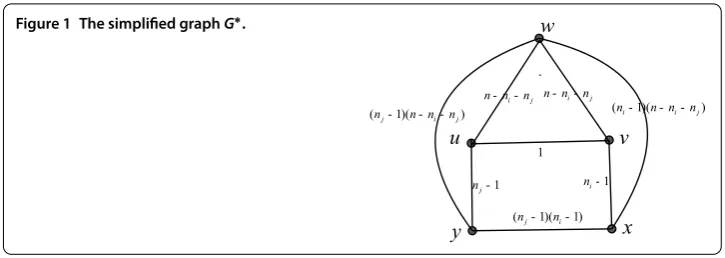
Now suppose thatu∈Viandv∈Vj. LetS=Vi∪VjandN=V–S. LetG∗be the graph obtained fromKn,n,...,nk by deleting all the edges between vertices inN. Then, by the
re-duction principle, the resistance distance between u andvin Kn,n,...,nk is equal to the
Figure 1 The simplified graphG∗.
Now apply a unit potential acrossuandvinN and suppose the absolute potentials of
u,v,x,y,wareVu= ,Vv= ,Vx,Vy,Vw, respectively. Then, by Kirchhoff ’s laws, we have (Vx–Vy)cxy+ (Vx–Vv)cxv+ (Vx–Vw)cxw= ,
(Vy–Vx)cxy+ (Vy–Vu)cyu+ (Vy–Vw)cyw= ,
(Vw–Vu)cwu+ (Vw–Vx)cxw+ (Vw–Vy)cyw+ (Vw–Vv)cwv= . Then simple calculation shows that
Vx=
(ni– )(nj– )Vy+ (ni– )(n–ni–nj)Vw
ni– + (ni– )(nj– ) + (ni– )(n–ni–nj)
, ()
Vy=
nj– + (ni– )(nj– )Vx+ (nj– )(n–ni–nj)Vw
nj– + (ni– )(nj– ) + (nj– )(n–ni–nj)
, ()
Vw=
n–ni–nj+ (ni– )(n–ni–nj)Vx+ (nj– )(n–ni–nj)Vy (n–ni–nj) + (ni– )(n–ni–nj) + (nj– )(n–ni–nj)
. ()
Solving the above linear system, we get
Vx=
n(nj– ) + (n– )(n–ni–nj) (n–ni–nj)(n– )
,
Vy=
n(n–ni) (n–ni–nj)(n– )
,
Vw=
n–ni n–ni–nj
.
Denote the total current flows fromutovbyI. Then, by Ohm’s law, we have
ruv=
Vu–Vv
I =
–
I
=
(Vu–Vw)(n–ni–nj) + (Vu–Vy)(nj– ) + (Vu–Vv)×
=
( – n–ni
n–ni–nj)(n–ni–nj) + [ –
n(n–ni)
(n–ni–nj)(n–)](nj– ) +
= (n– )(n–ni–nj)
n[n– (n
i+nj)n+ninj] ,
Remark It should be mentioned that resistance distances in complete multipartite graphs have also been determined in [] via an alternative method.
By Theorem ., for simplicity, in the following, we userito denote the resistance dis-tance between any two vertices inVi, and userijto denote the resistance distance between anyu∈Viandv∈Vj. Thus the resistance-distance matrixR(Kn,n,...,nk) ofKn,n,...,nk is
⎛ ⎜ ⎜ ⎜ ⎜ ⎝
rJn,n–rIn rJn,n rJn,n . . . rkJn,nk
rJn,n rJn,n–rIn rJn,n . . . rkJn,nk
..
. ... ... . . . ...
rkJnk,n rkJnk,n rkJnk,n . . . rkJnk,nk–rkInk
⎞ ⎟ ⎟ ⎟ ⎟ ⎠,
whereJstdenotes thes×tmatrix of all ones,Ildenotes the identity matrix of orderl. In what follows, we always writeR(Kn,n,...,nk) toRfor short.
3 The eigenvalues of the resistance-distance matrix of complete multipartite graphs
In this section we obtain the eigenvalues of the resistance-distance matrix of complete
k-partite graphsKn,n,...,nk.
Theorem . Let G be a complete k-partite graph Kn,n,...,nkon n vertices.Then the
char-acteristic polynomial of R is
RG(x) =det(xIn–R) = k
i=
(x+ri)ni–|xIk–D|,
where
D= ⎛ ⎜ ⎜ ⎜ ⎜ ⎝
(n– )r nr nr · · · nkrk
nr (n– )r nr · · · nkrk ..
. ... ... . .. ...
nrk nrk nrk · · · (nk– )rk ⎞ ⎟ ⎟ ⎟ ⎟
⎠. ()
Proof As given above, the resistance-distance matrix ofKn,n,...,nk is
R=
⎛ ⎜ ⎜ ⎜ ⎜ ⎝
rJn,n–rIn rJn,n rJn,n . . . rkJn,nk
rJn,n rJn,n–rIn rJn,n . . . rkJn,nk
..
. ... ... . . . ...
rkJnk,n rkJnk,n rkJnk,n . . . rkJnk,nk–rkInk
⎞ ⎟ ⎟ ⎟ ⎟ ⎠.
Hence, by linear algebra knowledge,
RG(x) =det(xIn–R)
=
(x+r)In–rJn,n –rJn,n –rJn,n . . . –rkJn,nk
–rJn,n (x+r)In–rJn,n –rJn,n . . . –rkJn,nk
..
. ... ... . . . ...
–rkJnk,n –rkJnk,n –rkJnk,n . . . (x+rk)Ink–rkJnk,nk
=
k
i=
(x+ri)ni–
x– (n– )r –nr –nr · · · –nkrk
–nr x– (n– )r –nr · · · –nkrk
..
. ... ... . .. ...
–nrk –nrk –nrk · · · x– (nk– )rk .
This completes the proof.
Corollary . Let G=Kn,n,...,nk.Then the eigenvalues for the resistance-distance matrix
of G are–riof multiplicity ni– (i= , , . . . ,k)and the remaining eigenvalues satisfy the
following:
|xIk–D|= ,
where Dis given by().
Corollary . The largest eigenvalue of the resistance-distance matrix of complete k-partite graph Kn,n,...,nk is given by
|xIk–D|= .
4 Lower and upper bounds on the largest eigenvalue of the resistance-distance matrix of complete multipartite graphs
In this section we give some lower and upper bounds onρ(G) of completek-partite graph
Kn,n,...,nk. For this we need the following two results.
Lemma .([]) If q,q, . . . ,qnare positive numbers,then min
i
pi
qi ≤
p+p+· · ·+pn
q+q+· · ·+qn ≤ max
i
pi
qi
for any real numbers p,p, . . . ,pn.Equality holds on both sides if and only if all the ratios pi
qi are equal.
Now we obtain the spectral radius for the resistance-distance matrix ofKn,n,...,n. Lemma . Let G be a complete k-partite graph Kn,n,...,nof order n.Then
ρ(G) =
n–n
n– +
n(k– )(n– )
n
.
Furthermore,all the remaining eigenvalues are– n–nand–
n,with multiplicities n–k and
k– ,respectively.
Proof For G=Kn,n,...,n, by Theorem ., we have ri =
n–n (i = , , . . . ,k) andrij =
n– n (
n–n+
n–n) for alliandj,i=j. Since
D= ⎛ ⎜ ⎜ ⎜ ⎜ ⎝
(n– )r nr nr · · · nr
nr (n– )r nr · · · nr
..
. ... ... . .. ...
it is easily obtained that the eigenvalues ofDare
(n– )r+ (k– )r, (n– )r–nr, . . . , ( n– )r–nr k–
.
Simple calculation shows that
(n– )r+ (k– )r=
n–n
n– +
n(k– )(n– )
n
and (n– )r–nr= –
n.
Thus it follows that
ρ(G) =
n–n
n– +
n(k– )(n– )
n
.
Together with the result in Theorem ., we conclude that eigenvalues other thanρ(G)
are
–
n, . . . , –
n
k–
, –
n–n
, . . . , –
n–n
n–k
.
Theorem . Let G be a complete k-partite graph Kn,n,...,nk of order n with n≥n≥
· · · ≥nk.Then
n–nk
nk– +
nk(k– )(n– )
n
≤ρ(G)≤
n–n
n– +
n(k– )(n– )
n
. ()
Moreover,the equality holds in both sides if and only if n=n=· · ·=nk.
Proof Let x = (x,x, . . . ,xn)Tbe an eigenvector corresponding to the eigenvalueρ(G) of
D. Then we have
Dx=ρ(G)x. ()
From theith equation of (), we get
ρ(G)xi= (ni– )rixi+ k
j=,j=i
njrijxj
=(ni– )
n–ni
xi+
n–
n
k
j=,j=i
n–ni
+
n–nj
njxj
≥(nk– )
n–nk
xi+
(n– )
n(n–nk) k
j=,j=i
njxj asni,nj≥nk. ()
Taking summation on both sides fromi= tok, we get
ρ(G) k
i=
xi≥
(nk– )
n–nk k
i=
xi+
(n– )(k– )
n(n–nk) k
i=
By Lemma ., we get
k i=nixi k
i=xi
≥nk. ()
From the above two results, we get
ρ(G)≥
(nk– )
n–nk
+(n– )(k– )
n(n–nk)
nk=
n–nk
nk– +
nk(k– )(n– )
n
.
Sinceni,nj≤nand k
i=nixi k
i=xi ≤n,
similarly, from the above, we get
ρ(G)≤
n–n
n– +
n(k– )(n– )
n
.
First part of the proof is done.
Now suppose that the left-hand side equality holds in (). Then all the inequalities above must be equalities. From the equality in (), we getn=n=· · ·=nk. From the equality in (), we getn=n=· · ·=nk. Similarly, if the right-hand side equality holds in (), then we haven=n=· · ·=nk.
Conversely, letG∼=Kn,n,...,n. By Lemma ., equalities on both sides hold in ().
Now we give another upper bound onρ(G) of completek-partite graphKn,n,...,nk.
Theorem . Let G be a complete k-partite graph Kn,n,...,nk of order n with n≥n≥
· · · ≥nk.Then
ρ(G)≤
(n– )
n–n
+ n(n– )
(k– )
n(n–n)(nk– )
–(n– )(n–n)
n(n– )
+(n– )(n–nk)(k– )
n(nk– )
–(n– )
n–n
+ n(n– ) (n–n)
()
with equality holding if and only if n=n=· · ·=nk.
Proof Let x = (x,x, . . . ,xn)Tbe an eigenvector corresponding to the eigenvalueρ(G) of
C–D
C, whereC= diag((n– )r, (n– )r, . . . , (nk– )rk). Then we have
C–DCX=ρ(G)X. ()
We can assume thatxi= andxk≤ for allk. From theith equation of (), we get
ρ(G)xi= (ni– )rixi+ k
j=,j=i
(nj– )rjnjrij (ni– )ri
that is,
ρ(G)≤(ni– )ri+ k
j=,j=i
(nj– )rjnjrij (ni– )ri
()
=(ni– )
n–ni +
k
j=,j=i
(n– )(nj– )nj
n(ni– )
n–nj
+ n–ni (n–nj)
. ()
Since
nj(nj– )
n–nj
= –n–nj+
n(n– )
n–nj and
nj(nj– ) (n–nj)
= –n–
n–nj
+ n(n– ) (n–nj) ,
from (), we get
ρ(G)≤
(ni– )
n–ni
+ n–
n(ni– ) k
j=,j=i
–n–nj+
n(n– )
n–nj
+(n– )(n–ni)
n(ni– )
× k
j=,j=i
–n–
n–nj
+ n(n– ) (n–nj)
.
Since
f(x) =n(n– ) (n–x) –
n– (n–x)
is an increasing function onx, from the above, we get
ρ(G)≤
(ni– )
n–ni
+ n–
n(ni– )
–(n– )(k– ) – (n–ni) +
n(n– )(k– )
n–n
+(n– )(n–ni)
n(ni– )
–n–
n–n
+ n(n– ) (n–n)
(k– )
=(ni– )
n–ni
+n(n– )
(k– )
n(n–n)(ni– )
–(n– )(n–ni)
n(ni– ) +(n– )(n–ni)(k– )
n(ni– )
–(n– )
n–n
+ n(n– ) (n–n)
. ()
Let us consider a function
g(x) = –(n– )
n–x +
n(n– )
(n–x), ≤x≤n– .
Then
g(x) = (n–x)
Thereforeg(x)≥g() = . Since
n–n
n–
≤n–ni
ni–
≤n–nk
nk–
andnk≤ni≤n(≤i≤k), from (), we get
ρ(G)≤
(n– )
n–n
+ n(n– )
(k– )
n(n–n)(nk– )
–(n– )(n–n)
n(n– )
+(n– )(n–nk)(k– )
n(nk– )
–(n– )
n–n
+ n(n– ) (n–n)
, ()
which gives the required result in (). First part of the proof is done.
Now suppose that equality holds in (). Then all the inequalities above must be equali-ties. From equality in (), we getx=x=· · ·=xk. From equality in (), we getn=n= · · ·=ni–=ni+=· · ·=nk. From equality in (), we getni=n=nk. From these results we conclude thatn=n=· · ·=nk.
Conversely, letn=n=· · ·=nk. Thenn=nk. Now,
(n– )
n–n
+n(n– )
(k– )
n(n–n)(n– )
–(n– )(n–n)
n(n– )
+(n– )(n–n)(k– )
n(n– ) ×
–(n– )
n–n
+ n(n– ) (n–n)
=(n– )
n–n
+ (n– )
n(n– )
–(n– )(n–n)
n(n– )
+(n– )(k– )
k(n– )
×n(n– )
(n–n)
=(n– )
n–n
+(n– )
n =ρ(G), by Lemma ..
5 Lower bound on the second largest eigenvalue of the resistance-distance matrix of complete multipartite graphs
In this section we find a lower bound on the second largest eigenvalue of the resistance-distance matrix of complete multipartite graphs. For this we need the following result.
Lemma .([]) Let A be a p×p symmetric matrix,and let Ak be its leading k×k
submatrix;that is,Ak is the matrix obtained from A by deleting its last p–k rows and
columns.Then,for i= , , . . . ,k,
λp–i+(A)≤λk–i+(Ak)≤λk–i+(A), ()
whereλi(A)is the ith largest eigenvalue of A.
Theorem . Let G be a complete k-partite graph Kn,n,...,nk of order n with n≥n≥
· · · ≥nk.Then
ρ(G)≥ max ≤i<j≤k
(n+ )(ni+nj) – (n+ninj) (n–ni)(n–nj)
–(n– )(ni+nj) (n–ni)(n–nj) ×
+ninj
n
– ninj
n(ni+nj)
Proof By Lemma ., we haveρ(G)≥max≤i<j≤kρandρ(G)≥max≤i<j≤kρ, whereρ
andρare given by
(ni– )ri–ρ njrij
nirij (nj– )rj–ρ = ,
that is,
ρ–(ni– )ri+ (nj– )rj
ρ+ (ni– )(nj– )rirj–ninjrij= . So,
ρ=
(ni– )ri+ (nj– )rj+
[(ni– )ri– (nj– )rj]+ ninjrij
and
ρ=
(ni– )ri+ (nj– )rj–
[(ni– )ri– (nj– )rj]+ ninjrij
. ()
Now,
(ni– )ri– (nj– )rj=
(ni– )
n–ni
–(nj– )
n–nj =(n– )(ni–nj)
(n–ni)(n–nj) .
Using the above result, we get
(ni– )ri– (nj– )rj
+ ninjrij =(n– )
(n i–nj) (n–ni)(n–nj)
+ninj(n– )
n
n–ni
+
n–nj
=(n– )
(n i+nj) (n–ni)(n–nj)
+ninj
n
– ninj
n(ni+nj)
. ()
Moreover,
(ni– )ri+ (nj– )rj=
(ni– )
n–ni
+(nj– )
n–nj
=[(n+ )(ni+nj) – (n+ninj)] (n–ni)(n–nj)
. ()
Using () and () in (), we get the required result in ().
Corollary . Let G be a complete k-partite graph Kn,n,...,nk of order n with n≥n≥
· · · ≥nk.Then
ρ(G)≥
(n+ )(n+n) – (n+nn)
(n–n)(n–n)
– (n– )(n+n) (n–n)(n–n)
+nn
n
– nn
n(n+n)
6 Conclusion
In this paper, resistance distances in complete multipartite graphs are given via the stan-dard electrical approach. Then eigenvalues of the resistance-distance matrix of complete multipartite graphs are studied, with emphasis being placed on bounds for the largest and second largest eigenvalues. However, up to now, the study on the eigenvalues of a resistance-distance matrix has still been in its infancy. Further study in this field is greatly anticipated.
Acknowledgements
We would like to thank the anonymous referees for their careful review and valuable comments. The second author was supported by the National Science Foundation of China through grant no. 11671347 and Yantai University Foundation through grant no. SX14GG3.
Competing interests
The authors declare that they have no competing interests.
Authors’ contributions
All the authors contributed equally to this work. All authors read and approved the final manuscript.
Author details
1Department of Mathematics, Sungkyunkwan University, Suwon, 440-746, Republic of Korea.2School of Mathematics and Information Science, Yantai University, Yantai, 264005, P.R. China.
Publisher’s Note
Springer Nature remains neutral with regard to jurisdictional claims in published maps and institutional affiliations.
Received: 2 May 2017 Accepted: 17 November 2017
References
1. Klein, DJ, Randi´c, M: Resistance distance. J. Math. Chem.12, 81-95 (1993)
2. Bu, C, Yan, B, Zhou, X, Zhou, J: Resistance distance in subdivision-vertex join and subdivision-edge join of graphs. Linear Algebra Appl.458, 454-462 (2014)
3. Tan, Z, Essam, JW, Wu, F: Two-point resistance of a resistor network embedded on a globe. Phys. Rev. E90, 012130 (2014)
4. Yang, Y, Klein, DJ: Resistance distances in composite graphs. J. Phys. A, Math. Theor.47, 375203 (2014)
5. Liu, J, Cao, J: The resistance distances of electrical networks based on Laplacian generalized inverse. Neurocomputing
167, 306-313 (2015)
6. Liu, X, Zhou, J, Bu, C: Resistance distance and Kirchhoff index of R-vertex join and R-edge join of two graphs. Discrete Appl. Math.187, 130-139 (2015)
7. Sun, L, Wang, W, Zhou, J, Bu, C: Some results on resistance distances and resistance matrices. Linear Multilinear Algebra63, 523-533 (2015)
8. Tan, Z: Recursion-transform method to a non-regularm×ncobweb with an arbitrary longitude. Sci. Rep.5, 11266 (2015)
9. Tan, Z, Fang, J: Two-point resistance of a cobweb network with a 2r boundary. Commun. Theor. Phys.63, 36-44 (2015) 10. Gervacio, SV: Resistance distance in complete n-partite graphs. Discrete Appl. Math.203, 53-61 (2016)
11. Huang, Q, Chen, H, Deng, Q: Resistance distances and the Kirchhoff index in double graphs. J. Appl. Math. Comput.
50, 1-14 (2016)
12. Zhou, J, Wang, Z, Bu, C: On the resistance matrix of a graph. Electron. J. Comb.23(1), P1.41 (2016)
13. Yang, Y, Zhang, H: Some rules on resistance distance with applications. J. Phys. A, Math. Theor.41, 445203 (2008) 14. Papendieck, B, Recht, P: On maximal entries in the principal eigenvector of graphs. Linear Algebra Appl.310, 129-138
(2010)