Volume 2008, Article ID 717614,14pages doi:10.1155/2008/717614
Research Article
A Refinement of Jensen’s Inequality for a Class of
Increasing and Concave Functions
Ye Xia
Department of Computer and Information Science and Engineering, University of Florida, Gainesville, FL 32611-6120, USA
Correspondence should be addressed to Ye Xia,[email protected]
Received 23 January 2008; Accepted 9 May 2008
Recommended by Ondrej Dosly
Suppose thatfxis strictly increasing, strictly concave, and twice continuously differentiable on a nonempty intervalI , andfxis strictly convex onI. Suppose thatxk a, bI, where 0< a < b, andpk 0 fork 1, , n, and suppose that n
k1pk 1. Letx n
k1pkxk, and 2 n
k1pkxk x 2
. We show nk1pkfxkfx 1 2, kn1pkfxkfx 2 2, for suitably chosen 1and 2. These results can
be viewed as a refinement of the Jensen’s inequality for the class of functions specified above. Or they can be viewed as a generalization of a refined arithmetic mean-geometric mean inequality introduced by Cartwright and Field in 1978. The strength of the above result is in bringing the variations of thexk’s into consideration, through 2.
Copyrightq2008 Ye Xia. This is an open access article distributed under the Creative Commons Attribution License, which permits unrestricted use, distribution, and reproduction in any medium, provided the original work is properly cited.
1. Main theorem
The goal is to generalize the following refinement of the arithmetic mean-geometric mean inequality introduced in 1. The result in this paper can also be viewed as a refinement of Jensen’s inequality for a class of increasing and concave functions. Many other refinements can be found in2.
Theorem 1.1 see 1. Suppose that xk ∈ a, band pk ≥ 0 for k 1, . . . , n, where a > 0, and
suppose thatnk1pk 1. Then, writingxnk1pkxk,
1 2b
n
k1 pk
xk−x
2≤ x−
n
k1 xpk
k ≤
1 2a
n
k1 pk
xk−x
2
. 1.1
For notational simplicity, define
σ2 n
k1 pk
xk−x
2n k1
The vector p p1, . . . , pnsatisfying pk ≥ 0 for k 1, . . . , nandnk1pk 1 will be called a
weight vector. Sometimes, we writexpandσ2pto emphasize the dependency on the weight
vectorp. We have the following main theorem.
Theorem 1.2. Suppose that fx is strictly increasing, strictly concave, and twice continuously differentiable on a nonempty intervalI ⊆ R, and suppose that fxis strictly convex on I. Suppose thatxk ∈a, b⊆I, where0< a < b, andpk ≥0fork 1, . . . , n, and suppose thatnk1pk 1. Then,
writingxnk1pkxk,
a
n
k1 pkf
xk
≤fx−θ1σ2
, 1.3
whereθ1min{μ1, μ2}. Here,
μ1min
q,t,x
f1qtx−f1tx
21−qtxf1qtx , 1.4
where the minimization is taken overq ∈0,1,t∈0,b−x/x, andx∈a, b, and
μ2 min
x∈a,b−
fx−fb
2x−bfx, 1.5
b
n
k1 pkf
xk
≥fx−θ2σ2
, 1.6
whereθ2 max{π1, π2}, provided 0 < π1 <∞ andxp−θ2σ2p ∈I for the givenx1, . . . , xn
and for all possible weight vectorsp. Here,
π1
min
t,q,x,θ
2f1qtx−θq1−qt2x2
−f1qtx−θq1−qt2x2−qtx
−1
, 1.7
where the minimization is taken overθ ∈0,1/21−qtx,q ∈ 0,1,t∈0,b−x/x, and x∈a, b we will see later that1qtx1−θq1−qt2x21is an alternative expression forx−θσ2
whenn2. And
π2 max
x∈a,b
fa−fx
2x−afx. 1.8
Proof. The proof is similar to the proof forTheorem 1.11, based on induction onn. We first demonstrate partaof the theorem. The fact that the functionf is always defined atx−θ1σ2
will be proved inLemma 1.3.
The case of n 1 is trivial because σ2 0. Whenn 2, write x
2 1tx1, where
0 ≤t≤b−x1/x1,p1 1−q, andp2 q. With these definitions, we havex 1qtx1, and σ2q1−qt2x21. Define
gt fx−θ1σ2
−2
k1 pkf
xk
f1qtx1−θ1q1−qt2x12
−1−qfx1
−qf1tx1
.
Clearly,g0 0. We will show that, for anyθ1 satisfying 0 ≤ θ1 ≤ μ1,gt≥ 0 fort ≥ 0, and
hence,gt≥0 fort≥0:
gt fx−θ1σ2
qx1−2θ1q1−qtx21
−qx1f
1tx1
qx1
fx−θ1σ2
1−2θ11−qtx1
−f1tx1
.
1.10
Since x1 > 0, let us ignore the factor qx1. We wish to show, for all admissible q, t, and x1
Admissible parameters are those that make x1, . . . , xn fall on a, b. In this case, q ∈ 0,1, x1∈a, bandt∈0,b−x1/x1.,
fx−θ1σ2
1−2θ11−qtx1
−f1tx1
≥0. 1.11
Equation1.11is true if and only if
θ1≤
1−f1tx1
/fx−θ1σ2
21−qtx1
. 1.12
The right-hand side The casesq 1 or t 0 do not pose problems because the right-hand side is still finite.is an increasing function ofθ1. Substitutingθ1 0 into the right-hand side,
it suffices to show
θ1 ≤
fx−f1tx1
21−qtx1f
x
f1qtx1
−f1tx1
21−qtx1f
1qtx1
. 1.13
Sinceμ1as in1.4achieves the minimum of the right-hand side above, we can choose anyθ1
satisfying 0≤θ1≤μ1.
Forn >2, let us suppose that1.3has been proved for up ton−1, and consider the case of n. Fix x1, . . . , xn. We may assume that allxk are distinct. Otherwise, we can combine those
identicalxktogether by combining the correspondingpktogether, and we are back to the case
ofn−1 or less.
Letp p1, . . . , pn, and let
hpfx−θ1σ2
−n
k1 pkf
xk
. 1.14
Define the setSby
Sp1, . . . , pn
| pk ≥0, ∀k
. 1.15
We wish to showhp≥ 0 on the setSsubject to the constraintp1· · ·pn 1. Suppose the
minimum ofhpis in the interior ofS. By the Lagrange multiplier method, any such minimum
pmust satisfy the following set of equations for some real numberλ:
∂h
∂pkp λ
∂ ∂pk
n
k1
This gives, for allk,
fx−θ1σ2
xk−θ1
x2k−2xxk
−fxk
λ. 1.17
From this, we deduce that each of thexkmust satisfy the following equation with variabley:
fx−θ1σ2
y−θ1y22θ1xy
−fy−λ0. 1.18
We will consider the critical points of the left-hand side above, that is, the zeros of its derivative with respect toy. By taking the derivative, the critical points are the solutions to the equation
fx−θ1σ2
2θ1
x−y1fy. 1.19
The left-hand side of 1.19 is a decreasing linear function ofy. Under the assumption that
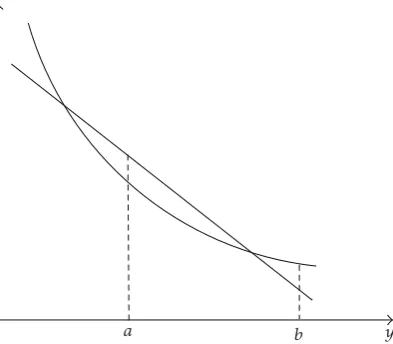
fyis strictly convex, there can be at most two solutions to the equation. We will show that, under suitable conditions, there is at most one solution. The situation is illustrated inFigure 1. We will find conditions for the following to hold, for any admissiblexandσ2,
fx−θ1σ2
2θ1
x−b1> fb. 1.20
When thexkare not all identical,σ2/0. Hence, forθ1>0,fx−θ1σ2> fx>0, it is enough
to consider
fx2θ1
x−b1≥fb 1.21
which is the same as
θ1≤ −
fx−fb
2x−bfx. 1.22
We can chooseθ1as in the theorem, which satisfiesθ1≤μ1and
θ1≤μ2 min x∈a,b−
fx−fb
2x−bfx. 1.23
By Rolle’s theorem, we conclude that there can be at most two distinct roots to 1.18 on the intervala, b. This contradicts our assumption that allx1, . . . , xn are distinct. Hence, it
must be true that the minimum ofhpinSsubject to the constraintp1· · ·pn1 occurs on
the boundary ofS, where some of thepk must be zero. At the minimum, saypo, we are back
to the case of n−1 or less, and by the induction hypothesis, hpo ≥ 0. Hence, hp ≥ 0 for
arbitraryp∈Ssubject to the constraintp1· · ·pn1.
We now proceed to show1.6in partb. For the case ofn 2, let us replaceθ1byθ2
in1.9, and rename the functiongt. Againg0 0. We will find appropriateθ2 for which
gt≤0 fort≥0. Following similar steps as before, we get
gt qx1
fx−θ2σ2
1−2θ21−qtx1
−f1tx1
a b y
Figure 1:Illustration of functionsfx−θ1σ22θ1x−y 1andfy.
To showgt≤0, it suffices to show fx−θ2σ2
1−2θ21−qtx1
−f1tx1
≤0. 1.25
Observe that if 1−2θ21−qtx1≤0, or equivalently,θ2≥1/21−qtx1, the above automatically
holds.We assume the convention 1/0∞.We sketch our subsequent strategy. For any fixed
q,t, andx1, findθ2q, t, x1that satisfies both1.25and
θ2
q, t, x1
≤ 21−1
qtx1
. 1.26
Suchθ2q, t, x1must exist because 1/21−qtx1qualifies. Then, we can take supθ2q, t, x1
over all admissibleq,t, andx1.
By the mean value theorem, there existsη∈x−θ2σ2,1tx1such that fx−θ2σ2
1−2θ21−qtx1
−f1tx1
−fη1−qtx1
1θ2qtx1
−fx−θ2σ2
2θ21−qtx1.
1.27
Note that, for1.25to hold, it suffices if −fη1θ2qtx1
−fx−θ2σ2
2θ2≤0. 1.28
Since−fxis decreasing and positive,1.28is implied by −fx−θ2σ2
1θ2qtx1
−fx−θ2σ2
2θ2≤0, 1.29
which is equivalent to
1
θ2 ≤
2fx−θ2σ2
−fx−θ2σ2
−qtx1. 1.30
For any fixedq,t, andx1, suppose we obtain
θ2
q, t, x1
min
θ∈0,1/21−qtx1
2fx−θσ2
−fx−θσ2−qtx1
−1
1.31
and suppose 0 < θ2q, t, x1< ∞. Let us considerθ2 ≥ θ2q, t, x1. Ifθ2 >1/21−qtx1, then
1.25holds trivially. Ifθ2≤1/21−qtx1, then
1
θ2
≤ 1
θ2
q, t, x1
min
θ∈0,1/21−qtx1
2fx−θσ2
−fx−θσ2−qtx1≤
2fx−θ2σ2
−fx−θ2σ2
−qtx1, 1.32
that is,1.30holds, which implies that1.28, and hence,1.25hold. Hence, we can choose
θ2≥supq,t,x1θ2q, t, x1, where the supremum is over all admissibleq,t, andx1. To summarize,
we can choose the followingθ2for the theorem, provided 0< π1<∞,
θ2≥π1
min
t,q,x1,θ
2fx−θσ2
−fx−θσ2−qtx1
−1
, 1.33
where the minimization is taken overθ∈ 0,1/21−qtx1, and over all admissibleq,x1,t,
that is,q∈0,1,x1∈a, b, andt∈0,b−x1/x1. This minimization can be solved easily in
a number of cases, which we will show later.
Forn >2, the proof is nearly identical to that for parta. Let us suppose1.6has been proved for up ton−1, and consider the case ofn. Fixx1, . . . , xn. We may assume that allxkare
distinct as before. Let
hpfx−θ2σ2
−n
k1 pkf
xk
. 1.34
We wish to showhp≤0 on the setSdefined before, subject to the constraintp1· · ·pn1.
Suppose the maximum ofhpis in the interior ofS. Applying the Lagrange multiplier method for finding the constrained maximum of hpon S, we deduce that any maximum p must satisfy the following set of equations for some real numberλ:
∂h ∂pk
p λ ∂
∂pk
n
k1 pk−1
∀k. 1.35
This gives, for allk,
fx−θ2σ2
xk−θ2
x2k−2xxk
−fxk
λ. 1.36
Each of thexk must satisfy the following equation with variabley:
fx−θ2σ2
y−θ2y22θ2xy
−fy−λ0. 1.37
We will consider the critical points of the left-hand side above, which are the solutions to the equation
fx−θ2σ2
2θ2
a b y
Figure 2:Illustration of functionsfx−θ2σ22θ2x−y 1andfy.
Under the assumption thatfyis strictly convex, there can be at most two solutions to the equation. We will show that, under suitable conditions, there is at most one solution. The situation is illustrated in Figure 2. We will find conditions for the following to hold, for any admissiblexandσ2:
fx−θ2σ2
2θ2
x−a1> fa. 1.39
When thexkare not all identical,σ2/0. Hence, forθ2>0,fx−θ2σ2> fx>0, it is enough
to consider
fx2θ2
x−a1≥fa 1.40
which is the same as
θ2 ≥ −
fx−fa
2x−afx. 1.41
We can chooseθ2as in the theorem, which satisfiesθ2≥π1and
θ2≥π2 max x∈a,b−
fx−fa
2x−afx. 1.42
By Rolle’s theorem, we conclude that there can be at most two distinct roots to 1.37 on the intervala, b. This contradicts our assumption that allx1, . . . , xn are distinct. Hence, it
must be true that the maximum ofhpinSsubject to the constraintp1· · ·pn1 occurs on
the boundary ofS, where some of thepk must be zero. At the maximum, saypo, we are back
to the case of n−1 or less, and by the induction hypothesis, hpo ≤ 0. Hence, hp ≤ 0 for
arbitraryp∈Ssubject to the constraintp1· · ·pn1.
Lemma 1.3. For any integer n ≥ 1, and for all x1, . . . , xn with each xk ∈ a, band allp1, . . . , pn,
where eachpk ≥0andnk1pk 1,
x−θ1σ2≥a, 1.43
whereθ1is as given inTheorem 1.2.
Proof. It suffices to show
x−μ1σ2≥a. 1.44
The case of n 1 is trivial, since σ2 0. For the casen 2, as before, write x
2 1tx1,
where 0 ≤ t ≤ b−x1/x1,p1 1−q, andp2 q. With these, we havex 1qtx1, and σ2 q1−qt2x2
1. In the cases whereq 0,q 1 ort 0,1.44holds trivially. For 0 < q < 1
andt >0,1.44holds if and only if
μ1≤ψq
1qtx1−a q1−qt2x2
1
. 1.45
We will show that this is indeed true for all admissibleq,t, andx1. For the casex1 a,ψq
1/1−qta. Becauseta≤b−a,ψq≥1/b−a. Whena < x1≤b, the value ofψqapproaches
∞asqapproaches 0 or 1. The minimum value must be on0,1. The derivative ofψqis
ψq q1−qtx1
1qtx1−a
2q−1
1−q2q2t2x2 1
. 1.46
Forqothat satisfiesψqo 0, we have the following identity:
1qot
x1−a qo
1−qo
tx1
1−2qo . 1.47
Hence,
ψqo
1
1−2qo
tx1
. 1.48
Becausetx1≤b−a, we getψqo≥1/b−a. By the definition ofμ1, for all admissibleq,t, and x1,
μ1≤
fx−f1tx1
21−qtx1f
x ≤
1 21−qtx1
. 1.49
Hence,μ1≤1/2b−a. Therefore,1.45holds for all admissibleq,t, andx1.
Consider the case ofn≥3. Fixx1, . . . , xnand suppose they are all distinct. Let
φp x−μ1σ2−a n
k1
pkxk−μ1 n
k1
pkx2kμ1
n
k1 pkxk
2
−a. 1.50
Consider minimizing φpover all possible weight vectors and supposepo is the minimum.
Then, there exists a constantλsuch that, for anykwithpok >0, we must have∂φ/∂pkpo λ.
That is,
xk−μ1
x2k−2xpoxk
λ, ∀k with pok >0. 1.51
For the given po, there can be at most two distinct x
k satisfying the equation y −μ1y2 −
2xpoy λin variable y. Hence, there can be at most two nonzero components inpo. This
For partbofTheorem 1.2, the proof requiresxp−θ2σ2pto be within the domain of
the functionffor various unknown weight vectorsp. This is why the statement ofTheorem 1.2 makes the assumption that this is true for all possible weight vectors. The following lemma gives a simple sufficient condition for this assumption to hold.
Lemma 1.4. Fix x1, . . . , xn on a, b, n ≥ 2. Let θ2 be as given in Theorem 1.2. Without loss of
generality, assumex1< x2<· · ·< xn. Then,
awhenθ2≤1/xn−x1,
xp−θ2σ2p≥x1 for all weight vectors p, 1.52
and hence,xp−θ2σ2p∈a, bfor all weight vectorsp;
bwhenθ2>1/xn−x1,
xp−θ2σ2p≥x1−
θ2
xn−x1
−12
4θ2 for all weight vectorsp. 1.53
Hence, ifmin{a, x1−θ2xn−x1−12/4θ2}, b ⊆ I, thenxp−θ2σ2p ∈ Ifor all weight
vectorsp.
Proof. Writep p1, . . . , pn. Consider the minimization problem,
min
p≥0, nk1pk1
xp−θ2σ2p. 1.54
Using the same argument as in the proof ofLemma 1.3, we can conclude that the minimum is achieved at some p with at most two nonzero components. Hence, it suffices to consider
minimization problems of the following form:
min
pi≥0, pj≥0, pipj1
pixipjxj−θ2
pixi2pjxj2−
pixipjxj
2
. 1.55
It remains to be decided which i and j should be used in the above minimization. Suppose xi < xj here,i and j are unknown indices. We claim that i 1. To see this, the
partial derivative of the objective function with respect to xi is pi −θ22pixi−2xpi, where x pixipjxj. Sincexi ≤ x, the partial derivative is nonnegative, and hence, the function is
nondecreasing inxi.
Oncexiis chosen to bex1, the second partial derivative of the function with respect to xjis−2θ2pj−pj2, which is nonpositive. The minimum is achieved at eitherxj x1orxj xn.
To summarize, the original minimization problem 1.54is achieved either at p1 1,
in which case the minimum value isx1, or it has the same minimum value as the following
problem:
min
p1≥0, pn≥0, p1pn1
p1x1pnxn−θ2
p1x21pnx2n−
p1x1pnxn
2
. 1.56
It is easy to show that, ifθ2 ≤1/xn−x1, the minimum of1.60is achieved atp11 and the
minimum value isx1. Otherwise, the minimum is achieved at
p1 1
2
1 1
θ2
xn−x1
, p2 1
2
1− 1
θ2
xn−x1
, 1.57
and the minimum value is x1 −θ2xn−x1−12/4θ2, which is no greater than x1 for all θ2>0.
Remark 1.5. For partaof the theorem, we can chose a smaller value,−u/2fa, forμ1than
that in1.4. Letu≤0 be an upper bound offxona, b. Note that
1qtx1−1tx1−1−qtx1. 1.58
By the mean value theorem, there exists someη∈1qtx1,1tx1such that f1qtx1
−f1tx1
21−qtx1f
1qtx1
−fη 2f1qtx1
≥ −u
2fa. 1.59
Therefore, we can choose−u/2faforμ1.
Remark 1.6. For part bof the theorem, two simpler but less widely applicable choices forθ2
can be deduced from1.33. Sinceqtx1≤b−a,π1can be relaxed to
π11 1
minx∈a,b2fx/−fx−b−a
. 1.60
We must require minx∈a,b2fx/−fx−b−a > 0 forπ11 to be useful. An even simpler
choice is, when 2fb fab−a>0,
π12 1
2fb/−fa−b−a
−fa
2fb fab−a. 1.61
Note that 0 < π12 < ∞ implies 0 < π11 < ∞, which, in turn, implies 0 < π1 < ∞. In this case, π1≤π11≤π12. Similarly, if 0< π11<∞, thenπ1≤π11.
π2as in1.8can also be relaxed. Since, for someξ∈a, b,
−2fx−fa
x−afx − fξ
2fx, 1.62
a relaxation is
π21 −f
a
2fb. 1.63
Hence, for partbof the theorem, we can chooseθ2 max{π11, π21}, provided 0 < π11 < ∞.
Alternatively, we can chooseθ2max{π12, π21}π12, provided 0< π12<∞.
Remark 1.7. The strength ofTheorem 1.2is in bringing the variations ofxk’s into consideration,
through σ2. There are alternative methods for finding tighter upper bound of nk1pkfxk
than that given by Jensen’s inequality, nk1pkfxk ≤ fx. For instance, we can apply the
arithmetic mean-geometric mean inequality. For anyα,
n
k1
eαfxkpk ≤
n
k1
pkeαfxk. 1.64
Hence, for anyα >0,
n
k1 pkf
xk
≤ 1
αlog
n
k1
pkeαfxk
. 1.65
2. Special cases and examples
The following theorem is needed.
Theorem 2.1see3, page 4. LetIbe a nonempty interval ofR. A functionh:I → Ris convex if and only if, for allxo ∈I,hx−hxo/x−xois a nondecreasing function ofxonI\ {xo}. Corollary 2.2. Let I be a nonempty interval of R. Suppose the function h : I → Ris convex, and
hx/0for allx∈I. If1/hxis a convex function, then, for allxo ∈I,hx−hxo/x−xohx
is a nonincreasing function of xon I\ {xo}. If 1/hx is a concave function, then, for all xo ∈ I,
hx−hxo/x−xohxis a nondecreasing function ofxonI\ {xo}.
Proof. Consider
hx−hxo
x−xo
hx
1−hxo
/hx
x−xo
−gx−g
xo
x−xo , 2.1
where we definegx hxo/hx. If 1/hxis convex, thengxis convex. ByTheorem 2.1,
hx−hxo/x−xohxis nonincreasing. If 1/hxis concave, thengxis concave, and
hence,hx−hxo/x−xohxis nondecreasing.
Theorem 2.3. Consider the functionfxas specified in Theorem 1.2. In addition, supposefxis convex. If1/fxis concave, then
θ1 min
x∈a,b
−fx
2fx. 2.2
If1/fxis convex, then
θ1
fa−fb
2b−afa. 2.3
Proof. If 1/fxis a concave function, then 1/f1qtx1is a concave function inq forq ∈
0,1. ByCorollary 2.2,f1qtx1−f1tx1/21−qtx1f1qtx1is nonincreasing
inq. Its minimum with respect toqoccurs atq1. Substitutingq1, we get
μ1 min
t,x1
−f1tx1
2f1tx1
min
q,t,x1
f1qtx1
−f1tx1
21−qtx1f
1qtx1
min
x∈a,b
−fx
2fx. 2.4
On the other hand, byCorollary 2.2,−fx−fb/2x−bfxis a nonincreasing function ofx. Hence,
μ2− fb
2fb ≥μ1. 2.5
If 1/fxis a convex function,f1qtx1−f1tx1/21−qtx1f1qtx1
achieves its minimum with respect toqatq0. Substitutingq0, we get
μ1min
t,x1
fx1
−f1tx1
2tx1f
x1
ByTheorem 2.1,fx1−f1tx1/2tx1is a nonincreasing function oft, and hence, its
minimum occurs att b−x1/x1. Hence,
μ1 min
x1∈a,b
fx1
−fb
2b−x1
fx1
μ2. 2.7
By Corollary 2.2, fx1 − fb/2b − x1fx1 is a nondecreasing function of x1. Its
minimum, which occurs atx1a, isfa−fb/2b−afa.
Example 2.4fx logx. Here,fx 1/xandfx −1/x2. Hence,fxand 1/fxare both convex functions. We can choose
θ1 min q,t,x1
f1qtx1
−f1tx1
21−qtx1f
1qtx1
min
t,x1 1 21tx1
1 2b,
θ2
q, t, x1
min
θ∈0,1/21−qtx1
2fx−θσ2
−fx−θσ2 −qtx1
−1
min
θ∈0,1/21−qtx1
2x−θσ2−qtx1
−1
2
x−21−1 qtx1σ
2 −qtx
1 −1 2
x1qtx1−
q1−qt2x2 1
21−qtx1 − qtx1
−1
2x1
−1 .
2.8
Maximizing overx1, we getπ1 1/2a. Also,
π2 max
x∈a,b−
fx−fa
2x−afx
1
2a. 2.9
Example 2.5 fx xα, where 0 < α < 1. Here,fx αxα−1 is convex, andfx αα−
1xα−2. Because 1/xα−1is a concave function, we can applyTheorem 2.3, and get
θ1 min
x∈a,b
−fx
2fx xmin∈a,b
1−α
2x
1−α
2b ,
θ2
q, t, x1
min
θ∈0,1/21−qtx1
2fx−θσ2
−fx−θσ2−qtx1
−1
min
θ∈0,1/21−qtx1
2x−θσ2
1−α −qtx1
−1
2x
1qtx1
1−α −qtx1
−1
2x1
1−α α
1−αqtx1
Maximizing the last expression overq, we get1−α/2x1. Maximizing the result overx1, we
get
π1 1−α
2a . 2.10
Also, by Corollary 2.2,−fx−fa/2x−afxis a nonincreasing function ofx, and achieves its maximum atxa. Hence,
π2 max
x∈a,b−
fx−fa
2x−afx − fa
2fa
1−α
2a . 2.11
Example 2.6fx −e−x. Here,fx e−xandfx −e−x. Because 1/fxis convex, we
can applyTheorem 2.3, and get
θ1
fa−fb
2b−afa
1−e−b−a 2b−a ,
θ2
q, t, x1
min
θ∈0,1/21−qtx1
2fx−θσ2
−fx−θσ2 −qtx1
−1
2−qtx1
−1 .
Maximizing the last expression overqtx1, we get
π1
1
2−b−a. 2.12
We must require b − a < 2. Also, by Corollary 2.2, −fx − fa/2x − afx is a nondecreasing function ofx, and achieves its maximum atxb. Hence,
π2 max
x∈a,b−
fx−fa
2x−afx −
fb−fa
2b−afb
eb−a−1
2b−a. 2.13 Lemma 2.7. For0< b−a <2,
1 2−b−a≥
eb−a−1
2b−a. 2.14
Proof. Note that, for 0< b−a <2,2.14is equivalent to
2b−a≥2eb−a−1−b−aeb−a b−a. 2.15
Letvb−a, and assumev ∈0,2. It suffices to show
v−2ev−1vev ≥0. 2.16
Since at v 0, the left hand above is 0. We need only to show that v −2ev −1 vev is nondecreasing function ofv forv ≥ 0. Its derivative is 1−evvev, which is equal to zero at
v0. But, forv≥0,
1−evvevvev≥0. 2.17
Example 2.8fx −1/xk wherek > 0. Here,fx k/xk1,fx −kk1/xk1. Since
1/fx xk1/kis convex, byTheorem 2.3,
θ1
fa−fb
2b−afa
1−a/bk1
2b−a ,
θ2
q, t, x1
min
θ∈0,1/21−qtx1
2fx−θσ2
−fx−θσ2−qtx1
−1
min
θ∈0,1/21−qtx1
2x−θσ2
k1 −qtx1
−1
2x1qtx1
k1 −qtx1
−1
2x1
k1 −
k k1qtx1
−1 .
Maximizing the last expression overqandt, we get 1/k2x1/k1−bk/k1. Maximizing
the result overx1, we get
π1 k1
k2a−bk. 2.18
We must requirek2a−bk >0, ork <2a/b−a, for the aboveπ1to be useful forTheorem 1.2.
Also, byCorollary 2.2,−fx−fa/2x−afxis a nondecreasing function ofx, and achieves its maximum atxb:
π2 max
x∈a,b−
fx−fa
2x−afx−
fb−fa
2b−afb
b/ak1−1
2b−a . 2.19
References
1 D. I. Cartwright and M. J. Field, “A refinement of the arithmetic mean-geometric mean inequality,”
Proceedings of the American Mathematical Society, vol. 71, no. 1, pp. 36–38, 1978.
2 J. E. Peˇcari´c, F. Proschan, and Y. L. Tong,Convex Functions, Partial Orderings, and Statistical Applications, vol. 187 ofMathematics in Science and Engineering, Academic Press, Boston, Mass, USA, 1992.