International Research Journal of Natural and Applied Sciences Vol. 3, Issue 8, August 2016 IF- 3.827 ISSN: (2349-4077)
© Associated Asia Research Foundation (AARF)
Website: www.aarf.asia Email : [email protected] , [email protected]
EFFECT OF TRANSPLANTING DATE ON THE PHYSIOLOGICAL
PERFORMANCE OF
PUERARIA TUBEROSA
(ROXB. EX. WILD) DC.
Anup Kalra, Amit Kumar Jain, Nagendra Mishra, Anurag Padhan and Mohan Ji Saxena
Ayurvet Research Foundation, New Delhi.
ABSTRACT
For optimization of better yield from a crop, transplanting at the appropriate time to fit the
physiological growth period is critical. A study was carried out in a time period of July 2015
to June 2016 to determine the best planting spell for the Pueraria tuberosa (Rox. Ex. Wild)
DC. In the study, tubers of Pueraria tuberosa were planted in mid of every months from July,
2015 to June, 2016. The highest plant height was attained in plants transplanted on
September 15th, 2015 (T3), followed by those on July 15th , 2015 (T1) and August 15th , 2015
(T2) respectively. The information generated here in the study seems to be useful for making
varying transplanting decisions for Pueraria tuberosa with shifting maturity times.
Keywords: Pueraria tuberose, date of Transplanting; physiological growth, and yield
INTRODUCTION
Indian Kudzu or Pueraria tuberosa (Rox. Ex. Wild) DC is one among a number of
plants that have been proved to have potential pharmacological properties in Indian
traditional and folklore system of medicine (Ayurveda and Siddha). The herb is found
throughout in India except in very humid or very arid regions up to 1200 m (Malviya et al,
2016). Its tuber is popularly used as active component in various formulations in Indian
therapeutic system. It has been used as an aphrodisiac, cardiotonic, diuretic, anti-carcinogen,
condition (Verma et al. 2009). Traditionally, the tubers have been in practice against pain,
inflammations, burning sensations and skin problems (Puri, 2003). The tubers have also
curative effects on cough, rheumatism, malarial fever and promote secretion of milk in
woman (Juyal and Ghildiyal, 2013). It is a constituent of various formulations used as
nutritive, diuretic, expectorants, and for the management of rheumatism, fever, and bronchitis
(Pandey et al., 2007 ). P. tuberosa tubers are rich in isoflavonoids and the important
phytoconstituents are puerarin, daidzein, genistein, puetuberosanol, and tuberosin ( Khan et
al., 1996).
Such promising data on the enriched bioactive molecules in the tubers of Pueraria
tuberosa fetches wider attention of plant scientists to expedite its agronomic prospects of
advancement. Agronomic improvement of the herb will certainly establish efficacy of their
use as nutraceutical. Hence, the present study was undertaken to optimize the month of
transplanting with respect to major growth attributes of plants.
MATERIAL & METHODS
Field experiments were conducted during July 2015 to April 2016 at Daluwala
Mazafta village near Roorkee (District-Haridwar, Uttarakhand) on 29.85° N altitude and
77.89° E longitude to study the effect of different date of transplanting on the growth and
survival attributes. The experiment was laid out in Randomized block design with four
replications. 12 different dates of transplanting viz., July, 15th, 2015 (T1), August, 15th, 2015
(T2), September, 15th, 2015 (T3), October, 15th, 2015 (T4), November, 15th, 2015 (T5),
December, 15th, 2015 (T6), January, 15th, 2016, February, 15th, 2016 (T7), March, 15th,
2016 (T8), April, 15th, 2016 (T9), May, 15th, 2016 (T10), June, 15th, 2016 (T11), and
July, 15th, 2016 (T12), with the spacing of 1 ×1m and 30 kg FYM /plot accommodating 20
tubers/ plot. The tubers along with 10 to 15 cm stem of P. Tuberosa uprooted from nearby
forest area (Rajaji National Park) were transplanted on the same day. The average weight of
each tuber was 500 g. to 750 g. The experimental observations were made on major growth
attributes such as plant height (cm), No. of leaves per plants, and thickness of stem (mm) of
flowering plants.
Statistical Analysis
Sukhatme. 1985. Wherever necessary, the percent values were transformed to angular
(Arc-sine) values before analysis. The critical differences (CD) were calculated at 5 per cent
probability level. The data were tested for statistical significance.
RESULT & DISSCUSSION:
1. Number of Leaf per plant
Number of Leaf per plant observed after transplanting observed after
transplanting were observed against different dates from July 15th 2015 (T1) to June
15th 2016 (T12) and has been presented in table 1.1
Table 1.1 No. of Leaf per plantobserved after transplanting on different dates (T1-T12)
T1 T2 T3 T4 T5 T6 T7 T8 T9 T10 T11 T12
Fig: 1.1 No. of Leaf per plantobserved after transplanting on different dates (T1-T12)
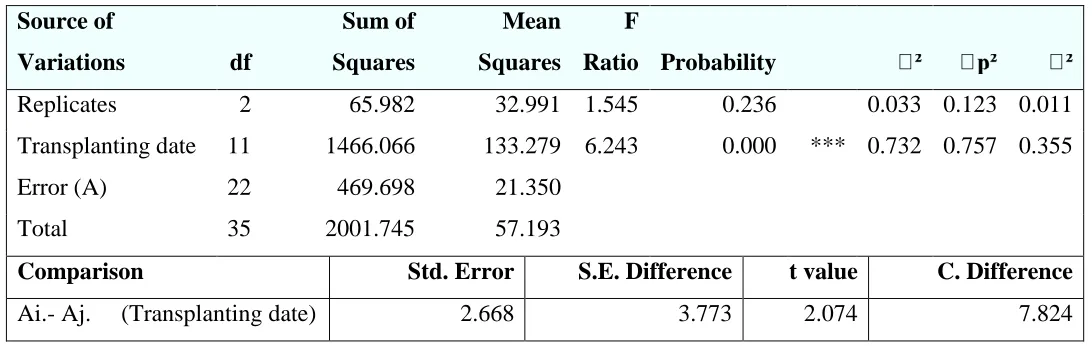
Table 1.2 ANOVA for Number of leaves/ Plant
Source of
Variations df
Sum of
Squares
Mean
Squares
F
Ratio Probability
Replicates 2 65.982 32.991 1.545 0.236 0.033 0.123 0.011
Transplanting date 11 1466.066 133.279 6.243 0.000 *** 0.732 0.757 0.355
Error (A) 22 469.698 21.350
Total 35 2001.745 57.193
Comparison Std. Error S.E. Difference t value C. Difference
Ai.- Aj. (Transplanting date) 2.668 3.773 2.074 7.824
2. Plant height
Plant height (cm) observed after transplanting were observed against different dates from July 15th 2015 (T1) to June 15th 2016 (T12) and has
Table 2.1: plant heightobserved after transplanting on different dates (T1-T12)
T1 T2 T3 T4 T5 T6 T7 T8 T9 T10 T11 T12
132.533 132.067 135.733 73.067 75.133 83.867 40.867 59.400 43.733 13.400 6.667 4.000
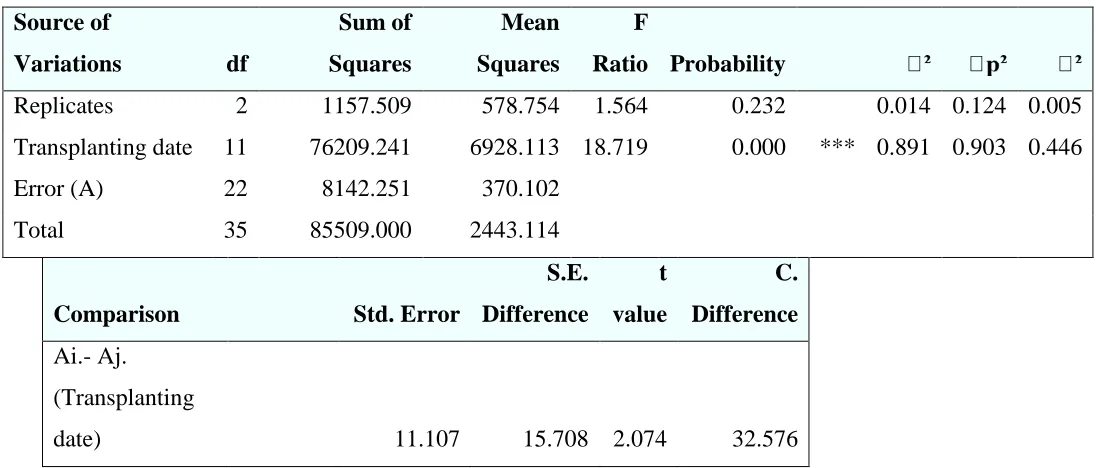
Table 2.2: ANOVA for Plants height (cm)
Source of
Variations df
Sum of
Squares
Mean
Squares
F
Ratio Probability
Replicates 2 1157.509 578.754 1.564 0.232 0.014 0.124 0.005
Transplanting date 11 76209.241 6928.113 18.719 0.000 *** 0.891 0.903 0.446
Error (A) 22 8142.251 370.102
Total 35 85509.000 2443.114
Comparison Std. Error
S.E.
Difference
t
value
C.
Difference
Ai.- Aj.
(Transplanting
Fig: 2.1 Plant Heightobserved after transplanting on different dates (T1-T12)
3. Plants diameter followed by transplanting date
Plant diameter measured after transplanting against following dates against different dates from July 15th 2015 (T1) to June 15th 2016 (T12) and
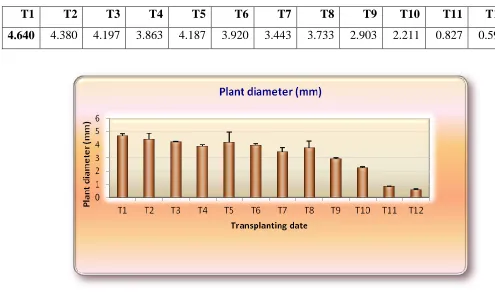
Table 3.1: Plant diameter measured against different transplanting dates
T1 T2 T3 T4 T5 T6 T7 T8 T9 T10 T11 T12
4.640 4.380 4.197 3.863 4.187 3.920 3.443 3.733 2.903 2.211 0.827 0.598
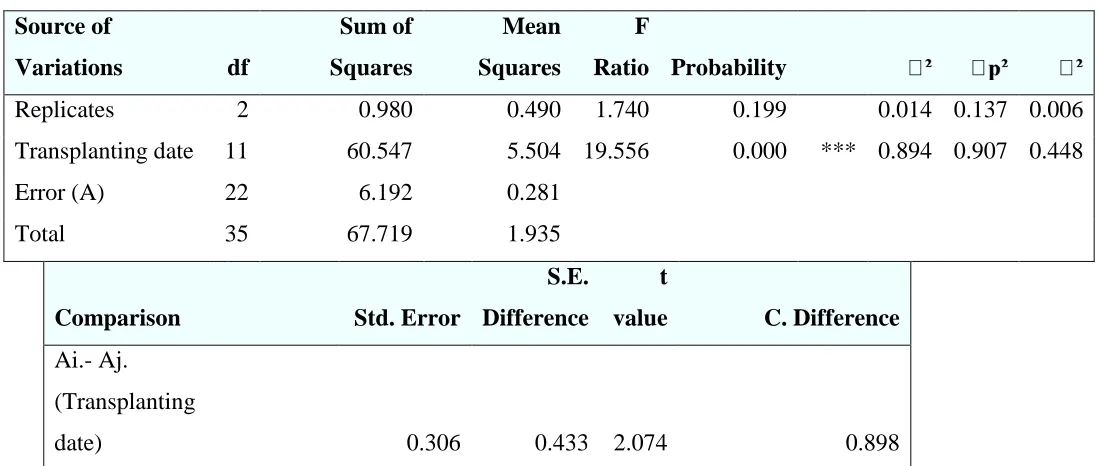
Table 3.2: ANOVA for Plant diameter (mm)
Source of
Variations df
Sum of
Squares
Mean
Squares
F
Ratio Probability
Replicates 2 0.980 0.490 1.740 0.199 0.014 0.137 0.006
Transplanting date 11 60.547 5.504 19.556 0.000 *** 0.894 0.907 0.448
Error (A) 22 6.192 0.281
Total 35 67.719 1.935
Comparison Std. Error
S.E.
Difference
t
value C. Difference
Ai.- Aj.
(Transplanting
Appropriate and proper time of transplanting is one of the basic requirements for
having good harvest from any crop. As emphasized by Snoek (1981), the total yield of the
crop is markedly influenced by different transplanting times. This must be on account of
environmental conditions particularly the light, humidity and temperature interacting with
genetic system and elicit developmental changes during physiological growth, which exert
influence on overall maturity. In the present study, maximum number of leaves (24.133)
emerged in the plants those were transplanted in September 15th, 2015 (T3) followed by
21.067 leaves in August 15th, 2015 (T2) and 19.067 leaves in February 15th, 2016 (T7). With
respect to plant height, T3 resulted as maximum (135.733 cm) followed by T1 (132.533 cm)
and T2 (132.067 cm) respectively while plants under T1 attained maximum diameter 4.640
mm) followed by T2 (4.380 mm) and T3 (4.197 mm) respectively. These results could be
due to availability of adequate soil and environmental moisture in complementation with
moderate contributing good physiological growth of the transplanted tubers.
CONCLUSION
From the present study, it could be concluded that the tubers of Pueraria tuberosa
transplanted on September 15th, 2015 recorded the maximum number of leaves as well as
maximum height with considerable stem thickness. Hence, September 15th November could
be considered suitable for Pueraria transplantation.
Further study is envisaged to correlate the aerial growth with respect to the yield and
puerarin content of tubers to conclude the best treatment (month) of transplantation for its
commercial scale production. Authors are very grateful to the National Medicinal Plants
Board, (NMPB) New Delhi for providing financial assistance.
REFERENCES
1. Juyal, P., & Ghildiyal, J. C. (2013). Medicinal phyto-diversity of Bhabar tract of
Garhwal Himalaya. Journal of Medicinal Plants, 1(6).
2. Khan, R. A., Agrawal, P. K., & Kapil, R. S. (1996). Puetuberosanol, an
epoxychalcanol from Pueraria tuberosa. Phytochemistry, 42(1), 243-244.
3. Malviya, A., Gupta, R., & Porte, S. M. (2016). CRITICAL REVIEW ON
VIDARIKAND (PUERARIA TUBEROSA DC.)-AN AYURVEDIC
4. Pandey, N., Chaurasia, J. K., Tiwari, O. P., & Tripathi, Y. B. (2007). Antioxidant
properties of different fractions of tubers from Pueraria tuberosa Linn. Food
chemistry, 105(1), 219-222.
5. Panse V. G. and Sukhatme P. V., Statistical Methods for Agriculture Workers. ICAR
Publication, New Delhi, 1985, pp-327-340.
6. Puri, H. S. (2003). Rasayana: ayurvedic herbs for longevity and rejuvenation. Crc
press.
7. Snoek, N. “How Close Should Broccoli Be Planted,” Greontenen Fruit, Vol. 36,
1981, pp. 50-51.
8. Tanwar, Y. S., Goyal, S., & Ramawat, K. G. (2008). Hypolipidemic effects of tubers
of Indian kudzu (Pueraria tuberosa). J Herb Med Toxicol, 2(1), 21-25.
9. Verma, S. K., Jain, V., Vyas, A., & Singh, D. P. (2009). Protection against stress
induced myocardial ischemia by Indian kudzu (Pueraria tuberosa)-A case study. J