2019 International Conference on Computation and Information Sciences (ICCIS 2019) ISBN: 978-1-60595-644-2
Study of Cloud ERP Service Mode Selection
Model Based on IFS-TOPSIS
Yiwu Jia, Lin Xu, Zongqian Zhu and Dan Li
ABSTRACT
The selection of Cloud ERP service mode is one of the key problems in the process of Cloud ERP application. In order to reduce information loss, in this paper, the interval intuitionistic fuzzy number is used to replace the real number, and the fuzzy measure is used to replace the weight to express the importance of the evaluation index. Based on the interval intuitionistic fuzzy average operator IFA, a multi-attribute decision-making method based on IFS-TOPSIS is constructed to realize the optimal selection of Cloud ERP service mode.
1. INTRODUCTION
Enterprise Resource Planning (ERP) is a widely used management information system in modern enterprises, but there are always bottlenecks such as large investment, high risk and long cycle. The emergence of cloud service brings useful enlightenment for the breakthrough of the problems mentioned above, that is, to deploy ERP on cloud platform and offer ERP service to customers in the form of cloud service, and we call this new ERP application mode as Cloud ERP service mode. In August 2018, the ministry of industry and information technology of China issued a notice on the guidance for implementation of enterprise cloud platform (2018-2020), emphasized the scientific formulation and deployment mode, reasonable selection of cloud services, and moderate and orderly migration for enterprise business from local to the cloud. With the help of Cloud ERP service mode, enterprises can apply ERP more efficiently and improve their core competitiveness more markedly.
However, at present, Cloud ERP service mode is still in the initial stage of research, and relevant theories are not yet perfect, which leads to the key problem of how
Yiwu Jia, School of Information, Southwest Petroleum University, Nanchong, 637001, China Lin Xu, School of Information, Southwest Petroleum University, Nanchong, 637001, China Zongqian Zhu, School of Economic and Management, Xi’an University of Technology, Xi’an, 710054, China
enterprises should choose the Cloud ERP service mode that matching with themselves in practical application. Only by solving the problems above can the enterprise effectively implement Cloud ERP and realize the enterprise's high efficiency in the cloud. Therefore, research on Cloud ERP service mode selection has important theoretical value and practical significance.
2. MODE SELECTION EVALUATION INDEX SYSTEM
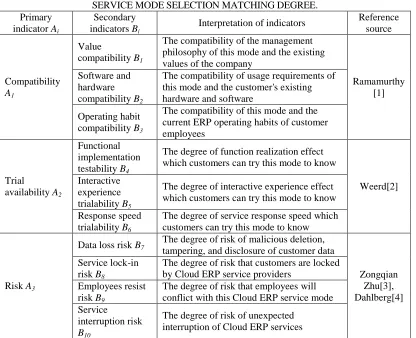
[image:2.612.92.508.370.708.2]In the process of constructing the evaluation index system of Cloud ERP service mode selection, we subdivide and improve the selection index from the perspective of enterprise Cloud ERP service mode application, mainly combining with the current practical situation of Cloud ERP innovation and relevant research literatures. In accordance with the principles of science, operable, concise and purposeful setting of indicators, we establish the Cloud ERP service mode selection index system, aiming at finding out the most optimal Cloud ERP service mode which matches the business of enterprise best. At last, a total of 6 primary indicators and 19 secondary indicators are identified. The exact index composition of the mode selection index system is shown in Table I.
TABLE I. EVALUATION INDEX SYSTEM OF CLOUD ERP SERVICE MODE SELECTION MATCHING DEGREE. Primary
indicator Ai
Secondary indicators Bi
Interpretation of indicators Reference source
Compatibility
A1
Value
compatibility B1
The compatibility of the management philosophy of this mode and the existing values of the company
Ramamurthy [1] Software and
hardware compatibility B2
The compatibility of usage requirements of this mode and the customer's existing hardware and software
Operating habit compatibility B3
The compatibility of this mode and the current ERP operating habits of customer employees
Trial
availability A2
Functional implementation testability B4
The degree of function realization effect which customers can try this mode to know
Weerd[2] Interactive
experience trialability B5
The degree of interactive experience effect which customers can try this mode to know Response speed
trialability B6
The degree of service response speed which customers can try this mode to know
Risk A3
Data loss risk B7
The degree of risk of malicious deletion, tampering, and disclosure of customer data
Zongqian Zhu[3], Dahlberg[4] Service lock-in
risk B8
The degree of risk that customers are locked by Cloud ERP service providers
Employees resist risk B9
The degree of risk that employees will conflict with this Cloud ERP service mode Service
interruption risk
B10
Economic A4
Capital budget matching degree
B11
The matching degree of service fee of this mode and customers' expected investment
Design by authors of this article Efficiency
improvement matching degree
B12
The degree of enterprise efficiency
improvement caused by the adoption of this Cloud ERP service mode
Business satisfaction matching degree
B13
The satisfaction degree of Cloud ERP service mode to customers' s business requirements
Environmental maturity A5
Market maturity
B14
The degree of maturity of relevant market in terms of scale, competition and order
Gangwar [5] Policy and
regulatory maturity B15
The degree of perfection of government policies and regulations that guarantee the continued operation of this mode
Security mechanism maturity B16
The perfection of security mechanism of this mode in the Cloud ERP industry
Informatization level A6
Staff IT skill matching degree
B17
The matching degree of employees’ IT skills and the requirements of this mode
Qiansheng Fu[6] Infrastructure
level matching degree B18
The matching degree of customer's per capita intelligent terminal ownership and the requirement of this mode
Business process matching degree
B19
The matching degree of customer's informatization level in core business and the requirements of this mode
3. MODE SELECTION MODELANALYSIS
3.1Related Theory and Problem Description
Bulgaria scholars Atanassov first puts the Intuitionistic Fuzzy Sets, namely IFS, the definition of Intuitionistic Fuzzy Sets can be more delicate than traditional Fuzzy Sets in describing Fuzzy nature of the objective world. In the intuitionistic fuzzy set, let X be a given domain, then an intuitionistic fuzzy set A on X can be
expressed as A=
x,A( ),x A( )x x X
in which A( ) :x X
0,1 and
( ) : 0,1
A x X
represent the membership functions of A A( )x and non-subordinate function A( )x ,and as to all the xX, 0A( )x A( ) 1x in A
set up. A( ),x A( )x is called Intuitionistic fuzzy number that including the
membership A( )x and the membership degree A( )x 。As to every Intuitionistic
fuzzy subset in A, A( ) 1x A( )x A( )x is viewed as intuition index of A,
Because Cloud ERP service mode selection problem is relatively recent, Cloud ERP service mode selection is a complex multi-attribute and multi-objective decision problem. There are a lot of fuzzy and uncertain factors in the mode selection process, including ambiguity and difficulty in quantification of evaluation indicators. Such objective factors include subjective factors such as decision makers' preferences, leadership style, and cognitive depth. Intuitionistic Fuzzy Set (IFS) can complement the advantages of the ideal point method (TOPSIS) to deal with the multi-attribute decision making problem with fuzziness, which can solve the problem of Cloud ERP service mode selection. Therefore, we intend to extend TOPSIS into intuitionistic fuzzy set multi-attribute decision making, and adopt IFS-TOPSIS combination evaluation method to select Cloud ERP service mode.
3.2Construct ion of Mode Selection Model
For the Cloud ERP application enterprise, the Cloud ERP service mode selection needs to prioritize the Cloud ERP service mode in the mode alternative solution, and select the better Cloud ERP service mode. Here, the alternative Cloud ERP service mode in the solution set X
X X1, 2,,Xl
is represented asXj(j 1, 2, , )…l , and the 19 indicators O ii( 1, 2,,19) in the Cloud ERP service mode selection index system constitute the attribute set of the intuitionistic fuzzy decision of the mode selection, which can be recorded asO
O O1, 2,,O19
.Since the selection of Cloud ERP service mode belongs to the group decision problem with strong professionalism, experts from universities, client companies and Cloud ERP service providers are invited to form decision-making groups
( 1, 2, , ) k
P k n for group decision-making, and comprehensive evaluation values are obtained by means of expert group wisdom. In this study, we assumed that comprehensive evaluation value of scheme XjX about attributes OiO can be represented as the form of intuitionistic fuzzy set
, ( )
ij ij ij
F i = 1,2, ,19; j = 1,2, ,l , then all the 19 attributes values in
alternatives XjX j = 1,2, ,l( ) can be shorthand for the vector
T T
1 2 19, 1 1 2 2 19, 19,
( , , , ) ( , , , , , , ) ( 1, 2, , )
j j j j j j j j j j
A F F F j l
Therefore, the intuitionistic fuzzy set multi-attribute group decision problem for Cloud ERP service mode selection can be summarized as matrix:
1
X X2
11, 11
1 O
2 O
( ij, ij )19 l
F
l
X
19 O
21, 21
19,1, 19,1
12, 12
22, 22
19,2, 19,2
1l, 1l
2l, 2l
19,l, 19,l
(1)
F is also commonly referred to as the intuitionistic fuzzy set decision matrix in which the importance of the attribute OiO i( 1, 2,,19) is expressed by the
[0,1]( 1, 2, ,19)
i i
and
19
1
1 i i
[image:5.612.90.504.186.260.2]
. In order to facilitate experts to give intuitionistic fuzzy set for decision-making and reduce the influence of randomness and subjectivity on judgment, the reference standard of intuitionistic fuzzy value judgmentstandard is given, as showed in Table II.TABLE II. INTUITIONISTIC FUZZY VALUE JUDGMENT REFERENCE STANDARD. Level Compatibility Evaluation of variable Intuitionistic ambiguity value
1 Very high Very well <0.95,0.05>
2 High Well <0.70,0.25>
3 General General <0.50,0.40>
4 Low Bad <0.25,0.70>
5 Very low Very bad <0.05,0.95>
Considering that most of the evaluation indexes of Cloud ERP service mode selection belong to qualitative indexes, it is necessary to use intuitionistic fuzzy evaluation method to carry out the necessary classification and formulate corresponding evaluation standards, so as to better apply them to specific mode selection.
A unified reference standard is established according to Table II, which is helpful for the expert decision-making group to determine the intuitionistic fuzzy value of each evaluation index based on the specific situation of the enterprise.
The specific evaluation value can be fluctuated according to the fuzzy degree of the evaluation of this index by referring to the judgment standard of intuitionistic fuzzy value (in Table II), and there is no need to be completely consistent with intuitionistic fuzzy value deliberately, so as to fully highlight the characteristics and advantages of intuitionistic fuzzy evaluation.
4. RESULTS
Based on the Cloud ERP service mode selection index system and mode selection model built above, IFS-TOPSIS method [7] is applied to further select Cloud ERP service mode. The specific selection model solving process can be divided into seven steps, and can be expressed as follows.
(1) Building a solution set composed of alternative Cloud ERP service modes
1, 2, ,
j l
X X X X and properties set Oi
O O1, 2, ,O19
which consists ofCloud ERP service mode selection index.
(2) Obtaining the intuitionistic fuzzy set decision matrix of the aggregation
19
( ij) l
implementation consultant of Cloud ERP service providers. Subsequently, to each expert's intuitionistic fuzzy evaluation opinion carries on the aggregation.Considering that experts from academia and industry have their respective strengths in ERP research and practice, they are given the same weight, namely weight of each expert is
T
1 1 1 ( , , , ) P
n n n
. Then IFA can be used to aggregate the individual evaluation
matrix of experts into the comprehensive evaluation matrix
19 19
( ij) l ( ij, ij ) l
F F . The operation process formula is
1 1 1 2
1 1 1
1
, ( , , , ) 1 (1 k) , k
ij ij
n n
n
n k n n
ij ij ij ij ij ij ij F F
k k k
F μ ν IFA F F F F μ μ
n
(2)(3) Formula (3) is used to calculate the weighted intuitionistic fuzzy set decision matrixF ( ij, ij )19l. The specific calculation formula is
, , 1 (1 ) ,i i ( 1, 2, ,19; 1, 2, , )
ij ij = Fi ij i ij ij ij ij i j l
(3)
(4) Formula (4) is used to determine the positive ideal solution A and negative ideal solution A of the IFS (B is for benefit attribute, C is for cost attribute). The solution formula can be expressed as follows
T 1 1 2 2 19 19
(
,
,
,
,
,
)
A
…,
- - - T
1 1 2 2 19 19
(
,
,
,
,
,
)
A
…,
(4)In Formula (4),calculation formulacan be expressed as follows
1 1 1 1
, {[ max , min | ],[ min , max | ]}
i i ij ij ij ij
j l j l
j l i B j l i C
1, 2, ,19
i
1 1 1 1
, {[ min , max | ],[ max , min | ]}
i i ij ij ij ij
j l j l i B j l j l i C
(5) Formula (5) and (6) are used to calculate the Euclidean distance between alternative Cloud ERP service modes and intuitionistic fuzzy set positive and negative ideal solutions can be given by
19
2 2 2
2
1
1
( , ) ( ) ( ) ( ) ( 1, 2, , )
2
j ij i ij i ij i
i
D X A j l
(5)19
- - 2 - 2 - 2
2
1
1
( , ) ( ) ( ) ( ) ( 1, 2, , )
2
j ij i ij i ij i
i
D X A j l
(6)The relationship between variables can be expressed as 1
ij ij ij
,i 1 i i,i- 1 i- i-.
(6) Formula (7) is used to calculate the relative closeness degree j(j1, 2,, )l
between the solution Xj(j1, 2,, )l and the intuitionistic fuzzy set positive ideal solution is 2 2 2 ( , ) ( , ) ( , ) j j j j
D X A
D X A D X A
(7) According to the order of non-increasing arrangement ofj(j1, 2, , )l , the
sorting and optimal scheme of scheme set X is determined, and the larger j is, the better the corresponding scheme will be, that is, the more the Cloud ERP service mode matches the customer.
5. CONCLUSIONS
An evaluation index system for Cloud ERP service mode selection has been established in this paper, which mainly analyzes the selection of Cloud ERP service mode of six aspects: compatibility, trialability, risk, economy, environmental maturity and informatization level. The Cloud ERP service mode selection evaluation model is constructed, and the interval intuitionistic fuzzy number is used to replace the real number for evaluation, so as to reduce the loss of information. According to the idea of mode matching, based on IFA of interval intuitionistic fuzzy average operator, a multi-attribute decision-making method based on intuitionistic fuzzy set and ideal point method is constructed to optimize Cloud ERP service mode.
In this paper, we solve the problem of information loss and multi-dimensional matching of evaluation indexes effectively in Cloud ERP mode selection decision-making. The mode selection model we construct increases the rationality and scientifically of decision-making, and provides reference value for ERP project decision makers in mode selection. In the future research, the operability and effectiveness of the model set out in the present paper should be optimized through a certain number of Cloud ERP service mode selection cases.
ACKNOWLEDGEMENTS
This research was supported by the Sichuan Province E-Commerce and Modern Logistics Research Center Project Research on risk management and control of fresh agricultural supply chain based on SaaS mode of Sichuan Province Social Science Key Research Base [grant number DSWL18-15]; Nanchong City & School Science and Technology Strategic Cooperation Project [grant number 18SXHZ0018]. The authors are grateful to thank the funding above and the editors.
REFERENCES
1. Ramamurthy, K., Premkumar, G. 1995. “Determinants and outcomes of electronic data interchange diffusion,” IEEE Transactions on Engineering Management, 42(4), 332-351.
2. Inge, V. D. W., Mangula, I. S. and Brinkkemper, S. 2016. “Adoption of software as a service in indonesia: examining the influence of organizational factors,” Information & Management, 53(7), 915-928.
3. Z. Q. Zhu, Y.Q. Zhu, X. W. Liao, W. D. Wang. 2017. “Evaluation model of employee resistance risk in ERP implementation based on Bayes classification analysis,” Journal of Systems & Management, 26(1), 107-116. (In Chinese)
performance,” In Proceedings of the 50th Hawaii International Conference on System Sciences, 2017.
5. Gangwar, H., Date, H., & Ramaswamy, R. 2015. “Understanding determinants of cloud computing adoption using an integrated TAM-TOE model,” Journal of Enterprise Information Management, 28(1), 107-130.
6. Q. S. Fu, H.R. Zhu and J. M. Liu. 2007. “Evaluation model of enterprise informatization based on principal component analysis,” Journal of Nanjing University of Aeronautics and Astronautics (Social Science Edition), 9(2), 40-43.(In Chinese)