R E S E A R C H
Open Access
Domain of the double sequential band matrix
in the classical sequence spaces
Murat Candan
**Correspondence:
[email protected]; [email protected] Department of Mathematics, Faculty of Arts Sciences, ˙Inönü University, Malatya, 44280, Turkey
Abstract
Let
λ
denote any one of the classical spaces∞,c,c0and
pof bounded, convergent, null and absolutelyp-summable sequences, respectively, and
λ
also be the domain of the double sequential band matrixB(r,s) in the sequence spaceλ
, where (rn)∞n=0and (sn)∞n=0are given convergent sequences of positive real numbers and 1≤p<∞. The present paper is devoted to studying the sequence spaceλ
. Furthermore, theβ
- andγ
-duals of the spaceλ
are determined, the Schauder bases for the spacesc,c0andp are given, and some topological properties of the spacesc0,
1and
pare examined. Finally, the classes (
λ
1:λ
2) and (λ
1:λ
2) of infinite matrices are characterized, whereλ
1∈ {∞,c,c0,
p,
1}and
λ
2∈ {∞,c,c0,
1}.
MSC: 46A45; 40C05
Keywords: matrix domain of a sequence space;
β
- andγ
-duals; Schauder basis and matrix transformations1 Preliminaries, background and notation
By asequence space, we understand a linear subspace of the spaceω=CN of all
com-plex sequences which containsφ, the set of all finitely non-zero sequences, whereC
de-notes the complex field andN={, , , . . .}. We write∞, c,c andp for the classical
sequence spaces of all bounded, convergent, null and absolutelyp-summable sequences,
respectively, where ≤p<∞. Also, bybsandcs, we denote the spaces of all bounded and
convergent series, respectively.bvis the space consisting of all sequences (xk) such that
(xk–xk+) inandbvis the intersection of the spacesbvandc. We assume throughout,
unless stated otherwise, thatp,q> withp–+q–= and use the convention that any
term with a negative subscript is equal to naught.
LetA= (ank) be an infinite matrix of complex numbersank, wheren,k∈N, and write
(Ax)n:=
k
ankxk
n∈N,x∈D(A)
, (.)
whereD(A) denotes the subspace ofωconsisting ofx∈ωfor which the sum exists as
a finite sum. For simplicity in notation, here and in what follows, the summation without
limits runs from to∞. More generally ifμis a normed sequence space, we can write
Dμ(A) forx∈ω, for which the sum in (.) converges in the norm ofμ. We write
(λ:μ) :=A:λ⊆Dμ(A)
for the space of those matrices which send the whole of the sequence spaceλinto the
sequence spaceμin this sense.
A matrixA= (ank) is called atriangleifank= fork>nandann= for alln∈N. It is
trivial thatA(Bx) = (AB)xholds for the triangle matricesA,Band a sequencex. Further,
a triangle matrixUuniquely has an inverseU–=V which is also a triangle matrix. Then
x=U(Vx) =V(Ux) holds for allx∈ω.
Let us give the definition of some triangle limitation matrices which are needed in the text. Lett= (tk) be a sequence of positive reals and write
Tn:= n
k=
tk (n∈N).
Then the Cesáro mean of order one, Riesz mean with respect to the sequencet= (tk) and
Euler mean of orderrare respectively defined by the matricesC= (cnk),Rt = (rtnk) and
Er= (er
nk), where
cnk:= ⎧ ⎨ ⎩
n+ (≤k≤n),
(k>n), r
t nk:=
⎧ ⎨ ⎩ tk
Tn (≤k≤n),
(k>n)
and
ernk:=
⎧ ⎨ ⎩ n
k
( –r)n–krk (≤k≤n),
(k>n)
for allk,n∈N. We writeUfor the set of all sequencesu= (uk) such thatuk= for allk∈N.
Foru∈U, let /u= (/uk). Letz,u,v∈U and define the summation matrixS= (snk), the
difference matrix= (δnk), the generalized weighted mean or factorable matrixG(u,v) =
(gnk),(m)= ((nkm)),Aur ={ank(r)}andAz= (aznk) by
snk:= ⎧ ⎨ ⎩
(≤k≤n),
(k>n),
δnk:= ⎧ ⎨ ⎩
(–)n–k (n– ≤k≤n),
(≤k<n– ork>n),
gnk:= ⎧ ⎨ ⎩
unvk (≤k≤n),
(k>n),
(nkm):=
⎧ ⎨ ⎩
(–)n–km n–k
(max{,n–m} ≤k≤n),
(≤k<max{,n–m}ork>n),
ank(r) := ⎧ ⎨ ⎩
+rk
n+uk (≤k≤n),
(k>n) and a
z nk:=
⎧ ⎨ ⎩
(–)n–kz
k (n– ≤k≤n),
(≤k<n– ork>n)
Letr,s∈R\ {}and define the generalized difference matrixB(r,s) ={bnk(r,s)}by
bnk(r,s) := ⎧ ⎪ ⎪ ⎨ ⎪ ⎪ ⎩
r (k=n),
s (k=n– ),
(≤k<n– ork>n)
for allk,n∈N. We should record here that the matrixB(r,s) can be reduced to the
differ-ence matrix()in caser= ,s= –. So, the results related to the matrix domain of the
matrixB(r,s) are more general and more comprehensive than the corresponding
conse-quences of the matrix domain of()and include them.
ThedomainλAof an infinite matrixAin a sequence spaceλis defined by
λA:=
x= (xk)∈ω:Ax∈λ
, (.)
which is a sequence space. If A is triangle, then one can easily observe that the sequence
spacesλA andλare linearly isomorphic,i.e.,λA∼=λ. Ifλis a sequence space, then the
continuous dualλ∗Aof the spaceλAis defined by
λ∗A:=f :f =g◦A,g∈λ∗.
Although in most cases the new sequence spaceλAgenerated by the limitation matrix
Afrom a sequence spaceλis the expansion or the contraction of the original spaceλ, it
may be observed in some cases that those spaces overlap. Indeed, one can easily see that
the inclusionλS⊂λstrictly holds forλ∈ {∞,c,c}. Similarly, one can deduce that the
inclusionλ⊂λ()also strictly holds forλ∈ {∞,c,c,p}. However, if we defineλ:=c⊕ span{z}withz= ((–)k),i.e.,x∈λif and only ifx:=s+αzfor somes∈c
and someα∈C,
and consider the matrixAwith the rowsAndefined byAn:= (–)ne(n)for alln∈N, we have
Ae=z∈λbutAz=e∈/λwhich lead us to the consequences thatz∈λ\λAande∈λA\λ,
wheree= (, , , . . .) ande(n) is a sequence whose only non-zero term is a innth place
for eachn∈N. That is to say, the sequence spacesλAandλoverlap but neither contains
the other. The approach of constructing a new sequence space by means of the matrix domain of a particular limitation method has recently been employed by Wang [], Ng and Lee [], Malkowsky [], Altay and Başar [, , , , , ], Malkowsky and Savaş
[], Başarır [], Aydın and Başar [, , , , ], Başaret al.[], Şengönül and Başar
[], Altay [], Polat and Başar [] and Malkowskyet al.[]. In Table ,,andm
are the transpose of the matrices(),()and(m), respectively, andc(u,p) andc(u,p)
are the spaces consisting of the sequencesx= (xk) such thatux= (ukxk) in the spacesc(p)
andc(p) foru∈U, respectively, and studied by Başarır []. Finally, the new technique for
deducing certain topological properties, for exampleAB-,KB-,AD-properties, solidity
and monotonicityetc., and determining theβ- andγ-duals of the domain of a triangle
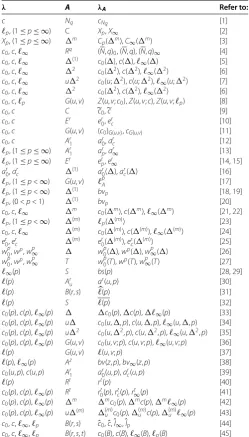
Table 1 The domains of some triangle matrices in certain sequence spaces
λ A λA Refer to:
c Nq cNq [1]
p, (1≤p≤ ∞) C Xp,X∞ [2]
Xp, (1≤p≤ ∞) m Cp(m),C∞(m) [3]
c0,c,∞ Rq (N,q)0, (N,q), (N,q)
∞ [4]
c0,c,∞ (1) c0(),c(),∞() [5]
c0,c,∞ 2 c0(2),c(2),∞(2) [6]
c0,c,∞ u2 c0(u;2),c(u;2),∞(u;2) [7]
c0,c,∞ 2 c0(2),c(2),∞(2) [6]
c0,c,p G(u,v) Z(u,v;c0),Z(u,v;c),Z(u,v;p) [8]
c0,c C c0,c [9]
c0,c Er er0,erc [10]
c0,c G(u,v) (c0)G(u,v),cG(u,v) [11]
c0,c Ar1 ar0,arc [12]
p, (1≤p≤ ∞) A1r arp,ar∞ [13] p, (1≤p≤ ∞) Er erp,er∞ [14, 15]
ar
0,arc (1) ar0(),arc() [16] p, (1≤p<∞) G(u,v) pA [17] p, (1≤p<∞) (1) bvp [18, 19] p, (0 <p< 1) (1) bvp [20]
c0,c,∞ m c0(m),c(m),∞(m) [21, 22] p, (1≤p<∞) (m) p((m)) [23]
c0,c,∞ (m) c0((m)),c((m)),∞((m)) [24]
er0,erc (m) er0((m)),erc((m)) [25]
wp0,wp,wp
∞ w0p(),wp(),wp
∞() [26]
wp0,wp,wp
∞ T w0p(T),wp(T),wp
∞(T) [27]
∞(p) S bs(p) [28, 29]
(p) Ar
u ar(u,p) [30]
(p) B(r,s) (p) [31]
(p) S (p) [32]
c0(p),c(p),∞(p) c0(p),c(p),∞(p) [33]
c0(p),c(p),∞(p) u c0(u,,p),c(u,,p),∞(u,,p) [34]
c0(p),c(p),∞(p) u2 c0(u,2,p),c(u,2,p),
∞(u,2,p) [35]
c0(p),c(p),∞(p) G(u,v) c0(u,v;p),c(u,v;p),∞(u,v;p) [36]
(p) G(u,v) (u,v;p) [37]
(p),∞(p) Az bv(z,p),bv
∞(z,p) [38]
c0(u,p),c(u,p) Ar1 ar0(u,p),arc(u,p) [39]
(p) Rt rt(p) [40]
c0(p),c(p),∞(p) Rt rt
0(p),rct(p),r∞t (p) [41]
c0(p),c(p),∞(p) m mc0(p),mc(p),m
∞(p) [42]
c0(p),c(p),∞(p) u(m) (m)
u c0(p),(um)c(p),(um)∞(p) [43]
c0,c,∞,p B(r,s) cˆ0,cˆ,ˆl∞,ˆlp [44]
c0,c,∞,p B(r,s,t) c0(B),c(B),∞(B),p(B) [45]
Let˜r= (rn)∞n=and˜s= (sn)∞n=be given convergent sequences of positive real numbers.
Define the sequential generalized difference matrixB(r,s) ={bnk(r,s)}by
bnk(r,s) := ⎧ ⎪ ⎪ ⎨ ⎪ ⎪ ⎩
rn (k=n),
sn (k=n– ),
(≤k<n– ork>n),
for allk,n∈N, the set of natural numbers. We should record here that the matrixB(r,s)
can be reduced to the generalized difference matrixB(r,s) in the casern=randsn=sfor
B(r,s) and include them. For the literature concerning the domainλAof the infinite
ma-trixAin the sequence spaceλ, Table may be useful.
The main purpose of the present paper is to introduce the sequence spaceλB(r,s)and to
determine theβ- andγ-duals of the space, whereλdenotes any one of the spaces∞,c,
corp. Furthermore, the Schauder bases for the spacesc,candpare given and some
topological properties of the spacesc, andp are examined. Finally, some classes of
matrix mappings on the spaceλB(r,s)are characterized.
The paper is organized as follows. In Section , we summarize the studies on the
dif-ference sequence spaces. In Section , we introduce the domainλB(r,s)of the generalized
difference matrixB(r,s) in the sequence spaceλwithλ∈ {∞,c,c,p}and determine the β- andγ-duals ofλB(r,s). After proving the fact, under which conditions for the
inclu-sionλ⊂λB(r˜,˜s)and the equalityλ=λB(r,s) hold, we give the Schauder basis of the spaces
(c)B(˜r,s˜),cB(r,s)and (p)B(r,s). Finally, we investigate some topological properties of the spaces
(c)B(r,s), ()B(r,s)and (p)B(r,s)withp> . In Section , we state and prove a general theorem
characterizing the matrix transformations from the domain of a triangle matrix to any se-quence space. As an application of this basic theorem, we make a table which gives the necessary and sufficient conditions of the matrix transformations fromλB(˜r,˜s)toμ, where
λ∈ {∞,c,c,p}andμ∈ {∞,c,c,}. In the final section of the paper, we note the
signif-icance of the present results in the literature about difference sequences and record some further suggestions.
2 Difference sequence spaces
In this section, we give some knowledge about the literature concerning the spaces of difference sequences.
Letλdenote any one of the classical sequence spaces∞,corc. Thenλ() consisting
of the sequencesx= (xk) such thatx= (xk–xk+)∈λis called thedifference sequence
spaceswhich were introduced by Kızmaz []. Kızmaz [] proved thatλ() is a Banach space with the norm
x=|x|+x∞; x= (xk)∈λ()
and the inclusion relationλ⊂λ() strictly holds. He also determined theα-,β- andγ
-duals of the difference spaces and characterized the classes (λ() :μ) and (μ:λ()) of
infinite matrices, whereλ,μ∈ {∞,c}. Following Kızmaz [], Sarıgöl [] extended the
difference spacesλ() to the spacesλ(r) defined by
λ(r) :=
x= (xk)∈ω:rx=
kr(xk–xk+)
∈λforr<
and computed theα-,β-,γ-duals of the spaceλ(r), whereλ∈ {∞,c,c}. It is easily seen
thatλ(r)⊂λ(), if <r< andλ()⊂λ(r), ifr< .
In the same year, Ahmad and Mursaleen [] extended these spaces toλ(p,) and
stud-ied related problems. Malkowsky [] determined the Köthe-Toeplitz duals of the sets
∞(p,) andc(p,) and gave new proofs of the characterization of the matrix
transfor-mations considered in []. In , Choudhary and Mishra [] studied some properties
of the sequence spacec(r) forr≥. In the same year, Mishra [] gave a
characteriza-tion ofBK-spaces which contain a subspace isomorphic tosc() in terms of matrix maps
operator. He showed that any matrix froms∞() into aBK-space which does not contain
any subspace isomorphic tos∞() is compact, where
sλ() =x= (xk)∈ω: (xk)∈λ,x= forλ=∞orc
.
In , Mursaleenet al.[] defined and studied the sequence space
∞(p,r) =
x= (xk)∈ω:rx∈∞(p)
(r> ).
Gnanaseelan and Srivastava [] defined and studied the spacesλ(u,) for a sequence
u= (uk) of non-complex numbers such that
(i) |uk|
|uk+|
= +O(/k)for eachk∈N={, , , . . .}.
(ii) k–|u
k| k
i=|ui|–=O().
(iii) (k|u–
k |)is a sequence of positive numbers increasing monotonically to infinity.
In the same year, Malkowsky [] defined the spacesλ(u,) for an arbitrary fixed
se-quenceu= (uk) without any restrictions onu. He proved that the sequence spacesλ(u,)
areBK-spaces with the norm defined by
x=sup
k∈N
uk–(xk––xk) withu=x= .
Later, Gaur and Mursaleen [] extended the spaceSr() to the spaceSr(p,), where
Sr(p,) =
x= (xk)∈ω:
kr|xk|
∈c(p)
(r≥)
and characterized the matrix classes (Sr(p,) :∞) and (Sr(p,) :). Malkowskyet al.
[] and, independently, Asma and Çolak [] extended the spaceλ(u,) to the space
λ(p,u,) and gave Köthe-Toeplitz duals of this spaces for λ=∞, c or c. Recently,
Malkowsky and Mursaleen [] characterized the matrix classes (λ:μ) and (λ:μ)
forλ=c(p),c(p),∞(p) andμ=c(q),c(q),∞(q).
Recently, the difference spacesbvpconsisting of the sequencesx= (xk) such that (xk–
xk–)∈phave been studied in the case <p< by Altay and Başar [], and in the case
≤p≤ ∞by Başar and Altay [] and Çolaket al.[].
3 Some new sequence spaces derived by the domain of the matrixB(r,s)
In this section, we define the sequence spaces∞,c,candp, and determine theβ- and
γ-duals of the spaces.
We introduce the sequence spaces∞,c,candp as the set of all sequences whose
B(r,s)-transforms are in the spaces∞,c,candp, respectively, that is,
∞:=
x= (xk)∈ω:sup
k∈N|sk–xk–+rkxk|<∞
,
c:=
x= (xk)∈ω:∃l∈C lim
k→∞|sk–xk–+rkxk–l|=
,
c:=
x= (xk)∈ω: lim
k→∞|sk–xk–+rkxk|=
,
p:=
x= (xk)∈ω:
k
|sk–xk–+rkxk|p<∞
With the notation of (.), we can redefine the spaces∞,c,candpby
∞:={∞}B(r,s), c:=cB(r,s), c:={c}B(˜r,˜s), p:={p}B(˜r,˜s).
Define the sequencey= (yk) by theB(r,s)-transform of a sequencex= (xk),i.e.,
yk:=sk–xk–+rkxk (k∈N). (.)
Since the spacesλandλB(r,s)are linearly isomorphic, one can easily observe thatx= (xk)∈ λB(˜r,s˜) if and only ify= (yk)∈λ, where the sequencesx= (xk) andy= (yk) are connected
with the relation (.).
Prior to quoting the lemmas which are needed for deriving some consequences given in Corollary . below, we give an inclusion theorem related to these new spaces.
Theorem . Letλ∈ {∞,c,c,p}and B=B(˜r,˜s).Then
(i) λ=λB,ifsupinfrnsn< .
(ii) λ⊂λBis strict,if supinfrnsn≥.
Proof Letλ∈ {∞,c,c,}andB=B(r˜,˜s). Since the matrixBsatisfies the conditions
sup
n∈N
k
|bnk| ≤sup
n∈Nrn+supn∈Nsn,
lim
n→∞bnk= ,
lim
n→∞
k
bnk=n→∞lim rn+n→∞limsn
and
sup
k∈N
n
|bnk| ≤sup k∈Nrk+
sup
k∈Nsk,
B∈(λ:λ). For any sequencex∈λ,Bx∈λhencex∈λB. This shows thatλ⊂λB.
(i) Let supinfrnsn < . Since the inverse matrixB–= (b–nk) of the matrixBalso satisfies the conditions
sup
n∈N
k
b–nk≤ infrn
k
supsn
infrn k
<∞,
lim
n→∞b
–
nk=n→∞lim
rn
n–
i=k
–si
ri
= ,
lim
n→∞
k
b–nk≤ infrn
lim
n→∞ n
k=
–infsn infrn
k
exists
and
sup
k∈N
k
b–nk≤ infrk
n
supsk
infrk n
B–∈(λ:λ). Therefore, ifx∈λ
B, theny=Bx∈λandx=B–y∈λ. Thus, the opposite
inclusionλB⊂λis just proved. This completes the proof of Part (i).
(ii) Let us consider the sequencesu:={rn ni=––siri},u:={(–)n(n+ )}andu:={[ + (–)n]/}.
If supinfrnsn > , thenBu=e()= (, , , . . .)∈λ. Hence,u∈λB\λ.
Suppose that supinfrnsn = .
(a) Letλ=c,p. If(sn) = (rn), thenu∈λB\λ.
(b) Letλ=∞,c. If(sn) = (rn+), thenBu={rn(–)n} ∈∞,Bu= (r,r,r, . . .)∈c.
Hence,u∈(∞)B\∞andu∈cB\c.
This step completes the proof.
The setS(λ,μ) defined by
S(λ,μ) :=z= (zk)∈ω:xz= (xkzk)∈μfor allx= (xk)∈λ
(.)
is called themultiplier spaceof the spacesλandμ. One can easily observe for a sequence
spaceνwithλ⊃ν⊃μthat the inclusions
S(λ,μ)⊂S(ν,μ) and S(λ,μ)⊂S(λ,ν)
hold. With the notation of (.), theα-,β-andγ-dualsof a sequence spaceλ, which are
respectively denoted byλα,λβandλγ, are defined by
λα:=S(λ,), λβ:=S(λ,cs) and λγ:=S(λ,bs).
Lemma .[, p., Exercise .(i)] Letλ,μbe the sequence spaces andξ∈ {α,β,γ}.If
λ⊂μ,thenμξ ⊂λξ.
We read the following useful results from Stieglitz and Tietz []:
sup
n∈N
k
|ank|q<∞, (.)
sup
k,n∈N|ank|<∞, (.)
lim
n→∞ank=αk (k∈N), (.)
lim
n→∞
k |ank|=
k
|αk|, (.)
lim
n→∞
k
ank=α. (.)
Lemma . The necessary and sufficient conditions for A∈(λ:μ)whenλ∈ {∞,c,c,,
p}andμ∈ {∞,c}can be read from Table.
Basic Lemma[, Theorem .] Let C= (cnk)be defined via the sequence a= (ak)∈ω
and the inverse matrix V= (vnk)of the triangle matrix U= (unk)by
cnk:= ⎧ ⎨ ⎩
n
j=kajvjk (≤k≤n),
Table 2 The characterization of the class (λ1:λ2) withλ1∈ {∞,c,c0,p,1}andλ2∈ {∞,c}
To From
∞ c c0 p 1
∞ 1. 1. 1. 2. 3.
c 4. 5. 6. 7. 8.
Here 1. (3.3) withq= 1. 2. (3.3). 3. (3.4). 4. (3.5) and (3.6). 5. (3.3) withq= 1, (3.5) and (3.7). 6. (3.3) withq= 1and (3.5). 7. (3.3) and (3.5). 8. (3.4) and (3.5).
for all k,n∈N.Then
{λU}γ :=
a= (ak)∈ω:C∈(λ:∞)
and
{λU}β:=
a= (ak)∈ω:C∈(λ:c)
.
Combining Lemma . with Basic Lemma, we have
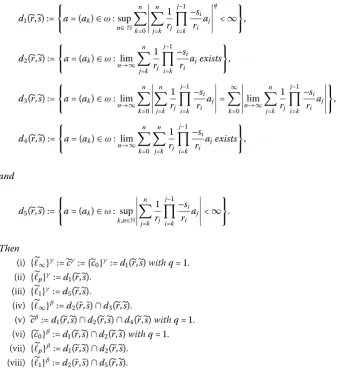
Corollary . Define the sets d(r,s),d(r˜,˜s),d(r,s),d(r,s)and d(r,s)by
d(r,s) :=
a= (ak)∈ω:sup n∈N n k= n
j=k
rj
j–
i=k
–si
ri aj q <∞ ,
d(r,s) :=
a= (ak)∈ω:n→∞lim n
j=k
rj
j–
i=k
–si
ri
ajexists
,
d(r,s) :=
a= (ak)∈ω:n→∞lim n k= n
j=k
rj
j–
i=k
–si
ri aj = ∞ k= n→∞lim n
j=k
rj
j–
i=k
–si
ri aj ,
d(r,s) :=
a= (ak)∈ω:n→∞lim n
k=
n
j=k
rj
j–
i=k
–si
ri
ajexists
,
and
d(r,s) :=
a= (ak)∈ω: sup k,n∈N
n
j=k
rj
j–
i=k
–si
ri aj <∞ . Then
(i) {∞}γ :=cγ:={c
}γ :=d(r,s)withq= .
(ii) {p}γ :=d(r,s).
(iii) {}γ :=d(r,s).
(iv) {∞}β:=d(r˜,˜s)∩d(r,s).
(v) cβ:=d
(r,s)∩d(r,s)∩d(r,s)withq= .
(vi) {c}β:=d(r,s)∩d(r,s)withq= .
(vii) {p}β:=d(r,s)∩d(r,s).
A sequence space λwith a linear topology is called a K -spaceprovided each of the
mapspi:λ→Cdefined bypi(x) =xiis continuous for alli∈N. A K-spaceλis called
anFK -spaceprovidedλis a complete linear metric space. AnFK-space whose topology
is normable is called aBK -space. If a normed sequence spaceλcontains a sequence (bn)
with the property that for everyx∈λ, there is a unique sequence of scalars (αn) such that
lim
n→∞x– (αb+αb+· · ·+αnbn)= ,
then (bn) is called aSchauder basis(or brieflybasis) forλ. The series
αkbkwhich has
the sumxis then called the expansion ofxwith respect to (bn) and written asx=
αkbk.
Since it is known that the matrix domainλAof a normed sequence spaceλhas a basis
if and only ifλhas a basis wheneverA= (ank) is a triangle (cf.[, Remark .]), we have
Corollary . Define the sequences z= (zn)and b(k)(r,s) ={b(nk)(r,s)}n∈N for every fixed
k∈Nby
zn:= n
k=
rk
k–
i=
–si
ri
and b(nk)(r,s) :=
⎧ ⎨ ⎩
(n<k),
rn n–
i=k
–si
ri (n≥k).
Then
(a) the sequence{b(k)(r,s)}
k∈Nis a basis for the spacescandp,and anyxincor inp has a unique representation of the form
x:=
k
αk(r)b(k)(r,s),
whereαk(r) :={B(r,s)x}kfor allk∈N.
(b) the set{z,b(k)(r,s)}is a basis for the spacec,and anyxinchas a unique
representation of the form
x:=lz+
k
αk(r) –l
b(k)(r,s),
wherel:=limk→∞{B(r,s)x}k.
Byλμ, we mean the set
λμ:=z= (zk)∈ω:zk=xkyk∀k∈N,x= (xk)∈λ,y= (yk)∈μ
for the sequence spacesλandμ.
Given aBK-spaceλ⊃φ, we denote thenthsection of a sequence x= (xk)∈λbyx[n]:=
n
k=xke(k), and we say thatxhas the property
AKiflimn→∞x–x[n]λ= (abschnittskonvergenz), ABifsupn∈Nx[n]
λ<∞(abschnittsbeschränktheit), ADifx∈φ(closure ofφ⊂λ) (abschnittsdichte),
If one of these properties holds for everyx∈λ, then we say that the spaceλhas that
property (cf.[]). It is trivial thatAKimpliesADandAK iffABandAD. For example,
candpareAK-spaces andcand∞are notAD-spaces.
The sequence spaceλis said to besolidif and only if
˜
λ:=(uk)∈ω:∃(xk)∈λsuch that|uk| ≤ |xk|for allk∈N
⊂λ.
For a sequenceJofNand a sequence spaceλ, we defineλJ by
λJ:=x= (xi) : there is ay= (yi)∈λwithxi=yni,∀ni∈J
and callλJ theJ-stepspace or aJ-sectional subspace ofλ. IfxJ∈λJ, then the canonical
preimage ofxJ is the sequencex¯J which agrees withxJ on the indices in J and is zero
elsewhere. Thenλis calledmonotoneprovidedλcontains the canonical preimages of all
its stepspaces.
Lemma .[, Theorem . and Lemma .] Letλ,μbe the BK -spaces and CU
μ = (cnk)
be defined via the sequenceα= (αk)∈μand the triangle matrix U= (unk)by
cnk:= n
j=k αjunjvjk
for all k,n∈N.Then the domain of the matrix U in the sequence spaceλhas the property
(i) KBif and only ifCU∈(λ:λ),
(ii) ABif and only ifCU
bv∈(λ:λ),
(iii) monotone if and only ifCU
m∈(λ:λ),
(iv) solid if and only ifCU
∞∈(λ:λ).
From Lemma ., we have
Corollary . If sn=rnfor all n∈N,thenhas the KB- and AB-properties.
Lemma .[, Theorem .] Letλbe a BK -space which has the AK -property,U be a triangle matrix andλU⊃φ.Then the sequence spaceλUhas the AD-property if and only
if the fact tU=θfor t∈λβimplies the fact t=θ.
Sincecandphave theAK-property, we can employ Lemma . for the matrixU=
B(r,s). Then we have
Corollary .candp(p> )have the AD-property if and only if sn≤rnfor all n∈N.
4 Some matrix transformations related to the sequence spaces
∞,c,c0and
1 In the present section, we characterize some classes of infinite matrices related to new sequence spaces.
Theorem . Letλbe an FK -space,U be a triangle,V be its inverse andμbe an arbitrary subset ofω.Then we have A= (ank)∈(λU:μ)if and only if
and
C= (cnk)∈(λ:μ), (.)
where
c(mkn) :=
⎧ ⎨ ⎩
m
j=kanjvjk (≤k≤m),
(k>m) and cnk:=
∞
j=k
anjvjk for all k,m,n∈N.
Proof LetA= (ank)∈(λU:μ) and takex∈λU. Then we obtain the equality
m
k= ankxk=
m k= ank k j= vkjyj
= m k= m
j=k
anjvjk
yk= m
k=
c(nkn)yk (.)
for allm,n∈N. SinceAxexists,C(n) must belong to the class (λ:c). Lettingm→ ∞in
equality (.) we haveAx=Cy. SinceAx∈μ, thenCy∈μ,i.e.,C∈(λ:μ).
Conversely, let (.), (.) hold and takex∈λU. Then we have (cnk)k∈N∈λβ, which
to-gether with (.) gives that (ank)k∈N∈λβUfor all n∈N. Hence,Axexists. Therefore, we
obtain from equality (.) asm→ ∞thatAx=Cyand this shows thatA∈(λU:μ).
Now, we list the following conditions:
sup m∈N m k= m
j=k
rj
j–
i=k
–si
ri anj q
<∞, (.)
lim
m→∞ m
j=k
rj
j–
i=k
–si
ri
anj=cnk, (.)
lim m→∞ m k= m
j=k
rj
j–
i=k
–si
ri anj = k
|cnk| for eachn∈N, (.)
lim m→∞ m k= m
j=k
rj
j–
i=k
–si
ri
anj=αn for eachn∈N, (.)
sup
k,m∈N
m
j=k
rj
j–
i=k
–si
ri
anj
<∞, (.)
sup
n∈N
k
|cnk|q<∞, (.)
lim
n→∞cnk=βk, (.)
lim
n→∞
k |cnk|=
k
|βk|, (.)
lim
n→∞
k
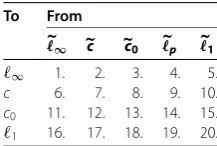
Table 3 The characterization of the class (λ:μ) withλ∈ {∞,c,c0,p,1}and μ∈ {∞,c,c0,1}
To From
∞ c c0 p 1
∞ 1. 2. 3. 4. 5.
c 6. 7. 8. 9. 10.
c0 11. 12. 13. 14. 15.
1 16. 17. 18. 19. 20.
Here 1. (4.5), (4.6) and (4.9) withq= 1. 2. (4.5), (4.7) and (4.4), (4.9) withq= 1. 3. (4.5) and (4.4), (4.9) withq= 1. 4. (4.4), (4.5) and (4.9). 5. (4.5), (4.8) and (4.13). 6. (4.5), (4.6), (4.10) and (4.11). 7. (4.5), (4.7), (4.10), (4.12) and (4.4), (4.9) withq= 1. 8. (4.5), (4.10) and (4.4), (4.9) withq= 1. 9. (4.4), (4.5), (4.9) and (4.10). 10. (4.5), (4.8), (4.10) and (4.13). 11. (4.5), (4.6) and (4.15). 12. (4.5), (4.7), (4.10) withβk= 0and (4.12) withβ= 0, and (4.4), (4.9) withq= 1. 13. (4.5), (4.10) withβk= 0and (4.4), (4.9) withq= 1. 14. (4.4), (4.5), (4.9) and (4.10) withβk= 0. 15. (4.5), (4.8), (4.10) withβk= 0and (4.13). 16. (4.5), (4.6) and (4.16). 17. (4.4) withq= 1, (4.5),
(4.7) and (4.16). 18. (4.4) withq= 1, (4.5) and (4.16). 19. (4.4), (4.5) and (4.17). 20. (4.5), (4.8) and (4.14).
sup
k,n∈N|cnk|<∞, (.)
sup
k∈N
n
|cnk|<∞, (.)
lim
n→∞
k
cnk= , (.)
sup
N,K∈F
n∈N
k∈K
cnk
<∞, (.)
sup
N∈F
k
n∈N
cnk
q<∞, (.)
whereFdenotes the collection of all finite subsets ofN.
We have from Theorem .
Corollary . The necessary and sufficient conditions for A∈(λ:μ)whenλ∈ {∞,c,c,
p,}andμ∈ {∞,c,c,}can be read from Table.
Now, we may present our final lemma given by Başar and Altay [, Lemma .] which is useful for obtaining the characterization of some new matrix classes from Corollary ..
Lemma . Let λ,μ be any two sequence spaces, A be an infinite matrix and U be a triangle matrix.Then A∈(λ:μU)if and only if UA∈(λ:μ).
We should finally note that ifankis replaced byrnank+sn–an–,kfor allk,n∈Nin
Corol-lary ., then one can derive the characterization of the class (λ:μ) from Lemma . with
U=B(r,s).
5 Conclusion
Quite recently, Kirişçi and Başar [] studied the domain of the generalized difference matrixB(r,s) in the classical sequence spaces∞,c,candp. Later, Sönmez []
general-ized these results by using the triple band matrixB(r,s,t). Since the generalized difference matrixB(r,s) is obtained in the special casern=randsn=sfor alln∈Nfrom the double
sequential band matrixB(r,s), our results are much more general than the corresponding
Finally, we should note that our next paper will be devoted to the investigation of the
domain of the double sequential band matrixB(r,s) in the spacef of almost convergent
sequences introduced by Lorentz in [] which generalizes the corresponding results of Başar and Kirişçi [].
Competing interests
The author declares that they have no competing interests.
Acknowledgements
The author would like to express their gratitude to professor Bilal Altay, Department of Mathematical Education, ˙Inönü University, 44280 Malatya-Turkey, for making some constructive comments on the main results of the earlier version of the manuscript which improved the presentation of the paper.
Received: 4 January 2012 Accepted: 19 November 2012 Published: 5 December 2012 References
1. Wang, C-S: On Nörlund sequence spaces. Tamkang J. Math.9, 269-274 (1978)
2. Ng, P-N, Lee, P-Y: Cesàro sequence spaces of non-absolute type. Ann. Soc. Math. Pol., 1 Comment. Math.20(2), 429-433 (1978)
3. Et, M: On some generalized Cesàro difference sequence spaces. Istanb. Üniv. Fen Fak. Mat. Derg.55-56, 221-229 (1996-1997)
4. Malkowsky, E: Recent results in the theory of matrix transformations in the sequence spaces. Mat. Vesn.49, 187-196 (1997)
5. Kızmaz, H: On certain sequence spaces. Can. Math. Bull.24(2), 169-176 (1981) 6. Et, M: On some difference sequence spaces. Turk. J. Math.17, 18-24 (1993)
7. Mursaleen, M: Generalized spaces of difference sequences. J. Math. Anal. Appl.203(3), 738-745 (1996) 8. Malkowsky, E, Sava¸s, E: Matrix transformations between sequence spaces of generalized weighted means. Appl.
Math. Comput.147, 333-345 (2004)
9. ¸Sengönül, M, Ba¸sar, F: Some new Cesàro sequence spaces of non-absolute type which include the spacesc0andc.
Soochow J. Math.31(1), 107-119 (2005)
10. Altay, B, Ba¸sar, F: Some Euler sequence spaces of non-absolute type. Ukr. Math. J.57(1), 1-17 (2005) 11. Rhoades, BE: Some sequence spaces which includec0andc. Hokkaido Math. J.35, 587-599 (2006)
12. Aydın, C, Ba¸sar, F: On the new sequence spaces which include the spacesc0andc. Hokkaido Math. J.33(2), 383-398
(2004)
13. Aydın, C, Ba¸sar, F: Some new sequence spaces which include the spacespand∞. Demonstr. Math.38(3), 641-656 (2005)
14. Altay, B, Ba¸sar, F, Mursaleen, M: On the Euler sequence spaces which include the spacespand∞I. Inf. Sci.176(10), 1450-1462 (2006)
15. Mursaleen, M, Ba¸sar, F, Altay, B: On the Euler sequence spaces which include the spacespand∞II. Nonlinear Anal. TMA65(3), 707-717 (2006)
16. Aydın, C, Ba¸sar, F: Some new difference sequence spaces. Appl. Math. Comput.157(3), 677-693 (2004)
17. Khan, FM, Rahman, MF: Matrix transformations on Cesà ro sequence spaces of nonabsolute type. J. Anal.4, 97-101 (1996)
18. Ba¸sar, F, Altay, B: On the space of sequences of p-bounded variation and related matrix mappings. Ukr. Math. J.55(1), 136-147 (2003)
19. Çolak, R, Et, M, Malkowsky, E: Some Topics of Sequence Spaces. Lecture Notes in Mathematics. Fırat Univ. Press, Elazı ˘g (2004). ISBN:975-394-0386-6
20. Altay, B, Ba¸sar, F: The matrix domain and the fine spectrum of the difference operatoron the sequence spacep,
(0 <p< 1). Commun. Math. Anal.2(2), 1-11 (2007)
21. Et, M, Çolak, R: On some generalized difference sequence spaces. Soochow J. Math.21(4), 377-386 (1995) 22. Çolak, R, Et, M: On some generalized sequence spaces and related matrix transformations. Hokkaido Math. J.26(3),
483-492 (1997)
23. Altay, B: On the space ofp-summable difference sequences of orderm, (1≤p<∞). Studia Sci. Math. Hung.43(4), 387-402 (2006)
24. Malkowsky, E, Parashar, SD: Matrix transformations in space of bounded and convergent difference sequence of orderm. Analysis17, 87-97 (1997)
25. Polat, H, Ba¸sar, F: Some Euler spaces of difference sequences of orderm. Acta Math. Sci.27(2), 254-266 (2007) 26. Altay, B, Ba¸sar, F, Malkowsky, E: Matrix transformations on some sequence spaces related to strong Cesàro
summability and boundedness. Appl. Math. Comput.211, 255-264 (2009)
27. Ba¸sar, F, Malkowsky, E, Altay, B: Matrix transformations on the matrix domains of triangles in the spaces of strongly
C1-summable and bounded sequences. Publ. Math.73(1-2), 193-213 (2008)
28. Ba¸sar, F: Infinite matrices and almost boundedness. Boll. Unione Mat. Ital., A6(3), 395-402 (1992)
29. Ba¸sar, F, Altay, B: Matrix mappings on the spacebs(p) and itsα-,β- andγ-duals. Aligarh Bull. Math.21(1), 79-91 (2001)
30. Aydın, C, Ba¸sar, F: Some generalizations of the sequence spacear
p. Iran. J. Sci. Technol., Trans. A, Sci.30(A2), 175-190
(2006)
31. Aydın, C, Ba¸sar, F: Some topological and geometric properties of the domain of the generalized difference matrix
32. Choudhary, B, Mishra, SK: On Köthe-Toeplitz duals of certain sequence spaces and their matrix transformations. Indian J. Pure Appl. Math.24(5), 291-301 (1993)
33. Ahmad, ZU, Mursaleen, M: Köthe-Toeplitz duals of some new sequence spaces and their matrix maps. Publ. Inst. Math. (Belgr.)42, 57-61 (1987)
34. Asma, Ç, Çolak, R: On the Köthe-Toeplitz duals of some generalized sets of difference sequences. Demonstr. Math.33, 797-803 (2000)
35. Bekta¸s, ÇA: On some new generalized sequence spaces. J. Math. Anal. Appl.277, 681-688 (2003)
36. Altay, B, Ba¸sar, F: Some paranormed sequence spaces of non-absolute type derived by weighted mean. J. Math. Anal. Appl.319(2), 494-508 (2006)
37. Altay, B, Ba¸sar, F: Generalization of the sequence space(p) derived by weighted mean. J. Math. Anal. Appl.330(1), 174-185 (2007)
38. Ba¸sar, F, Altay, B, Mursaleen, M: Some generalizations of the spacebvpof p-bounded variation sequences. Nonlinear
Anal.68(2), 273-287 (2008)
39. Aydın, C, Ba¸sar, F: Some new paranormed sequence spaces. Inf. Sci.160(1-4), 27-40 (2004)
40. Altay, B, Ba¸sar, F: On the paranormed Riesz sequence spaces of non-absolute type. Southeast Asian Bull. Math.26(5), 701-715 (2002)
41. Altay, B, Ba¸sar, F: Some paranormed Riezs sequence spaces of non-absolute type. Southeast Asian Bull. Math.30(5), 591-608 (2006)
42. Et, M, Ba¸sarır, M: On some new generalized difference sequence spaces. Period. Math.-Phys10, 63-71 (1987) 43. Malkowsky, E, Mursaleen, M, Suantai, S: The dual spaces of sets of difference sequences of ordermand matrix
transformations. Acta Math. Sin. Engl. Ser.23(3), 521-532 (2007)
44. Kiri¸sçi, M, Ba¸sar, F: Some new sequence spaces derived by the domain of generalized difference matrix. Comput. Math. Appl.60(5), 1299-1309 (2010)
45. Sönmez, A: Some new sequence spaces derived by the domain of the triple band matrix. Comput. Math. Appl.62(2), 641-650 (2011)
46. Altay, B, Ba¸sar, F: Certain topological properties and duals of the matrix domain of a triangle matrix in a sequence space. J. Math. Anal. Appl.336(1), 632-645 (2007)
47. Ba¸sarır, M: On some new sequence spaces and related matrix transformations. Indian J. Pure Appl. Math.26(10), 1003-1010 (1995)
48. Sarıgöl, MA: On difference sequence spaces. J. Karadeniz Tech. Univ. Fac. Arts Sci. Ser. Math.-Phys.10, 63-71 (1987) 49. Malkowsky, E: Absolute and ordinary Köthe-Toeplitz duals of some sets of sequences and matrix transformations.
Publ. Inst. Math. (Beograd) (N.S.)46(60), 97-103 (1989)
50. Choudhary, B, Mishra, SK: A note on certain sequence spaces. J. Anal.1, 139-148 (1993)
51. Mishra, SK: Matrix maps involving certain sequence spaces. Indian J. Pure Appl. Math.24(2), 125-132 (1993) 52. Mursaleen, M, Gaur, AK, Saifi, AH: Some new sequence spaces and their duals and matrix transformations. Bull.
Calcutta Math. Soc.88(3), 207-212 (1996)
53. Gnanaseelan, C, Srivastava, PD: Theα-,β- andγ-duals of some generalised difference sequence spaces. Indian J. Math.38(2), 111-120 (1996)
54. Malkowsky, E: A note on the Köthe-Toeplitz duals of generalized sets of bounded and convergent difference sequences. J. Anal.4, 81-91 (1996)
55. Gaur, AK, Mursaleen, M: Difference sequence spaces. Int. J. Math. Math. Sci.21(4), 701-706 (1998) 56. Malkowsky, E, Mursaleen, M, Qamaruddin: Generalized sets of difference sequences, their duals and matrix
transformations. In: Sequence Spaces and Applications, pp. 68-83. Narosa, New Delhi (1999)
57. Malkowsky, E, Mursaleen, M: Some matrix transformations between the difference sequence spacesc0(p),c(p)
and∞(p). Filomat15, 353-363 (2001)
58. Kamthan, PK, Gupta, M: Sequence Spaces and Series. Dekker, New York (1981)
59. Stieglitz, M, Tietz, H: Matrix transformationen von folgenräumen eine ergebnisübersicht. Math. Z.154, 1-16 (1997) 60. Jarrah, AM, Malkowsky, E: BK spaces, bases and linear operators. Rend. Circ. Mat. Palermo (2)52, 177-191 (1990) 61. Grosse-Erdmann, K-G: Onl1-invariant sequence spaces. J. Math. Anal. Appl.262, 112-132 (2001)
62. Lorentz, GG: A contribution to the theory of divergent sequences. Acta Math.80, 167-190 (1948)
63. Ba¸sar, F, Kiri¸sçi, M: Almost convergence and generalized difference matrix. Comput. Math. Appl.61(3), 602-611 (2011)
doi:10.1186/1029-242X-2012-281