2018 2nd International Conference on Applied Mathematics, Modeling and Simulation (AMMS 2018) ISBN: 978-1-60595-580-3
Burst Stream Resource Reservation Algorithm of Satellite E-OBS
Network Based on Preemption Window
Rui-xin LI
1,*, Jiang-bo YANG
2, Yong-jun LI
1and Xiang WANG
11College of Information and Aviation, AFEU, Xian Shanxi, 710077, China
2Information Station of Air Force, Beijing, 100076, China
*Corresponding author
Keywords:Satellite optical burst switching, E-OBS, Burst stream, Preemption window, Resource reservation.
Abstract. An onboard optical burst network resource reservation algorithm named PWBR is proposed for satellite optical switching network. The algorithm uses burst stream as reservation unit and is based on preemption window which can guarantee the QoS of HP burst; network delay performance and packet loss ration are improved through big granularity burst stream. Computer simulations show that the packet loss ratio of HP BDP is lowered 79%, the packet loss ratio of LP BDP is lowered 73% in E-OBS structure than C-OBS when network load is 0.7.and its end-to- end delay is improved 2.1% than RRBS, 3.5% than JET, 7.7% than DRR, 11.5% than JIT.
Introduction
Laser satellite network technology is hot in satellite communication field, and onboard switching is a key technology of it[1-2].This paper selects Emulated-OBS (E-OBS) architecture as the basis of optical switching in laser satellite network. Comparing to Conventional-OBS (C-OBS), E-OBS introduces the local offset time by the fiber delay unit (FDU) locating on the input port[3-4]. Burst Data Packet (BDP) and Burst Control Packet(BCP)is sent to network together by edge node. When BDP and BCP arrive at core node, BCP will be sent to SCU (Switching Control Unit), and SDU is sent to FDU for delay. SCU will identify, process the BCP, configure optical switching units. After that BDP is sent to switch unit to forward. BCP will be stored and multiplexed together with BDP, and sent to next node when the offset time is over. Comparing to C-OBS, the offset time of E-OBS is fixed, and no operation is needed at core nod so E-OBS architecture is fit for laser satellite network.
Resource reservation algorithm is one of the key technologies[5], so the design of resource reservation is important for satellite laser network through ground OBS technology use for reference. Now scholars have put forward many algorithms, such as classical JIT (Just In Time)[6],
JET(Just Enough Time)[7], and DRR (Differenced Resource Reservation) [8]which can provide QoS
for high priority data, RRBS (Resource Reservation Burst Stream)[9] which is an onboard resource reservation algorithm based on burst stream. These are based on C-OBS architecture. An onboard E-OBS network resource reservation algorithm is brought out considering many factors such as satellite resource limit, remote space between satellites[10], low received optical power[11], optical memory limit, and high continuous transmission probability, fairness and delay and so on. Simulation results verify the algorithm can provide high success ration in high load and improve packet ration and end to end delay performance.
Onboard E-OBS Network Resource Reservation Algorithm PWBR
The Procedure of Reservation
identifying BS, but using BS as reservation unit can improve network throughout and packet loss ratio performance.
If BDP’s length is fixed, BCP will reserve resources according LAUC. If the Burst is single BDP (the highest bit is 1), the BDP will be sent to switching matrix directly once the delay time is over. If the burst is the first BDP of a burst stream (the label field is 011), the resources will not be released after the BDP finish switching (until the last one finishes switching). Therefore next BDP can be sent to optical switch from FDU after the prior one finished its switching, the moved up time equals (TFDU delay time-TBCP processing time).If the reservation is not successful, the feedback scheme is needed(NAK message is sent back to edge node before BDP is sent.). Then BDP is cached for waiting next transmission.
Data Channel Preemptive Scheme Based on Window
Resource reservation procedure refers to preemptive window scheme based on window[4,12].All the
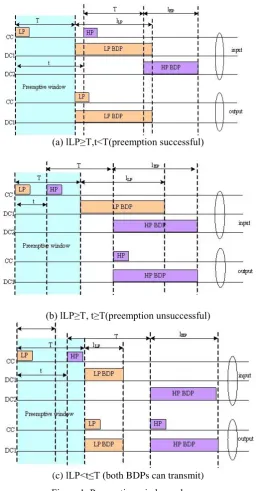
BDP is classed into High Priority (HP) and Low Priority (LP), and every class BDP is allocated some data channels. When HP BDP’s corresponding data channel is busy it will preempt LD BDP’s reserved channels. The preemptive condition is following: the arriving time of HP BCP must be in the range of preemptive window T, and LP BDP hasn’t transmitted, or the preempt will be forbidden. Fig.1 shows the procedure of onboard switching based on preemptive window.
Fig.1 shows the preemptive window rules. In Fig.1(a), the arriving time of HP BCP is just in LP BCP’s preemptive window(t<T), and LP BDP hasn’t been sent, that is lLP+T≥t+T(lLP≥t). In Fig.1(b), the arriving time of HP BCP is not in LP BCP’s preemptive window(t>T), and LP BDP has been sent, so the preemptive conditions couldn’t be satisfied, of course the resource can’t
preempted. In Fig.1(c), the arriving time of HP BCP is in LP BCP’s preemptive window(t≤T), and
LP BDP hasn’t been sent, so the preemptive conditions can be satisfied, of course the resource can be preempted, but the transmission time of HP BDP and LP BDP, that is
(a) lLP≥T,t<T(preemption successful)
(b) lLP≥T, t≥T(preemption unsuccessful)
[image:3.595.169.426.68.560.2](c) lLP<t≤T (both BDPs can transmit)
Figure 1. Preemptive window scheme.
The burst stream resource reservation procedure (PWBR) which is based on preemptive window works like this: when the burst stream reserve resource, if all waves is busy, then the system will check the packet type on the ‘busy’ channel. If the packet type is a BDP on the busy channel, and the burst stream’s BCP arriving time is in the range of preemptive window T, then it will preempt the resources of this BDP, and discard the BDP; If the packet type is a burst stream on the busy channel, then the preemption will be forbidden, and HP BDP will be discarded.
For convenience of discussing, the core node processing time is assumed to 0.Assuming the HP burst stream has the highest preemptive level, and the same level BDP can’t preempt resources each other, LP BDP(burst stream) can’t preempt the resources of HP BDP.
Simulation Result and Analysis
low limit is 50 us, upper limit is 100 us, length threshold low limit is 500 byte, upper limit is 1,500 k byte; and the offset time of JIT, JET, DRR algorithm is set to 30us. Core node (GEO) optical switch unit has 4 input and output ports, 4 waves every port, and three of which is used for BDP, one for BCP. The data channel rate is 2.5Gb/s, and the probability of BDP to every output is same. The edge nodes use linear predicting filter to predict the bust stream. Here is the ratio of HP BDP, then 1is the ratio of LP BDP. We use different algorithms to simulate in same conditions, and same parameters. Fig.2,3,4,5 give the simulation results.
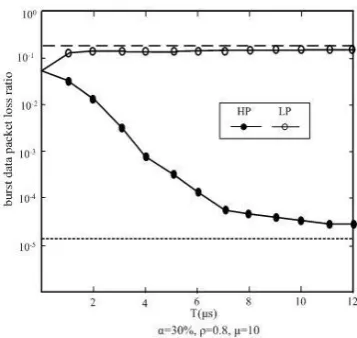
[image:4.595.197.400.272.436.2]Fig.2 indicates the relationship of BDP loss ratio and preemptive window when HP BDP ratio is 30%, network load is 0.8, service rate is 10. From the results, we can get that with T increasing the loss ratio of HP BDP decreases quickly, and tend to constant value. The reason is long preemptive window can produce more preemption chances. Therefore the length of FDU in input port meets the performance requirement, too long FDU will increase satellite hardware complexity and weight up. The loss ratio of LP BDP increases with big T, and tend to a constant value at last. The reason is that LP BDP is discarded with the HP BDP’s preemption.
Figure 2. Relationship of packet loss ratio and preemptive window T.
Figure 3. Relationship of packet loss ratio and network load.
[image:4.595.208.387.459.628.2]Fig.4 illustrates the relation of packet loss ratio and load when satellite e E-OBS network uses preemptive window algorithm, here we consider burst stream as reservation unit. From the results, we can get that burst stream can improve the packet loss performance. When the normalized load is 0.7, the packet loss ratio of HP BDP of E-OBS improves 65% than the one of C-OBS, the packet loss ratio of LP BDP of E-OBS improves 40% than the one of C-OBS. The reason of the results is that the burst stream can transmitted continuously, and HP BDP can’t preempt the resources of LP burst stream, so the packet loss ratio is better.
[image:5.595.314.497.168.322.2]
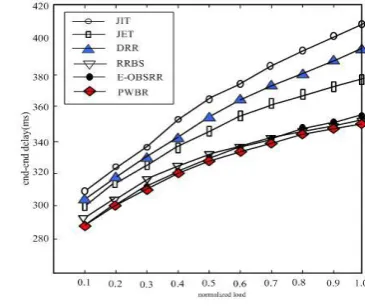
Figure 4. Packet loss ratio (considering burst stream). Figure 5. End-end delay comparison.
Fig.5 compares the average delay of some resource reservation algorithms, here the HP data proportion is 40%, T=20μs, service rate is 8. From the results we get the average delay performance of PWBR,E-OBSRR,RRBS is better than others when the network load is high, so the burst stream as reservation unit has clear advantage: when the normalized load is 0.7, the end-end delay of PWBR improves 2.1%,3.5%,7.7% than E-OBSRR, JET, DRR respectively. DRR algorithm needs some waiting time at edge node to form burst stream, but E-OBSRR and PWBR set no waiting time, the scheduling time at core node is near 0, therefore the delay is shorter than DRR. The end-end delay of PWBR,E-OBSRR,RRBS is near and small. The reason of this is FDU set at input provides offset time, but the offset time is very small comparing with propagation time, and C-OBS network usually uses maximum offset time to lessen packet loss, so the offset time is longer than E-OBS network which influences the performance of end-end delay.
Summary
To meet the forwarding requirements of future satellite laser network, a resource reservation algorithm is brought forward in which burst steam is used for forwarding unit, E-OBS used as network structure, and preemptive window guarding network QoS. Simulation results verify that the algorithm achieves high successful resource reservation probability, good packet loss ratio, end-end delay performance.
Acknowledgement
This research was financially supported by the Training Program of the Major Research Plan of the National Science Foundation of China (91638101) and Shanxi natural fund projects(2016JM6073).
References
[1] Vincent W. S. Chan. Optical Satellite Networks. J. of Lightwave Technology. 21(2003)2811-2827.
[image:5.595.98.268.172.320.2][3] Mirosław Klinkowski, Davide Careglio, Josep Solé-Pareta, et al. Performance Overview of the
Offset Time Emulated OBS Network Architecture. J. of Lightwave Technology.
27(2009)2751-2764.
[4] Guan Aihong, Wang Boyun, Fu Hongliang. A resource reservation mechanism based on window in emulated-optical burst switching networks. J. of Optoelectronics. Laser. 22(2011)1007-1012.
[5] N. Barakat, E.H. Sargent. Separating resource reservations from services requests to improve the performance of optical burst-switching networks. IEEE J. Select. Areas Communication. 24(2006)95-107.
[6] J. Y. Wei, R. I. McFarland. Just-in-Time signaling for WDM optical burst switching networks. J. of Lightwave Technology. 12 (2000) 2019-2037.
[7] C. Qiao, M. Yoo. Optical burst switching (OBS)-A new paradigm for an optical Internet. J. of High Speed Networks. 8(1999)69-84.
[8] Liu Jianping, Huang Bohu, Liu Zengji. A differentiated resource reservation mechanism for optical burst switching. Acta Photonica Sinica. 35(2006)583-586.
[9] Li Ruixin, Zhao Shanghong, Liu Zhenxia, et al. An on-board optical switching data channel scheduling algorithm based on burst stream. Chinese J. Lasers. 40(2013)1105004-1-1105004-5.
[10] Yi Kechu, Li Yi, Sun Chenhua, et. al. Recent development and its prospect of satellite communications. J. of Communications, 36(2015)2015223-1-2015223-16.
[11] Tang Chenkai, Lian Baowang, Zhang Lingling. An algorithm to Eliminate self-interference of bidirectional relaying for satellite communication systems. J. of Xi’an Jiaotong University. 49(2015)74-79.