R E S E A R C H
Open Access
OD
-characterization of the automorphism
groups of simple
K
-groups
Yanxiong Yan
1,2, Haijing Xu
1, Guiyun Chen
1*and Liguan He
3*Correspondence:
[email protected] 1School of Mathematics and
Statistics, Southwest University, Chongqing, 400715, China Full list of author information is available at the end of the article
Abstract
The degree pattern of a finite groupGassociated to its prime graph has been introduced in (Moghaddamfaret al.in Algebra Colloq. 12(3):431-442, 2005) and denoted byD(G). The groupGis calledk-foldOD-characterizable if there exist exactly knon-isomorphic groupsHsatisfying conditions (1)|G|=|H|and (2)D(G) =D(H). Moreover, a one-foldOD-characterizable group is simply calledOD-characterizable group. In this problem, those groups with connected prime graphs are somewhat much difficult to be solved. In the present paper, we continue this investigation and show that the automorphism groups of simpleK3-groups are characterized by their
orders and degree patterns. In fact, the automorphism groups of simpleK3-groups
exceptA6andU4(2) areOD-characterizable. Moreover, Aut(A6) is fourfold
OD-characterizable and Aut(U4(2)) is at least fourfoldOD-characterizable.
AMS Subject Classification: 20D05
Keywords: almost simple group; prime graph; degree pattern; simpleK3-group;
degree of a vertex
1 Introduction
LetGbe a finite group,πe(G) denote the set of element orders ofGandπ(G) the set of all prime divisors of|G|. The prime graph ofGwas defined by Gruenberg and Kegel (ref. to []), which was denoted by(G) and constructed as follows: The vertex set of this graph is π(G) and two distinct verticespandqare jointed by an edge if and only ifpq∈πe(G). In this case, we say verticespandqare adjacent and denote this fact byp∼q. The number of connected components of(G) is denoted byt(G) and the sets of vertices of connected components of(G) are denoted asπi=πi(G) (i= , , . . . ,t(G)). If|G|is even, we always assume that ∈π(G). SetT(G) ={πi(G)|i= , , . . . ,t(G)}.
Letnbe a positive integer, we useπ(n) to denote the set of all prime divisors ofn. If the prime graph ofGis known, then|G|can be expressed as a product ofm,m, . . . ,mt(G),
wheremis are positive integers such thatπ(mi) =πi. Thesemis were called theorder
com-ponentsofGby the second author, who proved a lot of finite simple groups can be uniquely determined by their order components (ref. to []). The set of order components ofGis denoted asOC(G) ={m,m, . . . ,mt(G)}. We also use the following notations. Given a
fi-nite groupG, denote bySoc(G) the socle ofGwhich is the subgroup generated by the set of all minimal normal subgroups ofG.Sylp(G) denotes the set of all Sylowp-subgroups ofG, wherep∈π(G). AndPrdenotes a Sylowr-subgroup ofGforr∈π(G). All further unexplained notations are referred to [].
Definition .[] LetGbe a finite group and|G|=pα
p α
· · ·p αk
k , wherepis are primes andαiare integers. Forp∈π(G), letdeg(p) :=|{q∈π(G)|p∼q}|, called thedegreeofp. We also defineD(G) := (deg(p),deg(p), . . . ,deg(pk)), wherep<p<· · ·<pk. We callD(G) thedegree patternofG.
Definition .[] A groupMis calledk-fold OD-characterizableif there exist exactly
knon-isomorphic groupsGsuch that|G|=|M|andD(G) =D(M). Moreover, a one-fold OD-characterizable group is simply called anOD-characterizable group.
Definition . A groupGis said to be almost simple related toSif and only ifSG≤
Aut(S) for some non-abelian simple groupS.
In a series of articles such as [–], many finite non-abelian simple groups or almost simple groups were shown to beOD-characterizable. For convenience, we recall some of them in the following proposition.
Proposition . A finite group G is OD-characterizable if G is one of the following groups:
() All sporadic simple groups and their automorphism groups exceptAut(J)and Aut(McL);
() The alternating groupsAp,Ap+,Ap+and the symmetric groupsSpandSp+,wherep
is a prime;
() All finite simpleK-groups exceptA;
() The simple groups of Lie typeL(q),L(q),U(q),B(q)andG(q)for certain prime
powerq;
() All finite simpleC,-groups;
() The alternating groupsAp+,wherep+ is a composite number,p+ is a prime and
=p∈π(,!);
() The almost simple groups ofAut(O+
()),Aut(O–())andAut(F()).
Till now a lot of finite simple groups have been shown to beOD-characterizable, and also some finite groups, especially the automorphism groups of some finite simple groups, have been shown not to beOD-characterizable butk-foldOD-characterizable for some k> . In this paper, we continue this topic and get the following Main Theorem.
Main Theorem Let M be a simple K-group and G be a finite group such that |G|= |Aut(M)|and D(G) =D(Aut(M)).
() IfMis one of the following simpleK-groups:A,A,L(),L(),U(),L()and
L(),thenG∼=Aut(M).In other words,Aut(M)isOD-characterizable.
() IfM=A,thenGis isomorphic to one of the following groups:Aut(A),Z×Z×A,
Z×(Z·A)andZ×A.In other words,Aut(A)is fourfoldOD-characterizable.
() IfM=U(),thenGis isomorphic to one of the following groups:Z·U(),
Z×U(),Aut(U())and(PP)P,wherePr∈Sylr(G)for eachr∈π(G).In other words,Aut(U())is at least fourfoldOD-characterizable.
2 Preliminaries
Lemma .[, Theorem A] Let G be a finite group with t(G)≥,then G is one of the
following groups:
(a) Gis a Frobenius or-Frobenius group;
(b) Ghas a normal seriesHKGsuch thatHandG/Kareπ-groups andK/H
is a non-abelian simple group,whereπis the prime graph component containing,
His a nilpotent group and|G/H| | |Aut(K/H)|.Moreover,any odd order component ofGis also an odd order component ofK/H.
Remark . A groupGis a -Frobenius group if there exists a normal series HK Gsuch thatKandG/Hare Frobenius groups with kernelsHandK/H, respectively.
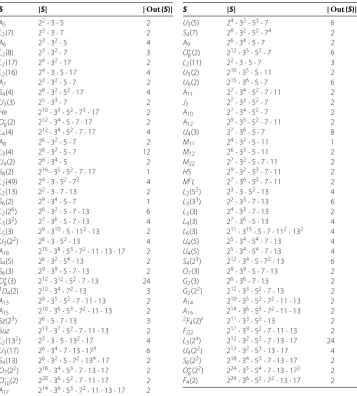
[image:3.595.119.477.333.730.2]Lemma .[] Let S be a finite non-abelian simple group with order having prime divisors at most.Then S is isomorphic to one of the simple groups listed in Table.In particular, if|Out(G)| = ,thenπ(Out(G))⊆ {, }.
Table 1 Finite non-abelian simple groups withπ(S)⊆ {2, 3, 5, 7, 11, 13, 17}
S |S| |Out(S)|
A5 22·3·5 2
L2(7) 23·3·7 2
A6 23·32·5 4
L2(8) 23·32·7 3
L2(17) 24·32·17 2
L2(16) 24·3·5·17 4
A7 23·32·5·7 2
S4(4) 28·32·52·17 4
U3(3) 25·33·7 2
He 210·33·52·73·17 2
O–
8(2) 212·34·5·7·17 2
L4(4) 212·34·52·7·17 4
A8 26·32·5·7 2
L3(4) 26·32·5·7 12
U4(2) 26·34·5 2
S8(2) 216·35·52·7·17 1
L2(49) 24·3·52·72 4
L2(13) 22·3·7·13 2
S6(2) 29·34·5·7 1
L2(26) 26·32·5·7·13 6
L3(32) 27·36·5·7·13 4
L5(3) 29·310·5·112·13 2
U3(22) 26·3·52·13 4
A18 215·38·53·72·11·13·17 2
S4(5) 26·32·54·13 2
S6(3) 29·39·5·7·13 2
O+8(3) 212·312·52·7·13 24
3D4(2) 212·34·72·13 3
A13 29·35·52·7·11·13 2
A15 210·36·53·72·11·13 2
Sz(23) 26·5·7·13 3
Suz 213·37·52·7·11·13 2
L2(132) 23·3·5·132·17 4
U3(17) 26·34·7·13·173 6
S4(13) 26·32·5·72·134·17 2
O7(22) 218·34·53·7·13·17 2
O–
10(2) 220·36·52·7·11·17 2
A17 214·36·53·72·11·13·17 2
S |S| |Out(S)|
U3(5) 24·32·53·7 6
S4(7) 28·32·52·74 2
A9 26·34·5·7 2
O+
8(2) 212·35·52·7 6
L2(11) 22·3·5·7 3
U5(2) 210·35·5·11 2
U6(2) 215·36·5·7 6
A11 27·34·52·7·11 2
J2 27·33·52·7 2
A10 27·34·52·7 2
A12 29·35·52·7·11 2
U4(3) 27·36·5·7 8
M11 24·32·5·11 1
M12 26·33·5·11 2
M22 27·32·5·7·11 2
HS 29·32·53·7·11 2
McL 27·36·53·7·11 2
L2(52) 23·3·52·13 4
L3(33) 22·33·7·13 6
L3(3) 24·33·7·13 2
L4(3) 27·36·5·13 4
L6(3) 211·315·5·7·112·132 4
U4(5) 25·34·54·7·13 4
U4(5) 25·34·54·7·13 4
S4(23) 212·34·5·72·13 6
O7(3) 29·39·5·7·13 2
G2(3) 26·36·7·13 2
G2(22) 212·33·52·7·13 2
A14 210·35·52·72·11·13 2
A16 214·36·53·72·11·13 2
2F4(2) 211·33·52·13 2
Fi22 217·39·52·7·11·13 2
L3(24) 212·32·52·7·13·17 24
U4(22) 212·32·53·13·17 4
S6(22) 218·34·53·7·13·17 2
O+
8(22) 224·35·54·7·13·172 2
Lemma .[] Let G be a Frobenius group with kernel F and complement C.Then the following assertions hold:
(a) Fis a nilpotent group. (b) |F| ≡(mod|C|).
Lemma .[] Let G be a Frobenius group of even order with H and K being its Frobenius kernel and Frobenius complement,respectively.Then t(G) = and T(G) ={π(K),π(H)}.
Lemma .[] Let G be a simple Cp,p-group,where p is a prime.Then
(a) Ifp= ,Gis isomorphic to one of the following simple groups:A,A,A,M,M,
L(),S(),S(),U(),Sz(),Sz(),L(),L(m),L(·m±),wherem∈N
and·m±∈P.
(b) Ifp= ,Gis isomorphic to one of the following simple groups:A,A,A,M,J,J,
HS,L(),S(),O+(),G(),G(),U(),U(),U(),U(),U(),Sz(),
L(),L(m),L(·m– ),wherem∈Nand·m– ∈P.
(c) Ifp= ,Gis isomorphic to one of the following simple groups:A,A,A,Suz,
Fi,L(),L(),O(),S(),S(),O+(),U(),U(),G(),G(),F(),
Sz(),E
(),D(),F(),L(),L(),L(m),L(·m– ),wherem∈N
and·m– ∈P.
(d) Ifp= ,Gis isomorphic to one of the following simple groups:A,A,A,J,He,
Fi,Fi,L(q)(q= , m, ·m±which is a prime,m≥),S(),S(),O–(),
F(),E().
Remark . Letpbe a prime. A groupGis called aCp,p-group if and only ifp∈π(G) and
the centralizers of its elements of orderpinGarep-groups.
3 Proof of Main Theorem
In this section, we give the proof of Main Theorem.
Remark . Letnbe a positive integer andn> . We say that a finite groupGis aKn-group if and only if|π(G)|=n.
Proof of Main Theorem LetMbe a simpleK-group, thenMis isomorphic to one of
the following simpleK-groups:A,A,L(),L(),U(),L(),L() andU(). For
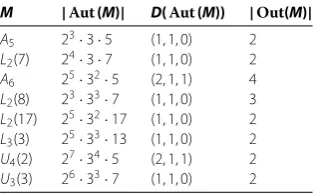
[image:4.595.219.376.635.732.2]convenience, using [], we have tabulated|Aut(M)|,D(Aut(M)) and|Out(M)|in Table . LetGbe a finite group satisfying ()|G|=|Aut(M)|and ()D(G) =D(Aut(M)). We prove the theorem up to choice ofMone by one. The proof is written in four cases.
Table 2 K3-groups
M |Aut(M)| D(Aut(M)) |Out(M)|
A5 23·3·5 (1, 1, 0) 2
Case . To prove the theorem ifM=A.
Evidently,t(G) = . In fact, we haveπ(G) ={, }andπ(G) ={}. We first show thatG
is neither Frobenius nor -Frobenius group. SupposeG=NHis a Frobenius group with kernelN and complementH, and henceT(G) ={π(N),π(H)}by Lemma .. Since|H| divides|N|– , it follows that|N|= · and|H|= . Clearly, this is impossible because
Pcannot act fixed-point-freely for instance onPas ( – ).
Now assume thatGis a -Frobenius group with kernelsHandK/H, respectively. Since T(G) ={π(H)∪π(G/K),π(K/H)}and ∈π(H)∪π(G/K), it follows that|K/H|= . On the other hand,G/KAut(K/H)∼=Z. Hence|G/K| |, which implies{, } ⊆π(K). In
this case, we have ∈π(H), so an element of order must act fixed-point-freely on a subgroup of order inH, which is clearly a contradiction by Table .
By Lemma ., G has a normal series N G G such that N and G/G are
π-groups andG/Nis a non-abelian simple group,Nis a nilpotent group. Note that one of
the components of the prime graph ofG/Nmust be{}andG/Nis a simpleC,group.
By Lemma .,G/Ncan only be isomorphic to one of the following simple groups:A,
A,A,M,M,L(),S(),S(),U(),Sz(),Sz(),L(),L(m) andL(·m±),
wherem∈Nand ·m±∈P.
Considering the orders of the simple groups,G/Ncan only be isomorphic toA, that
is,G/N∼=A. SinceG/NAut(G/N), we getAG/NAut(A).
IfG/N∼=Aut(A), and since|G|=|Aut(A)|, we deduceN= andG∼=Aut(A).
IfG/N∼=A, then|N|= and soN≤Z(G). ThereforeGis a central extension ofZby
AandGis isomorphic to one of the following groups:
·A (a non-split extension ofZbyA);
:A∼=Z×A (a split extension ofZbyA).
But whetherGis isomorphic to ·Aor :A∼=Z×A, it always follows that ∈πe(G) by [] (see ATLAS), a contradiction.
Till now we have proved thatG∼=Aut(A) if|G|=|Aut(A)|andD(G) =D(Aut(A)), that
is,Aut(A) isOD-characterizable.
Case . To prove the theorem holds forM, one of the following simple groups:L(),
L(),U(),L() andL().
Since|G|=|Aut(M)|andD(G) =D(Aut(M)), we have to discuss the following five cases. The method used below is the same as Case , so the detailed processes are omitted.
(a) IfM=L(), thenG∼=Aut(L());
(b) IfM=L(), thenG∼=Aut(L());
(c) IfM=U(), thenG∼=Aut(U());
(d) IfM=L(), thenG∼=Aut(L());
(e) IfM=L(), thenG∼=Aut(L()).
Hence all the almost simple groupsAut(L()),Aut(L()),Aut(U()),Aut(L()) and Aut(L()) areOD-characterizable.
Case . To prove the theorem holds forM=A.
By Table ,|G|=|Aut(A)|= ·· andD(G) =D(Aut(A)) = (, , ). By these facts,
Subcase .. LetKbe a maximal normal solvable subgroup ofG. ThenKis a -group. In particular,Gis nonsolvable.
We first prove thatKis a -group. Assume the contrary, thenKpossesses an element xof order . SetC=CG(x) andN=NG(x). By the structure ofD(G),Cis a{, }-group. By N-C Theorem,N/CAut(x)∼=Z. Hence,N is a{, }-group. By the Frattini
ar-gument,G=KN. This implies that{, } ⊆π(K). SinceKis solvable, it possesses a Hall
{, }-subgroupLof order ·. Clearly,Lis nilpotent, and hence ∈π
e(G), a contradic-tion.
Next, we show thatKis a -group. Otherwise, letP∈Syl(K). Again, by the Frattini
argument G=KNG(P). Hence divides the order ofNG(P). ThenNG(P) contains a
subgroup of order ·, which leads to a contradiction as before. ThereforeKis a -group.
SinceK=G, it follows thatGis nonsolvable. This completes the proof of Subcase .. Subcase .. The quotient group G/K is an almost simple group. In fact,SG/K
Aut(S), whereSis a non-abelian simple group.
LetG:=G/KandS:=Soc(G). ThenS=B×B× · · · ×Bm, whereBis are non-abelian simple groups andSGAut(S). In what follows, we will prove thatm= .
Suppose thatm≥. It is easy to see that does not divide the order ofS, since otherwise ∈πe(G), a contradiction. On the other hand, by the order ofG, we obtain thatπ(S)⊆ {, }, which is impossible. Thereforem= andS=B.
Subcase ..S∼=AandGis isomorphic to one of the following groups:Aut(A),Z×
Z×A,Z×(Z·A) andZ×A.
By Lemma . and Subcase ., we may assume that|S|= a··, where ≤a≤.
Using Table , we see thatScan only be isomorphic to the simple groupA. ThusA
G/KAut(A).
IfG/K∼=Aut(A), then by the order comparison, we obtain thatK= andG∼=Aut(A).
IfG/K∼=A, then|K|= and soK∼=Z×ZorK∼=Z. Now, we divide the proof into
two subcases.
Subsubcase ...G/K∼=AandK∼=Z×Z. By N-C Theorem, we know that the factor
groupG/CG(K) is isomorphic to a subgroup ofAut(K). Thus|G/CG(K)| |(– )(– ), that is,|G/CG(K)| |, which implies that | |CG(K)|. In particular,K<CG(K). On the other hand, we haveCG(K)/KG/K∼=Aand hence we obtainG=CG(K). SoK≤Z(G). ThereforeGis a central extension ofKbyA. IfGis a non-split extension ofKbyA, then
G∼=Z×(Z·A) (see []). IfGis a split extension overK, we haveG∼=Z×Z×A.
Subsubcase ...G/K∼=AandK∼=Z. In this case, we haveG/CG(K)Aut(Z)∼=Z,
and so|G/CG(K)|= or . If|G/CG(K)|= , thenK<CG(K). SinceCG(K)/KG/K∼=A,
we obtainG=CG(K), a contradiction. Therefore|G/CG(K)|= andK≤Z(G). Further-more,Gis a central extension ofZbyA. Obviously,Gcannot be a non-split extension
central extension ofZbyAsince the order of Schur multiplier ofAis . IfGis a split
extension overK, we obtainG∼=Z×A. This completes the proof of Subcase . and
the case.
Case . To prove the theorem ifM=U().
In this case, we have|G|=|Aut(U())|= ·· andD(G) =D(Aut(U())) = (, , )
by Table . By these hypotheses, we immediately conclude that{, , , , } ∈πe(G) and /∈πe(G). Clearly, the prime graph ofGis connected, because the vertex is adjacent to all other vertices. Moreover, it is easy to see that(G) =(Aut(U())). We separate the
Subcase .. To prove the theorem holds whileGis nonsolvable.
LetK be the maximal normal solvable subgroup ofG. ThenKis a{, }-group by the same approach as that in Subcase .. We assert thatG/Kis an almost simple group. And in fact,SG/KAut(S).
LetG:=G/KandS:=Soc(G). ThenS=B×B× · · · ×Bm, whereBis are non-abelian simple groups andSGAut(S). It is easy to see thatm= by Table . ThereforeS=B.
By Lemma ., we can suppose that|S|= a··, where ≤a≤, ≤b≤. Using
Table , we see thatScan only be isomorphic to one of the following simple groups:A,
AandU().
IfS∼=A, thenAG/KAut(A)∼=S. Hence ·∈πe(G)\πe(S), a contradiction.
IfS∼=A, thenAG/KAut(A) and ·divides the order ofK.
LetPr∈Sylr(K) for each r∈π(G). By the Frattini argument G=KNG(P), divides
the order ofNG(P). Let T be a subgroup ofNG(P) of order . By N-C Theorem, the
factor group NG(P)/CG(P) is isomorphic to a subgroup ofAut(P). Thus|G/CG(K)| | (– )(– ), which implies thatT≤C
G(K). Then ∈πe(G), a contradiction.
IfS∼=U(), thenU()G/KAut(U()). In this case,G/K∼=U(), then|K|=
andK≤Z(G). ThereforeGis a central extension ofKbyU(). IfGis a non-split extension
ofKbyU(), thenG∼=Z·U(). IfGis a split extension overK, we haveG∼=Z×U().
In the latter caseG/K∼=Aut(U()), by order comparison, we deduce thatK= andG∼= Aut(U()).
Till now we have proved thatGis isomorphic to one of the following groups:Z·U(),
Z×U() andAut(U()) ifGis nonsolvable. It is easy to see that the groupsZ·U(),
Z×U() andAut(U()) satisfy the conditions ()|G|=|Aut(U())|and ()D(G) =
D(Aut(U())) (see ATLAS).
Subcase .. To prove the theorem holds whileGis solvable.
SinceGis solvable, we may take a normal series ofG: NNGsuch thatNis
unity or a -group,N/Nis a -group or -group. WhileN/Nis a -group, we consider
the action a -elementxN onN/N, then we see thatG/N has an element of order
, so doesG, a contradiction. While N/N is a -group, it is enough to consider the
action of a -element ofG/NonN/N, a contradiction appears too if|N/N| |. Hence, |N/N|= and the -element ofG/Nmust act fixed-point-freely onN/N. Moreover,
the{, }-Hall subgroupHofGis a Frobenius group with kernelPand complementP,
since otherwise there exists an automorphism ofPof order , sayφ, such thatφ(x) =x
for eachx∈P. We first show thatPis an elementary abelian -group.
Set H =PP. Since Z((P)) char P H and |P|= , then Z((P)) H and |Z((P))| ≤. By the structure ofD(G),Ghas no elements of order , neither doesH.
Therefore,Z((P)) is an elementary abelian -group of order , as required.
Letxbe an element ofPof order , then we haveφ(gx) =gxfor everyg∈P. Now
a direct computation shows thatφ(g) =g·xi, wherei= , , . Henceφ(g) =g·xi=g. However, the order ofφis , a contradiction.
We haveG= (PP)P, a product ofP andPP. It is obvious that there exists
such a finite group satisfying the following conditions: ()|G|=|Aut(M)|and ()D(G) = D(Aut(M)). This completes the proof of Main Theorem.
Conjecture . Let G be a group and M be a finite simple group.Then G∼=M if and only if()|G|=|M|and()πe(G) =πe(M).
Corollary . Let M be one of the following simple K-groups:A,A,L(),L(),U(),
L(),L()and G be a finite group such that |G|=|Aut(M)|andπe(G) =πe(Aut(M)).
Then G∼=Aut(M).
Proof Ifπe(G) =πe(Aut(M)), thenGandAut(M) have the same degree pattern. Hence the
result follows from Main Theorem.
4 An example and a question
Example . According to Main Theorem, letG= (PP)×PandM=U(), then |G|=|Aut(M)|andD(G) =D(Aut(M)). However,Gis not isomorphic toAut(M). Hence, we put forward the following question:
Question . IsAut(U()) exactly fourfoldOD-characterizable?
Competing interests
The authors declare that they have no competing interests.
Authors’ contributions
YY carried out the study of the alternating group of degree 5. HX carried out the study of the alternating group of degree 6. GC and LH carried out the study of the groupU4(2). All authors read and approved the final manuscript.
Author details
1School of Mathematics and Statistics, Southwest University, Chongqing, 400715, China.2Department of Mathematics
and Information Engineering, Chongqing University of Education, Chongqing, 400067, China. 3College of Mathematics and Computer Science, Chongqing Normal University, Chongqing, 400047, China.
Acknowledgements
This work was supported by the Natural Science Foundation of China (Grant Nos. 11171364; 11271301); by ‘The Fundamental Research Funds for the Central Universities’ (Grant No. XDJK2012D004) and Natural Science Foundation Project of CQ CSTC (Grant No. cstc2011jjA00020); by the Fundamental Research Funds for the Central Universities (Grant No. XDJK2009C074) and Graduate-Innovation Funds of Science of SWU (ky2009013).
Received: 17 December 2012 Accepted: 18 February 2013 Published: 7 March 2013 References
1. Williams, JS: Prime graph components of finite groups. J. Algebra69(2), 487-513 (1981) 2. Chen, GY: A new characterization of sporadic simple groups. J. Algebra3(1), 49-58 (1996)
3. Conway, JH, Curtis, RT, Norton, SP, Parker, RA, Wilson, RA: Atlas of Finite Groups. Clarendon, Oxford (1985) 4. Moghaddamfar, AR, Zokayi, AR, Darafsheh, MR: A characterization of finite simple groups by the degrees of vertices
of their prime graphs. Algebra Colloq.12(3), 431-442 (2005)
5. Zhang, LC, Shi, WJ:OD-characterization of simpleK4-groups. Algebra Colloq.16(2), 275-282 (2009)
6. Yan, YX, Chen, GY, Wang, LL:OD-characterization of the automorphism groups ofO±10(2). Indian J. Pure Appl. Math.
3(43), 183-195 (2012)
7. Yan, YX, Chen, GY: Recognizing finite groups having connected prime graphs through order and degree pattern. Chin. Ann. Math., Ser. B (to appear)
8. Gorenstein, D: Finite Groups. Harper & Row, New York (1980)
9. Chen, GY: On structure of Frobenius and 2-Frobenius group. J. Southwest China Norm. Univ.20(5), 485-487 (1995) 10. Chen, ZM, Shi, WJ: OnCpp-simple groups. J. Southwest China Norm. Univ.18(3), 249-256 (1993)
11. Shi, WJ: A new characterization of some simple groups of Lie type. Contemp. Math.82, 171-180 (1989)
doi:10.1186/1029-242X-2013-95