2018 International Conference on Computer, Communications and Mechatronics Engineering (CCME 2018) ISBN: 978-1-60595-611-4
A Vertical Handoff Algorithm Based on DFT-based Trend Detection and
Differential Pre-Decision Method
Xin-gang WANG
*, Fang ZHAO
and Xiao-chuan WEI
Electric Power Research Institute, State Grid Shanghai Municipal Electric Power Company, Shanghai 200437, China
*Corresponding author
Keyword: DFT-based trend detection, Vertical handoff, Differential pre-decision, Heterogeneous power networks.
Abstract. This paper mainly discusses a vertical handoff algorithm based on differential pre-decision and DFT (Discrete Fourier Transform)-based trend detection method in heterogeneous power networks. We have employed Fourier Transform based signal trend detection to detect the unavailability and the decay of the WLAN signal. Then, we propose the differential prediction algorithm that has sufficiently accurate of the further RSS prediction to determine whether to switch to the new WLAN. Finally, we apply the MATLAB software to gain the simulated analysis based on this algorithm. Simulation results demonstrate the proposed algorithm can significantly reduce the impact of the ping-pong effect.
Introduction
In recent years, with the rapid development of mobile communication systems, wireless Internet consist of different types of wireless networks. What’s more, with the great application of the power acquisition system, especially the gradual promotion of the "multi-meter integration" project, the acquisition system can not only satisfy the acquisition of electricity information data, but also constitute a multi-source data fusion management system. Given various communication techniques including 4G, GPRS, CDMA, RF, Lora, Ethernet, and PLC, the next generation communication system would be an open heterogeneous network which can organically combine existing and future access systems. However, different access networks differ in coverage, user experience and service type, how to ensure the mobile users to move freely across heterogeneous networks with needed quality-of-service (QoS) requirement, has become one of the research hotspots in academia [1].
There has been several works focusing on vertical handoff decision algorithm. In [2], Gustafsson et al. proposed the “always best connected (ABC)” concept that offered connectivity over multiple- access technologies to enhance user experience. This work provided the framework of ABC; but mobility management was not discussed. In Ref [3,4], by using Fuzzy Inference System (FIS) or neural network for processing to calculate the sample values of network parameters to describe the vertical handoff decision. Simple weighting method (SAW) and close to the ideal solution for ordinal preference methods (TOPSIS) are proved and proposed [5]. In [6], a neural network-based approach was proposed to detect the received signal decay and make handoff decision. Because of the complicated neural network topology, the above algorithm is difficult to implement in practice.
In this paper propose a vertical handoff algorithm based on differential pre-decision and DFT-based trend detection method in heterogeneous power networks. We employed the Fourier Transform based approach to detect the signal trend. We use the forward differential prediction method to carry out the decision by predicting the next time received signal strength of the network. The main contribution of this paper is significantly reducing the impact of the ping-pong effect.
Signal Trend Detection
Consider a case where a WLAN hotspot exists entirely within the cellular coverage. A mobile node (MN) entering the hotspot will switch its connection to WLAN and stay in WLAN as long as possible due to less cost and better QoS. However, because of fading effect, the WLAN RSS may fluctuate severely. Thus, the key problem is how to timely detect the unavailability and the decay of the WLAN signal. To this end, we present a DFT-based approach for accurately detecting the unavailability of WLAN.
To detect the signal trend, we have employed the Fourier Transform based signal trend detection. Let xk represent the discrete Fourier Transform (DFT) of the past N values of RSS signal x k( ).
Then X1 is the imaginary part of fundamental component of xk would be:
1
1 0
1 2
( ) sin( ) N
k
k
X x k
N N
(1) And we obtain the expected value of X1 to detect the x k( ) trend. A positive value for E X[ 1] indicates a rising signal trend while negative value indicates decaying signal trend. The prove of this method we can find in Ref [9].If we regard ( 2 k N/ ) as a linear filter applied to the sequence x k( ), it is obvious that X1 is the most smooth metric because sin( 2 k N/ ) is the filter with the least high-frequency component. This will reduce the variation of X1 even x k( ) may vary severely.
Differential Prediction Algorithm
In this part, we consider the prediction of signal strength as the decision parameters. Which can improve the speed and accuracy of switching. Considering the prediction of signal strength as the decision parameters can improve the speed and accuracy of switching. And we applied a simple forward differential predication method to predicate the next time received signal strength of the network. Then based on the prediction we can carry out the switching decision. The signal predictor formula as follows:
( 1) 2 ( ) ( 1)
RSS k RSS k RSS k (2)
[image:2.595.100.473.560.761.2]where, RSS k( ) is the current time input signal strength value, RSS k( 1) is the input signal strength value at k-1. RSS k( 1) is predication signal strength value at next time. To demonstrate the effectiveness of the predication algorithm, we perform the simulation and the results shown in Figure 1.
Pre-Decision Model
In this section, we give a pre-decision model to reduce the unnecessary handoff and ping-pong effect and improve performance and effectiveness of vertical handoff.
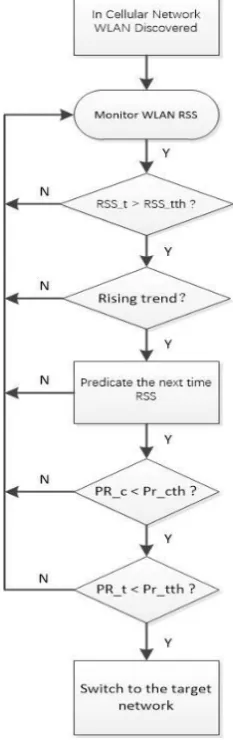
[image:3.595.238.355.151.523.2]To sum up our proposed vertical handoff algorithm (depicted in Figure 2), we choose to perform a downward vertical handover to WLAN only if the following conditions are true.
Figure 2. Pre-Decision Process.
(1) The mean RSS value of target network RSS_t is greater than entry-threshold RSS_tth. And the entry-threshold can calculated by the method in Ref [7].
(2) The DFT-based Trend Detection detect the signal strength weather has rising trend . This is useful for a case when MN is only moving along the edge of WLAN coverage circle instead of moving inwards to the AP. In this case, handover to the WLAN is unnecessary and should be avoided.
(3) Then we apply the Differential Pre-Decision Method to predicate the signal strength at next time.
(4) The predication of current network signal strength is less than the pre-decision entry-threshold of current network. Where PR_c and PR_cth represent predication of current network signal strength and pre-decision entry-threshold of current network respectively.
(5) The predication of target network signal strength is less than the pre-decision entry-threshold of target network. Where PR_t and PR_tth represent predication of target network signal strength and pre-decision entry-threshold of target network respectively.
Simulation
based on MATLAB for a heterogeneous environment. The model consist of two WLAN base station and a cellular base station.
[image:4.595.210.382.100.271.2]LTE WLAN1 WLAN
Figure 3. Heterogeneous Network Convergence Model.
(1) Network Performance Parameters
The Network Performance Parameters shown as Table 1
Table 1. The network performance parameters.
Environment Settings LTE WLAN1 WLAN2
Total network bandwidth 10 15 15
The maximum transmitted
Strength of station 45 35 35
Transmitting antenna gain 1 1 1
Receive antenna 1 1 1
Radius 1000 300 300
Carrier frequency 2500 2500 2500
(2) Other Relevant Parameters Setting
For other parameters setting, in this paper we set coordinate about LTE and WLAN base stations to (0, 0), (300, 0) (600,0). Initially, the speed of mobile terminal is set to 5m / s, and its move is a uniform linear motion. The mobile terminal scan the network at interval 0.5s.
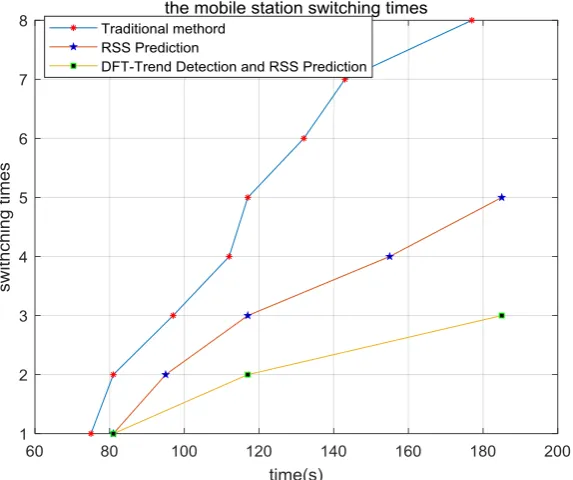
[image:4.595.155.442.532.772.2]Figure 4 is the times of the vertical handoff, which is gotten by the traditional method, RSS prediction and DFT-trend detection and RSS prediction. It can clearly be seen from Figure 6 that the DFT-trend detection and RSS prediction significantly reduce the number of vertical switching.
Conclusion
In this paper we have employed Fourier Transform based signal trend detection to detect the unavailability and the decay of the WLAN signal. Then, we propose the differential prediction algorithm that has sufficiently accurate of the further RSS prediction to determine whether to switch to the new WLAN. The simulation results demonstrate the proposed algorithm can significantly reduce the impact of the ping-pong effect.
Reference
[1] Goudarzi S, Wan H H, Anisi M H, et al. MDP-based network selection scheme by genetic algorithm and simulated annealing for vertical-handover in heterogeneous wireless networks[J]. Wireless Personal Communications, 2017, 92(2):399-436. doi: 10.1007/s11277-016-3549-5.
[2] E. Gustafsson and A. Jonsson, “Always best connected,” IEEE Wireless Commun., vol. 10, pp. 49–55, Feb. 2003.
[3] Vasu K, Maheshwari S, Mahapatra S, et al. QoS-aware fuzzy rule-based vertical handoff decision algorithm incorporating a new evaluation model for wireless heterogeneous networks[J]. EURASIP Journal on Wireless Communications and Networking, 2012, 2012: 322. doi: 10.1186/1687-1499-2012-322.
[4] Wu J S And Huey R S. Improved joint radio resource management usage grey fuzzy control in heterogeneous wireless networks[J]. Journal of Internet Technology, 2015, 16(5): 777-788. doi: 10.6138/JIT.2015.16.5.20130319.
[5] W. Zhang, “handoff decision using fuzzy MADM in heterogeneous networks. IEEE Wireless Communications and Networking Conference”, WCNC’04, vol. 2, (2004), pp. 653-658, Atlanta, GA.
[6] K. Pahlavan, P. Krishnamurthy, A. Hatami, M. Ylianttila, J. Makela, R. Pichna, and J. Vallstrom, “Handoff in hybrid mobile data networks,” IEEE Pers. Commun., vol. 7, pp. 34–47, Apr. 2000.
[7] Haider A, Gondal I, Kamruzzaman J. Dynamic Dwell Timer for Hybrid Vertical Handover in 4G Coupled Networks.[C]// Vehicular Technology Conference. IEEE, 2011.
[8] Tang S, Ma L, Xu Y. A Novel Parameter Estimation Algorithm Based on GHMM for Vertical Handover[C]// Global Communications Conference. IEEE, 2017.