© Associated Asia Research Foundation (AARF)
A Monthly Double-Blind Peer Reviewed Refereed Open Access International e-Journal - Included in the International Serial Directories.
Page | 1
SPECIATION OF TRACE METALS IN SEDIMENT: MODIFIED TESSIER
SEQUENTIAL EXTRACTION SCHEME VERSUS BCR SCHEME
Amel Yousif Ahmed
Department of Chemistry, Faculty of ScienceKing Faisal University,P.O. Box 400, Al-Ahsa, Saudi Arabia
Md Rozali Osman and Md Pauzi Abdulah
School of Chmical Science and Food Technology, Universiti Kebangsaan Malaysia, 43600 UKM Bangi, Selangor, Malaysia.
Abdul Khalik Wood and Md Suhaimi Hamza
Malaysian Nuclear Agency, Bangi, 43000 Kajang, Malaysia.
Saifeldin M. Siddeeg,
Chemistry Department, College of Science, King Khalid University, P. O. Box 9132, Abha, Saudi Arabia.
ABSTRACT
Modified Tessier sequential chemical extraction scheme connected with ICP-MS was compared with the European Community Bureau of Reference (BCR) procedure for extraction of As, Cd, Co, Cr, Cu, Fe, Mn, Ni, Pb, Se, V and Zn for sediment samples collected from the coast of Sabah
International Research Journal of Natural and Applied Sciences
ISSN: (2349-4077) Impact Factor- 5.46, Volume 5, Issue 8, August 2018 Website- www.aarf.asia, Email : [email protected] , [email protected]
© Associated Asia Research Foundation (AARF)
A Monthly Double-Blind Peer Reviewed Refereed Open Access International e-Journal - Included in the International Serial Directories.
Page | 2
and Sarawak, Malaysia. Reliability of the obtained data was achieved by calculating the recovery of the fractions results for the two sequential extraction methods. The distribution of the concentration of the elements through the chemical fractions showed that no significant differences between the two procedures for all elements under study with an exception of Zn element. According to the recovery calculation, both techniques are an equally competitive procedure for extraction of As, Cu, V, Se, Co and Pb. BCR is a superior technique for Mn and Fe over the modified Tessier procedure, while for Cr, Ni and Zn element the later one is the preferable method.
Key Words: Sequential extraction, Trace elements, Sediment
1. Introduction
© Associated Asia Research Foundation (AARF)
A Monthly Double-Blind Peer Reviewed Refereed Open Access International e-Journal - Included in the International Serial Directories.
Page | 3
possible redistribution of heavy metals among extraction phases are the main disadvantages in using sequential extraction (Naji, Ismail et al. 2010). Despite these disadvantages, sequential extraction procedures are still widely used for the evaluation of availability and mobility of trace metals in solid matrixes.
Various sequential extraction schemes have been established and largely applied to determine which chemical forms of the trace metals are present (Tessier et al., 1979; Conesa et al., 2008; Saffari et al., 2009). The main differences between them are the number of fractions obtained using different reagents and extraction conditions, based on the purpose of the extraction ((Fanfani et al., 1997; Go´mez-Ariza et al., 1999; Li and Thornton, 2001) . These schemes have been criticized due to many reasons including; lack of consistency in the procedure; time needed to move from one step to the other; lack of selectivity of extracting reagents and lack of quality control. Moreover, the significant influence of operational parameters such as pH, temperature, the concentration of reagents, time of extraction, the ratio of solid mass to volume of extractants and stirring system are also factors stand as weaknesses of these schemes. However, these procedures are still used in the assessment of sediment and soil-associated metals in environmental studies and ultimately suggest information about their geochemical association help to predict the mobility and bioavailability of metals to living organisms (Kartal, AydIn et al. 2006), (Ngiam and Lim 2001).
© Associated Asia Research Foundation (AARF)
A Monthly Double-Blind Peer Reviewed Refereed Open Access International e-Journal - Included in the International Serial Directories.
Page | 4
and organic matter. Another popular sequential extraction scheme is Schultz et. al. (1998), and it is based on five fractions, exchangeable, bound to organic matter, carbonates, associated with Fe/Mn oxides and residual. In 1987, the Commission of the European Communities Bureau of Reference (BCR), now the Standards, Measurement and Testing Program, initiated a programme to match the methodology used in different schemes (Ure et al., 1993). The BCR scheme extracts metals into three fractions, i.e. exchangeable, Fe and Mn oxides, organic matter and sulfides fraction.
These include, for example those developed by Tessier and BCR methods(Tessier, Campbell et al. 1979, Salomons and Förstner 1984), (Nemati, Bakar et al. 2011).
In this study, modifications in Tessier sequential extraction scheme were carried out by using NH4CH3COO in the exchangeable fraction to minimize the matrix effect caused by MgCl2 (Filgueiras, Lavilla et al. 2002).Moreover, The concentration of NH2OH·HCl was raised up to 0.1M to increase the extractability in Fe-Mn oxide fraction. This new modified scheme was compared with BCR protocol developed by Commission of the Reference European Communities Bureau.
2. Materials and Methods
2.1 Samples Collection
© Associated Asia Research Foundation (AARF)
A Monthly Double-Blind Peer Reviewed Refereed Open Access International e-Journal - Included in the International Serial Directories.
Page | 5
samples were stored in polyethylene containers at -4°C. Then the samples were dried in a thermal oven at 50°C and homogenized by powdering in an agate mortar. The homogenized samples were sieved through 0.2 mm nylon grid sieve and heated at 50°C until constant weight was established. The moisture content was measured for the prepared samples using AND MX-50 moisture analyzer and found to be ≤ 5%. The pH of the samples was also detected by dissolving the sediment samples in deionized water with a ratio of sediment to water of 1 to 5. The pH was measured after 10 minutes and found to be 6.5-7.5.
2.2 Sequential Extraction Procedures:
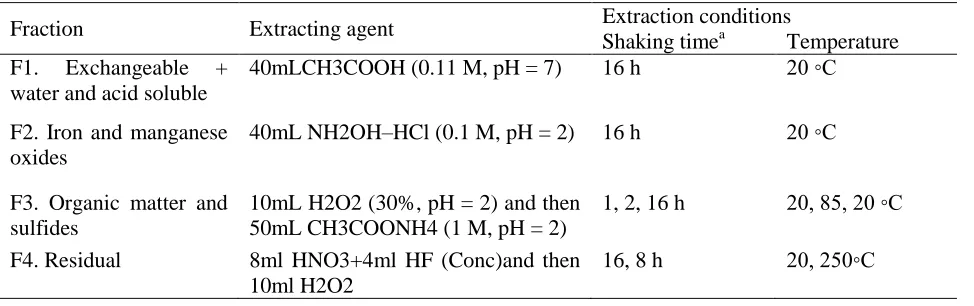
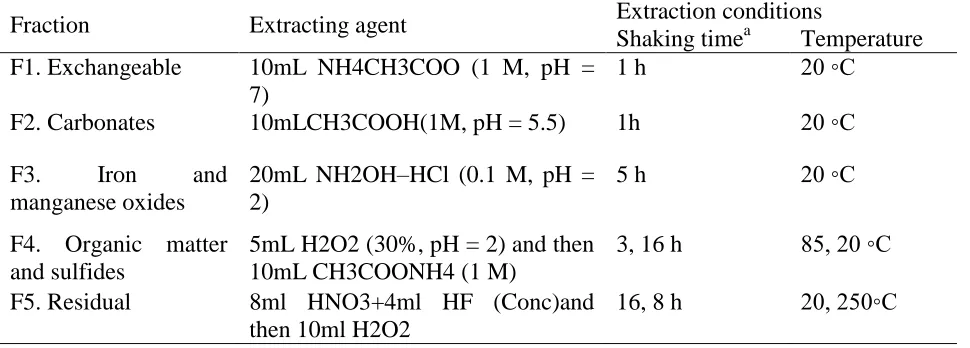
[image:5.612.67.554.467.620.2]Accurately, 1.00g of the dry sample was weighed and then the BCR and modified Tessier schemes were followed as shown in Tables 1 and 2, the extraction was carried out using 100 ml centrifuge tube. At the end of each step the tube was centrifuged for 10 mints at 4000 rpm and then the solution was decanted into 50 ml polyethylene container, then 10 ml of deionized water was added to the residue and centrifuged for 5 mints and the solution decanted. The solution completed to 50 ml and then stored at -8◦C until analysis. The residue was taken to the next step. Blank samples were prepared following the above procedures.
Table 1: Operation Conditions in BCR sequential extraction procedure
Fraction Extracting agent Extraction conditions
Shaking timea Temperature F1. Exchangeable +
water and acid soluble
40mLCH3COOH (0.11 M, pH = 7) 16 h 20 ◦C
F2. Iron and manganese oxides
40mL NH2OH–HCl (0.1 M, pH = 2) 16 h 20 ◦C
F3. Organic matter and sulfides
10mL H2O2 (30%, pH = 2) and then 50mL CH3COONH4 (1 M, pH = 2)
1, 2, 16 h 20, 85, 20 ◦C
F4. Residual 8ml HNO3+4ml HF (Conc)and then 10ml H2O2
16, 8 h 20, 250◦C
© Associated Asia Research Foundation (AARF)
A Monthly Double-Blind Peer Reviewed Refereed Open Access International e-Journal - Included in the International Serial Directories.
[image:6.612.67.552.65.239.2]Page | 6
Table 2: Operation conditions in the modified Tessier sequential extraction procedure
Fraction Extracting agent Extraction conditions
Shaking timea Temperature F1. Exchangeable 10mL NH4CH3COO (1 M, pH =
7)
1 h 20 ◦C
F2. Carbonates 10mLCH3COOH(1M, pH = 5.5) 1h 20 ◦C
F3. Iron and manganese oxides
20mL NH2OH–HCl (0.1 M, pH = 2)
5 h 20 ◦C
F4. Organic matter and sulfides
5mL H2O2 (30%, pH = 2) and then 10mL CH3COONH4 (1 M)
3, 16 h 85, 20 ◦C F5. Residual 8ml HNO3+4ml HF (Conc)and
then 10ml H2O2
16, 8 h 20, 250◦C
a Shaking was applied at150 rpm. 2.3 Sample Analysis:
Concentrations of metal in the prepared extracts obtained after each step were determined using PE SCIEX ELAN 6000 inductively coupled plasma mass spectroscopy ICP/MS system atomic absorption spectrometer. Instrument settings were applied as recommended in the manufacturer's manual and all readings of the absorbance were made in triplicate.
3. Results and discussion:
3.1 Reliability of the results:
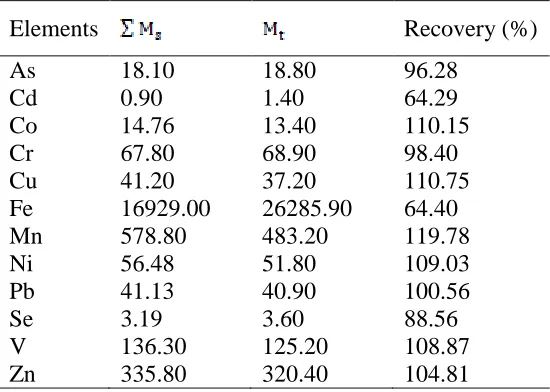
Reliability of the obtained data was achieved by calculating the recovery of the fractions results of the tow sequential extraction procedures by sum of the amounts of the metals removed in
each step of the procedures with the results of the pseudo-total digestion as shown in the following equation (Hullebusch, Utomo et al. 2005) :
© Associated Asia Research Foundation (AARF)
A Monthly Double-Blind Peer Reviewed Refereed Open Access International e-Journal - Included in the International Serial Directories.
Page | 7
[image:7.612.168.444.117.312.2]Tables 3 and 4 show the reliability for BCR procedure and modified Tessier procedure respectively.
Table 3 The reliability for the BCR procedure
Elements Recovery (%)
As 17.44 18.80 92.74
Cd 1.89 1.40 134.72
Co 15.10 13.40 112.67
Cr 87.49 68.90 126.98
Cu 34.69 37.20 93.26
Fe 23157.33 26285.90 88.10
Mn 452.87 483.20 93.72
Ni 62.48 51.80 120.62
Pb 37.25 40.90 91.08
Se 3.44 3.60 95.55
V 107.57 125.20 85.92
[image:7.612.169.444.365.561.2]Zn 252.10 320.40 78.68
Table 4 The reliability for the modified Tessier procedure
Elements Recovery (%)
As 18.10 18.80 96.28
Cd 0.90 1.40 64.29
Co 14.76 13.40 110.15
Cr 67.80 68.90 98.40
Cu 41.20 37.20 110.75
Fe 16929.00 26285.90 64.40
Mn 578.80 483.20 119.78
Ni 56.48 51.80 109.03
Pb 41.13 40.90 100.56
Se 3.19 3.60 88.56
V 136.30 125.20 108.87
Zn 335.80 320.40 104.81
© Associated Asia Research Foundation (AARF)
A Monthly Double-Blind Peer Reviewed Refereed Open Access International e-Journal - Included in the International Serial Directories.
Page | 8
Cd (134.7%) and Cr (127%) or poor recovery, Zn (78.8%). While for the modified Tessier procedure, as in Table 4, the elements As, Co, Cr, Cu, Ni, Pb, V and Zn show acceptable recovery (between 90 - 110%) and to some extend Mn and Se (119% and 88%), respectively. While elements Cd and Fe show poor recovery values (64%). These results indicate that, in both sequential extraction schemes, for most elements, the sums of the fractions are in good agreement with the total concentrations, and therefore the procedures are reliable and repeatable. 3.2 Distribution of elements in different chemical fractions:
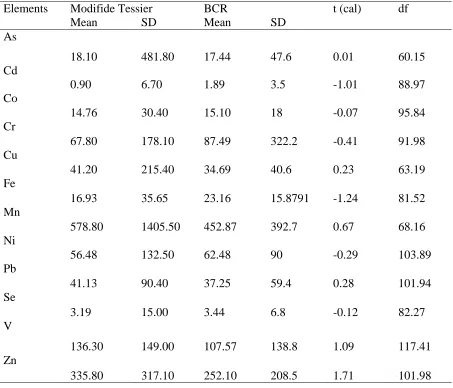
To compare between modified Tessier and BCR schemes which were applied in this work, the tow side t-test was applied using equation (2) and (3). The result was tabulated in Table 5.
(2) Where:
= mean of the first method.
=mean of the second method.
and = respective variances.
and = respective number of measurements.
(3)
When the , it can be concluded that the difference between the means obtained by the
© Associated Asia Research Foundation (AARF)
A Monthly Double-Blind Peer Reviewed Refereed Open Access International e-Journal - Included in the International Serial Directories.
[image:9.612.74.527.62.450.2]Page | 9
Table 5 Comparison between modified Tessier and BCR sequential extraction schemes
Elements Modifide Tessier BCR t (cal) df
Mean SD Mean SD
As
18.10 481.80 17.44 47.6 0.01 60.15
Cd
0.90 6.70 1.89 3.5 -1.01 88.97
Co
14.76 30.40 15.10 18 -0.07 95.84
Cr
67.80 178.10 87.49 322.2 -0.41 91.98
Cu
41.20 215.40 34.69 40.6 0.23 63.19
Fe
16.93 35.65 23.16 15.8791 -1.24 81.52
Mn
578.80 1405.50 452.87 392.7 0.67 68.16
Ni
56.48 132.50 62.48 90 -0.29 103.89
Pb
41.13 90.40 37.25 59.4 0.28 101.94
Se
3.19 15.00 3.44 6.8 -0.12 82.27
V
136.30 149.00 107.57 138.8 1.09 117.41
Zn
335.80 317.10 252.10 208.5 1.71 101.98
From Table 5 and the table of values for the two-sided t-distribution, it can be observed that in all elements concentrations there is no significant difference between the two procedures except for Zn.
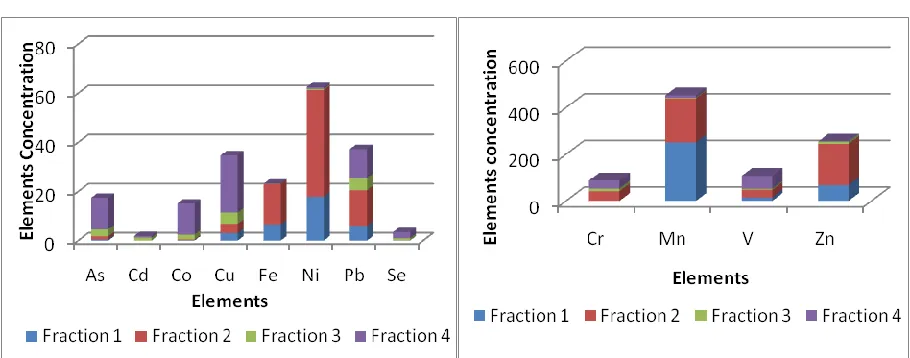
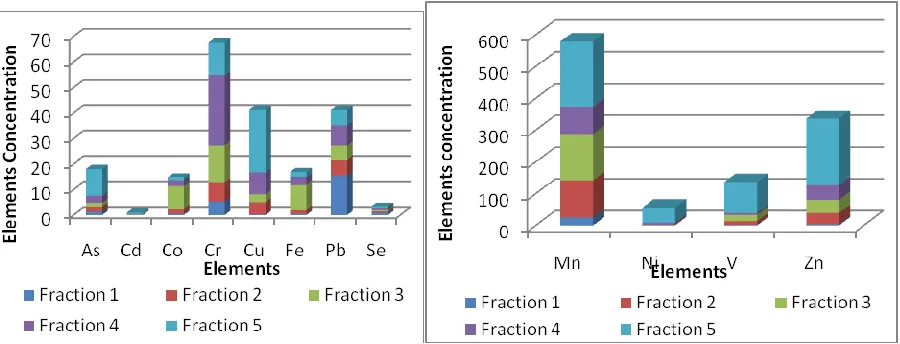
Figures 3 and 4 showed the distribution of the elements under study over different chemical fractions for BCR and modified Tessier scheme, respectively.
© Associated Asia Research Foundation (AARF)
A Monthly Double-Blind Peer Reviewed Refereed Open Access International e-Journal - Included in the International Serial Directories.
Page | 10
© Associated Asia Research Foundation (AARF)
A Monthly Double-Blind Peer Reviewed Refereed Open Access International e-Journal - Included in the International Serial Directories.
Page | 11
[image:11.612.72.527.436.615.2]respectively in modified Tessier procedure, and 70% for each extracted in Fe-Mn oxide fraction when BCR procedure was applied. This different in the fraction in which these elements extracted between the two procedures may be due to the extraction condition applied in the tow methods in Fe-Mn oxide fraction (16 h in BCR procedure and 5h in Tessier procedure). For Pb the different in the extracting agents used in the two procedures, CH3COO was used as extracting agent in the tow first fractions in modified Tessier procedure and the first fraction in BCR procedure, but 10 times less than in Tessier procedure) may cause the different appear during element extraction, were 38% of the element extracted in exchangeable fraction in modified Tessier procedure, while 39% of the element extracted in Fe-Mn oxide fraction when BCR procedure was applied. Se 72% of this element extracted in the residual fraction when BCR procedure was applied, with a significant amount in organic-sulphide fraction (29%). In contrary 29% of this element extracted in the exchangeable fraction when modified Tessier scheme was applied. However, a significant amount of the element distributes over all fractions. The behaviour of this element in the tow procedures gives evidence that this element is difficult to extract.
© Associated Asia Research Foundation (AARF)
A Monthly Double-Blind Peer Reviewed Refereed Open Access International e-Journal - Included in the International Serial Directories.
Page | 12
[image:12.612.78.528.40.212.2]Figure 4 Distribution of the elements in the different chemical fractions using modified Tessier scheme
4. Conclusion:
Speciation analysis of metal in environmental samples particularly in sediment is important since it will give more information concerning of bioavailability, mobility and chemical form. For this purpose, sequential extraction technique is normally used. In this study, the modified Tessier scheme was compared with BCR protocol. The results indicated that the sum of metals concentrations within all fractions showed no significant different between the two procedures except for Zn. However, regarding the distribution of these metals through the chemical fractions, which depends on the strength of the chemicals used and the reaction condition in the fraction, it was found that the two protocols agree in the distribution of As, Cu, Fe and V but disagree in the distribution of the other elements.
© Associated Asia Research Foundation (AARF)
A Monthly Double-Blind Peer Reviewed Refereed Open Access International e-Journal - Included in the International Serial Directories.
Page | 13
will give more information about the distribution of a particular element over the chemical fractions. Hence, if the aim of the study is to quantify the distribution of the particular element through chemical fractions, the BCR procedure is suitable for this purpose. However, if the aim of the study is to quantify the amount of the particular element in an individual fraction, Tessier scheme is recommended.
6. References
Conesa, H.M., Robinson, B.H., Schulin, R., Nowack, B., (2008). Metal extractability in acidic and neutral mine tailings from Cartagena-La Union Mining District (SE Spain). Applied Geochemistry 23, 1232–1240.
Cuong, D. T. and J. P. Obbard (2006). "Metal speciation in coastal marine sediments from Singapore using a modified BCR-sequential extraction procedure." Applied Geochemistry 21(8): 1335-1346.
Fanfani, L., Zuddas, P., Chessa, A., (1997). Heavy metals speciation analysis as a tool for studying mine tailings weathering. Journal of Geochemical Exploration 58, 241–248
Filgueiras, A. V., I. Lavilla and C. Bendicho (2002). "Chemical Sequential Extraction For Metal Partitioning In Environmental Solid Samples." J. Environ. Monit. 4: 823-857.
Go´mez-Ariza, J.L., Gira´ldez, I., Sa´nchez-Rodas, D., Morales, E., (1999). Metal readsorption and redistribution during the analytical fractionation of trace elements in oxic estuarine sediments. Analytica Chimica Acta 399, 295–307.
© Associated Asia Research Foundation (AARF)
A Monthly Double-Blind Peer Reviewed Refereed Open Access International e-Journal - Included in the International Serial Directories.
Page | 14
Kartal, S., Z. AydIn and S. TokalIoglu (2006). "Fractionation of metals in street sediment samples by using the BCR sequential extraction procedure and multivariate statistical elucidation of the data." Journal of Hazardous Materials 132(1): 80-89.
Kot, A. and J. Namiesnik (2000). "The Role Of Speciation In Analytical Chemistry." Trends in analytical chemistry 19: 69-79.
Li, X., Thornton, I., (2001). Chemical partitioning of trace and major elements in soils contaminated by mining and smelting activities. Applied Geochemistry 16, 1693–1706
Naji, A., A. Ismail and A. R. Ismail (2010). "Chemical speciation and contamination assessment of Zn and Cd by sequential extraction in surface sediment of Klang River, Malaysia." Microchemical Journal 95(2): 285-292.
Nemati, K., N. K. A. Bakar, M. R. Abas and E. Sobhanzadeh (2011). "Speciation of heavy metals by modified BCR sequential extraction procedure in different depths of sediments from Sungai Buloh, Selangor, Malaysia." Journal of Hazardous Materials 192(1): 402-410.
Ngiam, L.-S. and P.-E. Lim (2001). "Speciation patterns of heavy metals in tropical estuarine anoxic and oxidized sediments by different sequential extraction schemes." Science of The Total Environment 275(1-3): 53-61.
Saffari,M., Yasrebi, J., Karimian, N., Shan, X.Q., (2009). Evaluation of three sequential extraction methods for fractionation of zinc in calcareous and acidic soils. Research Journal of Biological Sciences 4, 848–857.
Salomons, W. and U. Förstner (1984). Metals in the hydrocycle, Springer-Verlag.
© Associated Asia Research Foundation (AARF)
A Monthly Double-Blind Peer Reviewed Refereed Open Access International e-Journal - Included in the International Serial Directories.
Page | 15