University of Michigan
1996-03
Preservation in the Digital World
Conway, Paul
Washington, DC: Council on Library and Information Resources, 1996
http://hdl.handle.net/2027.42/150192
The Commission on
Pre~~rvatiOO
-
&_
Access
Preservation in the Digital world
March 1996
Published by
The Commission on Preservation and Access 1400 16th Street, NW, Suite 740
Washington, DC 20036-2217
Reports issued by the Commission on Preservation and Access are intended to stimulate thought and discussion. They do not necessarily reflect the
views of Commission members.
Additional copies are available for $15.00 from The Commission on Preservation and Access. Orders must be prepaid, with checks made payable to "The Commission on Preservation and Access,"
with payment in U.S. funds.
This paper has been submitted to the ERIC Clearinghouse on Information Resources. ~ The paper in this publication meets the minimum requirements of the American National Standard
'CJ
for Information Sciences-Permanence of Paper for Printed Library Materials ANSI 239.48-1992.ISBN 1-887334-49-1
© COPYRIGHT
1996
by the Commission on Preservation and Access. No part of this publication may be reproduced or transcribed in any form without permission of the publisher. Requests for reproduction for noncommercial purposes, including educational advancement, private study, or research will be granted.Preservation in the Digital World
Paul Conway
Head, Preservation Department
Yale University Library
March 1996
Author's
Acknowledgement
Table of Contents
Co
mmission Preface .
.
. . . .
. .
.
. . .
. .
.
.
.
. . . . .
.
.
.
.
. . . . .
. .
.
1Author's Preface ....
. . . .
..
. . . .
. . .
1
Introduction . . . .
. . . . .
.
.
..
. . . . .
.
.
...
...
. . . .
..
.
....
3,
A Central Dilemma . . .
.
.
. . .
.
. .
.
.
. . . .
.
.
.
. . . .
.
.
.
. .
. .
. .
.
.
. . 4
A Jlramework of Preservation
C
on
cepts . . . .
. . . .
.
. .
, .
.
.
.
.
. .
.
. .
.
.
5
Context for Action . . . .
.
. . . . . .
. .
.
. .
. .
. . . . .
.
. .
.
. . . .
. 7
Priorities for Action . . . .
.
. . .
. . . .
. .
. .
.
. .
.
.
.
. . .
. .
. . .
. .
8
Technology and Organizational Change ...
.
...
.
.
.
.
.
.
.
.
....
. . .
10
Preservation Management in the Digital World . .
.
.
.
. . . . .
. . . .
.
.
. 1
2
Context for Action . .
.
. . .
.
.
.
. . .
. .
.
.
. . .
. . .
.
. .
.
.
. .
. .
.
.
. 13
Priorities for Action .
.
.
.
. .
.
.
.
. .
. . . .
.
,
.
.
. . .
. . .
.
.
.
. .
.
1
3
A New Framework for Effective Leadership
.
. . .
.
.
.
. .
.
. . .
.
.
.
.
.
.
1
5
Conclusion
..
...
..
.
..
. . . .
. . . .
. . . . .
. . .
17
List of Figures . . . .
.
..
. . . .
...
.
.
.
.
...
...
19
=
========
===•■!=
-
==
=
===
====
=
=
Commission Preface
T
his paper provides an intellectual rationale for maintaining the centrality of preservation concepts and ethics in an increasingly digital information environment. This includes a framework for preservation planning and management from two perspectives: (1) con-texts for action and (2) priorities for action, pointing out similarities and differences between present practice and future needs. It suggests that many of the basic tenets of preservation management can be applied in a highly technological environment, but that some long-held principles may no longer apply. The paper also considers where the accumulated knowledge and experience of preservation management may be most effective in a digital world, and where it may be more difficult to affect change.In its conceptualization and development, this paper has served as a basis for in-depth discussions among preservation managers and technical specialists. The Commission trusts that with its publication and dissemination, the paper will stimulate many more discussions among broader audiences as we explore together how to maintain the safety and accessibility of the world's historical and cultural heritage as far into the future as possible for all people.
Author's Preface
D
igital images are everywhere in libraries and archives. In many cases, the quality of digital image products from demonstration projects is spectacular, while others are less satisfactory. Nevertheless, there is widespread belief that the ability to produce high-quality images will improve as the technology matures. Even though a major investment is required for digital image conversion, libraries are rearranging budgets, raising funds, and anticipating income streams to make it happen. Can any institution-library, archives, historical society, or museum-afford to squander this investment in moving from pilot project to a fully operational system? The risk of loss extends beyond the financial, however, without a seriouseffort to ensure long-term access to digital image files. Understanding how to adapt preserva-tion concepts to manage risk in the midst of rapid technological ferment is what preservapreserva-tion in the digital world is all about.
In the public at large, preservation is a concern chiefly in the world of paper. Digital information gives us worry-free preservation, it is asserted, because an exact copy of a file can
be made with the click of a button. However, those who have been involved in digital imaging projects, including university and library administrators, technology system specialists, product vendors, and research scholars, have learned quickly that digital imaging technology, in and of
=
Introduction
I
n Motel of the Mysteries 0979), illustrator David Macaulay speculates about how people 2,000 years from now might interpret the cultural significance of a low-budget roadside motel buried intact under junk mail and pollution. Beyond being a wry satire on the science of archaeology, the book is a clever reminder of the danger of interpreting the past without documentary evidence. A "Do Not Disturb" sign becomes a sacred seal ·'placed upon the han-dle of the great outer door by the necropolis officials following the closing of the tomb." A television represents ''the essence of religious communication."Anthropologists and historians know that the impulses to record and to keep are a part of human nature. Truth is embedded in the symbols and artifacts that we create and then keep by choice or by accident. And yet, as we approach the end of the twentieth century, we find our-selves confronting a dilemma such as the one faced by Howard Carson, Macaulay's amateur digger: a vast void of knowledge filled by myth and speculation. Information in digital form-the evidence of form-the workf we live in-is more fragile than form-the fragments of papyrus foµnd buried with the Pharaohs.
We are living in a digital world. Computers now far outnumber office workers in many parts of the globe. We bank by phone, enjoy digitally mastered music, fax carry-out orders, and communicate with each other through keyboarded thoughts. One of the sure signs that the global village has a digital face is the high investment of money and competitive energy now being directed toward changing the Internet into the National Information Infrastructure. After only a few years of life, the World Wide Web is crowded with time-sensitive data, news summaries, chat, and multimedia entertainment. The electronic landscape changes so rapidly-and the lines between the old and the new seem drawn so sharply-that Wired magazine can refer to a four-year-old network service provider as a "dinosaur," and get this retort: "It's very funny that a petroleum-based product like a magazine can call an online service that has an integrated Web browser irrelevant" (Nollinger 1995, p. 204).
It has long been the responsibility of libraries and archives to assemble, organize, and protect documentation of human activity. The ethic of preservation as coordinated, conscious management, however, is a more recent phenomenon. Librarians and archivists--like the clerks and scribes who went before them-have increased the chances that evidence about how we live, how we think, and what we have accomplished will be preserved. Traditional preservation, as responsi-ble custody, works only when this evidence has a physical form; when the value of the evidence exceeds the cost of keeping it; and when the
The Digital World
T
his era and what we arebuilding go by many names, including Cyberspace, Global Information Infrastructure, Infobahn, Information Age, Information (Super) Highway, Interspace, and Paperless Society. They are all supported by networking (e.g., the Internet). However, their essence is information. Information is what flows over the networks, what is presented to us by our consumer elec-tronics devices, what is manipu-lated by our computers, and what is stored in our libraries.
-Edward A. Fox, "Dtgtta/ Libraries:
Introduction, " CommunicatiotJS of the ACM 38, April 1995.
roles of evidence creators, evidence keepers, and evidence users are mutually reinforcing.
Digital imaging technology is more than another reformatting option. Imaging involves transforming the very concept of format, rather than creating an accurate picture of a book, document, photograph, or map on a different medium. The power of digital enhancement, the possibilities for structured indexes, and the mathematics of compression and communication together alter the concept of preservation. The digital world transforms traditional preservation
concepts from protecting the physical integrity of the object to specifying the creation and maintenance of the object whose intellectual integrity is its primary characteristic. This transfor-mation, along with the new leadership possibilities it creates, will force librarians and archivists to transform their services and programs in turn. Just as the invention of the vacuum tube cre-ated an entirely new form of mass communication-radio-instead of simply making point to point messaging possible without wires, digital imaging technologies create an entirely new form of information. Yet, many of the core tenets of preservation developed in the analog world can be carried fonvard to the digital world to continue the necessary roles of steward-ship and service.
====
=■
;=====
A Central Dilemma
T
he earliest known evidence of writing-pictorial signs on sun-dried clay tablets-origi~nated roughly 6,000 years ago. Tens of thousands of examples of Sumerian and Babylonian writing exist today in the world's major research centers. Archaeologists unearth hundreds more eveiy year. From ancient timJs to the present, the entire technology of writing has undergone steady evolution. Today. we have the capacity to store detailed bit-mapped images of hundreds of books on an optical disk the size of a coaster. This capacity 10
record and store gives rise to one of the central dilemmas of recorded history: Our capacity to record information has increased exponentially over time while the longevity of the media used to store the information has decreased equivalently.
The graph below illustrates these changes in broad strokes. The '·X" axis lays out ten ''Writing'' surfaces in the chronological order of their widespread introduction. The "Y" axis is a logarithmic scale \'.·here each level increases in order of magnitude-a factor of ten. The dotted line is a plot of the approximate number of characters per square inch that can be convenient-ly recorded on any particular surface. There is relative stability in density-fewer than 150 char-acters per square inch-in the centuries before modern printing presses and electronic technolo-gies caused storage densities to skyrocket. Today's typical 5-112 inch rewritable optical disk can
100,000,000 10,000,000 1,000,000 100,000
The Dilemma of Modern Media
Information Density v. Life Expectancy
10,000107· --..il,,l;l:.:!...._
1,000 ---.i.11111--.i~
100
10
Papyrus Gutenberg Newspaper Microfiche Optical Clay Tablet Illuminated Moby Dick Microfilm Disk
hold 650 million characters on each of its two sides-yielding an equivalent density of 51 mil-lion characters per square inch of writable surface.
The solid line-representing the life-expectancy in years of each recording medium-declines through the years. Papyrus fragments of Egyptian writing from 4,500 years ago, while quite fragile today, are still legible. Moving ahead in time, stunning examples of illuminated manuscripts and other documents from Medieval times are quite able to withstand centuries more study and admiration. A similar situation prevails with early modern book printing tech-nologies. Herman Melville's Moby Dick, or The Whale, first published in 1851 on typically acidic paper, symbolizes the worldwide preservation challenges of all nineteenth- and twentieth-centu-ry publishing (Banks 1969). The introduction of wood pulp and acidic compounds to paper,
required at the time by a manufacturing industry desperate to keep up with demand, started the "slow fires'' of deterioration that preservation efforts are now attempting to squelch.
During the twentieth century, the permanence, durability, and stamina of newer recording media have continued to decline, with the exception of microfilm (Sebera 1990). Magnetic tape may be unreadable just thirty years after manufacture (Van Bogart 1995, p. 11). The newest recording medium--0ptical disk-may indeed have a longer life than the digital recording sur-faces that have gone before. It is likely, however, that today's optical storage media may long outlast the life of the computer system that created the information in the first place. This is the ultimate irony of recorded history. In order to achieve the kind of information density that is common today, we must depenµ on machines that rapidly reach obsolescence to create infor~ mation and then make it readable and intelligible (Dollar 1992).
The mLx of machinery and media of the digital world increases the need for responsible preservation activity in institutions. To help discover how to meet this increased need, this report first presents a framework of primary preservation concepts as they have evolved in past decades. It then redefines and transforms these concepts into a new framework for action in the digital world.
===
=
==■
=====
A Framework of Preservation Concepts
I
n the past two decades, a community of practitioners has reached consensus on a set of fundamental preservation concepts for managing available resources in a mature pre serva-tion program (Conway 1989). At one time, advocates for the protecserva-tion of cultural artifacts, including books, primary source documents, and museum objects, used the terms "conserva-tion" and "preserva"conserva-tion" interchangeably. Today, preservation is an umbrella term for the many policies and options for action, including conservation treatments. Preservation is the acquisi-tion, organiza-tion, and distribution of resources to prevent further deterioration or renew the usability of selected groups of materials.
The essence of preservation management is resource allocation. People, money, and materials must be acquired, organized, and put to work to ensure that information sources are given adequate protection. Preservation is concerned with evidence-what Michael Buckland (1991) calls •"information as thing"-embedded in the intellectual content of objects and in the objects themselves. Nearly endless varieties of forms and formats are preserved so that people can use them for equally varied purposes, scholarly and otherwise. Those with the
responsibili-ty to do so find the small portions of the vast sea of information-stmctured as collections of documents, books, photographs and films, sound recordings, and other "things~ -that have
research value as evidence of thought and action well beyond the time and intentions of those who created or published them.
Cost-effective preservation action cannot take place without compromising ideal out-comes. Preservation management encompasses all the policies, procedures, and processes that together prevent further deterioration of physical objects, renew the information they contain,
and increase their functional value. This distinction between the value of the content (usually
text and illustration) and the value of the artifact is at the heart of a decision-making process that itself is central to effective management. Preservation management includes an ongoing, iterative process of planning and implementing prevention activities (e.g., maintaining a stable, safe, and secure environment, ensuring disaster preparedness, and building a basic
collection-level maintenance program) and renewal activities (e.g., undertaking conservation treatments,
replacing the content of library materials, or reformatting them on microfilm).
In the world of paper and film, preservation and access are separate but related activities. It is possible to fulfill a preservation need of a manuscript collection, for example, without
solv-ing the collection's access problems. Similarly, access to scholarly materials can be guaranteed
for a very long period of time with taking concrete preservation action. Modern preservation
management strategies, however, posit that preservation action is taken on an item so that it
may be used. In this view, creating a preservation copy of a deteriorated book on microfilm without making it possible to find the film (usually by cataloging it and then depositing the bibliographidrecord in a national database) is a waste of money. Preservatibn in the digital
Figure I. Clay tableL 34 cbar./tn.Z (per square lncb)
world puts to rest any lingering notion that
preserva-tion and access are separable activities.
Significant financial barriers slow the design and implementation of effective preservation strategies. Some leaders in the field have suggested. however,
that inadequate funding may not be the only brake on
preservation success. "The major obstacle to the development and administration of preservation pro-grams is the shortage, not of money, as many
sup-pose, but of knowledge.'' wrote Pamela Darling (1981.
p. 185). "Financial constraints are serious and will become more so; but until the preservation field reaches the point at which most people know what ought to be done and how it should be done, the lack of money to do it on a scale appropriate to the need is not terribly significant.·· The basic conscious-ness-raising task for preservation may have been
accomplished for the world of paper and film. It is
just beginning for the digital world.
At this critical juncture in the evolution of preservation thinking, there is a large body of
knowl-edge upon which to draw. The literature documents
some fundamental concepts that have been described,
tested, and codified (Swartzburg 1995). The following nine concepts, defined below in part by
the words of some of the most articulate preservation advocates of past decades, form the
[image:10.612.25.264.315.574.2]Context for Action
Four concepts describe what might be called the context for preservation action.
Custody: Fifty years ago, one of the foremost and persistent advocates for quality
book-binding put his finger on the centrality of preservation to the mission of modern research libraries and archives. Preservation, wrote Pelham Barr in his most frequently cited work, "as responsible custody, is the only library function which should be continuously at work twenty-four hours a day. It is the only function which should ·be concerned with every piece of materi-al in the library from the moment the selector becomes aware of its existence to the day it is discarded" (1946, pp. 218-19). Barr's allusion to the life-cycle of information sources is highly relevant today. The concept is at the center of information management theory and practice, including specifications for the disposition of government archives, the management of book collections, and the maintenance of large-scale information technology systems (Atherton 1986).
Social value: Organizations that accept preservation as central to their mission also serve
a larger societal need. The fundamental value of keeping intact the documentation of people and institutions has endured through years of changing practice. Almost sixty years ago Robert C. Binkley, a pioneer of preservation microfilming. pinpointed the cultural value of preserva• tion. "The objective of archival policy in a democratic country cannot be the mere saving of paper," he said to one of the first gatherings of professional archivisL'>. ·'It must be nothing less than the enriching of the complete historical consciousne~s of the people as a whole'' 0939, p. 168). More recently, educator Guy Petherbridge
echoed the same sentiments. ·The perpetuation of society as we are accustomed to conceive or idealize it is dependent to a very large extent on the preserva-tion en masse of our accumulated group memories and consciousness stored in the form of the written, printed and otherwise recorded word or symhol"
(198"'.', p. 1).
Efforts to explain and illustrate the overarching value of preservation ha\'e had a positive effect. Today. the widespread recognition of the value of an investment in preservation action-fueled, perhaps, by the persuasive message in the film "Slow Fires"-has resulted in national and regional planning efforts and new dollars for preservauon programs. Even the word "archives," carrying the mandate to preserve and pro-tect the secrets they contain, has entered the popular vocabulary (Cox 1993). Part of the service that libraries and archives provide to society is (or will be) their investment in converting, storing. and making available research resources in digital image form. Protecting this investment through pmdent preservation action will continue to be the social role of hundreds of or-ganizations !hat participate in digital library initiatives.
~
;:X •.
'
..: ":t';7
t.-f-•• ..
.~~
-
[image:11.612.350.591.319.574.2]•,-' l - ' • • ,._
Figure 2. Papyrus. 53 cbar./tn.Z
Stmcture: An organizational structure that enables presen·ation resource allocation is
imperative. The mission of an institution and the relevance of chat mission to a larger social purpose are necessary. though insufficient on their own, to mobilize preservation action. Robert Patterson suggested a mechanism for a library-wide preservation development process that was equal parts consciousness raising and strategic planning. His argument on the adminis-trative difficulties of building an effective new program rings true today when it is read with the recognized challenges of digital image technologies in mind. ·'Historically, many librarians have felt that a conservation program was too technically complex a matter for them to undertake ....
Armed with some basic principles and facts, a program with realistic goals can be developed" 0979, p. 1116). The overwhelming trend in the development of mature preservation programs has been the coalescing of responsibility in a single department, which then sets about making itself, in the best Weberian tradition, essential to the organization.
Cooperation: Resource sharing and cooperation among institutions to select and preserve the best and most valuable cultural artifacts are core preservation values. The ups and downs of cooperative activities are well documented, as are the challenges of maintaining momentum when taking any action that does not immediately benefit the local institution (Gwinn 1985). The largest and most prestigious research libraries-spurred by the ready availability of exter-nal funding-may have led preservation program development in the last tv.·o decades, but advocates for peer-to-peer or regional cooperation have sounded a warning about the dangers of elitism. Vartan Gregorian reminded a large audience of preservation activists that ·'all of us are in the same boat. When the boat sinks, no one can claim the fact that they had a first class ticket as solace" (Morrow 1991, p. 85).
The need to organize for local action often creates a direct tension with national
coopera-tive initiacoopera-tives. Rutherford Rogers, Yale University's librarian during the heyday of preservation
program growch, called for an emphasis on local goals, informed but not controlled by national
priorities. National planning, he declared, ··cannot supplant local programs or relieve us of our
responsibility to develop them. Instead, we must take advantage of the large suppo11 network of
[image:12.612.25.264.310.585.2]collective research and educational activities to dbvelop local programs suited to local needs. a
Figure 3. Illuminated manuscript. 141 cbar./in.Z
network that may serve as the basis of a tnie national
progmm'' 0985, p. 8). When properly managed.
inter-institutional cooperative preservation programs
supple-ment local priorities.
Priorities for Action
Five concepts together can be seen to help
direct the priorities for preservation action.
Longel-'i~}': The central concern in traditional preservation practice has been the media upon which information is stored. The term '·archival"' used to
mean '"permanent·· and preservation focused on
infini-ty. Jim O'Toole reviews the transformation of the
defi-nition of longevity: ··Toe idea of permanence as it is
understood by archivists has changed considerably
over time, passing from an unattainable desire to an
absolute value within the realm of achievement to an
extremely relative notion of little clarity" (1989, p. 23).
Today, archivists and librarians evaluate storage media
in terms of their life expectancies. The top priority is
extending the useability of papers, films, magnetic
tapes, and other media by stabilizing their structures
and limiting the ability of internal and external factors to cause deterioration. The focus on
external factors led to specifications for proper environmental controls, care and handling
guidelines, and disaster recovery procedures. Progress on efforts to control the internal factors
of deterioration has resulted in alkaline paper standards, archival quality microfilm, and more
rugged magnetic media (Calmes 1987).
Choice.-Preservation adds value through selection. Choice involves defining value,
recog-nizing it in something, and then deciding to address preservation needs in the way most
appro-priate to that value. Selection in archives and research libraries was once thought to be primarily
when the documents ceased to serve the primary purposes for which they had been created originally (Atkinson 1986, p. 345). Over decades the act of preservation has evolved from saving material from oblivion and assembling it in secure buildings to encompass more sophisticated condition, value, and use assessments on the already-collected. Preservation selection in libraries has been dictated largely by the need to stretch limited resources in as wise a fashion as possi-ble, resulting in the dictum that '·no item shall be reformatted twice." The end result is a grow-ing ·•virtual'' special collection of items preserved using a variety of techniques, most notably by microfilming. Selection is perhaps the most difficult of undertakings precisely because it is static and conceived by practitioners as either completely divorced from present use or completely driven by demand (Demas 1994).
Quali(Y: Maximizing the quality of all work performed is such an important maxim in the preservation field that few people state this fundamental principle directly. Instead, the preser-vation literature dictates high quality outcomes by specifying standards for treatment options,
reformatting processes. and preventive measures. The commitment to quality standards---do it
once, do it right-permeates all preservation activity, including library binding standards, archival microfilming guidelines, conservation treatment procedures, the choice of supplies and materials. and a low tolerance for error. The evolution of microfilming as a central strategy for preserving brittle library materials has placed the quality of the medium and the quality of the image on an equal plane (Fox 1996). In the pursuit of quality microfilm, compromise on visual
truth and archival stability is dictated more by the characteristics of the item chosen for r reser-vation and less by cost or lthe present state of display technologies.
Integrity: The concept of integrity has two dimensions in the preservation context: physical and intellectual. Physical integrity largely concerns the item as artifact and plays out most directly in the con
-servation studio, where skilled bench staff use water-soluble glues. age-old hand-binding techniques, and high-quality materials to protect historical evidence of use, past conservation treatments, and intended or unintended changes to the structure of the item (Tanselle 1989). The ethics of conservation recognize that all physical treatments change the nature of the object and, therefore, are not really reversible by nature (Dureau 1986).
The preservation of intellectual integrity is based upon concern for evidence of a different sort. The authenticity, or truthfulness, of the information content of an item- maintained through careful and complete
reformatting or sensitive treatment-is at the heart of intellectual integrity (Duranti 1995). Ideally, documen-tation supports the preservation of intellectual and
physical integrity by creating a chain of evidence
con-Figure 4. Gutenberg Bible. 25 cbar./in.Z
necting multiple formats of the object and recording
what has been or needs to be done to any one of these formats in the name of preservation. Preservation also protects and documents the relationships among items in a collection. The
concepts of quality and integrity reinforce each other.
Access: For years, preservation simply meant collecting. The sheer act of pulling a
collec-tion of manuscripts from a barn, a basement, or a parking garage and placing it intact in a dry
building with locks on the door fulfilled the fundamental preservation mandate of the institu-tion. In this regard, preservation and access have been mutually exclusive activities often in constant tension. "While preservation is a primaiy goal or responsibility, an equally compelling mandate-access and use-sets up a classic conflict that must be arbitrated by the custodians
[image:13.612.101.595.318.614.2]and caretakers of archival records," states a fundamental textbook in the field (Ritzenthaler
1993, p. 1). Access mechanisms, such as bibliographic records and archival finding aids, simply provide a notice of availability and are not an integral part of the object.
After years of disciplined practice, most librarians, archivists, conservators, and scientists recognize these nine concepts of preservation action. The same learning curve that has led to the acceptance of current preservation practice must now take place for digital imaging tech-nology in a time-frame of years instead of decades.
====----===
■
i=========
Technology and Organizational Change
T
echnologies and organizations affect each other in different w.iys, depending in large part upon the characteristics of technologies and how organiz:nions choose to use them. In this regard, it is important. first. to distinguish between acquiring digital imag-ing ted1nology to solve a particular problem and adoptimag-ing it as an information managementCHAPTER I. LOO~INGS.
Soma years ago-nev-er mind how I e or no money in my purse, and not!
e on shore, I thought I ~rnuld sail a tery par~ of tho ,vorld. It is a way I
n, and regulating the circulation. " wing grim about tho mouth ; whenev i$'sa,.,.,.,1"'1,..,...,-:"t;.1~..-'!~-cmber in my soul; whenever I find my inv-oluntnrily pausing before coffin warehouses, and bringin the rear of every funeral I meet; and especially whenc\·cr hypos get such an upper hand of me, that it requires a st moral principle lo prevent me from <lcliberately stepping i the street, nnd methodically knocking people's hats off-th account it high time to get to sea WI soon as I can. TI1is is
substitute for pistol and bnll. With a philosophical ftou Cato throws himself upon his sword ; I quietly take to ship. There is nothing surprising in this. If they but kne almost all men in their degree, some time or other, cherish v nearly the same feelings toward;; the ocean with mo.
There now is our insular cit of tho Manhattocs, be!
Figure 5. Nineteenth-century noveL 101 cbar./in.Z
strategy. Acquiring an imaging system to experiment ,vith its capability to enhance access to library and archive materials is now almost as simple as purchas-ing tools in a hardware store. Simply buying a tech-nology '·solution" has no long-term implications for an organization. Hmvever, when pilot imaging projects are transformed and adopted as core systems for cre-ating and delivering electronic documents with long-term value, preservation in the digital world be<.:omes an important organizational issue.
Minofilm technology. as it has quickly proliferat-ed in libraries and archives, has been largely a means for achieving ends already decided upon. Microfilm was. and remains. well-suited for reproducing bulky and fragile newspapers and for distributing research materiab largely unknown or unusable in their native locations. Continuous wave radio, on the other hand, created a world of new possibilities for which new corporate goals had to be formulated. "In that sense It
acquired a determinative force to which organizational decision-making had to adapt," writes Hugh Aitken. Unlike microphotography, radio broadcasting ··encountered a cultural phenomenon that it has not itself created: a mass market for information and entertainment the existence of which had been barely suspected·' (Aitken 1985, p. 562).
radio, typewriters by printers). People cherish convenience and will ignore any technology
whose characteristics (e.g., cumbersome equipment, poor image quality, weak indexing) limit
that convenience.
Digital image technologies present a similar situation for libraries that radio presented more generally for the corporate world some sixty years ago. In the digital world, preservation becomes possible because preservation-as it is defined in this paper-is an intimate part of the new possi-bilities. In the digital world, preservation must he concerned with entire technology systems. not one or another component, such as a film or a storage disk. Like radio, television, and electric power nern·orks. digital imaging is not one
tech-nology. It is an interlinked, open system of
hard-ware, softhard-ware, and service subsystems, each with their own components, that develops in cycles.
Digital systems are characterized by multiple core
subsystems (scanners and transmission devices).
D:ita storage is but one of many peripheral
sub-systems, among them comprbssion hardware and
software, display technologies, and output devices.
Early students of the history of
communica-tion ;ind technology wanted to know in what
sense an individual, an organizarion, or a social class can be said to be in control of. or to be managing. a body of information (Innis 19;0). They wrote in terms of monopolies of knowledge
and the degree to which different media-clay
tablets, papyms, the printed book. LP vinyl
disks-lent themselves to the formation of such
monopolies. More recent scholarship suggests that
understanding and influencing technological
change encompasses not only managing a
tech-nology process but also managing the
conse-quences of technology on people and organiz
a-tions (Czitrom 1982). Expanding this argument
further, Columbia University scholar ll:lichael
Tushman suggests that we cannot even begin to
understand tedmological progress by examining technical characteristics alone. At critical junctures, he suggests, "organizational action (and inaction) dramaucally affects the shape and direction of technological change" 0992, p. 312).
Libraries and archives are an interrelated
part of this new and complt:x digital marketplace,
but not necessarily a critical element. They need to recognize their role in the development of dig -ital imaging technologies, as well as the new demands that these technologies will place on them as organizations.
11
Preserving Visionary
Technology
E
nthusiasm for the potential of newinforma-tion technologies is nothing new. A century
ago, electrical engineers imagined a publish-ing revolution driven by mass storage on glass plate negatives. One such engineer, Henry Morton, related a perhaps apocryphal tale of a microscopic version
of the Lord's prayer, ~written in characters so small
that the entire 227 letters of that petition are
engraved within an area measuring 1/294 by 1/441
of an inch." At that rate, he claimed, "a square inch of glass would accommodate the entire text of the
Bible eight times over~ (Norton, 1895, p. 432).
Reginald A. Fessenden, an engineer on the eve
of his breakthrough invention of the modem radio transmitter, used Dr. Morton's story as a point of departure for describing his own use of micropho-tography to reproduce technical notes gathered in his investigations. He had a miniature camera built that was capable of recording a single page on a single
glass plate negative measuring 1-1/2 by 1-1/4 inches.
He developed batches of these negatives himself in
his bathtub and stored them in small envelopes pas
t-ed to the reverse side of the blank library catalog cards that he used to index the contents.
Fessenden's success led him to speculate on
how microphotography could revolutionize book
publishing. "It is well within the bound of possibility that the scientific student of the future will do his
book work with the aid of a small projection lantern
and a library of small positives, purchased at a small
fraction of the price now paid." Rapid access was an
essential part of Fessenden's model. "It would be an
extremely easy matter, for instance, to arrange the
mechanism of a plate containing a German dictio
-nary so that by the pressure of a couple of keys the
page commencing with any given letters would be
thrown on the screen" (Fessenden, 1896, p. 224).
The glass strip containing the Lord's prayer in
miniature has apparently vanished. The only
evi-dence of Fessenden's extensive glass-plate microfiles
is his scrapbook of photos and notes in the North
Carolina Division of Archives and History. Yesterday's
new technology is today's rare specimen. What is
0
Preservation Management in the Digital world
A
s librarians and archivists have experimented with the capabilities of digital imagingtechnologies, the concept of preservation has come to have at least three distinct meanings.
Make Use Possible: For a very small subset of valuable but deteriorated documents, digital
imaging technology is a viable, and possibly the only, cost-effective mechanism for facilitating
research use. A recent experiment involving digitizing oversize color maps (Gertz 1995)
demonstrated that the only way to really use the maps, which have faded badly and are very brittle, is to view them on a large color monitor after they have been digitized and enhanced. Similarly, the managers of the Andrew Wyeth estate have found that reproductions of the
artist's work are most faithfully represented in digital form (Mintzer and McFall 1991).
Protect Origi1ta/ Items: Digital image technology can be us~d to create a high quality copy of an origjnal item. By limiting direct physical access to valuable documerts, digital imaging
becomes a '·preservation application" as distinct from
I
tRIEF EXPRESSED AT YALE
an "access application:· The original order of the col-lection, or book, is "frozen," much like microfilm sets images in a linear sequence. Sophisticated indexing schemes facilitate browsing and minimize the potential
for damage or disruption to a collection caused by
•·fishing expeditions'" through the published or unpub-lished record. Preservation via digital copying has been the most compelling force motivating archives and
libraries to experiment with hardware and software
capabilities. OVER TH:E A'rl'E~PT ~POS THE
LIFE '9F Tim PRESIDEST.
J.
-the ,.Dastardly b'e' Azdior oc Deed thO RCommUtee hl H DllnipeuodCblll'l'le-'Should the l'nal~ent Die There May Bo a. Change In tbe
'
Maintain Digital Objects: Once digital
conver-sion of the original document has been completed,
the challenge of protecting the digits from corruption
or destruction becomes the preservation focus. This
facet, now being called "digital preservation," typically centers on the choice of interim storage media, the
life expectancy of a digital imaging system, and the
concern for migrating the digital files to future systems
as a way of ensuring future access (Presen1ing Digital
Information 1995).
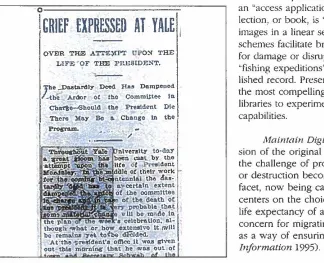
Figure 6. Newspaper. 174 cbar./tn.2 A workable framework for preservation in the digital world could encompass the initial choice of the technology, the use of digital imaging technology for reproducing research materials, and the
protection of the digital information for as long as that information has value to the institution
and the patrons the institution serves. The process of converting library materials to an
elec-tronic form-a process which in many aspects is similar to the one used to create preservation
microfilm-is distinct from any particular medium upon which the images may be stored at a
particular point in time. This distinction allows for a continuing commitment to creating and
maintaining digitized information while entertaining the possibility that other, more advanced
[image:16.612.35.359.313.576.2]files encompasses their creation, organization and indexing, storage, transmission, and contin-ued intellectual integrity.
The following section proposes how the nine fundamental concepts of preservation described above can be transformed in response to the particular characteristics of digital information.
Context For Action
Custody: In the digital world, a libr<try, archives, or museum cannot make a decision to adopt imaging technologies for Jong-term conversion and storage of research collections in dig -ital form without a deep and continuing commitment to preservation hy the parent institution. The preservation mission tha1 was once largely the prerogative of the library must become the preservation mandate of the parent institution. The necessary financial and technological com-mitments to maintain image system life and migrate image system data to future generations must permeate the highest levels of the organization.
Social Value: The particular value to society of preservation in the digital world has less to do with historical consciousness and group memory-as advocates for traditional preservation have claimed-and much more to do with service to academic. scholarly, and public communi-ties. Active use is the lifeline of the loosely connected clusters of unique ~in digital form), highly valuable, arid intensely consulted digital collections tha1 form a digital librhry worth preserving.
Stntcture: Organizing for preservation in the dig-ital world is not, first and foremost, a search for process efficiency. as has been the case with tradition-al preservation. but rather an ongoing process of risk management, where the cost of digital file migration is judged against the cost of failure to preserve the files in terms of the patrons who need the information. The stakeholders in this organization extend well beyond the bounds of a preservation department or the administration of a library or archives to encom-pass technology specialists, marketing experts, and commercial vendors.
[image:17.612.353.580.322.583.2]Cooperation.-As preservation in the digital world becomes less a centrally managed enterprise at the institutional level and more a mutually reinforcing shared responsibility. cooperation and institutional self-interest should reinforce each other. When approaching the challenges of preservation, institu-tions will contribute to the required cost and the tech-nical expertise because there will simply be no other way to satisfy their patrons· information needs.
Figure 7. Microfilm. 10,000 char. per incb2
Priorities for Action
longevity: Preservation in the digital world has little concern for the longevity of optical disks, magnetic tape, and other new, fragile storage media. The viability of digital image files is much more dependent on the life expectancy of the access system-a chain only as strong as its weakest component. Digital storage media must be handled with care, hut they most likely will far outlast the capability of systems to retrieve and interpret the data stored on them. Since we can never know for certain when a system has become obsolete, libraries must be prepared to migrate valuable image data, indexes, and software to future gene,,nions of the technology.
Migration is now and will remain a very challenging task, as the recent digital archiving task force has pointed out (Preserving Digital Information 1995).
Choice: Selection for preservation in digital form is not a one-time choice made near the
end of an item's life cycle, but rather an ongoing process intimately connected to the active use of the digital files. The value judgments applied when making a decision to convert docu-ments from paper or film to digital image are valid only within the context of the original sys-tem. With the need to migrate data to another storage and access system comes the mandate to revisit again and again the decision to continue preserving the information. It is a rare collec-tion of digital files, indeed, that can justify the cost of a comprehensive migracollec-tion strategy with-out factoring in the larger intellectual context of related digital files stored elsewhere and their combined uses for research and scholarship (Conway 1996).
Quali(y: Quality in the digital world-that is, the usefulness and useability of systems-is
conditioned significantly by the limitations of capture and display technology. Digital conversion places less emphasis on obtaining a faithful reproduction of the original in favor of finding the best representation of the original in digital form. Mechanisms and techniques for judging quali-ty of digital reproductions are different and more sophisticated than those for assessing micro-film or photocopy reproductions (Kenney and Chapman 1995). Additionally, the primary goal of preservation quality is to capture as much intellectual and visual content as is technically possi-ble and then display that content to viewers in ways most appropriate to their needs.
1840 NEW HAVEN, CONN.
Figure 8. Mlcrojicbe. 36,400 cbar./ln.:Z
Integrity: In the digital world, both physical and
intellectual integrity have their place in preservation. A commitment to the physical integrity of a digital image file has far less to do with the media upon which the data are stored than with the loss of information that occurs when a file is created originally and then com-pressed mathematically for storage or transmL'iSion across a network. In the domain of intellecwal integri -ty. index information is not independent of the
con-tent of the item but rather is an integral part of the digital file. Structural indexes and data descriptions traditionally published with an item as tables of con-tents or prepared as discrete finding aids or biblio-graphic records must he preserved- as metadata
-along with the digital image files themselves (Weibel 1995). The preservation of intellectual integrity also involves authentication procedures, like audit trails, to make sure files are not altered intentionally or acci
-dentally (Lynch 199-i).
Access: In the digital world, the concept of
access is transformed from a convenient byproduct of the preservation process to its central motif. The con-tent, structure, and integrity of the information object assume center stage; the ability of a machine to transport and display this information object
becomes an assumed end result of preservation action rather than its primary goal. Preservation
in the digital world is not simply the act of preserving access but also includes a description of
the "thing" to be preserved. In the context of this report, the object of preservation is a high-qualicy, high-value, well-protected, and fully integrated version of an original source document.
[image:18.612.24.263.316.582.2]of a book, a manuscript collection, or a series of photographs in its original format is the nec-essary point of departure for making a judgment about preservation of the digital image ver-sion. The mere potential for increased access to a digitized collection does not add value to an underutilized collection. Similarly, the powerful capabilities of a relational index cannot com-pensate for a collection of documents whose structure, relationships, and intellectual content is poorly understood.
If libraries, archives, and museums expect to adopt digital imaging technology for purpos-es of transforming the way they serve their patrons and each other, then they must move beyond the experimental stage. Digital image conversion in an operational environment requires a deep and longstanding institutional commitment to preservation, the full integration of the technology into information management procedures and processes, and significant leadership in developing appropriate definitions and standards for digital preservation.
=---==========
=
=i■
====
=
=
===
--=
""""'=
A New Framework for Effective Leadership
0
ne view of leadership involves establishing control through the application ofstan-dards and procedural guidelines. Those who hope to exercise comprehensive control over digital imaging technology most probably will find that moral persuasion cannot often prevail in the absence of a significant market share. Others have argued that the rapid pace of technological change and the sheer complexity of information technologies render librarians and archivists helpless in influencing product developments. Yet, those who prefer to wait and see how digital imaging technology shakes out before making the administrative
com-mitments necessary to ensure long-term preservation are shirking their responsibility to help define the terms of the debate.
Each of these perspectives ignores an imperative of leadership. ''A leader is one who mobilizes others toward a goal shared by leader and followers,'' writes Garry Wills (1994, p. 70).
Preservation in the digital world must encompass shared goals that leaders and followers elicit
together. It is the responsibility of many people in many institutions fulfilling many roles of both leader and follower. Accepting the differentiation of roles is crucial if librarians and
archivists are to identify which of the many facets of digital technology they can control, where their expertise is one of many important influences, and when they must accept the processes and products of the socioeconomic system of which libraries and archives are but one part.
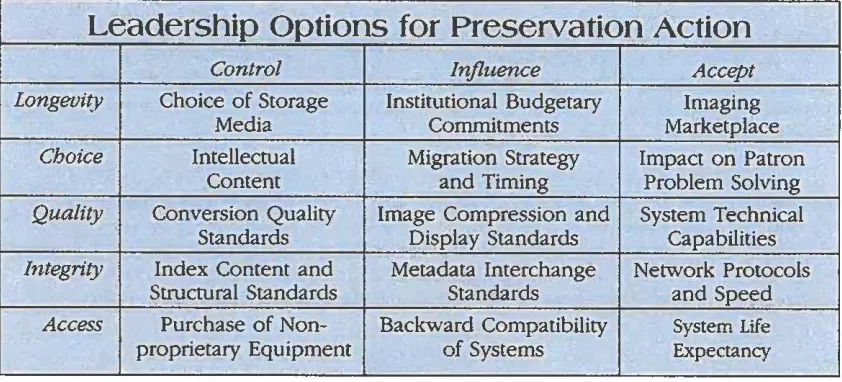
The following table summarizes key aspects of digital imaging technology that are impor-tant for creating and maintaining access to digital image files over a long period of time. It arrays
these aspects on two dimensions: the priorities for action and the degree of power that librarians
and archivists can have over accomplishing the goals implied by the priorities.
Longevity: Librarians can exercise a large measure of control over the life-expectancy of
digital image data through the careful selection, handling. and maintenance of rugged, well-tested recording and storage systems. They can influence the life expectancy of the information by making sure that local budgetary commitments are made consistently and at an appropriate
level in support of long-term migration strategies. Ultimately, the library community may have little control over the evolution of the imaging marketplace, especially corporate research and
development activities that have a tremendous impact on the life expectancy of the digital files
being creating today.
Leadership Options for Preservation Action
Control Influence Accept
Longevi~y Choice of Storage Institutional Budgetary Imaging
Media Commitments Marketplace
Choice Intellectual Migration Strategy Impact on Patron
Content and Timing Problem Solving
Quality Conversion Quality Image Compression and System Technical
Standards Display Standards Capabilities
Integrity Index Content and Metadata Interchange Network Protocols
Structural Standards Standards and Speed
Access Purchase of Non- Backward Compatibility System Life
proprietary Equipment of Systems Expectancy
-Choice: Even while recognizing that selection decisions cannot be made autonomously or
in a vacuum, librarians and archivists can choose which books, articles, photographs, films, and other materials are converted from paper or film into digital image form. Influence over the con-tinuing value of digital image files is largely vested in the right to decide when it is time to migrate image data to a future storage and access system and in knowing when a digital file has
outlived its usefulness to the institution charged with preserving it. Librarians and archivists, while not directly responsible for the capabilities of their patrons, can nonetheless help determine how digital informa-tion will be provided and help educate users about use of new technologies to meet their needs.
[image:20.612.93.514.41.232.2]Quality: The commercial imaging market has transformed the principle of maintaining the highest possible quality over time to one of finding the mini-mal level of quality acceptable to today's system users. Quality of the digital object, including the rich-ness of both the image and the associated indexes, is the heart and soul of preservation in the digital world. This means maximizing the amount of data captured in the digital scanning process, documenting image enhancement techniques, and specifying file compres-sion routines that do not result in the loss of data dur-ing telecommunication. Librarians and archivists can control standards of digital image quality, just as they have done for microfilm. They can only influence the development of standards for data compression, com-munication, and derivatives for display and output. Figure 9. Floppy disk. 106.200 cbar./in.2
Research laboratories and the imaging marketplace will have the greatest influence over improvements in the technical capabilities of digital con-version and storage systems.
Integrity: Librarians and archivists can help exercise control over the integrity of digital
to be shared across platforms, systems, and international boundaries. However, librarians and archivists may find they are but bystanders in the rapid development of network protocols, bandwidth, or data security techniques.
Access: The digital imaging marketplace is highly competitive. Librarians and archivists can
do the most to ensure continuing access to digital image files through prudent purchases of non-proprietary hardware and software components. In the present environment, true "plug and play" components are becoming more widely available; purchase decisions are the most powerful incentives for vendors to adopt open system architectures or at least provide better documenta-tion on the inner workings of their systems. Addidocumenta-tionally, librarians and archivists can influence vendors and manufacturers to develop new systems that are "backwardly compatible"' with exist-ing ones. This capability assists image file system migration in the same way that today's word processing software allows access to documents created with earlier versions. The life expectancy of a given digital image system and the requirement to migrate valuable digital image files to future generations of the technology are profoundly important matters over which librarians and
archivists have little or no control. It seems that the commitment of a vendor to support and
maintain an old system is inversely related to that vendor's ability to market a new system.
========;
■
!--===
===
Conclusion
P
reservation in the digital world challengeslibrarians and archivists, but not necessarily
due to a lack of understanding of digital
tech-nologies. selection criteria, or appropriate preservation options. The technologies are becoming understood
well enough. Informed choices about what to
pre-serve in the digital world and the best ways to
accom-plish preservation goals both denve from this under
-standing.
The real challenge is creating appropriate
organi-zational contexts for action. Cooperative strategies adopted from ongoing preservation practice are not all that is needed to address the complexities or the costs of digital technologies. Libraries and archives
must do more than simply divide the preservation pie.
The national digital libraries that are now under con
-struction should be built under an umbrella of guiding preservation concepts. Additionally, new approaches
to creating and maintaining digital files cooperatively Figure 10. Optical disk. 50 million cbar./in.2
must be developed. The acceptance of shared responsibility and shared funding commitments
will preserve access to what are, in essence, uni_que electronic collections.
Will the totality of the national digital library-whether it is a single entity or many things
to many people-be of such high quality and of such extraordinary value to a university, a
state government, or other institution that each participant will make a long-term commitment
to help support its preservation? Only if the answer to this question is yes will it be possible to
build that library cooperatively. Establishing such commitments requires the kind of leadership
that has set the context for traditional preservation action in the past two decades.
[image:21.612.96.593.262.604.2]List of Figures
1. Clay tablet: Arcadian Low Song. Early 18th century BC. ~Early Incantations and Rituals" "'24, Museum# YBC4643, Yale Babylonian Collection, Sterling Library, Yale University. I33x173x33 mm.
2. Papyrus: Unidentified Fragment. P.Ct.YBR inv. 422(A)fol. Beinecke Photo File, Beinecke Librnry, Yale University. 215.9x228.6 mm.
3. Illuminated manuscript: Rothschild Canticles. 1300-1400, 182v.-183r. MS404, Beinecke Phoco File, Beinecke Library, Yale University. l 18x84 mm.
4. Gutenberg Bible: Bible. Latin. Vulgate. (Mainz, Printer of the 42-line Bible (Johann Gutenberg), ca. 1454-55.J. Zzi 561, 43 cm. Beinecke Photo File, Beinecke Library, Yale University.
5. Nineteenth-century novel: Melville. Herman. Moby Dick, or, the Whale. New York: Harper & Brothers, 1851, p. 1. Tinker 1545, Beinecke Librnry, Yale University. 1:1 Reproduction.
6. Newspaper: Evening leader. New Haven, CT. Septertiber 7, 1901, p. 1. Sterling Library Stacks, Yale University. 1: 1 Reproduction.
7. Microfilm: Melville, Herman. Moby Dick, or, the Whale. New York: Harper & Brothers. 1851. Film 11B838, V2, reel M-17, no. 1701. Sterling Library, Yale University. Microtext RR.
8. Microfiche: American City Directories, through 1860-New Haven. Fiche B1272, #817. Sterling Libr-.ary, Yale University. Microtext RR.
9. Floppy disk: 1.44 megabyte floppy disk. Preservation Department, Yale University Libr-.ary.
BIBLIOGRAPHY
Preservation
Atherton, Jay. "From Life Cycle to Continuum: Some Thoughts on the Records Management-Archives
Relationship." Arcbivaria 21 (Winter 1985-86); 43-51.
Atkinson, Ross. "Selection for Preservation: A Materialistic Approach.'' Library Resources & Technical
Seroices 30 (October/December 1986): 341-53.
Banks, Paul N. "The Treatment of the First Edition of Melville's Tbe Whale .. , Guild of Bookworkersjourna/
7 (Spring 1969): 15-22.
Barr, Pelham. "Book Conservation and University Libr-ary Administration: Coflege & Research Libraries 7
(July 1946): 214-19.
Bearman, David. Archival Methods. Pittsburgh: Archival andlMuseum Informatics, 1989.
Binkley, Robert C. "Strategic Objectives in Archival Policy." American Archivist 2 (July 1939): 162-68.
Calmes, Alan. "To Archive and Preserve: A Media Primer." Inform (May 1987): 14-17, 33.
Conway, Paul. ·'Archival Preservation: Definitions for Improving Education and Tr-.iining." Restaurator IO
(1989): 47-60.
Cox, Richard J. ;,International Perspectives on the Image of Archivists and Archives: Coverage by 1be New
}'<:Irk Times, 1992-1993." International Information & Library Review 25 0993): 195-231.
Cummings, Anthony M., et al. University Libraries and Scholarly Communication: A Study Prepared/or
7be Andrew W Mellon Foundation. Washington, D.C.: Association of Research Llbr-Jries. 1992.
Darling, Pamela W. "Creativity v. Despair: The Challenge of Preservation Administration." Livrary Trends
30 (Fall 1981): 179-88.
Demas, Samuel. "Sening Preservation Priorities at Mann Library: A Disciplinary Approach." Library Hi Tech
12 (1994): 81-88.
Durand, Luciana. "Reliability and Authenticity: The Concepts and Their Implications." Arcbivaria 39
(Spring 1995): 5-10.
Dureau, Jean Marie and D. W. G. Clements. Principles for the Preseroation and Conservation of Library
Materials. The Hague: IFLA, 1986.
Morrow, Carolyn Clark, ed. National Conference on the Development of Statewide Preseroalion Programs.
Washington, D.C.: Commission on Preservation and Access, 1991.
O'Toole, James M. •on the Idea of Permanence." American Archivist 52 (Winter 1989): 10-25.
Ogden, Barclay. On the Preservation of Books and Documents in Original Form. Commission on
Preservation and Access, October 1989.
Patterson, Robert H. ·organizing for Conservation: A Model Charge to a Conservation Committee;· Livrary
Journal 104 (May 15, 1979): 1116-19.
Petherbridge, Guy, ed. Conseroation of Library and Archive Materials and the Graphic Arts. London:
Bunerworths, 1987.
Ritzenthaler, Mary Lynn. Preserving Archives and Manuscripts. Chicago: Society of American Archivists, 1993.
Rogers, Rutherford D. "Library Preservation: Its Scope, History, and Importance." In The library
Preseroation Program: Models, Priorities, Possibilities, pp. 7-20. Edited by Jan Merrill-Oldham and Merrily
Smith. Chicago: American Library Association, 1985.
Sebera, Donald. "The Effects of Strengthening and Deacidification on Paper Permanence: Some Fundamental Considerations." Book & Paper Group Annual, vol. 9, pp. 65-117. Washingron, D.C.: American Institute for Conservation, 1990.
Swanzburg, Susan G. Preserving Library Materials: A Manual. 2nd. ed. Metuchen, N.J.: Scarecrow, 1995.
Tanselle, G. Thomas. "Reproductions and Scholarship." Studies in Bibltograpby 42 (29 Sept. 1989): 25-54.
Walch, Victoria Irons, "Checklist of Standards Applicable to the Preservation of Archives and Manuscripts," American Archivist 53 (Spring 1990): 324-38.
Winger, Howard W. and Daniel Smith. Deterioration and Presen.:ation of librar;• Materials: 1be
1birty-fourtb Annual Conference of the Graduate Library School. Chicago: University of Chicago Press, 1970.
Digital Preservation
Ackerman, Mark S., and Roy T. Fielding. "~ollection Maintenance in the Digital Library." Proceedings of Digital libraries 95, Austin, TX, June 1995, pp. 39-48.
Battin, Patricia. "From Preservation to Access: ParJdigm for the Nineties." IFLAJournal 19 0993): 367-73.
Conway, Paul. "Digital Preservation: Paper and Microfilm Go Electronic:· Library Journal 119 (February I, 1994): 42-45.
Conway, Paul. "The Implications of Digital Imaging for Preservation .. In Preseroation of library and
Archival Materials, 2nd ed. Edited by Sherelyn Ogden. Andover, MA: Northeast Document Conservation
Center, 1994.
Conway, Paul. "Selecting Microfilm for Digital Preservation: A Case Study from Project Open Book.n
Library Resources & Technical Seroices 40, (January 1996): 67-77.
Digital-Imaging and Optical Digital Data Disk Storage Systems: Long-Term Access Strategies/or Federal
Agencies. Technical Information Paper No. 12. Washington, D.C.: National Archives and Records Administration, 1994.
Dollar, Charles M. Archival Theory and Information Technologies: 1be Impact of Information Technologies
on Archival Principles and Methods. Macerata: University of Macerata Press, 1992.
Fox, Edward A., et al. "Digital Libraries: Introduction," Communications of the ACM 38 (April 1995): 23-28.
Genz, Janet, et al. Oversize Color Images Project, 1994-1995: Final Report of Phase I. Washington, D.C.: Commission on Preservation and Access, 1995.
Graham, Peter S. "Requirements for the Digital Research Library." College & Research Libraries 56 (July 1995): 331-39.
Kenney, Anne R. "Digital-to-Microfilm Conversion: An Interim Preservation Solution." Library Resources & Technical Sen.tices 37 (1993): 380-401.
Kenney, Anne R. and Stephen Chapman. Digital Resolution Requirements/or Replacing Text-Based
Material: Methods/or Benchmarking Image Quality. Washington, D.C.: Commission on Preservation and
Access, 1995.
Lesk, Michael. Preseroation of New Technology: A Report of the Technology Assessment Advisory Committee.
Lesk, Michael. Electronic Libraries and Electronicjourne1/s. London: The British Library, 1994.
Levy, David M. and Catherine C. Marshall. "Going Digital: A Look at Assumptions Underlying Digital Libr.irics." Communications of the ACM 38 (April 1995): 77-84.
Lynch, Clifford. "The Integrity of Digital Information: Mechanics and Definitional Issues." Journal cif the American Society for Information Science 45 (December 1994): 737-44.
Mintzer, Fred, and John D. McFall. "Organization of a System for Managing the Text and Images that Describe an Art Collection." SPIE Image Handling and Reproduction Systems ltltegration 1460 0991): 38-49.
Mohlhenrich, Janice. Presen'afion of Electronic Formats: Electronic Formats/or Preseroation. Fort Atkinson, WI: Highsmith, 1993.
Preserving Digital Information: Draft Report of the Task Force on Arcbi11ing of Digital Information. Version
1.0 August 23, 1995. Research Libraries Group and Commission on Preservation and Access. URL: http://www.ode.org: 5046/ ~weibeVarchtf. html.
Robinson, Peter. The Digitization of Primary Textual Sources. Office for Humanities Communication Publication, no. 4. Oxford: Oxford University Computing Services, 1993.
Rothenberg, Jeff. "Ensuring the Longevity of Digital Documents." Scientific American 272 (January 1995): 42-47.
Waters, Donald J. "Transforming Libraries Through Digital Preservation ... In Digittll Imaging Technology for
Preservation. Proceedings from an RLG Symposium held March 17 & 18, 1994, pp.115-27. Edited by Nancy E. Elkington. Mountain View, CA: Research Libraries Group, 1994.
Van Bogart, John W. Mt1gnelic Tape Storage and Handling: A Guide/or Libraries and Archiues. Washington, D.C.: Commission on Preservation and Access, 1995.
Weibel, Stuart. ".Metadata: The Foundations of Resource Description." D-Lib Magazine, July 1995. URL: http