Subgroup Formation in Human–Robot
Teams
Completed Research Paper
Sangseok You
HEC Paris
1 Rue de la Liberation, Jouy-en-Josas,
France
[email protected]
Lionel P. Robert Jr.
University of Michigan
105 S. State St., Ann Arbor, Michigan,
USA
[email protected]
Abstract
Subgroup formation is vital in understanding teamwork. It was not clear whether subgroup formation takes place in human–robot teams and what the implications of the subgroups might be for the team’s success. Therefore, we conducted an experiment with 44 teams of two people and two robots, where each team member worked with a robot to accomplish a team task. We found that subgroups were formed when team members identified with their robots and were inhibited when they identified with their team as a whole. Robot identification and team identification moderated the negative impacts of subgroup formation on teamwork quality and subsequent team performance.
Keywords: Robots, subgroup, human–robot collaboration, teamwork quality, performance
Introduction
The use of physical robots to support teamwork continues to increase (Gombolay et al. 2014). Robots are employed in human–robot teams to accomplish teamwork (You and Robert 2018). The National Aeronautics and Space Administration (NASA) uses remote-controlled robots paired with humans to work alongside astronauts on space missions (Hoffman and Breazeal 2007). Construction sites and urban search-and-rescue teams are employing robots for dangerous and labor-intensive tasks. Robots are often viewed as unique and distinct from other team technologies because of their physical embodiment (You and Robert 2018). Physical embodiment can cause individuals to project identities and personalities onto robots and view them as humans (Groom and Nass 2007). As a result, individuals can develop strong emotional bonds with robots (Hiolle et al. 2012).
Is it possible that humans can form bonds with robots that are strong enough to create subgroups? According to the literature on robots, people develop emotional bonds with their robots in much the same way they do with other people (Hiolle et al. 2012; Robert 2018; You and Robert 2018). This suggests that the human–robot relationships within a team could act as the basis for a faultline. If this is true, would the emergence of subgroups be detrimental to the success of human–robot teams? Although no study has explicitly examined faultlines in human–robot teams, one study has found evidence that attachment to robots can be detrimental to the success of human–robot teams. In explosive ordnance disposal (EOD) teams, attachment to a robot made operators hesitant to deploy the robot to dangerous missions, and, as a result, the effectiveness of the EOD team was decreased (Carpenter 2013). These findings suggest that strong bonds with robots do not always result in positive outcomes.
Despite the importance of faultlines and the subgroups they create in traditional teams, the consequences of faultlines in human–robot teams remain relatively unexplored. Yet, as robots are increasingly being designed to elicit social and psychological responses, this becomes vital to understanding how such reactions are likely to manifest themselves in human–robot teams. We believe this calls for IS scholars to broaden our view of the role of technology. In this paper, we began to explore the concept of subgroup formation in human–robot teams with the following research question.
RQ) How does a bond between a human and his or her robot influence the formation of human– robot subgroups and the subsequent team outcomes?
Our goal is to determine whether the bonds between team members and their robots can act as a faultline and have negative effects on team outcomes as they do in traditional teams. We examined 44 human–robot teams. Results offer evidence for both the existence and impacts of subgroups in human–robot teams.
Background
Robots in the Current Study
Although definitions of robots vary widely across disciplines, we highlight the most common characteristic for this study: the physical embodiment. The physical embodiment distinguishes robots from other technological agents, such as chatbots, recommendation agents, and avatars (Ziemke et al. 2015). Due to robots’ physical embodiment, interactions with these robots are qualitatively different from those with other technological agents because they allow for more visceral and tangible experiences, such as touching and hitting (Lee et al. 2006). Existing in the same physical space enables people to interact with a robot “real-time and real-space, here and now” (Dourish 2001, p. 235). We believe that the physical embodiment is a key property of robots that creates strong bonds between an individual and a robot. Thus, the robots in this paper were chosen primarily to manifest physical embodiment rather than intelligence, autonomy, or human-likeness.
Bonds with Technology and Robots
Research has shown that strong bonds with a technology artifact can have important implications for understanding technology use. The basic premise behind the importance of bonds with technology is that the stronger the bonds individuals feel to a technology artifact, the more they prefer to use it and enjoy using it. Typically, the consequences of the bonds with technology are positive. For instance, emotional attachment has been positively related to individuals’ willingness to use and continue to use their technology, such as a mobile phone and an online avatar (Kim et al. 2010; Suh et al. 2011). Emotional bonds with technology can also enhance the quality of interaction. Individuals who built an emotional bond with avatars felt higher levels of social presence in videogames and a better shopping experience in virtual worlds (Kim et al. 2015; Suh et al. 2011). Also, emotional bonds with robots were shown to increase the performance and viability of human–robot teams (You and Robert 2018). However, emotional bonds with technology can also have adverse effects. People sometimes hesitate to adopt new technology when they develop strong bonds with their current technology (Read et al. 2011).
(Lee et al. 2006). This explains, in part, why people can build emotional bonds with physically embodied agents like robots more easily than virtual avatars (Groom and Nass 2007; Lee et al. 2006).
The importance of human–technology bonds has prompted both IS and HRI researchers to investigate the conditions that promote these bonds. The degree to which people believe that a technology artifact is a part of them or represents them has been found to be a facilitator of emotional bonds with technology (Lee and Sundar 2015). This can come in the form of perception of shared identity between people and their technology in terms of characteristics (Vincent 2006), personality (Govers and Mugge 2004), and appearance (Suh et al. 2011). Such bonds can be facilitated when users build, personalize, or customize their technology artifacts and robots (Lee and Sundar 2015). This is because people often view the artifacts they create or personalize as representations of themselves (Ahuvia 2005).
Subgroup Formation in Teams
Although the implications of faultlines and subgroup formation have not been studied in the context of human–robot teams, both have an extensive literature base (Thatcher and Patel 2012). Next, we review the literature on faultlines and subgroups within teams. We also introduce the idea of faultlines and subgroup formation in human–robot teams. Specifically, we discuss how the human–robot relationship can act as a faultline in human–robot teams and lead to subgroup formation.
Faultlines — which represent potential breaks within teams — have been used to explain the formation of subgroups within teams. These potential breaks can be the basis for division within teams (Lau and Murnighan 2005). Faultlines have been based on variables such as race, gender, age, and occupation (Thatcher and Patel 2012). Theories related to faultlines suggest that team members are likely to form stronger bonds with those they are more similar to (Lau and Murnighan 2005; Li and Hambrick 2005). For example, in a team with two engineers and two accountants, occupations could potentially be a faultline. Faultlines increase in strength as the number of similar attributes between members within a subdivision increases relative to the number of differences across subdivisions (Polzer et al. 2006). In the previous example, if the two engineers were men and the two accountants were women, the strength of the potential faultline would increase because it would include gender and occupation.
Subgroups can form when faultlines are activated (Bezrukova et al. 2009; Thatcher and Patel 2012). Subgroups are a subset of the team consisting of two or more members (Carton and Cummings 2012). The presence of subgroups has been associated with negative implications. Subgroup formation has been found to reduce variables that promote teamwork, such as trust and satisfaction, while increasing variables that are harmful to teamwork, such as conflict (Cronin et al. 2011; Pearsall et al. 2008; Robert 2016a). Traditionally, subgroup formation has been studied in collocated teams, but recent studies have found the evidence in virtual teams (Robert 2016b). In many cases, subgroups are formed in geographically distributed teams when team members form stronger bonds with collocated team members than with dispersed members (Polzer et al. 2006). Subgroups in virtual teams have been associated with more conflict and coordination problems, lower trust, lower team identification, and lower-functioning transactive memory systems (O’Leary and Mortensen 2010; Spell et al. 2011).
Although there are many ways to measure faultlines, the underlying core logic remains similar. When team members form stronger bonds within subdivisions than with the team as a whole, the team is likely to fracture into subgroups. The word likely should be emphasized because faultlines do not always lead to subgroup formation (Homan et al. 2007). Faultlines do, however, provide the basis for which subgroup formation occurs within teams (Lau and Murnighan 2005). There is still much ongoing research into what activates faultlines from potential to actual subgroup formation (Jehn and Bezrukova 2010; Pearsall et al. 2008). Most scholars seem to agree that once activated, subgroups can be harmful to effective teamwork (Jehn and Bezrukova 2010; Thatcher and Patel 2012).
(Krämer et al. 2011; Melson et al. 2009). Therefore, we believe that human–robot bonds can act as a faultline and, when triggered, lead to subgroup formation. Thus, we investigated the existence of human– robot subgroups and the implications associated with the outcomes of human–robot teams.
Hypotheses Development
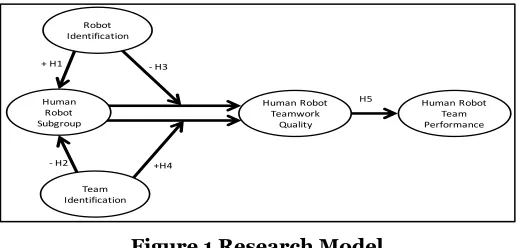
[image:4.612.178.436.271.395.2]To understand the implications of subgroup formation in human–robot teams, we developed a theoretical model (Figure 1). The model posits that the relationship between an individual and a robot can be the basis of a faultline. In particular, this faultline can become activated when individuals in teams establish stronger bonds with their robots than with a human teammate. The model draws from social identity theory (Hogg et al. 2004) to describe how identity-based bonds can result in subgroups in human–robot teams. Robot identification (i.e. identifying oneself with a robot) is likely to engender subgroups based on human–robot bonds, while team identification (i.e. identifying oneself with the whole team) is likely to reduce the formation of subgroups. The model also illustrates the moderation effects of both robot and team identification for teamwork quality. Specifically, subgroup formation decreases teamwork quality when robot identification is higher than low, whereas it increases teamwork quality when team identification is higher than low.
Figure 1 Research Model
Robot Identification and Subgroup Formation
Robot identification is associated with increases in subgroup formation in human–robot teams. Robot identification can be defined as the extent to which individuals believe their robot is a part of the self (You and Robert 2018). This can happen because individuals believe that an object and themselves share the same qualities (Connell and Schau 2013). Robot identification can be viewed as a specific instance of material identification. Material identification can be represented by the concept of self-extension and occurs when an individual becomes attached to a material object (Mugge et al. 2009). Self-extension, as it pertains to material identification, literally means to extend one’s self to include a material object (Belk 2013). Self-extension has been used to explain brand identification (Kim et al. 2001), digital goods (Belk 2013), and avatars (Suh et al. 2011; You and Sundar 2013).
Robot identification represents a strong attachment to the robot when individuals have extended themselves to include the robot (You and Robert 2018). In the first place, robot identification speaks to the individual-level psychological process based on the individual’s relationship with his or her robot. However, in teams working with multiple robots, team members use and control their own robot as part of the collaboration with other teammates (Yanco and Drury 2004). Thus, the shared experience of identification with a robot can also be viewed as a team-level phenomenon. In such cases, subgroup formation is likely to occur when individuals have a stronger relationship within their subdivision than across the team as a whole (Cronin et al. 2011). In a human–robot team, the relationship between an individual and his or her robot engenders the subdivision of the whole team. All things being equal, the likelihood of subgroup formation increases as an individual’s identification with his or her robot increases.
Hypothesis 1: Robot identification increases subgroup formation in human–robot teams.
+H4 - H3 + H1
- H2
Human Robot Teamwork
Quality
Team Identification
Robot Identification
Human Robot Team Performance Human
Robot Subgroup
H5
Team Identification and Subgroup Formation
Team identification is associated with decreases in subgroup formation in human–robot teams. Team identification is defined as “the extent to which members are psychologically identified with a group” (Scott 1997, p. 120). Team identification is derived from social identity theory (Hogg et al. 2004). Social identity theory helps to explain who we are in comparison to others (Hogg et al. 2004). Team identification occurs when individuals believe their identity overlaps with the team’s identity (Van Der Vegt and Bunderson 2005). When this occurs, their membership in the team becomes self-defining (Janssen and Huang 2008). Team identification has been described as the glue that binds team members together (Bezrukova et al. 2009). This is because team identification promotes strong inter-team relationships, in part by leading team members to view their teammates more positively (Gibson and Vermeulen 2003). For example, team identification has been found to increase trust toward team members (Han and Harms 2010). Trust is associated with strong interpersonal bonds among all team members while team identification also facilitates inter-team relationships by reducing conflict and promoting cohesion and a sense of a shared faith (Robert and You 2018; You and Robert 2018).
Team identification represents a strong bond to one’s team. Teams with members who are psychologically bonded to the team as a whole have less chance of fracturing into subgroups (Ren et al. 2014). Conversely, fractures are likely to occur when individuals have a stronger relationship within their subdivision than across the team (Dovidio and Gaertner 2000). Thus, when human–robot teams are high in team identification, there is a greater chance that the relationship between an individual and his or her robot will be offset by the relationship between the individual and the team. As a result, increases in team identification should reduce the likelihood of subgroup formation in human–robot teams.
Hypothesis 2: Team identification decreases subgroup formation in human–robot teams.
Moderation Effects of Robot Identification and Team Identification
In this study, we built and tested a theoretical model to explain the impacts of human–robot subgroups in human–robot teams. We drew on theories related to intra-group bias, subgroup formation, and dual identification. Theories on the intra-group bias, subgroup formation, and dual identification suggest that a subgroup’s strength and the presence of a collective identity might help dictate the influence of a subgroup. Empirically, several meta-analyses offer strong evidence to support these assertions (see Carton and Cummings 2012 for a review). Taken together, both theory and empirical evidence suggest that the presence of a collective identity alters how subgroup formation influences teamwork and performance.
Negative Impacts of Subgroup Formation on Teamwork Quality
Generally, the subgroup formation has been found to reduce teamwork quality by increasing divisiveness within teams (Robert 2016a). Divisiveness degrades teamwork quality by negatively influencing members’ perception of their teammates and the work experience with them. Subgroup formation can lead team members to make negative attributions about members who are perceived to be outside the subgroup. The same actions taken by outgroup teammates is likely to be viewed more negatively when subgroups are formed (Cronin et al. 2011). This reduces intergroup relationships among team members and heightens the potential for conflict (Bezrukova et al. 2009). When this occurs, team members are likely to experience more frustration, anxiety, and discomfort (Lipponen et al. 2003; Polzer 2004). Increases in these factors should degrade teamwork quality.
Subgroup formation is also likely to reduce the motivation of team members. Team members are less likely to exert much effort when they do not trust the actions taken by outgroup teammates (Kameda et al. 1992). Research on effort-withholding in teams has repeatedly shown that negative attributions to one’s teammate or poor inter-team relationships are largely associated with members putting less effort toward the team’s objectives (Srinivasan et al. 2012).
mechanisms in teams working with robots. As discussed, the negative effects of subgroup formation have been observed in research on teamwork (see Carton and Cummings 2012 for a review). The evidence from research on teamwork offers an explanation to the negative relationship between the subgroup formation and performance in human–robot teams (Homan et al. 2007; O’Leary and Mortensen 2010).
Robot Identification, Subgroups, and Teamwork Quality
Scholars have identified the strength of subgroups as a critical element in understanding the relationship between subgroups and teamwork. The logic is simple. As the strength of subgroups increases, so does the divisiveness in the team. This divisiveness manifests itself in many forms, such as conflict and discord (Goyal et al. 2008). The subgroup strength has also been shown to alter variables like satisfaction and performance (Cronin et al. 2011). Subgroups can have positive impacts on teamwork quality by providing emotional and psychological support to its members. This view of subgroups was originally put forth by Gibson and Vermeulen (2003). They found empirical evidence that moderate levels of subgroup strength facilitate learning in teams. They argued that moderate levels of subgroup strength provide team members with a safe space to engage in the learning process. This was in contrast to when subgroup formation was weak or strong. When subgroup strength was weak, subgroups had little or no relationship with team learning. When subgroup strength was strong, subgroups actually decreased team learning by creating a divisive environment. Other scholars have found evidence that subgroup formation can have positive impacts on teamwork in the form of social integration, open communications, and perceptions of fairness (Robert 2016b; Spell et al. 2011).
In a similar vein, robot identification should moderate the relationship between subgroup formation and teamwork quality in human–robot teams. Specifically, subgroups should hurt teamwork quality when robot identification is high. When subgroups are formed, increases in robot identification result in increases in the strength of the subgroup. High levels of robot identification coupled with subgroup formation lead to the divisiveness associated with subgroups by reinforcing the subgroup boundaries. As many studies have shown, divisiveness is likely to be associated with decreases in teamwork quality (Thatcher and Patel 2012). We believe this condition best represents the high levels of subgroup formation observed by Gibson and Vermeulen (2003). Studies have shown that individuals can build a strong bond with a robot that surpasses teamwork among human teammates. For instance, because of strong bonds with a bomb disposal robot, soldiers sometimes do not want to deploy the robot to dangerous missions that expose the robot to the risk of destruction (Carpenter 2013).
Conversely, subgroups should have a positive impact on teamwork quality when robot identification is low. We believe this condition represents the low levels of subgroup formation observed by Gibson and Vermeulen (2003). In their study, subgroup formation revealed positive effects on the team learning experience. We expected a similar mechanism to be at play in teams with subgroups and low levels of robot identification. Subgroups based on human–robot bonds might provide a comfortable and enjoyable interaction with robots without interfering with the team’s collective, collaborative effort. Therefore, when robot identification is low, increases in subgroup formation should lead to increases in teamwork quality.
Hypothesis 3: Robot identification moderates the impact of subgroup formation on teamwork quality. Subgroup formation decreases teamwork quality when robot identification is high and increases teamwork quality when robot identification is low.
Team Identification, Subgroups, and Teamwork Quality
Theories related to dual identification posit that individuals seek to be a part of smaller subgroup while being a part of a larger collective identity (Hogg et al. 2004; Richter et al. 2006). According to these theories, a collective identity could alter the effects of a subgroup. A collective identity can act as a unifying force that can bridge the divide between subgroups (Lau and Murnighan 2005; Ren et al. 2014). The bridging can allow both subgroups to exist along with a broader collective identity without the negative effects traditionally associated with subgroups (Ren et al. 2014). Several studies examining the influence of subgroups have found evidence of the benefits of a collective identity in teams with subgroups (Thatcher and Patel 2012).
when subgroup formation can have a positive or negative impact on teamwork quality. To do so, we draw attention to the literature on dual identification. Theories around multiple identifications in organizations assert that identification with a workgroup can have a positive impact when that identity is nested within a larger superordinate organizational identity. Richter et al. (2006) examined the impact of workgroup identification on inter-work group conflict and productivity. They found that when employees identified with their organization, work identification was associated with decreases in conflict and increases in inter-work productivity. Van Dick et al. (2008) found that inter-workgroup identification only leads to more job satisfaction and extra-role behavior when employees also identify with their organization.
Richter et al. (2006) and Van Dick et al. (2008) did not examine subgroup formation. However, given these findings, we expect that team identification should moderate the impact of subgroup formation in human– robot teams. Subgroup formation should increase teamwork quality when team identification is high. When this occurs, teams should benefit from both the emotional support of a subgroup member (i.e. robot) and a collective identity. However, when team identification is low, the subgroup formation represents the divisiveness associated with subgroups.
Hypothesis 4: Team identification moderates the impact of subgroup formation on teamwork quality by increasing teamwork quality when high and decreasing teamwork quality when low.
Teamwork Quality and Human–Robot Team Performance
Last, we posit that teamwork quality increases the performance of human–robot teams. Teamwork quality is a team’s perception of the interactions involved during the teamwork. Teamwork quality, thus, includes the degree to which team members enjoy and are satisfied with teamwork and the perceived support from teammates (Dayan and Di Benedetto 2008; Easley et al. 2003). Prior literature demonstrates the positive link between the quality of teamwork and the team’s performance (Hoegl and Gemuenden 2001).
Prior studies have not examined the impacts of teamwork quality on performance in human–robot teams (Oriz et al. 2010). However, they at least provide evidence by examining constructs similar to the perception of teamwork quality. Hoffman and Breazeal (2007) reported perceived efficiency of collaboration with a robot as a measure of successful teamwork.
We believe that the general mechanism of teamwork quality increasing team performance can also apply to human–robot teams. Specifically, positive teamwork quality can lead team members to be more committed to the teamwork to maintain the ongoing positive experience. Also, good teamwork quality often indicates good interaction, coordination, and communication among teammates and the effective use of the robots, all of which contributes to better team performance (Hoegl and Gemuenden 2001).
Hypothesis 5: Teamwork quality increases team performance in human–robot teams.
Method
As part of a larger research project, we conducted a 3 x 1 between-subjects lab experiment with individuals recruited at a large university in the United States. We randomly assigned 88 individuals (mean age = 23.6, standard deviation [SD] = 4.1, 42 females) to 44 teams, each of which consisted of two humans and two robots. Teams were randomly assigned to one of the three conditions in the experiment: robot identification (15 teams), team identification (14 teams), and control (15 teams). Each participant was paired with a robot to accomplish a team task. Participants were paid $20 and received additional compensation based on their team performance against other teams in the experiment.
Experimental Task and Robots
information and skills to complete the task faster, such as better robot controls, route coordination, and locations to place water bottles at Point B to hand over. We measured total time for each team to move all water bottles from Point A to Point C. The robots were designed, based on LEGO Mindstorms EV3, to grab small objects. The robots were not highly intelligent but were controlled by a remote controller. The robots spoke the word “okay” when successfully grabbing and releasing objects.
Figure 2 Experimental Task Setting and Robot
Experimental Conditions
In the robot identification condition, teams were asked to finish assembling the robot before performing the team task. The treatment was to assemble a head compartment of a robot and add it to the robot. Each participant was given robots without heads, parts to complete heads of the robots, and written instructions with images for completing the robots. The assembly task was individual, and the two individuals in a team were each asked to complete their own robot. All participants finished the assembly task.
The team identification condition involved a treatment to induce the sense of team to participants in a team. Two individuals in a team were asked to create a team name and choose a t-shirt as a uniform for their team from two colors. The uniform had the same design and color for both human team members and robots. For example, when a team chose a yellow t-shirt, both team members were given two yellow infant t-shirts and asked to put them on their robots by themselves. All teams in the team identification condition were asked to wear the chosen t-shirts and to keep the small t-shirts on the robots during the team task. Last, the control condition did not involve any treatments from either of the conditions above. Control teams were given two complete robots and did not undergo creating team names nor choosing or wearing t-shirts.
Procedure
After arriving at the lab, participants were provided with a brief introduction of the study along with consent forms. The introduction included information that they were competing against other teams in the study and that additional compensation would be given based on the team performance. Upon consenting, participants were guided to a treatment room where two computers and experimental treatments were placed according to the condition assigned to them. In the treatment room, participants were asked to fill out a short pre-treatment questionnaire using the computers. The questionnaire collected demographic information and individual traits for control variables. Then, participants were given written instructions about the experimental task and the control of the robots along with video instructions for the same content. Upon completing reading and watching the instructions, participants were exposed to the experimental treatments based on the condition they were randomly assigned to. Specifically, participants assigned to the robot identification condition were asked to build their robots following instructions regarding the assembly of the robots. On the other hand, participants assigned to the team identification condition were asked to choose a uniform and create a team name. In the control condition, participants were guided directly to the next step without undergoing any treatment.
Measures
Robot Identification
To capture robot identification, we measured self-extension using an index of seven items based on a five-point Likert scale (1 = strongly disagree to 5 = strongly agree) (Schifferstein and Zwartkruis-Pelgrim 2008). One example was, “If I were describing myself to my team members, this robot would likely be something I would mention.” The scale was reliable (Cronbach’s α = 0.89). Self-extension was increased by the robot identification treatment (ß = 0.40, p < 0.05), which shows the success of robot identification manipulation.
Team Identification
Team identification was captured using an index of six items adapted from prior works (Bos et al. 2010). The items measured the degree to which team members identified themselves with their team. The index included items such as, “I was happy with being identified as a member of this team.” The scale was reliable (α = 0.94). Perceived team identification was increased by the presence of the team identification treatment (ß = 0.33, p < 0.05), which indicates the success of team identification manipulation.
Human–Robot Subgroup Formation
To measure subgroup formation, we captured and averaged the level of cohesion reported by participants between themselves and their teammate and compared them against their level of cohesion between themselves and their robot. Cohesion was measured using an index of five items from Craig and Kelly (1999). One example from the index was, “I feel close to this team member (robot).” The scale of cohesion was reliable (Cronbach’s α = 0.85). The level of cohesion between participants and their robots (human– robot cohesion) was subtracted from the level of cohesion between participants (human–human cohesion) in the team. Negative values were coded as “1” to represent a subgroup formation, while non-negative values were coded as “0” to represent no subgroup formation. The aim of the study was to find empirical evidence for the existence of subgroup formation and examine the impact of the presence of subgroup formation, rather than the magnitude of the subgroup formation. This is why subgroup formation was coded dichotomously with two levels: presence and absence of the phenomenon.
Teamwork Quality and Team Performance
We captured teamwork quality by measuring the participants’ perception of their performance. Teamwork quality in this paper concerned how team members assessed their experience of working as a team for the experimental team task. We measured teamwork quality using an index of three items created for this study based on a five-point Likert scale. The index included items such as, “This team met or exceeded my expectations and fulfilled its overall objectives.” The scale of teamwork quality was reliable (α = 0.91). Finally, team performance was recorded by measuring the duration of the experimental task. The average team performance time across the experiment was 262 seconds (SD = 52.18).
Control Variables
We measured participants’ previous experience of LEGO Mindstorms and the general knowledge on the robotics. The scale included questions regarding the degree to which participants have done activities using LEGO Mindstorms and the degree to which they were confident and knowledgeable about robotics. It should be noted that the level of analysis for this study was the team level. Therefore, the responses from the experiment were collected at the individual level and aggregated to the team level. All team-level constructs in this study had intra-class correlation (ICC) values higher than the threshold of 0.11 (Bliese 2000).
Results
subgroups and without subgroups (χ2= 11.47, p < 0.05 with df = 4). Nagelkerke’s R2, which ranges between
0 and 1, was 0.35. Accuracy of the prediction overall was 80%. The Wald criteria demonstrated that robot identification (4.85, p < 0.05) made significant contributions to the prediction. Team identification (-0.80, p = 0.10) indicated a negative relationship with the subgroup formation, although the result was not statistically significant. Robot identification positively contributed to subgroup formation, whereas team identification showed marginally negative impacts. Therefore, H1 was supported, while H2 was marginally supported.
Independent Variable Human–Robot Subgroup Formation (SGF)
Model 1 Model 2
B SE Wald B SE Wald
Constant -1.40** 0.41 11.43 -1.70 ** 0.51 11.25
Control Variables Team Knowledge on Robotics
(TKR) 0.50 0.40
1.54 0.38 0.42 0.82
Team Lego Experience
(TPLE) 0.52 0.38
1.88 0.86 † 0.47 3.36
Main Effects
Robot Identification (RID) 1.38 * 0.63 4.85
Team Identification (TID) -0.80 † 0.49 2.63
-2 Log Likelihood 42.62 35.69
χ2 4.54 11.47
df 2 4
Model Sig. 0.10 0.02
Nagelkerke R2 0.15 0.35
Change in Nagelkerke R2 0.20
Classification Accuracy 80% 80%
[image:10.612.75.543.573.717.2]Note: †: p < 0.10, * p < 0.05, ** p < 0.01. All variables were standardized.
Table 1 Results of Logistic Regression for Human–Robot Subgroup Formation
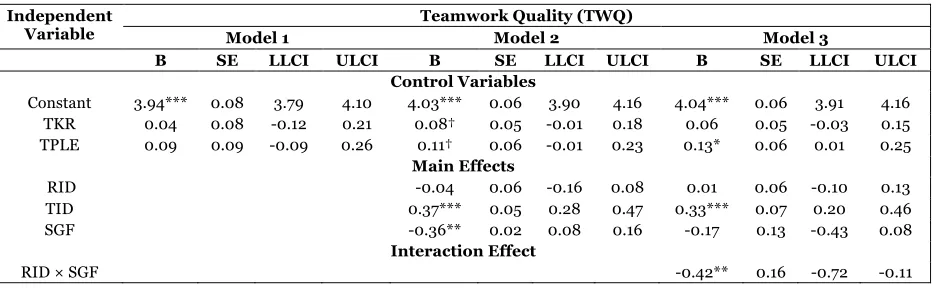
Hypotheses 3 and 4 posited moderation effects of robot and team identification for the relationship between the subgroup formation and teamwork quality. Tests of Hypotheses 3 and 4 were done through the generalized linear model (GLM). We employed the GLM based on the results of a Levene’s test of dependent variables. The Levene’s test is conducted to verify the assumption of the equal variances of errors of groups by rejecting the null hypothesis that the variances are equal. Results of the Levene’s test revealed that teamwork quality did not have equal variances (F = 6.73, p < 0.01). The violation of the assumption required us to use an alternative to the analysis of variance, which is the GLM.
Results of the GLM are shown in Table 2. The results indicate that both robot identification (B = -0.42, p < 0.01) and team identification (B = 0.22, p < 0.05) moderated the impacts of human–robot subgroup formation on teamwork quality (pseudo R2 = 0.66). Pseudo R2 in the models was calculated to estimate the
improvement from a null model to fitted models by computing the ratio between the null model deviance and the fitted model deviance (Faraway 2016). Teamwork quality decreased as subgroup formation increased when robot identification was high (Figure 3, left). Subgroup formation increased teamwork quality when team identification was high (Figure 3, right). Therefore, Hypotheses 3 and 4 were supported.
Independent Variable
Teamwork Quality (TWQ)
Model 1 Model 2 Model 3
B SE LLCI ULCI B SE LLCI ULCI B SE LLCI ULCI
Control Variables
Constant 3.94*** 0.08 3.79 4.10 4.03*** 0.06 3.90 4.16 4.04*** 0.06 3.91 4.16 TKR 0.04 0.08 -0.12 0.21 0.08† 0.05 -0.01 0.18 0.06 0.05 -0.03 0.15 TPLE 0.09 0.09 -0.09 0.26 0.11† 0.06 -0.01 0.23 0.13* 0.06 0.01 0.25
Main Effects
RID -0.04 0.06 -0.16 0.08 0.01 0.06 -0.10 0.13
TID 0.37*** 0.05 0.28 0.47 0.33*** 0.07 0.20 0.46
SGF -0.36** 0.02 0.08 0.16 -0.17 0.13 -0.43 0.08
Interaction Effect
TID × SGF 0.22* 0.10 0.03 0.42
AIC 75.17 41.0 40.16
df 2 5 7
Pseudo R2 0.04 0.62 0.66
[image:11.612.87.529.65.274.2]Note: †: p < 0.10, * p < 0.05, ** p < 0.01, *** p < 0.001. TKR: Team Knowledge on Robotics; TPLE: Team Previous Lego Experience; RID: Robot Identification; TID: Team Identification; SGF: Subgroup Formation; TWQ: Teamwork Quality. AIC = Akaike’s Information Criterion. All variables, except Subgroup Formation, were standardized.
Table 2 Results of the Generalized Linear Model for Teamwork Quality
[image:11.612.74.541.73.128.2]
Figure 3 Two-way interactions between RID (left) and TID (right) and SGF on TWQ
Hypothesis 5 posited that teamwork quality would increase performance and was supported. As shown in Table 3, the performances of human–robot teams was increased by teamwork quality (B = -33.89, p < 0.01). The positive impacts of teamwork quality are denoted with negative time values.
IVs Actual Team Performance (ATP)
Model 1 Model 2 Model 3
B SE LLCI ULCI B SE LLCI ULCI B SE LLCI ULCI
Control Variables
Constant 262.27*** 7.67 247.22 277.32 256.38*** 8.29 240.28 272.49 263.12*** 8.94 245.60 280.64 TKR -10.01 6.83 -23.49 3.30 -10.26† 5.49 -21.02 0.50 -5.20 4.80 -14.56 4.17 TPLE 4.46 7.87 -10.96 19.88 -0.23 8.89 -17.65 17.18 6.23 8.38 -10.20 22.66
Main Effects 1
RID -12.68 9.68 -31.65 6.29 -14.98† 8.78 -32.19 2.23
TID -8.44 7.22 -22.60 5.73 14.01 9.61 -4.82 32.84
SGF 25.27† 14.29 -2.74 53.27 3.41 18.08 -32.02 38.84
Main Effects 2
TWQ -33.89** 12.22 -57.84 -9.93
AIC 478.37 477.89 471.37
df 2 5 6
Pseudo
R2 0.03 0.17 0.31
Note: †: p < 0.10, * p < 0.05, ** p < 0.01, *** p < 0.001. TKR: Team Knowledge on Robotics; TPLE: Team Previous Lego Experience; RID: Robot Identification; TID: Team Identification; SGF: Subgroup Formation; TWQ: Teamwork Quality. AIC = Akaike’s Information Criterion. All variables, except Subgroup Formation, were standardized.
Table 3 Results of the Generalized Linear Model for Actual Team Performance
Discussion
The objective of this study was to understand the formation of subgroups and its impacts on the outcomes of human–robot teams. In this study we examined whether different identification mechanisms — robot identification and team identification — could contribute to formation of human–robot subgroups, and how they influence teamwork quality and performance. Our results suggest that robot identification contributes to subgroup formation by reinforcing the human–robot bonds more than human–human bonds, and team identification decreases subgroup formation. We further explored the moderation effects of robot identification and team identification for the impact of subgroup formation on teamwork quality. Subgroup formation decreased teamwork quality when robot identification was high, while it increased teamwork quality when robot identification was low. Teamwork quality was increased in teams with both subgroups and high levels of team identification, whereas such impacts were not apparent in teams with other conditions. Furthermore, teamwork quality enhanced the performance of human–robot teams.
2.5 3 3.5 4 4.5 5
NO Subgroup Formation Subgroup Formation
T e a m w o rk Q u a li ty Low Robot Identification High Robot Identification 2.5 3 3.5 4 4.5 5
NO Subgroup Formation Subgroup Formation
[image:11.612.127.492.162.267.2] [image:11.612.72.543.327.506.2]Implications for Theory and Research
Our findings have several implications for theory and research in the field of information systems. First, we found empirical evidence for subgroup formation in human–robot teams. Results from our experiment showed that teams could be divided into multiple subgroups based on a faultline created by strong human– robot bonds. We observed that the human–robot bonds from identification with a robot could divide a team into segments of an individual and his or her robot, while bonding with the team could reduce the segmentation. This observation suggests that teams can take different strategies to engender or prohibit the formation of subgroups during teamwork: robot identification for activating a faultline and team identification for suppressing the faultline.
Previous IS research demonstrated that strong bonds with technology could benefit individuals’ technology use and the outcomes of using the technology (Kim et al. 2010; Read et al. 2011). Also, team identification has been deemed, in general, a positive driving force for team members’ committed effort and more effective collaboration (Van Der Vegt and Bunderson 2005). However, other researchers have not examined how different bonding strategies could influence teamwork by altering the team’s collective effort; moreover, current theories failed to make links between subgroup formation in traditional teams and emotional bonds with robots.
Therefore, it is important to note that technologies, such as robots, are essential elements in teamwork and thus can influence dynamics and interactions among team members. By showing that team members can be more bonded to their robots than their teammates, we argue that study of the impacts of human– technology bonds deserves more attention. Indeed, teams now rely more on different types of technologies beyond computers (Maruping and Magni 2015; de Vreede and Briggs 2019). Team members can use and interact with physically embodied robots, artificial-intelligence agents, and chatbots to accomplish tasks ranging from physical labors to cognitively challenging problems (Stock and Merkle 2018). Theories of subgroup formation should be expanded from traditional teamwork and explore how different technology characteristics affect the creation of human–technology bonds and the formation of subgroups.
However, it is imperative to note that time can be a boundary condition for our findings. We reported results from a lab experiment in which individuals were allowed to interact with robots for a short duration. Although our interventions elicited bonds with robots, we could not examine these bonds or how they might have unfolded over a longer duration of time. In reality, time plays a significant role in building a stable bond (Mugge et al. 2009). Moreover, time invites scholars to consider material agencies that robots manifest (Leonardi 2011). Given that time can be an important variable, future studies should examine time and test whether our findings hold true during different durations of bonding activities.
Second, our findings highlight that subgroup formation could negatively influence teamwork quality, but different identification strategies can moderate that influence. It was revealed that the combination of robot identification and subgroup formation led to decreases in teamwork quality. However, team identification led to increases in teamwork quality when teams had subgroups. These findings suggest that the impacts of subgroup formation can be harnessed by different identification strategies in human–robot teams. Specifically, it is possible that robot identification strengthens and activates the faultline between human– robot pairs and results in people focusing more on their own subgroup than the team as a whole. However, high levels of team identification can act as an effective glue to the team and allow the team to benefit from the bonds with their technology without sacrificing the cohesive teamwork. Overall, these findings imply that the impacts of subgroup formation are not necessarily negative.
The moderation effects of robot and team identification can inform theories on subgroup formation and teamwork. Previous IS literature reported various factors contributing to faultlines and the formation of subgroups in teams. Those factors include the team’s demographic compositions, beliefs, and knowledge and skills (Ren et al. 2014; Thatcher and Patel 2012). Research also examined different strategies to control the consequences of faultlines and bridge different subgroups (Homan et al. 2007; Spell et al. 2011). Leadership structures, communication styles, and task types could influence the relationship between subgroup formation and team outcomes (Meyer et al. 2015; Thatcher and Patel 2012). More research on subgroup formation should identify more variables that alter its impacts in human–robot teams.
generalizing the findings because the positive link between teamwork quality and performance might hold true only in particular circumstances. Human–robot teamwork involves a wide variety of tasks including decision-making, cognitive problem-solving, sorting objects, and building parts in assembly lines (Gombolay et al. 2014; Groom and Nass 2007). Research should examine whether the positive impacts of teamwork quality can also lead to better performance in other types of tasks by human–robot teams. Finally, we call for more research examining the potential impacts of human–robot bonds in teams and their outcomes for teamwork. Much research has found positive impacts of strong bonds with robots in dyadic interactions (Hiolle et al. 2012; Melson et al. 2009). Yet, this study is one of the first to examine the impacts of human–robot bonds in teams with more than one human and one robot. Robots are now becoming an essential part of a collaboration for many teams, beyond a technology companion in our homes (Yanco and Drury 2004).
Implications for Practice and Design
Robots for human–robot teams should be designed to promote social integration with some room for individual personalization at the same time. Robots can be designed to highlight the commonality among all team members, thereby suppressing factors that can cause divisions, such as demographic characteristics (Li and Hambrick 2005). Also, the bonding exercises introduced in this paper can be incorporated into training in human–robot teams. The performance benefits come from not only honing required skills to maneuver robots but also establishing bonds with robots. At the same time, the training should include bonding exercises between humans to avoid negative consequences of subgroup formation.
Limitations and Future Research
The study has several limitations. First, we used one method to measure subgroup formation among other possible approaches. We measured cohesion between humans and robots to capture the subgroup formation. Previous research employed various measures of subgroup formation (Polzer et al. 2006; Thatcher and Patel 2012). Therefore, other approaches should be examined. Second, our experiment has several limitations by design. For instance, interaction with robots was brief compared to human–robot teams in reality. Thus, the impacts of bonding exercises in the experiment should be understood with caution; duration of time and types of bonding exercises should be boundary conditions in applying our findings into other settings. Also, the experiment only used a team of two humans and two robots. However, human–robot teams in the real world can exist in various configurations and sizes. Team size, in particular, has been shown to impact team outcomes (Srinivasan et al. 2012). Third, it should be noted that our experiment used a particular type of physical robot that could be assembled by human members and controlled with a remote controller. The robots in our study did not display high degrees of intelligence or autonomy. Intelligent features can promote more natural interactions and emotional closeness with robots. It still remains unknown how our findings might manifest in teams using different types of robots, such as intelligent humanoid robots. As a result, we encourage future studies to test the phenomena in field settings, in addition to controlled laboratory environments. Field settings allow researchers to qualitatively unpack the process of how team members develop emotional bonds with their robots over time. Given that the team structure can vary, future studies should examine the impacts of subgroup formation across different team structures.
Conclusion
Subgroup formation is a vital element in understanding the effectiveness of teamwork. Despite its importance, it has not been clear whether the subgroup formation can take place in human–robot teams and, if so, what the implications are for the team’s success. Subgroups can be formed by robot identification and inhibited by team identification. Robot identification and team identification moderated the negative impacts of subgroup formation on teamwork quality and its subsequent team performance.
References
Belk, R. W. 2013. “Extended Self in a Digital World,” Journal of Consumer Research (40:3), pp. 477–500. Bezrukova, K., Jehn, K. A., Zanutto, E. L., and Thatcher, S. M. 2009. “Do Workgroup Faultlines Help or
Hurt? A Moderated Model of Faultlines, Team Identification, and Group Performance,” Organization Science (20:1), pp. 35–50.
Bliese, P. D. 2000. Within-Group Agreement, Non-independence, and Reliability: Implications for Data Aggregation and Analysis.
Bos, N. D., Buyuktur, A., Olson, J. S., Olson, G. M., and Voida, A. 2010. “Shared Identity Helps Partially Distributed Teams, but Distance Still Matters,” in Proceedings of the 16th ACM International Conference on Supporting Group Work, ACM, pp. 89–96.
Carpenter, J. 2013. “The Quiet Professional: An Investigation of US Military Explosive Ordnance Disposal Personnel Interactions with Everyday Field Robots.”
Carton, A. M., and Cummings, J. N. 2012. “A Theory of Subgroups in Work Teams,” Academy of Management Review (37:3), pp. 441–470.
Connell, P. M., and Schau, H. 2013. “Self-expansion and Self-extension as Distinct Strategies,” The Routledge Companion to Identity and Consumption, p. 21.
Craig, T. Y., and Kelly, J. R. 1999. “Group Cohesiveness and Creative Performance.,” Group Dynamics: Theory, Research, and Practice (3:4), p. 243.
Cronin, M. A., Bezrukova, K., Weingart, L. R., and Tinsley, C. H. 2011. “Subgroups within a Team: The Role of Cognitive and Affective Integration,” Journal of Organizational Behavior (32:6), pp. 831–849. Dayan, M., and Di Benedetto, A. 2008. “Procedural and Interactional Justice Perceptions and Teamwork
Quality,” Journal of Business & Industrial Marketing (23:8), pp. 566–576.
de Vreede, G.-J., and Briggs, R. O. 2019. “A Program of Collaboration Engineering Research and Practice: Contributions, Insights, and Future Directions,” Journal of Management Information Systems (36:1), pp. 74–119.
Dourish, P. 2001. “Seeking a Foundation for Context-aware Computing,” Human–Computer Interaction (16:2–4), pp. 229–241.
Dovidio, J. F., and Gaertner, S. L. 2000. “Aversive Racism and Selection Decisions: 1989 and 1999,” Psychological Science (11:4), pp. 315–319.
Easley, R. F., Devaraj, S., and Crant, J. M. 2003. “Relating Collaborative Technology Use to Teamwork Quality and Performance: An Empirical Analysis,” Journal of Management Information Systems (19:4), pp. 247–265.
Faraway, J. J. 2016. Extending the Linear Model with R: Generalized Linear, Mixed Effects and Nonparametric Regression Models, Chapman and Hall/CRC.
Friedman, B., Kahn Jr, P. H., and Hagman, J. 2003. “Hardware Companions?: What Online AIBO Discussion Forums Reveal about the Human-Robotic Relationship,” in Proceedings of the SIGCHI Conference on Human Factors in Computing Systems, ACM, pp. 273–280.
Gibson, C., and Vermeulen, F. 2003. “A Healthy Divide: Subgroups as a Stimulus for Team Learning Behavior,” Administrative Science Quarterly (48:2), pp. 202–239.
Gombolay, M. C., Gutierrez, R. A., Sturla, G. F., and Shah, J. A. 2014. “Decision-making Authority, Team Efficiency and Human Worker Satisfaction in Mixed Human-Robot Teams,” Proceedings of the Robots: Science and Systems (RSS).
Govers, P. C., and Mugge, R. 2004. “I Love My Jeep, Because It’s Tough like Me’: The Effect of Product-Personality Congruence on Product Attachment,” in Proceedings of the Fourth International Conference on Design and Emotion, Ankara, Turkey.
Goyal, S., Maruping, L., and Robert, L. P. 2008. “Diversity and Conflict in Teams: A Faultline Model Perspective,” in Academy of Management Proceedings (Vol. 2008), Academy of Management, pp. 1– 6.
Groom, V., and Nass, C. 2007. “Can Robots Be Teammates? Benchmarks in Human–Robot Teams,” Interaction Studies (8:3), pp. 483–500.
Han, G., and Harms, P. D. 2010. “Team Identification, Trust and Conflict: A Mediation Model,” International Journal of Conflict Management (21:1), pp. 20–43.
Hiolle, A., Cañamero, L., Davila-Ross, M., and Bard, K. A. 2012. “Eliciting Caregiving Behavior in Dyadic Human-Robot Attachment-like Interactions,” ACM Transactions on Interactive Intelligent Systems (TiiS) (2:1), p. 3.
Hoffman, G., and Breazeal, C. 2007. “Effects of Anticipatory Action on Human-Robot Teamwork Efficiency, Fluency, and Perception of Team,” in Proceedings of the ACM/IEEE International Conference on Human-Robot Interaction, HRI ’07, New York, NY, USA: ACM, pp. 1–8.
Hogg, M. A., Abrams, D., Otten, S., and Hinkle, S. 2004. “The Social Identity Perspective Intergroup Relations, Self-conception, and Small Groups,” Small Group Research (35:3), pp. 246–276.
Homan, A. C., Van Knippenberg, D., Van Kleef, G. A., and De Dreu, C. K. 2007. “Bridging Faultlines by Valuing Diversity: Diversity Beliefs, Information Elaboration, and Performance in Diverse Work Groups.,” Journal of Applied Psychology (92:5), p. 1189.
Janssen, O., and Huang, X. 2008. “Us and Me: Team Identification and Individual Differentiation as Complementary Drivers of Team Members’ Citizenship and Creative Behaviors,” Journal of Management (34:1), pp. 69–88.
Jehn, K. A., and Bezrukova, K. 2010. “The Faultline Activation Process and the Effects of Activated Faultlines on Coalition Formation, Conflict, and Group Outcomes,” Organizational Behavior & Human Decision Processes (112:1), pp. 24–42.
Kameda, T., Stasson, M. F., Davis, J. H., Parks, C. D., and Zimmerman, S. K. 1992. “Social Dilemmas, Subgroups, and Motivation Loss in Task-oriented Groups: In Search of an "Optimal" Team Size in Division of Work,” Social Psychology Quarterly, pp. 47–56.
Kim, C. K., Han, D., and Park, S.-B. 2001. “The Effect of Brand Personality and Brand Identification on Brand Loyalty: Applying the Theory of Social Identification,” Japanese Psychological Research (43:4), pp. 195–206.
Kim, K., Schmierbach, M. G., Bellur, S. (Saras), Chung, M.-Y., Fraustino, J. D., Dardis, F., and Ahern, L. 2015. “Is It a Sense of Autonomy, Control, or Attachment? Exploring the Effects of in-Game Customization on Game Enjoyment,” Computers in Human Behavior (48), pp. 695–705.
Kim, K.-K., Shin, H.-K., Lee, Y., and Lee, K.-W. 2010. “A Study on the Influences of Attachment Perspectives toward Continued Use Intention in Smartphone Service Usage,” Journal of Information Technology Applications & Management (17:4), pp. 83–105.
Krämer, N. C., Eimler, S., von der Pütten, A., and Payr, S. 2011. “Theory of Companions: What Can Theoretical Models Contribute to Applications and Understanding of Human-Robot Interaction?,” Applied Artificial Intelligence (25:6), pp. 474–502.
Lau, D. C., and Murnighan, J. K. 2005. “Interactions within Groups and Subgroups: The Effects of Demographic Faultlines,” Academy of Management Journal (48:4), pp. 645–659.
Lee, K. M., Jung, Y., Kim, J., and Kim, S. R. 2006. “Are Physically Embodied Social Agents Better than Disembodied Social Agents? The Effects of Physical Embodiment, Tactile Interaction, and People’s Loneliness in Human–Robot Interaction,” International Journal of Human-Computer Studies (64:10), pp. 962–973.
Lee, S., and Sundar, S. S. 2015. “Cosmetic Customization of Mobile Phones: Cultural Antecedents, Psychological Correlates,” Media Psychology (18:1), pp. 1–23.
Leonardi, P. M. 2011. “When Flexible Routines Meet Flexible Technologies: Affordance, Constraint, and the Imbrication of Human and Material Agencies,” MIS Quarterly (35:1), pp. 147–167.
Li, D., Browne, G. J., and Chau, P. Y. 2006. “An Empirical Investigation of Web Site Use Using a Commitment-based Model,” Decision Sciences (37:3), pp. 427–444.
Li, J., and Hambrick, D. C. 2005. “Factional Groups: A New Vantage on Demographic Faultlines, Conflict, and Disintegration in Work Teams,” Academy of Management Journal (48:5), pp. 794–813.
Lipponen, J., Helkama, K., and Juslin, M. 2003. “Subgroup Identification, Superordinate Identification and Intergroup Bias between the Subgroups,” Group Processes & Intergroup Relations (6:3), pp. 239–250. Maruping, L. M., and Magni, M. 2015. “Motivating Employees to Explore Collaboration Technology in Team
Contexts.,” MIS Quarterly (39:1), pp. 1–16.
Melson, G. F., Kahn Jr, P. H., Beck, A., and Friedman, B. 2009. “Robotic Pets in Human Lives: Implications for the Human–Animal Bond and for Human Relationships with Personified Technologies,” Journal of Social Issues (65:3), pp. 545–567.
Meyer, B., Shemla, M., Li, J., and Wegge, J. 2015. “On the Same Side of the Faultline: Inclusion in the Leader’s Subgroup and Employee Performance,” Journal of Management Studies (52:3), pp. 354–380. Mugge, R., Schoormans, J. P., and Schifferstein, H. N. 2009. “Emotional Bonding with Personalised
Products,” Journal of Engineering Design (20:5), pp. 467–476.
Oriz, E., Fiorella, L., Vogel-Walcutt, J., Stevens, J., and Hudson, I. 2010. “Teaming with a Robot: Effects on Teamwork Quality and Human-Robot Trust,” in The Interservice/Industry Training, Simulation & Education Conference (I/ITSEC) (Vol. 2010), NTSA.
Pearsall, M. J., Ellis, A. P., and Evans, J. M. 2008. “Unlocking the Effects of Gender Faultlines on Team Creativity: Is Activation the Key?,” Journal of Applied Psychology (93:1), p. 225.
Polzer, J. T. 2004. “How Subgroup Interests and Reputations Moderate the Effect of Organizational Identification on Cooperation,” Journal of Management (30:1), pp. 71–96.
Polzer, J. T., Crisp, C. B., Jarvenpaa, S. L., and Kim, J. W. 2006. “Extending the Faultline Model to Geographically Dispersed Teams: How Colocated Subgroups Can Impair Group Functioning,” Academy of Management Journal (49:4), pp. 679–692.
Read, W., Robertson, N., and McQuilken, L. 2011. “A Novel Romance: The Technology Acceptance Model with Emotional Attachment,” Australasian Marketing Journal (AMJ) (19:4), pp. 223–229.
Ren, H., Gray, B., and Harrison, D. A. 2014. “Triggering Faultline Effects in Teams: The Importance of Bridging Friendship Ties and Breaching Animosity Ties,” Organization Science (26:2), pp. 390–404. Richter, A. W., West, M. A., Van Dick, R., and Dawson, J. F. 2006. “Boundary Spanners’ Identification,
Intergroup Contact, and Effective Intergroup Relations,” Academy of Management Journal (49:6), pp. 1252–1269.
Robert, L. P. 2016a. “Healthy Divide or Detrimental Division? Subgroups in Virtual Teams,” Journal of Computer Information Systems (56:3), pp. 253–260.
Robert, L. P. 2016b. “Monitoring and Trust in Virtual Teams,” in Proceedings of the 19th ACM Conference on Computer-supported Cooperative Work & Social Computing, CSCW ’16, New York, NY, USA: ACM, pp. 245–259.
Robert, L. P. 2017. “The Growing Problem of Humanizing Robots,” International Robotics & Automation Journal (IRAJ) (3:1).
Robert, L. P. (2018). "Personality in the Human Robot Interaction Literature: A Review and Brief Critique," in Proceedings of the 24th Americas Conference on Information Systems, (AMCIS 2018), Aug 16-18, New Orleans, LA.
Robert, L. P., and You, S. 2018. “Disaggregating the Impacts of Virtuality on Team Identification,” in Proceedings of the 2018 ACM Conference on Supporting Groupwork, ACM, pp. 309–321.
Schifferstein, H. N., and Zwartkruis-Pelgrim, E. P. 2008. “Consumer-Product Attachment: Measurement and Design Implications,” International Journal of Design (2:3), pp. 1–13.
Scott, C. R. 1997. “Identification with Multiple Targets in a Geographically Dispersed Organization,” Management Communication Quarterly (10:4), pp. 491–522.
Spell, C. S., Bezrukova, K., Haar, J., and Spell, C. 2011. “Faultlines, Fairness, and Fighting: A Justice Perspective on Conflict in Diverse Groups,” Small Group Research (42:3), pp. 309–340.
Srinivasan, S.-S., Maruping, L. M., and Robert, L. P. 2012. “Idea Generation in Technology-supported Teams: A Multilevel Motivational Perspective,” in System Science (HICSS), 2012 45th Hawaii International Conference On, IEEE, pp. 247–256.
Stock, R. M., and Merkle, M. 2018. “Customer Responses to Robotic Innovative Behavior Cues During the Service Encounter,” in Proceedings of the ICIS 2018.
Suh, K.-S., Kim, H., and Suh, E. K. 2011. “What If Your Avatar Looks like You? Dual-Congruity Perspectives for Avatar Use,” MIS Quarterly (35:3), pp. 711–729.
Thatcher, S. M., and Patel, P. C. 2012. “Group Faultlines: A Review, Integration, and Guide to Future Research,” Journal of Management (38:4), pp. 969–1009.
Van Der Vegt, G. S., and Bunderson, J. S. 2005. “Learning and Performance in Multidisciplinary Teams: The Importance of Collective Team Identification,” Academy of Management Journal (48:3), pp. 532– 547.
Van Dick, R., Van Knippenberg, D., Hägele, S., Guillaume, Y. R., and Brodbeck, F. C. 2008. “Group Diversity and Group Identification: The Moderating Role of Diversity Beliefs,” Human Relations (61:10), pp. 1463–1492.
Vincent, J. 2006. “Emotional Attachment and Mobile Phones,” Knowledge, Technology & Policy (19:1), pp. 39–44.
Yanco, H. A., and Drury, J. L. 2004. “Classifying Human-Robot Interaction: An Updated Taxonomy,” in SMC (3), pp. 2841–2846.
You, S., and Sundar, S. S. 2013. “I Feel for My Avatar: Embodied Perception in VEs,” in Proceedings of the SIGCHI Conference on Human Factors in Computing Systems, ACM, pp. 3135–3138.
Zhang, P. 2013. “The Affective Response Model: A Theoretical Framework of Affective Concepts and Their Relationships in the ICT Context,” MIS Quarterly (37:1), pp. 247–274.