
http://dx.doi.org/10.4236/health.2016.88077
Sensitivity Numerical Analysis of Human
Body Exergy Balance under an
Unsteady-State Thermal Environment
—Behavioral Adaptation Induced by Undesirable Cold Storage by
Building Envelope in Winter
Koichi Isawa1, Masanori Shukuya2
1Department of Architecture, Faculty of Engineering, Fukuyama University, Fukuyama, Japan 2Department of Restoration Ecology and Built Environment, Tokyo City University, Yokohama, Japan
Received 23 February 2016; accepted 28 May 2016; published 31 May 2016
Copyright © 2016 by authors and Scientific Research Publishing Inc.
This work is licensed under the Creative Commons Attribution International License (CC BY). http://creativecommons.org/licenses/by/4.0/
Abstract
We analyzed the relationships between the human body exergy balance and behavioral adapta-tions induced by undesirable cold storage by a building envelope under an unsteady-state thermal environment in winter. The complex interaction of the warm exergy production by shivering, lift-ing of the shell ratio, and reduction of the blood flow rate was considered to constitute the physio-logical adaptation necessary for maintaining the constant core temperature, which was an impor-tant aspect in living organisms. In the case of intermittent use room, it was suggested that better thermal comfort and desirable behavioral adaptations, which decreased the consumption of fossil fuels, could be achieved if interior wooden cladding was used in constructions with building en-velopes that had a comparatively large heat capacity, or in cases of wooden constructions in which the building envelope heat capacity was comparatively small.
Keywords
Passive System, Exergy, Human Body, Adaptive Comfort, Unsteady State
1. Introduction
equip-ment is influenced considerably by the turning on/off the air-conditioning/heating units and the clothing of the residents [1].
The adaptive comfort temperature in an adaptive model is predicted on the basis of the outside air temperature
[2][3]. Since, exergy is calculated by considering the outside air temperature as the environmental temperature
[1], it can be surmised that there is a certain relationship between adaptation and exergy.
Behavioral adaptation (the cycle from sensation to behavior [4]) in an unsteady-state thermal environment is influenced both by long-term and short-termvariations. Therefore, it is considered that thermal adaptation re-flects the unsteady state. The consideration of the pattern of the unsteady-state human body exergy balance can help in the design of environmental systems of buildings, which is to provide both thermal comfort and desirable adaptations that decrease consumption of fossil fuels. It can also clarify, to some extent, the mechanisms of phy-siological adaptation.
Therefore, in this research, we performed a sensitivity analysis that focused on the relationships between thermal adaptations and the pattern of the human body exergy balance. Using numerical analysis, we investi-gated the human body exergy balance under an unsteady-state thermal environment surrounding the human body in the course of individuals moving indoors after having been outside for a while in winter.
2. Application of Exergy to the Built Environmental System
In terms of the energy (i.e., electricity and heat) and matter (i.e., air and water) flowing in and out of an archi-tectural environmental space, it is inevitable that the natural phenomenon of diffusion occurs. Therefore, al-though the “quantities” of these energies and matters are conserved, their “qualities” are consumed. Thus, when evaluating the function of an architectural environmental system, we consider it important to use the concept of exergy, because this can evaluate explicitly the “diffusing capacity” of energy and matter [5].
According to natural rhythms, such as the annual and daily fluctuations of external air temperature and hu-midity, exergy is repeatedly generated and quenched. The concept of exergy can quantify the ability of energy and matter to disperse within an outdoor environment and it can clarify the relationship between “resources” and the “environment”. In addition, exergy can be used to quantify the consumption of energy and matter penetrat-ing a “system” while diffuspenetrat-ing, accordpenetrat-ing to the spatial variation of temperature and relative humidity with time. Thus, it can be claimed that the merit of an evaluation of exergy is the evaluation of process for the effective use of resources.
3. Application of Exergy to the Human Body System
Oshida, a pioneer of exergy research, has claimed that thermal comfort might relate more to the speed of energy flowing in and out of the human body than to the temperature of the surrounding environment. Furthermore, there could be a strong relationship between thermal comfort and the speed of exergy flowing in and out of the human body rather than the speed of the energy flow [6]. Hence, to complement the conventional index for the evaluation of thermal comfort based on the human body “energy” balance, we focus on a new evaluation index based on the human body “exergy” balance. Because the diffusion of energy and matter, i.e., natural deteriora-tion, occurs randomly in an architectural environmental space and in the human body, it must be expected that thermal sensations such as “hot” and “cold” correspond to the human body exergy balance.
3.1. Steady-State Valuation Using Steady-State Models
Saito and Shukuya were the first to find a relationship between thermal comfort and the exergy balance. They found that the smallest exergy-consumption rate appears at approximately 23˚C, which corresponds roughly to the neutral condition [7]. They also found that greater exergy consumption burdens the human body [8]. It has also become clear that there is an optimal combination of indoor thermal environmental elements, such as air temperature and mean radiant temperature, that provide the lowest possible human body exergy consumption rate in both winter [9] and summer [10]. A series of research projects on the relationship between the human body exergy balance and thermal comfort revealed that the minimal exergy consumption provides thermal com-fort [11]. Asada developed software to calculate the human body exergy balance [12]. Simone et al. analyzed the relationship between human body exergy consumption rates and subjectively assessed thermal sensations
human body exergy consumption rate [14]. Ala-Juuselaand Shukuya used the human body exergy analysis to evaluate the case of office workers in typical and extreme weather conditions in Finland [15]. Dovjak et al. ana-lyzed thermal exergy flows through the building envelope jointly with the human body exergy balance in four typical climates (temperate, cold, hot/dry, and hot/humid) [16].
3.2. Unsteady-State Valuation Using Steady-State Models
Saito and Shukuya were the first to conduct a numerical analysis to investigate how the transition between ther-mal environments, i.e., from outdoors into indoors, affects the human body exergy balance [17]. Tokunaga and others have performed unsteady-state human-body analyses using a steady state model for cases in the summer
[18] and winter [19]. There were differences in body-core and skin-layer temperatures, which cannot be disre-garded, between a subject’s actual value and the computed value when a human moves to the indoors from the outdoors.
3.3. Unsteady-State Valuation Using Unsteady-State Models
The original calculation model, i.e., the famous 2-node model, was not really an unsteady-state model because the one-hour periods for the calculation of the body-core and skin-layer temperature were assumed in between the time steps representing the actual unsteady-state condition [20]-[22]. Therefore, Shukuya reviewed the entire calculation procedure for the body-core and skin-layer temperature and modified the calculation method to per-form under unsteady-state conditions [23]. Using the modified method, Schweiker et al. explored the relation-ship between the human-body exergy consumption rate and the subjective assessment of the thermal environ-ment represented by thermal sensations and extended the investigation to thermal acceptability votes [24].
4. Positioning of the Current Paper
The originality of this paper and its differences from previous research are as follows. First, we preformed the unsteady-state sensitivity analysis using an unsteady-state model. Few studies have used this approach so that further analysis is necessary. Second, we set a unique case-study situation, i.e., “undesirable cold storage by the building envelope in winter”, described in Section 5.1. Third, we set a “step transition” in the numerical analysis in contrast to the “ramp transition” used in previous research [24]. Fourth, we reflected the “behavioral adapta-tion” using a calculation condition described in Section 5.4. Fifth, we tried to clarify the mechanisms of “physi-ological adaptation” from the exergetic viewpoint, i.e., we investigated each term of the human body exergy balance equation thoroughly, as described in Section 6.
5. Numerical Analysis
5.1. Situation of Case StudySpaces such as school lecture rooms and office conference rooms tend to be used for short periods on an inter-mittent basis, and the periods when they may remain unheated (e.g., during holidays or overnight) can be com-paratively long. Furthermore, “undesirable cold storage in winter” can arise because a building envelope can be cooled by external air brought in via a ventilation system, even when thermal insulation of the building envelope is installed, particularly in the case of a building envelope that has a comparatively large heat capacity, e.g., concrete.
The feeling of “cold”, which cool radiation (shortage of warm radiant exergy) from the interior surfaces of a building envelope can cause when a person walks into a room, could induce the behavioral adaptation in the oc-cupants of presetting the air-conditioner/heating temperature to be relatively high. It is thought that the period during which the stored coldness within a building envelope becomes warm, after the heating is started, requires a large amount of exergy and that during this period the thermal comfort is comparatively low.
5.2. Human Body System and Exergy Balance Equation
[
Exergy input] [
− Exergy consumed] [
= Exergy stored] [
+ Exergy output]
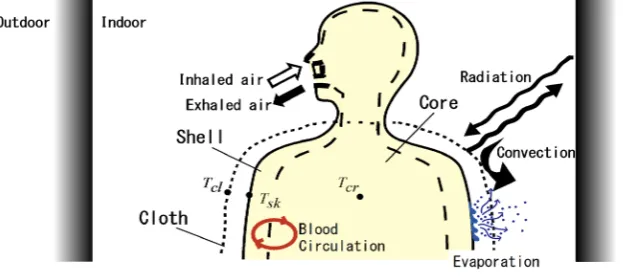
(1)Figure 1 shows the human body system. The human body exergy balance equation is also derived by com-bining the following three elements: a human body energy balance equation, a human body entropy balance eq-uation, and the environmental temperature (outdoor air temperature). The human body exergy balance equation is expressed as follows [1]:
[
]
[
]
[
]
Warm exergy generated by metabolism
Warm/Cool and wet/dry exergies of inhaled humid air
Warm and wet exergies of liquid water generated in the core by metabolism Warm/Cool and wet/dry exergies of the
+ + +
[
]
[
]
sum of the liquid water generated in the shell by metabolism and dry air to let the liquid water disperse
Warm/Cool radiant exergy absorbed by the entire surface of the skin and clothing Exergy consump + −
[
]
[
]
[
]
[
tionWarm exergy stored in the core and shell Warm and wet exergies of exhaled humid air
Warm/cool exergy of water vapor originating from sweat and the wet/dry exergy of humid air containing evaporated
= + +
]
[
]
[
water from sweat
Warm/cool radiant exergy discharged from the entire surface of the skin and clothing Warm/cool exergy transferred by convection from the entire surface of the skin
and clothing into t +
+
]
[
]
he surrounding air External work .
+
(2)
5.3. Calculation Method
The temperatures of the core, shell, and clothing under “steady-state” conditions are determined by the two-node model (human body energy balance model), which was originally developed by Gagge et al. [20]-[22]. The body-core and skin-layer temperatures under “unsteady-state” conditions can be calculated using a modified method based on the two-node model. This method enables us to conduct unsteady-state human-body exergy analyses [23]. In the modified method, the two-node thermal “energy” balance equations for the calculation of the human-body core, skin-layer, and clothing surface temperatures are numerically solved using the explicit fi-nite-difference method (forward differencing). We set the calculation interval to 1 minute to stabilize the calcu-lation in this study since such calcucalcu-lations become unstable when the time interval is equal to or greater than 2 minutes. The detailed procedure is described in [23][24].
5.4. Fixed Conditions
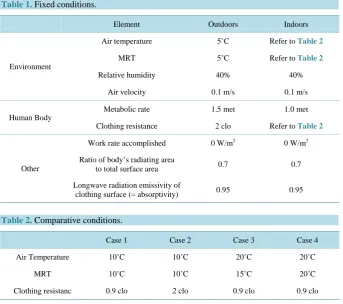
The fixed conditions of the experiment are shown in Table 1. The calculation considered a period of 240 mi-nutes, which assumed a transfer (e.g., commute to school or work) of 0 - 60 minutes in the outdoor environment and a period of 60 - 240 minutes within the indoor space (room). The metabolic rate and the amount of clothing were set to reflect the outdoor transit period and the period indoors.
5.5. Comparative Conditions
Four Cases are shown in Table 2 for comparison. In Case 1 and Case 2, both the room air temperature and the mean radiant temperature (MRT) were 10˚C. These values represent the ambient temperatures when heating was inactive. It was assumed that the occupants removed a coat (outside clothing) after entering the room space in Case 1, while they kept wearing the coat in Case 2. Both Case 3 and Case 4 considered a room air temperature of 20˚C and an MRT of 15˚C and 20˚C, respectively. The temperatures in both cases represent the activation of convective heating immediately after the occupants entered a room that has not been in use for a long period of time. Case 3 represents a building envelope that has a comparatively large heat capacity, whereas Case 4 represents a room where wood paneling was installed on the interior surfaces of a building envelope with a comparatively large heat capacity (such as concrete), or a wooden construction where the building envelope has a comparatively small heat capacity.
6. Results and Discussion
6.1. Body Temperature [image:5.595.143.487.422.726.2]The temperatures of the core, shell, and clothing are shown in Figures 2-4, respectively. During the time of the outdoor transfer, all four cases changed at the same rate in response to the external environment. In the indoor period in Figure 2, the core temperature in Case 1, Case 2, and Case 3 dropped, whereas that in Case 4 remained almost stable. In the indoor period in Figure 3, the shell temperature in Case 1, Case 2, and Case 3 dropped, whereas that in Case 4 rose gradually. It is considered in Case 4 that the shell temperature that dropped during
Table 1. Fixed conditions.
Element Outdoors Indoors
Environment
Air temperature 5˚C Refer to Table 2
MRT 5˚C Refer to Table 2
Relative humidity 40% 40%
Air velocity 0.1 m/s 0.1 m/s
Human Body
Metabolic rate 1.5 met 1.0 met
Clothing resistance 2 clo Refer to Table 2
Other
Work rate accomplished 0 W/m2 0 W/m2
Ratio of body’s radiating area
to total surface area 0.7 0.7
Longwave radiation emissivity of
clothing surface (= absorptivity) 0.95 0.95
Table 2. Comparative conditions.
Case 1 Case 2 Case 3 Case 4
Air Temperature 10˚C 10˚C 20˚C 20˚C
MRT 10˚C 10˚C 15˚C 20˚C
Figure 2. Core temperature [˚C].
Figure 3. Shell temperature [˚C].
Figure 4. Clothings temperature [˚C].
the outdoor transfer period started to recover during the indoor period. In the indoor period in Figure 4, the clothing temperature in Case 3, Case 1, and Case 2 dropped slightly, whereas that in Case 4 rose slightly. 6.2. Physiological Adaptation
Figure 5. Shell ratio [-].
Figure 6. Blood flow rate [L/(m2 h)].
2, and Case 3, prevented superfluous heat (warm exergy) release. However, in Case 4, it is thought that a mod-erate rate of heat release (discarding of entropy) occurred.
6.3. Exergy Balance
6.3.1. Input
The warm exergy production rate by the metabolism is shown in Figure 7. The fall from 8 to 6 W/m2 imme-diately after entering the room is influenced by the calculation condition, whereby the metabolic rate alters in-stantaneously (outdoor 1.5 met → indoor 1.0 met). In Case 1, the exergy production rate by the metabolism in-creased rapidly after about 80 minutes. This was because shivering started to prevent the core temperature from falling rapidly and thus, the warm exergy production increased. A warm radiant exergy input rate is shown in
Figure 8, which during the period in the room, decreased in the order Case 4 > Case 3 > Case 2 = Case 1, ac-cording to calculation conditions (Table 2, MRT).
6.3.2. Consumed
Figure 7. Warm exergy production rate by metabolism [W/m2].
Figure 8. Warm radiant exergy input rate [W/m2].
Figure 9. Human body exergy consumption rate [W/m2].
6.3.3. Stored
The rate of accumulation of warm exergy in the core is shown in Figure 10. This value was negative (i.e., de-creasing) in all cases immediately after entering the room. It is considered that the change in the rate of warm exergy accumulation from increasing to decreasing is due to insufficient production of warm exergy. This is something that is influenced by the change in the metabolic rate, when moving indoors from outside (outdoor 1.5 met → indoor 1.0 met), in the calculation condition.
The warm exergy accumulation rate in the shell is shown in Figure 11. The rate increased in all cases imme-diately after entering the room. It is thought that the clothing temperature also rose because the ambient temper-ature of the room was higher than that in the outdoor tempertemper-ature; hence, the rate of warm exergy flow from the shell to the clothing fell.
The rate of exergy accumulation in the core and shell recovered toward zero as the duration of the period in the room increased. It is thought that the complex interaction of the warm exergy production by shivering (Fig- ure 7), lifting of the shell ratio (Figure 5), and reduction of the blood flow rate (Figure 6) constitutes the physi-ological adaptation necessary for maintaining the constant core temperature, which is an important aspect in liv-ing organisms.
6.3.4. Output
The rate of warm radiant exergy output is shown in Figure 12. The decreasing order of Case 4 > Case 3 > Case 1 > Case 2 corresponds to the order of clothing temperature (Figure 4).
The rate of warm convective exergy output is shown in Figure 13. Unlike Figure 12, the decreasing order is Case 1 > Case 4 > Case 2 > Case 1, which corresponds to the decreasing order of the temperature difference between the clothing (Figure 4) and indoor air (Table 2).
Figure 10. Warm exergy accumulation rate in the core [W/m2].
Figure 12. Warm radiant exergy output rate [W/m2].
Figure 13. Warm convective exergy output rate [W/m2].
7. Conclusions
We performed an unsteady-state sensitivity analysis by using the unsteady-state two-node model, focusing on the relationships between behavioral adaptations and the pattern of the human body exergy balance. Using nu-merical analysis, we investigated the variation of thermal environment surrounding the human body when indi-viduals moved indoors after having been outside in winter.
1) This study confirmed that behavioral adaptations such as wearing clothing and activating an air-condi- tioning/heating unit could cause the rate of exergy consumption within a human body to decrease.
2) The mechanisms of “physiological adaptation” were clarified from the exergetic viewpoint to some extent. It was thought that the complex interaction of the warm exergy production by shivering, lifting of the shell ratio, and reduction of the blood flow rate constituted the physiological adaptation necessary for maintaining the con-stant core temperature, which was an important aspect in living organisms.
3) In the case of intermittent use room, it was suggested that greater thermal comfort and desirable behavioral adaptations, which decreased the consumption of fossil fuels, could be achieved for rooms used infrequently if interior wooden cladding was used in constructions with building envelopes that had a comparatively large heat capacity, or in cases of wooden constructions in which the building envelope heat capacity was comparatively small.
8. Future Work
consider the use of meteorological data, obtained at 1-minute intervals, for performing quantitative investiga-tions of the exergy resulting from adaptainvestiga-tions (physiological and behavioral) that may arise from daily (day and night) or seasonal (spring, summer, autumn, and winter) rhythms.
Acknowledgements
This work was supported by JSPS KAKENHI Grant Number 25289200.
References
[1] Shukuya, M. (2012) Exergy-Theory and Applications in the Built Environment. Springer, London, 69-79, 107-113, 305-335.
[2] Nicol, F., Humphreys, M. and Roaf, S. (2012) Adaptive Thermal Comfort: Principles and Practice. Routledge, Oxon and New York, 23-43.
[3] Humphreys, M., Nicol, F. and Roaf, S. (2016) Adaptive Thermal Comfort: Foundations and Analysis. Routledge, Oxon UK and New York, 296-318.
[4] Shukuya, M. (2015) An Overview of the Cyclic Process from Sensation to Adaptive Behavior—Interaction between Body Proper, Brain and Built Environment. Proceedings of AIJ Annual Meeting, Kanagawa, September 2015, 467-470. [5] Ala-Juusela, M. (2003) Heating and Cooling with Focus on Increased Energy Efficiency and Improved Comfort— Guidebook to IEA ECBCS Annex 37 Low Exergy Systems for Heating and Cooling of Buildings. VTT Technical Re-search Centre of Finland.
[6] Oshida, I. (1981) Solar Energy, NHK Books, Nippon Houso Kyoukai (Japan Broadcasting Association). (In Japanese) [7] Saito, M. and Shukuya, M. (2001) The Human Body Consumes Exergy for Thermal Comfort. International Energy
Agency (IEA) Energy Conservation in Buildings and Community Systems (ECBCS)-Annex 37, Low-Ex News No.2, 5-6.
[8] Saito, M. and Shukuya, M. (2001) Study on the Sensation of Tiredness Due to Cyclic Exposing to Air-Conditioned Rooms and Outdoors (Part 3. Analysis on the Exergy Consumption within a Human Body). Proceedings of AIJ Annual Meeting, Tokyo, September 2001, 445-446. (In Japanese)
[9] Isawa, K., Komizo, T. and Shukuya, M. (2002) Human-Body Exergy Consumption and Thermal Comfort. Internation-al Energy Agency (IEA) Energy Conservation in Buildings and Community Systems(ECBCS)-Annex 37, Low-Ex News No.5, 5-6.
[10] Shukuya, M. (2015) Indoor-Environmental Requirement for the Optimization of Human-Body Exergy Balance under Hot/Humid Summer Climate. Proceedings of the PLEA 2015, Bologna, 9-11 September 2015, No. 0280.
[11] Shukuya, M., Saito, M., Isawa, K., Iwamatsu, T. and Asada, H. (2010) Low Exergy Systems for High-Performance Buildings and Communities: Human-Body Exergy Balance and Thermal Comfort. Working Report of IEA-ECBCS- Annex 49.
[12] Iwamatsu, T. and Asada, H. (2009) A Calculation Tool for Human Body Exergy Balance. The International Energy Agency, Energy Conservation in Buildings and Community Systems Annex 49 Newsletter, No. 6, 4-5.
[13] Simone, A., Kolarik, J., Iwamatsu, T., Asada, H., Dovjak, M., Schellen, L., Shukuya, M. and Olesen, B.W. (2011) A Relation between Calculated Human Body Exergy Consumption Rate and Subjectively Assessed Thermal Sensation.
Energy and Buildings, 43, 1-9. http://dx.doi.org/10.1016/j.enbuild.2010.08.007
[14] Schweiker, M. and Shukuya, M. (2012) Adaptive Comfort from the Viewpoint of Human Body Exergy Consumption.
Building and Environment, 51, 351-360. http://dx.doi.org/10.1016/j.buildenv.2011.11.012
[15] Ala-Juusela, M. and Shukuya, M. (2014) Human Body Exergy Consumption and Thermal Comfort of an Office Work-er in Typical and Extreme WeathWork-er Conditions in Finland. Energy and Buildings, 76, 249-257.
http://dx.doi.org/10.1016/j.enbuild.2014.02.067
[16] Dovjak, M., Shukuya, M. and Krainer, A. (2015) Connective Thinking on Building Envelope—Human Body Exergy Analysis. International Journal of Heat and Mass Transfer, 90, 1015-1025.
http://dx.doi.org/10.1016/j.ijheatmasstransfer.2015.07.021
[17] Saito, M. and Shukuya, M. (2001) Exergy Balance of a Human Body Caused by Changes in Thermal Environment. Architectural Institute of Japan, Hokkaido Affiliate, 163-1666. (In Japanese)
[18] Tokunaga, K. and Shukuya, M. (2011) Human Body Exergy Balance Calculation under Un-Steady State Conditions.
Building and Environment, 46, 2220-2229. http://dx.doi.org/10.1016/j.buildenv.2011.04.036
2012.
[20] Gagge, A.P., Nishi, Y. and Gonzalez, R.R. (1973) Standard Effective Temperature—A Single Temperature Index of Temperature Sensation and Thermal Discomfort. Proceedings of the CIB Commission W45 Symposium, London, 1972, 229-250.
[21] Gagge, A.P., Stolwijk, J. and Nishi, Y. (1971) An Effective Temperature Scale Based on a Simple Model of Human Physiological Regulatory Response. ASHRAE Transactions, 77, 247-262.
[22] Gagge, A.P., Fobelets, A.P. and Berglund, L.G. (1986) A Standard Predictive Index of Human Response to the Ther-mal Environment. ASHRAE Transactions, 92, 709-731.
[23] Shukuya, M. (2015) Calculation of Human Body-Core and Skin-Layer Temperatures under Unsteady-State Condi-tions—For Unsteady-State Human Body Exergy Analysis. Internal Report of Exergy-Research Group, Technical Re-port, KIT/TCU, July 2015. http://www.researchgate.net/publication/284486168
![Figure 2. Core temperature [˚C].](https://thumb-us.123doks.com/thumbv2/123dok_us/7926284.748392/6.595.181.457.79.608/figure-core-temperature-c.webp)
![Figure 5. Shell ratio [-].](https://thumb-us.123doks.com/thumbv2/123dok_us/7926284.748392/7.595.184.447.84.437/figure-shell-ratio.webp)
![Figure 7. Warm exergy production rate by metabolism [W/m2].](https://thumb-us.123doks.com/thumbv2/123dok_us/7926284.748392/8.595.183.444.87.630/figure-warm-exergy-production-rate-metabolism-w-m.webp)
![Figure 12. Warm radiant exergy output rate [W/m2].](https://thumb-us.123doks.com/thumbv2/123dok_us/7926284.748392/10.595.186.465.79.433/figure-warm-radiant-exergy-output-rate-w-m.webp)
