Munich Personal RePEc Archive
Recent reforms of the tax and benefit
systems in the framework of flexicurity
Carone, Giuseppe and Stovicek, Klara and Pierini, Fabiana
and Sail, Etienne
European Commission -DG ECFIN
2009
Online at
https://mpra.ub.uni-muenchen.de/24862/
Occasional Papers are written by the Staff of the Directorate-General for Economic and Financial Affairs, or by experts working in association with them. The “Papers” are intended to increase awareness of the technical work being done by the staff and cover a wide spectrum of subjects. Views expressed do not necessarily reflect the official views of the European Commission.
Comments on the report would be gratefully received at the following addresses:
DG ECFIN - Unit B3
Directorate-General for Economic and Financial Affairs European Commission
Giuseppe Carone Rue de la Loi 200 B-1049 Brussels
E-mail: [email protected]
This paper exists in English only and can be downloaded from the website
http://ec.europa.eu/economy_finance/publications
A great deal of additional information is available on the Internet. It can be accessed through the Europa server (http://europa.eu )
ISBN 978-92-79-11255-3 doi: 10.2765/92751
European Commission
Directorate-General for Economic and Financial Affairs
Recent reforms of the tax
and benefit systems
in the framework of flexicurity
by G. Carone, F. Pierini, K. Stovicek and E. Sail
A
BSTRACT:
This paper provides an analysis of recent reforms of tax-benefit systems and a preliminary assessment of their impact on financial incentives to work and on labour supply. Many Member States have introduced policies to “make work pay” and have targeted low-wage workers with the aim of increasing their take-home pay. The labour market improvements observed over recent years are a sign that structural reforms have started to pay off. The reduction of disincentives to work and to hire, especially for the low-skilled, embedded in tax and benefit systems, a greater link with activation policies and a stronger reliance on preventive and targeted active labour market policies (ALMPs), and widespread wage moderation are all factors that have contributed to the structural improvement in the functioning of labour markets. Yet, despite these improvements, in view of the ageing of the population and rapid technological change, more progress is needed to further increase and maintain high levels of employment and participation rates, especially among female and older workers, and to reduce structural unemployment. Member States should continue along the line of reforms followed so far. The Commission has stressed the importance of a comprehensive strategy of labour market reforms ("flexicurity") that shift the focus from protection on the job to insurance in the market. These reforms would enable workers to move more smoothly from declining to expanding activities, thus easing tensions in the adjustment process, while ensuring adequate income support and responding to potential anxieties among European citizens.
Key words: Employment, Tax and benefit policies, Unemployment insurance, Labour supply, Flexicurity, Structural Reforms.
JEL classification: J01, J08, J20, J65, E24, J31, J32, H20, H53
A
CKNOWLEDGEMENTSThe authors are grateful to the members of the Labour Market Working Group (LMWG) and the Country Review Working Group (CRWG) attached to the Economic Policy Committee for having provided the information on reforms and useful comments. Comments and suggestions by colleagues in the Directorate-General for Economic and Financial Affairs, in particular by those in unit B3, as well as by other services of the Commission are gratefully acknowledged.
Secretarial support was provided by Agnieszka Budzinska.
3
TABLE OF CONTENTS
1 INTRODUCTION... 9
2 REFORMING TAX-BENEFIT SYSTEMS TO INCREASE LABOUR SUPPLY: CLOSING THE GAP WITH THE LISBON EMPLOYMENT TARGETS... 10
3 MAKING WORK PAY POLICIES... 13
3.1 Making Work Pay and Flexicurity ... 13
3.2 Making Work Pay in the Integrated Guidelines ... 14
3.3 The relevance of Making Work Pay policies ... 15
4 MAIN POLICY INSTRUMENTS IN THE FIELD OF TAXES AND BENEFITS... 16
4.1 Labour taxation ... 16
4.2 Unemployment benefits ... 16
4.3 Other welfare-related benefits ... 17
5 INDICATORS ON FINANCIAL INCENTIVES TO WORK (2001-2007)... 19
5.1 Measuring financial incentives to work ... 19
5.2 Net income replacement for unemployed persons (NRRs) ... 21
5.3 Implicit tax on returning to work: unemployment traps... 23
5.4 Implicit tax on returning to work: inactivity traps... 29
5.5 Implicit tax on increasing work effort: low wage traps... 32
6 RECENT REFORMS IN TAX AND BENEFIT SYSTEMS... 32
6.1 Fighting benefit dependency and improving employability ... 33
6.1.1 Unemployment insurance ... 33
6.1.2 Means-tested benefits ... 34
6.1.3 In-work benefits... 35
6.1.4 Sickness and disability... 35
6.1.5 Family-related schemes ... 36
6.2 Reviewing the incentives to work embedded in the tax system ... 37
6.3 Modernising job protection ... 38
7 TRENDS IN LABOUR MARKET POLICY EXPENDITURE... 42
ANNEX 1: FLEXICURITY RELATED COUNTRY'S SPECIFIC RECOMMENDATIONS AND POINTS TO WATCH... 47
ANNEX 2: MAIN FEATURES OF RECENT TAX AND BENEFIT REFORMS - BASED ON LABREF... 51
LIST OF TABLES
Table 1 – Overview Table...8
Table 2 - Lisbon employment targets: required job performance...10
Table 3 - Structural Indicators on financial incentives to work, 2007...25
Table 4 - Tax wedge on labour for low-wage workers (67% of AW) and its components...26
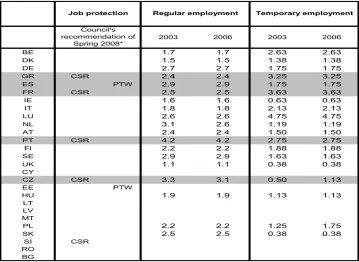
Table 5 – Employment protection legislation...40
Table A1 - Unemployment trap (1st month of unemployment)...74
Table A2 - Net replacement rates for unemployed persons (1st month of unemployment)...75
Table A3 - Inactivity trap...76
Table A4 - Inactivity trap...77
Table A5 - Low wage trap...78
Table A6 - Low wage trap...79
Table A7 - Total tax wedge on labour (including soc. sec. employers)...80
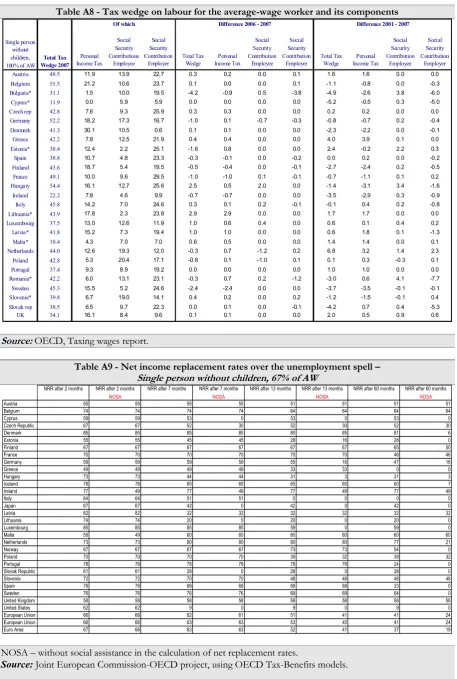
Table A8 - Tax wedge on labour for the average-wage worker and its components...81
Table A9 - Net income replacement rates over the unemployment spell –...81
Table A10 - Net income replacement rates over the unemployment spell –...82
Table A11 - Income replacement rates over the unemployment spell –...82
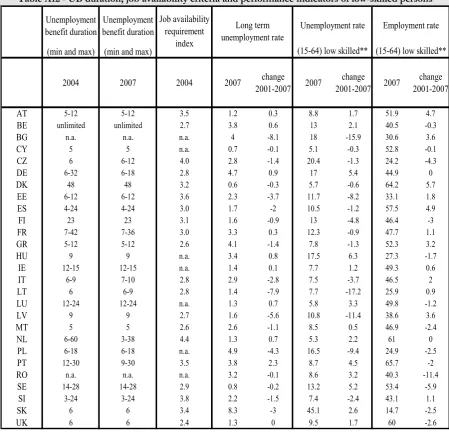
Table A12 - UB duration, job availability criteria and performance indicators of low-skilled persons...83
Table A13 - Main features of the unemployment insurance benefits, 2007 (for a 40-year-old single worker without children, with a 22-year employment record)...84
LIST OF GRAPHS Graph 1 - Progress towards the Lisbon targets: total and female employment rate, 2007...11
Graph 2 - Progress towards the Lisbon targets: total and older workers employment rate, 2007...12
Graph 3 - Net income replacement rates over different periods within the unemployment spell...22
Graph 4 - Components of unemployment trap in 2001 and 2007 (1st month of unemployment)...27
Graph 5 - Components of unemployment trap in 2001 and 2007 (1st month of unemployment)...28
Graph 6 - Components of inactivity trap in 2001 and 2007...30
5
SUMMARY AND MAIN FINDINGS
This paper provides an analysis of recent reforms of tax-benefit systems and a preliminary assessment of their impact on financial incentives to work and on labour supply.
Recent years have seen a substantial fall in unemployment (from about 10% in 1998 to reach 6.9% in July 2007), accompanied by increases in the employment rate (from 59.3% to about 64.8% in the first quarter of 2007) and participation rates (70.5% in the first quarter of 2007).
However, despite the progress made, Member States still need to reinforce or speed up reforms in various areas.1 Given the relative under-utilisation of labour resources in
many European countries and the need for dealing with population ageing, the Council recommendations of 14 May 2008, issued to all Member States within the framework of the Growth and Jobs Strategy (Lisbon Strategy), aimed at improving the economic and the labour market performance.
A sustained reform activity has been undertaken over recent years, largely aimed at improving the labour utilisation. A central part of many recent tax and welfare reform strategies has been to reduce benefit dependency by making work an economically attractive and rewarding option compared with welfare and by encouraging beneficiaries to actively seek work. Many Member States have introduced policies to “make work pay” and have targeted low-wage workers with the aim of increasing their take-home pay. These policies can be successful in raising employment and cutting poverty. But, as they are costly and must be financed by increased taxes elsewhere or cuts in public spending, they need to be well targeted and implemented carefully, and their interaction with social benefits has to be taken into account.
The analysis of the interaction of tax and benefit provisions and of their recent developments shows that Member States have undertaken a series of reforms since the re-launch of the Lisbon strategy in 2005. Some progress has been made in helping unemployed or inactive people to get a job. Some countries have reduced both the level and duration of unemployment benefits, notably Germany, the Netherlands, Hungary and France. However, looking at the indicators of financial incentives to work, the overall impression is that many of the financial measures adopted in the EU have addressed mainly the part of the tax-benefit system - such as reducing tax rates or social security contributions on low-wages to make work pay and to reduce the cost of labour - that encounters less political resistance. They also show remaining risks of low-wage traps and unemployment/inactivity traps for the unskilled or low income earners in many Member States. The increasing use of in-work benefits is making it more attractive to work relative to non-employment, although often with substantial budgetary impact and at the cost of introducing high effective marginal tax rates at a higher level of earnings. Many recent reforms that do not appear to directly target financial incentives to work may nonetheless have improved the overall incentive structure of the benefit system. In particular, this is the case for reforms which have aimed at enhancing the enforcement of benefit systems or at tightening eligibility to some benefits. Work-availability conditions have been tightened in a number of countries. These reforms have typically reduced the scope of the unemployed to reject job offers because of occupational incompatibility with the previous job, pay and/or workplace location. Tighter work-availability conditions
1
have often gone hand-in-hand with increasing and more systematic and effective application of sanctions for refusal of suitable job offers. These reforms are very promising as they could go a long way towards reducing disincentive effects. Indeed, as also recognised in the Integrated Guidelines, there are ways other than reducing out-of-work benefits to encourage people to out-of-work, in particular activation policies (effective individualised help with job search and close monitoring of job-seeking activities, although they can be costly) and mutual obligations (the requirement to take any suitable work).
Many countries have enacted measures that increase the access to more flexible working time arrangements for both employers and employees (such as working time accounts, part-time, opening clauses allowing deviation from working time schedules agreed in collective agreements). While it is too early to evaluate their overall impact, it is important to underline that the more frequent use of opening clauses has increased the flexibility in the use of the labour force. More flexibility at the workplace can also be achieved by revising company-level legislation (e.g. reviewing the legislation restraining the opening hours of labour intensive sectors, as recently done for the retail sector in Germany, Belgium and Slovenia).
A better reallocation of labour could be achieved through reforms of the labour market and of the welfare state that, in line with the flexicurity approach2, shift the focus from
protection of workers in the same job for their entire lifetime to protection of workers in the market. Measures increasing flexibility at the margins, through easier access to part-time and temporary forms of work, were enacted by many countries. The reforms of employment protection legislation (EPL) enacted so far have contributed to the emergence of a dual regime, as the increase in the labour market reallocation was achieved mainly with the liberalisation of temporary contracts while leaving almost unchanged the legislation for those workers with open-ended contracts. These reforms may have contributed to sustaining labour demand in periods of uncertain macroeconomic conditions by lessening the impact on firms’ hiring and firing practices. On the negative side, one should consider that in some instances partial easing of the employment protection legislation governing temporary contracts, combined with overly-strict protection of permanent contracts, resulted in a surge in the use of temporary contracts in several countries. It also divided the labour market into segments providing different levels of protection. Thus, there is room to rebalance workers' protection in the labour market by revising the legislation for workers employed under permanent contracts.
2
7
Conclusions
Although good macroeconomic fundamentals may have played a role, the labour market improvements observed so far are also a sign that structural reforms have started to pay off. In addition to a liberalisation of the labour market (although partial and imperfect), the reduction of disincentives to work and to hire, especially for the low-skilled, embedded in tax and benefit systems, a greater link with activation policies and a stronger reliance on preventive and targeted active labour market policies (ALMPs), and widespread wage moderation are all factors that have contributed to the structural improvement in the functioning of labour markets.
Yet, despite these improvements, in view of the ageing of the population and rapid technological change, more progress is needed to further increase and maintain high levels of employment and participation rates, especially among female and older workers, and to reduce structural unemployment. Table 1 provides a synthetic view of the current country-specific recommendations and of the functioning of tax-benefit systems on the basis of the most recent available indicators. It shows different combinations of flexibility and security, with countries like Denmark and Netherlands featuring a rather flexible employment relation interplaying with a relatively generous social protection system but also rather strict job-search obligations and developed active labour market policies, and other countries characterised by stricter employment relation but relatively less generous social safety net.
Member States should continue along the line of reforms followed so far. The Commission has stressed the importance of a comprehensive strategy of labour market reforms ("flexicurity") that shift the focus from protection on the job to insurance in the market.3 These reforms would enable workers to move more smoothly from declining to expanding activities, thus easing tensions in the adjustment process, while ensuring adequate income support and responding to potential anxieties among European citizens. Policies that enhance the flexibility of labour markets and promote higher labour market participation, such as reforms in the tax-benefit systems, effective activation measures and employment services, together with investment in human capital and an efficient use of policies such as training and lifelong learning that increase the adaptability to change, will contribute to improving the functioning of the EU labour markets as well as enhancing the adjustment capacity of the euro area and thus reap the full benefits of EMU.
Policies should also be evaluated rigorously in order to make employment programmes cost-effective. A high priority should be assigned to identifying and disseminating best practice in this area and to limiting the budgetary impact of policy measures.
3
Table 1 – Overview Table
MS
Covering at least one of the 4 main
policy areas
Flexicurity Flexicurity Flexicurity
Net Income Replacement (single 67% average wage) Net Income Replacement (single 67% average wage) Net Income Replacement (single 67% average wage; including social assistance)
Implicit tax on returning to work - spouse with 2 children
Tax burden on low-wage EPL highly restrictive EPL highly restrictive Loose availability
criteria & job-search obligations
2007 2007 2007 2007 2007 2006 2006 2004
Higher than Higher than Higher than METR higher than Tax wedge higher than index for regular employment index for temporary contracts index
80% 80% 60% 40% 40% (0-6) (0-6)
after 2 month after 1 year after 5 years equal to or
higher than
equal to or higher than
equal or lower than
2,5 2,5 3
AT CSR x
BE CSR CSR x x x x x
BG CSR n.a. n.a. n.a. n.a. n.a. n.a. n.a.
CZ CSR CSR x x x
CY CSR n.a. n.a. n.a.
DK x x x x
DE CSR CSR CSR x x x x
EE PTW PTW n.a. n.a.
ES PTW PTW x x
EL CSR CSR CSR x x
FI x
FR CSR PTW PTW CSR x x x x
HU PTW PTW x n.a.
IE x n.a.
IT PTW x x x
LT CSR x n.a. n.a. x
LU PTW x x x n.a.
LV CSR x x x n.a. n.a. x
MT CSR CSR x n.a. n.a. x
NL CSR x x x x x x
PL CSR CSR x x n.a.
PT CSR CSR x x
RO PTW n.a. n.a. n.a. n.a. x n.a. n.a. n.a.
SE PTW PTW PTW x x x x
SI CSR x n.a. n.a.
SK x
UK x
Flexicurity related CSRs or PTW Indicators of tax-benefit systems and EPL
Benefit system Taxation system Employment protection legislation-EPL
9
1 INTRODUCTION
This paper provides an analysis of recent reforms in tax-benefit systems and a preliminary assessment of their impact on financial incentives to work and on labour supply. The analysis is based on information on most recent reform measures provided by the members of the EPC-Labour Market Working Group (LMWG) in August 2008. In addition, the paper presents the latest available data on existing comparable cross-country indicators of the financial incentives to work, which have been calculated within the framework of a joint Commission (EMPL-ECFIN-TAXUD-EUROSTAT)-OECD research project. By combining information on reform measures with comparable cross-country indicators, it is in fact possible to take a first step towards analysing their possible effects and to gauge whether they are having a material impact on growth and employment.
The reform activity in 2008 largely confirms the importance given to the reduction of benefit dependency by making work an economically attractive and rewarding option relative to welfare and by encouraging beneficiaries to actively seek a job. Flexicurity, which had come to the forefront of the European reform agenda in 2007, has been at the centre of the policy debate this year, and its making-work-pay dimension continued to be a key element of national reform activity.
Some further progress has been made to help unemployed or inactive people get a job, mainly through reforms of the tax and unemployment benefit systems and more effective active labour market policies. Reforms which aimed at enhancing the enforcement of benefit systems or at tightening the eligibility to some benefits also contributed to improve the overall incentive structure of the benefit system. Work-availability conditions in particular, have been further tightened in a wide number of countries in 2008. These reforms have typically reduced the scope for the unemployed to reject job offers because of occupational incompatibility with the previous job, pay and/or workplace location, and have often gone hand-in-hand with more systematic and effective application of sanctions for refusal of suitable job offers.
The remainder of this paper is organised as follows. Section 2 motivates the need for reforming tax-benefit system in order to increase labour supply and employment. Section 3 illustrates the topic of "making work pay" policies and puts it in the context of flexicurity and of the integrated guidelines for growth and jobs. Section 4 illustrates the main policy instruments in the field of taxes and benefits. Section 5 presents the latest available data on quantitative indicators on progress towards removing financial disincentives to work via reforms to both tax and benefit systems. In particular, it presents the estimates for the implicit tax on returning to work (Marginal Effective Tax Rates - METRs) in 2007, which are calculated in a joint OECD-Commission project. Section 6 considers the most recent reforms in the field of tax and benefit systems, based on the information provided by the Members of the EPC-Labour Market Working Group (LMWG) in September 2008. Section 7 comments upon public expenditure on labour market policy interventions across countries and over time.
2 REFORMING TAX-BENEFIT SYSTEMS TO INCREASE LABOUR SUPPLY: CLOSING THE GAP WITH THE LISBON EMPLOYMENT TARGETS
Despite the overall good performance of labour markets over most recent years, employment and labour force participation rates remain rather low in the EU, and particularly so in the euro area, especially among women and older workers. Policy-makers have started to address this problem with a combination of measures to encourage both job creation (labour demand) and labour participation (labour supply). Removing disincentives to entering and staying in the labour market is an important element of the strategy for increasing labour supply, and therefore for achieving the EU employment targets and for ensuring the long-term sustainability of public finances, in view of the looming ageing of the EU population.
Progress made between 2001 and 2007 towards the Lisbon employment targets (overall, female and older workers employment rate of respectively 70%, 60% and 50% at the
horizon 2010) is shown in Table 2. In the period under consideration, the overall EU
[image:13.595.80.512.360.540.2]employment rate rose by about 3 percentage points, to reach 65.4% in 2007.
Table 2 - Lisbon employment targets: required job performance
LISBON PROJECTIONS 2001 2007 2010 Pro memoria
2008-2010 Annual
Total (15-64) 1998-2000 2001-2007
Employees (15-64) (000) 200385 214673 234491 19818 3.0% 1.4% 1.2%
Employment rate (%) 62.5 65.4 70
Population (15-64) (000) 320435 328307 334987
Older workers (55-64 ) 2001 2007 2010 1998-2000 2001-2007
Employees (55-64) (000) 19597 25795 30375 4580 5.6% 1.8% 5.3%
Employment rate (%) 37.5 44.7 50
Population (55-64) (000) 52312 57721 60750
Female 2001 2007 2010 1998-2000 2001-2007
Employees (15-64) (000) 87407 96009 100294 4285 1.5% 2.2% 1.6%
Employment rate (%) 54.3 58.3 60
Population (15-64) (000) 160935 164596 167157
New Jobs Required
Employment growth
New Jobs
New Jobs
Source:Commission services, DG ECFIN calculation using Eurostat figures (Europop2004 demographic projections)
Only six countries (Denmark, Sweden, United Kingdom, Cyprus, Finland and the Netherlands) exceed in 2007 the three employment targets set under the Lisbon Strategy, while five countries stood out as being particularly far from the three targets (Hungary, Italy, Greece, Poland and Malta) (see Graphs 1 and 2 hereafter).
Despite considerable recent improvements, in 2007 the employment rate of older workers stood at 44.7%, still far from the 50% Lisbon target. The target had been already exceeded by 12 Member States in 2007 (Denmark, Germany Ireland, the Netherlands, Portugal, Finland, Sweden, the United Kingdom, Cyprus, Estonia, Lithuania and Latvia).
Graph 1 - Progress towards the Lisbon targets: total and female employment rate, 2007
Note: EU objective 2010: 70% for total employment rate, 60% for female employment rate. Source: Commission services
Staying at data from 2007, reaching the 70% overall employment target by 2010 would require about 20 millions additional jobs to be created – equivalent to an employment growth between 2008-2010 of 3% per year, far above the growth of both the most recent period and the historical average.
Yet, after several years of favourable growth and of good performance in terms of employment creation, economic conditions have deteriorated rapidly in 2008, mainly due to the impact of a financial crisis which came on top of a correction of in-house prices in many economies. The financial crisis deepened and broadened in autumn 2008 and started to negatively impact economic growth and labour market performance during the third quarter of 2008.
Labour market performance is expected to further deteriorate sharply in 2009. Employment is expected to increase by a meagre ¼ million jobs in the EU and ½ million in the euro area over the period 2009-2010, compared with the 6 million new jobs that were created in 2007-2008 in the EU. As a result of the decline in employment, the unemployment rate is expected to increase by about 1 percentage point in the next two years, to some 8% in the EU and 8.75% in the euro area by 2010, with increasing
differences across Member States.4
4
Source: Commission autumn forecast, October 2008.
On the other hand, the increase in the participation rates observed over the last months of 2008, despite the strong headwinds faced by the European economy, seems to go in the opposite direction of what one would expect from a "normal" cyclical reaction of labour supply to a deterioration of the employment opportunities. Available evidence suggests in fact that the labour market has become more flexible and adaptable due to recent reforms. In particular, the reforms of the tax and benefit systems and the less easy access to early retirement seem to have reduced the elasticity of the labour supply to cyclical developments. The availability to work of those less attached to the labour market has in fact increased as the employment opportunities of the main earner in the household deteriorate and family incomes fall. A decline in the labour demand amid an unchanged, if not increasing, labour supply could soon bring the unemployment rate to unprecedented levels. Yet, it may relatively fast revert towards the pre-shock levels when the economy recovers.
Graph 2 - Progress towards the Lisbon targets: total and older workers employment rate, 2007
13
3 MAKING WORK PAY POLICIES
3.1 Making Work Pay and Flexicurity
A broad consensus has emerged that labour markets should be adaptable to technological change and increasing heterogeneity of the workforce, and that the failure to reform is a source of poor economic performance. Labour markets should create jobs, not distort the incentives to supply labour, promote the reallocation of labour between sectors and occupations and, especially in periods of rapid change, be able to respond to the demand of security coming from risk-adverse individuals, particularly from those at high risks of
non-employment. Europe is thus confronted with a double constraint, symbolized by the
flexibility-security nexus.
Recent policy debate at European level has concluded that flexibility and security, rather than being two conflicting dimensions of a market economy, can be part of comprehensive labour market and welfare state reform strategies. These strategies should help reconcile workers' demand for protection against unemployment and income risks with the need of modern firms to respond quickly to - and anticipate - swings in consumers' preferences and the challenges created by technological progress and globalisation. By combining new forms of flexibility and security, these strategies can help increase adaptability, employment and social cohesion. They have become a key component of the renewed Lisbon Strategy for Growth and Jobs.
The move towards a flexicurity approach has had important implications in the policy
debate. First of all, it is helping develop comprehensive rather than partial approach to
reforms of the welfare state. The recognition of the advantages of more flexible European
labour markets has also led to a rethinking of the design of employment and social
policies. The focus has shifted from measures of unconditional basic income support to measures based on the right and duties of every citizen to receive support if she/he falls
in the condition of need (right and duties principle). Finally, it has been acknowledged
that partial labour market liberalisations have increased the inequality in the treatment of
workers with similar characteristics. A better governance of the labour market
relationship requires reforms of the unemployment insurance system and of the dismissal rules aimed to limit the differences in the treatment of workers with similar characteristics but having different types of contracts.
The Commission and the Member States have reached a consensus that flexicurity
policies can be designed and implemented across four policy components5:
– Flexible and reliable contractual arrangements through modern labour laws, collective agreements and work organisation;
– Comprehensive lifelong learning strategies to ensure the continual adaptability and employability of workers, particularly the most vulnerable;
– Effective active labour market policies that help people cope with rapid change, reduce unemployment spells and ease transitions to new jobs;
5
– Modern social security systems that provide adequate income support, encourage employment and facilitate labour market mobility.
One of the key areas of reforms within the flexicurity approach is indeed to attract more people in the labour market and to make the underlying incentive structure in the tax and benefit systems supportive to employment. The aim of this policy objective, known as 'making work pay', is to modernise tax and benefit systems so that they provide effective incentives to participate in training, take up jobs and remain in work, thereby shifting the focus away from passive income support towards active measures designed to get people back to work. Policies to 'make work pay' have largely targeted low-wage workers with the aim of increasing their take-home pay. Given that the labour supply of low-wage workers is estimated to be relatively more elastic, especially with reference to the decision of working/not working (the so-called 'extensive margin'), such targeted measures have become increasingly popular as they may have not only a redistributive property but also contribute to enhance labour market efficiency.
3.2 Making Work Pay in the Integrated Guidelines
Policies to improve financial incentives to work (or to "make work pay") are a key feature of the Integrated Guidelines (see box below) and were for many years central to the Broad Economic Policy Guidelines and to the Employment Guidelines. A widespread consensus has emerged on the fact that policies in the field of tax and benefit systems (including unemployment insurance, social assistance, social security, incapacity/disability or sickness benefits) are key ingredients to mobilising more people into employment, although clearly remaining only one element of the comprehensive set
of measures needed to raise labour utilisation and improve labour market performance.6
Improving financial incentives to work and raising the employment rates of older workers – key elements in the Integrated Guidelines
Increasing labour force participation, reducing unemployment and increasing employment have been identified as key challenges by a majority of the Member States.
The importance of improving financial incentives to work is recognised in the following guidelines:
• Guideline 2 indicates that "Member States should, in view of the projected costs of ageing populations, reform and reinforce pension, social insurance and healthcare systems to ensure that they are financially viable, socially adequate and accessible and take measures to increase labour market participation and labour supply amongst women, young and older workers, and promote a life-cycle approach to work in order to increase hours worked in the economy".
• Guideline 5 states that "Member States should pursue labour and product markets' reforms that at the same time increase the growth potential and support the macroeconomic framework by increasing flexibility, factor mobility and adjustment capacity in labour and product markets. In particular, Member States should renew impetus in tax and benefit reforms to improve incentives and to make work pay …"
• Guideline 18 calls for the Member States to "… promote a life-cycle approach to work through […] support of active ageing, including … adequate incentives to work and discouragement of early retirement and modern social protection systems, including pensions and healthcare, ensuring their social adequacy, financial sustainability and responsiveness to changing needs, so as to support participation and better retention in employment and longer working lives".
6
15
• Guideline 19 calls for the Member States to "… ensure inclusive labour markets, enhance work attractiveness, and make work pay, through … continual review of the incentives and disincentives resulting from the tax and benefit systems, including the management and conditionality of benefits and a significant reduction of high marginal effective tax rates, notably for those with low incomes, whilst ensuring adequate levels of social protection …".
• Guideline 22 calls for the Member States to "… ensure employment-friendly labour cost developments and wage-setting mechanisms, by … reviewing the impact on employment of non-wage labour costs and where appropriate adjust their structure and level, especially to reduce the tax burden on the low-paid".
3.3 The relevance of "Making Work Pay" policies
In this section the economic arguments on the importance of financial incentives to work
are briefly recalled.7
The need to reconcile poverty alleviation with labour market efficiency is an old debate
in the field of labour economics and also in the political debate.8 There is clearly a case
for income support programs due to risk aversion, liquidity constrained agents and the lack of private insurance in this area. Unemployment insurance programmes help recipients make efficient job choices and sustain their consumption during a period of
financial stress.9 They are also particularly relevant in the context of increasing global
competition and technological change. Within this framework, there is a need for a policy design that is conducive to the full realisation of the opportunities offered by deeper international economic integration, while at the same time aiming at minimising unavoidable adjustment costs. The challenge here is about how to create well-designed policies, matching flexibility with fairness, which help to equip people with the skills, support and incentives they need to succeed in a changing world. A well designed social security net requires also a better conditionality and control over benefits and eligibility (employment services and search effort by the non-employed), in order to avoid disincentive effects.
Whether the current welfare systems and their interactions with the tax system provide sufficient employment incentives, in particular for unskilled and low wage workers, has become an increasingly relevant policy issue. A central part of many recent tax and welfare reform strategies is to reduce benefit dependency by making work an economically attractive and rewarding option relative to welfare. In combination with measures to improve people’s chances of finding employment and working the desired hours, maintaining and improving financial work incentives is an essential component of efforts to improve the functioning of labour markets. In-work benefit programmes are one of the tools that EU countries have used more recently in order to raise the financial returns to work. In order to minimise the budgetary impact of these measures (and avoid deadweight costs), a well-designed targeting has proved to be essential. In order to help the transition from welfare to work, in-work benefits also need to be embedded in more comprehensive strategies, including adequate and affordable child care, efficient public
7
For a detailed analysis see Carone G. and A. Salomäki (eds.) (2005), “Indicators and Policies to Make Work Pay. Proceedings of the workshop organised by the European Commission (DG ECFIN)”, European Economy, Special Reports No. 2, European Commission, and the report on "Making Work Pay" of the Expert Group of Employment Committee (2003).
8
A clear discussion of the trade-off between equity and efficiency related to redistributive transfers (the so-called "leaky bucket" effect) is in Okun's book published in 1970. For a critical view see R. M. Blank (2002), "Can equity and efficiency complement each other?", NBER, WP. No 8820.
9
employment services and effective active labour market policies (especially job-search assistance or targeted training programmes tailored to local labour market needs).
It must also be stressed that the incentive structure encompasses a broad range of features beyond the financial gains from work, such as eligibility rules for benefits, their duration, related activation and monitoring measures, as well as the enforcement of the systems. In order to ensure incentives and assistance to work, income support should be accompanied by an appropriate set of rights and duties.
4 MAIN POLICY INSTRUMENTS IN THE FIELD OF TAXES AND BENEFITS
Interventions in the field of taxes and benefits are key instruments to improve the financial attractiveness of work relative to welfare and to encourage beneficiaries to actively seek a job. The main areas for policy action can be grouped as follows.
4.1 Labour taxation
Taxes on labour put a wedge between product wage paid by firms and the consumption wage received by employees. Their effect on labour demand and labour supply depends on whether and to what extent the tax burden increases the total labour cost for the employer or is transferred on to the worker, translating into a lower net wage. When
increasing the total labour cost, taxes on labour (notably in the form of employer's social
security contributions) tend to reduce labour demand. On the labour supply side, taxes
levied on wages (both direct taxation on labour income and employee's social security
contributions) reduce the net income and drive a wedge between the marginal product
of labour and the marginal value of leisure. They thus tend to discourage the availability to work, especially at the lower end of the wage scale.
Typical employment-friendly tax reform packages involve tax-wedge reductions for the low income, including the extension of the tax-free range of income, coupled with tax credits and rebates of social security contributions for low-wage earners. Cuts in employers' social security contributions are also commonly used to boost labour demand and create incentives to hire specific target groups, especially among the groups with the highest difficulties to join the labour market. The success of these policy measures is heavily dependent upon their design and in particular the capacity to minimising the risk of substitution effects (where supported employment creation replaces non-subsidised jobs) or deadweight costs (supporting hires that would have in any cases taken place) and their limit lies in their usually short-term, non-structural nature. To overcome the disincentive effects embedded in joint-income tax systems for second-earners in a couple, and thus improve female labour market participation, Member States are also increasingly introducing the possibility to opt for split family taxation or for individual taxation on incomes. In countries operating joint income tax systems, second earners are in fact likely to face above-average income tax burdens when moving into work as the marginal tax rate is pushed up by the earnings of their partner. This mechanism is particularly relevant in the case of low-wage work.
4.2 Unemployment benefits
17
duration) may put upwards pressure on wages pushing up the minimum wage workers are ready to accept (so-called "reservation wage"). In both cases they worsen the employment chances of those looking for a job. On the other hand, as long as subsidised job-search allows job-seekers more time to find a better job, it can improve the matching between unemployed and vacancies, by allowing job seekers more time to find a job which matches their skills and thus maximising their productivity.
Interventions on the level and duration of benefits nevertheless do not suffice to
evaluate the capacity of the tax and benefit system to make work pay relative to staying on unemployment. The incentive structure of the benefit system encompasses in fact a broader range of features that do not appear to directly targeting the financial gains from
work, such as eligibility and work-availability conditions, related activation and
monitoring measures as well as the enforcement of the system. There is increasing
empirical evidence that making the disbursement of unemployment benefits strictly conditional upon complying with eligibility rules (e.g. employment record needed to have access to benefits; waiting periods before unemployment benefits are paid out), work-availability conditions and job-search requirements, can offset the disincentive effects linked to these scheme and have a stronger impact on the decision to work than the level of benefits in itself. Also, since the threat of losing benefits if a job offer is not accepted tends to raise the incentive to work, a properly functioning system of
monitoring in conjunction with sanctions should restore search incentives most
effectively, thus allowing for higher benefits than otherwise. In order to ensure incentives and assistance, unemployment income support should therefore be accompanied by rights and duties. Since monitoring usually takes place through the public employment services (PES), the quality of services provided by the employment offices and the development of adequate synergies between the unemployment benefit providers and the
PES are central to ensuring the enforcement of the job-search criterion.10
4.3 Other welfare-related benefits
Welfare-related schemes also include in-work benefits, means-tested benefits and family-friendly policies. Besides these, other relevant policy fields the design of which can contribute to increasing the financial incentives to work are disability and sickness schemes.
In-work benefit programmes are designed to create incentives to take up low-paid work,
by raising the income from work above out-of-work income levels. EU countries have increasingly used these policy tools over the last years in order to raise the financial returns to work and to support the most recent reforms in the unemployment benefit systems. Their effects on the labour market can be diverse, also in the light of the great variety of measures they can include. In particular, since in-work benefits are phased-out as incomes increase, they may result in high marginal tax rates that generate low-wage traps in the low income/productivity segment and may create an incentive to resort to the shadow economy.
In most countries, jobless persons who are searching for a job but are not eligible to unemployment benefits or who have exhausted their period of unemployment insurance
can receive means-tested benefits. This is the typical situation of low-income families
where one or both the spouses have never worked or are not entitled to unemployment
10
benefits or their eligibility to unemployment insurance has expired, and they thus only qualify for social assistance. Means-tested benefits (minimum-income/social assistance benefits, housing, etc.) granted to non-working families or individuals, often with the primary aim to reduce child poverty, can give rise to strong work disincentives, especially for lone parents, because of the cash benefit withdrawal which follows a transition from labour market inactivity to employment. Empirical research shows that the policy design of out-of-work benefits can play an even bigger role on work attractiveness than the level of benefits in itself. To partly overcome the disincentive effects embedded in these schemes, means-tested benefits are increasingly made conditional upon the participation of benefit recipients in activation and workfare measures (i.e. the requirement that a benefit recipient participate in some work activity/labour market programmes in exchange for benefits). This is particularly relevant, as the duration of means-tested social-assistance is generally very long and can create strong benefit dependency.
Family-related benefits broadly include: family allowances, child benefits/tax credits
and childcare benefits. Child benefits are of relevance for the determination of financial incentives to work in those few countries where they are related to the level of the taxpayer's (or family's) income. This is the case in Italy and UK, where means-tested child benefits may contribute to high average effective tax rates distorting female participation incentives. In most other countries, child benefits are universal, without any means-testing, and are paid for each dependant child. In these cases, the child benefit does not in itself create a problem for incentives to work but it may affect the level of earnings up to which social assistance is available to families with children. Given that numerous types of social transfers are specifically targeted towards low-income households, especially if children are present, parents in these households are particularly likely to face adverse work incentives.
Finally, there is a wide consensus in the economic literature that badly designed
disability schemes have played an important role in distorting the incentives to
participate in the labour market. During the past decades, disability pensions awarded on the basis of labour market considerations were often offered to redundant or unemployed elderly workers in response to severe shocks in the labour market. More recently, this trend has been reversed and new employment and support allowances have started to be introduced, requiring incapacity claimants to have an active engagement with employment advisors and the construction of personal paths with the goal of facilitating
people from inactivity to work. The sickness systems can also become a bridge to
19
5 INDICATORS ON FINANCIAL INCENTIVES TO WORK (2001-2007)
This section presents the latest estimates for quantitative indicators aimed at measuring progress towards the reduction of financial disincentives to work via reforms to both tax
and benefit systems.11 Indicators of the implicit tax on retuning to work or METRs have
been developed in co-operation by the Commission and the OECD using a micro-simulation model for hypothetical households covering different standardized in- and out-of-work cases, different family types (single/married) and different wage levels. Since these indicators refer to the situation of tax and benefit systems in 2007, they do not incorporate the most recent reform measures as reported in the following section. However, given that these indicators have been collected since 2001, they can provide a useful basis for monitoring and commenting upon progress in the field of financial incentives to work over the last years. Drawing upon the 2008 Commission "Strategic report on the renewed Lisbon Strategy for Growth and Jobs: Keeping up the pace of change", the indicators are shown in parallel to the tax-benefit related country's specific recommendations (CSRs) and points to watch (PTW) (see Table 3). For full text of the CSRs and PTW see Annex 1.
5.1 Measuring financial incentives to work
The design of tax and benefit systems (individually and through their interaction) has an influence on all labour market transitions, that is labour market participation, the schooling/work choice, the early retirement decision and the duration of unemployment. More specifically, taxes and welfare schemes almost inevitably create a potential distortion in some segments of the labour market (notably persons with low earnings prospects and second earner in a couple) in the form of disincentives to work, thereby reducing the potential labour supply in terms of participation and/or hours worked. The impact of the tax and benefit systems is particularly relevant for low-skilled persons
(with low earning prospect) and potential second earner in a couple (usually women)12.
Three typical situations can be described:
• If the level of unemployment benefit is high relative to earnings and its duration
long, its effect on the participation decision of the unemployed is negative, discouraging or delaying the job search, because the benefit will be withdrawn when the unemployed person finds a job (this will give rise to a so-called
'unemployment trap').
• Similarly, an 'inactivity trap' may arise where a high level of income-tested
benefits, which is withdrawn when non-active persons accept a job, reduces the economic incentives to work.
• Finally, a 'low wage trap' (or 'poverty trap') is the situation where the increase
in earnings due to higher work efforts (working longer, shifting from part-time to
11
For a detailed description of the methodology used and an analysis of the main results see Carone, G., A. Salomaki, H. Immervoll and Paturot, D. (2003), "Indicators of Unemployment and Low-Wage Traps (Marginal Effective Tax Rates on Employment Incomes)”, OECD Social, Employment and Migration Working Paper No. 18, OECD, Paris (also published as European Economy Economic Papers No. 197). Details of the METR indicator can also be found in European Commission (2005), "Indicators and policies to make work pay", European Economy Special Report N°2.
12
full-time or moving to a better job) leads to either no, or only a very small increase in disposable income, owing to the combined effect of higher taxes and the withdrawal of means-tested benefits.
As individuals' incentives to work largely depend on the shape of their budget constraint for a given hourly wage, we are interested in knowing the financial reward to doing any work, measured by some function of incomes in and out of work, and the incentive for those already in work to work harder or to progress in the labour market. A first measure
of incentives to work can be provided by the net replacement rates. These indicators are
obtained by calculating the ratio of net income when not working (mainly unemployment benefits if unemployed or means-tested benefits if on social assistance) to net income in work. A lower replacement rate is associated with a greater incentive to search for and take up a job when unemployed.
On the tax side, the tax barrier to employment can be measured by the 'tax wedge', the proportional difference between the costs of a worker to their employer (wage and social security contributions, i.e. the total labour cost) and the amount of net earnings that the worker receives (wages minus personal income tax and social security contributions, plus
any available family benefits). The indicator of the tax wedge on labour measures both
incentives to work (labour supply side) and to hire persons (labour demand side) and takes into account the income tax and social security components.
Finally, the indicators of the implicit tax on retuning to work , or marginal effective tax
rates indicators (METRs) are more specific quantitative indicators of progress towards
removing financial disincentives to work, since they provide information on how financially rewarding is for an employee to increase working hours or for an unemployed/inactive person to take up employment. They measure what part of a change in earnings is 'taxed away' by the combined operation of taxes, social security contributions and any withdrawal of replacement or means-tested benefits when a person moves from one labour market status to another or increases his/her work effort.
In particular,
• The implicit tax on retuning to work for unemployed persons or METR for the
unemployment trap measures the part of the additional gross wage that is taxed
away in the form of increased taxes and withdrawn benefits in the case where a person returns to work from unemployment. It is calculated as the change in net-of-tax income over the change in gross earnings that results from taking up a job. The 'trap' indicates that the change in disposable income is small and, conversely, the work-disincentive effect of tax and benefit systems is large.
• A similar indicator - the METR for the inactivity trap - measures the part of
additional gross wage that is taxed away in the case where an inactive person (not entitled to receive unemployment benefits but eligible for income-tested social assistance) takes up a job – in other words the financial incentives to move from inactivity and social assistance to employment. In this case, social assistance (or other last-resort benefit) is the main component of out-of-work income, and thus replaces the unemployment benefits in the calculation.
• Finally, the METR for thelow-wage trap is defined as the rate at which taxes are
increased and benefits withdrawn as earnings rise due to an increase in work
effort.This kind of trap is most likely to occur at relatively low wage levels due to
21
low income, adds to the marginal rate of income taxes and social security contributions.
The METRs and the other policy indicators mentioned above, however, do not reflect important features of the unemployment insurance - such as the benefit duration and job-search and work availability requirements – that, as already mentioned, have a relevant impact on the incentive structure of the benefit system even if they do not directly target the financial gains from work. In particular, strict conditionality and work-availability criteria and their consistent enforcement increase job search and can counterbalance the negative effects of high unemployment benefits on job search behaviour. A measure of
the strictness of availability criteria is provided by the 'Availability for work
requirements' indicator, which has been developed by the Danish Ministry of Finance
and lastly update in 200413 (see Table A12 in the Statistical Annex).
5.2 Net income replacement for unemployed persons (NRRs)
Graph 3 shows the evolution of net income replacement rates after 6 months and 5 years of unemployment for a single person, previously working at a wage level equivalent to 67% of the average wage (see also Tables A9-A11 in the Statistical Annex for other family types). Most Member States register a substantial reduction of the NRRs over the unemployment spell. The EU 25 average NRR after 6 months of unemployment falls down to 51% at the end of the first year of unemployment spell, to drop further to 41% in the long run (after 5 years of unemployment). Since 2001, many countries have reduced their NRRs, with the notable exception of Ireland and the Netherlands, where already high NRRs have been further increased over recent years to reach levels close to 80% in 2007.
13
Graph 3 - Net income replacement rates over different periods within the unemployment spell
Single person without children, 67% of AW
DK LU
IC
PT
ES
IE SE
BE
HU
NL
FR PL
CZ
FI
JP
NW
US
SK DE UK AT
IT GR
0 10 20 30 40 50 60 70 80 90
0 10 20 30 40 50 60 70 80 90
Net income replacement rates for unemployment - Short-term (after 6 months)
2001 2007
EU25 AVG
EU25 AVG
AT UK
DE
SK
US
NW
JP
FI
CZ
PL FR
NL
HU
BE SE
IE
ES
PT
IC LU
DK
0 10 20 30 40 50 60 70 80 90
0 10 20 30 40 50 60 70 80 90
Net income replacement rates for unemployment - Long-term (after 5 years)
2007
2001
Source: Commission services.
23
5.3 Implicit tax on returning to work: unemployment traps
The largest contribution to the METRut is generally provided by a withdrawal of
unemployment benefits, followed by income taxes, social security contributions and the withdrawal of housing benefits, where available.
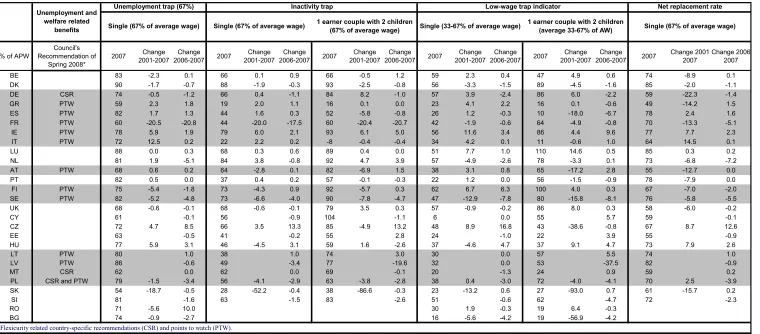
Table 3 shows figures related to an unemployed person (a single without children)
receiving unemployment benefits correlated to a previous job position where gross wages
were equivalent to 67% of the average wage (AW)14. Taking up a new job at the same
wage as before unemployment (that is 67% of AW), the marginal effective tax rate
measuring the unemployment trap (METRut) remains over 70% in almost all countries in
2007, and close to 90% in Denmark, Luxembourg and Latvia. This means that the net financial rewarding for taking up a job is about only 10% of the earnings in the latter
group of countries. Obviously, taking up a job at a wage lower (higher)15 than the wage
before unemployment implies even higher (lower) METRut in most Member States (see
the case for a return to work with a re-entry wage equivalent to 50% of AW earnings16 in
Table A1 of the statistical annex, the first row for each family type). Table 3 presents
also a comparison with METRut in 2001 and shows the evolution intervened between
2006 and 2007. We can see that over the last six years the largest reductions in the unemployment trap have been achieved by France, Slovak Republic, Finland, Sweden, Belgium and Denmark (plus the Czech Republic for one-earner couple with and without children, Austria for lone parents and one-earner couple with children; Ireland for lone parents with children, Spain for two-earner couple with and without children and UK for one-earner couple without children - See also Table A1 in the Statistical annex). In
France, a significant decrease in unemployment traps, in particular over 2006-2007, was
registered for all family types and wage levels above 50% of the AW. This decline
followed the introduction of new measures in October 2006 that increased the earning disregards for RMI beneficiaries. Furthermore, for an unemployed single person who receives benefits correlated to a previous wage equivalent to 67% of AW and who takes
up a new job with a correspondent wage of 50% of AW, the METRut has been reduced by
12% over the period 2001-2006. This is largely due to targeted interventions made in
recent years, including specific in-work benefits (Prime pour l'emploi, PPE), the
extensive use of employers' social security reductions for low-wage employees and the
development of various activation policies. In the Slovak Republic, a large increase in
financial incentives to work, in particular for a single person and one-earner couple with and without children, was achieved by the combination of a reduction in social assistance, housing benefits and the introduction of in-work benefits. In-work benefits
are indeed largely used to reduce METRut in some countries, in particular in the Slovak
Republic and in Ireland (single person without children). In Finland, for all the
considered family types, the higher earnings disregard for social assistance and income
tax reductions strongly contributed to the reduction in the METRut, followed by the
in-work-benefits component. In Sweden a decline in the unemployment trap for all family
14
Given that looking only at one point in the income distribution and one typology can not reflect the complex interaction of tax benefit systems, we have reported detailed tables in the statistical annex, showing the METRs for the return to work of unemployed people (eligible for unemployment benefits) for a few representative earnings levels (50%, 67%, 100%, 150% of the AW wage level) and for six household typologies.
15
Obviously, the METRut decreases with a higher "post-unemployment" wage: the average METRut is 63% for a new wage equivalent to 100% of AW and 56% for a new wage equivalent to 150% of AW.
16
types and income levels was mainly driven by the introduction of in-work benefits.
In Belgium the unemployment insurance reform introduced in 2004, together with a
reduction in income taxation, increased incentives to work. In the Czech Republic, the
positive evolutions highlighted in previous years, mainly benefiting families with dependent children, were largely due to the effects of the new regulation of the unemployment benefits system introduced in 2004 and the increase of the average gross wage and minimum wage recorded over recent years, but also to the increased child
allowances and social benefits associated with the lowest income band. Poland reduced
the unemployment trap for all family types without children by reducing net replacement rates and social security contributions (paid by employee).
Furthermore, some countries considerably reduced the unemployment trap for certain family types over the last year (2007), in particular France, Sweden and Poland (plus Spain for two-earner couple with and without children, Portugal and Latvia for single parent and one-earner couple with two children and the Netherlands for single parent without children - See also Table A1 in the statistical annex). With the reform of the
personal income tax in 2007, Spain strongly reduced the METRut for two-earner couple
with and without children by reducing income tax rates, in particular for the lowest
income levels. A revision of family related benefits in Portugal in 2007 considerably
reduced the METRut for single parent and one-earner couple with children. A reduction
in the unemployment trap for these same family types was achieved also in Latvia,
mainly by a revision of housing benefits and the reduction of income taxes. Graph 4 and
Graph 5 present the components of METRut for a single person (with and without
Table 3 - Structural Indicators on financial incentives to work, 2007
% of APW
Council's Recommendation of
Spring 2008*
2007 Change 2001-2007
Change 2006-2007 2007
Change 2001-2007
Change 2006-2007 2007
Change 2001-2007
Change 2006-2007 2007
Change 2001-2007
Change 2006-2007 2007
Change 2001-2007
Change 2006-2007 2007
Change 2001-2007
Change 2006-2007
BE 83 -2.3 0.1 66 0.1 0.9 66 -0.5 1.2 59 2.3 0.4 47 4.9 0.6 74 -8.9 0.1
DK 90 -1.7 -0.7 88 -1.9 -0.3 93 -2.5 -0.8 56 -3.3 -1.5 89 -4.5 -1.6 85 -2.0 -1.1
DE CSR 74 -0.5 -1.2 66 0.4 -1.1 84 8.2 -1.0 57 3.9 -2.4 86 6.0 -2.2 59 -22.3 -1.4
GR PTW 59 2.3 1.8 19 2.0 1.1 16 0.1 0.0 23 4.1 2.2 16 0.1 -0.6 49 -14.2 1.5
ES PTW 82 1.7 1.3 44 1.6 0.3 52 -5.8 -0.8 26 1.2 -0.3 10 -18.0 -6.7 78 2.4 1.6
FR PTW 60 -20.5 -20.8 44 -20.0 -17.5 60 -20.4 -20.7 42 -1.9 -0.6 64 -4.9 -0.8 70 -13.3 -5.1
IE PTW 78 5.9 1.9 79 6.0 2.1 93 6.1 5.0 56 11.6 3.4 86 4.4 9.6 77 7.7 2.3
IT PTW 72 12.5 0.2 22 2.2 0.2 -8 -0.4 -0.4 34 4.2 0.1 11 -0.6 1.0 64 14.5 0.1
LU 88 0.0 0.3 68 0.3 0.6 89 0.4 0.0 51 7.7 1.0 110 14.6 0.5 85 0.3 0.2
NL 81 1.9 -5.1 84 3.8 -0.8 92 4.7 3.9 57 -4.9 -2.6 78 -3.3 0.1 73 -6.8 -7.2
AT PTW 68 0.6 0.2 64 -2.8 0.1 82 -6.9 1.5 38 3.1 0.8 65 -17.2 2.8 55 -12.7 0.0
PT 82 0.5 0.0 37 0.4 0.2 57 -0.1 -0.3 22 1.2 0.0 56 -1.5 -0.9 78 -7.9 0.0
FI PTW 75 -5.4 -1.8 73 -4.3 0.9 92 -5.7 0.3 62 6.7 6.3 100 4.0 0.3 67 -7.0 -2.0
SE PTW 82 -5.2 -4.8 73 -6.6 -4.0 90 -7.8 -4.7 47 -12.9 -7.8 80 -15.8 -8.1 76 -5.8 -5.5
UK 68 -0.6 -0.1 68 -0.6 -0.1 79 3.5 0.3 57 -0.9 -0.2 86 8.0 0.3 58 -6.0 -0.2
CY 61 -0.1 56 -0.9 104 -1.1 6 0.0 55 5.7 59 -0.1
CZ 72 4.7 8.5 66 3.5 13.3 85 -4.9 13.2 48 8.9 16.8 43 -38.6 -0.8 67 8.7 12.6
EE 63 -0.5 41 -0.2 55 2.8 24 -1.0 22 3.9 55 -0.9
HU 77 5.9 3.1 46 -4.5 3.1 59 1.6 -2.6 37 -4.6 4.7 37 9.1 4.7 73 7.9 2.6
LT PTW 80 1.0 38 1.0 74 3.0 30 0.0 57 5.5 74 1.0
LV PTW 86 -0.6 49 -3.4 77 -19.6 32 0.0 53 -37.5 82 -0.9
MT CSR 62 0.0 62 0.0 69 -0.1 20 -1.3 24 0.9 59 0.2
PL CSR and PTW 79 -1.5 -3.4 56 -4.1 -2.9 63 -3.8 -2.8 38 0.4 -3.0 72 -4.0 -4.1 70 2.5 -3.9
SK 54 -18.7 -0.5 28 -52.2 -0.4 38 -86.6 -0.3 23 -13.2 0.6 27 -93.0 0.7 61 -15.7 0.2
SI 81 -1.6 63 -1.5 83 -2.6 51 -0.6 62 -4.7 72 -2.3
RO 71 -5.6 10.0 30 1.9 -0.3 19 6.4 -0.3
BG 74 -0.9 -2.7 16 -5.6 -4.2 19 -56.9 -4.2
Net replacement rate Unemployment and
welfare related
benefits Single (67% of average wage)
1 earner couple with 2 children (average 33-67% of AW)
*Flexicurity related country-specific recommendations (CSR) and points to watch (PTW).
AT, IE, IT, LV, LT, PL, ES have PTW in the area of childcare (e.g. availability of childcare, childcare provision, childcare infrastructure, access to childcare). In case of EL, a broad reference to female participation is made without specifying expected policy measures. FI has a PTW that is referring to high structural unemployment; however, no explicit measure to address this issue is specified.
Unemployment trap (67%) Inactivity trap Low-wage trap indicator
Single (67% of average wage) Single (67% of average wage) 1 earner couple with 2 children
(67% of average wage) Single (33-67% of average wage)
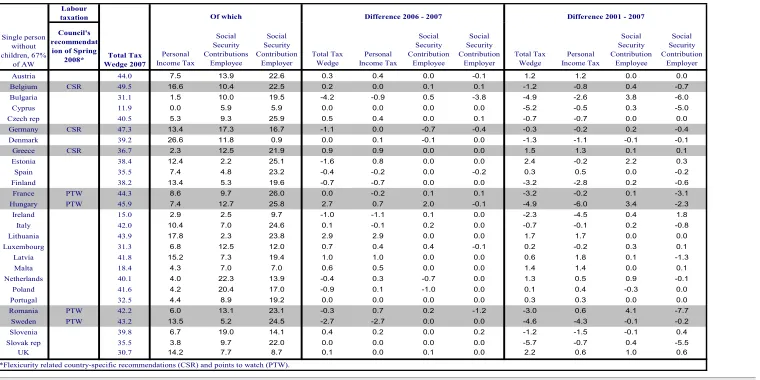
Table 4 - Tax wedge on labour for low-wage workers (67% of AW) and its components
Labour taxation Council's recommendat
ion of Spring
2008* Income TaxPersonal
Social Security Contributions
Employee
Social Security Contribution
Employer
Total Tax Wedge
Personal Income Tax
Social Security Contribution
Employee
Social Security Contribution
Employer
Total Tax Wedge
Personal Income Tax
Social Security Contribution
Employee
Social Security Contribution
Employer
Austria 44.0 7.5 13.9 22.6 0.3 0.4 0.0 -0.1 1.2 1.2 0.0 0.0
Belgium CSR 49.5 16.6 10.4 22.5 0.2 0.0 0.1 0.1 -1.2 -0.8 0.4 -0.7
Bulgaria 31.1 1.5 10.0 19.5 -4.2 -0.9 0.5 -3.8 -4.9 -2.6 3.8 -6.0
Cyprus 11.9 0.0 5.9 5.9 0.0 0.0 0.0 0.0 -5.2 -0.5 0.3 -5.0
Czech rep 40.5 5.3 9.3 25.9 0.5 0.4 0.0 0.1 -0.7 -0.7 0.0 0.0
Germany CSR 47.3 13.4 17.3 16.7 -1.1 0.0 -0.7 -0.4 -0.3 -0.2 0.2 -0.4
Denmark 39.2 26.6 11.8 0.9 0.0 0.1 -0.1 0.0 -1.3 -1.1 -0.1 -0.1
Greece CSR 36.7 2.3 12.5 21.9 0.9 0.9 0.0 0.0 1.5 1.3 0.1 0.1
Estonia 38.4 12.4 2.2 25.1 -1.6 0.8 0.0 0.0 2.4 -0.2 2.2 0.3
Spain 35.5 7.4 4.8 23.2 -0.4 -0.2 0.0 -0.2 0.3 0.5 0.0 -0.2
Finland 38.2 13.4 5.3 19.6 -0.7 -0.7 0.0 0.0 -3.2 -2.8 0.2 -0.6
France PTW 44.3 8.6 9.7 26.0 0.0 -0.2 0.1 0.1 -3.2 -0.2 0.1 -3.1
Hungary PTW 45.9 7.4 12.7 25.8 2.7 0.7 2.0 -0.1 -4.9 -6.0 3.4 -2.3
Ireland 15.0 2.9 2.5 9.7 -1.0 -1.1 0.1 0.0 -2.3 -4.5 0.4 1.8
Italy 42.0 10.4 7.0 24.6 0.1 -0.1 0.2 0.0 -0.7 -0.1 0.2 -0.8
Lithuania 43.9 17.8 2.3 23.8 2.9 2.9 0.0 0.0 1.7 1.7 0.0 0.0
Luxembourg 31.3 6.8 12.5 12.0 0.7 0.4 0.4 -0.1 0.2 -0.2 0.3 0.1
Latvia 41.8 15.2 7.3 19.4 1.0 1.0 0.0 0.0 0.6 1.8 0.1 -1.3
Malta 18.4 4.3 7.0 7.0 0.6 0.5 0.0 0.0 1.4 1.4 0.0 0.1
Netherlands 40.1 4.0 22.3 13.9 -0.4 0.3 -0.7 0.0 1.3 0.5 0.9 -0.1
Poland 41.6 4.2 20.4 17.0 -0.9 0.1 -1.0 0.0 0.1 0.4 -0.3 0.0
Portugal 32.5 4.4 8.9 19.2 0.0 0.0 0.0 0.0 0.3 0.3 0.0 0.0
Romania PTW 42.2 6.0 13.1 23.1 -0.3 0.7 0.2 -1.2 -3.0 0.6 4.1 -7.7
Sweden PTW 43.2 13.5 5.2 24.5 -2.7 -2.7 0.0 0.0 -4.6 -4.3 -0.1 -0.2
Slovenia 39.8 6.7 19.0 14.1 0.4 0.2 0.0 0.2 -1.2 -1.5 -0.1 0.4
Slovak rep 35.5 3.8 9.7 22.0 0.0 0.0 0.0 0.0 -5.7 -0.7 0.4 -5.5
UK 30.7 14.2 7.7 8.7 0.1 0.0 0.1 0.0 2.2 0.6 1.0 0.6
*Flexicurity related country-specific recommendations (CSR) and points to watch (PTW).
Difference 2001 - 2007
Single person without children, 67%
of AW
Total Tax Wedge 2007
Of which Difference 2006 - 2007