Munich Personal RePEc Archive
Methods for Evaluating Innovative
Health Programs (EIHP): A
Multi-Country Study
Thomas, Ranjeeta and Jones, Andrew M and Squire, Lyn
University of York, United Kingdom
July 2010
Online at
https://mpra.ub.uni-muenchen.de/29402/
Methods for Evaluating Innovative Health
Programs (EIHP): A Multi-Country Study
Ranjeeta Thomas
1, MSc, Andrew M Jones
1, PhD, Lyn Squire
2, PhD,
Affiliations:1University of York, UK,2Brookings Institution, USA
Corresponding author:Prof Andrew M Jones, Department of Economics and Related Studies, University of York, York, YO10 5DD, United Kingdom. Tel: 433766. Fax: +44-1904-433759. Email: [email protected].
Keywords:Millennium Development Goals; child and maternal health; communicable diseases; impact evaluation; capacity building; Asia; Africa; Latin America
Running title:Methods for Evaluating Innovative Programs
Acknowledgements:The authors would like to thank the Bill & Melinda Gates Foundation for their generous funding of this project.
Authorship: LS and RT were involved in the planning and management of the EIHP project throughout its duration. AJ was involved in the reporting and dissemination phases of the project. All authors have participated in the interpretation of the studies and the reporting stage of this manuscript and seen and approved the final version.
Methods for Evaluating Innovative Health
Programs (EIHP): A Multi-Country Study
ABSTRACT
INTRODUCTION
Over the last few decades billions of dollars of international aid have been channelled to Africa
and Asia. However, despite these resources these regions continue to remain the poorest in the
world (Chen and Ravallion 2007) with the worst health outcomes. The continuing poverty and
poor health reflects the limited impact aid has had in improving the conditions in these regions.
Despite a large amount of research on aid effectiveness the causal link between aid and improved
outcomes is at best still murky (Bourguignon and Sundberg 2007). Research on the last link in
the casual chain, on the evaluation of development programs and policies, is a critical tool in
channelling resources to where they are likely to have the greatest impact (White 2006). The
combined need of improved health and aid effectiveness point to the urgency of identifying and
evaluating the impact of innovative programs and policy measures to address each health goal in
ways that are appropriate in the specific context of Africa and Asia.
The Global Development Network’s (GDN) project “Evaluating Innovative Health Programs”
(EIHP), funded by the Bill & Melinda Gates Foundation, seeks to inform policy on the
effectiveness of health solutions that have the potential to improve health outcomes in
developing countries. It evaluates the impact of nineteen programs from across developing and
transition countries that focus on the health-related Millennium Development Goals (MDGs) of
reducing child and maternal mortality, and halting and reversing the trend of communicable
diseases such as HIV/AIDS, malaria and other diseases (United Nations 2008).
The EIHP project includes in its portfolio a range of programs including national programs and
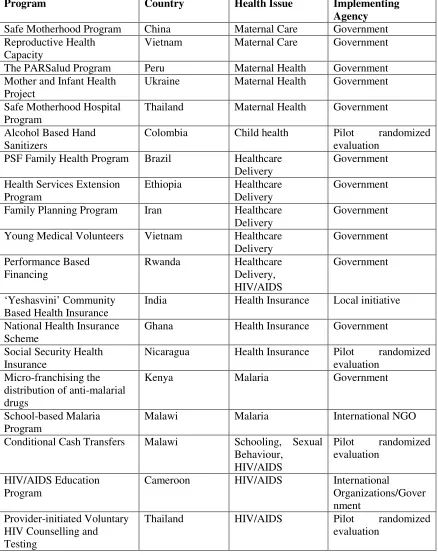
summarizes the classification of the programs in terms of their location, the health issue they
address and the agency responsible for their implementation.
INSERT TABLE 1 AROUND HERE
METHODOLOGICAL
ISSUES
Impact evaluation involves answering policy-relevant questions using counterfactual analysis
(see Heckman and Vytlacil 2007, Blundell and Costa-Dias 2008, Imbens and Wooldridge 2008,
for overviews of program evaluation methods). Specifically, the evaluations aim to assess
whether changes in outcomes for an individual, household or institution are attributable to a
specific program or intervention. They are based on the notion of causal inference, which aims to
isolate the impact of the program from other confounding factors that influence the outcomes
(see for example: Rubin 1974, Holland 1986, Heckman 2008). The methods available to assess
impact vary according to the nature of the program under evaluation, for example whether it is
new or ongoing. Also, they differ in terms of the policy questions they can answer, their data
requirements and the costs involved in carrying out the evaluations.
The programs evaluated in this project differ greatly in size and scope. Most of the national
programs have been operational for several years and cover a large proportion of the target
population, while others are either new programs implemented as small scale pilots or on-going
local initiatives. The identification strategy adopted to evaluate a program depends on the nature
investigators had some discretion over the assignment of the program, randomization was used to
create a source of exogenous variation, with the collection of baseline and follow-up data built
into the evaluation process. More often, in the case of national programs which are implemented
to achieve a specific policy target or for a specific group, treatment is not randomly assigned but
variation in the geographical coverage and intensity of treatment is exploited to isolate program
effects. The growth in availability of observational data has resulted in significant developments
in techniques for evaluations using non-experimental approaches. Where suitable longitudinal
data are available difference-in-differences (DiD) is used, sometimes combined with adjustments
for observed confounders by regression or matching methods. In cases where longitudinal data
are not available, matching methods or the regression discontinuity approach is applied using
cross-sectional data.
The experimental and non-experimental approaches have their benefits and limitations in terms
of their applicability to a particular situation and in the costs and resources required to carry them
out. Banerjee and Duflo (2008) review the advantages of randomized experiments. Experimental
designs allow the assignment of treatment to be isolated and controlled by researchers,
improving the scope to provide internally valid estimates of program effectiveness. They also
seek to address some of the common criticisms of randomized experiments: that the results of an
experiment are dependent on the specific environment where it is carried out, limiting their
generalizability to other contexts; that there are often problems with compliance in experimental
studies; that randomization itself may affect the outcomes (for example, through Hawthorne
effects); that small-scale experiments may only reflect partial equilibrium effects and fail to
a larger scale; and that experiments may not be able to capture heterogeneity in treatment effects.
The drawbacks of a mechanical reliance on the experimental approach, and of
‘quasi-experimental’ approaches that use instrumental variables, with instruments selected to mimic a
randomized experiment, rather than being drawn from a structural economic model, are reviewed
by Deaton (2008). He is critical of the use of these methods to evaluate projects per se and
favours their use as tools to aid our understanding of the underlying theoretical mechanisms that
drive behaviour. The EIHP project lies within the tradition of applying impact evaluation
methods to specific interventions.
A critical element of these evaluations is the cost involved in implementing them. In resource
constrained settings such as those where these programs are operational, costs can be a
significant barrier in undertaking an evaluation. Each of the evaluations submitted detailed
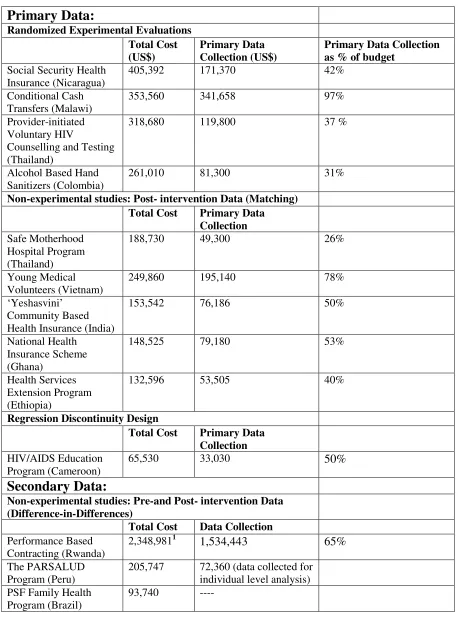
budgets covering costs for personnel, data collection and administration. Table 2 shows the
reported costs of the evaluations by the method applied.
INSERT TABLE 2 AROUND HERE
E
VALUATINGN
EWP
ROGRAMSEvaluating new ideas with the potential for improving health outcomes involves implementing
pilots of untested ideas and subjecting them to evaluations using the most rigorous techniques
available. Randomized experiments have widely been considered the ‘gold standard’ in
Randomized Experiments
Four of the EIHP programs use randomized experimental designs to examine a variety of
outcomes and the economic implications of the programs. In this approach, a sample of
individuals is selected from the population of interest, where the selection may be done on a set
of observable variables that makes the sample homogeneous. This sample is then divided
randomly into two or more groups. In the simplest case one group receives the treatment and the
other serves as the control. The random assignment should ensure balanced control and treatment
groups and should remove any selection bias in participation. The key assumption here is that all
other variables – either observed or unobserved are independent of treatment allocation
(Ravillion 2008). The impact is estimated as the difference in means between the two groups
before and after the program is implemented (i.e. the difference between the differences).
Primary data collection for both treatment and control groups before and after the program is
implemented is a key component of experiments. Randomization’s adaptability to different
definitions of treatment and multiple treatment arms can be seen in the four studies.
Randomized experiments can overcome potential bias from adverse selection in programs
involving economic incentives such as health insurance. In the case of health insurance,
individuals with greater risks of illness are more likely to enrol in insurance programs. By
randomizing the provision of insurance this unobserved (by the researcher) risk is on average
equal in the treatment and control groups. The experimental program in Nicaragua randomizes
‘incentives’ to obtain health insurance for informal sector workers in the capital city of Managua
(Thornton et al. 2010). It uses multiple treatment arms and randomizes information on the
include, a brochure detailing the insurance program, a brochure with a 6-month insurance
subsidy with instructions to sign up at Nicaraguan Social Security Institute’s (INSS) central
office, and a 6-month insurance subsidy with instructions to sign up at any one of three
participating microfinance institutions (MFI). The impact of the treatment is relatively
straightforward to recover by comparing the difference in the means between the treatment and
control groups for the outcome of interest (in this case the take-up of insurance). Comparisons
between the MFI group with the INSS and the baseline is used to evaluate the effectiveness of
MFIs as delivery agents for health insurance. In order to measure the effect of having insurance
on utilization and expenditures they use an instrumental variables framework with the treatment
status as an instrument for having insurance.
In contrast to economic incentives, the experimental program in Thailand analyzes the take-up of
HIV testing when the service is initiated by providers (Teerawattananon et al. 2009). Closer in
design to a pure experimental setting, a cluster randomized trial design allocated hospitals with
low and high HIV prevalence into treatment and controls. The intervention in this program
involves presenting each patient between the ages of 13 and 64 who visited an outpatient
department with an invitation card for free counselling and HIV/AIDS test. The validity of the
results of experiments depends critically on the success of the randomization in balancing the
control and treatment arms across observable (and unobservable) characteristics. Most often in
social experiments differences do remain between the groups and regression methods are applied
to correct for these differences. In the case of the Thailand experiment, the Generalized
Estimating Equation (GEE) approach is used to estimate the impact of the intervention on
Of the other two experimental evaluations the Malawi conditional cash transfer program focuses
on economic incentives (Baird et al. 2010), while the Colombia program randomizes childcare
centres to test the impact of frequent hand washing, using hand gels, on preventing diseases in
children (Correa et al. 2010).
Successful randomized evaluations provide the best basis for internally valid estimates of
treatment effects by simultaneously controlling for differences in observables and unobservables.
On this basis the four programs by this classification score the highest in terms of internal
validity. The four experimental programs are all pilots, with sample sizes ranging from 3,821
(CCT in Malawi), 4,001 respondents at the baseline and 2608 at the follow-up for the Nicaragua
program, 16 hospitals in the Thailand program and 46 childcare centres (1,671 children) in the
Colombian program. Each of these programs was implemented in a single district or
metropolitan area and collected baseline and follow-up data for the treatment and control groups.
One common factor that distinguishes these experimental evaluations from the others in the
project is the much larger financial outlay required to estimate the impact after one year of the
program. This however is driven largely by the data collection required in these experiments
which as shown in Table 3 are a significant component of total costs for these evaluations. This
financial outlay must be placed in the light of the benefits from estimating accurate impact of
pilot programs through well designed experiments prior to their expansion or implementation on
Randomized experiments however are limited in their time scale as well as in their ability to
evaluate on-going programs. For example, successful pilots that are gradually expanded to cover
the entire target population allow randomization until the control group is exhausted or until the
randomization process is contaminated. Long term, large scale evaluations require randomization
to be complemented by the non-experimental methods discussed in the following sections.
E
VALUATINGO
N-
GOINGP
ROGRAMSFifteen programs in this project fall under the category of on-going interventions. These
interventions have been evaluated using a range of non-experimental methods. The methods
applied depend on the way that the programs are implemented as well the data available. These
programs are classified below based on the data availability.
Pre- and Post-Intervention Data
The basic difference-in-differences approach used to estimate the treatment effect in the
randomized experiments is applicable to evaluations based on observational data. This approach
is the most widely used in identifying treatment effects in non-experimental settings, particularly
for large programs implemented in multiple regions. In this project, six of the programs are
evaluated using the method of DiD (Ashenfelter 1978, Ashenfelter and Card 1985, Heckman and
Robb 1985). These programs are national interventions that cover large portions of the
population and have been active for several years. As in the case of randomized experiments,
data are required before and after the intervention for both treatment and control groups. The
data may either be longitudinal for a particular set of individuals (as in randomized experiments)
Depending on the data available slightly different sets of assumptions are required for the DiD
estimator. Particularly in the case of repeated cross-sections, two critical assumptions are (1) that
the composition of the observations in the cross-sections has not changed over time (2) the
treatment group can be clearly identified in the first time period. The second assumption would
not hold if a program was implemented nationwide in a single time period. However, this
assumption usually holds in most development policy scenarios where programs are typically
targeted at a particular group of individuals or implemented in specific regions. The DiD
approach falls under the category of methods that allows for selection on unobservable
confounders, but any unobservable factors that are likely to influence participation are assumed
to be time invariant. Without the exogenous variation provided by randomization to treatment
and control, this approach relies on variation in implementation and timing to identify treatment
effects. However, endogeneity can often be a problem in this approach if program allocation has
been purposive based on pre-existing characteristics or other dynamic characteristics, for
example if assignment of the program is influenced by a dip in pre-treatment outcomes.
The Family Health Program (PSF) in Brazil illustrates the different dimensions of using a DiD
approach (Rocha and Soares 2010). It uses municipality level data from five different sources to
capture information on different aspects of mortality (outcomes), timing and implementation of
the program (treatment-variation) and municipality level controls (covariates). It uses variation in
which municipalities adopted the program and the length of time they have been exposed to it for
identification of treatment effects. The endogeneity problem discussed earlier is critical in this
with high mortality rates then allocation to treatment can no longer be used as an exogenous
source of variation. However, since the program in Brazil was eventually expanded to cover all
the municipalities it would seem this source of endogeneity is not an issue. Similarly, if the
timing of adoption in a municipality followed the occurrence of a negative health shock that
resulted in a spike in the mortality rates the treatment effects identified will be biased. To address
this problem the evaluation uses municipality level and state level fixed-effects respectively to
control for differences leading to adoption and timing of the program. The study also carries out
a simple test for the existence of endogeneity to verify whether the above concerns of
endogeneity are indeed an issue. The test involves a hazard rate analysis of the determinants of
the probability of a municipality joining the program. The probability is estimated as a function
of municipality fixed characteristics, changes in health variables, political variables and
socioeconomic variables. The findings show a very small correlation between participation and
previous health shocks while political considerations were found to have larger impacts
indicating that the above concerns of endogeneity may not be too serious an empirical issue.
The DiD estimator can be biased by factors other than endogeneity of the policy variable.
Particularly in the case of national programs, where this approach is most often used, identifying
causal impact of the program under consideration can prove difficult. Most often governments
are implementing multiple programs in the same region addressing different policy issues, but
the impact of these programs could have indirect effects on outcomes not directly targeted by it.
This potential problem is addressed in the Mother and Infant Health Program (MIHP) (Nizalova
and Vyshnya 2010) in Ukraine which evaluates the impact on the program on infant mortality
this case existence of other health programs could result in an upward-bias of the estimated
results of the MIHP evaluation. In order to test this contamination of the identified treatment
effect, the evaluation of the MIHP program uses a placebo test by estimating the DiD model on
pregnancy unrelated outcomes (in this case prevalence of diabetes and hepatitis). The lack of
statistically significant impacts on health improvement for these unrelated outcomes is used as a
measure of the validity of the DiD estimator on pregnancy related outcomes.
A further source of contamination in non-experimental settings is the contamination of the
control group due to spillover effects. In health related development programs improvement of
supply-side factors is a key intervention. These could include building health houses or
improvements in procedures. In such non-experimental settings there is little to prevent
individuals from non-intervened locations from accessing services in a ‘treated’ location. The
only barrier in such cases would be the distance to the ‘treated’ facility. In such cases the
recovered treatment effect is a biased estimate. One example of this problem is addressed in the
evaluation of the Family Planning Program in Iran (Salehi-Isfahani et al. 2010). Implemented at
the village level, this program involves the construction of rural health houses to provide family
planning services to residents of the village. Contamination of the control group would occur if a
treated village is located in close proximity to a non-treated village whose residents could easily
access these services. To test for spillover effects the DiD regression includes a control variable
for the interaction between coverage of the program at the (higher) district level and the
characteristics influencing the likelihood of having a health house. This variable shows a positive
impact on fertility (outcome) indicating that spillovers were not a major cause for concern in this
Similar to these three programs, the PARSalud in Peru (Díaz and Jaramillo 2009) and the CFW
program in Kenya (Oduor et al. 2009) also use DiD to control for observable differences. For
large programs it is particularly useful in identifying impact on aggregate statistics such as
maternal mortality ratios, fertility rates or death rates from malaria. But it is easily extended to
household level analysis as well. In the PARSalud evaluation, both levels of analysis are carried
out. The household level analysis requires microdata which are less likely to be readily available
and, as in this case, may have to be collected directly.
The accuracy of the DiD approach in generating unbiased measures of impact depends on the
exogeneity of the variation in the areas adopting the program or in the timing of adoption and on
controlling for observable factors that may bias the outcomes. Based on these criteria, an
evaluation such as the Family Health Program in Brazil, which successfully tests and controls for
these issues, could be given the highest credibility among the non-experimental evaluations. In
contrast the program in Kenya has limited data on confounding factors, making the evaluation
more prone to potential biases.
The final program in this section is Performance Based Financing for general health services in
Rwanda (Basinga et al. 2009). This program was originally designed as a large scale district
level randomized experiment to remunerate providers according to their performance on a given
set of quantity and quality indicators. The intervention implemented at the health facility level
covered 19 administrative districts across Rwanda. Due to the experimental design data
collection at the facility level and exit interviews of service users was done at baseline and
district boundaries led to some districts originally allocated to treatment having some health
facilities from the control group. For equity purposes all facilities in such districts were classified
as treatment. This break in the randomization results in a change in the analysis from a pure
experiment to a DiD combining data from Rwanda’s Health Information Management System
with the primary data collected controlling for facility level and time fixed effects.
The DiD approach is only applicable in situations where data are available before and after the
program for both groups. Such data however are not available in all developing countries. The
growth in the use of the DiD approach has been driven by the growth of national data collection
efforts such as the Living Standards Measurement Survey (LSMS) and the Demographic and
Health Survey (DHS). It’s applicability across all settings will remain limited, until data
collection efforts are improved and standardized in all developing countries.
On the positive side, in the absence of randomization, the DiD approach will often give reliable
estimates of program impact for on-going programs. It is serves as an excellent alternative for
new programs where randomization is not possible or as a complement to randomization when
programs run for several years and randomization is no longer possible. For on-going programs
it provides the quickest turn-around time for policy messages. In this project the DiD evaluations
reached completion in just over one year with preliminary results for some being available as
quickly as eight months. The major time consuming activity is the merging of large data sets
from multiple sources. All of the evaluations used multiple sources of data that needed to be
manually transcribed to electronic format from physical records held by government
departments.
The biggest benefit of the DiD approach is the high return to investment in evaluating large
scale, long-term programs. Table 3 shows the evaluation cost of the six programs using DiD.
Except for the Rwanda evaluation that was designed as a randomized experiment which includes
two rounds of data collection, five of the evaluations have costs ranging from $93,740 for the
evaluation of Brazil’s large scale national program to $205,747 for Peru’s national program. A
point to note about the Peru program is that household data was collected for the individual level
analysis which accounted for $72,360 of the costs. These evaluation costs must be viewed in
light of the size of the programs being evaluated and the years of operation of the program;
covering almost 85-90% of the target locations in the case of Brazil and Iran and multiple
regions in Ukraine, Kenya and Peru. The Ukraine program, though not collecting primary data,
has high costs compared to the other DiD evaluations because of expenses for transcribing data
to electronic form. A note of caution here is that these should not be interpreted as full economic
costs as much of the staff costs are not accounted and it is not possible to compare costs of
evaluation and program costs. These programs have also been operational for several years
allowing for long-term impacts to be estimated and heterogeneity in treatment effects. The
identified impacts also pertain to a much larger population or in some cases the entire target
Post-intervention Data
As mentioned earlier, the longitudinal data required by DiD estimators is still not widely
available in all regions, limiting the applicability of this approach for many programs. A range of
cross-sectional estimators are available to overcome data limitations. Broadly they can be
classified into those rely on ‘selection on observables’ (matching, regression analysis) and those
that also account for ‘selection on unobservables’ (instrumental variables, regression
discontinuity, control function approach). Applications of two of these approaches (matching and
regression discontinuity) are discussed below.
The first alternative to DiD used in this project is that of matching. This approach is based on the
assumption that selection into treatment is fully reflected by observable variables. This
cross-sectional approach is applicable when experimental control groups are not available for direct
comparison of outcomes. In this case a suitable comparison group is constructed from
non-participant individuals based on the similarity of observables characteristics with the treatment
group under evaluation. The key assumption underlying this approach is that conditional on a set
of covariates, selection into treatment is independent of the outcomes being evaluated. This
conditional independence, or ignorability, assumption when combined with an assumption of
overlap or common support, that is, the availability of comparison individuals with similar
covariate values to the treated group, permits non-parametric identification of the treatment
effect (see for example: Cochran and Rubin 1973, Rubin 1973a, 1973b, 2006, LaLonde 1986,
Heckman, Ichimura and Todd 1998, Deheija and Wahba 1999, 2002). A range of methods are
available for matching. In cases where the number of variables affecting treatment assignment
is not the case and a large number of variables impact treatment and outcomes. In this case
propensity scores are used to reduce the dimensionality of the matching (Rosenbaum and Rubin
1983, 1984). The propensity score is a balancing score representing the conditional probability of
allocation to treatment given the observed confounders.
In this project all the programs evaluated using matching rely on propensity scores. The wide
range of programs that can be evaluated using this approach is evident in those selected for this
project. The Ghana National Health Insurance is similar to those in the DiD category and is a
large scale, nationwide program covering 55% of the national population (Mensah et al. 2010).
The Ghana program is similar to the Safe Motherhood program in Thailand, implemented in
central, general and community hospitals and the Health Services Extension program in Ethiopia
(Chandoevwit and Vacharanukulkieti 2009, Admassie et al. 2009). The other program in this
category - ‘Yeshasvini’ insurance program in India (Aggarwal 2010) is smaller in scale and
implemented in a specific region as a joint enterprise between the government and other
organizations.
The accuracy of matching estimators relies heavily on the similarity between the treatment
groups and the selected comparison group. In order to enhance the quality of the analysis the
Young Medial Volunteers Program evaluation applies two rounds of matching (Ngoc and Quoc
2010), the first to prune the sample of available treatment and control sites prior to data
collection, and the second at the analysis stage. This evaluation uses a combination of primary
and secondary data. In the first stage, secondary data from a rural census is used to match
using nearest-neighbours without replacement resulting in 213 pairs of treated and comparison
communes. 180 treatment communes with the highest propensity scores are then selected into a
further round of matching including all comparison communes (213). The resulting 180 pairs
were selected for the survey. The household survey consisted of 13,365 respondents. The second
round of matching was used to identify the program impacts by applying three different
matching methods – kernel matching, single nearest-neighbour and 3 nearest-neighbours.
In contrast to the YMV program, none of the other matching evaluations use secondary data,
primary data on both treatment and controls were collected for the purpose of the evaluations.
The matching estimator identifies the average treatment effect over a region of common support.
In the case of propensity scores, common support requires that for levels of the probability of
participation (propensity score), the probability of observing a non-participant is positive. One
way of checking whether the common support requirement is met i.e. the extent of the similarity
between the treatment and comparison groups is by comparing the estimated propensity scores
across blocks or intervals of the common support region. For example, the Ghana NHIS
evaluation was carried out in two administrative districts each (one urban and one rural) from
two regions of the country. A random sample of 400 participants and 1600 non-participants from
these districts were surveyed and data was collected for eight outcome and ten control variables
that impact both participation and treatment. Once propensity scores were estimated, the
common support region was divided into four blocks with each block containing both treated and
untreated individuals. The mean of the propensity scores between the two groups within each
block is then compared. The study finds no significant difference in the averages in any of the
different blocks. The study then uses nearest-neighbour matching and kernel matching to
estimate the average treatment effect on the treated.
Propensity score matching is also applicable to multiple treatment arms and comparison groups
as used in the Yeshasvini health insurance program. In this program health insurance is provided
to members of a co-operative society who can sign-up on a voluntary basis. The evaluation
focuses on a range of outcomes covering healthcare utilization, economic well-being, financial
protection and surgery/treatment outcomes. The coverage of the program is also broad and
includes out-patient care, surgery and maternal health. Thus, the definitions of treatment vary by
duration of membership and on being a beneficiary or not – households with membership at the
time of the survey, households who had not renewed their membership in the last 3 or more
years, and households who had been beneficiaries in the last 4 years. In this program selection of
an appropriate comparison group was also not straight forward. Theoretically, co-operative
society members eligible for the insurance but who do not participate may be the closest in terms
of observables to the treatment group. However, due to the voluntary nature of the program there
is the danger of selection bias from time varying unobservable characteristics. For instance,
non-participant households eligible to sign-up (members of a co-operative society) may not
participate if they have recently undergone surgery and do not expect to face catastrophic health
costs in the near future. This group would then be less suitable as a comparison group as opposed
to non-eligible households. To examine the sensitivity of the results to different specifications of
comparison groups, two different groups were used – co-operative society members who did not
take up insurance and non-cooperative society members (who are not eligible for the insurance).
both the comparison groups, the study finds that non-participant –eligible households are more
similar in distribution to the treatment arms than the non-eligible households. The evaluation
collected data on 4,109 households for 400 control variables and the outcome variables.
The choice of observed characteristics is important and should capture all factors that affect both
treatment assignment and outcomes of interest but are not affected by the treatment itself (to
avoid post-treatment bias). Where this is not the case, matching fails to control for treatment
selection. To ensure the conditional independence assumption holds, matching should be carried
out on baseline characteristics of both control and treatment groups. Often, pre-treatment
(lagged) outcome variables are included in estimating the propensity scores. Such information
was however not available for all of the programs in this category. To circumvent this problem
the Health Extension Workers Program (HSEP) in Ethiopia included a village level survey of
leaders and senior residents to elicit information on pre-intervention village level characteristics
that could account for differences in the treatment and control groups. This survey was also used
to obtain information on access to markets and social infrastructure. The HSEP is a national
program covering about 50% of the rural villages. The selection of the regions was purposive
and based on the availability of both treated and non-treated districts in the region. The total
sample size includes 3,396 children between the ages of 0-5 and 3,540 women between 15-49
years.
In the absence of random assignment and longitudinal data, the cross-sectional estimator of
matching relies on post-intervention level characteristics to select comparable comparison
justified by including all relevant covariates that are likely to influence treatment selection and
outcomes and justifying that treatment allocation to different regions or districts was carried out
randomly.
Program allocation based on certain criteria such as cut-off points can also be exploited to
recover impact estimates. This cross-sectional approach is regression discontinuity design (RDD)
where controlling for an observable variable occurs in circumstances where the probability of
assignment to the treatment group is a discontinuous function of one or more observable
variables (Duflo et al. 2008). The treatment effect is a comparison of mean outcomes of
individuals just below with those just above the cut-off points. This approach is applied in the
HIV/AIDS teacher training program in Cameroon (Arcand and Wouabe 2010). It exploits the
natural experiment generated by the program implementation where teachers in towns having
between 1 and 4 secondary schools were trained in communicating HIV/AIDS related
information to students while those towns with more than 4 schools received no training. Since
the number of schools in a town was determined several years earlier by independent factors, the
target population had no control over this factor, the threshold then generates a sort of ‘local
randomized experiment’. The sample surveyed consists of 2,279 15-17 year old and 2,267 12-13
year olds between grades 1 to 6. 108 schools were surveyed, 56 schools received the teacher
training component and 52 served as the control.
As mentioned earlier all these evaluations involved primary data collection. Costs of these
evaluations are provided in Table 2. The range of costs for this approach lies between the DiD
comparison to the DiD approach, the return to investment in matching is compromised if the
validity of the approach is questionable due to the lack of pre-program information to control for
likely differences. This approach would then score relatively low amongst the viable options and
should be implemented only if none of the others are possible. Alternatively, considerable time
and resources must be spent to elicit such pre-program characteristics through surveys, as was
done in the Ethiopia evaluation.
Mixed Methods
Matching methods and DiD both seek to ensure comparability between the treatment and control
groups. Matching aims to improve the balancing of observed characteristics, using methods that
are more semiparametric than standard linear regression. DiD allows for imbalance in
unobservable characteristics, so long as they remain constant over time, but imbalance in
observed covariates is typically handled through linear regression of the DiD specification. The
strengths of the two methods can be combined in the evaluation process using a mixed approach:
matching can be used to improve the balance in observed covariates and then the DiD regression
can be applied to the matched sample to allow for time invariant unobservables that are not
captured by the covariates. Two studies in this project – Evaluation of the Safe Motherhood
Program in China (Feng et al. 2010) and School Based Malaria Treatment in Mangochi district
of Malawi (Simwaka et al. 2009) apply matching methods and DiD, while the Government
Social Franchise (GSF) evaluation at commune health stations in Vietnam (Ngo et al. 2009)
combines one-to-one matching with multivariate regression and factor analysis. In these
evaluations matching is used to select appropriate comparison groups, following which DiD or
China did not select counties for treatment based on random assignment so, in order to correct
for the possible endogeneity of program placement, treatment and non-treatment counties were
matched on baseline characteristics using radius matching on propensity scores. 283 treatment
counties were matched with a sample of 1,583 comparison counties. The pruned sample was then
used in the DiD estimation applying two estimation strategies, the first, to establish a
dose-response relationship between years of treatment and outcomes by including a set of dummy
variables representing years, and the second, to explore the channels through which the outcome
(maternal mortality ratio) is affected by the treatment (MCH, mother and child health services)
the dummy variables are interacted with the MCH variables.
In contrast to the other large programs applying DiD, the School Based Malaria Treatment
Program is implemented by the Save the Children Fund in Mangochi district of Malawi. The
program covers half the schools in the district. The evaluation uses administrative records at
school and student level from 2001/02 to 2005/06. In this application, which is quite similar to
the Safe Motherhood Program in China, treated schools were first matched with other
non-treated schools. From the pruned sample, 10 student records from each school were randomly
selected. Regression adjusted DiD was then applied at the student level to estimate impact of the
program on sickness and absenteeism.
The evaluation of the GSF model at health commune stations in Vietnam uses household surveys
of potential users and client surveys of actual users to assess improvements in reproductive
health and family planning service quality. Unlike the other two evaluations in this category, this
after the franchise network was established. The sample was selected from two treatment and
two control provinces using 1:1 matching of 38 treatment and control commune health stations.
Multivariate regression was fitted for the community level indicators – perception of service
quality and staff expertise. At the client level, factor analysis was applied to various outcomes –
client satisfaction, likeliness to return to the franchise and other quality related factors.
CONCLUSIONS
Choosing an evaluation strategy
Well-designed and conducted randomized experiments recover the average treatment effect on
the treated for a specifically chosen set of subjects. An extension of these results is not
necessarily guaranteed when such programs are implemented on a much larger scale in the same
location and even less when transported for replication in another region or country. The changes
in effects could be induced in many ways – scaling up in the same location could lead to general
equilibrium effects; different factors could influence outcomes in different locations, especially
in developing countries. Identifying universally consistent impacts of specific factors requires
replication of these programs in different settings. Further financial investments still need to be
made in re-evaluating these programs in local settings either as randomized experiments
wherever possible or using non-experimental methods where experiments are not feasible.
Programs that seek to have behavioural impacts on the target population have long-turnaround
times; several years of operation may be required before impact can be measured. The Malawi
conditional cash transfer program is such an example (Baird et al. 2010). The costs provided in
(these were provided free). The program has been extended through other sources of funding for
a further two years of implementation and data collection. Despite the costs and the
administrative requirements of implementing experiments, randomized experiments are crucial
to evaluating ideas that have not been implemented before or exploring the impact from
replicating successful ideas. However, their contribution in evaluating programs over a long
horizon or on-going programs is limited and this task typically requires the use of observational
data.
Answers to the problems facing health policy in developing countries do not necessarily lie in
new programs. Often existing programs can provide insights into success. Within particular
countries the results from DiD evaluations of large programs are likely to be more generalisable
as compared to pilot randomized experimental evaluations. However, caution must be used in
extending lessons from one country to another, often in vastly differing settings. In such cases
the external validity of the DiD approach is no more than that of a randomized evaluation. The
programs in this project show that if sufficient data are available to control for observable
differences and program placement is not endogenous, or factors affecting endogenous program
placements can be controlled for, then the DiD approach is most favourable in non-experimental
settings. It is economical and, if implemented well, can provide accurate impact estimates with
quick turn-around times. They are the least cost way of monitoring impacts over several years
and serve as an excellent substitute when randomization is no longer feasible.
The EIHP programs that use pre- and post-intervention data show that, when program allocation
problem can be addressed by combining methods that capture selection on observables and
unobservables. Particularly when treatment assignment is not at the individual level, it is usually
based by program operators on observable characteristics – such as pre-program outcome levels,
poverty or infrastructure. Matching methods can then be applied on baseline characteristics to
control for differences in selection. The DiD approach then controls for time-invariant
unobservables that are likely to be confounding factors. In cases where it is possible to exploit a
natural experiment, RDD is an option, limited however in identifying the effects for the
population immediately around the threshold.
The post-intervention methods such as matching used in the EIHP programs make an important
contribution to identifying solutions from existing programs. It encourages evaluations in the
many cases where longitudinal data may not be available. However, they depend on finding a
suitable comparison group and typically require significant efforts in data collection for both
treatment and comparison groups. These methods also require a clear justification of the
selection on observables. Until it becomes standard to collect data pre and post intervention for
programs implemented in the future, this method is an efficient solution to the evaluation of
program impact.
The EIHP project provides policy-makers looking to identify successful innovative programs
with evidence on the effectiveness of 19 health programs. These evaluations provide a starting
point for evidence based replication of successful programs. However, there are several
methodological messages that emerge. Caution must be exercised in replicating programs, as
relevant to the population they are evaluating. Replications must be built around pilot
evaluations. Irrespective of the type of program and its scale, evaluations are critical to
identifying good ideas. Data collection for the purpose of evaluations must be built into program
designs. New programs must look to randomize where possible and if planned for the long term
must build in non-experimental methods to continue the evaluations. In the case of existing
programs this project shows that a range of methods are available that can be adapted to
evaluating a wide array of programs.
Notes:
1. The EIHP project’s contribution was 4% of the total cost of the Rwanda study. The
REFERENCES
Admassie, A., Abebaw, D. and Woldemichael, A.D., 2009. Impact evaluation of the Ethiopian Health Services Extension Program.Journal of Development Effectiveness, 1(4), 430-449.
Aggarwal, A., 2010. Impact evaluation of India’s ‘Yeshasvini’ community based health insurance program.Health Economics, in press, 10.1002/hec.1605.
Arcand, J-L. and Wouabe, E.D., 2010. Teacher Training and HIV/AIDS prevention in West Africa: Regression discontinuity design evidence from Cameroon.Health Economics, in press.
Ashenfelter, O., 1978. Estimating the effect of training programs on earnings. Review of Economics and Statistics,60, 47-57.
Ashenfelter, O. and Card, D., 1985. Using the longitudinal structure of earnings to estimate the effect of training programs.Review of Economics and Statistics, 67, 648-60.
Baird, S., Chirwa, E., McIntosh, C. and Ozler, B., 2010. The short-term impacts of a schooling conditional cash transfer program on the sexual behaviour of young women.Health Economics, in press, DOI: 10.1002/hec.1569.
Banerjee, A. V. and Duflo E., 2008 The experimental approach to development economics. NBER working paper w14467. National Bureau of Economic Research, Inc.
Basinga, P., Gertler, P.J., Binagwaho, A., Soucat, A.L.B., Sturdy J.R. and Vermeersch, C.M.J., 2009. Impact of performance based financing in Rwanda: health facility level analysis. GDN working paper 32. Global Development Network.
Blundell, R. and Costa-Dias, M., 2008. Alternative approaches to evaluation in empirical microeconomics. CEMMAP working paper CWP26/08. Centre for Microdata Methods and Practice, Institute for Fiscal Studies.
Bourguignon, F. and Sundberg, M., 2007. Aid effectiveness - opening the black box. American Economic Review, 97, 316–321.
Chandoevwit, W. and Vacharanukulkieti, K., 2009. An evaluation of a safe motherhood hospital program. GDN working paper 23. Global Development Network.
Chen, S. and Ravallion, M., 2007. Absolute poverty measures for the developing world, 1981-2004. Policy Research Working Paper WPS4211. The World Bank.
Cochran, W. and Rubin, D., 1973. Controlling bias in observational studies: a review. Sankhya: The Indian Journal of Statistics, Series A, 35(4), 417-46.
sanitizer gel for prevention of infectious diseases in children. GDN working paper 39. Global Development Network.
Deaton, A.S., 2008. Instruments of development: randomization in the tropics, and the search for the elusive keys to economic development. NBER working paper w14690. National Bureau of Economic Research, Inc.
Deheija, R. and Wahba, S., 1999. Causal effects in nonexperimental studies: re-evaluating the evaluation of training programs.Journal of the American Statistical Association,94, 1053-62.
Deheija, R. and Wahba, S., 2002. Propensity score matching methods for nonexperimental causal studies.Review of Economic Studies,84, 151-61.
Díaz, J.J. and Jaramillo, M., 2009 Evaluating interventions to reduce maternal mortality: evidence from Peru's PARSalud programme. Journal of Development Effectiveness, 1(4), 387-412.
Duflo, E., Glennerster, R., and Kremer, M., 2007.Using Randomization in Development Economics Research: A Toolkit.In: T.P. Schultz and J.A. Strauss, ed.Handbook of Development Economics. Amsterdam: Elsevier, vol. 4, chap. 61, 3895–3962.
Feng, X.L., Shi, G., Wang, Y., Xu, L., Luo, H., Shen, J., Yin, H. and Guo, Y., 2010. An impact evaluation of the Safe Motherhood Program in China. Health Economics, in press, DOI: 10.1002/hec.1593.
Heckman, J. J., 2008. Econometric causality. CEMMAP working paper CWP1/08. Centre for Microdata Methods and Practice, Institute for Fiscal Studies.
Heckman, J.J., Ichimura, H. and Todd, P. E., 1998. Matching as an econometric evaluation estimator.Review of Economic Studies, 65, 261-94.
Heckman, J.J. and Robb, R., 1985. Alternative models for evaluating the impact of interventions,
In: J. J. Heckman and B. Singer (eds.), Longitudinal Analysis of Labour Market Data.
Cambridge: Cambridge University Press, chap. 4, 156
Heckman, J.J., and Vytlacil, E., 2007. Econometric evaluation of social programs. In: J,J Heckman and E. Leamer, ed.Handbook of Econometrics, Amsterdam: Elsevier, vol 6B.
Imbens, G.W. and Wooldridge, J.M., 2008. Recent developments in the econometrics of program evaluation. NBER Working Paper 14251. National Bureau of Economic Research, Inc.
Holland, P.W., 1986. Statistics and causal inference. Journal of the American Statistical Association,81, 945-60.
Mensah, J., Oppong, J.R. and Schmidt, C.M., 2010 Ghana’s National Health Insurance Scheme in the Context of the Health MDGS – An Empirical Evaluation Using Propensity Score Matching.Health Economics, in press.
Ngo, A., Phan, H., Pham, V., Trinh, T. and Truong, K., 2009. Impacts of a government social franchise model on perceptions of service quality and client satisfaction at commune health stations in Vietnam.Journal of Development Effectiveness, 1(4),413-429.
Ngoc, U.V., and Huy, V.Q., 2010. Health impact evaluation: Project Young Medical Volunteers for Vietnam Rural Mountain. GDN working paper 38. Global Development Network.
Nizalova, O. and Vyshnya, M., 2010. Evaluation of the impact of the Mother and Infant Health Project in Ukraine.Health Economics, in press, DOI: 10.1002/hec.1609.
Oduor, J., Kamau, A. and Mathenge, E., 2009. Evaluating the impact of micro-franchising the distribution of anti-malarial drugs in Kenya on malaria mortality and morbidity. Journal of Development Effectiveness, 1(3), 353-377.
Ravillion, M., 2007. Evaluating Anti-Poverty Programs. In: T. P. Schultz and J. A. Strauss, ed.
Handbook of Development Economics, Amsterdam: Elsevier, vol. 4, chap. 59, 3787-3846.
Rocha, R. and Soares, R., 2010. Evaluating the impact of community based health interventions: Evidence from Brazil’s Family Health Program. Health Economics, in press, DOI: 10.1002/hec.1607.
Rosenbaum, P.R. and Rubin, D.B., 1983. The central role of the propensity score in observational studies for causal effects.Biometrika,70, 41-55.
Rosenbaum, P.R. and Rubin, D.B., 1984. Reducing the bias in observational studies using subclassification on the propensity score. Journal of the American Statistical Association, 79, 516-24.
Rubin, D. B., 1973a. Matching to remove bias in observational studies.Biometrics,29, 159-83.
Rubin, D.B., 1973b. The use of matched sampling and regression adjustments to remove bias in observational studies.Biometrics,29, 185-203.
Rubin, D.B., 1974. Estimating causal effects of treatments in randomized and non-randomized studies.Journal of Educational Psychology,66, 688-701.
Salehi-Isfahani, D., Abbasi-Shavazi, M.J. and Hosseini-Chavoshi, M., 2010. Family planning and rural fertility decline in Iran: A study in program evaluation. Health Economics, in press, DOI: 10.1002/hec.1613.
Simwaka, B. N., Simwaka, K. and Bello, G., 2009. Retrospective analysis of a school-based malaria treatment programme demonstrates a positive impact on health and education outcomes in Mangochi district, Malawi.Journal of Development Effectiveness, 1(4), 492–506.
Teerawattananon, Y., Leelukhanaveera, Y., Thavorncharoensap, M., Hanvoravovongchai, P., Ingsrisawang, L., Tantivess, S., Chaikledkaew, U., Mohara, A., Lertpiriyasuwat, C. and Pimsawan, N., 2009. Provider-initiated HIV/AIDS counselling and testing at healthcare facilities in Thailand: a cluster-randomization trial.Journal of Development Effectiveness, 1(4), 450-469.
Thornton, R., Hatt, L., Islam, M., Field, E., Solís, F. and González Moncada, M.A., 2010. Social security health insurance for the informal sector in Nicaragua: A randomized evaluation.Health Economics, in press, DOI: 10.1002/hec.1635.
United Nations Department of Economic and Social Affairs, 2008. Millennium Development Goals Report.
Table 1: The EIHP Programs
Program Country Health Issue Implementing
Agency
Safe Motherhood Program China Maternal Care Government Reproductive Health
Capacity
Vietnam Maternal Care Government
The PARSalud Program Peru Maternal Health Government Mother and Infant Health
Project
Ukraine Maternal Health Government
Safe Motherhood Hospital Program
Thailand Maternal Health Government
Alcohol Based Hand Sanitizers
Colombia Child health Pilot randomized evaluation
PSF Family Health Program Brazil Healthcare Delivery
Government
Health Services Extension Program
Ethiopia Healthcare Delivery
Government
Family Planning Program Iran Healthcare Delivery
Government
Young Medical Volunteers Vietnam Healthcare Delivery Government Performance Based Financing Rwanda Healthcare Delivery, HIV/AIDS Government ‘Yeshasvini’ Community Based Health Insurance
India Health Insurance Local initiative
National Health Insurance Scheme
Ghana Health Insurance Government
Social Security Health Insurance
Nicaragua Health Insurance Pilot randomized evaluation
Micro-franchising the distribution of anti-malarial drugs
Kenya Malaria Government
School-based Malaria Program
Malawi Malaria International NGO
Conditional Cash Transfers Malawi Schooling, Sexual Behaviour, HIV/AIDS Pilot randomized evaluation HIV/AIDS Education Program
Cameroon HIV/AIDS International
Organizations/Gover nment
Provider-initiated Voluntary HIV Counselling and Testing
Table 2: Evaluation Costs
Primary Data:
Randomized Experimental Evaluations Total Cost (US$)
Primary Data Collection (US$)
Primary Data Collection as % of budget
Social Security Health Insurance (Nicaragua)
405,392 171,370 42%
Conditional Cash Transfers (Malawi)
353,560 341,658 97%
Provider-initiated Voluntary HIV
Counselling and Testing (Thailand)
318,680 119,800 37 %
Alcohol Based Hand Sanitizers (Colombia)
261,010 81,300 31%
Non-experimental studies: Post- intervention Data (Matching) Total Cost Primary Data
Collection
Safe Motherhood Hospital Program (Thailand)
188,730 49,300 26%
Young Medical Volunteers (Vietnam)
249,860 195,140 78%
‘Yeshasvini’ Community Based Health Insurance (India)
153,542 76,186 50%
National Health Insurance Scheme (Ghana)
148,525 79,180 53%
Health Services Extension Program (Ethiopia)
132,596 53,505 40%
Regression Discontinuity Design
Total Cost Primary Data Collection
HIV/AIDS Education Program (Cameroon)
65,530 33,030 50%
Secondary Data:
Non-experimental studies: Pre-and Post- intervention Data (Difference-in-Differences)
Total Cost Data Collection
Performance Based Contracting (Rwanda)
2,348,9811 1,534,443 65%
The PARSALUD Program (Peru)
----Mother and Infant Health Project (Ukraine)
187,088 64,860 (transcribing data and collection from regions)
Family Planning Program (Iran)
120,000
----Micro-franchising for the Distribution of Anti-malaria Drugs (Kenya)
136,601
----Mixed Methods
Total Cost Data Collection
School Based Malaria Program (Malawi)
97,507 49,800 (cost benefit analysis)
Safe Motherhood Program (China)
135,000
----Reproductive Health Capacity (Vietnam)