Munich Personal RePEc Archive
Law, Finance and Development: Further
Analyses of Longitudinal Data
Sarkar, Prabirjit and Singh, Ajit
Centre for Business Research, Cambridge University, UK
June 2009
Online at https://mpra.ub.uni-muenchen.de/39060/
LAW, FINANCE AND DEVELOPMENT
FURTHER ANALYSES OF LONGITUDINAL DATA
Centre for Business Research, University of Cambridge Working Paper No. 387
by
Prabirjit Sarkar Economics Department
Jadavpur University, Kolkata-700032, India; and University of Cambridge
Centre for Business Research Judge Business School Building Trumpington Street, Cambridge CB2 1AG
email: [email protected]
and
Ajit Singh Director of Research
Cambridge Endowment for Research in Finance, CERF, Judge Business School, University of Cambridge
Chair in Economics, University of Birmingham Business School Emeritus Professor of Economics, University of Cambridge
Life Fellow, Queens' College, Cambridge, CB3 9ET, U.K. Tel: +44 1223 350434; Fax: +44 1223 740479
email: [email protected]
June 2009
Abstract
This paper analyses a longitudinal dataset on legal protection of shareholders over a 36 year period, 1970-2005 for four advanced countries, UK, France, Germany and the US. It examines two aspects of the legal origin hypothesis - whether shareholder protection is higher in the common law countries (UK and USA) than in the civil law countries (France and Germany) and whether shareholder protection matters for stock market development in the short and long runs. It also examines the ‘causation’ issue and the ‘endogeneity’ problem- whether greater shareholder protection leads to stock market development or whether stock market development leads to changes in law.
The paper casts serious doubt on the validity of the basic theses of the Anglo Saxon legal and developmental model.
JEL classification: G30, G38, K22, K40
Keywords: Shareholder protection, Corporate Governance, Stock market development, Law and Finance
1. Introduction
This paper reports on the work of an interdisciplinary research project on law, finance and development being carried out at the Centre for Business Research (CBR), University of Cambridge. The project involves both economists and lawyers. It has prepared new longitudinal data sets on legal protection of shareholders as well as on creditors’ rights and labour rights over a 36 year period, 1970-2005 for four OECD countries (UK, France, Germany and the US) and India. Such time-series information has hitherto not been available. The first results from the analysis of the time-series data on shareholder protection for four OECD countries are reported in Fagernas, Sarkar and Singh (2008).1 The present paper complements that article by further statistical and econometric analysis of the assembled data. Specifically, the paper presents two kinds of additional analysis:
It has made a full examination of the ‘causation’ issue and the ‘endogeneity’ problem. The central question here is whether legal changes such as, for example, greater shareholder protection lead to stock market development or whether stock market development leads to changes in law. Granger causality tests have been employed to shed light on this issue.
The co-integration analysis used in Fagernas, Sarkar and Singh (2008) has been taken a step further by distinguishing between short-term changes arising from observed relationships between economic time-series and their long-term relationships.
In addition to this fuller econometric analysis of the data the paper introduces and analyses time-series data on three new indicators of stock market development.
Although the Cambridge longitudinal data is available only for four countries, these are the critical countries in relation to the literature on law, finance and development. In the LLSV theory of legal origin, the three countries, England, France and Germany, may be termed as ‘mother countries’. These are essentially countries where different legal systems originated, and subsequently spread to developing countries often through colonisation and conquest. In the US, not a mother country, the Anglo-Saxon system nevertheless reached a high level of development and the model was exported to other countries. Two main empirical questions are explored in this paper:
What is the nature of the relationship between legal protection to shareholders and legal origin of countries?
Does better shareholder protection lead to faster development of the financial sector and particularly of stock markets?
The next section will provide the intellectual background and the motivation for these questions.
The rest of the paper is organised as follows. Section 3 will discuss the variables used in our longitudinal data set and how these relate to the variables used by LLSV in their mainly cross-sectional studies. Sections 4 and 5 outline the results of the empirical analysis and section 6 concludes.
2. Motivations for Empirical Questions: Theoretical Background
In studying the relationship between law, finance and development, the following issues immediately come to the fore:
How does law affect economic development?
How does one explain inter-country differences in legal rules, particularly in relation to corporate finance, corporate bankruptcy and minority shareholder rights.
Are some countries’ legal rules better than others from the perspective of economic development?
The legal systems not only differ with respect to protection for shareholders, but also with respect to labour, contract enforcement and self-dealing rules, among other attributes (see further La Porta et al, 2008; Djankov et al, 2008, 2003; Botero et al 2004). However, in this paper, we shall mainly be concerned with the question of protection for shareholders and its implications for corporate finance and economic development. LLSV argue that common law works better than civil law and is more conducive to economic development, because3:
Judges interpret the law in common law countries whereas in civil law countries judges are bound by long explicit laws and codes leaving them with little discretion.
This evolution of the difference between the two systems (common law and civil law system) has occurred over the last 300 years and has continued to affect development of laws to the present day. In other words, they assume very strong path dependence.
The policy implications of this analysis are far reaching. Essentially LLSV argue that the Anglo-Saxon model based on English common law is most conducive to the protection of shareholders – more broadly, to safeguarding property rights, and freedom of contracts. As a consequence, common law country firms have greater access to outside finance, are less subject to government control, have faster corporate growth. These characteristics in turn generate faster growth of national GDP.4
On that basis LLSV and their adherents suggest that the Anglo-Saxon model of corporate law represents the end of history as there is wide consensus that main corporate goal should be shareholders’ wealth maximization subject to constraints of liquid stock markets (Hansman and Kraakman 2001). LLSV’s work also connects up with that of the development economists who suggest that the ultimate determinant of economic development is institutions. Legal institutions clearly play a significant role, but LLSV analysis suggests that their role is crucial (Rodrik 2002).
perceptions are based on the outdated comparative legal scholarship of the 1960s.
However from a Third World perspective, it would seem arguable that it is not law which determines economic development, but rather politics that determines both law and development. The last point may be illustrated readily by considering the case of India – a common law country par excellence. Soon after independence in 1947 the Indian government decided to have a socialist pattern of society. This required government ownership of the ‘commanding heights’ of the economy as well as a massive regulation of the private sector. Such a development model held sway between 1950 and 1980 and its implementation was certainly not hampered by the common law legal system. In 1980 the government changed policy and decided to do the opposite, i.e. privatize, deregulate. This again was not hampered by the common law legacy of the British rule. Indian economic history thus suggests that it is politics rather than law which determines economic design and outcomes (see further Singh 2008; see also Roe, 2002).
Be that as it may, in summary this discussion together with the other relevant literature on law, finance and development, suggests that the two questions listed at the end of Section 1 are clearly among the central empirical propositions bearing on the validity of the LLSV theses.
3. Shareholder Protection Data
The longitudinal data on 60 variables indicating in each case some aspect of shareholder protection have been assembled by the legal members of the CBR team for the period 1970-2005. This entailed a gigantic amount of hard work by the legal scholars. It requires even greater further effort to push such legal time-series back in time. This is the reason why such data could only be collected for four advanced countries as well as a developing country, India, not considered in this essay. In contrast, LLSV’s empirical analysis is based on an index of so-called anti-director rights consisting only of 6 variables, namely proxy by mail; shares not blocked before meeting; cumulative voting/proportional representation; oppressed minority; pre-emptive rights to new issues; percentage share of capital to call a special meeting of shareholders. However, in mitigation it should be noted that the LLSV’s original data covered 49 developed and developing countries for a single cross-section year in the mid-1990s.
theoretical basis to LLSV’s original list is provided by the addition of anti self-dealing variables, as in Djankov et al (2008).
For the purposes of comparison with the LLSV variables, important characteristics of the CBR longitudinal data set may be summarised as follows:
It is based on ‘law on books’.
It takes into account company law, and some areas of securities law, although most parts of the latter are excluded.
Corporate governance codes are included as are case law and changes brought about by court decisions.
In the case of the US, the coding is based on Delaware Law.
Self-regulatory listing rules of the stock exchange are also taken into account and in the case of the UK, the City Code on takeover and mergers is included, although it is not statutory, but compliance is considered a rule.
Significantly, the CBR longitudinal data set also takes into account the fact that the same function may be performed by different laws in different countries. Functional equivalence is an important concept in comparative corporate law. Regulatory takeover codes are generally thought to play a major role in underpinning minority shareholder rights and encouraging the dispersion of ownership in some common law systems, such as the UK and Australia, but this type of regulation is absent in the United States. In the latter country certain specific rules of securities law, the law of fiduciary duties and a more permissive approach to shareholder-led litigation play a similar role (Armour and Skeel, 2007).
Unlike the LLSV, which use only binary variables, the CBR data set has each of the variables taking a value between 0 and 1. An explanation of the variables included can be found in Annex 1. Many take intermediate values, since it was considered inaccurate and in many cases impossible to describe the level of a certain type of protection simply with a binary variable. A value of 1 relates to the highest level of protection and a 0 to the lowest; so if a country were to have the maximum level of shareholder protection, the indicators would sum up to 60. There are two major categories of variables identified: a) those protecting shareholders against management and board, and b) those protecting the shareholders against other shareholders.
Fagernas, Sarkar and Singh (2008) reported the following main differences in shareholder protection on the basis of elementary analyses of individual variables.
Over the 36-year time span, there was a change in roughly a third of the 60 variables in each country.
Countries protect differently – laws adapt to the circumstances of the country.
Of the 60 variable set, 42 represented shareholder protection against board and management and 18 indicated protection against other shareholders.
In many areas law does not change but these are not the same areas in each country.
In all four countries, changes in law have occurred in variables relating to corporate governance, such as board composition, directors’ compensation etc.
However, it would be useful to aggregate the variables in order to make comparative statements about legal protection for shareholders in different countries. In line with much of the literature we use the un-weighted sum of all variables as an aggregated index of shareholder protection. This procedure thus assumes that all variables are equally important which is of course unlikely to be true but assigning unequal weights risks the exercise becoming too arbitrary.
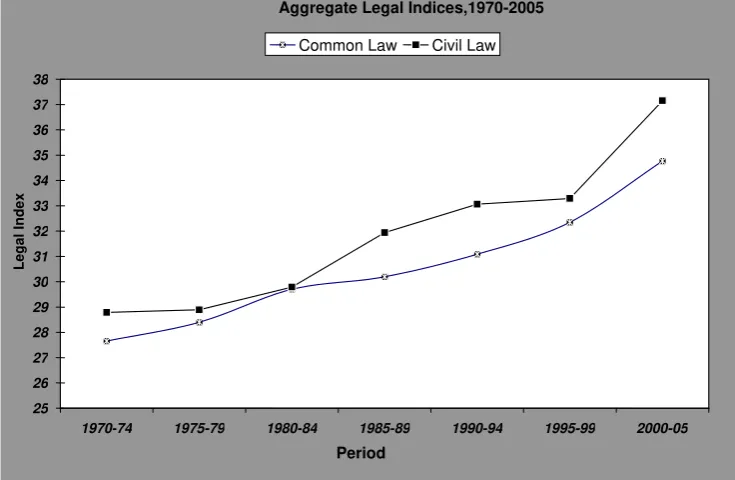
Some elementary but highly pertinent results, based on aggregated data are reported in Table 1. The table provides aggregate legal indices of shareholder protection from 1970-2005 in the three mother countries and the US, averaged over 7 consecutive 5-year periods. The table suggests that in 1970-74 the UK had the lowest protection and Germany had the highest. Shareholders protection increased throughout the 36 year period in all countries. By 2000-05, the US had the lowest protection followed by Germany, then the UK and France.
higher shareholder protection in common law countries (results available on request).
Table 1. Aggregate Legal Indices of Shareholder Protection, 1970-2005: ‘Original Sin’ Countries
(Period averages)
Period USA UK Common Law1
Germany France Civil
Law2
1970-74 28.5 26.8 27.65 29.33 28.25 28.79
1975-79 29.4 27.4 28.4 29.53 28.25 28.89
1980-84 30 29.4 29.7 30.93 28.65 29.79
1985-89 29.5 30.88 30.19 31.33 32.55 31.94
1990-94 29.69 32.48 31.085 31.33 34.8 33.065
1995-99 29.39 35.3 32.345 32.43 34.15 33.29
2000-05 32.54 37 34.77 36.81 37.5 37.155
Mean Comparison Paired t test
mean(difference) = mean (Common Law-Civil Law) t = -4.0148
Ho: mean(difference) = 0 degrees of freedom = 6
Ha: mean(difference) < 0
Reject Ho in favour of Ha at 0.01 % level of significance
1 Average of USA and UK series
2 Average of Germany and France series
Source: Lele and Siems (2007)
Figure 1
These broad-brush results are all in conflict with the predictions of the Legal Origin model. Following Fagernas, Sarkar and Singh (2008), the same point may be illustrated in a slightly different way as follows: If LLSV’s Legal Origin theory was valid, one would expect to see the following rank order of shareholder protection in the four countries: UK (A), followed by or equal to the US (B, A), followed by Germany (C), followed by France (D), which may be summarised as the rank order ABCD or AACD. What in fact we observe in different sub-periods since 1970 are nowhere near the LLSV predictions. The outcome differs from the predicted sequence for shareholder protection for each of the 7 sub-periods in Table 1.
5. Shareholders’ Protection and Stock Market Development
As indicated earlier, an important part of LLSV thesis holds that countries with high shareholder protection will also have greater development of their financial sectors generally and, more specifically, their stock markets. This question was empirically examined in Fagernas, Sarkar and Singh (2008) by means of
co-Aggregate Legal Indices,1970-2005
25 26 27 28 29 30 31 32 33 34 35 36 37 38
1970-74 1975-79 1980-84 1985-89 1990-94 1995-99 2000-05
Period
Legal
I
nde
x
integration analysis and contrary to the received literature it indicated that there is no long-term relationship between shareholder protection and the development of the stock market. The conclusion was fine as far as it went but it was subject to some important reservations. First, as mentioned in the introduction, it did not take into account the question of causality, nor did it consider the short-term dynamics of the relationship between the two variables and how it led to long-term equilibrium.
Further the study considered only one indicator of stock market development – the turnover ratio (defined below). In the rest of this paper we provide analysis both of short term dynamics as well as long run equilibrium relationships for these three other indicators of stock market development (in addition to the turnover ratio). It will be interesting to see whether this more comprehensive exercise will sustain the Fagernas, Sarkar and Singh (2008) conclusions.
The four indicators of stock market development used successively as variables on the left hand side of the equation in the following analysis are:
LMKP is the value of listed shares to GDP (in natural log); it is calculated using the following formula: {(0.5)*[Ft/Pet + Ft-1 /Pet-1]}/[GDPt /Pat] where Ft is
stock market capitalization, Pet is the end-of period consumer price index, CPI,
and Pat is average annual CPI in current period t.
LVTRD is the value of total shares traded on the stock market exchange to GDP (in natural log).
LTURN is log of the ratio of the value of total shares traded to average real market capitalization. This is calculated using the following method:
Tt/Pat/{(0.5)*[Ft/Pet + Ft-1/Pet-1] where T is total value traded, F is stock market
capitalization, Pe is end-of period CPI, Pa is average annual CPI.
LLISTPOP is the number of listed firms per million of population (in natural log).
The sources of the data of the above variables (excepting the shareholder protection data which are from CBR project already mentioned) are the Financial Structure Dataset (see Beck et al 2000) and the World Development Indicators, both from the World Bank. Due to non-availability of data our period of analysis is 1976-2005 for three stock market variables, LMKP, LVTRD and LTURN and a shorter period 1980-2005 for LLISTPOP.
5.1 Tests of Causality
We first consider tests of causality. To understand whether the direction of causality is from shareholder protection (X) to stock market development (Y) or the opposite or both (mutual causation) we shall use VAR Granger causality test for each of four OECD countries over the period, 1976-2005 (1980-2005 for the data on stock market listing). In addition to the right-hand side variables outlined above we have also included intercept (c), trend (t) and dummies -intercept and slope dummies for the dotcom bubble bursting during 2000-05 (d2yk and sd2yk respectively).
To understand whether Y (log of the four indicators of stock market developments chosen one at a time) is caused by X (two components of shareholder protection index chosen one at a time) through VAR (Vector-Autoregressive)-Granger causality we have fitted a regression where Y is a function of its past values and past values of X and Z plus c, t, d2yk, sd2yk and tested whether the coefficients of the lags of X are jointly significant (different from zero) through Wald-test statistic. To test whether Y causes X we have fitted a regression where X is a function of its past values and past values of Y and Z plus c, t, d2yk, sd2yk and tested the joint significance of the coefficients of the lags of Y. If the Wald test statistic is very high (higher than a critical value) in the first case then we can say that X causes Y; if in both cases these statistics are significant we can say that the two variables are related in mutual causation.
Similarly we can test whether Z causes Y or X or there is a reverse or mutual causation. We have chosen the optimum lag (how many years past are to be considered) as the maximum of the lags determined by a number of criteria such as Schwarz Bayesian Criterion.
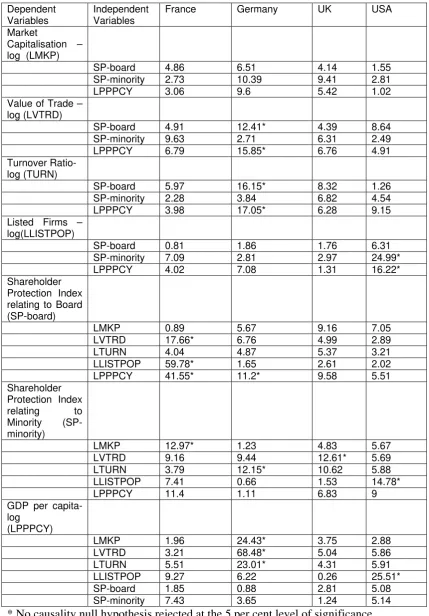
board (SPBRD) Granger-causes the value of stock trade (LVTRD) and turnover (LTURN); in the USA minority shareholder protection (SPMIN) influences stock market listing (LLIST).
There is some evidence of reverse causation. In France stock market development (as indicated by value of stock trade, LVTRD and stock market listing, LLISTPOP) Granger-causes shareholder protection relating to board, and market capitalization Granger-causes minority shareholder protection (popularly known as investor protection). Value of stock trading (LVTRD) in UK, turnover ratio (LTURN) in Germany and stock market listing (LLISTPOP) in the USA Granger-causes minority shareholder protection
From the above findings it follows that in the USA stock market listing and minority shareholder protection are connected in a relationship of mutual causation. This stock market listing is also in a mutual causal relationship with US GDP per capita. These two relationships are not enough to establish a significant relationship between minority shareholder protection and GDP per capita.
In Germany also stock market development as indicated by value of stock trading and turnover ratio and GDP per capita are linked through a mutual causal relationship. No such link between financial sector and real sector exists in France and the UK.
Lastly, in both France and Germany shareholder protection relating to board is influenced by GDP per capita. No such connection can be found in the USA and UK.
Table 2. Relationships among Shareholder Protection, Stock Market Development Indicators and Real GDP per capita for Four OECD Countries, 1976-2005: VAR Granger Causality
Dependent Variables
Independent Variables
France Germany UK USA
Market
Capitalisation – log (LMKP)
SP-board 4.86 6.51 4.14 1.55
SP-minority 2.73 10.39 9.41 2.81
LPPPCY 3.06 9.6 5.42 1.02
Value of Trade – log (LVTRD)
SP-board 4.91 12.41* 4.39 8.64
SP-minority 9.63 2.71 6.31 2.49
LPPPCY 6.79 15.85* 6.76 4.91
Turnover Ratio- log (TURN)
SP-board 5.97 16.15* 8.32 1.26
SP-minority 2.28 3.84 6.82 4.54
LPPPCY 3.98 17.05* 6.28 9.15
Listed Firms – log(LLISTPOP)
SP-board 0.81 1.86 1.76 6.31
SP-minority 7.09 2.81 2.97 24.99*
LPPPCY 4.02 7.08 1.31 16.22*
Shareholder Protection Index relating to Board (SP-board)
LMKP 0.89 5.67 9.16 7.05
LVTRD 17.66* 6.76 4.99 2.89
LTURN 4.04 4.87 5.37 3.21
LLISTPOP 59.78* 1.65 2.61 2.02
LPPPCY 41.55* 11.2* 9.58 5.51
Shareholder Protection Index relating to Minority
(SP-minority)
LMKP 12.97* 1.23 4.83 5.67
LVTRD 9.16 9.44 12.61* 5.69
LTURN 3.79 12.15* 10.62 5.88
LLISTPOP 7.41 0.66 1.53 14.78*
LPPPCY 11.4 1.11 6.83 9
GDP per capita-log
(LPPPCY)
LMKP 1.96 24.43* 3.75 2.88
LVTRD 3.21 68.48* 5.04 5.86
LTURN 5.51 23.01* 4.31 5.91
LLISTPOP 9.27 6.22 0.26 25.51*
SP-board 1.85 0.88 2.81 5.08
SP-minority 7.43 3.65 1.24 5.14
5.2 Estimates of Short run and Long-run Relationships
To understand the nature of the relationships observed via VAR-Granger causality we shall use the Autoregressive Distributive Lag (ARDL) approach to co-integration developed by Pesaran et al. (1999). This technique helps us to estimate a short-term relationship and its adjustment dynamics (error-correction mechanism) leading to a long-term relationship. The ARDL approach accommodates both stationary and non-stationary variables. 6
The following ARDL (p, q, r) equation was fitted:
(1) t k
r
k k j
t q
j j i
t p
i i
t t X Y Z
X
0 0
1
where is the intercept, is the coefficient of time, t, X is the dependent variable, Y and Z represent independent variables. Subscripts t, t-i, t-j, t-k (i =1,2,3..p, j = 1,2,3..q and k = 1,2,3,.. r) indicate different time periods and p, q and r are the lags to be determined. If needed we have added intercept and slope dummies for dotcom bubble bursting (dy2k and sdy2k).
Table 3. Short-run and Long-run Relationships between Stock Market Development Indicator and Shareholder Protection Indices, 1976-2005
Country & Dependent Variables (ARDL Model)
Independent Variables
Short Run Coefficients
Long Run Coefficients
GERMANY SPBRD
(0,0) LPPPCY -0.24 -0.24
C 2.82* 2.82*
T 0.01* 0.01*
DY2K -0.36** -0.36**
SDY2K 0.02** 0.02**
LVTRD
(2,3,0) LVTRD (-1) 0.29
LVTRD (-2) 0.67
SPBRD -2.09 890.23
SPBRD (-1) 5.19
SPBRD (-2) 9.42**
SPBRD (-3) 12.49**
LPPPCY -16.19** -572.08
C 144.13** 5128.9
T 0.29** 10.28
DY2K 18.86** 671.28
SDY2K -0.75** -26.99
ecm (-1) -0.03
LTURN
(2, 5, 5) LTURN (-1) 0.16
LTURN (-2) 0.35
SPBRD -1.77 81.53
SPBRD (-1) -4.38
SPBRD (-2) 0.48
SPBRD (-3) 10.49*
SPBRD (-4) 18.12
SPBRD (-5) 16.89
LPPPCY -10.34 -16.16
LPPPCY (-1) 6.22
LPPPCY (-2) -8.17
LPPPCY (-3) -4.82
LPPPCY (-4) 18.23*
LPPPCY (-5) -9.01
C 57.35 177.37
T 0.08 0.16
DY2K 12.76* 26.11
SDY2K -0.47 -0.96
ecm (-1) -0.49
LPPPCY
LPPPCY (-2) -0.65**
LVTRD -0.01** 6.66**
LVTRD (-1) 0.01*
LVTRD (-2) 0.01
LVTRD (-3) 0.01
LVTRD (-4) 0.01
LVTRD (-5) 0.01*
C 10.89** 458.53
T 0.02** 22.03**
DY2K 0.39** 8.09**
SDY2K -0.02** -8.46**
ecm (-1) -1.12**
SPMIN
(1,5) SPMIN (-1) 0.43
LTURN 0.001 -0.05**
LTURN (-1) -0.02*
LTURN (-2) 0.002
LTURN (-3) 0.01
LTURN (-4) -0.004
LTURN (-5) -0.02**
C 0.25** 0.44**
T 0.004** 0.01**
ecm (-1) -0.57**
USA LLIST
(0,4) LPPPCY -24.68 -147.75**
LPPPCY (-1) -6.88
LPPPCY (-2) -34.55
LPPPCY (-3) -42.87
LPPPCY (-4) -38.77*
C 1491.9** 1491.9**
T 2.76** 2.76**
DY2K 42.59** 42.59**
SDY2K -1.78** -1.78**
ecm (-1) -1**
LLIST
(3,4) LLIST (-1) 0.82**
LLIST (-2) -0.07
LLIST (-3) -0.49
SPMIN -12.34 100.81
SPMIN (-1) 49.33**
SPMIN (-2) -27.42
SPMIN (-3) -12.01
SPMIN (-4) 77.12**
C -22.63 -30.55
T 0.48 0.65
DY2K 48.93** 66.07**
SDY2K -1.97* -2.65*
France SPBRD
(3,4,2) SPBRD (-1) 0.72**
SPBRD (-2) 0.68**
SPBRD (-3) -1**
LVTRD -0.01 0.02
LVTRD (-1) 0.0005
LVTRD (-2) 0.01*
LVTRD (-3) -0.02*
LVTRD (-4) 0.01
LPPPCY 0.14 0.62**
LPPPCY (-1) -0.42*
LPPPCY (-2) 0.65**
C -3.29** -5.47**
T -0.001** -0.01**
ecm (-1) -0.6**
* Significant at 10 per cent level. ** Significant at 5 per cent level.
Notes:
The following ARDL (p, q, r) equation was fitted:
(1) t k
r k k j t q j j i t p i i
t t X Y Z
X
0 0 1 where is the intercept, is the coefficient of time, t, X is the dependent variable, Y and Z represent independent variables. Subscripts t, t-i, t-j, t-k (i =1,2,3..p, j = 1,2,3..q and k = 1,2,3,.. r) indicate different time periods and p, q and r are the lags to be determined. We have retained the time trend in the ARDL equation only if the coefficient of t is found significant in equation (1). If needed we have added intercept and slope dummies for dotcom bubble bursting (dy2k and sdy2k).
The optimum lag structure (p,q,r) is chosen on the basis of Schwarz Bayesian Criterion (SBC).
the long-run (without any significant adjustment path from the short run to long run). There is however some trace of reverse causation: minority shareholder protection (SPMIN) is negatively influenced by stock market turnover (LTURN). The influence of LPPPCY on LVTRD and LTURN is significant in the short run but not significant in the long run. It could be verified by fitting the ARDL equations without SPBRD (details are skipped). However the favourable influence of stock market development (as indicated by LVTRD and LTURN) on the real sector (as indicated by real GDP per capita, LPPPCY) is valid in both short run and long run; there exists also a stable adjustment path towards the long-run equilibrium (we have skipped the estimates of the equation concerning LPPPCY and LTURN to save space).
Next we examine US cases. Examining the mutual causation between stock market listing (LLIST) and per capita GDP (LPPPCY) we find a significant negative (!) short-run and long run influence of LPPPCY on LLIST. On the contrary there is short run favourable influence of LLIST on LPPCY but no long run influence (details are skipped). If we include LPPPCY in the ARDL equation we could observe significant negative short run and long run both way relationship between LLIST and SPMIN (details are skipped). Otherwise we could find significant positive short run influence of SPMIN on LLIST but no long-run impact. There is however neither short run nor long run reverse relationship from LLIST to SPMIN (details are skipped).
In France the short run influence of stock market development (as indicated by LVTRD and LLIST) and LPPPCY on SPBRD is complex (in some years we find positive and in some years negative influence). In the long run only the favourable impact of LPPPCY prevails (in Table 3 we have reported the estimates of one ARDL equation to save space). Similar is the story for the relationship between SPMIN and LMKP in France and SPMIN and LVTRD in UK (details are skipped).
Only in Germany real economic activities (as measured by real GDP per capita, LPPPCY) get some favourable feedback from stock market activities but the opposite is true only in the short run. In the USA stock market activities as measured by stock market listing exert favourable short run effect on the real sector but the real sector exerts a perverse effect on stock market so far as stock market listing is concerned.
6. Conclusion
The foregoing analyses lead to two rather different kinds of conclusions. The first are the narrow technical findings concerning whether the more comprehensive econometric analysis of the present paper supports the results of Fagernas, Sarkar and Singh (2008). The answer is an unqualified ‘yes’. Thus by the same token, the LLSV propositions concerning legal origin, shareholder protection and stock market development are not sustained by the analyses of the longitudinal data employed in this paper. This raises an important question – why do our results differ from those of the received literature? There are two hypotheses which are relevant in this context. First the divergence could be due to the differences in the data sets used in this study and those employed in LLSV-type studies. The second hypothesis points to the differences in cross-sectional and time series analyses. The task of establishing the validity or otherwise of these hypotheses is one which requires a paper in its own right and
will not be attempted here. All that can be said here is that it is not surprising that cross-sectional results (particularly LLSV type results based on one or two years of observation per country) should differ from those provided by time series analysis. A well known example is that of education and democracy. On a cross-sectional basis the two variables are found to be highly correlated, however, time series analysis shows no relation between the variables. On the first hypothesis it is worth observing that the data used in this paper is much more comprehensive and thoroughly grounded in comparative legal theory, which is in striking contrast to the ad hoc collection of variables used particularly in the earlier LLSV type studies.
Notes
1
For an analysis of Indian shareholder protection scenario see Sarkar (2007).
2
For a recent review article of the literature on the subject and for a spirited defence of their various positions against all critics see La Porta et al (2008). This article contains a full list of references to the relevant literature.
3
In addition to the references above to the works of LLSV and La Porta et al (2008) see also Pagano and Volpin (2006) and Pistor et al (2003).
4
See further: La Porta et al (2008); Rajan and Zingales (1998); Beck et al (2003); Beck and Demirgüç-Kunt (2005); Beck and Levine (2005); Perotei and Volpin (2004); Guiso et al (2004).
5
The two sub-categories are described below:
Under the first sub-aggregate, protection against board and management, the following headings are listed: powers of the general meeting (indicated by variables 1 to 7 in the full list given in Annex and so on for the other headings); agenda setting power (8 to 10); extraordinary shareholder meeting (11 to 12); anticipation of shareholder decision (13 to 15); information in the run-up of the general meeting (16 and 17); shares not blocked before general meeting (18); individual information rights (19 and 20); communication with other shareholders (21 and 22); board composition (23 to 25); no excessive remuneration for non-executive and executive directors (26 to 28); performance based remuneration (29); duration of director’s appointment (30 and 31); directors duties (32 to 34); shareholder supremacy (35 and 36); pre-emptive rights (37); director’s disqualification (38); corporate governance code (39); and public enforcement of company law (40 to 42).
Under sub-aggregate, protection against other shareholders, the following headings and the corresponding variable numbers are listed: quorum (43); supermajority requirements (44); one share – one vote (45 to 47); cumulative voting (48); voting by interested shareholders prohibited (49); no squeeze out (freeze out) (50); right to exit (51 to 53); disclosure of major share ownership (54); oppressed minority (55 and 56); and shareholder protection is mandatory (57 to 60).
6
References
Armour J. and Skeel D. A. Jr. 2007. Who writes the rules for hostile takeovers, and why? The peculiar divergence of US and UK takeover regulation,
Georgetown Law Journal, vol. 95, no. 6, 1727-1794
Beck, T., Demirgüç-Kunt, A. and Levine, R. 2000. A new database on financial development and structure, World Bank Economic Review, vol.14, 597-605
Beck, T., Demirgüç-Kunt, A. and Levine, R. 2003. Law and finance: why does legal origin matter?, Journal of Comparative Economics, vol. 31, no.4, 653-675
Beck, T. and Demirgüç-Kunt, A. 2005. Law and firms’ access to finance,
American Law and Economics Review, vol. 7, no.1, 211-252
Beck, T., and Levine, R. 2005, Legal institutions and financial development, in Menard, C. and Shirley, M. (eds), Handbook for New Institutional Economics, Kluwer Academic Publishers, Norwell MA
Botero, J., Djankov, S., La Porta, R., Lopez-de-Silanes, F. and Shleifer, A. 2004. The regulation of labor, Quarterly Journal of Economics, vol.119, no.4, 1339-82
Deakin, S. and Singh, A. 2008. The stock market, the market for corporate control and the theory of the firm: legal and economic perspectives and implications for public policy, Mimeograph, CBR, University of Cambridge
Djankov, S., La Porta, R., Lopez-de-Silanes, F. and Shleifer, A.2008. The law and economics of self-dealing, Journal of Financial Economics, vol.88, no.3, 430-465
Fagernas, S., Sarkar, P. and Singh, A. 2008. Legal origin, shareholder protection and the stock market: new challenges from time series analysis, in Gugler, K. and Yurtoglu, B. (eds.), The Economics of Corporate Governance and Mergers, Edward Elgar
Guiso, L., Sapienza, P. and Zingales, L. 2004. Does local financial development matter?, Quarterly Journal of Economics, vol.119, no.3, 929-69
Hall, P A. and Soskice, D. 2001. Varieties of Capitalism: The Institutional Foundations of Comparative Advantage, Oxford and New York, Oxford University Press
Hansmann, H. and Kraakman, R. 2001. The end of history for corporate law,
La Porta, R., Lopez-de-Silanes, F., Shleifer, A. and Vishny, R. 1997. Legal determinants of external finance, Journal of Finance, vol.52, no.3, 1131-50
La Porta, R., Lopez-de-Silanes, F., Shleifer, A. and Vishny, R., 1998. Law and finance, Journal of Political Economy, vol.106, no.6, 1113-55
La Porta, R., Lopez-de-Silanes, F. and Shleifer, A. 2008. The Economic consequences of legal origins, Journal Economic Literature, vol.46, no.2, 285–332
Lele, P. and Siems, M. 2007. Shareholder protection: a leximetric approach,
Journal of Corporate Law Studies, Vol.7, no.1, 17-50
Pagano, M. and Volpin, P. 2006. Shareholder protection, stock market development, and politics, Journal of the European Economic Association, vol. 4, 315-341
Perotti, E. and Volpin, P. 2004. Lobbying on entry, CEPR Discussion Paper no. 4519
Pesaran, M.H. and Shin, Y.1999. An Autoregressive Distributed Lag Modelling Approach to Cointegration Analysis, in Strom, S. (ed.), Econometrics and Economic Theory in the 20th Century: The Ragnar Frisch Centennial Symposium, Cambridge, Cambridge University Press
Pistor, K., Keinan, Y., Kleinheisterkamp, J., and West, M. 2003. The Evolution of corporate law: a cross-country comparison, University of Pennsylvania Journal of International Economic Law, vol.23, 791-871
Rajan, R. and Zingales, L. 2003. The great reversals: the politics of financial development in the twentieth century, Journal of Financial Economics, vol.69, no.1, 5-50
Rodrik, D. 2002. One Economics, Many Recipes: Globalization, Institutions, and Economic Growth, Princeton, Princeton University Press
Sarkar, Prabirjit. 2009. Stock market development and capital accumulation: does law matter? a case study of India’, paper presented at Queens Seminar (University of Cambridge, 6 February, 2007) available online at
http://ssrn.com/abstract=963171, also in Marjit, S. (ed.), India Macroeconomics Annual 2008, CSSSC, Kolkata, Sage Publications.
Singh, A. 2008. The past, present and future of industrial policy in India: adapting to the changing domestic and international environment,
Mimeograph, CBR, University of Cambridge
Annex: Indices
Shareholder protection index: 60 variables
Variables Description1
Part 1: Protection
against board and
management
1. Powers of the general meeting2
The following variables equal 0 if there is no power of the general meeting and 1 if there is a power of the general meeting..
(1) Amendments of articles of association (2) Mergers and divisions
(3) Capital measures3
(4) De facto changes: The decisive thresholds are the sale of substantial assets of the company (e.g., if the sale of more than 50 % requires approval of the general meeting it equals 1; if more than 80 %, it equals 0.5; and otherwise 0).
(5) Dividend distributions: Equals 1 if the general meeting can effectively influence the amount of dividend (e.g., if it decides about the annual accounts and the annual dividend, and if the board has no significant possibility of ‘manipulating’ the accounts); equals 0.5 if there is some participation of the general meeting; equals 0 if it is only the board that decides about the dividend.
(6) Election of board of directors
(7) Directors’ self-dealing of substantial transactions
2. Agenda setting power
(8) General topics: Equals 1 if shareholders who hold 1 % or less of the capital can put an item on the agenda; equals 0.5 if there is a hurdle of more than 1 % but less than 10 %; equals 0 otherwise. (9) Election of directors: ditto
(10) Costs: Equals 1 if shareholders do not have to pay for their proposals; equals 0 otherwise.
3. Extraordinary shareholder
meeting
(11) Right: Equals 1 if the minimum percentage of share capital to demand an extraordinary meeting is less than or equal to 5 %; equals 0.5 if it is more than 5 % but less or equal than 10 %; equals 0 otherwise.
(12) Enforcement: Equals 1 if shareholders can call the meeting themselves or have a right that the court will enforce it; equals 0 if the court has discretion.
4. Anticipation of shareholder
decision
(13) Restrictions on proxy voting: Equals 0 if there are restrictions on who can be appointed or which rights the proxy has so that it is likely that proxy voting does usually not take place; equals 0.5 if
1
Even where the description of the variables does not mention so specifically, we have given intermediate scores wherever necessary.
2
For the power of the general meeting for remuneration see variable 26.
3
there are some restrictions which reduce the relevance of proxy voting; equals 1 if there are no restrictions.
(14) Anticipation facilitated: Equals 1 if postal voting or proxy solicitation with two-way voting proxy form has to be provided by the company; equals 0.5 if two-way proxy form has to be provided but not proxy solicitation; equals 0 otherwise.
(15) Costs of proxy contest: Equals 1 if the costs of proxy solicitations are paid by the company or if proxies have the right to have their proposals included in the company’s proxy form; equals 0 otherwise.
5. Information in the run-up of the general meeting
(16) Amendments of the articles of association: Equals 1 if the exact wording has to be sent in advance (‘push-system’); equals 0.5 if the shareholders have to request it (‘pull-system’); equals 0 otherwise. (17) Mergers: Equals 1 if a special report has to be sent in advance
(‘push-system’); equals 0.5 if the shareholders have to request it (‘pull-system’); equals 0 otherwise.
6. Shares not blocked before general meeting
(18) Equals 0 if shareholders have to deposit their shares prior to the general meeting and if this has the consequence that shareholders are prevented from selling their shares for a number of days; equals 1 otherwise.
7. Individual information rights
(19) Right to demand information (1): equals 1 if an individual shareholder or shareholders with 5 % or less capital can demand information which will be answered at the general meeting; equals 0.5 if shareholders with 10% or less capital have this right; equals 0 otherwise.
(20) Right to demand information (2): equals 1 if an individual shareholder or shareholders with 5 % or less capital can demand information independent of the general meeting; equals 0.5 if shareholders with 10% or less capital have this right; equals 0 otherwise.
8. Communication
with other shareholders
(21) Right to access the register of shareholders and (if necessary) beneficial owners: Equals 1 if the right of inspection can be used by a single shareholder; equals 0 if there is no such right.
(22) Equals 1 if communication is not affected by proxy rules; equals 0 otherwise.
9. Board composition
(23) Division between management and control: Equals 1 if there is a two-tier system or at least half of the board members are executive; equals 0.5 if at least 25% of the board members are non-executive; equals 0 otherwise.
(24) Independent board members:4 Equals 1 if at least half of the board members must be independent; equals 0.5 if at least 25 % of them must be independent or if the independence requirement is very low; equals 0 otherwise.
(25) Committees: Equals 1 if companies have to install an audit and a remuneration committee with a majority of independent members; intermediate scores are possible if the requirement is partial, (for instance requires setting up of one of the committees or the independent members of the committees constitute less than a
4
majority); equals 0 if committees are not necessary or if they are not required to have independent members.
10.No excessive remuneration for non-executive and executive
directors
(26) General meeting power:5 Equals 1 if the general meeting has to approve all compensation schemes; equals 0.5 if this is limited (e.g., applies to stock option plans only, or if some directors are excluded); equals 0 otherwise.
(27) Annual disclosure: Equals 1 if there is full and specific disclosure about the individual remuneration of each director; equals 0.75 if there is information about the individual remuneration of some directors; equals 0.5 if there is disclosure about the top 2 directors (executives); equals 0.25 if there is only disclosure about the overall remuneration; equals 0 otherwise.
(28) Substantive requirements placing limit for remuneration in order to protect shareholders: Equals 1 if there is a direct regulation; equals 0 otherwise
11. Performance based
remuneration
(29) Equals 1 if performance based remuneration of directors and managers is fostered (e.g. facilitation of stock options to reward performance); equals 0 otherwise.
12. Duration of director’s
appointment
(30) Normal duration: Equals 1 if this is one year or less; 0 if this is five years or more; equals 0.5 if this is more than 1 but less than 5 years .
(31) Dismissal feasible: Equals 1 if there are no special requirements; equals 0 if an important or good reason is required; intermediate scores are possible if there are no special requirements but there may be financial burden for the company (e.g. in the form of compensation under a statute or contract or damages for breach of contract or salary under a fixed term contract).
13. Directors duties6
(32) Directors’ liability - duty of care: Equals 0 if there are narrow criteria which virtually exclude liability; equals 0.5 if there are some restrictions (e.g., business judgement rule; gross negligence); equals 1 if there are no or little restrictions regarding business judgement and standard of care.
(33) Directors’ liability - duty of loyalty: Equals 1 if there is a duty not to put personal interests ahead of the company; equals 0 otherwise. (34) Private enforcement: Equals 0 if this is typically excluded (e.g.,
because of strict subsidiarity requirement, hurdle which is at least 10 %; cost rules); equals 0.5 if there are some restrictions [e.g., certain percentage of share capital (unless the hurdle is at least 10 %); cost rules; demand requirement]; equals 1 otherwise.
14. Shareholder supremacy
(35) General principle: Equals 1 if the board always has to give priority to shareholders interests; equals 0 if the board have to give priority to the interests of other stakeholders; equals 0.5 in other cases. (36) Takeover law: Equals 1 if there is the principle of strict neutrality in
case of takeovers; equals 0.5 if the principle of neutrality is subject to exceptions; equals 0 otherwise.7
5
For the involvement of boards and committees see generally variables 23-25.
6
15. Pre-emptive right
(37) Equals 1 when the law grants shareholders the first opportunity to buy new issues of shares, and this right can be waived only by the general meeting;8 equals 0 otherwise.
16. Director’s disqualification
(38) Equals 1 if negligent conduct can lead to disqualification; 0.5 if directors are disqualified only in specific instances of negligence (e.g., failure of financial reporting); equals 0 if negligent conduct itself is not sufficient for disqualification
17. Corporate governance code
(39) Equals 1 if companies have to disclose and explain whether they comply with a corporate governance code; equals 0.5 if this is only recommended; equals 0 otherwise.
18. Public enforcement of company law
The following variables equal 0 if there is no power of public authority and 1 if public authority has power.
(40) Authorisation for director’s self dealing of substantial transactions (41) Authorisation for appointment of managers
(42) Power to intervene in cases of prejudice to public interest or interest of the company for instance due to ‘mismanagement of company’ or in cases of oppression of shareholders
Part 2: Protection
against other shareholder
1. Quorum (43) Equals 1 if there is a 50 % quorum for the extraordinary shareholder meeting (when it is called for the first time); equals 0.5 if the quorum is 1/3; equals 1/4 if the quorum is 1/4. Equals 0 otherwise.
2. Supermajority requirements
(44) Equals 1 if there are supermajority requirements (e.g., 2/3 or 3/4) for amendments of the articles of association, mergers, and voluntary liquidations; equals 0 if they do not exist at all.
3. One share – one vote9
(45) Default rule: Equals 1 if this principle exists as a default rule; equals 0 otherwise.
(46) Prohibition of multiple voting rights (super voting rights): Equals 1 if there is a prohibition; equals 2/3 if only companies which already have multiple voting rights can keep them; equals 1/3 if state approval is necessary; equals 0 otherwise.
(47) Prohibition of capped voting rights (voting right ceilings): Equals 1 if there is a prohibition; equals 2/3 if only companies which already have voting caps can keep them; equals 1/3 if state approval is necessary; equals 0 otherwise.
4. Cumulative voting
(48) Equals 1 if shareholders can cast all their votes for one candidate standing for election to the board of directors or if there exists a mechanism of proportional representation in the board by which minority interests may name a proportional number of directors to the board (default or mandatory law); equals 0 otherwise.
5. Voting by (49) Equals 1 if a shareholder cannot vote if this vote favours him or her
8
For the requirements for a waiver (e.g. supermajority, good reason) see variables 44, 55, 56.
9
interested shareholders prohibited
personally (i.e., only ‘disinterested shareholders’ can vote); equals 0 otherwise.
6. No squeeze out (freeze out)
(50) Equals 0 if a shareholder holding 90 % or more can ‘squeeze out’ the minority; equals 1 otherwise.
7. Right to exit (51) Appraisal rights: Equals 1 if they exist for mergers, amendments of the articles and sales of major company assets; equals 0 if they do not exist at all.
(52) Mandatory bid: Equals 1 if there is a mandatory bid for the entirety of shares in case of purchase of 30% or 1/3 of the shares; equals 0 if there is no mandatory bid at all.
(53) Mandatory public offer: Equals 1 if there is a mandatory public offer for purchase of 10% or less of the shares; equals 0.5 if the acquirer has to make a mandatory public offer for acquiring more than 10% but less than 30 % of the shares; equals 0 otherwise.
8. Disclosure of major share ownership
(54) Equals 1 if shareholders who acquire at least 3 % of the companies capital have to disclose it; equals 0.75 if this concerns 5 % of the capital; equals 0.5 if this concerns 10 %; equals 0.25 if this concerns 25 %; equals 0 otherwise
9. Oppressed minority
(55) Substantive law: Equals 0 if majority decisions of the general meeting have to be accepted by the outvoted minority; equals 1 if some kind of substantive control is possible (e.g., in cases of amendments to the articles of association, ratification of management misconduct, exclusion of the pre-emption right, related parties transactions, freeze outs); equals 0.5 if this control covers only flagrant abuses of majority power.
(56) Shareholder action: Equals 1 if every shareholder can file a claim against a resolution by the general meeting because he or she regards it as void or voidable; equals 0.5 if there are hurdles such as a threshold of at least 10 % voting rights or cost rules; equals 0 if this kind of shareholder action does not exist.
10. Shareholder Protection is mandatory10
(57) Exclusion of directors duty of care (see variable 32) in articles: equals 0 if possible and equals 1 otherwise.
(58) Rules on duration of director’s appointment (see variables 30 and 31): equals 1 if mandatory and 0 otherwise.
(59) Board composition (supervisory boards, non-executive directors) (see variables 23 and 24): equals 1 if mandatory and 0 otherwise. (60) Other topics: equals 1 if there is the general rule that company law
is mandatory; equals 0 if company law is in general just a ‘model off the shelf’; equals 0.5 if there is no general rule.
Source: Lele and Siems, 2007.
10