http://dx.doi.org/10.4236/ojas.2016.63020
How to cite this paper: Ahad, W.A., et al. (2016) Sequence Characterization of Coding Regions of the Myostatin Gene (GDF8) from Bakerwal Goats (Capra hircus) and Comparison with the Sheep (Ovis aries) Sequence. Open Journal of Animal Sciences, 6, 157-162. http://dx.doi.org/10.4236/ojas.2016.63020
Sequence Characterization of Coding
Regions of the Myostatin Gene (GDF8)
from Bakerwal Goats (Capra hircus) and
Comparison with the Sheep (Ovis aries)
Sequence
Wani A. Ahad1*, Sajad A. Beigh1, Mir Mehraj1, Masroor Hussain2, Hina F. Bhat1,
Riaz A. Shah1, Ahmad S. Mudasir1
1Division of Animal Biotechnology, Faculty of Veterinary Sciences and Animal Husbandry, Sher-e-Kashmir
University of Agricultural Sciences & Technology of Kashmir, Shuhama Alusteng, India
2Faculty of Veterinary Sciences and Animal Husbandry, Sher-e-Kashmir University of Agricultural Sciences &
Technology of Jammu, R S Pura, India
Received 14 April 2016; accepted 23 May 2016; published 26 May 2016
Copyright © 2016 by authors and Scientific Research Publishing Inc.
This work is licensed under the Creative Commons Attribution International License (CC BY).
http://creativecommons.org/licenses/by/4.0/
Abstract
The Bakerwal breed of goat in Kashmir valley is a good meat purpose breed of goat. That attains an appreciable body weight under a low input production system. As these goats are mainly reared by Gujjar and Bakarwal tribes of the J & K state, so they usually are fed with the weeds, herbs, shrubs and grasses of pastures that will otherwise go waste. These goats constitute the main livestock wealth. With the good productive and reproductive potential, it makes these ani-mals an important animal protein source for developing countries like India. The myostatin gene (GDF8) is important in the physiology of stock animals because its product produces a direct effect on muscle development and consequently also on meat production. The myostatin sequence is known in several mammalian species and shows a high degree of amino acid sequence conserva-tion, although several alterations in the intron and exon regions have been identified. The objec-tive of our work is to characterize the myostatin coding regions using gene sequencing and poly-merase chain reaction methods of Capra hircus (Bakerwal breed) and to compare them with the Ovis aries and other livestock species of animal, looking for variations in nucleotide and protein sequences. As mutations in the myostatin gene can inactivate its expression and result in a non-functional protein, which leads to increase in muscle growth in many species. In this way, we
are able to identify 3 alterations on the presumed myostatin protein sequence as compared to non double-muscled ovine sequences.
Keywords
Goat, GDF8, Myostatin, Bakerwal, Intron, Exon
1. Introduction
The Bakerwal goat (Capra hircus) is not only an important animal but is also a major meat and/or milk producer but has been underutilized as compared to other stock animals used in husbandry, because these animals are mainly reared by Gujjar and Bakarwal tribes of the J & K state. Bakerwal goats are good in size and have mas-sive structure as compared to other goat breeds in Kashmir valley. This growth is due to the fact that these ani-mals are highly adaptable to temperate climates and are resistant to ectoparasites and endoparasites and show excellent nutritional efficiency combined with good productive and reproductive potential: characteristics that render these animals an interesting alternative protein source especially for poor or developing countries.
The role of protein factors responsible in the development of muscle mass in goats has been best elucidated by the study of the transforming growth factor-beta (TGF-β) superfamily of genes, which encode important fac-tors for the regulation of embryo development and tissue homeostasis in adult animals. Within this family, growth differentiation factor 8 (GDF8) encodes the myostatin protein that is expressed during muscle develop-ment and in adult skeletal muscle [1]. Myostatin, like other members of the transforming growth factor-β (TGF-β) family, is synthesized by a 376 amino acid precursor protein including three domains namely, a C-terminal do-main or active molecule, an N-terminal propeptide dodo-main which will be cleaved at the RSRR site during matu-ration, and a signal sequence [1]. Proteasic digestion processing between the propeptide domain and the C-terminal domain results in an N-terminal propeptide and the mature form of myostatin, a 12-kDa car-boxy-terminal fragment. Both mature and unprocessed myostatin form disulfide linked dimers. Moreover, the only active form of the protein is the processed myostatin dimer [2].
Over a decade has passed, since myostatin was first identified by McPherron in mice and its biological func-tion as a negative regulator of muscle growth [1]. Since then, variations in myostatin have been found to be as-sociated with the “double-muscled” phenotype in various species of animals including mice [1], cattle [3], hu-mans [4], dogs [5], pigs [6], and sheep [7]. The presence of variation in myostatin in other species and its asso-ciation with variation in muscling suggests that further naturally occurring variation in myostatinin. Bakerwal goat can also affect muscle traits including skeletal muscle growth and meat yields. The GDF8 gene has been extensively investigated in bovines and a large number of alleles have been identified [8]. Several mutations in both the second and third exons strongly affect the phenotype and are described by [9] as responsible for mus-clehypertrophy (double-muscled) and have been responsible worldwide for increased meat production in several breeds.
Despite its important role in the control of muscle development, the Bakerwal goat myostatin gene has never been characterized, and the objective of the work described in this paper is to characterize the myostatin coding regions from Bakerwal and compare them to sheep in an effort to locate alterations in nucleotide and protein sequences.
2. Materials and Methods
Whole blood samples were obtained from ten adult Bakerwal breed goats. The blood samples were collected in Vacutainer tubes, homogenized and kept frozen once until needed for DNA extraction, which was performed by using Phenol-Chloroform-Proteinase-K Method [10].
Table 1. Sequence of the forward (F) and reverse (R) primers used for the amplification and sequencing of Bakerwal goat myostatin exons.
Exon Primers (5’ to 3’) Reference
1 F-TGGCGTTACTCAAAAGCAAA
R-AACAGCAGTCAGCAGAGTCG [11]
2 F-TGGAGGCGTTCGTTCATT
R-GATGGTAGCCCTGTACCCAA [9]
3 F-TCTTTAATAATGACTCCCTGCG
R-GAACACCCACAGCGATCTACT [12]
min denaturation at 95˚C, 35 cycles of 94˚C for 1 min, 59˚C for 1 min and a 72˚C extension for 1 min, and a fi-nal extension at 72˚C for 4 min.
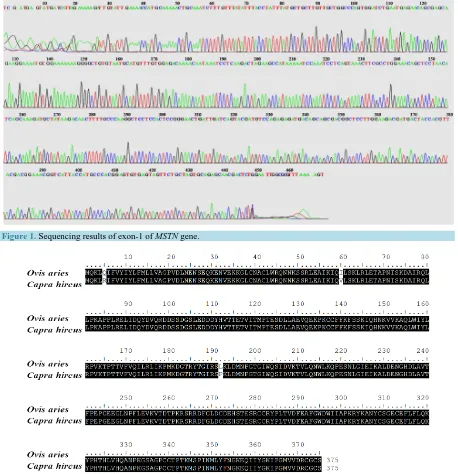
Sequencing was performed at Macrogen Inc. Korea, with an automated sequencer (Applied Biosystems) (Figure 1). The resulting sequences were aligned using the BioEdit program (BioEdit v5.0.9) and the obtained consensus sequences were used to compare it with GenBank caprine sequences using the BLAST algorithm [13]. The nucleotide sequences of exons 1, 2 and 3 of the GDF8 gene of Bakerwal goat were deposited in GenBank under Accession No KU980201, KU991727 and KX171679 respectively.
3. Results and Discussion
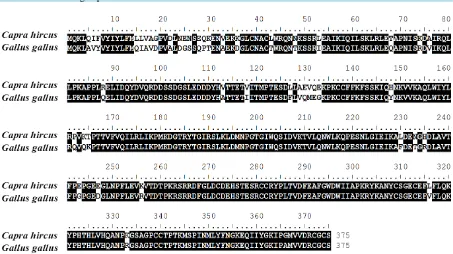
The ten goats sequenced did not show polymorphisms among themselves but 3 nucleotide variations were found when the goat myostatin gene was compared with the ovine myostatin gene. Exon 1 showed two alterations, the first was an A→G transition located at position 14 from the start codon and was responsible for the substitution of Glutamine with Arginine at position 5 of the protein chain. The second substitution was an A→G transver-sion at position 178 of the nucleotide sequence leading to a Isoleucine being replaced by valine at position 60 in the protein sequence. Exon 2 revealed the presence of one T→C transition at position 575 responsible for a Leu192Pro substitution in the amino acid sequence. No changes were observed in exon 3. All alterations in the presumed myostatin amino acids sequence as compared to ovine sequence are shown inFigure 2. And all alte-rations in the myostatin amino acids sequence as compared to other species of livestock animal sequences are shown inFigure 3 andFigure 4.
The observation of amplified fragments of the expected sizes and subsequent analysis of the obtained se-quences confirmed the amplification of the regions of interest, demonstrating the complete transferability of the primer pairs developed for Ovis aries to Capra hircus. This is important in terms of reducing the costs of ge-nome analysis of closely related species, as has been widely demonstrated for a large number of organisms, es-pecially plants [14].
Our result shows a high degree of conservation in Bakerwal goat myostatin compared to the ovine protein. The similarity and identity between the nucleotide and amino acid sequences from Ovis aries and Capra hircus were, as expected, high due to the close proximity of the species which belong to the same family Bovidae. Of the three alterations observed, none of the alteration could possibly represent a biological effect. Identifying mutations in sequences of myostatin gene using molecular techniques is an effective solution for the survey of double muscle phenotype and help the breeders to get important information in order to make the precise deci-sion for management and selecting the best population for reproduction and it lets the breeders to have a lot of data about genetic status of MSTN gene in livestock animals.
It could be inferred that the MSTN gene may be a major gene or linked to the major gene affecting the goat growth traits. The polymorphic site could be a molecular marker-assisted selection program for body weight. Mutations have effects on the MSTN protein structure and on the biological function of the MSTN protein [8]. In addition, missense mutation (p.Lys to Thr) locus have a direct effect on the MSTN gene expression or be closely correlated with traits affected by loci in the nearby region, but further verification is needed. Hadjipavlou et al.
Figure 1. Sequencing results of exon-1 of MSTN gene.
Figure 2. Comparative alignment of the presumed myostatin amino acid sequence from non double muscled Ovis aries
(ENSOARG00000016285) and Capra hircus. Shaded amino acids indicate matching sequence consensus.
quality traits of Bos taurus. In cattle breeds, an 11-bp deletion in the coding sequence of the MSTN gene deter-mines increased skeletal muscle mass, relevantly in shoulders and thighs, and the produced phenotype is known as double-muscling [19]. This supports the notion that further investigation of the MSTN variation in different goat breeds is needed. In goat breeds, a number of myostatin variants of different phenotypic consequence have been described across a variety of breeds [20], but there is scarcity of reports on the association analysis of SNPs with growth traits. The biochemical and physiological functions, indicate that the MSTN gene might play im-portant roles in affecting the growth traits in goats and other species of productive livestock animals.
4. Conclusion
Figure 3. Comparative alignment of the myostatin amino acid sequence from Bos taurus and Capra hircus. Shaded amino acids indicate matching sequence consensus.
Figure 4. Comparative alignment of the myostatin amino acid sequence from Gallus gallus and Capra hircus. Shaded amino acids indicate matching sequence consensus.
in Kashmir valley and also its comparison with other livestock species of animals.
References
[1] McPherron, A.C. and Lee, S.J. (1997) Double Muscling in Cattle Due to Mutations in the Myostatin Gene.
Proceed-ings of the National Academy of Sciences of the United States of America, 23, 12457-12461.
http://dx.doi.org/10.1073/pnas.94.23.12457
[image:5.595.87.540.326.580.2]http://dx.doi.org/10.1016/j.yexcr.2006.04.012
[3] Bellinge, R.H.S., Liberles, D.A., Iaschi, S.P.A. and O’brien, P.A. (2005) Myostatin and Its Implications on Animal Breeding. Animal Genetics, 36, 1-6. http://dx.doi.org/10.1111/j.1365-2052.2004.01229.x
[4] Schuelke, M., Wagner, K.R., Stolz, L.E., Hübner, C., Riebel, T., Kömen, W., Braun, T., Tobin, J.F. and Lee, S.J. (2004) Myostatin Mutation Associated with Gross Muscle Hypertrophy in a Child. The New England Journal of Medicine,
350, 2682-2688. http://dx.doi.org/10.1056/NEJMoa040933
[5] Mosher, D.S., Quignon, P., Bustamante, C.D., Sutter, N.B., Mellersh, C.S., Parker, HG. and Ostrander, E.A. (2007) A Mutation in the Myostatin Gene Increase Muscle Mass and Enhances Racing Performance in Heterozygote Dogs. PLoS
Genetics, 3, 779-786. http://dx.doi.org/10.1371/journal.pgen.0030079
[6] Stinckens, A., Bijttebier, J., Luyten, T., Van Den Maagdenberg, K., Harmegnies, N., De Smet, S., Georges, M. and Buys, N. (2005) Detection of Polymorphisms in the Myostatin Gene in Belgian Pietrain Pigs. Communications in
Agricultural and Applied Biological Sciences, 70, 37-41.
[7] Johnson, P.L., Dodds, K.G., Bain, W.E., Greer, G.J., McLean, N.J., McLaren, R.J., Galloway, S.M., van Stijn, T.C. and McEwan, J.C. (2009) Investigations into the GDF8 g+6273G-A Polymorphism in New Zealand Texel Sheep. Journal
of Animal Science, 87, 1856-1864. http://dx.doi.org/10.2527/jas.2008-1508
[8] Kambadur, R., Sharma, M., Smith, T.P. and Bass, J.J. (1997) Mutations in Myostatin (GDF8) in Double-Muscled Bel-gian Blue and Piedmontese Cattle. Genome Research, 7, 910-916.
[9] Grobet, L., Poncelet, D., Royo, L.J., Brouwers, B., Pirottin, D., Michaux, C., Menissier, F., Zanotti, M., Dunner, S. and Georges, M. (1998) Molecular Definition of an Allelic Series of Mutations Disrupting the Myostatin Function and Causing Double-Muscling in Cattle. Mammalian Genome, 9, 210-213. http://dx.doi.org/10.1007/s003359900727
[10] Sambrook, J. and Russell, D.W. (2001) Molecular Cloning: A Laboratory Manual. 3rd Edition, Vol. 1, Cold Spring Harbor Laboratory Press, New York.
[11] Li, X.L., Liu, Z.Z., Zhou, R.Y. and Zheng, G.R. (2008) Deletion of TTTTA in 5’UTR of Goat MSTN Gene and Its Distribution in Different Population Groups and Genetic Effect on Bodyweight at Different Ages. Frontiers of
Agri-culture in China, 2, 109. http://dx.doi.org/10.1007/s11703-008-0004-8
[12] An, X.P., Wang, W.G., Hou, J.X., Zhao, H.B., Bai, L., Li, G., Wang, L.X., Liu, X.Q., Xiao, W.P., Song, X.Y. and Cao, B.Y. (2011) Polymorphism Identification in the Goat MSTN Gene and Association Analysis with Growth Traits.
Czech Journal of Animal Science, 56, 529-535.
[13] Altschul, S.F., Gish, W., Miller, W., Myers, E.W. and Lipman, D.J. (1990) Basic Local Alignment Search Tool.
Jour-nal of Molecular Biology, 215, 403-410. http://dx.doi.org/10.1016/S0022-2836(05)80360-2
[14] Katzir, N., Danin-Poleg, Y., Tzuri, G., Karchi, Z., Lavi, U. and Cregan, P.B. (1996) Length Polymorphism and Ho-mologies of Microsatellites in Several Cucurbitaceae Species. Theoretical and Applied Genetics, 93, 1282-1290.
http://dx.doi.org/10.1007/BF00223461
[15] Hadjipavlou, G., Matika, O., Clop, A. and Bishop, S.C. (2008) Two Single Nucleotide Polymorphisms in the Myosta-tin (GDF8) Gene Have Significant Association with Muscle Depth of Commercial Charollais Sheep. Animal Genetics,
39, 346-353. http://dx.doi.org/10.1111/j.1365-2052.2008.01734.x
[16] Boman, I.A. and Vage, D.I. (2009) An Insertion in the Coding Region of the Myostatin (MSTN) Gene Affects Carcass Conformation and Fatness in the Norwegian Spaelsau (Ovis aries). BMC Research Notes, 2, 98.
http://dx.doi.org/10.1186/1756-0500-2-98
[17] Stinckens, A., Luyten, T., Bijttebier, J., Van den Maagdenberg, K., Dieltiens, D., Janssens, S., De Smet, S., Georges, M. and Buys, N. (2008) Characterization of the Complete Porcine MSTN Gene and Expression Levels in Pig Breeds Dif-fering in Muscularity. Animal Genetics, 39, 586-596. http://dx.doi.org/10.1111/j.1365-2052.2008.01774.x
[18] Esmailizadeh, A.K., Bottema, C.D.K., Sellick, G.S., Verbyla, A.P., Morris, C.A., Cullen, N.G. and Pitchford, W.S. (2008) Effects of the Myostatin F94L Substitution on Beef Traits. Journal of Animal Science, 86, 1038-1046.
http://dx.doi.org/10.2527/jas.2007-0589
[19] Gill, J.L., Bishop, S.C., McCorquodale, C., Williams, J.L. and Wiener, P. (2009) Associations between the 11-bp Dele-tion in the Myostatin Gene and Carcass Quality in Angus-Sired Cattle. Animal Genetics, 40, 97-100.
http://dx.doi.org/10.1111/j.1365-2052.2008.01790.x