Munich Personal RePEc Archive
Fraternities and labor market outcomes
Popov, Sergey V. and Bernhardt, Dan
University of Illinois
7 October 2009
Online at
https://mpra.ub.uni-muenchen.de/26522/
Fraternities and Labor Market Outcomes
∗
Sergey V. Popov
Department of EconomicsUniversity of Illinois
Dan Bernhardt
Department of EconomicsUniversity of Illinois
Draft: October 7, 2009
Abstract
We model how the choices by students to “rush” a fraternity, and the choices by a fraternity of whom to admit, interact with the signals that firms receive about student productivities to determine labor market outcomes. Both the fraternity and students care about future wages and fraternity socializing values. We first show that if the signals firms receive about students are either perfectly informative or perfectly noisy, then fraternity membership has no impact on labor market outcomes. For intermediate signaling technologies, however, three types of equilibria can exist: pessimistic beliefs by firms about the abilities of fraternity members can support an equilibrium in which no one pledges; optimistic beliefs can lead to higher wages for fraternity members than non-members, so that in equilibrium everyone whom the fraternity would like to admit actually pledges; and an equilibrium in which most fraternity members have intermediate abilities—less able students apply, hoping to be mixed in with better students, but are rejected unless they have high fraternity socializing values, while most very able students do not apply to avoid being tainted in labor market outcomes due to being mixed in with less able fraternity members. We provide sufficient conditions for this latter “hump-shaped” equilibrium to exist, take the model to the data and show that this equilibrium can reconcile the ability distribution of fraternity members at the University of Illinois. Finally, we estimate the welfare impact of the fraternity on different students.
Keywords: Signaling, fraternities, statistical discrimination JEL: J31, D82, H4
∗We thank George Deltas, Odilon Camara and participants at the Midwest Economics Association Annual
1
Introduction
To many, the word “fraternities” brings to mind images of beer, parties and fun. Yet,
frater-nity membership also enters prominently the job seeking process of many students: resumes
often devote scarce space to highlighting a student’s society memberships in addition to the
standard information about education, work experience, awards, etc. This suggests that
fraternity membership helps employers evaluate a person’s productivity. On first
impres-sion it is not clear why fraternity or sorority membership should matter for labor market
outcomes. In particular, while fraternities make significant time demands — members must
spend considerable time picking up trash on highways, raising money for charitable causes, and so on — these activities appear largely unrelated to skill development for future careers.
Nonetheless, fraternities draw many applicants who eagerly spend money and devote time
to these activities, and employers seem to weigh membership information positively.
We develop a theory of fraternity membership and filtering by firms that makes sense of these observations. Students are distinguished by a fraternity socializing value and their
productivity as a worker. Fraternities value both the future wages generated by members
and their socializing values. Firms combine information in noisy signals about student
pro-ductivities with fraternity membership status to set wages. To emphasize the key economic
forces, we suppose that fraternity socializing values are not directly valued by firms and also
that they are uncorrelated with worker productivities. We further assume away all
stan-dard club features for fraternities as in Buchanan [1965], so that there are no consumption
spillovers due to the presence of other students. So, too, we assume away any networking
services that a fraternity might provide. As a result, the fraternity membership statuses of other students only affect job market outcomes for a given student via the equilibrium beliefs
that firms form about the distribution of abilities of fraternity members and non-members.
We first identify sufficient conditions for fraternity membership not to matter for job
mar-ket outcomes. In particular, we show that if the signal that firms receive about a student’s productivity is either perfectly informative or perfectly noisy, then equilibrium wages do not
fra-ternity depends only on his frafra-ternity socializing value. If signals are perfectly informative,
fraternities trade off between productivity and socializing value in admission, but a student’s
wage will equal his known productivity, rendering membership irrelevant for labor market outcomes. If, instead, signals are perfectly noisy, a fraternity would like to commit to
exclud-ing low ability students with high socializexclud-ing value, and to acceptexclud-ing high ability students
with low socializing value. However, with perfectly noisy productivity signals, firms have no
source other than fraternity membership for evaluating a student’s ability, so that
fraterni-ties weigh only socializing values in admission. As a result, fraternity membership conveys
no information to firms about ability, so that wages do not hinge on fraternity membership.
In sum, we show that for fraternity membership to affect job market outcomes, firms
must receive signals about a student productivities that are noisy, but not perfectly so.
Then, because more productive students tend to earn higher wages, fraternities trade off
between productivity and fraternity socializing values when deciding which pledge applicants
to accept. In particular, fraternities accept students with low socializing values who are
sufficiently able. Students may face a different type of trade off—more able students may
incur a labor market cost from joining a fraternity, as their fraternity membership may lump them in with intermediate quality students, making it harder for the able students
to distinguish themselves in the eyes of firms. In such a situation, sufficiently more able
students may be reluctant to pledge fraternities.
We then turn to a three-signal setting in which we can explicitly solve for the multiple equilibria that emerge in the fraternity game. We identify three types of equilibria: (a) an
“empty fraternity” equilibrium in which no student applies to the fraternity, supported by
beliefs of firms that any student who joins the fraternity is especially lacking in ability; (b) a
“hump-shaped” equilibrium in which most fraternity members have intermediate abilities—
less able students apply, but are rejected unless they have high fraternity socializing values,
while very able students who do not have very high fraternity socializing values do not apply;
and (c) an equilibrium in which employer beliefs about the abilities of fraternity members
are more optimistic—so that fraternity membership would increase the expected wage of
each student type. In these latter two equilibria, relatively low ability students expect higher wages if they gain fraternity membership than if they do not; while in the second equilibrium,
fra-ternity membership may taint labor market outcomes for high ability students, but not low.
We return to a more general signal framework, in which we only assume that the
con-ditional distribution of ability signals that firms receive satisfies the monotone likelihood
ratio property—more able students are more likely to generate higher signals. We then
pro-vide gross sufficient conditions for non-trivial equilibria to have the hump-shaped feature.
In particular, these sufficient conditions imply that the wage premium due to fraternity
membership declines with ability—the lowest ability fraternity members always receive a particularly large wage premium, as their membership ensures that they are separated away
from all lower ability types, and are mixed in with relatively higher proportions of more able
types, while high ability types gain less (or lose) from being mixed in with less able fraternity
members. The hump-shaped equilibrium then emerges, due to the filtering by fraternities of
low ability students, and, when membership costs are of an appropriate magnitude relative
to socializing values, the reluctance of high ability students to join.
Finally, we investigate whether equilibria of our three-signal model are consistent with
actual practice. To do this, we obtain data on cumulative GPAs of seniors at the
Univer-sity of Illinois for fraternity members and non-members. Using GPA as a noisy indicator
of ability, we find that the equilibrium in which most fraternity members have intermediate
abilities—where high ability students are tainted by membership in fraternities—can
gener-ate a distribution over probability of membership conditional on ability that closely mirrors
the distribution over the probability of fraternity membership conditional on GPA found in the data. We back out plausible estimates of primitives—the time costs of fraternity
par-ticipation, and the tradeoffs of both students and fraternity between socializing values and
future wages. We use these estimates to derive how the presence of the fraternity affects the
welfare of different student types.
We next review the literature and then provide a brief overview of fraternities. In section
2 we develop our model and analysis. Section 3 considers a three signal setting. Section 4
returns to a general setting and provides sufficient conditions for all non-trivial equilibria to
exhibit the hump-shaped pattern that we find in the data. Section 5 provides our empirical
1.1
Related Literature
Our model and analysis can be integrated into the endogenous statistical discrimination
lit-erature. The closest papers are Moro and Norman [2004] and Austen-Smith and Fryer [2005].
Moro and Norman [2004] consider a setting in which individuals choose whether to make a costly investment in education, when firms receive noisy signals of that investment.1 They
show how a productivity irrelevant aspect such as racial identity can affect investment choices
if firms believe that one population is more likely to invest.2 In particular, one can support
multiple equilibria, one where beliefs do not depend on race, and one where they do.3,4 So,
too, in our economy, the essence is how the beliefs of firms about the abilities of workers
who generate different signals are affected by the equilibrium fraternity membership status.
One difference between our economy and this literature is that fraternity membership in our
economy is not productivity enhancing, and uncertainty does not relate to whether or not an investment was made. More importantly, race is exogenous, while fraternity membership
is endogenous; in particular, fraternity membership is notsolely determined by the student,
but rather is the outcome of an admission game played by the fraternity and students.
Austen-Smith and Fryer [2005] consider a setting in which a “peer group” generates ad-ditional utility from leisure for its members, and this drives members to shift time allocation
toward less education, which leads to lower wages. Those who are rejected by the peer group
study more, “acting white”.
1
See also Coate and Loury [1993], Fang and Norman [2006] and Norman [2003] for related models.
2
Fang [2001] considers a variant in which firms interpret participation in an irrelevant activity as a signal that the agent has a low investment cost, and assign agents who signal to the job where such investment is productive. By way of contrast, ours is not a signaling model (indeed, sufficiently higher ability students are
reluctantto join), and the information content of fraternity membership is determined by the equilibrium
interaction between the fraternity and different student types.
3
We could augment our economy to have firm beliefs depend on race as well, with the result that race will enter both the decision of whether to apply to a fraternity, and the decision by the fraternity of whether to accept an applicant.
4
1.2
Fraternities and Sororities
To ease presentation, we drop gender differences and refer to both fraternities and sororities
as “fraternities”. The first club-like fraternity with a centralized organization, was Kappa
Alpha Society, founded in 1825. For a history and current status of fraternities, see Anson and Marchesani [1991].
Fraternities require pledge applicants to submit extensive information about themselves:
their school GPA, recommendations, interests and useful skills. Fraternities devote far more
time to evaluating applicants than do potential employers. In particular, almost all fraternity applicants are interviewed, and applicants take part in an extensive series of activities during
the evaluation process. For example, Sigma Chi requires a potential member to spend one
year working for the fraternity before the pledge. This suggests that fraternities are
well-situated to evaluate a pledge applicant’s ability, so that fraternity membership can provide
firms with valuable information.
Fraternities rely on membership fees and donations to fund activities. A substantial share
of a fraternity’s income comes from alumni donations. Because high income alumni donate
more, fraternities care about the future job market outcomes of members. An indication of
the value that fraternities place on productive members is that GPA-based stipends to
frater-nity members are widespread. Fraternities frequently reject pledge applicants. Conversely,
many highly-productive students choose not to apply to fraternities. Finally, students almost
never join more than one fraternity. This reflects both secrecy issues (secret handshakes, for example, allow one member to verify the membership status of others), and because
frater-nity activities are quite time-consuming.
2
The Fraternity Game
There is a population of measure 1 of students. A student is fully described by his future
employment productivity θ and his fraternity socializing value, µ. Students have separable preferences over income and fraternity membership: a non-member’s payoff corresponds to
utility
M +nµ,
where n > 0. M equals the student’s expected lifetime future wage minus the monetary value cof the time costs of fraternity service activities. Note that to sever all links with the club-good literature, we assume away any externalities from the socializing values of other
fraternity members. So, too, to ensure that there is no direct link between productivity
and membership, we assume that θ and µare uncorrelated in the population. That is, the density over θ and µ is given by
h(θ, µ) = hθ(θ)hµ(µ),
where the bounded supports ofθandµare given by[θ,θ¯] and [µ,µ¯], respectively, andθand ¯µ
are both positive. The associated cdf isH, and the measurem, used in some proofs, is based on H. We emphasize that while we believe that socializing skills and productivity may be correlated in practice, we assume such correlation away in order to highlight the impact of application decisions by students and filtering by fraternities on the equilibrium distribution
of abilities in the fraternity.5
There is a single representative fraternity that chooses which “rush” applicants to admit.
The fraternity cares about both the future market wages that its members will obtain, and
the socializing values of its members. For simplicity, we assume that the fraternity has
separable linear preferences over wages and socializing values, so that the fraternity’s payoff from members (θ, µ) in the set C of fraternity members is given by
Z
(θ,µ)∈C
[W1Eeθ(wC(θe|θ)) +W2µ]h(θ, µ)dθdµ,
where W1 > 0 and W2 ≥ 0. We assume that the fraternity is limited by space constraints
to admitting at most a measure Γ of students: in practice, a fraternity house has a
lim-ited number of bedrooms. This means that the fraternity will tradeoff between µ and θ
in admission—trading off future higher contributions from more able and hence wealthier
alumni against their social contribution.
5
Our analysis is qualitatively unaffected by alternative preferences of the fraternity that
continue to induce the fraternity to tradeoff between socializing value and ability in
admis-sions. In particular, qualitatively identical outcomes obtain if the fraternity did not face a space constraint, but instead cared about the average socializing value of its members (say
due to externalities), in addition to the future wages that members earn. So, too, outcomes
are qualitatively unaffected if the fraternity, rather than facing a space constraint, incurred
costs that were a convex function of the measure of members (say due to cramming more
students into each room), or if the fraternity cared about the market value of the time
contributions of its members.
After graduation, students are employed by firms. We assume that several risk-neutral
firms make simultaneous wage offers to students. The firms do not observe an individual
student’s productivityθ or fraternity socializing valueµ. However, firms do observe whether a student is a member of a fraternity. Firms also observe a common signal ˜θ about the student’s productivity θ, where ˜θ is distributed according to Fθ˜(·|θ). We assume that more
able students are more likely to generate higher signals: Fθ˜(˜θ|θ) is strictly decreasing in θ
for all (θ,θ˜) with Fθ˜(˜θ|θ) ∈(0,1). Competition drives firms to offer each individual a wage
equal to his expected productivity given his fraternity membership status and ability signal, ˜
θ.
There are four stages to our “fraternity rush” game. At stage one, each student type (θ, µ) decides whether to apply for fraternity membership. We leta(θ, µ) be an indicator function taking on the value 1 if student type (θ, µ) applies, and taking on the value 0 if the student type does not apply. We sometimes use the setA={(θ, µ)|a(θ, µ) = 1}. At stage 2, the fra-ternity chooses which applicants to accept. We letbA(θ, µ) be an indicator function taking on the value 1 if, given the set of applicantsA, the fraternity would admit a student type (θ, µ) who applied, and taking on the value 0 otherwise. We useBA={(θ, µ)|bA(θ, µ) = 1}to rep-resent the set of admitted student types. Then, the set of fraternity member types is CA=
{(θ, µ)|a(θ, µ)bA(θ, µ) = 1}, and the set of nonmembers is ¯CA ={(θ, µ)|a(θ, µ)bA(θ, µ) = 0}. At stage 3, firms see whether an individual is a fraternity member, and they see a noisy
of the fraternity, and ρF (θ, µ) = 0 if not. Finally, wC(˜θ) denotes the wage of a fraternity member who emits the signal ˜θ, andwC(˜θ) denotes the wage of a non-member who generates signal ˜θ. At stage 4, a worker with productivity θ produces output with value θ.
An equilibrium is a collection of functions, {a(θ, µ), bA(θ, µ), wC(˜θ), wC(˜θ)} and firm beliefsρF (θ, µ) such that
i) Students optimize: a(θ, µ) = 1 ifE[wC(˜θ)|θ] +nµ−c≥E[wC(˜θ)|θ]; 0 otherwise. We let A∗ be the associated set of fraternity applicants.
ii) For every A the fraternity optimizes: BA solves
Problem 1
max BA
Z
(θ,µ)∈A∩BA
[W1E[wC(˜θ)|θ] +W2µ]h(θ, µ)dθdµ (1)
subject to m(A∩BA)≤Γ.
iii) wages are competitive given beliefs by firms ρF(θ, µ):
wC(˜θ) = R
Cθh(θ, µ)ρF(θ, µ)fθ˜(˜θ|θ)dθdµ R
Ch(θ, µ)ρF (θ, µ)fθ˜(˜θ|θ)dθdµ
; wC(˜θ) = R
Cθh(θ, µ) (1−ρF(θ, µ))fθ˜(˜θ|θ)dθdµ R
Ch(θ, µ) (1−ρF(θ, µ))fθ˜(˜θ|θ)dθdµ
.
iv) Firm beliefs are consistent with choices of student types and fraternity: For a.e. (θ, µ),
ρF(θ, µ) =a(θ, µ)bA∗(θ, µ).
Off-equilibrium path characterizations are not intrinsically interesting, and to ease
presen-tation, we only characterize equilibrium path outcomes. Moreover, measure zero
perturba-tions of the fraternity’s acceptance setBA∗ are uninteresting—any measure zero perturbation
toBA∗ is also part of an equilibrium, so we focus on a best response of the fraternity that is
agood set, i.e., a setBA∗ that is equal to the closure of its own interior. Finally, to simplify
notation, we omit the A∗ index on the equilibrium acceptance set.
We begin by providing conditions under which fraternity membership has no effect on
labor market outcomes.
i.e., wC(˜θ) = wC(˜θ), for all θ˜. Hence, a student type (θ, µ) applies for membership in the fraternity if and only if nµ−c≥0.
0 0.2 0.4 0.6 0.8 1
0 0.1 0.2 0.3 0.4 0.5 0.6 0.7 0.8 0.9 1
µ
θ
Fraternity members Welcome to join but don’t apply
Try to join but are rejected Don’t apply, would be
[image:11.612.168.432.112.342.2]rejected
Figure 1: Perfect signaling equilibrium.
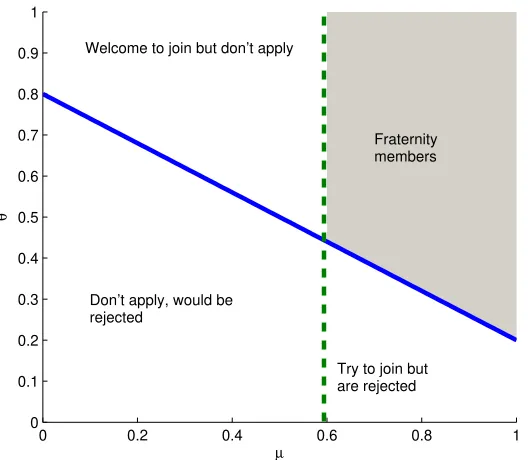
Suppose signaling is perfect. Then wC(˜θ) = wC¯(˜θ) = ˜θ =θ (a.e.). Optimization by
stu-dents then implies that a student type (θ, µ) applies if and only if nµ−c≥0, independently of θ. In contrast to students, the fraternity selectively admits higher θ applicants who will earn higher wages. In particular, the fraternity trades off betweenµand θ in admission; let-tingµB(θ) denote the boundary of the admission set, indifference implies that the boundary has slope dµB(θ)
dθ =
−W1
W2 . Figure 1 illustrates the equilibrium. The solid line is the fraternity’s
equilibrium cutoff rule—all types to the right of the line who apply are accepted, while all
those to the left are rejected. The vertical dashed line represents the accept-or-reject line of students—student types to the right apply in equilibrium, i.e., are in the set A. Hence, the equilibrium set C of fraternity members consists of those types to the right of both the dashed and solid lines, and the measure of the set C is at most Γ.
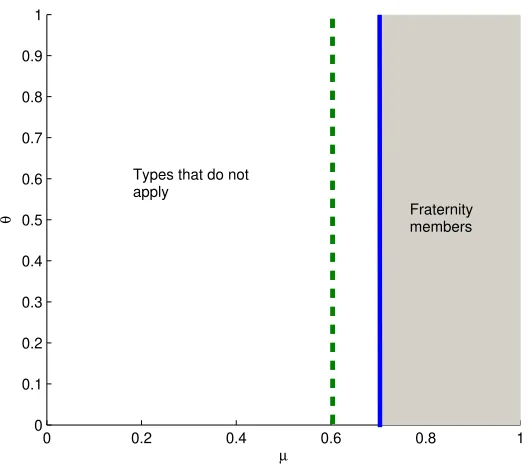
If, instead, signals are completely uninformative, then all individuals receive the same
wage, wC(˜θ) = wC¯(˜θ) = E[θ]. A fraternity would like to commit to excluding low θ
values. However, since firms have no source other than fraternity membership for evaluating
a student’s ability, all fraternity members must receive the same wage. But then, givenany
beliefs that firms hold about the abilities of fraternity members, the fraternity’s optimal admission policy only depends on µ, admitting a type (θ, µ) if and only if µ exceeds some critical cutoff. Hence, fraternity membership conveys no information to firms aboutθ. As a result, in equilibrium, both fraternity and non-fraternity members receive wage E[θ]. Since wages do not depend on membership, it follows that only students withnµ≥capply. Figure 2 illustrates this uninformative signal case.
0 0.2 0.4 0.6 0.8 1
0 0.1 0.2 0.3 0.4 0.5 0.6 0.7 0.8 0.9 1
µ
θ Fraternitymembers
[image:12.612.166.432.222.456.2]Types that do not apply
Figure 2: Contentless signaling equilibrium.
Although we do not explore it further, the case of completely uninformative signals about
abilities highlights the gains that fraternities may achieve from an ability to commit to their
admission policies. In particular, the fraternity would like to commit to excluding low ability
students who have moderately high socializing values, and to accepting high ability students
with lower socializing values. In practice, imperfect commitment devises that fraternities use
include having university officials report the average GPA of members, and having the Greek
council forbid fraternity participation to students with GPAs below some standard. This
and thereby raising the fraternity’s payoff.
The central implication of Proposition 1 is that for fraternity membership to affect job
market outcomes, firms must receive signals about student productivities that are noisy, but
not perfectly so. Then, because more productive students tend to earn higher wages,
fra-ternities value both productivity and fraternity socializing value, and will tradeoff between
the two in admission. We now examine the choice problems of students and the fraternity
in more detail.
2.1
Student’s Problem
Students compare the expected payoffs from being a fraternity member and not, taking
into account both the consequences for expected wages, and his fraternity socializing value.
Optimization implies that a student type (θ, µ) applies for fraternity membership if and only if
Eθ˜
h
wC(˜θ)|θi+nµ−c≥Eθ˜
h
wC(˜θ)|θi. (2)
That is, a student applies to the fraternity either to obtain higher expected wages, or
be-cause his fraternity socializing value µ is sufficiently high.6 The following result follows
straightforwardly.
Proposition 2 If a(θ, µ) = 1, then a(θ, µ′) = 1, for all µ′ > µ.
Proof. The expected wages of individuals (θ, µ) and (θ, µ′) are the same, but a type (θ, µ′)
student gains strictly more utility from joining the membership.
Corollary 1 The equilibrium supply of fraternity applicants is summarized by a continuous
function µA(θ) such that a type (θ, µ) student applies if and only if µ≥µA(θ).
Proof. The result follows because expected wages of fraternity and non-fraternity members
are continuous inθ. Therefore, student payoffs and hence choices are continuous in expected wages.
6
If (2) holds, then student type (θ, µ) applies even if he expects to be rejected by the fraternity. If
2.2
Fraternity’s Problem
In any equilibrium, the fraternity offers membership to the set of students B that solves Problem 1. The setsAand B implicitly define the set of fraternity members C =A∩B and the set of nonmembers C. Since the fraternity’s payoff is increasing in the socializing values of its members, we have
Proposition 3 For almost all (µ, θ) in ATB, almost all types (θ, µ′) with µ′ > µ also belong to B.
Proof. See the appendix.
We next show that we can extend this characterization to establish that the fraternity
also wants to admit students who are more able as long as expected wages are increasing
in θ; and expected wages are increasing in θ if wC(˜θ) is increasing in ˜θ. As a preliminary step, we present an implication of the MLRP property on signals (see Milgrom [1981]) for
equilibrium wages.
Lemma 1 Assume that f(θ|θ˜) > 0 on [θ,θ¯], and that f(θ|x) satisfies the MLRP property. Fix a set D ⊂ Θ×Θ˜ with P(˜θ =k|θ˜∈ D) <1 for all signals k. Let Q(˜θ) = E(θ|θ, D˜ ) be a firm’s estimate of ability given signalθ˜and set D. Then from the perspective of a student with ability θ, his expected wage Eθ˜[Q(˜θ)|θ, D], increases with his ability θ.
Proof. See the appendix.
Proposition 4 Suppose that the signals that firms receive about student abilities have the
MLRP property. Then for almost all (θ, µ)if b(θ, µ) = 1, we have b(θ′, µ) = 1 for almost all
θ′ > θ.
Proof. By Lemma 1, the expected wage Eθ˜[wC(˜θ)|θ] is an increasing function of θ. The logical construction of Proposition 3 then applies.
Propositions 3 and 4 pin down the attributes of the set B of student types that the fra-ternity would admit. For example, if every student whom the frafra-ternity would want to admit
0 0.2 0.4 0.6 0.8 1 0
0.1 0.2 0.3 0.4 0.5 0.6 0.7 0.8 0.9 1
µ
θ
[image:15.612.175.423.56.258.2]Applicant types accepted by Fraternity
Figure 3: Unconstrained admissions set B.
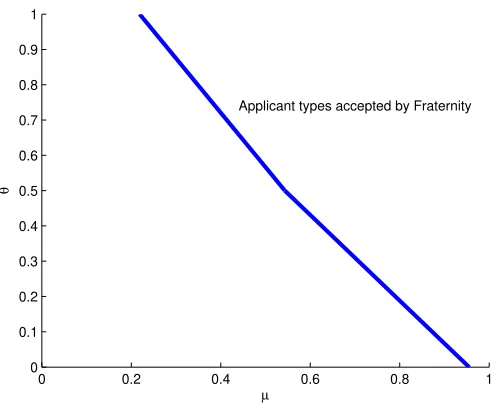
admits almost every student type above (Proposition 4) and to the right (Proposition 3) of
this curve (see Figure 3), i.e., B = {(θ, µ)|µ ≥ µB(θ)}, and C = ATB. Both µA(θ) and
µB(θ) are continuous in θ, reflecting the continuity of expected wages in θ.
More generally, for almost all θ where the fraternity’s admission decision is not con-strained by student application, i.e., for almost all θ with µB(θ) > µA(θ), the fraternity trades off linearly between expected wage and fraternity socializing value in admission. That is, forθ1, θ2 with µB(θj)> µA(θj), j = 1,2, we have
W1E(wC(˜θ)|θ1) +W2µ(θ1) =W1E(wC(˜θ)|θ2) +W2µ(θ2).
That is, marginal contributions of these marginal types, (θ1, µB(θ1)) and (θ2, µB(θ2)) are
equal.7
2.3
Existence of equilibrium
We first characterize when the “empty fraternity” is an equilibrium. In this “Groucho Marx”
equilibrium, the fraternity would accept anyone who applies, but no one applies because firms
7
This result extends if we relax the structure on the fraternity’s preferences, so that preferences over
aggre-gate wages and socializing values are non-linear,W(m(EwC(˜θ)), m(µ|C)). Then, the appropriate marginal
believe that anyone who joins the fraternity has low abilityθ and hence would be given wage
wC(˜θ) = θ. If no one joins the fraternity, then someone who generates signal ˜θ receives wagewC¯(˜θ) =E[θ|θ˜]. Let w=Eθ˜[wC¯(˜θ)|θ] be the wage that a student with lowest ability θ expects if he does not join the fraternity in this scenario.
Proposition 5 Suppose that the signaling technology has a full support property, f(θ|x) >
0,∀x. Then an equilibrium exists with A =C =∅ if and only if nµ¯−c≤w−θ.
Proof. See the appendix.
If nµ¯−c ≤ w−θ, then pessimistic firm beliefs can support the empty fraternity equi-librium. However, if the inequality does not hold, then sufficiently inept students with high
socializing values would prefer to join the fraternity because they also expect to receive low
enough wages outside the fraternity that the maximum wage cost from joining the fraternity is more than offset by their high socializing values.
We next prove that an equilibrium always exists to this fraternity game, establishing a
fixed point to a mapping from conjectured optimal student application and fraternity
admis-sion choices by firms to the best responses to those conjectures by students and fraternities. To do so, we exploit Propositions 2 and 4 and consider continuous student and fraternity
choice functions µA(·) and µB(·), where a student type (θ, µ) is a member of the fraternity if and only if µ≥ max{µA(θ), µB(θ)}. Existence of equilibrium then follows from standard fixed point theorems.
Proposition 6 An equilibrium exists to the fraternity game.
Proof. See the appendix.
3
Three Signal Economy
To gain explicit insight into the equilibria of this fraternity game, we next consider an
economy in which student productivities and fraternity socializing values are uniformly
able students withθ > 0.5 generate either medium or high signals, where the probability of a high signal is linearly increasing in ability; and that less able students withθ <0.5 generate either low or medium signals:
P rob(H|θ) = 2θ−1, θ > 1
2 and 0 otherwise.
P rob(L|θ) = 1−2θ, θ < 1
2 and 0 otherwise.
P rob(M|θ) = 1−P rob(L|θ)−P rob(H|θ).
This signal technology obviously satisfies the MLRP property. Its central feature is that
a student with θ < 0.5 hopes to get lucky and receive a medium signal, and thereby be indistinguishable from a student with θ >0.5 who unluckily receives a medium signal.
Let wC(˜θ) be the wage that a fraternity member who generates signal ˜θ receives and
wC¯(˜θ) be the wage that a non-member who generates signal ˜θ. The expected wage of a
student with abilityθ who joins the fraternity is
EwC
˜
θ|θ=wC(H)P rob(H|θ) +wC(M)P rob(M|θ) +wC(L)P rob(L|θ).
An analogous expression describes wages of students who are not fraternity members.
The piecewise linear structure of the signaling technology implies that the expected wage functions are piecewise linear in θ with a single kink at θ= 1
2. It follows that the boundary
describing the set of students that the fraternity would admit, where not limited by students’
application decisions, is also linear with a kink at θ = 1
2. Since the difference in wages of
fraternity members and non-members is linear with a kink atθ = 1
2, the boundary of the set
of applicants to the fraternity,µA(θ), is also linear with a kink atθ = 12. Therefore, the set of fraternity members,{(µ, θ)|µ≥max{µA(θ), µB(θ)}}, is described by a continuous piecewise-linear function from [0,1] to [0,1] that has one or two kinks, where one kink is at θ = 0.5, and the other (if it exists) is at the intersection of the fraternity and student cutoff rules.
One equilibrium is obviously the “empty fraternity”, but there are also more interesting
equilibria. In particular, given Γ, we search for (i) an equilibrium in which the boundary
µA(θ) of A is everywhere to the left of the boundary µB(θ) of B, i.e., where every student that the fraternity would want is admitted and (ii) an equilibrium in whichµA(θ) and µB(θ) intersect, so the piecewise-linear function describing the frontier of the set of fraternity
(the slope and intercepts of the three lines plus the intersection point of the student and
fra-ternity frontier, plus six wages) and thirteen equations (6 equations from the firm’s problem
— wages equal expected skill given signal realization and membership status, 4 equations from the fraternity and 3 equations from the students). We solve this system numerically
for the associated equilibrium outcome, when it exists.
0 0.2 0.4 0.6 0.8 1
0 0.1 0.2 0.3 0.4 0.5 0.6 0.7 0.8 0.9 1
µ
θ
Fraternity members
[image:18.612.168.431.167.381.2]Want to join the fraternity, but are rejected
Figure 4: Application-unconstrained equilibrium.
In our base parameterization, student utilities are M +nµ, with n= 0.18, student time costs of participating in the fraternity arec= 0.09, the fraternity trades off between wages and socializing value according to W1
W2 = 1.1, and the fraternity’s capacity is Γ = 0.35. Figure
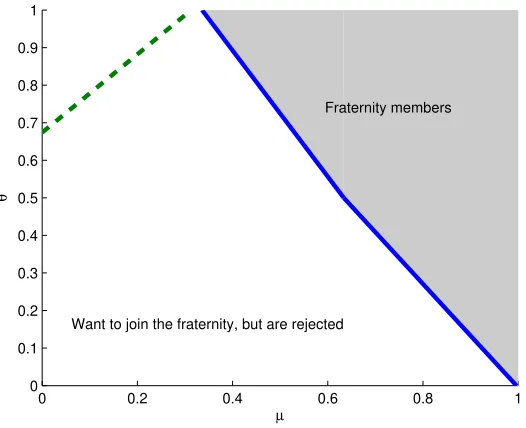
4 illustrates the unique “application-unconstrained” equilibrium. In this equilibrium firms
have optimistic beliefs about the productivities of fraternity members, so that given any
signal emitted by a student, his wage is higher if he is a member of a fraternity than if he
is a non-member. As a result, in this equilibrium every student whom the fraternity would
like to admit chooses to apply—and, indeed, because wC(H) = 0.8480 > wC(H) = 0.8143, only very productive people with especially low socializing values choose not to apply (and
while less productive students apply, most are rejected).
However, for exactly the same parameterization, there is also an “application constrained”
0 0.2 0.4 0.6 0.8 1 0
0.1 0.2 0.3 0.4 0.5 0.6 0.7 0.8 0.9 1
µ
θ
Fraternity members
Want to join the club, but are not accepted
[image:19.612.166.431.57.273.2]Desired by fraternity, but don’t apply
Figure 5: Application constrained fraternity game equilibrium.
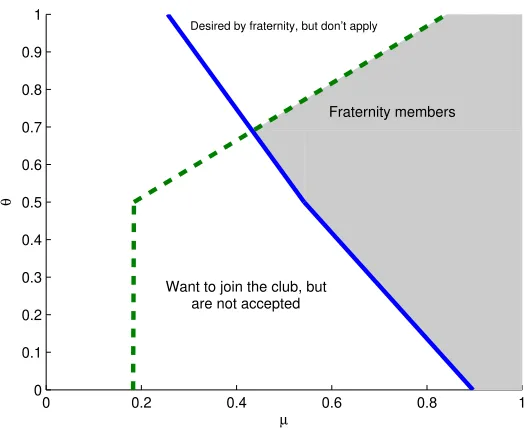
Figure 5 depicts this equilibrium: the solid line denotes the fraternity’s cutoff rule, and
dashed line denotes locus of students who are indifferent between joining the fraternity and
not. In this equilibrium, firms hold more pessimistic beliefs about the abilities of fraternity
members, so that higher ability students are more reluctant to join the fraternity.
Inter-mediate quality students remain eager to join, and the fraternity’s composition is radically
shifted to reflect this population. Comparing the fraternity’s cutoff line in Figure 4 with that
in Figure 5 reveals that the fraternity is less “picky” when its choice set is constrained by
the reluctance of able students to apply. Because able typesθ = 1 expect lower wages inside the fraternity than out, wC(H) = 0.7940 < wC¯(H) = 0.8555, the fraternity attracts only a
small fraction of able students, and the bulk of its members have intermediate abilities.
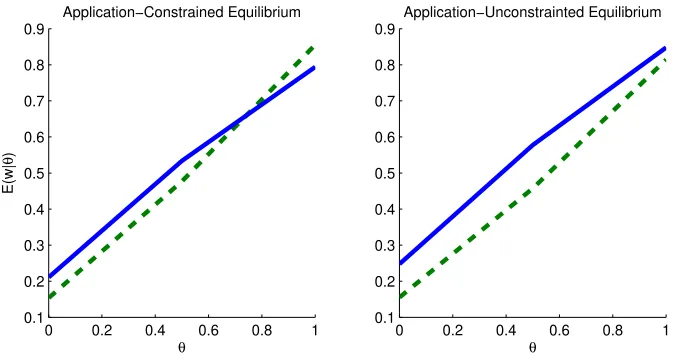
Figure 6 presents the expected wage that a student with abilityθ would receive as a fra-ternity member and non-member for these two equilibria. Notice the crossing of wages in the
application-constrained equilibrium. This reflects that while all lower ability student receive higher wages as fraternity members, higher θ students in the application-constrained equi-librium accept a direct loss in wage by joining the fraternity, for which they are compensated
by high socializing values.
0 0.2 0.4 0.6 0.8 1 0.1
0.2 0.3 0.4 0.5 0.6 0.7 0.8 0.9
Application−Unconstrainted Equilibrium
θ
0 0.2 0.4 0.6 0.8 1
0.1 0.2 0.3 0.4 0.5 0.6 0.7 0.8 0.9
Application−Constrained Equilibrium
θ
E(w|
θ
[image:20.612.131.470.46.226.2])
Figure 6: Equilibrium Wages. The solid line is the expected wage of a fraternity member (as a function ofθ), and the dashed line is the expected wage of a nonmember.
then all existing members of the fraternity would still apply, and the fraternity’s payoff would
be increased. This observation implies that were we to replace the fraternity’s capacity
con-straint with a strictly convex cost function of admitting more members, the fraternity would
admit more members when beliefs of firms about member abilities are optimistic, thereby
encouraging able students to apply.
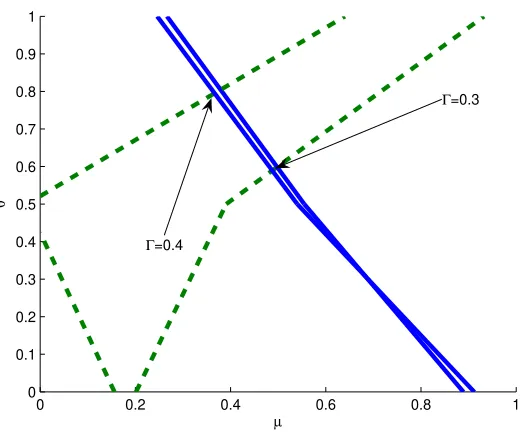
Figure 7 reveals how the fraternity’s capacity affects equilibrium outcomes.
Interest-ingly, raising capacity can raise the wages of able fraternity members. Essentially, when
Γ is increased, the mix of students that the fraternity admits shifts slightly toward more
able students with lower socializing values, i.e., toward students with higher θs and lower values ofµ. But this raises the expected wages of able students who join the fraternity. But then, able students are more willing to join—there is a significant increase in the measure of
able students who apply to the fraternity. Notice also that as Γ increases, the slope of the boundary characterizing the application decision of less able students withθ ∈[0,12] changes. This result reflects a change in the relative slope of wage functions: when, among students
0 0.2 0.4 0.6 0.8 1 0
0.1 0.2 0.3 0.4 0.5 0.6 0.7 0.8 0.9 1
µ
θ
Γ=0.4
[image:21.612.169.429.56.272.2]Γ=0.3
Figure 7: Application-constrained equilibrium for different capacities; arrows denote the intersection of fraternity’s and students’ choices in corresponding equilibrium.
4
Hump-Shaped Equilibria
Our three-signal setting shows that one possible equilibrium fraternity composition (see e.g.,
Figure 5) is where membership is “hump-shaped” in student ability. Empirically (see Figure
8), we will see that conditioning on student ability, among sufficiently able students, the
percentage who are members is a declining function of ability. This makes it important to
understand when and how the hump-shaped equilibrium emerges in a more general setting,
and, in particular, to ensure that it is not the three-signal setting that underlies the shaped outcome. Accordingly, we now identify sufficient conditions under which the
hump-shape is a characteristic of the fraternity equilibrium.
We say that an equilibrium set of fraternity members is hump-shaped if:
1. A∩B 6=B and A∩B 6=∅.
2. The students’ acceptance threshold µA(θ) is increasing in θ for (θ, µA(θ))∈B.
The first condition says that there are students who would be accepted by the fraternity,
members, the first condition always holds as long as the costs c of joining are neither too small (possibly negative) that even the students with the lowest socializing values want to
join, nor so large that even the students with the highest socializing values do not want to join. When the fraternity also values the socializing values of its members by enough that
it does not accept the most able student with the least socializing value, then the necessary
lower bound on cis higher.
We begin by showing that if the wage premium from membership in the fraternity falls with higher signals (recall, for example, Figure 6), then more able students are more reluctant
to join the fraternity.
Lemma 2 If wC(˜θ) − wC¯(˜θ) is a decreasing function of θ˜ then the students’ acceptance threshold µA(θ) is an increasing function of θ.
Proof. See the Appendix.
We next establish conditions under which the hump-shaped equilibrium emerges when the
fraternity only cares about the wages of its members, and not their socializing values. Then,
it follows that the fraternity admits every students whose ability exceeds some cutoff,θ0, and
further that as capacity Γ falls,θ0 rises. We make two weak assumptions. The first is
tech-nical in nature, and the second says that the cost of membership is such that students with
the highest socializing value want to join, but those with the lowest socializing value do not.
Assumption 1 Either the support for signals θ˜is finite, or the support of fθ˜(˜θ|θ¯) is
non-trivial.
Assumption 2 Suppose that the cost cof joining the fraternity satisfies
nµ+ ¯θ−E[θ]< c < nµ¯+ ¯θ−E[θ].
Proposition 7 Suppose that Assumptions 1 and 2 hold and the fraternity does not care
about the socializing values of its members. Then when the fraternity is small enough, the
Proof. See the appendix.
The role of ¯Γ is to provide a gross sufficient condition for a declining wage premium for
fraternity membership—it ensures that the fraternity is sufficiently picky. The lowest ability
fraternity members always receive a large wage premium, as their membership ensures that
they are separated away from all lower ability types, and are mixed in with relatively higher
proportions of more able types. The smaller is Γ, the higher is the wage premium for a given
low ability type, due to the increased filtering out of lower ability students by the fraternity. High ability types gain less, because they only benefit from separation from low ability
non-members, whom they may be unlikely to be confused with (as they are unlikely to generate
the signals sent by low ability students), and fraternity membership lumps them in with
inter-mediate ability students. When costs of membership are of an appropriate magnitude, they
cause higher ability students to become increasingly reluctant to join, giving rise to the
hump-shaped equilibrium. That is, the fraternity’s filtering eliminates higher proportions of lower
ability students, while on the high ability end, increasing proportions of higher and higher
ability students choose not to join to avoid the increasing wage “penalty” for membership.
The logic of the proof of Proposition 7 extends immediately to settings where the
fra-ternity cares about socializing values, so that µB(θ) is a decreasing function of θ, but not so much that µB(¯θ) < µ. As the weight W2 that the fraternity places on socializing values
increases, the analysis follows directly, albeit inelegantly, if we replace Assumption 2 with
an assumption that we write implicitly in terms of equilibrium values:
Assumption 3 Suppose that the cost c of joining the fraternity satisfies
nµB(¯θ) + ¯θ−E[θ]< c < nµ¯+ ¯θ−E[θ].
In essence, if the fraternity places a sufficient weight on socializing values, it will not
admit high ability students who have low socializing values, so it may already be filtering
out the set of high ability students who are reluctant to join. As a result, a higher cost of
membership may be required to support a hump-shaped equilibrium.
Proposition 8 Suppose that the fraternity places a positive weight on both socializing values
enough, the equilibrium is hump-shaped. That is, there exists a Γ > 0, such that for all Γ<Γ, any non-trivial equilibrium is hump-shaped.
Proof. The argument follows directly along the lines of the proof of Proposition 7, with
the added structure onc guaranteeing that ¯µ > µA(¯θ)> µB(¯θ).
Summing up, the hump-shaped nature of the equilibrium is generated not by any
par-ticular specification of the signal structure that must be imposed to solve explicitly for equilibrium. Rather, the hump-shaped property derives only from the monotone likelihood
property of the distribution of signals that firms receive about students combined with the
conflicting interests of students and the fraternity that necessarily emerges whenever the
fraternity is sufficiently selective and membership is costly.
• The monotone likelihood ratio property means that when the fraternity filters out low ability students, it is lower ability student types who gain more from fraternity
mem-bership, as most people who would generate low signals are rejected by the fraternity.
• The filtering out of low ability students by the fraternity, combined with the frater-nity’s trade off between future earnings and socializing values, initially leads to student
participation in the fraternity being an increasing function of ability (for lowθ types).
• The MLRP signal structure implies that higher and higher ability students gain less
and less, or are even hurt in terms of wages by fraternity membership due to mixing in with less able students; and a cost-benefit calculation eventually causes higher ability
students to become increasingly reluctant to join. This implies that when Γ is small,
student participation in the fraternity eventually declines in ability.
5
Empirical Analysis
To see whether our model can reconcile the actual application and selection process of
fra-ternities, we obtained data on the cumulative GPAs of the 8634 seniors at the University of
2 2.5 3 3.5 4 0
0.05 0.1 0.15 0.2 0.25
All seniors’ GPA
[image:25.612.120.480.73.356.2]Fraternity members’ GPA Prob(Fraternity member|GPA)
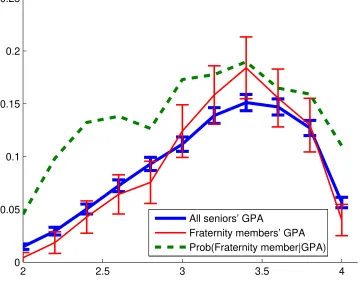
Figure 8: Conditional Distributions of GPAs
Notes: The dashed line is the conditional probability that a student is a fraternity member
given his or her GPA (rounded to the nearest 0.2). The thin line graphs the distribution of GPAs for 701 seniors who are fraternity members (fall 2007), and the thick line graphs the probability distribution for all 8634 seniors at the University of Illinois (fall 2007). The bars indicate 2 standard deviation confidence intervals.
reflect courses taken at the University of Illinois (i.e., omitting transferred courses), but the
senior classification is based on all hours accumulated prior to the end of the fall, 2007 term.
Figure 8 presents the conditional probability that a student is a member of a fraternity
given his or her GPA. Figure 8 reveals that the conditional probability that a student with a
low GPA of 2.0 is a fraternity member is less than 0.05, but that this probability more than
triples for intermediate GPAs between 3 and 3.4, before falling by more than a third for
stu-dents with high GPAs. Interpreting a student’s GPA as a noisy indicator of his or her ability,
this inverted U-shaped pattern is precisely what emerges in the equilibrium to our fraternity game where able students are reluctant to join fraternities to avoid being tainted in labor
screens out most of the less able students, i.e., those who do not have high socializing values.
This finding suggests that it is plausible to estimate our three-signal model formally, and
to extract the implications of our structural estimates for student welfare. We illustrate our
model’s potential by exploiting our limited data on grades and fraternity membership as far
as possible. To be consistent with the premises of our three-signal model, we assume thatθ
corresponds to the quantile of the GPA distribution so that θ is distributed uniformly; and that fraternity-socializing values, µ, are independently and uniformly distributed. Fixing ability, our model indicates that fraternities admit higher µ types, allowing us to estimate 1− µ(θ). In particular, letting Φ be the event that a randomly-selected person is in the fraternity, the fraction of students with abilityθ who are in the fraternity is
1−max(µA(θ), µB(θ)) =P(Φ|θ) = Pr(Φ)fθ(θ|Φ)
fθ(θ) ,
whereµA(θ) andµB(θ) are the cutoff rules of students and fraternity, fθ(·) is the density of
θ, and Pr(Φ) is the probability that a randomly-selected senior is a member of the fraternity. Our estimate of Pr(Φ) is 1345
8634, the number of senior fraternity members divided by the
number of seniors. To estimate fθ(·) we use the sample of all senior students with GPAs of at least 2,8 and we use the sample of fraternity members’ GPAs exceeding 2 to estimate
fθ(·|Φ).9 The densities are estimated using a kernel estimator, and we use them to smooth
the conditional probability of being in the fraternity conditional on GPA (the dashed line in
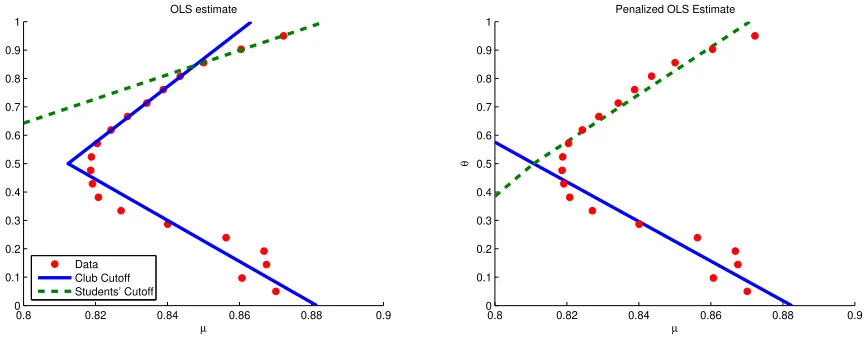
Figure 8). We then take 20 equally spaced θs between 0.05 and 0.95 as our pseudosample, and evaluate ˆµ(θ) = max(µA(θ), µB(θ)) from our smoothed conditional probability estimator at these points. They are represented by dots in Figure 9.
The boundary in our model describing the set of fraternity members is piecewise linear
with two kinks, one at θ = 0.5, and another that we estimate. We first do this non-structurally, simply finding the slopes and intercepts of the three line segments, and the
second kink position by minimizing the SSE, without imposing the equilibrium consistency
requirements (i.e., consistency of firm’s beliefs over the distribution of fraternity member
8
We drop the few students with GPAs below 2, as they are subject to screening by the University (and, indeed, only students with GPAs of at least 2 can graduate).
9
types with the set of fraternity members implied by the estimates). To do this, we use a
two-step estimation procedure to estimate the kink. We first take a possible kink value as
given, and find the slopes of the cut-off rules that minimize the SSE; our estimate of the kink location minimizes the SSE overall.
0.8 0.82 0.84 0.86 0.88 0.9
0 0.1 0.2 0.3 0.4 0.5 0.6 0.7 0.8 0.9 1 µ θ OLS estimate Data Club Cutoff Students’ Cutoff
0.8 0.82 0.84 0.86 0.88 0.9
0 0.1 0.2 0.3 0.4 0.5 0.6 0.7 0.8 0.9 1 µ θ
[image:27.612.87.521.131.304.2]Penalized OLS Estimate
Figure 9: Estimated Unconstrained Model and Structural Model Fits
Next, we contrast this non-structural estimate with that obtained when we penalize
cut-off rules that are inconsistent with equilibrium. Direct structural estimation is complicated
by the extreme nonlinearity of the equilibrium requirement. This leads us to adopt a
lasso-type estimation approach, in which we minimize the residual sum of squares plus a quadratic
measure of the distance from the equilibrium. In equilibrium, W1
W2 =
b1
2(wC(M)−wC(L)) =
b2
2(wC(H)−wC(M)), where b1 is the slope of the club’s cutoff rule below θ = 0.5, and b2 is
the slope forθ > 0.5. We use the penalty function
10 [b1(wC(H)−wC(M))−b2(wC(M)−wC(L))]2.
The first panel of Figure 9 presents the estimated cut-off rules from unconstrained
esti-mation approach. This fit is far from an equilibrium; most obviously, the cut-off rule for the club is not a monotonically decreasing function of θ. The panel on the right presents the estimated cut-off rules from the penalized estimation approach. The value of the penalty is
less than 10−10, indicating that the estimated model is very close to an equilibrium model.
An F-test10 indicates that the differences between the structural and non-structural models
are not statistically significant.
10
The penalized estimation approach implies estimates of the primitives for students: the
cost cis 0.23, or about 46% of the unconditional expected wage, and the fraternity socializ-ing parameter is n = 0.28. We bootstrap the estimator to obtain 95% confidence intervals. While the confidence intervals fornandcare wide ( [0.11,0.52] and [0.08,0.44], respectively), the fraction c
n = 0.82 has a tight 95% confidence interval of [0.73,0.84]; and it is this ratio that determines whether a student gains a net utility benefit from joining the fraternity in
a full information setting where firms know a student’s ability. Figure 9 shows that most
fraternity members are above this threshold, i.e., most fraternity members have socializing
values ofµ > nc ≈ 0.82. Thus, relative to a full information setting, the wage-setting mech-anism impedes the efficiency of club participation: there are too many fraternity members
with intermediate abilities and too few low and high ability students with high socializing
values. Our estimate of the club’s relative weighting on member wages versus socializing values, W1
W2 of 0.22 has a wide confidence interval of [0.06,0.33], but the fraternity’s capacity
is precisely estimated (95% confidence interval of [15.44%, 15.76%]).
0 0.01 0.02 0.03 0.04 0.05 0.06 Comparison to No Fraternity situation
µ
θ
0.8 0.82 0.84 0.86 0.88 0.9
0 0.1 0.2 0.3 0.4 0.5 0.6 0.7 0.8 0.9 1
Those who benefit
[image:28.612.157.469.346.579.2]Those who lose
Figure 10: Impact of Fraternity on Student Welfare
Our estimates allow us to explore how the presence of the fraternity affects the welfare of
non-normality of errors and the nonlinearity of both the model and restrictions. The asymptotic distribution of this test isχ2
−0.015 −0.01 −0.005 0 0.005 0.01 Comparison to No Wage Shift situation
µ
θ
0.8 0.82 0.84 0.86 0.88 0.9
0 0.1 0.2 0.3 0.4 0.5 0.6 0.7 0.8 0.9 1
Those who benefit Those who
benefit
Those who lose
[image:29.612.153.469.56.295.2]Those who lose
Figure 11: Impact of Fraternity’s Wage Redistribution on Student Welfare
different student types. Figure 10 presents welfare gains and losses of different student types
relative to a setting in which there is no fraternity [or equivalently relative to the “empty”
fraternity equilibrium]. The solid line divides the population of student types into those who benefit and those who are hurt, and the darker is the shade in the figure, the more
the fraternity’s presence hurts/benefits less a student. The figure reveals that all fraternity
members actually are made better off by the presence of the fraternity, gaining from the
socializing values of fraternity membership. In addition, able types, θ > 0.61 who are not members gain because they receive higher market wages—firms believe that most highly
productive types do not join the fraternity.
Figure 11 contrasts student welfare in the equilibrium with that which obtains when
firms ignore the information in fraternity membership, or equivalently where the fraternity
does not have better information about θ than firms, and hence only weighs socializing values in admission. Two groups of student types benefit when the fraternity weighs both
expected wage/ability and socializing values in admission: (i) low ability types with high
enough socializing values that they are admitted benefit from wage gain associated with
values who do not join benefit from the higher wages due to the partial separation from
mediocre ability types generated by the fraternity admission process. Low ability types with
moderately high socializing values are hurt the most, as they both would gain socializing values were the fraternity not to weigh ability, and they are punished by lower wages due to
their exclusion. The other group hurt consists of high ability/high socializing value students
who join in both environments, but are tarred by association with lesser types when the
fraternity weighs ability in admission, and therefore receive lower wages.
One should recognize caveats with our empirical analysis. In particular, one would like
better measures of ability. For example, an alternative explanation of the empirical
rela-tionship between GPA and fraternity membership that we document is that not only does
ability influence GPAs, but so does fraternity membership—fraternity cheat sheets may help
low ability students, but a fraternity party environment may make it difficult for high ability
students to study. Ideally, one would obtain measures of ability such as high school grade or
ACT scores that are not affected by fraternity membership. We also note that to show that
the ability distribution in the fraternity that we obtain theoretically is not driven by direct
factors, we assume that firms do not value fraternity socializing values and that socializing values are uncorrelated with ability. Still, our empirical finding that high GPA students are
reluctant to join fraternities indicates that, in practice, firms cannot value those skills by too
much, and that the correlation between ability and socializing value cannot be too high.
6
Conclusion
On first impression, it is not clear why fraternity or sorority membership should matter for
labor market outcomes—fraternity activities seem to have little to do with skill development
for future careers. Nonetheless, resumes regularly highlight fraternity membership, suggest-ing that membership augments the other signals that employers use to evaluate a person’s
productivity. Our paper provides insights into when fraternity membership matters for
la-bor market outcomes. We first show that if firms can either evaluate student productivities
perfectly, or are completely incapable of screening job applicants, then fraternity
member-ship has no impact on labor market outcomes. Otherwise, fraternity membermember-ship matters.
students for labor market outcomes. In one equilibrium, optimistic beliefs by firms about
the abilities of fraternity members lead to higher wages for fraternity members than
non-members. As a result, everyone whom the fraternity would like to admit chooses to pledge. We also identify an equilibrium in which able students are harmed in the labor market by
fraternity membership, but less able students benefit. In this equilibrium, most fraternity
members have intermediate abilities: less able students apply, hoping to be mixed in with
better students, but are rejected unless they have high fraternity socializing values, while
very able students who lack high socializing values do not apply to avoid being tainted in
labor market outcomes due to being mixed in with less able fraternity members. We find
that this latter equilibrium can reconcile the qualitative features of the ability distributions
of fraternity members and non-members at the University of Illinois.
While we pose our analysis in the context of fraternities, the central economic story
ex-tends with some variations to filtering by other organizations. For example, ROTC (reserve
officer training corps) may value both intellectual ability and leadership skills that firms
value, but also physical fitness that does not contribute productively in many occupations.
7
Appendix
Proof of Proposition 3: First observe that in light of Proposition 2, if (θ, µ) applies to the fraternity in equilibrium, then so does (θ, µ′). Suppose the proposition were false. Then
forε >0, sufficiently small, the set
Θε ={θ|∃zθ : Z zθ
−∞
a(θ, x)b(θ, x)hµ(x)dx > ε,
Z +∞
zθ
(1−b(θ, x))hµ(x)dx > ε}
has positive measure, i.e., there exists δ > 0 such that RΘεhθ(x)dx > δ. For every θ in Θε pick a set ofK ={(θ, µ)|µ < zθ, a(µ, θ)b(µ, θ) = 1}and L={(θ, µ)|µ > zθ, b(µ, θ) = 0}such that RKa(θ, µ)b(θ, µ)hµ(x)dx =RLa(θ, µ)(1−b(θ, µ))hµ(x)dx = ε. But then the fraternity decision rule
ˆb(θ, µ) =b(θ, µ)(1−I((θ, µ)∈K)) +I((θ, µ)∈L)
strictly raises the fraternity’s payoff as E(µ|K) < E(µ|L) and the expected wages gener-ated by members and fraternity size are unchanged. Therefore, b could not have been an equilibrium strategy for the fraternity.
Proof of Lemma 1: Consider two signals,x > y ∈Θ, and two productivities,˜ θ2 > θ1 ∈Θ,
such that (x, θ1), (x, θ2) and (y, θ2)∈D. By the MLRP property,
f(θ2|x)
f(θ1|x)
> f(θ2|y) f(θ1|y)
.
Notice that for every (j, k) ∈ D, f(j|k, D) = R f(j|k)I((j,k)∈D) ΘI((θ,θ˜)∈D)dF(θ|θ˜)
= f(j|k)I((Pj,k(D)∈)D). Rewrite the MLRP condition:
f(θ2|x, D)
f(θ1|x, D)
=
f(θ2|x)I((θ2,x)∈D)
P(D)
f(θ1|x)I((θ1,x)∈D)
P(D)
=
f(θ2|x)1
P(D)
f(θ1|x)1
P(D)
>
f(θ2|y)1
P(D)
f(θ1|y)1
P(D)
≥
f(θ2|y)I((θ2,y)∈D)
P(D)
f(θ1|y)I((θ1,y)∈D)
P(D)
= f(θ2|y, D)
f(θ1|y, D)
.
Therefore, if the MLRP condition holds for the entire support, it holds for a subset D of that support. This condition ensures that E(θ|θ, D˜ ) is an increasing function of ˜θ. By
F(x|θ2, D)F(x|θ1, D),
Eθ˜[E(θ|θ, D˜ )|θ2, D] =
Z
˜ Θ
E(θ|θ, D˜ )dF(˜θ|θ2, D)
>
Z
˜ Θ
Proof of Proposition 5: We first show that ifnµ¯−c≥w−θ, then the empty fraternity cannot be an equilibrium. If no one joins the fraternity, then equilibrium demands that θ
expect wage w if he does not join; and the expected wages of students with ability greater than θ who do not join exceed w. With the full support assumption, following any signal realization ˜θ, firms can hold equilibrium beliefs that the anyone who joins the fraternity and generated that signal has ability θ. These beliefs minimize the wage of any student who joins the fraternity. Given these beliefs, since expected wages are continuous in θ, if
nµ¯−c+θ > w, then all students in a sufficiently small neighborhood of (θ,µ¯) would apply for fraternity membership, and since their measure is less than Γ, the fraternity would accept
them. Hence, the empty fraternity cannot be an equilibrium.
Conversely, if nµ¯−c≤w−θ, then given the pessimistic beliefs by firms, wC(˜θ) = θ so that (θ,µ¯) at least weakly prefers not to apply to the fraternity; and all other types strictly prefer not to apply. Hence, no one applying to the fraternity is an equilibrium.
Proof of Proposition 6: To prove existence, it suffices to characterize student and
frater-nity choices via the continuous functionsµA(·) andµB(·) (see Propositions 2 and 4), proving the existence of an equilibrium in which a student type (θ, µ) is a member of the fraternity if and only ifµ≥max{µA(θ), µB(θ)}. In particular, given wC(·) andwC(¯ ·),µA(θ) solves
equa-tion (2) at equality, forµA(θ)∈(µ,µ¯). SinceµA(·) is uniquely defined, it follows thatµB(·) is uniquely defined. We have established that µj : [θ,θ¯]→[µ,µ¯], j =A, B, is continuous. The space of such functions, endowed with the weak∗ topology, is compact. So, too, we can focus
on beliefs by firms about which student types are fraternity members that are summarized
by continuous functions ˆµA(·) and ˆµB(·) about which student types apply and which ones are accepted by the fraternity, where (θ, µ) is a conjectured fraternity member if and only ifµ≥
max{µˆA(θ),µˆB(θ)}. These beliefs, ˆµA(·),µˆB(·) then determine competitive wage functions,
( ˆwC(˜θ), wˆC(˜θ)) = (E[θ|θ, µ˜ ≥max{µˆA(θ),µˆB(θ)}}], E[θ|θ, µ < max˜ {µˆA(θ),µˆB(θ)}]),
and these wage functions, in turn, imply optimal student and fraternity best response choices,
µA(·), µB(·). Hence, we have a mapping from (ˆµA(θ),µˆB(θ)) to (µA(θ), µB(θ)). Equilibrium is given by a fixed point to this mapping from [conjectured by firms] optimal student and
Proof of Lemma 2: µA(θ) solves
E(wC(˜θ)|θ) +nµA(θ)−c=E(wC(˜¯ θ)|θ) ⇔ E(wC(˜θ)|θ)−E(wC¯(˜θ)|θ) =c−nµA(θ).
ThenµA(θ) is increasing in θ if and only if
∂
∂θE(wC(˜θ)−wC¯(˜θ)|θ) = ∂ ∂θ
Z ∞
−∞
wC(˜θ)−wC¯(˜θ)fθ˜(˜θ|θ)dθ <˜ 0.
Consider g(˜θ|θ)≡ ∂
∂θfθ˜(˜θ|θ). As g(˜θ|θ) is the change in the distribution of signal ˜θ due to a change in θ, the integral of g over the support of ˜θ is zero. The MLRP assumption implies that g(˜θ|θ) is increasing in ˜θ:
MLRP:fθ˜(t2|θ+ ∆θ)
fθ˜(t2|θ)
> fθ˜(t1|θ+ ∆θ) fθ˜(t1|θ1)
∀t2 > t1, ∆θ >0 implies
1
fθ˜(t2|θ)
∆fθ˜(t2|θ)
∆θ > 1
fθ˜(t1|θ1)
∆fθ˜(t1|θ)
∆θ Therefore,
∂
∂θ lnfθ˜(t2|θ)≥ ∂
∂θ lnfθ˜(t1|θ)
implying that g(˜θ|θ) is nondecreasing in ˜θ; and since g integrates to zero, there exists a K
such thatg(˜θ|θ)≤0 for ˜θ≤K, and g(˜θ|θ)≥0 for ˜θ > K. Remember, we want to establish when
∂ ∂θ
Z ∞
−∞
h
wC(˜θ)−wC¯(˜θ)
i
fθ˜(˜θ|θ)dθ˜=
Z ∞
−∞
h
wC(˜θ)−wC¯(˜θ)
i∂f˜ θ(˜θ|θ)
∂θ dθ <˜ 0
Subtracting [wC(K)−wC¯(K)]
R∞ −∞
∂fθ˜(˜θ|θ)
∂θ dθ˜= 0 from the integral and breaking the multi-plicands under the integral into two parts yields
Z ∞
−∞
wC(˜θ)−wC¯(˜θ)
−(wC(K)−wC¯(K))
∂f˜ θ(˜θ|θ)
∂θ dθ˜
= Z K
−∞
wC(˜θ)−wC¯(˜θ)
−(wC(K)−wC¯(K))
g(˜θ|θ)dθ˜
+ Z ∞
K
wC(˜θ)−wC¯(˜θ)
−(wC(K)−wC¯(K))
g(˜θ|θ)dθ.˜
From the premise that wC(x)−wC¯(x) is decreasing, the difference in the w terms in the
integral is negative, and positive in the second integral. Therefore, the integral is the sum
of two negative values.
Finally, inspection reveals that an analogous argument holds if there are a finite number
of signals, ˜θ, interpreting the signal density fθ˜(˜θ|θ) as the probability mass on signal ˜θ.
Proof of Proposition 7: Denote the set of students with θ < θ0 as P, the set of students
in fraternity asP2, and the restP1; and let m(·) be the measure of students in the argument
set. Then
wC(˜θ) =E(θ|θ, P˜ 2) and wC¯(˜θ) = E(θ|θ, P˜ ∪P1).
RewritewC¯ as
wC¯(˜θ) =
m(P)
m(P) +m(P1)
E(θ|θ, P˜ ) + m(P1)
m(P) +m(P1)
E(θ|θ, P˜ 1).
Take two signals, H and L, withH > L. Then the expected wage premium is decreasing if
E(θ|H, P2)−
m(P)
m(P) +m(P1)
E(θ|H, P) + m(P1)
m(P) +m(P1)
E(θ|H, P1)
< E(θ|L, P2)−
m(P)
m(P) +m(P1)
E(θ|L, P) + m(P1)
m(P) +m(P1)
E(θ|L, P1)
. (3)
Observe thatθ0 →θ¯implies:
E(θ|H, P2)→θ¯ and E(θ|L, P2) → θ¯
m(P)
m(P) +m(P1)
E(θ|H, P) + m(P1)
m(P) +m(P1)
E(θ|H, P1) → E(θ|H)
m(P)
m(P) +m(P1)
E(θ|L, P) + m(P1)
m(P) +m(P1)
E(θ|L, P1) → E(θ|L).
Therefore, as θ0 →θ¯, (3) approaches
¯
θ−E(θ|H)<θ¯−E(θ|L),
which holds as by the MLRP assumption,E(θ|H)> E(θ|L). As the distribution ofθ has full support, and there are no atoms in the distribution, E(θ|H, θ > θ0) and E(θ|H, θ < θ0) are
continuous inθ0. Therefore, there exists a ˆθ0(H, L)<θ¯such that for all θ0 ≥ θˆ0(H, L), the
expected wage premium of fraternity members is decreasing in ˜θ. This bound onθ0 depends
for each signal pair; and if the support of ˜θ is not finite, but the support of fθ˜(˜θ|θ¯) is
non-trivial, then the expected wage difference that ¯θ expects places strictly positive probability on signals bounded away from ˆθ. Hence, there exists a small enough Γ > 0 such that for Γ< Γ, the equilibrium expected wage premium from fraternity membership is declining in ability.
References
Jack L. Anson and Robert F. Marchesani. Baird’s Manual of American College Fraternities.
Menasha, Wisconsin: Banta Publishing Company, 1991. ISBN 0-9637159-0-9.
David Austen-Smith and Roland G. Fryer. An economic analysis of “acting white”. The
Quarterly Journal of Economics, 120(2):551–583, 2005.
J.M. Buchanan. An economic theory of clubs. Economica, 32:1–14, 1965.
Stephen Coate and Glenn C. Loury. Will affirmative-action policies eliminate negative stereo-types? American Economic Review, 83(5):1220–1240, Dec 1993.
Hanming Fang. Social culture and economic performance. American Economic Review, 91
(4):924–937, 2001.
Hanming Fang and Peter Norman. Government-mandated discriminatory policies: Theory
and evidence. International Economic Review, 47(2):361–389, 2006.
George J. Mailath, Larry Samuelson, and Avner Shaked. Endogenous inequality in integrated
labor markets with two-sided search. American Economic Review, 90(1):46–72, Mar 2000.
Paul R. Milgrom. Good news and bad news: Representation theorems and applications. The Bell Journal of Economics, 12(2):380–391, Autumn 1981.
Andrea Moro and Peter Norman. A general equilibrium model of statistical discrimination.
Journal of Economic Theory, 114(1):1–30, 2004.
Peter Norman. Statistical discrimination and efficiency. Review of Economic Studies, 70(3):