http://dx.doi.org/10.4236/psych.2016.78116
How to cite this paper: Jilani, S. F., & Yasmin, M. (2016). Analyzing the Effectiveness of Simulation in Promoting Learner Autonomy: Perceptions of ESP Hotel Management Students. Psychology, 7, 1154-1162.
http://dx.doi.org/10.4236/psych.2016.78116
Analyzing the Effectiveness of Simulation in
Promoting Learner Autonomy: Perceptions
of ESP Hotel Management Students
Sartaj Fakhar Jilani
1, Musarat Yasmin
1,2*1Department of English, University of Gujrat, Gujrat, Pakistan
2Department of English, University of Azad Jammu and Kashmir, Muzaffarabad, Pakistan
Received 1 June 2016; accepted 19 July 2016; published 22 July 2016
Copyright © 2016 by authors and Scientific Research Publishing Inc.
This work is licensed under the Creative Commons Attribution International License (CC BY).
http://creativecommons.org/licenses/by/4.0/
Abstract
Simulation-based teaching with its life-long efficacy has led many researchers and educationists to probe deeply into the promotion of learner autonomy in the teaching and learning nexus. This newly emerging trend is an indication of accelerating concern in the area of global ESP perspective which has a pivotal significance regarding experimentation with interactive learning situations, eventually resulting in a broader understanding of learner autonomy along with refinement of problem-solving, decision making and critical thinking skills. The ultimate goal of the present study was to evaluate the effectiveness of simulation in nurturing learner autonomy. It further scrutinized the perceptions and beliefs of 40 ESP Hotel Management students (L2 learners) en-rolled in University of Gujrat (UOG), purposively selected, whose responses regarding simulation as a dynamic teaching tool, contributing actively in enhancing learner autonomy or not, were eventually examined. In this perspective the researchers designed a closed-ended questionnaire. Findings of the study revealed that simulation integrated in innovative and interactive learning scenarios stimulates the learning and enhances learner autonomy by increasing learner motiva-tion, encouraging team work, developing communicamotiva-tion, interpersonal and project management skills while boosting up learners’ confidence in task-based ventures and collaborative learning along with enrichment of workplace skills in multidimensional situations and in a tension free en-vironment.
Keywords
Learner Autonomy, Simulation, Hotel Management, Hospitality, Task-Based Learning, Simulation-Based Teaching
1. Introduction
The hotel industry in Pakistan is gaining momentum and experiencing swift expansion leading to a brighter dawn. This evolution calls for basic organizational innovations and workplace skills to align opportunities and progress. Owing to this significant investment in skill-oriented approach, vocational training and prestigious educational programs, relevant to Hotel Management industry, at graduate and postgraduate levels, become a dire need of the day, in order to gear the wheel of the human capital. In this regard, higher education offers many opportunities in which adult learners can take part in order to meet specific needs i.e. learning a new job-related skill or preparing for a new career (Jaeger, 2004). One valuable string of Hotel Management pro-grams offered by higher education department, along with other esteemed establishments, is entwined in Uni-versity of Gujrat (UOG), Pakistan. The present study encompasses the teaching of English in one such skill- development program-Bachelor in Hotel & Restaurant Management (IHRM), offered at University of Gujrat. This IHRM program intends to equip the students in developing communication and interpersonal skills, team management and leadership skills, along with rigorous development of professional competence in a self- directed milieu. “Hotel English” course taught at UOG, particularly focusing on communication skills, is a re-flection of this endeavor, by means of which students are groomed in effectual oral communication skills which are integral part of this most sought-after hotel enterprise. This study, most specifically, analyzes the perceptions of students regarding the effectiveness of simulation as an “in-use” teaching methodology in promoting learner autonomy in the practical and operational interplay.
1.1. Literature Review
Learner Autonomy and Learner-Centeredness constitute a hub of Foreign Language teaching and learning for some thirty years. The focal point of learner autonomy was to place learner in the center by making him ambas-sador of learning while sharing the responsibilities and carrying out multifaceted choices in the learning process. Candy (1991: pp. 459-466) makes an attempt to profile the autonomous learners by presenting 100 abilities of autonomous learning under 13 subtitles: methodical/disciplined, logical/analytical, reflective/self-aware, curious/ open/motivated, flexible, interdependent/interpersonally competent, persistent responsible, venturesome/creative, confident/have a positive self-concept, independent/self-sufficient, skilled in seeking/retrieving information, knowledgeable about/skilled in learning, able to develop/use evaluation criteria. In addition, Van Lier (2008) highlights the “Janus-faced nature of autonomy” which encompasses two dimensions simultaneously, i.e. per-sonal and social; to “myself” and to “the other”. Thus, all these aspects of learner autonomy can be interpreted in terms of three dimensions: control over learning behavior, control over psychology of learning, and control over learning circumstances and the three dimensions are implicitly interdependent (Benson, 2001).
Moreover, for the promotion and endorsement of learner autonomy, a number of studies were carried out in different cultural contexts. In Pakistani context, where teaching English as a foreign language is an uphill task particularly in public sector which contribute to promote the orthodox traditional beliefs and values of relational hierarchy in classrooms; where self-confidence, collaboration, cooperation, decision making, and critical think-ing approach may not foster; where learners do not share the control and responsibility side by side with the teacher; where fear may restrict their potential and where the learners do not feel autonomous to map out their own learning territories. Consequently, learners from such conventional set up really feel afraid when they come across proficient and efficient learners in the arena of learning (Tufail, Kanwal, & Toor, 2015). Little (1991) adds in this regard that some teachers assume that the educational system in Asia is “so all-powerful and inflexi-ble that autonomous learning can never happen” (p. 40). In this perspective, Pathan, Sohail, & Shahriar’s study (2013), particularly with special reference to the University of Sindh and Sarwar’s (2008) pro-autonomy ap-proach in large classes throw light on the useful strategies that can assist learning and autonomy and counter at-tack the boredom and monotony in language classrooms i.e. Teacher training regarding learner autonomy, need-based curriculum, facilitation on the part of instructor and useful teaching and learning resources.
responsi-bilities and learning opportunities over time by engaging them in interactive activities like dramatization, role-playing and simulation imbued in real life contexts.
The central focus of the present study is also to analyze the effectiveness of Simulation as a teaching method-ology in promoting Learner Autonomy. In the present study, simulation is associated with imitation as in role- playing and dramatization. It is a teaching methodology employed by teacher in order to play certain roles without any training and it focuses on extempore performances. In this respect, Simulation can be defined as learning by doing (Schank, 1997). The terms simulation and role-playing are closely related to each other. Role play involves certain parts to be played within some specific situations where as, simulation involves certain complexities which later turn up in the form of conflict resolution by means of authentic scenarios. Also, simu-lation as a teaching strategy can be employed as an effective and dynamic scenario changer in second language learning. Hsu (2006) and Miccoli (2003) hold the view that such kind of dramatization enhances second lan-guage skill and proficiency, whereas Brauer (2002) reveals its significance in cross-cultural understanding. Murillo (2007) focuses on behavior of learners in the development of critical thinking skills through contribution in simulated drama activities while Dornyei (2009) observes that teacher’s role as a facilitator becomes inevita-ble in such learning.
Hence, simulation, owing to its effectiveness as a teaching strategy, is progressively being used not only in military and industry, but also it has miraculous effects in the fields of medicine and nursing (Eaves & Flagg, 2001). In the field of medicine, Okuda, Bryson, DeMaria, Jacobson, Quiones, Shen, and Levine (2009) exam-ined around 100 articles and concluded that simulation-based training is more effective regarding procedural performance as compared to standard training. In the field of vocational teaching and learning Penfold, Kong, and Ma (2007) highlighted the development and use of virtual hotel for teaching hotel management through e-simulations which proved quite valuable in nurturing problem solving and interpersonal skills. Teach & Govahi (1993) further explored the rating of four teaching methodologies-lectures, case studies, computerized simulations and experiential exercises (including role-plays). Findings highlighted that experiential exercises proved effective in the development of various skills like interviewing, conflict resolution and effective public speaking. Moreover, Yasmin (2014) also studied the role of simulation as a teaching strategy in the development of oral skills of undergraduate students of Hotel English enrolled in University of Gujrat, Pakistan. Her findings revealed that simulated situations have productive and positive role in developing oral skills. Moreover, simula-tion-based teaching motivates the students and helps them in the refinement of vocabulary, grammar, fluency and conversational strategies.
The present study is exclusively relevant to analyze the effectiveness of simulation in promoting learner autonomy with special reference to perceptions of ESP Hotel Management students of UOG. This particular vocational setting is emphasized owing to its popularity in the upcoming years. In this connection, learners in Hotel and Management should be geared up for the transformation that crops up in the industry and more prominently they need to learn how to learn. The present study is also valuable because it addresses the gap by taking both simulation and learner autonomy into account. It also attends to the perceptions, voices, beliefs and practices of students which are almost non-existent in the relevant literature. Moreover, the interrelationship of simulation and learner autonomy has not yet been explored, particularly in Pakistani context. Therefore, the study will be fruitful regarding its practical implications in language teaching and learning in order to enhance communication, interpersonal and workplace skills.
1.2. Research Questions
The present study deals with the following questions:
1) What is the role of “Simulation” and “Learner Autonomy” in English Language learning?
2) How far Simulation is an effective teaching strategy in promoting Learner Autonomy of Hotel English learners enrolled in BS Program?
3) What is the relationship between Simulation and Learner Autonomy?
2. Research Design
2.1. Method of Data Collection
study. They were all native speakers of Urdu and Punjabi, studying “Hotel English” for some specific pur- poses.
Purposive sampling technique was employed to select 40 students as a sample for the study, 10 of those were females while 30 were males. Purposive sampling, also known as “purposeful sampling” entails certain units or cases “based on a specific purpose rather than randomly” (Tashakkori & Teddlie, 2003: p. 713) whether partici-pants can and are keen to give information by means of their knowledge or experience (Bernard, 2002; Lewis & Sheppard, 2006).
In order to accomplish the research goals, the researchers followed the Interactionist Paradigm and preferred a quantitative approach based on the survey method. Survey method is one of the most commonly employed methods in educational research. It engages researchers inquiring the questions of interest, interrelated to the re-search, from a significant number of respondents (Fraenkel & Wallen, 2000). Thus, the researchers employed questionnaire for collecting and processing data for the study. The two sections of questionnaire were formu-lated on the pattern of extracting students’ perceptions regarding the efficacy of simulation in cultivating learner autonomy in Hotel English learners. Following this, the first section was comprised of 10 items based on Simu-lation and the other section addressed 10 items on Learner Autonomy. Thus, the questionnaire consisting of 20 closed-ended, multiple choice items, based on a 3-point Likert scale, encompassing agree, disagree and neutral options, was designed. The items involved in the questionnaire were based on factual, behavioural and attitudi-nal statements (Dornyei & Taguchi, 2010) and were adapted from previous research studies, chiefly concerning with those of Holec (1981), Dam, Eriksson, Miliander, & Trebbi, (1990) and Little (1991). Further, the items of the questionnaire were constructed in the most precise, simple and in the best possible manner.
Moreover, to ensure the suitability and validity, the developed questionnaire was reviewed by the experts. The consistency and relevance of the items were guaranteed and thus the final version of questionnaire was con-structed accordingly. Afterwards, it was piloted with 10 students who were not actually the part of the study. Besides it, the reliability check was carried out by means of a commonly employed statistic i.e. Cronbach’s al-pha, which evaluates the degree to which scales exhibit “uni-dimensionality”. Bryman & Cramer (2005) hold the view that .8 is the alpha level which signifies a good quality of conceptual relevance between items. But .7 is also considered as having good quality of items. The items in the questionnaire produced an alpha of .716 which guaranteed the reliability of data. Moreover, the questionnaire was self-administered by the researchers during a face-to-face interaction, in order to avoid errors. In this connection, 40 participants had been requested to fill out the questionnaires voluntarily. Hence, from this perspective, the researchers very meticulously considered the nuts and bolts of survey in order to guarantee lucidity and precision of outcomes.
2.2. Method of Data Analysis
The quantitative responses of the respondents are scrutinized by means of SPSS 16 in order to find out the rela-tionship between simulation and learner autonomy. Moreover, the effectiveness of simulation as a teaching strategy and its role in promoting learner autonomy is also measured. Finally, the subsequent statistical methods and procedures were taken into account, complementing the research questions. Relative Frequency Distribution method was employed in order to get the general percentage of the respondents’ responses regarding simulation and learner autonomy. Comparative study was intended to find out the significance of each variable in the clus-ter. Pearson Chi-Square Test was applied in order to establish the association and relationship between the vari-ables i.e. simulation and learner autonomy and the level of significance for this test was at .05. The key rationale of using this test is to find out the significance value of the variables. Whereas, likelihood ratio was calculated in order to ascertain the effectiveness of the variables. Finally, the results were illustrated by using tables and de-scriptions.
3. Results
3.1. Demographic and Education-Related Characteristics
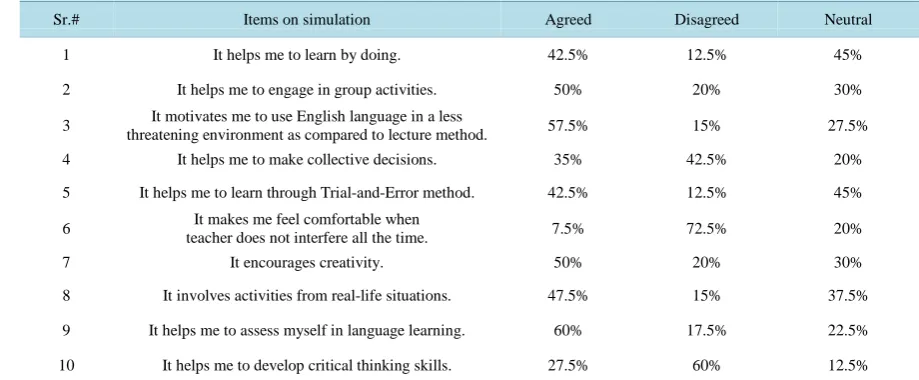
In response to the research questions, the researcher investigated the relationship and effectiveness of simulation and learner autonomy by means of aforementioned statistical methods. The variables were separately examined in this regard. The outline of statistical analysis for the variables is shown inTable 1.
Table 1.Analysis of students’ responses regarding effectiveness of simulation in promoting learner autonomy.
Sr.# Items on simulation Agreed Disagreed Neutral
1 It helps me to learn by doing. 42.5% 12.5% 45%
2 It helps me to engage in group activities. 50% 20% 30%
3 It motivates me to use English language in a less
threatening environment as compared to lecture method. 57.5% 15% 27.5%
4 It helps me to make collective decisions. 35% 42.5% 20%
5 It helps me to learn through Trial-and-Error method. 42.5% 12.5% 45%
6 It makes me feel comfortable when
teacher does not interfere all the time. 7.5% 72.5% 20%
7 It encourages creativity. 50% 20% 30%
8 It involves activities from real-life situations. 47.5% 15% 37.5%
9 It helps me to assess myself in language learning. 60% 17.5% 22.5%
10 It helps me to develop critical thinking skills. 27.5% 60% 12.5%
above-mentioned Tables 1-3 respectively. These tables present a synopsis of students’ responses, Pearson’s Chi square value as well as likelihood value for the variables highlighting the relationship and effectiveness.
3.2. Statistical Implications for Simulation & Learner Autonomy
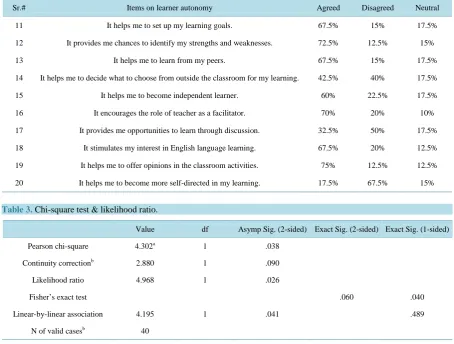
Table 1andTable 2show that a vast majority of the respondents responded towards agreement. Further, Table
3 highlights that the value of Pearson Chi-Square was 4.302 and d.f. was 1. Hence the significance value re-garding the relationship between simulation and learner autonomy as the chief constructs of the questionnaire was .038 which is less than .05. It clearly indicates that there is a relationship of association between two vari-ables i.e. simulation and learner autonomy. Moreover, Table 3 demonstrates the effectiveness of simulation in promoting learner autonomy by means of Likelihood Ratio value which was 4.968 and d.f. was 1. It clearly il-lustrates that the Likelihood Ratio value is also less than .05 which proves the effectiveness of simulation in promoting learner autonomy.
4. Discussion
In the present study, a vast majority of the students of IHRM showed their consent and agreement that simula-tion is undoubtedly an effective teaching strategy for Hotel English learners as it plays a dynamic role in pro-moting learner autonomy. The results of the study also threw light that the respondents reported each factor of simulation and learner autonomy differently.
Table 2. Analysis of students’ responses regarding effectiveness of simulation in promoting learner autonomy.
Sr.# Items on learner autonomy Agreed Disagreed Neutral
11 It helps me to set up my learning goals. 67.5% 15% 17.5%
12 It provides me chances to identify my strengths and weaknesses. 72.5% 12.5% 15%
13 It helps me to learn from my peers. 67.5% 15% 17.5%
14 It helps me to decide what to choose from outside the classroom for my learning. 42.5% 40% 17.5%
15 It helps me to become independent learner. 60% 22.5% 17.5%
16 It encourages the role of teacher as a facilitator. 70% 20% 10%
17 It provides me opportunities to learn through discussion. 32.5% 50% 17.5%
18 It stimulates my interest in English language learning. 67.5% 20% 12.5%
19 It helps me to offer opinions in the classroom activities. 75% 12.5% 12.5%
20 It helps me to become more self-directed in my learning. 17.5% 67.5% 15%
Table 3. Chi-square test & likelihood ratio.
Value df Asymp Sig. (2-sided) Exact Sig. (2-sided) Exact Sig. (1-sided)
Pearson chi-square 4.302a 1 .038
Continuity correctionb 2.880 1 .090
Likelihood ratio 4.968 1 .026
Fisher’s exact test .060 .040
Linear-by-linear association 4.195 1 .041 .489
N of valid casesb 40
every classroom activity which means that the teacher’s roles as facilitator is not very much encouraging in all sorts of activities regarding simulated-teaching and learning. In addition, 24 respondents (60%) were of the view that simulation as a teaching method provides them ample chances to assess their learning by pointing out their flaws and weaknesses during observations which may further open room for improvement. Furthermore, 19 re-spondents (47.5%) were of the view that simulation as a teaching method offers them opportunities to connect themselves to the outer world by means of real life situations which assist them in becoming life-long learners, having practical implications deeply rooted in the out of class scenarios. Most of these factors chiefly contribute in promoting simulation as an effective teaching method.
Furthermore, 28 respondents (70%) showed agreement with the teacher’s role as facilitator with no omni-presence. Esch (1998: p. 37) points out regarding learner autonomy that:
“It is not self-instruction/learning without a teacher; … it does not mean that intervention or initiative on the part of a teacher is banned; … it is not something teachers do to learners;i.e. a new methodology; … it is not a single easily identifiable behaviour…”.
Moreover, 13 respondents (32.5%) were of the view that autonomous learning provides them opportunities to learn through discussion, whereas, 30 respondents (75%) responded that learner autonomy encourages them to offer opinions in classroom activities. In this perspective, it is apt to assert that learner autonomy is an interde-pendent business and a joint enterprise which assists learners to take charge of their own learning (Holec, 1981). Little (1996) opines in this regard that learner autonomy fosters the “capacity to make and carry out choices” and also it “develops a capacity for detachment, critical reflection, decision making, and independent action”. 27 respondents (67.5%) were of the view that autonomous learning stimulates their interest in English Language learning. Further, 17 respondents (42.5%) were of the view that learner autonomy helps them to decide the ex-tent of exposure in real life situations whereas, only 7 respondents (17.5%) held the view that learner autonomy fosters self-directed learning. Such learners may have a deep rooted impact of traditional method in which teacher initiates and ends up every activity and where self-directed learning at the risk of the students is not much appreciated.
The overall results of the study imply that simulation as a teaching method plays an effective role in promot-ing learner autonomy of Hotel English Learners ultimately resultpromot-ing in project management, communication and interpersonal skills. The results further accentuate a positive relationship between simulation and learner auto- nomy. It is also interesting to note that not even a single factor of simulation and learner autonomy was entirely discarded in relation to its effectiveness and mutual relationship which entails that both simulation and learner autonomy are interconnected and thus part and parcel of each other.
5. Conclusion
The purpose of the present study was to analyze the effectiveness of simulation as a teaching method in promot-ing learner autonomy in the light of the perceptions and beliefs of BS Hotel English Learners, enrolled in Uni-versity of Gujrat, Pakistan. In the light of findings, it can be claimed that simulation as a teaching strategy not only furnishes the needs of Hotel English learners but also serves as an effective and valuable tool in promoting learning autonomy. Hence, in Pakistani context, there is a dire need to establish simulation-based-teaching in order to foster autonomous learning environment not only for the Hotel English learners but also for other Spe-cific and Academic purposes. In this perspective, the curriculum and syllabus designers need to formulate poli-cies and practices that address the teaching methodologies in connection with the refinement of communication skills and the growing concerns of the learners in the global world. Although, findings of the present study not only accounted for the effectiveness and success of simulation as a teaching methodology but also strengthened a positive relationship between Simulation and Learner Autonomy. So the need of the hour is to recognize the optimum utility of simulation as innovative and successful teaching methodology owing to its significance in English Language classroom. The study further lays emphasis that simulation is entirely experiential learning by means of which independent, peer and collaborative learning can be encouraged in connection with realia, along with minimum Teacher Talk Time (TTT) and maximum learning opportunities while monitoring the rate of learners’ progress as well as pros and cons of their learning outcomes. It further nourishes critical thinking, de-cision making and problem solving skills in a cooperative and less threatening environment. Hence, all these features have dynamic relationship in endorsing and promoting learner autonomy.
teach-ing methodologies in multidimensional fields. Overall, this study can be an effective whole that may add diver-sity to language teaching methodologies of other world languages pertaining to the efficacy of autonomous learning.
However, study is limited in scope with its small sample selected from one university. Hence, the results cannot be generalised. For a broader picture, other public and private institutes should also be included. It is, therefore, recommended for future researchers to include students and teachers as a sample from private and public institutions of Pakistan.
References
Bernard, H. R. (2002). Research Methods in Anthropology: Qualitative and Quantitative Methods (3rd ed.). Walnut Creek, CA: Alta Mira Press.
Benson, P. (2001). Teaching and Researching Autonomy in Language Learning. Harlow: Longman.
Bräuer, G. (2002). Body and Language: Intercultural Learning through Drama. Connecticut: Ablex Publishing.
Bryman, A., & Cramer, D. (2005). Quantitative Data Analysis with SPSS 12 and 13. Routledge: London.
Candy, P. C. (1991). Self-Direction for Lifelong Learning. San Francisco, CA: Jossey-Bass.
Dam, L., Eriksson, R., Little, D., Miliander, J., & Trebbi, T. (1990). Towards a Definition of Autonomy. In T. Trebbi (Ed.),
Third Nordic Workshop on Developing Autonomous Learning in the FL Classroom. Bergen: University of Bergen.
http://www.warwick.ac.uk/go/dahla/archive/trebbi_1990
Davis, B. G. (1993). Tools for Teaching. San Francisco, CA: Jossey-Bass.
Dörnyei, Z. (2009). The L2 Motivational Self-System. In Z. Dörnyei, & E. Ushioda (Eds.), Motivation, Language Identity
and the L2 Self (pp. 9-42). Bristol: Multilingual Matters.
Dornyei, Z., & Taguchi, T. (2010). Questionnaires in Second Language Research: Construction, Administration and Pro-
cessing (2nd ed.). New York: Routledge.
Eaves, R. H., & Flagg, A. J. (2001). The U.S. Air Force Pilot Simulated Medical Unit: A Teaching Strategy with Multiple Applications. Journal of Nursing Education, 3, 110-115.
Esch, E. (1998). Promoting Learner Autonomy: Criteria for the Selection of Appropriate Methods. In R. Pemberton, E. S. L. Li, W. W. F. Or, & H. D. Pierson (Eds.), Taking Control: Autonomy in Language Learning (pp. 35-48). Hong Kong: Hong Kong University Press.
Fraenkel, J. R., & Wallen, N. E. (2000). How to Design and Evaluate Research in Education. New York: McGraw-Hill Higher Education.
Holec, H. (1981). Autonomy in Foreign Language Learning. Oxford: Pergamon.
Hsu, M. (2006). The Effects of Dramatic Activities on Reading Comprehension of Senior High School: EFL Students in Taiwan. Ed. D. Dissertation, Kingsville, TX: Texas A & M University.
Jaeger, A. (2004). Meeting the Special Needs of Adult Students. Journal of College Student Development, 45, 99-101. http://dx.doi.org/10.1353/csd.2004.0009
Lewis, J. L., & Sheppard, S. R. J. (2006). Culture and Communication: Can Landscape Visualization Improve Forest Man-agement Consultation with Indigenous Communities? Landscape and Urban Planning, 77, 291-313.
http://dx.doi.org/10.1016/j.landurbplan.2005.04.004
Little, D. (1991). Learner Autonomy: Definitions, Issues and Problems. Dublin: Authentik.
Little, D. (1995). Learning as Dialogue: The Dependence of Learner Autonomy on Teacher Autonomy. System, 23, 175-182. http://dx.doi.org/10.1016/0346-251X(95)00006-6
Little, D. (1996). Freedom to Learn and Compulsion to Interact: Promoting Learner Autonomy through the Use of Informa-tion Systems and InformaInforma-tion Technologies. In R. Pemberton, S. L. Edward Li, W. F. Winnie, & H. D. Pierson (Eds.),
Taking Control: Autonomy in Language Learning. Hong Kong: Hong Kong University Press.
Miccoli, L. (2003). English through Drama for Oral Skills Development. ELT Journal, 57, 122-129. http://dx.doi.org/10.1093/elt/57.2.122
Okuda, Y., Bryson, E. O., DeMaria, S., Jacobson, L., Quinones, J., Shen, B., & Levine, A. I. (2009). The Utility of Simula-tion in Medical EducaSimula-tion: What Is the Evidence? Mount Sinai Journal of Medicine, 76, 330-343.
http://dx.doi.org/10.1002/msj.20127
Pathan, H., Sohail, A., & Shahriar, A. (2013). Learner Autonomy: Building a Curriculum around Autonomous Learning with Exclusive Reference to the University of Sindh, Pakistan. Kashmir Journal of Language Research, 16, 83-93.
Proceedings of the International Association for Development of the Information Society Conference (E-Learning 2007).
Ryan, M., Hodson Carlton, K., & Ali, N. (1998). Evaluation of Traditional Classroom Teaching Methods versus Course De-livery via the World Wide Web. Journal of Nursing Education, 38, 272-277.
Sarwar, Z. (2008). Taking the Bull by Its Horns: Pro-Autonomy Approach to Large Classes. IATEFL. http://iatefl.org
Schank, R. (1997). Virtual Learning: A Revolutionary Approach to Building a Highly Skilled Workplace. New York: McGaw-Hill.
Tashakkori, A., & Teddlie, C. (2003). Handbook of Mixed Methods in Social and Behavioral Research. Thousand Oaks: Sage.
Teach, D. T., & Govahi, G. (1993). The Role of Classroom Techniques in Teaching Management Skills. Simulation and
Gaming, 24, 429-445. http://dx.doi.org/10.1177/1046878193244002
Tufail, R., Kanwal, A., & Toor, S. (2015). Urdu Speaking EFL Students’ Problem in Learning English in Public and Private
Schools of Punjab, Pakistan. http://rfh.org.pk/jur/paper
Van Lier, L. (2008). Agency in the Classroom. In J. P. Lantolf, & M. E. Poehner (Eds.), Sociocultural Theory and the
Teaching of Second Languages. London: Equinox.
Yasmin, M. (2014). Using Simulation in Teaching Oral Skills to Hotel Management Students. In S. Borg (Ed.), Teacher
Re-search in Pakistan: Enhancing the Teaching and Learning of English (pp. 67-75). Lahore: British Council.
Submit or recommend next manuscript to SCIRP and we will provide best service for you:
Accepting pre-submission inquiries through Email, Facebook, LinkedIn, Twitter, etc. A wide selection of journals (inclusive of 9 subjects, more than 200 journals) Providing 24-hour high-quality service
User-friendly online submission system Fair and swift peer-review system
Efficient typesetting and proofreading procedure
Display of the result of downloads and visits, as well as the number of cited articles Maximum dissemination of your research work