0095-1137/06/$08.00⫹0 doi:10.1128/JCM.02305-05
Copyright © 2006, American Society for Microbiology. All Rights Reserved.
Development of a Sensitive and Specific Assay Combining Multiplex
PCR and DNA Microarray Primer Extension To Detect High-Risk
Mucosal Human Papillomavirus Types
Tarik Gheit,
1Stefano Landi,
2Federica Gemignani,
2Peter J. F. Snijders,
3Salvatore Vaccarella,
1Silvia Franceschi,
1Federico Canzian,
4and Massimo Tommasino
1*
International Agency for Research on Cancer, Lyon, France1; Genetica, Dip. Scienze Uomo e Ambiente, University of Pisa,
Pisa, Italy2; Vrije University Medical Center, Postbus 7057, NL-1007 MB Amsterdam, The Netherlands3; and
Deutsches Krebsforschungszentrum, D-69120 Heidelberg, Germany4
Received 3 November 2005/Returned for modification 5 January 2006/Accepted 30 March 2006
The importance of assays for the detection and typing of human papillomaviruses (HPVs) in clinical and epidemiological studies has been well demonstrated. Several accurate methods for HPV detection and typing have been developed. However, comparative studies showed that several assays have different sensitivities for the detection of specific HPV types, particularly in the case of multiple infections. Here, we describe a novel one-shot method for the detection and typing of 19 mucosal high-risk (HR) HPV types (types 16, 18, 26, 31, 33, 35, 39, 45, 51, 52, 53, 56, 58, 59, 66, 68, 70, 73, and 82). This assay combines two different techniques: multiplex PCR with HPV type-specific primers for amplification of viral DNA and array primer extension (APEX) for typing. This novel method has been validated with artificial mixtures of HPV DNAs and clinical samples that were already analyzed for the presence of mucosal HPV types by a different consensus PCR method, i.e., GP5ⴙ/GP6ⴙ. Our data showed a very good agreement between the results from the multiplex PCR/APEX assay and those from the GP5ⴙ/GP6ⴙPCR (overall rates of HPV positivity, 63.0 and 60.9%, respectively). Whereas the GP5ⴙ/GP6ⴙ PCR was slightly more sensitive for the detection of HPV type 16 (HPV-16), multiplex PCR-APEX found a higher number of infections with HPV-33, HPV-53, and multiple HPV types. These favorable features and the high-throughput potential make our present novel assay ideal for large-scale clinical and epidemiological studies aimed at determining the spectrum of mucosal HR HPV types in cervical specimens.
Cervical cancer affects more than 400,000 women in the world each year and represents the second most common ma-lignancy found after breast cancer (6). Cervical cancer screen-ing is currently based on the Papanicolaou (Pap) smear, which has had a vast impact on the reduction in the incidence of this disease in developed countries. However, the sensitivities of cytological tests vary greatly according to the experience of the cytologists and the type of quality control in place (4, 12, 14, 21, 29).
Epidemiological and functional studies have clearly demon-strated that certain types of human papillomavirus (HPV) from the genus alpha of the HPV phylogenetic tree, referred to as high-risk (HR) types, are the etiological cause of cervical cancer. A recent survey of 11 case-control studies in nine countries showed that 15 different HPV types are classified as high-risk types, namely, types 16, 18, 31, 33, 35, 39, 45, 51, 52, 56, 58, 59, 68, 73, and 82. An additional three HPV types of the same genus (types 26, 53, and 66) were classified as probable high-risk types, while several others were considered low-risk types, including HPV type 70 (HPV-70), which is phylogeneti-cally related to the high-risk HPV types (15). The clinical value of HPV DNA testing has increasingly been recognized (10).
Independent studies have shown that HPV DNA detection, when it is used as a primary screening method, has a higher sensitivity and a higher negative predictive value for the de-tection of preinvasive disease than the conventional Pap smear or the liquid-based cytology methods (2, 5, 22). In fact, in the United States the Food and Drug Administration has autho-rized the use of a commercial HPV detection test, Hybrid Capture-II (Digene), in women aged 30 years and older for primary screening, in addition to cytology and for the triage of atypical squamous cells of undetermined significance.
Constant progress in HPV typing based on PCR methods has been made over the past few years. The majority of avail-able protocols use degenerate and/or consensus primers, fol-lowed by an additional assay that allows the identification of the specific HPV types (7, 18, 25, 27, 30). Most commonly used PCR assays amplify the L1 region (18, 28), the E1 region (26), or the E6 and E7 regions (7, 20). The use of degenerate and/or consensus primers offers the advantage of detecting a large spectrum of HPV types by a single PCR. However, they may be less efficient in detecting specific HPV types, leading to some underdetection, particularly in cases of multiple infections (3, 16, 17).
In this report, we describe the development of a reliable novel E7 PCR-based assay for the detection of a large spec-trum of high-risk HPV types. The assay combines the advan-tages of the multiplex PCR methods, i.e., high sensitivity and the possibility to perform multiple amplifications in a single
* Corresponding author. Mailing address: Infections and Cancer Biology Group, International Agency for Research on Cancer, 150, cours Albert-Thomas, 69372 Lyon, France. Phone: 33-4-72738191. Fax: 33-4-72738442. E-mail: [email protected].
2025
on May 16, 2020 by guest
http://jcm.asm.org/
reaction with an array primer extension (APEX) assay. The latter method offers the benefits of Sanger dideoxy sequencing with the high-throughput potential of the microarray (8, 13, 23). Here, we also report on a comparison of the multiplex
PCR/APEX and the GP5⫹/GP6⫹PCR, followed by reverse
line blotting (RLB), a well-validated assay (27).
MATERIALS AND METHODS
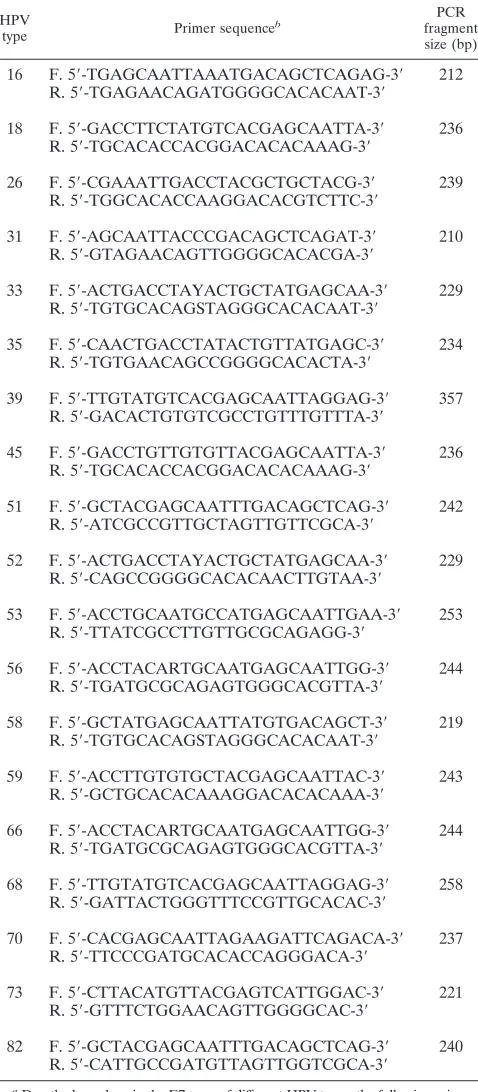
Development of multiplex PCR primers.Complete or partial HPV sequences were obtained from GenBank and were used for alignment of the whole E7-region gene. This E7-region is highly divergent, and primers specific to each type were developed based on the more conserved parts of this gene. The accession numbers of the GenBank sequences that we used as references, with the corre-sponding HPV types given in parentheses, were X05015 (HPV-18), X74479 (HPV-45), NC_001533 (HPV-51), M74117 (HPV-35), NC_001443 (HPV-58), M62849 (HPV-39), Y14591 (HPV-68), NC_001594 (HPV-56), NC_001695 (HPV-66), NC_001635 (HPV-59), M12732 (HPV-33), NC_001592 (HPV-52), K02718 (HPV-16), J04353 (HPV-31), X74472 (HPV-26), X74482 (HPV-53), U21941 (HPV-70), X94165 (HPV-73), and AB027021 (HPV-82). Oligonucleo-tides were synthesized by MWG Biotech (Ebersberg, Germany) and mixed to obtain a 10⫻solution containing 2M of each primer. As shown in Table 1, the total number of primers used in the mix was 31. Two primers for the amplifica-tion of-globin (GenBank accession number AY260740) were added to provide a positive control for the quality of the template DNA (19). Some primers are used for more than one type (e.g., HPV18R/HPV45R) due to the high similar-ities between the E7-region genes.
Multiplex PCR conditions.PCRs were performed with the QIAGEN multi-plex PCR kit according to the instructions of the manufacturer. dUTP (Fermen-tas) was added to a final concentration of 50M, to allow PCR product frag-mentation (see below). The PCR products ranged in size from 210 bp to 350 bp. The presence and the sizes of PCR products were systematically checked on agarose gels.
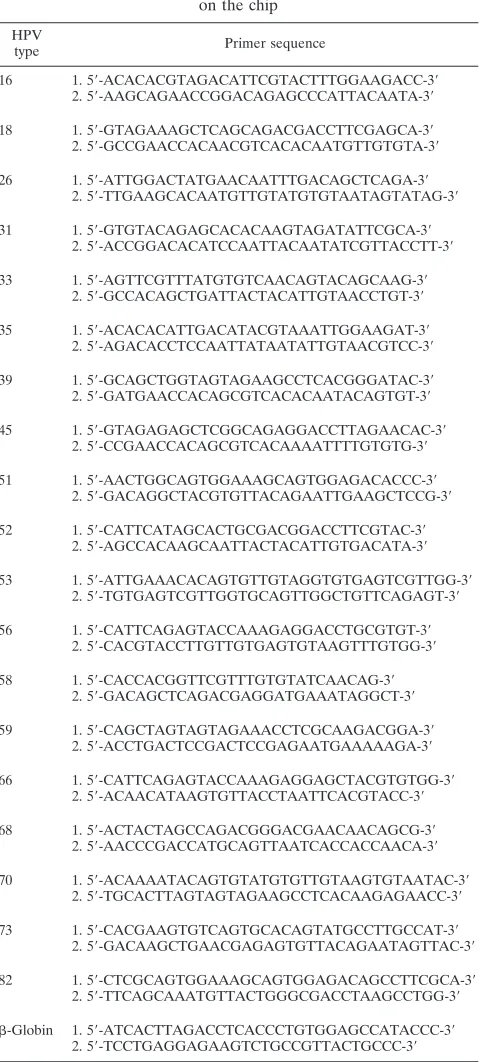
Generation of DNA chip.Two 5⬘-C-6 amino-linker-modified oligonucleotides (C-6 oligonucleotides) covering two 30-bp regions of each E7-region gene were designed, synthesized by MWG Biotech, and spotted onto silanized slides, as reported elsewhere (1a, 9). The layout of the chip is shown in Fig. 1C.
All C-6 oligonucleotides were designed in order to incorporate only uracyl (cyanine 5-ddUTP) during the extension reaction (Table 2).
APEX.By following the protocol described previously (8), the PCR products were purified, concentrated by using Millipore Y30 columns, and fragmented to facilitate the hybridization reaction with the arrayed oligonucleotides. Fragmen-tation was achieved by treatment of the purified PCR products with 1 U uracil
N-glycosylase (Epicenter Technologies, Madison, WI) and 1 U shrimp alkaline phosphatase (Amersham Biosciences, Milwaukee, WI). The fragmented PCR products were added to a reaction mixture containing cyanine 5-ddUTP and cyanine 3-ddATP, -ddCTP, and -ddGTP (4⫻50 pmol); 10⫻buffer; and 4 U of Thermo Sequenase (Amersham Biosciences, Uppsala, Sweden) and placed onto the chip and incubated at 58°C for 10 min. After hybridization of the PCR products to the chip, the extension reaction was performed to allow incorpora-tion of the cyanine 5-ddUTP. The slides were washed to remove the traces of the nonhybridized PCR products and the labeled dideoxynucleoside triphosphates (ddNTPs) not incorporated. The slides were imaged by use of a Genorama-003 four-color detector (Asper Biotech, Tartu, Estonia). The signal for specific HPV types in the APEX method was considered positive only if both APEX probes gave a signal in the U channel, as the probes were designed to extend only U. Although A, G, and C signals were not expected to be incorporated, ddA, ddC, and ddG were also included in the APEX reaction to allow detection of unspe-cific extensions and to have a further control for speunspe-cificity.
The fluorescence intensities at each position were measured and converted to base calls according to the Genorama image analysis and genotyping software (Asper Biotech).
Several strategies to ensure quality control were adopted: (i) each APEX oligonucleotide was spotted in duplicate, and (ii) internal positive controls were spotted on the corners of the microarray to verify that the intensities of the four channels (A, C, U, and G) were equilibrated.
Validation of the multiplex PCR/APEX assay.For evaluation of the sensitivity and the specificity of the APEX typing method, we analyzed artificial mixtures containing cloned HPV genomes at different concentrations and, in addition, random DNA samples extracted from cervical scrapes with or without cervical abnormalities. The latter comprised 92 DNA samples that were previously typed for 37 HPV types by the HPV GP5⫹/GP6⫹PCR reverse line blot assay (27) at
[image:2.585.302.541.91.637.2]the Department of Pathology, Vrije Universiteit Medical Center, Amsterdam, The Netherlands. These were liquid-based cytology samples from a group of women with abnormal or normal cytologies who participated in a population-based screening program. The DNA was extracted by using High Pure PCR TABLE 1. Sequences of forward and reverse HPV-type specific
primers and sizes of the PCR-amplified fragmentsa
HPV
type Primer sequence
b
PCR fragment size (bp)
16 F. 5⬘-TGAGCAATTAAATGACAGCTCAGAG-3⬘ 212 R. 5⬘-TGAGAACAGATGGGGCACACAAT-3⬘
18 F. 5⬘-GACCTTCTATGTCACGAGCAATTA-3⬘ 236 R. 5⬘-TGCACACCACGGACACACAAAG-3⬘
26 F. 5⬘-CGAAATTGACCTACGCTGCTACG-3⬘ 239 R. 5⬘-TGGCACACCAAGGACACGTCTTC-3⬘
31 F. 5⬘-AGCAATTACCCGACAGCTCAGAT-3⬘ 210 R. 5⬘-GTAGAACAGTTGGGGCACACGA-3⬘
33 F. 5⬘-ACTGACCTAYACTGCTATGAGCAA-3⬘ 229 R. 5⬘-TGTGCACAGSTAGGGCACACAAT-3⬘
35 F. 5⬘-CAACTGACCTATACTGTTATGAGC-3⬘ 234 R. 5⬘-TGTGAACAGCCGGGGCACACTA-3⬘
39 F. 5⬘-TTGTATGTCACGAGCAATTAGGAG-3⬘ 357 R. 5⬘-GACACTGTGTCGCCTGTTTGTTTA-3⬘
45 F. 5⬘-GACCTGTTGTGTTACGAGCAATTA-3⬘ 236 R. 5⬘-TGCACACCACGGACACACAAAG-3⬘
51 F. 5⬘-GCTACGAGCAATTTGACAGCTCAG-3⬘ 242 R. 5⬘-ATCGCCGTTGCTAGTTGTTCGCA-3⬘
52 F. 5⬘-ACTGACCTAYACTGCTATGAGCAA-3⬘ 229 R. 5⬘-CAGCCGGGGCACACAACTTGTAA-3⬘
53 F. 5⬘-ACCTGCAATGCCATGAGCAATTGAA-3⬘ 253 R. 5⬘-TTATCGCCTTGTTGCGCAGAGG-3⬘
56 F. 5⬘-ACCTACARTGCAATGAGCAATTGG-3⬘ 244 R. 5⬘-TGATGCGCAGAGTGGGCACGTTA-3⬘
58 F. 5⬘-GCTATGAGCAATTATGTGACAGCT-3⬘ 219 R. 5⬘-TGTGCACAGSTAGGGCACACAAT-3⬘
59 F. 5⬘-ACCTTGTGTGCTACGAGCAATTAC-3⬘ 243 R. 5⬘-GCTGCACACAAAGGACACACAAA-3⬘
66 F. 5⬘-ACCTACARTGCAATGAGCAATTGG-3⬘ 244 R. 5⬘-TGATGCGCAGAGTGGGCACGTTA-3⬘
68 F. 5⬘-TTGTATGTCACGAGCAATTAGGAG-3⬘ 258 R. 5⬘-GATTACTGGGTTTCCGTTGCACAC-3⬘
70 F. 5⬘-CACGAGCAATTAGAAGATTCAGACA-3⬘ 237 R. 5⬘-TTCCCGATGCACACCAGGGACA-3⬘
73 F. 5⬘-CTTACATGTTACGAGTCATTGGAC-3⬘ 221 R. 5⬘-GTTTCTGGAACAGTTGGGGCAC-3⬘
82 F. 5⬘-GCTACGAGCAATTTGACAGCTCAG-3⬘ 240 R. 5⬘-CATTGCCGATGTTAGTTGGTCGCA-3⬘
a
Due the homology in the E7 gene of different HPV types, the following primers have identical sequences: HPV18R/HPV45R, HPV33F/HPV52F, HPV33R/ HPV58R, HPV39F/HPV68F, HPV51F/HPV82F, HPV56F/HPV66F, HPV56R/ HPV66R.
b
F, forward; R, reverse.
on May 16, 2020 by guest
http://jcm.asm.org/
template preparation kits (Roche Applied Science, Mannheim, Germany), ac-cording to the recommendations of the manufacturer.
The purified amplicons were sequenced with the respective amplification primers on an ABI 3700 automated DNA analysis platform. The identities of the sequences obtained were verified by using Basic Local Alignment Search Tool (BLAST) analysis.
Statistical analyses.Descriptive statistics were carried out for the 92 women (panel 2) tested for HPV detection by the multiplex PCR/APEX (Lyon) and the GP5⫹/GP6⫹PCR (Amsterdam) methods. The overall and type-specific per-centages of HPV positivity were calculated for infections with single and multiple HPV types. The kappa statistic was calculated to measure the agreement be-tween the overall rate of HPV positivity detected by the two methods beyond that expected by chance. Kappa estimates of less than 0.2 represent “poor” agreement, those between 0.2 and 0.6 indicate that the agreement can be con-sidered from “fair” to “moderate,” and kappa values more than 0.6 represent “good” or “very good” agreement (1).
RESULTS
Primer design and development of multiplex-PCR protocol.
We have selected 19 different mucosal HPV types (types 16, 18, 26, 31, 33, 35, 39, 45, 51, 52, 53, 56, 58, 59, 66, 68, 70, 73, and 82) according to their association with cervical cancers or their phylogenetic link with the high-risk types (15). After alignment of the E7-region DNA sequences of all selected HPV types, 19 pairs of primers specific for each HPV type were designed at the 3⬘region of this viral gene. The sequences of all forward and reverse primers and the predicted sizes of the PCR prod-ucts are shown in Table 1. As a first step, we tested by PCR the
functionality of all primer pairs in single reactions using as a template the DNA of the corresponding HPV type. Each pair of primers gave a PCR product of the expected size (data not shown). Next, we tested the efficiencies of the HPV-specific primers in a multiplex PCR. All primers were mixed; and multiplex PCR was performed by using as the template serial dilutions of DNA of three randomly selected HPV types, i.e., types 16, 26, and 66 (from 1,000 to 0 copies of the viral ge-nome). PCR products were obtained even when only 10 copies of the viral genome for each HPV type were used as template (data not shown). Thus, the presence of a large number of primers in the PCR mixture does not hamper the sensitivity of the assay.
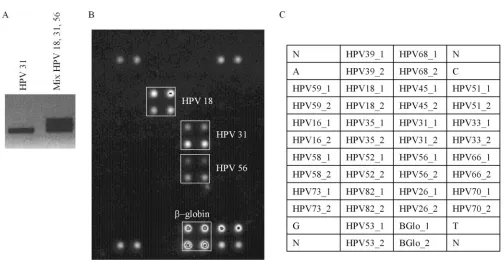
[image:3.585.41.545.59.320.2]Generation and characterization of an array primer exten-sion assay for detection of the different HPV types.To deter-mine the HPV types after performing a multiplex PCR, we have developed an APEX assay. Two oligonucleotides cover-ing two distinct regions of the E7-region gene were synthesized for the 19 HPV types and were spotted in duplicate on the chip (Table 2; Fig. 1C). APEX combines two different methods, i.e., microarray and Sanger dideoxy sequencing. After PCR, the amplified DNA fragments are hybridized to the chip, which is followed by an extension reaction in the presence of ddNTPs that fluoresce differently when they are labeled. Thus, the HPV type can be confirmed by the position of the positive signal on the chip and the incorporation of the correct florescent
FIG. 1. HPV typing by multiplex/APEX assay with an artificial mixture of HPV DNAs. (A) Gel image of multiplex PCR amplification products from an artificial mixture of three HPV types (types 18, 31, and 56) mixed with human genomic DNA extracted from the HPV-negative cervical cell line C33A. As a control, a PCR with only HPV-31 DNA as the template was included. (B) APEX assay of the multiplex PCR. After fragmentation of the PCR product, APEX was performed as described in the Materials and Methods. The image was obtained after excitation by a laser wavelength corresponding to cyanine 5 bound to ddUTP. The positive signals for HPV types 18, 31, and 56 and-globin correspond to four white spots (two different oligonucleotides for each gene spotted in duplicate) and are highlighted by the white boxes. (C) Layout of the APEX chip. The oligonucleotides printed on the array are indicated by their names in the boxes. Their sequences are given in Table 2. Each oligonucleotide has been spotted in duplicate. The four corners contain a mixture of four self-elongating marker oligonucleotides that give signals in all dideoxy nucleotide channels (named N) and one self-elongation marker oligonucleotide that gives a signal only in one dideoxy nucleotide channels (A, G, C, U).
on May 16, 2020 by guest
http://jcm.asm.org/
ddNTP. To make the test simpler and applicable for two-color scanners as well, we have designed the chip oligonucleotides in such a way that, during the extension reaction, the same ddNTP (ddUTP) is incorporated in all cases. To test the spec-ificity of the assay, we performed multiplex PCR using as the template the DNA of the individual HPV types. No false HPV-positive signals were detected by the APEX assay. In fact, hybridization of the PCR product on the chip in all cases gave
a positive signal for a single HPV type (data not shown). Subsequently, we have determined the efficiency of the assay in detecting multiple HPV types. For this purpose, we have ana-lyzed four artificial mixtures containing different HPV types: (i) HPV types 18, 31, and 56; (ii) HPV types 16, 31, 33, 39, and 68; (iii) HPV types 18, 26, 35, and 51; and (iv) HPV types 53, 56, 58, 59, and 66. In all four mixtures, the HPV DNAs were mixed with human genomic DNA extracted from the HPV-negative cervical cell line C33A. Several products were ob-tained by multiplex PCR, and their hybridization on the chip gave positive signals for the expected HPV types in the four artificial mixtures. The data obtained with the first mixture containing HPV types 18, 31, and 56 are shown in Fig. 1. Together, these data indicate that the multiplex PCR/APEX assay has a high sensitivity and a high specificity for detection of the mucosal high-risk HPV types.
Intermethod comparison.To validate further the novel HPV detection assay we blindly analyzed 92 DNA samples extracted from cervical scrapes collected at the Vrije Universiteit
Med-ical Center, which were previously HPV typed by the GP5⫹/
GP6⫹PCR/RLB assay (27). For comparison studies, we took
into account only the HPV types that are detectable by both assays (i.e., types 16, 18, 26, 31, 33, 35, 39, 45, 51, 52, 53, 56, 58, 59, 66, 68, 70, 73, and 82).
Both methods detected similar percentages of HPV-positive
samples (63% by multiplex PCR/APEX versus 61% by GP5⫹/
GP6⫹PCR/RLB), and the level of concordance between the
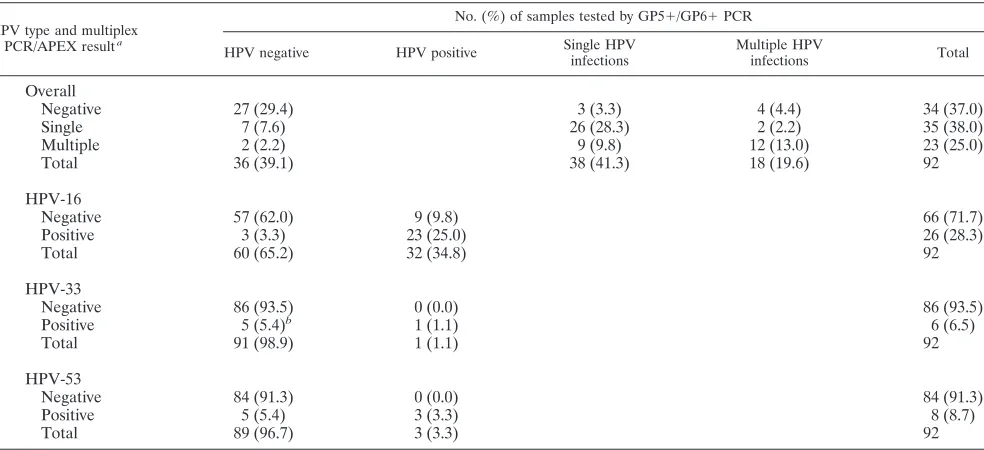
two assays in identifying HPV-negative or HPV-positive sam-ples was greater than 80% (Table 3). In addition, the GP5⫹/ GP6⫹PCR detected several low-risk HPV types (e.g., types 6, 11, 42, and 54) which were not included in the multiplex PCR/ APEX assay (data not shown). Multiple infections were de-tected in 23 women by the multiplex PCR/APEX and in 18
women by the GP5⫹/GP6⫹ PCR/RLB (Table 3). Seven
women classified as HR HPV negative according to the GP5⫹/ GP6⫹PCR/RLB result were found to be positive for infection with a single HR HPV type by the multiplex PCR/APEX assay, while only three women were negative by the multiplex PCR/
APEX assay and positive by the GP5⫹/GP6⫹PCR/RLB.
Sim-ilarly, nine women infected with a single HR HPV type
ac-cording to the results of GP5⫹/GP6⫹PCR/RLB were found
to have multiple infections by the multiplex PCR/APEX assay. In contrast, in only two subjects, the multiplex PCR/APEX assay detected infection with a single HPV type that was found to be infection with multiple types by the GP5⫹/GP6⫹PCR/ RLB method. Overall, more HPV types were found in multiple
infections by our method (n⫽71) than by the GP5⫹/GP6⫹
PCR/RLB assay (n ⫽ 47). To evaluate the specificity of our
novel assay, we have selected 10 cases in which additional HPV types were detected by multiplex PCR/APEX assay in
compar-ison to the number that were detected by the GP5⫹/GP6⫹
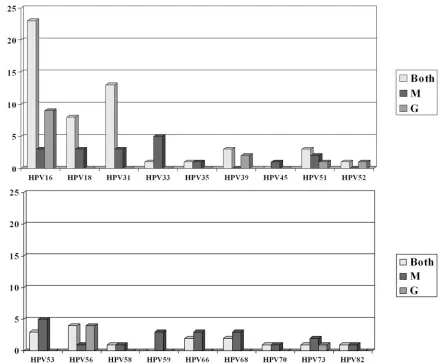
PCR/RLB method. After PCR, we performed DNA sequenc-ing ussequenc-ing HPV type-specific primers. In all cases the DNA sequencing confirmed the data obtained by the multiplex PCR/ APEX assay, excluding the possibility that the higher number of HPV types detected by the novel method was due to un-specific signals (data not shown). As shown in Table 3, the greatest difference between the two assays in detecting specific HPV types was found for HPV types 16, 33, and 53. More
[image:4.585.44.287.79.610.2]HPV-16-positive infections were identified by the GP5⫹/
TABLE 2. Sequences of each of the oligonucleotides spotted on the chip
HPV
type Primer sequence
16 1. 5⬘-ACACACGTAGACATTCGTACTTTGGAAGACC-3⬘ 2. 5⬘-AAGCAGAACCGGACAGAGCCCATTACAATA-3⬘
18 1. 5⬘-GTAGAAAGCTCAGCAGACGACCTTCGAGCA-3⬘ 2. 5⬘-GCCGAACCACAACGTCACACAATGTTGTGTA-3⬘
26 1. 5⬘-ATTGGACTATGAACAATTTGACAGCTCAGA-3⬘ 2. 5⬘-TTGAAGCACAATGTTGTATGTGTAATAGTATAG-3⬘
31 1. 5⬘-GTGTACAGAGCACACAAGTAGATATTCGCA-3⬘ 2. 5⬘-ACCGGACACATCCAATTACAATATCGTTACCTT-3⬘
33 1. 5⬘-AGTTCGTTTATGTGTCAACAGTACAGCAAG-3⬘ 2. 5⬘-GCCACAGCTGATTACTACATTGTAACCTGT-3⬘
35 1. 5⬘-ACACACATTGACATACGTAAATTGGAAGAT-3⬘ 2. 5⬘-AGACACCTCCAATTATAATATTGTAACGTCC-3⬘
39 1. 5⬘-GCAGCTGGTAGTAGAAGCCTCACGGGATAC-3⬘ 2. 5⬘-GATGAACCACAGCGTCACACAATACAGTGT-3⬘
45 1. 5⬘-GTAGAGAGCTCGGCAGAGGACCTTAGAACAC-3⬘ 2. 5⬘-CCGAACCACAGCGTCACAAAATTTTGTGTG-3⬘
51 1. 5⬘-AACTGGCAGTGGAAAGCAGTGGAGACACCC-3⬘ 2. 5⬘-GACAGGCTACGTGTTACAGAATTGAAGCTCCG-3⬘
52 1. 5⬘-CATTCATAGCACTGCGACGGACCTTCGTAC-3⬘ 2. 5⬘-AGCCACAAGCAATTACTACATTGTGACATA-3⬘
53 1. 5⬘-ATTGAAACACAGTGTTGTAGGTGTGAGTCGTTGG-3⬘ 2. 5⬘-TGTGAGTCGTTGGTGCAGTTGGCTGTTCAGAGT-3⬘
56 1. 5⬘-CATTCAGAGTACCAAAGAGGACCTGCGTGT-3⬘ 2. 5⬘-CACGTACCTTGTTGTGAGTGTAAGTTTGTGG-3⬘
58 1. 5⬘-CACCACGGTTCGTTTGTGTATCAACAG-3⬘ 2. 5⬘-GACAGCTCAGACGAGGATGAAATAGGCT-3⬘
59 1. 5⬘-CAGCTAGTAGTAGAAACCTCGCAAGACGGA-3⬘ 2. 5⬘-ACCTGACTCCGACTCCGAGAATGAAAAAGA-3⬘
66 1. 5⬘-CATTCAGAGTACCAAAGAGGAGCTACGTGTGG-3⬘ 2. 5⬘-ACAACATAAGTGTTACCTAATTCACGTACC-3⬘
68 1. 5⬘-ACTACTAGCCAGACGGGACGAACAACAGCG-3⬘ 2. 5⬘-AACCCGACCATGCAGTTAATCACCACCAACA-3⬘
70 1. 5⬘-ACAAAATACAGTGTATGTGTTGTAAGTGTAATAC-3⬘ 2. 5⬘-TGCACTTAGTAGTAGAAGCCTCACAAGAGAACC-3⬘
73 1. 5⬘-CACGAAGTGTCAGTGCACAGTATGCCTTGCCAT-3⬘ 2. 5⬘-GACAAGCTGAACGAGAGTGTTACAGAATAGTTAC-3⬘
82 1. 5⬘-CTCGCAGTGGAAAGCAGTGGAGACAGCCTTCGCA-3⬘ 2. 5⬘-TTCAGCAAATGTTACTGGGCGACCTAAGCCTGG-3⬘
-Globin 1. 5⬘-ATCACTTAGACCTCACCCTGTGGAGCCATACCC-3⬘ 2. 5⬘-TCCTGAGGAGAAGTCTGCCGTTACTGCCC-3⬘
on May 16, 2020 by guest
http://jcm.asm.org/
GP6⫹PCR/RLB assay, while HPV types 33 and 53 were better detected by the multiplex PCR/APEX assay. All five women in whom HPV-33 was detected by multiplex PCR/APEX but not
by GP5⫹/GP6⫹ PCR/RLB were concurrently infected with
other HPV types. Figure 2 shows the number of infections with each HPV type detected by both methods or only one method. A small number of infections with HPV types 18, 31, 59, 66, and 68 were detected by multiplex PCR/APEX and not by
GP5⫹/GP6⫹ PCR/RLB, while two infections with HPV-39
were identified only by GP5⫹/GP6⫹PCR/RLB.
The presence or absence of low-risk HPV types, as
deter-mined by the GP5⫹/GP6⫹PCR reverse line blot method, did
not affect the performance of the multiplex PCR/APEX assay. In fact, it detected similar proportions of high-risk HPV type-specific infections in samples with or without low-risk HPV types. The Fisher exact statistic for testing the differences in the proportions of infections was not significant for the most
commonly detected HPV types: HPV-16 (P⫽0.56), HPV-18
(P ⫽ 0.99), HPV-31 (P ⫽ 0.74), HPV-33 (P ⫽ 0.33), and
HPV-53 (P⫽0.55).
DISCUSSION
A considerable number of studies have demonstrated that detection of mucosal HPV DNAs in cervical specimens has significantly contributed to (i) identifying carcinogenic HPV types, (ii) understanding the natural history of the viral infection, and (iii) increasing the sensitivity of the screening for cervical abnormalities. Many accurate methods for HPV detection and typing have been developed in the past few decades (10). Most of these assays imply the use of degen-erated and/or consensus primers that allow the detection of a large spectrum of HPV types with a single PCR. The drawback of this approach is that the various primer sets,
although they are generally able to identify with a high sensitivity a broad spectrum of mucosal HPV types, have various efficiencies in detecting multiple infections (3, 16, 17). Intermethod comparisons clearly showed that the use of only one detection method could easily lead to an underes-timation of the overall prevalence of HPV DNAs in clinical specimens (11, 24). Therefore, the use of more than one assay would be the preferred means for the most reliable assessment of the prevalence of the complete spectrum of relevant HPV types in epidemiological studies.
Here, we describe a novel multiplex PCR-based method with a panel of HPV type-specific primers. This assay detects a wide spectrum of mucosal high-risk HPV types with a high sensitiv-ity by a single PCR and combines the advantages of PCR-based methods that use degenerated/consensus primers and type-specific primers. In addition, in order to identify the HPV types amplified by the multiplex PCR, we have developed a chip assay based on APEX. A comparative analysis between our method and the well-validated PCR-based assay, the
GP5⫹/GP6⫹PCR, followed by RLB, showed that the
multi-plex PCR/APEX protocols led to the identification of a higher number of infections with multiple HPV types. In this study, several HPV types were found more frequently by the novel
method than by the GP5⫹/GP6⫹PCR/RLB assay, especially
in women infected with multiple HPV types. These results are in agreement with the idea that in the case of multiple infec-tions, different HPV types will not compete for the same primer set, which is in contrast to case for the GP5⫹/GP6⫹ PCR method, which uses only one primer set.
The limitation of the current version of our assay is the lower
efficiency of detection of HPV-16 than that by the GP5⫹/
GP6⫹ PCR/RLB protocol. This phenomenon may be
ex-plained by possible natural variations within HPV-16
E7-re-TABLE 3. Concordance of overall HPV positivity tested by multiplex PCR/APEX and GP5⫹/GP6⫹PCR
HPV type and multiplex PCR/APEX resulta
No. (%) of samples tested by GP5⫹/GP6⫹PCR
HPV negative HPV positive Single HPV infections
Multiple HPV
infections Total
Overall
Negative 27 (29.4) 3 (3.3) 4 (4.4) 34 (37.0)
Single 7 (7.6) 26 (28.3) 2 (2.2) 35 (38.0)
Multiple 2 (2.2) 9 (9.8) 12 (13.0) 23 (25.0)
Total 36 (39.1) 38 (41.3) 18 (19.6) 92
HPV-16
Negative 57 (62.0) 9 (9.8) 66 (71.7)
Positive 3 (3.3) 23 (25.0) 26 (28.3)
Total 60 (65.2) 32 (34.8) 92
HPV-33
Negative 86 (93.5) 0 (0.0) 86 (93.5)
Positive 5 (5.4)b 1 (1.1) 6 (6.5)
Total 91 (98.9) 1 (1.1) 92
HPV-53
Negative 84 (91.3) 0 (0.0) 84 (91.3)
Positive 5 (5.4) 3 (3.3) 8 (8.7)
Total 89 (96.7) 3 (3.3) 92
a
Kappa test values were as follows: overall, 0.55 (95% confidence interval, 0.41 to 0.69); HPV-16, 0.70 (95% confidence interval, 0.54 to 0.86); HPV-33, 0.27 (95% confidence interval, 0.0 to 0.69); and HPV-53, 0.52 (95% confidence interval, 0.17 to 0.88).
b
All occurred in women infected with multiple HPV types.
on May 16, 2020 by guest
http://jcm.asm.org/
[image:5.585.49.541.80.305.2]gion genes. In fact, a natural variant with a variation in the region selected for the forward PCR primer has been reported (31). In addition, we are currently investigating whether this apparent reduced sensitivity of the multiplex PCR/APEX method is due to the primers used in the PCR or on the chip. Due to the general features of the multiplex PCR/APEX assay and its high degrees of versatility and flexibility, the sensitivity of the assay for detection of these HPV types can easily be improved by including new or modified oligonucleotides in the multiplex PCR and/or on the chip. Another advantage of our assay is that the PCR amplifies a part of the E7-region gene that is retained in all cancer cells. In contrast, many HPV detection protocols use PCR primers that anneal in the L1 gene, which may be lost or deleted during the integration of the viral DNA in the host genome.
In conclusion, this study describes a novel assay for detection of mucosal high-risk HPV types with a high sensitivity and a high specificity for the detection of several mucosal high-risk HPV types in women infected with single and multiple HPV types. This method may be a very valuable tool for epidemio-logical studies that aim to determine the distributions of vari-ous HPV types in different areas of the world.
ACKNOWLEDGMENTS
We are grateful to all members of our laboratory for their cooper-ation and Bakary Sylla and Uzma Hasan for critical reading of the manuscript.
REFERENCES
1.Altman, D. G.1991. Practical statistics for medical research. Chapman & Hall, Ltd., London, England.
1a.Auffray, C., C. Mundy, and A. Metspalu.2000. DNA arrays: methods and applications: report on HUGO Meeting, Tartu, Estonia, 23–26 May, 1999. Eur. J. Hum. Genet.8:236–238.
2.Clavel, C., M. Masure, J. P. Bory, I. Putaud, C. Mangeonjean, M. Lorenzato, P. Nazeyrollas, R. Gabriel, C. Quereux, and P. Birembaut.2001. Human papillomavirus testing in primary screening for the detection of high-grade cervical lesions: a study of 7932 women. Br. J. Cancer84:1616–1623. 3.Coutlee, F., P. Gravitt, J. Kornegay, C. Hankins, H. Richardson, N.
Lapointe, H. Voyer, and E. Franco. 2002. Use of PGMY primers in L1 consensus PCR improves detection of human papillomavirus DNA in genital samples. J. Clin. Microbiol.40:902–907.
4.Cox, J. T.1996. Clinical role of HPV testing. Obstet. Gynecol. Clin. N. Am. 23:811–851.
5.Cuzick, J., E. Beverley, L. Ho, G. Terry, H. Sapper, I. Mielzynska, A. Lorincz, W. K. Chan, T. Krausz, and P. Soutter.1999. HPV testing in primary screening of older women. Br. J. Cancer81:554–558.
6.Ferlay, J., F. Bray, P. Pisani, and D. M. Parkin.2001. GLOBOCAN 2000: Cancer incidence, mortality and prevalence worldwide, version 1.0. IARC Press, Lyon, France.
[image:6.585.82.522.65.429.2]7.Fujinaga, Y., M. Shimada, K. Okazawa, M. Fukushima, I. Kato, and K. FIG. 2. Frequency of detection of different HPV types by the multiplex PCR/APEX (M) and the GP5⫹/GP6⫹PCR/RLB (G) methods in 92 cervical scrapes of Dutch women.
on May 16, 2020 by guest
http://jcm.asm.org/
Fujinaga.1991. Simultaneous detection and typing of genital human papil-lomavirus DNA using the polymerase chain reaction. J. Gen. Virol.72(Pt 5):1039–1044.
8.Gemignani, F., S. Landi, A. Chabrier, A. Smet, I. Zehbe, F. Canzian, and M. Tommasino.2004. Generation of a DNA microarray for determination of E6 natural variants of human papillomavirus type 16. J. Virol. Methods119:95– 102.
9.Guo, Z., R. A. Guilfoyle, A. J. Thiel, R. Wang, and L. M. Smith.1994. Direct fluorescence analysis of genetic polymorphisms by hybridization with oligo-nucleotide arrays on glass supports. Nucleic Acids Res.22:5456–5465. 10.IARC Working Group, on the Evaluation of Cancer Prevention Strategies.
2005. Cervix cancer screening, vol. 10. IARC Press, Lyon, France. 11.Karlsen, F., M. Kalantari, A. Jenkins, E. Pettersen, G. Kristensen, R. Holm,
B. Johansson, and B. Hagmar.1996. Use of multiple PCR primer sets for optimal detection of human papillomavirus. J. Clin. Microbiol.34:2095– 2100.
12.Kaufman, R. H., and E. Adam.1999. Is human papillomavirus testing of value in clinical practice? Am. J. Obstet. Gynecol.180:1049–1053. 13.Kurg, A., N. Tonisson, I. Georgiou, J. Shumaker, J. Tollett, and A. Metspalu.
2000. Arrayed primer extension: solid-phase four-color DNA resequencing and mutation detection technology. Genet. Test.4:1–7.
14.Manos, M. M., W. K. Kinney, L. B. Hurley, M. E. Sherman, J. Shieh-Ngai, R. J. Kurman, J. E. Ransley, B. J. Fetterman, J. S. Hartinger, K. M. McIntosh, G. F. Pawlick, and R. A. Hiatt.1999. Identifying women with cervical neo-plasia: using human papillomavirus DNA testing for equivocal Papanicolaou results. JAMA281:1605–1610.
15.Munoz, N., F. X. Bosch, S. de Sanjose, R. Herrero, X. Castellsague, K. V. Shah, P. J. Snijders, and C. J. Meijer.2003. Epidemiologic classification of human papillomavirus types associated with cervical cancer. N. Engl. J. Med. 348:518–527.
16.Perrons, C., B. Kleter, R. Jelley, H. Jalal, W. Quint, and R. Tedder.2002. Detection and genotyping of human papillomavirus DNA by SPF10 and MY09/11 primers in cervical cells taken from women attending a colposcopy clinic. J. Med. Virol.67:246–252.
17.Qu, W., G. Jiang, Y. Cruz, C. J. Chang, G. Y. Ho, R. S. Klein, and R. D. Burk. 1997. PCR detection of human papillomavirus: comparison between MY09/ MY11 and GP5⫹/GP6⫹primer systems. J. Clin. Microbiol.35:1304–1310. 18.Resnick, R. M., M. T. Cornelissen, D. K. Wright, G. H. Eichinger, H. S. Fox, J. ter Schegget, and M. M. Manos.1990. Detection and typing of human papillomavirus in archival cervical cancer specimens by DNA amplification with consensus primers. J. Natl. Cancer Inst.82:1477–1484.
19.Saiki, R. K., D. H. Gelfand, S. Stoffel, S. J. Scharf, R. Higuchi, G. T. Horn, K. B. Mullis, and H. A. Erlich.1988. Primer-directed enzymatic amplifica-tion of DNA with a thermostable DNA polymerase. Science239:487–491.
20.Sasagawa, T., Y. Minemoto, W. Basha, H. Yamazaki, M. Nakamura, H. Yoshimoto, J. Sakaike, and M. Inoue.2000. A new PCR-based assay ampli-fies the E6-E7 genes of most mucosal human papillomaviruses (HPV). Virus Res.67:127–139.
21.Sasieni, P. D., J. Cuzick, E. Lynch-Farmery, et al.1996. Estimating the efficacy of screening by auditing smear histories of women with and without cervical cancer. Br. J. Cancer73:1001–1005.
22.Schiffman, M., R. Herrero, A. Hildesheim, M. E. Sherman, M. Bratti, S. Wacholder, M. Alfaro, M. Hutchinson, J. Morales, M. D. Greenberg, and A. T. Lorincz.2000. HPV DNA testing in cervical cancer screening: results from women in a high-risk province of Costa Rica. JAMA283:87–93. 23.Shumaker, J. M., A. Metspalu, and C. T. Caskey.1996. Mutation detection
by solid phase primer extension. Hum. Mutat.7:346–354.
24.Smits, H. L., L. J. Bollen, A. H. S. P. Tjong, J. Vonk, J. Van Der Velden, F. J. Ten Kate, J. A. Kaan, B. W. Mol, and J. Ter Schegget.1995. Intermethod variation in detection of human papillomavirus DNA in cervical smears. J. Clin. Microbiol.33:2631–2636.
25.Snijders, P. J., A. J. van den Brule, H. F. Schrijnemakers, G. Snow, C. J. Meijer, and J. M. Walboomers.1990. The use of general primers in the polymerase chain reaction permits the detection of a broad spectrum of human papillomavirus genotypes. J. Gen. Virol.71(Pt 1):173–181. 26.Tieben, L. M., J. ter Schegget, R. P. Minnaar, J. N. Bouwes Bavinck, R. J.
Berkhout, B. J. Vermeer, M. F. Jebbink, and H. L. Smits.1993. Detection of cutaneous and genital HPV types in clinical samples by PCR using consensus primers. J. Virol. Methods42:265–279.
27.van den Brule, A. J., R. Pol, N. Fransen-Daalmeijer, L. M. Schouls, C. J. Meijer, and P. J. Snijders.2002. GP5⫹/6⫹PCR followed by reverse line blot analysis enables rapid and high-throughput identification of human papillo-mavirus genotypes. J. Clin. Microbiol.40:779–787.
28.van den Brule, A. J., P. J. Snijders, R. L. Gordijn, O. P. Bleker, C. J. Meijer, and J. M. Walboomers.1990. General primer-mediated polymerase chain reaction permits the detection of sequenced and still unsequenced human papillomavirus genotypes in cervical scrapes and carcinomas. Int. J. Cancer 45:644–649.
29.Vizcaino, A. P., V. Moreno, F. X. Bosch, N. Munoz, X. M. Barros-Dios, J. Borras, and D. M. Parkin.2000. International trends in incidence of cervical cancer. II. Squamous-cell carcinoma. Int. J. Cancer86:429–435.
30.Yoshikawa, H., T. Kawana, K. Kitagawa, M. Mizuno, H. Yoshikura, and A. Iwamoto.1991. Detection and typing of multiple genital human papilloma-viruses by DNA amplification with consensus primers. Jpn. J. Cancer Res. 82:524–531.
31.Zehbe, I., E. Wilander, H. Delius, and M. Tommasino.1998. Human papil-lomavirus 16 E6 variants are more prevalent in invasive cervical carcinoma than the prototype. Cancer Res58:829–833.