Copyright © 2003, American Society for Microbiology. All Rights Reserved.
Development and Application of Real-Time PCR Assay for
Quantification of
Mycobacterium ulcerans
DNA
S. Rondini,
1* E. Mensah-Quainoo,
2H. Troll,
3T. Bodmer,
4and G. Pluschke
1 Swiss Tropical Institute,1and Solvias AG,3Basel, and Institute for Infectious Diseases, Bern,4Switzerland, andGhana Health Service, Amasaman, Ga District, Ghana2
Received 11 April 2003/Returned for modification 6 June 2003/Accepted 3 July 2003
Buruli ulcer, an infection caused byMycobacterium ulcerans, is, after tuberculosis and leprosy, the third most
common mycobacterial disease. The mode of transmission ofM. ulceransis not exactly known, but since Buruli
ulcer often occurs in focalized swampy areas, it is assumed that there is a reservoir of the pathogen in stagnant water. Buruli ulcer usually starts as a painless nodule and can lead to massive destruction of skin, subcuta-neous tissue, and eventually muscle and bone. Currently the only recommended treatment is wide surgical
excision. In this report we describe the development of a real-time PCR method for the quantification ofM.
ulceransDNA (IS2404 TaqMan). The highly specific assay is based on the detection of theM. ulceransspecific
insertion sequence IS2404. The IS2404 TaqMan assay turned out to be about 10 times more sensitive than the
available conventional PCR-based diagnostic test. It is demonstrated that the IS2404 TaqMan assay is suitable for the quantitative assessment of the dissemination of the mycobacteria in Buruli ulcer lesions. Prototype results obtained with excised tissue from a patient with a late preulcerative Buruli ulcer lesion reconfirmed earlier histopathological findings indicating that tissue damage occurs far beyond the regions in which large numbers of mycobacteria are detectable. The IS2404 TaqMan assay should be a useful tool for both diagnosis and research into the pathology and mode of transmission of this still inadequately investigated mycobacterial disease.
Mycobacterium ulceransis a slow-growing environmental my-cobacterium, which causes a disfiguring condition known as Buruli ulcer.M. ulceransinfections have been found in more than 30 tropical and subtropical countries of Africa, Asia, Latin America, and the Western Pacific but are most common and severe in West Africa (1). Buruli ulcer often occurs in people who live close to rivers and stagnant bodies of water.
The mode of transmission ofM. ulceransis not clear, but it is assumed that the environmental pathogens enter the body through small lesions in the skin (1, 6). Aquatic insects may be involved in some cases (1, 18). After entry, the bacteria pro-liferate in the subcutaneous tissue. In African patients, early lesions are characterized by coagulative necrosis of lower der-mis and subcutaneous fatty tissue associated with some calci-fication. Production of mycolactone (13), a toxin with an affin-ity for fatty cells (12), may be important for the pathogenesis of the disease by causing necrosis and thus providing a favorable milieu for the mycobacteria. It is likely, however, that addi-tional bacterial factors are involved in the pathogenesis (10). Even in the most minimal lesions, necrosis of fatty tissue seems to be a primary event (19). In contrast to other pathogenic mycobacteria, M. ulcerans is not a facultative intracellular pathogen but is found primarily as extracellular microcolonies (14, 19).
Depending on its progression, Buruli ulcer has different clin-ical manifestations. The disease often starts as a painless swell-ing in the skin, and as it progresses, all elements of the skin become affected. The early preulcerative forms (nodules,
pap-ules, plaques, and edemas) are followed by the ulcerative stage. Necrosis of the subcutaneous fatty tissue with vascular occlu-sion results in sloughing and secondary ulceration of the over-lying skin. Acid-fast bacilli (AFB) stained by the Ziehl-Neelsen (ZN) technique in tissue sections seem to be largely confined to the necrotic slough and surrounding necrotic fatty tissue. In the late stages massive areas of skin, subcutaneous tissue, and sometimes muscle and bone are destroyed, leading to gross deformities. If a healing response takes place, fibrosis, scarring, calcification, and contractures with permanent disabilities may result (30). To date, the treatment of choice is surgery, since current antimicrobial therapies appear to be ineffective, but recurrence of the disease after surgical treatment is a common problem that may be due to incomplete removal of the myco-bacteria and inadequate excision.
Early treatment of M. ulcerans disease provides a better outcome than treatment of the ulcerative forms, but it is often impaired by the difficulties of diagnosis. The commonly used diagnostic tests are (i) detection of mycobacteria by ZN stain-ing, a technique that lacks sensitivity and specificity; (ii) culture ofM. ulcerans, which may take several months; (iii) detection of characteristic histopathological changes in excised tissue; and (iv) detection ofM. ulceransDNA by PCR, representing a rapid, sensitive, and specific diagnostic method (21). IS2404, an insertion element present in multiple copies in theM. ul-ceransgenome, is commonly used as a target sequence for this purpose (26). IS2404is specific forM. ulceransand encodes a 328-amino-acid transposase (27). It has also been found re-cently in a mycobacterial isolate which may constitute a link betweenMycobacterium marinumandM. ulcerans(4).
In this report we describe the development of a PCR method for the quantification of M. ulceransDNA by
moni-* Corresponding author. Mailing address: Socinst. 57, Swiss Tropical Institute, CH 4002 Basel, Switzerland. Phone: 41 61 2848277. Fax: 41 61 2718654. E-mail: [email protected].
4231
on May 15, 2020 by guest
http://jcm.asm.org/
toring the real-time amplification of IS2404, using the TaqMan system (IS2404 TaqMan). Beyond the possibility of measuring the starting amount of target DNA in clinical specimens and other samples, real-time PCR has several advantages over the conventional endpoint PCR. These include reduction of risk of contamination by eliminating the post-PCR processing and a diminished sensitivity to PCR inhibitors. By applying IS2404 TaqMan PCR to samples from Buruli ulcer patients, it will be possible to correlate the dissemination ofM. ulceranswith the progression of the disease. The method may also help to de-termine the optimal extent of surgical excision in order to reduce recurrence.
MATERIALS AND METHODS
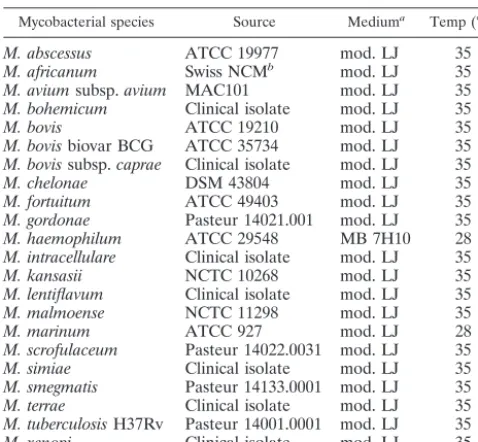
Mycobacterial isolates.Mycobacterial isolates that have been employed in this study are listed in Table 1. Clinical isolates were identified to the species level by the partial sequencing of the 16S ribosomal DNA gene and by conventional methods (20).
Clinical specimens.Samples of about 100 mg were taken from tissue excised from a Buruli ulcer patient (male, 12 years old) in Amasaman, Ghana, with a preulcerative plaque lesion at the ventral side of his left distal forearm. Care was taken to avoid cross-contamination among the different sample areas.
Cotton swabs were used to collect diagnostic samples from the base of under-mined margins of lesions of Buruli ulcer patients with ulcerative lesions. The samples were maintained in the cold chain until they were analyzed.
Informed consent.Informed consent was obtained from the patients or their parents before enrollment in the study.
DNA preparation.Extraction of DNA from cultivated mycobacteria was done as previously described by Telenti et al. (29). The tips of the cotton swabs were cut and heated for 30 min at 95°C in screw-cap tubes containing 600l of extraction buffer (0.2% sodium dodecyl sulfate, 0.05 M NaOH). After a brief centrifugation, 40l of a 20-mg/ml proteinase K solution was added to the supernatants. After 30 min of incubation at 60°C, the samples were vortexed for 2 min with 200l of 100-m-diameter glass beads and the DNA in the super-natants was precipitated and washed with ethanol. After another washing with acetone and air drying, the precipitated DNA was resuspended in 60l of water and 0.5-l amounts of the template solutions were used for PCR analysis.
following protocol: denaturation at 94°C for 10 min, amplification for 35 cycles of 94°C for 1 min, 60°C for 1 min, and 72°C for 1 min, and a final extension at 72°C for 7 min. Ten microliters of amplified DNA was subjected to electrophore-sis in a 1% agarose gel and detected by ethidium bromide staining and UV transillumination. A 1-kb ladder was used as a size marker.
Real-time PCR.Primer and probe sequences (Table 2) were selected from a region of the IS2404sequence with minimal homology with human DNA. The probe was labeled with the fluorescent dyes 5-carboxyfluorescein (FAM) on the 5⬘ end andN,N,N⬘,N⬘-tetramethyl-6-carboxyrhodamine (TAMRA) on the 3⬘
end. When the dyes are close to each other, the 5⬘reporter fluorophore (FAM) transfers laser-induced excitation energy to the 3⬘quencher (TAMRA). When the oligoprobe hybridizes to its template, the fluorophores are released by the 5⬘-3⬘exonuclease activity of theTaqpolymerase, leading to the separation of the dyes in solution. Once they are separated, the reporter emission is no longer quenched and it is possible to measure the increasing fluorescence, which is proportional to the amount of target DNA produced (16). DNA extracted from M. ulceransstrain Agy98 was used as a standard in all experiments.
Real-time PCR mixtures contained template DNA, 0.3M concentrations of each primer, 0.1M concentration of the probe, and TaqMan Universal PCR Mastermix (Applied Biosystems) in a total volume of 25l. Amplification and detection were performed with the ABI Prism 7700 sequence detection system by using the following profile: 1 cycle of 50°C for 2 min, 1 cycle of 95°C for 10 min, and 40 cycles of 95°C for 15 s and 60°C for 1 min. Analyses were done in triplicates. For quantification, an external standard curve withM. ulceransAgy98 DNA serially diluted over 6 logs was used. Negative controls were included in each amplification experiment. To analyze the potential inhibitory effect of human DNA on the real-time PCR, increasing amounts of human genomic DNA from 10 to 1,000 ng were added to a fixed amount of 20 fg ofM. ulceransDNA per PCR mix.
RESULTS
Development of an IS2404-based real-time PCR assay.With
IS2404, an insertion sequence unique forM. ulcerans, used as the target, an ABI Prism sequence detection system (TaqMan)
M. scrofulaceum Pasteur 14022.0031 mod. LJ 35
M. simiae Clinical isolate mod. LJ 35
M. smegmatis Pasteur 14133.0001 mod. LJ 35
M. terrae Clinical isolate mod. LJ 35
M. tuberculosisH37Rv Pasteur 14001.0001 mod. LJ 35
M. xenopi Clinical isolate mod. LJ 35
amod. LJ, modified Lo¨wenstein-Jensen; MB 7H10, Middlebrook agar with
10% oleic acid-albumin-dextrose-catalase enrichment supplement with 0.4% fer-rum-ammonium-citrate.
[image:2.603.43.282.80.301.2]bSwiss NCM: Swiss National Centre for Mycobacteria, Zurich, Switzerland.
TABLE 2. Primer and probe sequences used for the IS2404 TaqMan assay and conventional PCR
Primer or
probe Sequence (5⬘-3⬘) Reference
Primers
F1 ATTGGTGCCGATCGAGTTG This study
R1 TCGCTTTGGCGCGTAAA This study
MU1 GGCAGGCTGCAGATGGCATA Ross et al.
MU2 GGCAGTTACTTCACTTGCACA Ross et al.
Probe
P1 FAM-CACCACGCAGCATTCTTGCCGT-TAMRA This study
on May 15, 2020 by guest
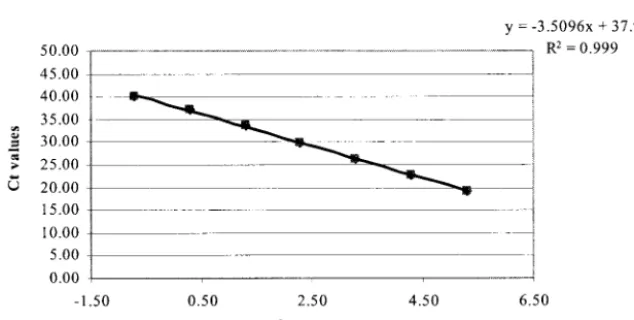
[image:2.603.300.543.624.723.2]quantitative real-time PCR method was developed. Primers F1 and R1 comprised residues 406 to 424 and 465 to 449, respec-tively, in the GenBank IS2404sequence (no. AF003002) (Ta-ble 2). They were used in combination with the probe P1, comprising residues 447 to 426. The standard curve obtained with a serially dilutedM. ulceransgenomic DNA preparation was linear over 6 orders of magnitude with a coefficient of correlation of 0.999 and a slope of 3.51, corresponding to a PCR efficiency of ⬎90% (Fig. 1). Assuming that 1 genome copy corresponds to 5 fg of DNA (28), the detection limit was 0.2 genome copies per reaction mixture. Since it is expected that the genome ofM. ulceransisolates contains approximately 50 to 100 copies of IS2404, the detection limit thus corre-sponded to 10 to 20 copies of IS2404. With amounts of M. ulcerans DNA equivalent to 0.2 to 200,000 genome copies, threshold cycle number (Ct) values ranging from 35 to 16 were obtained with a coefficient of variation of⬍2 (Table 3).
The potential inhibitory effect of human genomic DNA was evaluated by spiking fixed amounts ofM. ulceransDNA with increasing concentrations of human genomic DNA (Table 4). Human DNA on its own yielded no signal, and amounts of up to 500 ng of human DNA per reaction mixture had no inhib-itory effect on the amplification of a starting amount of 20 fg of
M. ulceransDNA. Only the addition of 1g of human genomic DNA resulted in some inhibition (Table 4). This was
compat-ible withM. ulceransDNA quantification in clinical specimens, since the amounts of human DNA in extracts from affected tissue were much smaller (50 ng). None of the genomic DNA from the other 22 mycobacterial species tested (Table 1) pro-duced an amplification product, demonstrating the high spec-ificity of the IS2404 TaqMan assay.
Use of the IS2404 TaqMan assay for the analysis of clinical
specimens.Swab samples taken from the undermined edges of
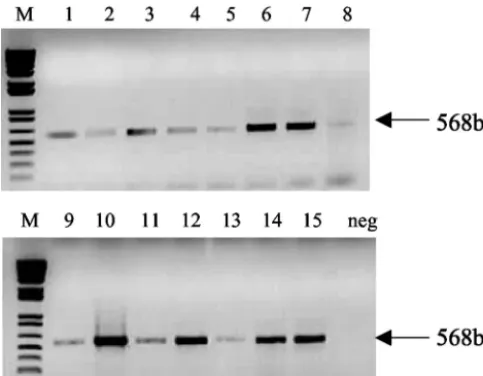
lesions from patients with ulcerative forms of Buruli ulcer were subjected to conventional and quantitative PCR. The conven-tional PCR allowed the detection of the expected 568-bp band, with some variation in the intensity of the signal among the different samples (Fig. 2). Southern blot hybridization con-firmed that IS2404-derived PCR products were obtained (data not shown). The real-time PCR revealed⬎400-fold differences in the amounts ofM. ulceransDNA, ranging from 13 to 5,267 genome copies/l of extract (Table 5).
[image:3.603.135.452.83.243.2]To demonstrate the suitability of the IS2404 TaqMan assay for the quantitative assessment of the dissemination of the mycobacteria in Buruli ulcer lesions, a surgical specimen widely excised from a patient with a nonulcerative plaque on the ventral side of the left forearm was analyzed. In addition to the firm and slightly elevated lesion (B, B*, and C in Fig. 3), the surgeon had excised a clear margin of normal tissue (A and A* in Fig. 3). In the center of the plaque a more elevated region (C in Fig. 3) was detectable, which was presumably the location of a papule or nodule in the earlier stage of the disease. Nine
[image:3.603.42.283.610.706.2]FIG. 1. Standard curve generated by the analysis of known amounts of genomic M. ulceransDNA with the IS2404 TaqMan assay. The regression line calculated for the data points is shown; the coefficient of correlation is more than 0.99.
TABLE 3. Measurement of replicate standard curves ranging from 0.2 to 200,000 genomes ofM. ulceransper reaction mixturea
No. of genome
copies copy no.Log
Ct for reaction no.:
Mean SD CV
1 2 3
0.2 ⫺0.70 35.0 35.5 34.6 35.05 0.49 1.39 2 ⫺0.30 31.5 32.5 31.8 31.94 0.52 1.62 20 1.30 29.1 29.1 28.7 28.95 0.20 0.70 200 2.30 26.0 25.7 26.0 25.88 0.18 0.68 2,000 3.30 22.2 22.2 22.3 22.25 0.02 0.10 20,000 4.30 18.8 18.9 18.8 18.85 0.06 0.29 200,000 5.30 15.8 15.8 16.0 15.89 0.11 0.68 aAbbreviations: Ct, threshold cycle number; SD, standard deviation; CV,
coefficient of variation.
TABLE 4. Evaluation of the potential inhibitory effect of human genomic DNA in quantification ofM. ulceransby IS2404 TaqMan
Human genomic DNA
per PCR (ng) Ct values
0... 28.51 10... 28.69 50... 28.48 100... 28.37 200... 28.37 500... 28.85 1,000... 30.20
on May 15, 2020 by guest
http://jcm.asm.org/
samples of about 100 mg extending from the skin into the subcutaneous fatty tissue were taken at different distances from this center of the lesion in a plane parallel to the skin surface (level 1 in Fig. 3). In the center of the lesion, deep subcutaneous tissue and fascia were also severely affected. The surgeon therefore removed two additional layers into the deeper tissues at this location, with the lowest one (level 3 in Fig. 3) extending deep down to the flexor tendon. Six samples were taken from these tissue specimens (levels 2 and 3 in Fig. 3), which exhibited pathological changes both in color and texture.
Results of a conventional PCR analysis with the tissue sam-ples demonstrated the presence ofM. ulceransDNA in all the specimens taken and already gave some indication that the
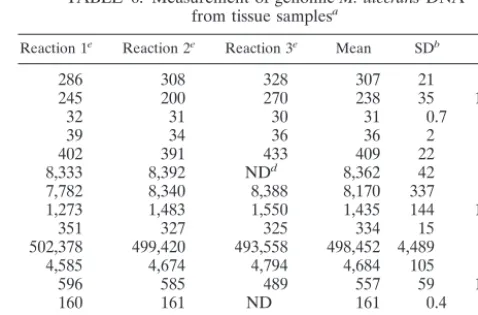
when tissue lysates instead of DNA purified from cultivated bacteria (Table 3) are used. Values from split tissue samples showed little variation (data not shown), indicating that the yield ofM. ulcerans DNA obtained with the optimized DNA extraction method used was quite reproducible. Nevertheless, the absolute values presented may represent underestimates, since the release of mycobacterial DNA may still have been incomplete.
DISCUSSION
In this paper the development of an IS2404-based real-time PCR assay for the quantification of M. ulceransDNA is de-scribed. IS2404is also the target of a conventional PCR assay (25) recommended in a slightly modified form (21) by WHO as a test for the confirmation of the clinical diagnosis of M. ul-ceransinfection. While conventional PCR assays basically pro-vide endpoint measurements suitable for qualitative yes/no results, the real-time IS2404 TaqMan assay quantifies the start-ing concentration of mycobacterial DNA by monitorstart-ing the amount of reaction product during the exponential phase of the amplification cycles. The remarkably broad dynamic range of the IS2404 TaqMan assay allowed us to analyze samples with widely different amounts of M. ulceransDNA without a prior estimation of template concentrations. When using genomic DNA extracted from cultivated mycobacteria, the IS2404 TaqMan assay exhibited a sensitivity about 10 times higher than that of the conventional IS2404-based PCR, which has been described as having a detection limit of two genome copies. It remains to be demonstrated whether this also con-verts into a statistically significant higher sensitivity of the IS2404 TaqMan assay when used for diagnostic purposes with clinical specimens. No amplification products were detected when the DNAs of 22 other mycobacteria species were tested with the IS2404 TaqMan assay, which reconfirms specificity data described for the conventional IS2404-based PCR (25).
As expected, IS2404 TaqMan analyses demonstrated that the amounts of M. ulcerans DNA present in extracts from wound swabs as taken routinely for PCR confirmation of clin-ical diagnosis vary widely. Endpoint determinations by conven-tional PCR did not fully reflect these differences. The amounts of DNA in the swab extracts were at the lowest end close to the detection limit of the conventional PCR. Already small varia-tions in the reaction condivaria-tions may in such cases cause
[image:4.603.44.286.71.259.2]incon-FIG. 2. Amplification products obtained by conventional diagnos-tic IS2404 PCR with DNA extracted from swabs used for taking sam-ples from undermined edges of Buruli ulcer lesions (lanes 1 to 15). The lane marked “neg” was loaded with an aliquot from a negative control amplification containing no template DNA.
TABLE 5. Numbers of genome copies ofM. ulceransin swabs of patients with Buruli ulcer
Sample copies/No. ofla SDb CVc
1 20 1.1 10.3
2 106 4.0 7.5
3 240 10.0 8.3
4 13 0.4 5.9
5 20 0.9 9.4
6 333 11.5 6.9
7 720 28.2 7.9
8 16 2.5 31.4
9 46 26.5 11.5
10 5,267 115.5 4.4
11 460 200.0 8.7
12 105 1.5 2.9
13 14 0.6 8.9
14 970 7.1 1.5
15 1090 21.2 3.9
a60l of extract was obtained per swab. bSD, standard deviation.
cCV, coefficient of variation.
on May 15, 2020 by guest
[image:4.603.44.283.534.700.2]sistencies in the results obtained in parallel analyses performed by the same laboratory or by different laboratories. Introduc-tion of the more sensitive IS2404 TaqMan assay will thus improve PCR confirmation of clinical diagnosis of Buruli ulcer and yield fewer false-negative results. Due to their high sensi-tivity, PCR-based assay systems are prone to yield false-posi-tive results caused by cross-contamination. Real-time PCR re-duces this risk considerably by avoiding the post-PCR handling of the samples containing vast amounts of PCR products. Nev-ertheless, it is advisable, even with the IS2404 TaqMan assay, to strictly adhere to the three-room principle: room 1 for the preparation of the PCR mix, room 2 for the processing of samples and the preparation of template DNA in a biosafety cabinet, and room 3 for PCR amplification.
Apart from the confirmation of clinical diagnosis, real-time PCR tests have a broad range of potential applications, includ-ing the quantification of target DNA in clinical specimens and environmental samples. M. ulceransis an environmental my-cobacterium, and it appears that infection with it is related to swampy environments. M. ulcerans has been isolated from aquatic bugs belonging to the genus Naucoris (18) and de-tected by conventional PCR both in water samples (24) and in water insects (22, 23, 26). The IS2404 TaqMan assay may help
in the future to identify the major environmental reservoir(s) of this pathogen.
Currently, surgery is the only proven effective treatment of
M. ulcerans disease (3). Lesions in the advanced stages, i.e., late preulcerative and ulcerated forms, may require excisions that include deep fascia and sometimes even muscle. In all forms, excisions must include healthy tissue at the lateral and deep margins. The IS2404 TaqMan assay may help to answer the question of how wide surgical excision has to be to avoid recurrences. Currently the decision on the size of excision is largely left to the experience and judgment of the surgeon. The surgeon has to compromise between the risk of recurrence and an oversized excision, associated with the need for more-ex-tensive skin grafting, increased risk of secondary infections, and longer hospitalization. IS2404 TaqMan analyses will be more suitable for the analysis of the dissemination of myco-bacteria in Buruli ulcer lesions than the more labor-intensive and less specific and sensitive enumeration of AFB in ZN-stained tissue sections. Cultivation ofM. ulceransis not a suit-able quantification method, since decontamination methods have a detrimental effect on the organism and primary culti-vation requires between 6 and 8 weeks or longer (21).
As a typical example, data obtained with excised tissue from
FIG. 3. Schema of the location of tissue samples taken from a surgically removed Buruli ulcer plaque lesion. The dots show the location of the specimens subjected to IS2404 TaqMan assay, and their sizes indicate the amounts ofM. ulceransDNA detected. The values correspond to the mycobacterial genome copies found in 100 mg of tissue sample. C, center of the plaque (diameter, about 1.5 cm); B and B*, firm and slightly elevated area of the plaque as identified by the surgeon (about 4 cm); A and A*, excised margins of apparently healthy tissue (3 and 1 cm, respectively) (A* faces towards the distal part of the forearm); 1, upper layer comprising epidermis and subcutaneous tissue; 2 and 3, deeper layers of subcutaneous tissue; 4, flexor tendon.
on May 15, 2020 by guest
http://jcm.asm.org/
a patient with a preulcerative plaque lesion on the forearm are presented in this report. The heaviest mycobacterial burden was found in a sample of subcutaneous tissue located about 0.5 cm below the surface in the center of the lesion. It is likely that this sample is part of the original focus of the infection, which seemed to be still relatively small in this late preulcerative stage, since three other samples taken from the center of the plaque (C in Fig. 3) contained less than 2% of this amount of
M. ulceransDNA. Levels were still lower in all the other sam-ples taken from more-peripheral affected tissues or from mac-roscopically healthy tissues. In agreement with these findings, immunohistopathological studies of Buruli ulcer lesions have indicated that tissue necrosis extends far beyond the regions in which microcolonies of AFB are detected (5). These results support the hypothesis that diffusible toxins are associated with the pathology ofM. ulceransinfection (10, 13). After introduc-tion of the mycobacteria into the dermis or subcutaneous tis-sue, there is presumably a latent phase during which the slow-growing bacteria proliferate and elaborate sufficient toxin to destroy the surrounding tissue. The subsequent necrosis, espe-cially of fatty tissue, may then provide a favorable milieu for further proliferation (19). Analyses of the spreading of the mycobacteria may contribute to our understanding of the pathogenesis of Buruli ulcer and guide surgical treatment. Le-sions appear to progress differently, and it is possible that differences in the dynamics of mycobacterial spreading that require different types of intervention can be distinguished. It is remarkable that the levels ofM. ulceransDNA in affected tissue outside the center of the plaque lesion and in the excised margins of apparently healthy tissue were comparable. During the collection of tissue samples and the preparation of tem-plate DNA, extreme care was taken to avoid
cross-contamina-tently effective in the treatment of Buruli ulcer (3). In a mouse footpad model ofM. ulceransinfection, treatment with a com-bination of rifampin and amikacin has yielded promising re-sults (7), and clinical trials with combinations of antibiotics are currently in progress (11). Monitoring of the response to che-motherapy may represent another useful application of the IS2404 TaqMan assay. Real-time PCR has been used to mon-itor the efficacy of antimalarial (15), antibacterial (2), and antiviral (17, 31) treatment. In the case of an IS6110TaqMan assay forM. tuberculosis, it has been found that the amounts of DNA quantified in sputum corresponded well with the num-bers of AFB counted by microscopy (8). Before initiation of antituberculosis therapy, measures of AFB, M. tuberculosis
DNA, and cultivable bacilli were comparable, suggesting that quantification of DNA is a good method for measuring the initial bacillary load. However, the decline in cultivable bacilli in the specimen did not correlate with the rate of disappear-ance of both AFB andM. tuberculosisDNA. Therefore, these tests were not appropriate for monitoring treatment efficacy (8). In contrast, the rapid disappearance of M. tuberculosis FIG. 4. Amplification products obtained by conventional
[image:6.603.57.269.70.259.2]diagnos-tic IS2404PCR with DNA extracted from tissue samples taken from a surgically removed Buruli ulcer plaque lesion. Lanes 1 to 9, specimens collected from left to right belonging to the layer 1 of Fig. 3; lanes 10 to 12, specimens collected from left to right belonging to the layer 3 of Fig. 3; lanes 13 to 15, specimens collected from left to right belonging to the layer 2 of Fig. 3. The lane marked “neg” was loaded with an aliquot from a negative control amplification containing no template DNA. The lane marked “⫹” was loaded with an aliquot from a positive control amplification containingM. ulceransgenomic DNA.
TABLE 6. Measurement of genomicM. ulceransDNA from tissue samplesa
Reaction 1e Reaction 2e Reaction 3e Mean SDb CVc
286 308 328 307 21 6.75
245 200 270 238 35 14.73
32 31 30 31 0.7 2.28
39 34 36 36 2 6.59
402 391 433 409 22 5.42
8,333 8,392 NDd 8,362 42 0.50
7,782 8,340 8,388 8,170 337 4.12
1,273 1,483 1,550 1,435 144 10.04
351 327 325 334 15 4.24
502,378 499,420 493,558 498,452 4,489 0.90
4,585 4,674 4,794 4,684 105 2.25
596 585 489 557 59 10.54
160 161 ND 161 0.4 0.25
153 165 161 160 6 4.08
127 119 123 123 4 3.22
aCorresponding to 1l of tissue extract (100mg/150l), the values are ordered
referring to tissue samples coming from left to right and from levels 1 to 3 according to the schema of the lesion shown in Fig. 3.
bSD, standard deviation. cCV, coefficient of variation. dND, not detected.
eValues are numbers of genome copies.
on May 15, 2020 by guest
[image:6.603.302.541.510.667.2]mRNA suggested that it is a good indicator of microbial via-bility and a useful marker for monitoring the efficacy of che-motherapy (9). The same may hold true for M. ulcerans dis-ease, which may also require the development of a real-time reverse transcription-PCR system. IS2404, encoding a 328-amino-acid transposase, should be a suitable target also for such an assay.
ACKNOWLEDGMENTS
We thank Thomas Junghanss for his critical reading of the manu-script and for his help during the sample collection.
This work was in part supported by the Stanley Thomas Johnson Foundation.
REFERENCES
1. Asiedu, K., R. Scherpbier, and M. Raviglione.2000. Buruli ulcer, Mycobac-terium ulceransinfection. World Health Organization, Geneva, Switzerland. 2. Bockenstedt, L. K., J. Mao, E. Hodzic, S. W. Barthold, and D. Fish.2002. Detection of attenuated, noninfectious spirochetes in Borrelia burgdorferi-infected mice after antibiotic treatment. J. Infect. Dis.186:1430–1437. 3. Buntine, J., and K. Crofts (ed.).2001. Buruli ulcer; management of
Myco-bacterium ulceransdisease; a manual for health care providers. World Health Organization, Geneva, Switzerland.
4. Chemlal, K., G. Huys, F. Laval, V. Vincent, C. Savage, C. Gutierrez, M. A. Laneelle, J. Swings, W. M. Meyers, M. Daffe, and F. Portaels.2002. Char-acterization of an unusualMycobacterium: a possible missing link between Mycobacterium marinumandMycobacterium ulcerans. J. Clin. Microbiol. 40:2370–2380.
5. Connor, D. H., W. M. Meyers, and R. E. Kreig.1976. Infection by Mycobac-terium ulcerans, p. 226–235.InC. H. Binford and D. H. Connor (ed.), Pathology of tropical and extraordinary diseases. Armed Forces Institute of Pathology, Washington, D.C.
6. Debacker, M., C. Zinsou, J. Aguiar, W. Meyers, and F. Portaels.2002. Mycobacterium ulcerans disease (Buruli ulcer) following human bite. Lancet 360:1830.
7. Dega, H., A. Bentoucha, J. Robert, V. Jarlier, and J. Grosset.2002. Bacte-ricidal activity of rifampin-amikacin againstMycobacterium ulceransin mice. Antimicrob. Agents Chemother.46:3193–3196.
8. Desjardin, L. E., Y. Chen, M. D. Perkins, L. Teixeira, M. D. Cave, and K. D. Eisenach.1998. Comparison of the ABI 7700 system (TaqMan) and com-petitive PCR for quantification of IS6110DNA in sputum during treatment of tuberculosis. J. Clin. Microbiol.36:1964–1968.
9. Desjardin, L. E., M. D. Perkins, K. Wolski, S. Haun, L. Teixeira, Y. Chen, J. L. Johnson, J. J. Ellner, R. Dietze, J. Bates, M. D. Cave, and K. D. Eisenach.1999. Measurement of sputum Mycobacterium tuberculosis mes-senger RNA as a surrogate for response to chemotherapy. Am. J. Respir. Crit. Care Med.160:203–210.
10. Dobos, K. M., P. L. Small, M. Deslauriers, F. D. Quinn, and C. H. King. 2001.Mycobacterium ulceranscytotoxicity in an adipose cell model. Infect. Immun.69:7182–7186.
11. Espey, D. K., G. Djomand, I. Diomande, M. Dosso, M. Z. Saki, J. M. Kanga, R. A. Spiegel, B. J. Marston, L. Gorelkin, W. M. Meyers, F. Portaels, M. S. Deming, and C. R. Horsburgh, Jr.2002. A pilot study of treatment of Buruli ulcer with rifampin and dapsone. Int. J. Infect. Dis.6:60–65.
12. George, K. M., L. P. Barker, D. M. Welty, and P. L. Small.1998. Partial
purification and characterization of biological effects of a lipid toxin pro-duced byMycobacterium ulcerans. Infect. Immun.66:587–593.
13. George, K. M., D. Chatterjee, G. Gunawardana, D. Welty, J. Hayman, R. Lee, and P. L. Small.1999. Mycolactone: a polyketide toxin from Mycobac-terium ulcerans required for virulence. Science283:854–857.
14. Hayman, J.1993. Out of Africa: observations on the histopathology of Mycobacterium ulcerans infection. J. Clin. Pathol.46:5–9.
15. Lee, M. A., C. H. Tan, L. T. Aw, C. S. Tang, M. Singh, S. H. Lee, H. P. Chia, and E. P. Yap.2002. Real-time fluorescence-based PCR for detection of malaria parasites. J. Clin. Microbiol.40:4343–4345.
16. Lie, Y. S., and C. J. Petropoulos.1998. Advances in quantitative PCR technology: 5⬘nuclease assays. Curr. Opin. Biotechnol.9:43–48.
17. Mackay, I. M., K. E. Arden, and A. Nitsche.2002. Real-time PCR in virology. Nucleic Acids Res.30:1292–1305.
18. Marsollier, L., R. Robert, J. Aubry, J. P. Saint Andre, H. Kouakou, P. Legras, A. L. Manceau, C. Mahaza, and B. Carbonnelle.2002. Aquatic insects as a vector forMycobacterium ulcerans. Appl. Environ. Microbiol. 68:4623–4628.
19. Meyers, W. M.1994. Mycobacterial infections of the skin, p. 291–377.InG. Seifert (ed.), Tropical dermatology. Springer-Verlag, Heidelberg, Germany. 20. Palca, A., C. Aebi, R. Weimann, and T. Bodmer.2002. Mycobacterium
bohemicum cervical lymphadenitis. Pediatr. Infect. Dis. J.21:982–984. 21. Portaels, F., P. Johnson, and W. M. Meyers (ed.).2001. Buruli ulcer;
diag-nosis ofMycobacterium ulceransdisease; a manual for health care providers. World Health Organization, Geneva, Switzerland.
22. Portaels, F., P. Elsen, A. Guimaraes-Peres, P. A. Fonteyne, and W. M. Meyers.1999. Insects in the transmission of Mycobacterium ulcerans infec-tion. Lancet353:986.
23. Roberts, B., and R. Hirst.1997. Immunomagnetic separation and PCR for detection ofMycobacterium ulcerans. J. Clin. Microbiol.35:2709–2711. 24. Ross, B. C., P. D. Johnson, F. Oppedisano, L. Marino, A. Sievers, T. Stinear,
J. A. Hayman, M. G. Veitch, and R. M. Robins-Browne.1997. Detection of Mycobacterium ulceransin environmental samples during an outbreak of ulcerative disease. Appl. Environ. Microbiol.63:4135–4138.
25. Ross, B. C., L. Marino, F. Oppedisano, R. Edwards, R. M. Robins-Browne, and P. D. Johnson.1997. Development of a PCR assay for rapid diagnosis of Mycobacterium ulceransinfection. J. Clin. Microbiol.35:1696–1700. 26. Stinear, T., J. K. Davies, G. A. Jenkin, F. Portaels, B. C. Ross, F.
Oppe-disano, M. Purcell, J. A. Hayman, and P. D. Johnson.2000. A simple PCR method for rapid genotype analysis ofMycobacterium ulcerans. J. Clin. Mi-crobiol.38:1482–1487.
27. Stinear, T., B. C. Ross, J. K. Davies, L. Marino, R. M. Robins-Browne, F. Oppedisano, A. Sievers, and P. D. Johnson.1999. Identification and char-acterization of IS2404and IS2606: two distinct repeated sequences for de-tection ofMycobacterium ulceransby PCR. J. Clin. Microbiol.37:1018–1023. 28. Stinear, T. P., G. A. Jenkin, P. D. Johnson, and J. K. Davies.2000. Com-parative genetic analysis ofMycobacterium ulceransandMycobacterium ma-rinumreveals evidence of recent divergence. J. Bacteriol.182:6322–6330. 29. Telenti, A., F. Marchesi, M. Balz, F. Bally, E. C. Bottger, and T. Bodmer.
1993. Rapid identification of mycobacteria to the species level by polymerase chain reaction and restriction enzyme analysis. J. Clin. Microbiol.31:175– 178.
30. Thangaraj, H. S., M. R. Evans, and M. H. Wansbrough-Jones.1999. Myco-bacterium ulcerans disease; Buruli ulcer. Trans. R. Soc. Trop. Med. Hyg. 93:337–340.
31. Vats, A., R. Shapiro, R. P. Singh, V. Scantlebury, A. Tuzuner, M. Saxena, M. L. Moritz, T. J. Beattie, T. Gonwa, M. D. Green, and D. Ellis.2003. Quantitative viral load monitoring and cidofovir therapy for the manage-ment of BK virus-associated nephropathy in children and adults. Transplan-tation75:105–112.