P O Box 1380, West Perth WA 6872 [email protected] +61 8 9215 4444
Heron Resources
Limited
ABN: 30 068 263 098
28 August, 2014
Mr James Rowe ASX – Perth
Dear Mr Rowe,
Following the successful merger between Heron Resources Ltd and TriAusMin Ltd on 5 August 2014, we duly provide the 2014 TriAusMin Annual Report and Management Discussion and Analysis (MD&A) for release on the ASX platform.
Yours sincerely
Simon Smith
1
TRIAUSMIN LIMITED
and its controlled entities
ACN 062 002 475
ANNUAL REPORT 2014
27 August 2014
Suite 702, 191 Clarence Street, Sydney, New South Wales, 2000 Telephone: +61 (0) 2 9299 7800 Facsimile: +61 (0) 2 9299 7500
CORPORATE PROFILE
TriAusMin Limited is an Australian based mineral exploration/development company focused on the exploration for and development of base and precious metal deposits located in the Lachlan Fold Belt in New South Wales, Australia.
TriAusMin’s corporate objective is to become a profitable, producing mining company in the near term while at the same time making a positive contribution to the economy of Australia and respecting the environment and the aspirations and safety of its employees.
The combination of achieving producer status and growth through successful exploration on its large tenement holdings in the Lachlan Fold Belt will form the basis upon which TriAusMin will achieve sustainable growth in the years ahead.
On 5 August 2014, TriAusMin Ltd became a wholly owned subsidiary of Heron Resources Ltd via a Scheme of Arrangement approved by TriAusMin shareholders on 28 July 2014.
TriAusMin Limited
2014 Annual Report
3
TABLE OF CONTENTS
Page Directors’ Report 4 Remuneration Report 9 Financial StatementsAuditor’s Independence Declaration 19 Consolidated Statement of Profit or Loss and other Comprehensive Income 20 Consolidated Statement of Financial Position 21 Consolidated Statement of Changes in Equity 22 Consolidated Statement of Cash Flows 23 Notes to the Consolidated Financial Statements 24
Directors’ Declaration 52
DIRECTORS’ REPORT
Your Directors present their report together with the financial report on the consolidated entity (referred to hereafter as “TriAusMin” or the “Company”) consisting of TriAusMin Limited and the entities it controlled at the end of, or during, the year ended 30 June 2014.
Directors
The following persons were directors of the Company during the financial year and up to the date of this report:
Mr. W R Taylor
Dr. J W Gill (Deputy Chairman) (resigned 19 August 2014) Mr. W F Killinger AM (resigned 5 August 2014)
Mr. A J E Snowden (resigned 5 August 2014) Dr. R I Valliant (resigned 5 August 2014) Mr I Buchhorn (appointed 5 August 2014)
Mr C Readhead (Chairman) (appointed 5 August 2014) Mr S Dennis (appointed 5 August 2014)
Principal activities
The principal activities of the Company during the financial year were the acquisition of mineral tenements, mineral exploration and project evaluation of the Company’s tenements.
Dividends
No dividends were paid or declared since the start of the financial year. No recommendation for payment of dividends has been made.
Financial position
At 30 June 2014, the Company had cash on hand of $594,833 (2013: $1,499,788). The net assets of the Company have decreased from $29,366,900 at 30 June 2013 to $27,705,938 at 30 June 2014.
Operating result
The loss of the Company for the financial year after providing for income tax amounted to $1,812,032 (2013: loss of $1,555,390).
Review of operations
During the financial year, the Company capitalised $537,475 after offsetting a R&D tax refund received of $755,477 (2013: $982,767) on project evaluation and exploration. The Company incurred administration expenses of $1,842,517 (2013: $1,622,554).
Environmental Regulation
The consolidated entity is subject to and is compliant with all aspects of environmental regulation of its exploration and mining activities. The directors are not aware of any environmental law that is not being complied with.
Significant changes in state of affairs
There were no significant changes in the state of affairs of the Company that occurred during the financial year.
Matters subsequent to the end of the financial year
On 5 August 2014, TriAusMin Ltd became a wholly owned subsidiary of Heron Resources Ltd via a Scheme of Arrangement approved by TriAusMin shareholders on 28 July 2014.
TriAusMin Limited
2014 Annual Report
5
DIRECTORS’ REPORT (Cont’d)
Likely developments and expected results of operations
The company intends to continue its development of the Woodlawn project and continue its exploration programmes.
Information on Directors
Dr James W Gill – Non-executive Deputy Chairman (resigned 19 August 2014) B.Sc, M.Sc, Ph.D.
Dr. Gill, aged 65 was appointed as a Non-executive Director on 18 November 2010 and as Chairman on January 29th, 2013.
Dr Gill has been involved in the mining business for over 40 years, and his experience ranges from exploration, mine development and operations, acquisitions to project financing. He founded Aur Resources Inc. in 1981, which grew from an exploration company into a significant, profitable producing copper mining company under his leadership as its President and Chief Executive Officer for 26 years until August 2007 when Aur was taken over by Teck Resources. He earned his B.Sc and M.Sc degrees from McGill University and a Ph.D degree in economic geology from Carleton University.
Other Directorships of Listed Companies in the three years ending 30 June 2014: Thundermin Resources Inc (TSX:THR)
Orezone Gold (TSX: ORE) until August 2011
Special responsibilities:
Dr. Gill is a member of the Audit Committee and the Chairman of the Remuneration Committee.
Interests in shares and options:
Ordinary shares in TriAusMin 37,223,010 Options to purchase ordinary shares in TriAusMin 500,000
William F Killinger AM - Non-executive Director (resigned 5 August 2014) BE, FIE (Aust).
Mr Killinger aged 69, was first appointed to the board of TriAusMin as a Non-executive Director on 19 July 1996 and was Non-executive Chairman of the Board of Directors of the Company from 24 June 2009 to 29th January 2013. He is a civil engineer by profession.
Mr Killinger has accumulated more than 40 years of experience in civil engineering construction associated with mineral, industrial and infrastructure projects in Australia, Africa, the Middle East, South East Asia, the United States of America and South America. Recently retired from the role of Director - International Business Development for Laing O’Rourke Australia Pty Ltd, Mr Killinger has also served as Director of a number of other companies in the mining and construction industries in Australia and USA. His experience includes a six year term as Managing Director of Minproc Engineers Limited, one of the world’s leading engineering and construction companies in the mining and mineral treatment industry. He has held senior management positions with Fluor Corporation of the USA and Murray and Roberts Group of South Africa.
On 26 January 2009, Mr Killinger was awarded the Member of the Order of Australia (AM) for service to railway engineering through the construction and development of passenger and freight transport systems in Australia and internationally, to professional organisations, to the mining sector, and to the community.
Other Directorships of Listed Companies in the three years ending 30 June 2014:
DIRECTORS’ REPORT (Cont’d)
Information on Directors (Cont’d) Special responsibilities:
Mr Killinger was a member of the Audit Committee and Remuneration Committee and Chairman of the Corporate Governance and Nominating Committee
Interests in shares and options:
Ordinary shares in TriAusMin 2,442,082 Options to purchase ordinary shares in TriAusMin 300,000
Alan J E Snowden – Non-executive Director (resigned 5 August 2014) FSCI, ICD.D
Mr Snowden, aged 62 was appointed to the board of TriAusMin on 27 September 2007 having previously served as an alternate director for Dr Valliant since 1 November 2004.
Mr. Snowden is a professional Corporate Director with over 30 years experience in Canadian and International financial markets and 20 years experience as an independent Board Director. He is a former Senior VP of Corporate Planning Associates, VP & Director for Western Canada of BMO Nesbitt Burns Inc. and Executive Director of Odlum Brown Limited. Mr Snowden is a member of the Canadian Institute of Corporate Directors and holds the ICD.D designation. He is a graduate of the Senior Management Programme from the Ivey Business School at the University of Western Ontario and of Harrow School in England.
Other Directorships of Listed Companies in the three years ending 30 June 2014:
Mr Snowden is a Non-executive Director of Tri Origin Exploration (TSX:TOE) having first been appointed to this role in 1991.
Special responsibilities:
Mr Snowden was a member of the Remuneration Committee and the Corporate Governance and Nominating Committee and was Chairman of the Audit Committee.
Interests in shares and options:
Ordinary shares in TriAusMin 807,500 Options to purchase ordinary shares in TriAusMin 200,000
Wayne R Taylor – CEO and Managing Director
B.Eng (Mining), MBA
Mr. Taylor, aged 48, was appointed as Managing Director and CEO on 1 May 2011
Mr. Taylor has over 25 years experience in the mining industry including direct operations, project evaluation and acquisition, and exploration in the base and precious metals fields. He holds a Bachelor of Engineering (Mining) degree from the University of New South Wales and a Masters of Business Administration from the University of New England. Mr Taylor has held senior operational management roles with Western Mining Corporation and Glencore International’s Australian operations. For the six years prior to joining TriAusMin he has managed Glencore’s base metal business development based out of Australia which involved assessing mining projects throughout the world.
Other Directorships of Listed Companies in the three years ending 30 June 2014: None
Special responsibilities:
Mr Taylor is the CEO and Managing Director.
Interests in shares and options:
TriAusMin Limited
2014 Annual Report
7
DIRECTORS’ REPORT (Cont’d)
Information on Directors (Cont’d)
Dr Robert IValliant– Non-executive Director (resigned 5 August 2014) BSc, PhD
Dr Robert Valliant aged 60, was appointed to the board of TriAusMin on 21 October 1993. He was re-appointed to the position of Executive Director on 24 June 2009, on 18 June 2010 he was appointed Company Secretary and resigned on the 20th of January 2012. Dr Robert Valliant assumed the functions of the Chief Executive Officer of the Company with effect from 1 August 2009 to the end of April 2011 and since that date has held the position of Non-executive Director.
Dr Valliant is a co-founder of TriAusMin’s major shareholder, Tri Origin Exploration (TSX:TOE) , and in 1993 founded Tri Origin Australia NL, later renamed TriAusMin. Prior to founding TOE, Dr Valliant was employed by LAC Minerals Ltd (“LAC”) from 1981 to 1988 and became Vice President Exploration for LAC. His responsibility for exploration activities in North America included significant discoveries in the Bousquet and Doyon area that became the largest gold producing district in Quebec. Dr Valliant was also responsible for the management and direction of all exploration work conducted by LAC resulting in the discovery of the Page-Williams mine at Hemlo, one of Canada’s largest gold deposits.
Other Directorships of Listed Companies in the three years ending 30 June 2014:
Dr Valliant is currently an Executive Director of TOE, and a Non-executive Director of Midland Exploration Inc., having been appointed to these roles in 1989 and 2005 respectively.
Special responsibilities:
Dr Valliant was a member of the Corporate Governance and Nominating Committee
Interests in shares and options:
Ordinary shares in TriAusMin 3,191,444 Options to purchase ordinary shares in TriAusMin 200,000
For information on the Directors appointed on 5 August 2014 please refer to the Heron Resources Limited website (www.heronresources.com.au).
Information on Company Secretary
Simon Smith was appointed CFO on 26 July 2011 and Company Secretary on 20 January 2012. Simon has been a Chief Financial Officer (CFO) of both private and public companies in Australia and the USA. He brings 20 years experience in the business world as a Chartered Accountant and holds a Bachelor’s Degree in Business from the University of Technology Sydney.
Meetings of Directors
The number of meetings of TriAusMin’s Board of Directors, Audit and Remuneration Committees, held during the financial year ended 30 June 2014, and the number of meetings attended by each director were:
DIRECTORS’ REPORT (Cont’d)
Board of Directors Meetings Audit Committee Meetings Remuneration Committee Meetings Corporate Governance & Nominating Committee Attended Eligible to attend Attended Eligible to attend Attended Eligible to attend Attended Eligible to attend J W Gill 12 13 4 4 1 1 - - W F Killinger 13 13 4 4 1 1 1 1 A J E Snowden 13 13 4 4 1 1 1 1 W R Taylor 13 13 - - - R I Valliant 13 13 - - - - 1 1Indemnification and insurance of Directors, Officers and Auditor
The Company has entered into an agreement to indemnify Directors and during or since the financial year has taken out an insurance policy to insure each of the Directors or former Directors against liabilities for costs and expenses incurred by them in defending any legal proceedings arising out of their conduct while acting in the capacity of Director of the Company, other than conduct involving a wilful breach of duty in relation to the Company. Insurance premiums of $15,499 (2013 $14,924) have been paid or accrued by the Company.
No indemnities have been entered into with the current or former Auditor.
Proceedings on behalf of the Company
No person has applied for leave of Court to bring proceedings on behalf of the Company or intervene in any proceedings to which the Company is a party for the purpose of taking responsibility on behalf of the Company for all or any part of those proceedings.
The Company was not a party to any proceedings during the year.
Corporate governance
The Directors are responsible for the corporate governance practices of the Company. The main corporate governance practices that were in operation during the financial year are set out in the Corporate Governance section of the annual report.
Auditor’s independence declaration
An independence declaration has been provided by the Company’s auditor, BDO East Coast Partnership. A copy of this declaration is attached to, and forms part of, the annual report for the financial year ended 30 June 2014.
Non-audit services
TriAusMin Limited
2014 Annual Report
9
REMUNERATION REPORT (Audited)
This remuneration report for the year ended 30 June 2014 outlines the Key Management Personnel remuneration arrangements of the Company in accordance with the requirements of the Corporations Act 2001 (“the Act”) and its regulations. This information has been audited as required by section 308(3C) of the Act.
The remuneration report details the remuneration arrangements for key management personnel (“KMP”) who are defined as those persons having authority and responsibility for planning, directing and controlling the major activities of the Company, directly or indirectly, including any director (whether executive or otherwise) of the parent company.
For the purposes of this report, the term “executive” includes the Chief Executive Officer (“CEO”), Executive Directors, Senior Executives, General Managers and Secretaries of the Parent and the Company and the term “Director” refers to Non-executive Directors only.
The remuneration report is presented under the following sections: 1. Individual key management personnel disclosures
2. Remuneration at a glance 3. Board oversight of remuneration
4. Non-executive Director remuneration arrangements 5. Executive remuneration arrangements
6. Executive contractual arrangements 7. Equity instruments disclosures
1. Individual key management personnel disclosures
Details of KMP of the Company are set out below:
Key management personnel
(i) Directors
James W Gill Chair (non-executive) (resigned 19 August 2014) William F. Killinger Non-executive (resigned 5 August 2014)
Alan J. Snowden Non-executive (resigned 5 August 2014) Robert I. Valliant Non-executive (resigned 5 August 2014) (ii) Executives
Wayne R Taylor Managing Director and CEO Simon Smith Chief Financial Officer Heath Sandercock Woodlawn Project Manager Alexandra Bonner Business Development Manager Roderick Arnold Senior Geologist
Erik Conaghan Senior Exploration Geologist
2. Remuneration at a glance
After assessing market practice and salary movements, the Board determined that some executives were entitled to receive increases in their base salary in line with the CPI increase during the 2014 financial year. In addition, the Board did not seek any increase to the director fee pool at the annual general meeting.
There are no increases to the remuneration received by Non-executive Directors during the year ended June 30, 2014.
3. Board oversight of remuneration Remuneration committee
The remuneration committee is responsible for making recommendations to the Board on the remuneration arrangements for Non-executive Directors (“NEDs”) and Executives.
The remuneration committee assesses the appropriateness of the nature and amount of remuneration of NEDs and executives on a periodic basis by reference to relevant employment
REMUNERATION REPORT (Audited) Cont’d
market conditions, with the overall objective of ensuring maximum stakeholder benefit from the retention of a high performing director and executive team. In determining the level and composition of executive remuneration, the remuneration committee may engage external consultants to provide independent advice.
The remuneration committee comprises three independent NEDs. Further information on the committee’s role, responsibilities and membership can be seen at www.triausmin.com
Remuneration approval process
The Board approves the remuneration arrangements of the CEO and executives and all awards made under the long-term incentive (LTI) plan, following recommendations from the remuneration committee. The Board also sets the aggregate remuneration of NEDs which is then subject to shareholder approval.
The remuneration committee approves, having regard to the recommendations made by the CEO, the level of the Company short-term incentive (STI) pool.
Remuneration strategy
The Company remuneration strategy is designed to attract, motivate and retain employees and NEDs by identifying and rewarding high performers and recognising the contribution of each employee to the continued growth and success of the Company.
To this end, key objectives of the Company’s reward framework are to ensure that remuneration practices:
Are aligned to the Company’s business strategy;
Offer competitive remuneration benchmarked against the external market;
Align the interests of executives with shareholders through measuring total shareholder return (TSR).
Remuneration structure
In accordance with best practice corporate governance, the structure of NED and executive remuneration is separate and distinct.
4. Non-executive Director remuneration arrangements Remuneration policy
The Board seeks to set aggregate remuneration at a level that provides the Company with the ability to attract and retain directors of the highest calibre, whilst incurring a cost that is acceptable to shareholders.
The amount of aggregate remuneration sought to be approved by shareholders and the fee structure is reviewed annually against fees paid to NEDs of comparable companies. The Board considers advice from external consultants when undertaking the annual review process.
The Company constitution and the ASX listing rules specify that the NED fee pool shall be determined from time to time by a general meeting. The latest determination was at the 2007 annual general meeting (“AGM”) held on 23 November 2007 when shareholders approved an aggregate fee pool of $300,000 per year.
Structure
Fixed remuneration:
The current base remuneration of directors was last reviewed with effect from 1 July 2009. Directors’ remuneration is inclusive of committee fees. The annual base fees paid to directors are:
Annualised Base Fee1 From 1 July 2009 to 30 June 2014 $ From 1 January 2009 to 30 June 2009 $ From 1 July 2008 to 31 December 2008 $ Chairman 40,000 10,0002 60,000
Other Non-executive Directors 40,000 10,0002 40,000
TriAusMin Limited
2014 Annual Report
11
REMUNERATION REPORT (Audited) Cont’d
Variable Remuneration:The Company provides Directors with incentives designed to align their remuneration with the interests of shareholders. This is done through issuing options to acquire ordinary shares in the Company. The number and the terms of the options issued are determined by the Remuneration Committee of the Board of Directors and approved by shareholders in a general meeting of members.
The remuneration of NEDs for the year ended 30 June 2014 and 30 June 2013 are detailed in table 1 and 2 respectively of this report.
5. Executive remuneration arrangements Remuneration levels and mix
The Company aims to reward executives with a level and mix of remuneration commensurate with their position and responsibilities within the Company and aligned with market practice. Base remuneration is not set by reference to the share price, market conditions or financial performance of the Company.
Structure
In the 2014 financial year, the executive remuneration framework consisted of the following components:
Fixed remuneration; and
Variable remuneration Fixed Remuneration:
Fixed remuneration is reviewed annually by the Board of Directors. The process consists of a review of relevant comparative remuneration in the employment market and within the Company and, where appropriate, external independent advice on policies and practices is obtained by the Board. Senior managers are given the opportunity to receive their fixed (primary) remuneration in a variety of forms and are offered the opportunity to enter into “salary sacrifice” arrangements with the Company where appropriate. It is intended that the manner of payment chosen will be optimal for the recipient without creating additional cost for the Company.
Variable Remuneration:
(i) Short-term incentives
Executives are set short-term incentive (STI) targets depending on the accountabilities of the role and impact of their performance on the organisation or business unit performance. Each year the Board of Directors considers, based on a recommendation from the Remuneration Committee, the appropriate targets and key performance indicators to link the STI plan and the level of payment if targets are met. This includes setting a maximum payment under the STI plan, and minimum levels of performance to trigger payment of the STI.
Currently, the STI targets and performance indicators are linked to the operational performances of the Company, in particular to the areas of safety and environmental management, achievement of project milestones, financial performance relative to budget and the health of community/landowner relations. As such the STI targets are indirectly linked to the financial performance of the Company and movements in shareholder wealth as determined by the Company’s share price, on the basis that subject to prevailing market conditions, strong operational performance should lead to improvements in the share price.
For the 2013/2014 financial year no cash bonuses were awarded to employees.
(ii) Long-term incentives
The Company provides long-term incentives to senior executives in a manner that aligns this element of remuneration with the creation of shareholder wealth. This is done under the terms of the Employee Share Option Plan (“ESOP”) which provides for executives and other employees to be issued, at no cost to the employee, options to acquire shares in the Company. The number and the terms of the options issued are determined by the Board of Directors after consideration of the employee’s performance and their ability to contribute to the achievement of the Company’s objectives.
REMUNERATION REPORT (Audited) Cont’d
As the options confer a right but not an obligation on the recipient of the options, the Board of Directors does not consider it necessary to establish a policy in relation to the person limiting his or her exposure to risk as a consequence of owning the options.
The remuneration of Executive Directors for the year ended 30 June 2014 and 30 June 2013 is detailed in Table 1 and 2 respectively of this report.
6. Executive contractual arrangements
The terms and conditions of the appointment and retirement of both Non-executive and Executive Directors are set out in a letter of appointment which covers remuneration, expectations, terms, the procedures for dealing with conflicts of interest and the availability of independent professional advice.
The terms of the contract of employment/engagement with each Executive Key Management Person are as follows:
Executive KMP Duration of Contract Notice Period Termination payments within contract Mr. W. Taylor On-going None $200,000
Mr. S Smith (1) On-going None $nil
Mr. H. Sandercock(1) On-going None $nil Mr. R. Arnold On-going 4 weeks notice $nil
Mr. E. Conaghan On-going 4 weeks notice $nil Mrs. A. Bonner On-going 4 weeks notice $nil
(1) Mr. Sandercock and Mr. Smith are paid as consultants
7. Equity instruments disclosures
Share-based Compensation
a. Options to acquire shares
Options over shares in the Company are granted to Key Management Personnel other than Directors under the ESOP which was originally approved by shareholders at the 2004 Annual General Meeting and later amended with shareholder approval at the Annual General Meetings held on 17 November 2011.
Participation in the ESOP is at the Board’s sole discretion. For each option issue, the Board specifies the vesting period, exercise price and exercise period in accordance with the provisions of the scheme. Vesting of the options is a function of time served rather than the performance of the recipient or the Company. The exercise price of the options must be not less than the volume weighted average (VWAP) of the closing sale prices of shares traded on the ASX over the five days on which the ASX was open for trading prior to the date of issue of the employee option. The exercise period cannot exceed five years.
Each option entitles the holder to subscribe for one fully paid ordinary share in the Company at the issue price specified, at any time from the issue date until the expiry of the options subject to any vesting requirements. The option holders are not entitled as a matter of course to participate in any share issues of the Company. Options granted under the ESOP carry no dividend rights or voting rights.
As previously noted, options to acquire ordinary shares in the Company are also issued from time to time to both Executive and Non-executive Directors. These options are not issued under the terms of the ESOP but are issued on terms that are approved by shareholders in a General Meeting and
TriAusMin Limited
2014 Annual Report
13
REMUNERATION REPORT (Audited) Cont’d
No amounts are paid or payable by recipients of options issued either under the ESOP or with specific shareholder approval, other than the exercise price which is payable upon exercising of the option to purchase the shares.
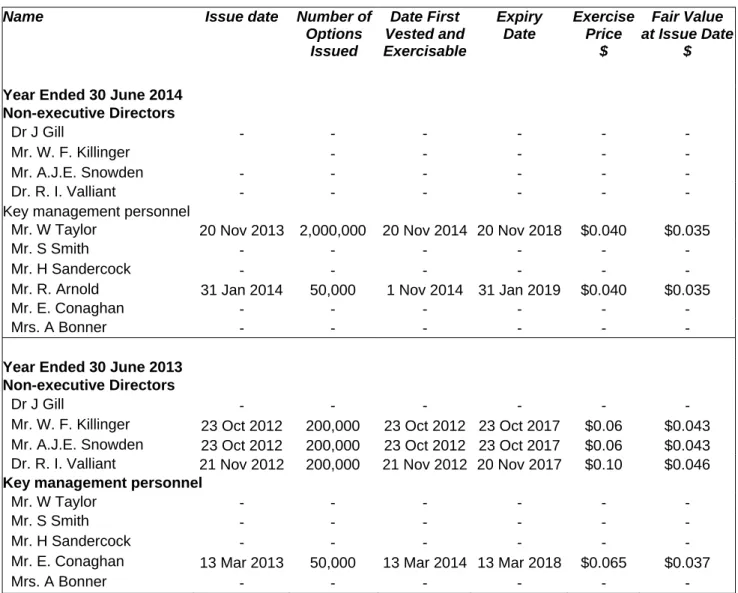
Details of options issued to Key Management Personnel, including directors, as remuneration during or since the end of the financial year, are set out below in Table 2. When exercisable, each option is convertible into one ordinary share of the Company. Further information on the options is set out in Notes 18 and 22 of the annual financial report.
The assessed fair value at issue date of options granted to the individuals is independently determined using a Black- Scholes option pricing model that takes into account the exercise price, the term of the option, the impact of dilution, the share price at grant date and expected price volatility of the underlying share, the expected dividend yield and the risk free interest rate for the term of the option. Refer to Note 22 Share Based Payment for further details.
The value of the options issued to the Key Management Personnel and outstanding at the date on which the Financial Report was authorised for issue by the Board of Directors, was $197,483 (2013: $448,174).
Consolidated entity performance and link to remuneration
Remuneration for certain individuals is directly linked to performance of the consolidated entity. A portion of bonus (if payable) and incentive payments are dependent on defined operational targets being met. The remaining portion of the bonus and incentive payments are at the discretion of the Remuneration Committee. Refer to section 8 of the remuneration report for details of the last five years earnings and total shareholders return.
8. Additional Information
The earnings of the consolidated entity for the five years to 30 June 2014 are summarised below:
2014 2013 2012 2011 2010
$'000 $'000 $'000 $'000 $'000
Profit/(Loss) after
income tax (1,812) (1,555) (1,556) (1,030) (1,594)
The factors that are considered to affect total shareholders return ('TSR') are summarised below:
2014 2013 2012 2011 2010
Share price at financial year end
($A) $0.05 $0.05 $0.08 $0.11 $0.05
Basic loss per share
REMUNERATION REPORT (Audited) Cont’d
Table 1: Details of Remuneration – Directors and Other Key Management PersonnelShort-term Benefits Post-employment Benefits Share-based
Payments Total Percentage Performance Based Bonus Payments Percentage Share Option-based Payments Cash Salary & Fees $ Cash Bonuses $ Super $ Prescribed Benefits $ Options Equity Settled $ $
Year ended 30 June 2014 Non-executive directors
Dr. J. W. Gill 43,700 - - - 9,000 52,700 - 17.0%
Mr. W. F. Killinger 40,000 - 3,700 - 4,733 48,433 - 9.7%
Mr. A.J.E. Snowden 43,700 - - - 2,867 46,567 - 6.1%
Dr. R. I. Valliant 43,700 - - - 3,067 46,767 - 6.5%
Other key management personnel
Mr. W R Taylor 367,403 - 55,967 - 33,333 456,703 - 7.2% Mr. S. Smith(1)(4) 208,911 - - - - 208,911 - - Mr. H Sandercock(1)(3) 79,635 - - - - 79,635 - - Mr. R. Arnold(6) 181,999 - 16,834 - 717 199,550 - 0.3% Mr. E. Conaghan(5) 174,625 - 15,447 - 1,550 191,622 - 0.8% Mrs. A Bonner 71,227 - 5,898 - 2,700 79,825 - 3.3% 1,254,900 - 97,846 - 57,967 1,410,713
Year ended 30 June 2013 Non-executive directors
Dr. J. W. Gill 43,600 - - - 9,074 52,674 - 17.2%
Mr. W. F. Killinger 40,000 - 3,600 - 4,708 48,308 - 9.7%
Mr. A.J.E. Snowden 43,600 - - - 2,846 46,446 - 6.1%
Dr. R. I. Valliant 43,600 - - - 3,066 46,666 - 6.5%
Other key management personnel
Mr. W R Taylor 367,000 - 55,158 - 33,552 455,710 - 7.3%
Mr. S. Smith(1)(4) 198,227 - - - - 198,227 - -
Mr. H Sandercock(1)(3) 113,960 - - - - 113,960 - -
Mr. E. Conaghan(5) 168,807 - 14,850 - 930 184,587 - 0.5%
15
REMUNERATION REPORT (Audited) Cont’d
(1) Mr Sandercock and Mr Smith’s remuneration was paid to their respective consulting company
(2) The bonuses were granted in June 2012 as part of the 2012 financial year end remuneration review and represent 100% of the available Bonus pool (3) Mr Sandercock became a KMP on July 1st 2011
(4) Mr Smith became a KMP on July 26th 2011.
(5) Mr Conaghan became a KMP on July 1st 2012 (6) Mr Arnold became a KMP on July 1st 2013
REMUNERATION REPORT (Audited) Cont’d
Table 2: Details of Options Issued as Remuneration
Name Issue date Number of
Options Issued Date First Vested and Exercisable Expiry Date Exercise Price $ Fair Value at Issue Date $ Year Ended 30 June 2014
Non-executive Directors
Dr J Gill - - - - - -
Mr. W. F. Killinger - - -
Mr. A.J.E. Snowden - - - - - -
Dr. R. I. Valliant - - - - - -
Key management personnel
Mr. W Taylor 20 Nov 2013 2,000,000 20 Nov 2014 20 Nov 2018 $0.040 $0.035
Mr. S Smith - - - - - -
Mr. H Sandercock - - - - - -
Mr. R. Arnold 31 Jan 2014 50,000 1 Nov 2014 31 Jan 2019 $0.040 $0.035
Mr. E. Conaghan - - - - - -
Mrs. A Bonner - - - - - -
Year Ended 30 June 2013 Non-executive Directors
Dr J Gill - - - - - -
Mr. W. F. Killinger 23 Oct 2012 200,000 23 Oct 2012 23 Oct 2017 $0.06 $0.043 Mr. A.J.E. Snowden 23 Oct 2012 200,000 23 Oct 2012 23 Oct 2017 $0.06 $0.043 Dr. R. I. Valliant 21 Nov 2012 200,000 21 Nov 2012 20 Nov 2017 $0.10 $0.046
Key management personnel
Mr. W Taylor - - - - - -
Mr. S Smith - - - - - -
Mr. H Sandercock - - - - - -
Mr. E. Conaghan 13 Mar 2013 50,000 13 Mar 2014 13 Mar 2018 $0.065 $0.037
Mrs. A Bonner - - - - - -
TriAusMin Limited
2014 Annual Report
17
REMUNERATION REPORT (Audited) Cont’d
Table 3: Details of Options Held by Key Management Personnel
Name Opening Balance Options Granted as Remunera tion Options Expired / Lapsed / Cancelled Options Exercis ed Closing Balance Number of Options Vested
Year Ended 30 June 2014 Non-executive Directors Dr J Gill 500,000 - - - 500,000 500,000 Mr. W. F. Killinger 600,000 - (300,000) - 300,000 200,000 Mr. A.J.E. Snowden 500,000 - (300,000) - 200,000 133,334 Dr. R. I. Valliant 2,200,000 - (2,000,000) - 200,000 133,334 Key Management Personnel Mr. W Taylor 2,000,000 2,000,000 - - 4,000,000 1,333,333 Mr. S Smith - - - - Mr. H Sandercock - - - - Mr. R. Arnold 50,000 50,000 - - 100,000 16,667 Mr. E. Conaghan 100,000 - - - 100,000 50,000 Mrs A Bonner 100,000 - - - 100,000 100,000 6,050,000 2,050,000 (2,600,000) - 5,500,000 2,466,668
Year Ended 30 June 2013
Non-executive Directors Dr J Gill 500,000 - - - 500,000 333,333 Mr. W. F. Killinger 600,000 200,000 (200,000) - 600,000 333,333 Mr. A.J.E. Snowden 500,000 200,000 (200,000) - 500,000 333,333 Dr. R. I. Valliant 2,200,000 200,000 (200,000) - 2,200,000 2,067,667 Key Management Personnel Mr. W Taylor 2,000,000 - - - 2,000,000 666,667 Mr. S Smith - - - - Mr. H Sandercock - - - - Mr. E. Conaghan 50,000 50,000 - - 100,000 16,667 Mrs A Bonner 100,000 100,000 66,667 5,950,000 650,000 (600,000) - 6,000,000 3,817,667
b.Shares Issued on Exercise of Remuneration Options
No shares were issued during or since the end of the financial year as a result of the exercising of options that were issued to a Director or other Key Management Personnel as part of a remuneration package.
The number of shares held by Key Management Personnel including directors and the most highly remunerated Company Executives are as summarised in Table 4 below:
REMUNERATION REPORT (Audited) Cont’d
Table 4: Details of Shares Held by Key Management Personnel Name Opening Balance Shares Issued as Remuneration Shares Issued on exercise of options Other Net Change in Shares held Closing Balance
Year Ended 30 June 2014 Non-executive Directors
Dr J Gill 17,223,010 - - 20,000,000 37,223,010 Mr. W. F. Killinger 1,742,082 - - 700,000 2,442,082
Mr. A.J.E. Snowden 807,500 - - - 807,500
Dr. R. I. Valliant 3,191,444 - - - 3,191,444
Key Management Personnel
Mr. W Taylor 1,519,366 - - 335,116 1,854,482 Mr. S Smith 170,000 - - - 170,000 Mr. H Sandercock - - - - Mr R. Arnold - - - 20,000 20,000 Mr. E. Conaghan 50,000 - - - 50,000 Mrs A Bonner 250,519 - - 180,346 430,865 24,953,921 21,235,462 46,189,383
Year Ended 30 June 2013 Non-executive Directors
Dr J Gill 9,361,677 - - 7,861,333 17,223,010 Mr. W. F. Killinger 1,393,666 - - 348,416 1,742,082 Mr. A.J.E. Snowden 760,712 - - 46,788 807,500 Dr. R. I. Valliant 3,191,444 - - - 3,191,444
Key Management Personnel
Mr. W Taylor 1,014,307 - - 505,059 1,519,366 Mr. S Smith - - - 170,000 170,000 Mr. H Sandercock - - - - Mr. E. Conaghan 50,000 - - - 50,000 Mrs A Bonner 81,500 - - 169,019 250,519 15,853,306 - - 9,100,615 24,953,921
This concludes the Remuneration Report which has been audited.
This Report of the Directors, incorporating the Remuneration Report, is signed in accordance with a resolution of the Board of Directors, pursuant to Section 298 (2) (a) of the Corporation Act.
Wayne Taylor DIRECTOR
Level 11, 1 Margaret St Sydney NSW 2000 Australia Tel: +61 2 9251 4100 Fax: +61 2 9240 9821 www.bdo.com.au
BDO East Coast Partnership ABN 83 236 985 726 is a member of a national association of independent entities which are all members of BDO (Australia) Ltd ABN 77 050 110 275, an Australian company limited by guarantee. BDO East Coast Partnership and BDO (Australia) Ltd are members of BDO International Ltd, a UK company limited by guarantee, and form part of the international BDO network of independent member firms. Liability limited by a scheme approved under Professional Standards Legislation (other than for the acts or omissions of financial services licensees) in each State or Territory other than Tasmania.
DECLARATION OF INDEPENDENCE BY GARETH FEW TO THE DIRECTORS OF TRIAUSMIN LIMITED
As lead auditor of TriAusMin Limited for the year ended 30 June 2014, I declare that, to the best of my knowledge and belief, there have been:
1. No contraventions of the auditor independence requirements of the Corporations Act 2001 in relation to the audit; and
2. No contraventions of any applicable code of professional conduct in relation to the audit.
This declaration is in respect of TriAusMin Limited and the entities it controlled during the period.
Gareth Few Partner
BDO East Coast Partnership
CONSOLIDATED STATEMENT OF PROFIT OR LOSS AND OTHER COMPREHENSIVE INCOME
FOR THE YEAR ENDED 30 JUNE 2014
Note 2014 2013
$ $
Continuing operations
Other income 2 30,485 67,164
Depreciation and amortisation 3 (22,345) (23,733)
Salary costs (including directors’ fees) (982,915) (1,000,216)
Scheme of Arrangement expense (337,930)
-Professional and legal fees (126,803) (199,668)
Share registry expense (40,183) (75,817)
Share based payment expense 22 (59,617) (57,808)
Occupancy expense (72,927) (54,875)
Travel and accommodation (89,206) (79,710)
Insurance expense (22,937) (41,224)
Computer expense (19,065) (32,392)
Interest expense –Convertible Note (34,218)
-Other expenses (34,371) (57,111)
Loss before income tax expense from
continuing operations (1,812,032) (1,555,390)
Income tax refund 4 -
-Loss after income tax expense for the year (1,812,032) (1,555,390)
Other comprehensive income
-Total comprehensive loss attributable to
members (1,812,032) (1,555,390)
Loss per share attributable to the ordinary equity holders of the company
Basic loss per share - cents 5 (0.72) (0.66)
Diluted loss per share - cents 5 (0.72) (0.66)
TriAusMin Limited
2014 Annual Report
21
_____________________________________________________________________ CONSOLIDATED STATEMENT OF FINANCIAL POSITION
AS AT 30 JUNE 2014
Note 2014 2013
$ $
CURRENT ASSETS
Cash and cash equivalents 8 594,833 1,499,788
Trade and other receivables 9 68,015 63,769
Other assets 10 16,346 15,994
TOTAL CURRENT ASSETS 679,194 1,579,551
NON-CURRENT ASSETS
Property, plant and equipment 11 177,402 199,747
Exploration and evaluation expenditure 12 28,562,798 28,025,323
TOTAL NON-CURRENT ASSETS 28,740,200 28,225,070
TOTAL ASSETS 29,419,394 29,804,621
CURRENT LIABILITIES
Trade and other payables 14 382,053 367,366
Provisions 16 58,638 40,355
Borrowings – Convertible Note 15 1,242,765
-TOTAL CURRENT LIABILITIES 1,683,456 407,721
NON-CURRENT LIABILITIES
Provisions 17 30,000 30,000
TOTAL NON-CURRENT LIABILITIES 30,000 30,000
TOTAL LIABILITIES 1,713,456 437,721
NET ASSETS 27,705,938 29,366,900
EQUITY
Contributed equity 18 41,243,917 41,243,917
Contributed equity – Convertible Note 15 91,453
-Reserves 19 3,010,371 2,950,754
Accumulated losses (16,639,803) (14,827,771)
TOTAL EQUITY 27,705,938 29,366,900
_____________________________________________________________________ CONSOLIDATED STATEMENT OF CHANGES IN EQUITY
FOR THE YEAR ENDED 30 JUNE 2014
Contributed Equity Options Reserve Equity Convertible Note Accumulated Losses Total Ordinary Shares $ $ $ $ $ Opening Balance at 1 July 2012 38,577,391 2,892,946 - (13,272,381) 28,197,956
Loss after income tax
expense for the year - - - (1,555,390) (1,555,390) Total comprehensive
loss for the year 38,577,391 2,892,946 - (14,827,771) 26,642,566 Transactions with
owners in their capacity as owners
Shares issued during
the year 2,934,395 - - - 2,934,395
Transaction costs (267,869) - - - (267,869) Share based payments
charge - 57,808 - - 57,808
Balance at
30 June 2013 41,243,917 2,950,754 - (14,827,771) 29,366,900
Opening Balance at
1 July 2013 41,243,917 2,950,754 - (14,827,771) 29,366,900
Loss after income tax
expense for the year - - - (1,812,032) (1,812,032)
Total comprehensive
loss for the year 41,243,917 2,950,754 - (16,639,803) 27,554,868 Transactions with
owners in their capacity as owners
Issue of Convertible
Note - - 91,453 - 91,453
Share based payments
charge - 59,617 - - 59,617
Balance at
30 June 2014 41,243,917 3,010,371 91,453 (16,639,803) 27,705,938
TriAusMin Limited
2014 Annual Report
23
CONSOLIDATED STATEMENT OF CASH FLOWS FOR YEAR ENDED 30 JUNE 2014
Note 2014 2013
$ $
CASH FLOWS FROM OPERATING ACTIVITIES:
Payments to suppliers and employees (1,647,966) (1,809,931)
Interest received 30,485 67,064
Net cash used in operating activities 27(b) (1,617,481) (1,742,867)
CASH FLOWS FROM INVESTING ACTIVITIES:
Payment for exploration activities
(net of R&D refund) (587,474) (859,719)
Payment for property, plant and
equipment - (12,727)
Net cash used in investing activities (587,474) (872,446) CASH FLOWS FROM FINANCING ACTIVITIES:
Proceeds from issue of shares - 2,934,395
Share issue cost - (267,869)
Issue of Convertible Note 1,300,000
Net cash provided by financing activities 1,300,000 2,666,526 Net increase/(decrease) in cash and
cash equivalents (904,955) 51,213
Cash and cash equivalents at beginning
of year 1,499,788 1,448,575
Cash and cash equivalents at end of
year 27(a) 594,833 1,499,788
NOTES TO THE FINANCIAL STATEMENTS
FOR THE YEAR ENDED 30 JUNE 2014
1. STATEMENT OF ACCOUNTING POLICIES
a) General
The financial report is a general purpose financial report that has been prepared in accordance with Australian Accounting Standards and Interpretations as issued by the Australian Accounting Standards Board (AASB) and the Corporations Act 2001 as appropriate for profit entities. The financial report of the consolidated entity also complies with the International Financial Reporting Standards (IFRSs) as issued by the International Accounting Standards Board (IASB).
The financial report covers the consolidated entity (referred to hereafter as the “Company” or “TriAusMin”) consisting of TriAusMin Limited as an individual entity and the entities it controlled at the end of, or during the year ended 30 June 2014. TriAusMin is a for profit listed public company, incorporated and domiciled in Australia. The financial report was authorised for issue by the Directors on 27 August 2014.
In accordance with the Corporation Act 2001 these financial statements present the results of the consolidated entity. Supplementary information about the parent is disclosed in note 34.
Material accounting policies adopted in the preparation of this financial report are presented below and have been consistently applied unless otherwise stated. The financial report has been prepared on a historical costs basis, modified, where applicable, by the measurement at fair value of selected non-current assets, financial assets and liabilities.
Both the functional and presentation currency of the Company is Australian dollars ($).
b) Going Concern basis of accounting
The Company incurred a loss for the year after tax of $1,812,032 (2013: $1,555,390) and a net cash out flow from operating activities of $1,617,481 (2013: $1,742,867). The Financial Report has been prepared on the basis of a Going Concern.
On 5 August 2014, TriAusMin Ltd became a wholly owned subsidiary of Heron Resources Ltd via a Scheme of Arrangement approved by TriAusMin shareholders on 28 July 2014. As a wholly owned subsidiary Heron will be responsible for meeting all future TriAusMin commitments. Heron have indicated that they intend to meet all future commitments for the 12 months following the date of this report.
c) Principles of consolidation
A controlled entity is any entity controlled by TriAusMin Limited whereby the Company has the power to control the financial and operating policies of an entity so as to obtain benefits from its activities. The consolidated financial report covering the economic entity, being the Company and its wholly owned controlled entities, Tri Origin Mining Pty Limited (“TOM”) and Tarago Operations Pty Limited (“TOP”), has been prepared based on the following principles:
All inter-company balances and transactions between entities in the economic entity, including any unrealised profits or losses, have been eliminated on consolidation. Accounting policies of subsidiaries have been changed where necessary to ensure consistencies with those policies applied by the parent entity.
Subsidiaries are all those entities over which the consolidated entity has control. The consolidated entity controls an entity when the consolidated entity is exposed to, or has rights to, variable returns from its involvement with the entity and has the ability to affect those returns through its power to direct the activities of the entity. Subsidiaries are fully consolidated from the date on which control is transferred to the consolidated entity. They are de-consolidated from the date that control ceases.
TriAusMin Limited
2014 Annual Report
NOTES TO THE FINANCIAL STATEMENTS
FOR THE YEAR ENDED 30 JUNE 2014
25
1. STATEMENT OF ACCOUNTING POLICIES (Continued)
c) Principles of consolidation (cont’d)Non-controlling interest in the results and equity of subsidiaries are shown separately in the statement of profit or loss and other comprehensive income, statement of financial position and statement of changes in equity of the consolidated entity. Losses incurred by the consolidated entity are attributed to the non-controlling interest in full, even if that results in a deficit balance. Where the consolidated entity loses control over a subsidiary, it derecognises the assets including goodwill, liabilities and non-controlling interest in the subsidiary together with any cumulative translation differences recognised in equity. The consolidated entity recognises the fair value of the consideration received and the fair value of any investment retained together with any gain or loss in profit or loss.
d) Share Based Payments
The cost to the Company of share options granted to Directors and Key Management Personnel is included at fair value as part of the Directors’ and Key Management Personnel’s aggregate remuneration in the financial year the options are granted.
The fair value of the share options is calculated using the Black Scholes option pricing model, which takes into account the exercise price, the term of the option, the vesting period and performance criteria, the impact of dilution, the non-tradable nature of the option, the current price and historical price volatility of the underlying share, the expected dividend yield and the
risk-free interest rate for the term of the option. The cost of these options is expensed in the statement of profit or loss and other comprehensive income on a pro rata basis to the vesting dates. Unvested options may be cancelled upon termination of service with the Company.
e) Income tax
The charge for current income tax expense/ (benefit) is based on the profit for the year adjusted for any non-assessable or disallowed items. It is calculated using the tax rates that have been enacted or are substantially enacted by the statement of financial position.
Deferred tax is accounted for using the statement of financial position method at the end of the reporting period in respect of temporary differences arising between the tax bases of assets and liabilities and their carrying amounts in the financial statements. No deferred income tax will be recognised from the initial recognition of an asset or liability, excluding a business combination, where there is no effect on accounting or taxable profit or loss.
Deferred tax is calculated at the tax rates that are expected to apply to the period when the asset is realised or liability is settled. Deferred tax is credited in the statement of profit or loss and other comprehensive income except where it relates to items that may be credited directly to equity, in which case the deferred tax is adjusted directly against equity.
Deferred income tax assets are recognised to the extent that there is convincing evidence that it is probable that future tax profits will be available against which deductible temporary differences can be utilised.
The amount of benefits brought to account or which may be realised in the future is based on the assumption that no adverse change will occur in income taxation legislation and the anticipation that the economic entity will derive sufficient future assessable income to enable the benefit to be realised and comply with the conditions of deductibility imposed by the law.
The potential net deferred tax asset at 30 June 2014 at 30% in respect of tax losses and timing differences not brought to account is set out in Note 4.
NOTES TO THE FINANCIAL STATEMENTS
FOR THE YEAR ENDED 30 JUNE 2014
1. STATEMENT OF ACCOUNTING POLICIES (Continued)
e) Income tax (cont’d) Tax Consolidation Legislation
TriAusMin Limited and its wholly owned Australian controlled entities implemented the tax consolidation legislation as of 1 July 2005.
The head entity, TriAusMin Limited and the controlled entities in the tax consolidated group continue to account for their own current and deferred tax amounts. The Company has applied the Company allocation approach in determining the appropriate amount of current taxes and deferred taxes to allocate to members of the tax consolidated group.
f) Earnings per share
i. Basic earnings per share:
Basic earnings per share are determined by dividing the operating profit/ (loss) after income tax by the weighted average number of ordinary shares outstanding during the period.
ii. Diluted earnings per share:
Diluted earnings per share adjusts the figures used in determining earnings per share by taking into account amounts unpaid on ordinary shares and any reduction in earnings per share that will probably arise from the exercise of options outstanding during the financial year. The diluted earnings per share are capped at the basic earnings per share in circumstances of losses.
g) Cash and Cash Equivalents
For the purposes of the statement of financial position and the statement of cash flows, cash includes bank accepted bills which are readily convertible to cash on hand and which are used in the management function on a day-to-day basis, net of outstanding bank overdrafts.
h) Property, Plant and Equipment
Property, plant and equipment are included in the accounts at cost or at independent or Directors’ valuation less, where applicable, any accumulated depreciation or amortisation.
The carrying value of property, plant and equipment is reviewed annually by the Directors to ensure it is not in excess of the recoverable amount from these assets. The recoverable amount is assessed on the basis of the expected net cash flows which will be received from the asset’s employment and subsequent disposal. The expected net cash flows have been discounted to their present values in determining recoverable amounts.
All fixed assets, including capitalised leased assets but excluding freehold land, are depreciated over their estimated useful lives to the Company. Mining plant and equipment is depreciated in this manner over the estimated life of the relevant mine with due regard to each item’s physical life limitations.
The depreciation rates used for each class of asset are:
Plant and Equipment 20% - 40% Diminishing Value Motor Vehicle 18.5% Diminishing Value
Depreciation and amortisation charged on fixed assets used in the Company’s exploration activities are included in the exploration expenditure as they are incurred.
TriAusMin Limited
2014 Annual Report
NOTES TO THE FINANCIAL STATEMENTS
FOR THE YEAR ENDED 30 JUNE 2014
27
1. STATEMENT OF ACCOUNTING POLICIES (Continued)
h) Property, Plant and EquipmentThe gain or loss on disposal of all fixed assets, including revalued assets, is determined as the difference between the carrying amount of the asset at the time of disposal and the proceeds of disposal, and is included in operating profit before income tax in the year of disposal. Any realised revaluation increment relating to a disposed asset which is included in the asset revaluation reserve is transferred directly to capital profits reserve.
i) Exploration expenditure and mineral leases
Exploration and evaluation expenditure in relation to separate areas of interest for which rights of tenure are current is carried forward as an asset in the statement of financial position where it is expected that the expenditure will be recovered through the successful development and exploitation of an area of interest, or by its sale; or exploration activities are continuing in an area and activities have not reached a stage which permits a reasonable estimate of the existence or otherwise of economically recoverable reserves. Where a project or an area of interest has been abandoned, the expenditure incurred thereon is written off in the year in which the decision is made.
Accumulated costs in relation to an abandoned area are written off in full against the results in the year in which the decision to abandon the area is made.
When production commences, the accumulated costs for the relevant area of interest are amortised over the life of the area according to the rate of depletion of the economically recoverable reserves. A regular review is undertaken of each area of interest to determine the appropriateness of continuing to carry forward costs in relation to that area of interest.
Costs of site restoration are provided over the life of the tenement from when exploration commences and are included in the costs of that stage. Site restoration costs include the dismantling and removal of mining plant, equipment and building structures, waste removal, and rehabilitation of the site in accordance with clauses of the mining permits. Such costs will be determined using estimates of future costs, current legal requirements and technology on a discounted basis.
Any changes in the estimates for the costs are accounted on a prospective basis. In determining the costs of site restoration, there is uncertainty regarding the nature and extent of the restoration due to community expectations and future legislation. Accordingly the costs have been determined on the basis that the restoration will be completed within one year of abandoning the site.
j) Restoration, rehabilitation and environmental expenditure
Restoration, rehabilitation and environmental expenditure to be incurred during the production phase of operations is accrued when the need for such expenditure is established, and then written off as part of the costs of production of the mine property concerned. Significant restoration, rehabilitation and environmental expenditure to be incurred subsequent to the cessation of production at each mine property are accrued, in proportion to production, when its extent can be reasonably estimated.
k) Leased Assets
Leases of fixed assets where substantially all the risks and benefits incidental to the ownership of the asset, but not the legal ownership, are transferred to the Company, are classified as finance leases and are capitalised and amortised on a straight line basis over the estimated useful life of the asset where it is assumed the Company will obtain ownership of the asset or over the term of the lease. Finance lease payments are allocated between interest expense and reduction of lease liability over the term of the lease. The interest expense is determined by applying the interest rate implicit in the lease to the outstanding lease liability at the beginning of each lease payment period. Lease incentives received are spread over the life of the lease.
NOTES TO THE FINANCIAL STATEMENTS
FOR THE YEAR ENDED 30 JUNE 2014
1. STATEMENT OF ACCOUNTING POLICIES (Continued)
k) Leased Assets (cont’d)Lease payments for operating leases where substantially all the risks and benefits remain with the lessor are charged as expenses in the periods in which they are incurred.
l) Business undertakings – joint ventures
The Company has certain exploration activities conducted through joint ventures with other parties. The Company’s interest in these joint ventures is shown in the statement of financial position under the appropriate heading. Details of the interests in the joint venture assets and liabilities are set out in Note 20.
The Company’s interests in joint venture entities are accounted for using the cost method, rather than the equity method of accounting which approximates fair value.
m) Trade and Other Payables
Trade and other payables represent the liability outstanding at the end of the reporting period for goods and services received by the Company during the reporting period which remains unpaid. The balance is recognised as a current liability with the amount being normally paid within 30 days of recognition of the liability.
n) Employee Benefits
Provision is made for the Company’s liability for employee benefits arising from services rendered by employees to balance date. Employee benefits expected to be settled within one year together with entitlements arising from wages and salaries, annual leave and on costs which will be settled after one year, have been measured at their nominal rate. Contributions are made by the Company to employee superannuation funds and are charged as expenses when incurred.
o) Revenue Recognition
Revenue is measured at the fair value of the consideration received or receivable. The Company recognises revenue when the amount of revenue can be reliably measured, it is probable that future economic benefits will flow to the entity and specific criteria have been met for each of the Company’s activities as described below. The amount of revenue is not considered to be reliably measurable until all contingencies relating to the sale have been resolved. The Company bases its estimates on historical results, taking into consideration the type of customer, the type of transaction and the specifics of each arrangement.
Interest income
Revenue is recognised as interest accrues using the effective interest method. This is a method of calculating the amortised cost of a financial asset and allocating the interest income over the relevant period using the effective interest rate, which is the rate that exactly discounts estimated future cash receipts through the expected life of the financial asset to the net carrying amount of the financial asset.
p) Comparative Information
Comparative figures are, where appropriate, reclassified so as to be compatible with the figures presented for the financial year.
q) Foreign currency transactions and balances
Foreign currency transactions during the year are converted to Australian currency at the rates of exchange applicable at the date of the transactions. Amounts receivable and payable in foreign currencies at balance date are converted to the rates of exchange ruling at that date.
TriAusMin Limited
2014 Annual Report
NOTES TO THE FINANCIAL STATEMENTS
FOR THE YEAR ENDED 30 JUNE 2014
29
1. STATEMENT OF ACCOUNTING POLICIES (Continued)
r) Goods and services tax (GST)Revenues, expenses and assets are recognised net of the amount of GST, except where the amount of GST incurred is not recoverable from the Australian Tax Office. In these circumstances the GST is recognised as part of the cost of acquisition of the asset or as part of an item of the expense. Receivables and payables in the statement of financial position are shown inclusive of GST. Cash flows are presented in the statement of cash flow on a net basis.
s) Impairment of assets
Assets that have an indefinite useful life are not subject to amortisation and are tested annually for impairment. Assets that are subject to amortisation/depreciation are reviewed for impairment whenever events or changes in circumstances indicate that the carrying amount may not be recoverable. An impairment loss is recognised in the statement of profit or loss and other comprehensive income for the amount by which the asset’s carrying amount exceeds its recoverable amount. The recoverable amount is the higher of an asset’s fair value, less costs to sell, and discounted cash flow. For the purposes of assessing impairment, assets are grouped at the lowest levels for which there are separately identifiable cash flows (cash generating units).
t) Critical accounting estimates and judgments
The Directors’ evaluation of estimates and judgments incorporated into the financial report are based on historical knowledge and best available current information. Estimates assume a reasonable expectation of future events and are based on current trends and economic data, obtained both externally and within the Company.
i. Share-based payment transactions
The consolidated entity measures the cost of equity-settled transactions with employees by reference to the fair value of the equity instruments at the date at which they are granted. The fair value is determined by using the Black-Scholes model taking into account the terms and conditions upon which the instruments were granted. The accounting estimates and assumptions relating to equity-settled share-based payments would have no impact on the carrying amounts of assets and liabilities within the next annual reporting period but may impact profit or loss and equity.
ii. Estimation of useful lives of assets
The consolidated entity determines the estimated useful lives and related depreciation and amortisation charges for its property, plant and equipment and finite life intangible assets. The useful lives could change significantly as a result of technical innovations or some other event. The depreciation and amortisation charge will increase where the useful lives are less than previously estimated lives, or technically obsolete or non-strategic assets that have been abandoned or sold will be written off or written down.
iii. Rehabilitation provision
A provision has been made for the present value of anticipated costs for future rehabilitation of land explored or mined. The consolidated entity's mining and exploration activities are subject to various laws and regulations governing the protection of the environment. The consolidated entity recognises management's best estimate for assets retirement obligations and site rehabilitations in the period in which they are incurred. Actual costs incurred in the future periods could differ materially from the estimates. Additionally, future changes to environmental laws and regulations, life of mine estimates and discount rates could affect the carrying amount of this provision.