Symantec AntiVirus™ for Linux®
Implementation Guide
Symantec AntiVirus™ for Linux®
Implementation Guide
Copyright ©2005 Symantec Corporation. All rights reserved. Documentation version 1.0
Federal acquisitions: Commercial Software - Government Users Subject to Standard License Terms and Conditions.
Symantec, the Symantec logo, and LiveUpdate are trademarks or registered trademarks of Symantec Corporation or its affiliates in the U.S. and other countries. Symantec AntiVirus is a trademark of Symantec Corporation. Other names may be trademarks of their respective owners.
The product described in this document is distributed under licenses restricting its use, copying, distribution, and decompilation/reverse engineering. No part of this document may be reproduced in any form by any means without prior written authorization of Symantec Corporation and its licensors, if any.
THE DOCUMENTATION IS PROVIDED “AS IS” AND ALL EXPRESS OR IMPLIED CONDITIONS, REPRESENTATIONS AND WARRANTIES, INCLUDING ANY IMPLIED WARRANTY OF MERCHANTABILITY, FITNESS FOR A PARTICULAR PURPOSE OR NON-INFRINGEMENT, ARE DISCLAIMED, EXCEPT TO THE EXTENT THAT SUCH
DISCLAIMERS ARE HELD TO BE LEGALLY INVALID. SYMANTEC CORPORATION SHALL NOT BE LIABLE FOR INCIDENTAL OR CONSEQUENTIAL DAMAGES IN CONNECTION WITH THE FURNISHING, PERFORMANCE, OR USE OF THIS DOCUMENTATION. THE INFORMATION CONTAINED IN THIS DOCUMENTATION IS SUBJECT TO CHANGE WITHOUT NOTICE.
Symantec Corporation 20330 Stevens Creek Blvd. Cupertino, CA 95014 USA http://www.symantec.com
Technical support
Symantec Technical Support maintains support centers globally. Technical Support’s primary role is to respond to specific queries about product feature and function, installation, and configuration. The Technical Support group also authors content for our online Knowledge Base. The Technical Support group works collaboratively with the other functional areas within Symantec to answer your questions in a timely fashion. For example, the Technical Support group works with Product Engineering and Symantec Security Response to provide alerting services and virus definition updates.
Symantec’s maintenance offerings include the following:
■ A range of support options that give you the flexibility to select the right amount of service for any size organization
■ Telephone and Web-based support that provides rapid response and up-to-the-minute information
■ Upgrade insurance that delivers automatic software upgrade protection ■ Global support that is available 24 hours a day, 7 days a week worldwide.
Support is provided in a variety of languages for those customers that are enrolled in the Platinum Support program
■ Advanced features, including Technical Account Management
For information about Symantec’s Maintenance Programs, you can visit our Web site at the following URL:
www.symantec.com/techsupp/ent/enterprise.html
Select your country or language under Global Support. The specific features that are available may vary based on the level of maintenance that was purchased and the specific product that you use.
Contacting Technical Support
Customers with a current maintenance agreement may access Technical Support information at the following URL:
www.symantec.com/techsupp/ent/enterprise.html Select your region or language under Global Support.
Before contacting Technical Support, make sure you have satisfied the system requirements that are listed in your product documentation. Also, you should be at the computer on which the problem occurred, in case it is necessary to recreate the problem.
When you contact Technical Support, please have the following information available:
■ Product release level ■ Hardware information
■ Operating system ■ Version and patch level ■ Network topology
■ Router, gateway, and IP address information ■ Problem description:
■ Error messages and log files
■ Troubleshooting that was performed before contacting Symantec ■ Recent software configuration changes and network changes
Licensing and registration
If your Symantec product requires registration or a license key, access our technical support Web page at the following URL:
www.symantec.com/techsupp/ent/enterprise.html
Select your region or language under Global Support, and then select the Licensing and Registration page.
Customer service
Customer service information is available at the following URL: www.symantec.com/techsupp/ent/enterprise.html
Select your country or language under Global Support.
■ Customer Service is available to assist with the following types of issues: ■ Questions regarding product licensing or serialization
■ Product registration updates such as address or name changes
■ General product information (features, language availability, local dealers) ■ Latest information about product updates and upgrades
■ Information about upgrade insurance and maintenance contracts ■ Information about Symantec Value License Program
■ Advice about Symantec's technical support options ■ Nontechnical presales questions
■ Issues that are related to CD-ROMs or manuals
Maintenance agreement resources
If you want to contact Symantec regarding an existing maintenance agreement, please contact the maintenance agreement administration team for your region as follows:
■ Asia-Pacific and Japan: [email protected] ■ Europe, Middle-East, and Africa: [email protected]
■ North America and Latin America: [email protected]
Additional enterprise services
Symantec offers a comprehensive set of services that allow you to maximize your investment in Symantec products and to develop your knowledge, expertise, and global insight, which enable you to manage your business risks proactively. Additional services that are available include the following:
To access more information about Enterprise Services, please visit our Web site at the following URL:
www.symantec.com
Select your country or language from the site index. Symantec Early Warning
Solutions
These solutions provide early warning of cyber attacks, comprehensive threat analysis, and countermeasures to prevent attacks before they occur.
Managed Security Services
These services remove the burden of managing and monitoring security devices and events, ensuring rapid response to real threats.
Consulting services Symantec Consulting Services provide on-site technical expertise from Symantec and its trusted partners. Symantec Consulting Services offer a variety of prepackaged and customizable options that include assessment, design, implementation, monitoring and management capabilities, each focused on establishing and maintaining the integrity and availability of your IT resources.
Educational Services These services provide a full array of technical training, security education, security certification, and awareness communication programs.
SYMANTEC SOFTWARE LICENSE AGREEMENT
Symantec AntiVirus
SYMANTEC CORPORATION AND/OR ITS SUBSIDIARIES (“SYMANTEC”) IS WILLING TO LICENSE THE SOFTWARE TO YOU AS AN
INDIVIDUAL, THE COMPANY, OR THE LEGAL ENTITY THAT WILL BE UTILIZING THE SOFTWARE
(REFERENCED BELOW AS “YOU” OR “YOUR”) ONLY ON THE CONDITION THAT YOU ACCEPT ALL OF THE TERMS OF THIS LICENSE AGREEMENT. READ THE TERMS AND CONDITIONS OF THIS LICENSE AGREEMENT CAREFULLY BEFORE USING THE SOFTWARE. THIS IS A LEGAL AND ENFORCEABLE CONTRACT BETWEEN YOU AND THE LICENSOR. BY OPENING THIS PACKAGE, BREAKING THE SEAL, CLICKING THE “AGREE” OR “YES” BUTTON OR OTHERWISE INDICATING ASSENT
ELECTRONICALLY, OR LOADING THE SOFTWARE, YOU AGREE TO THE TERMS AND CONDITIONS OF THIS AGREEMENT. IF YOU DO NOT AGREE TO THESE TERMS AND CONDITIONS, CLICK THE “I DO NOT AGREE” OR “NO” BUTTON OR OTHERWISE INDICATE REFUSAL AND MAKE NO FURTHER USE OF THE SOFTWARE.
1. License:
The software and documentation that accompanies this license (collectively the “Software”) is the proprietary property of Symantec or its licensors and is protected by copyright law. While Symantec continues to own the Software, You will have certain rights to use the Software after Your acceptance of this license. This license governs any releases, revisions, or enhancements to the Software that the Licensor may furnish to You. Except as may be modified by an applicable Symantec license certificate, license coupon, or license key (each a “License Module”) that accompanies, precedes, or follows this license, and as may be further defined in the user documentation accompanying the Software, Your rights and
obligations with respect to the use of this Software are as follows.
You may:
A. use the number of copies of the Software as have been licensed to You by Symantec under a License Module. If the Software is part of a suite containing multiple Software titles, the total number of copies You may use, in any combination of Software titles, may not exceed the total number of copies indicated in the License Module. Your License Module shall constitute proof of Your right to make such copies. If no License Module accompanies, precedes, or follows this license, You may make one copy of the Software You are authorized to use on a single computer; B. make one copy of the Software for archival purposes, or copy the Software onto the hard disk of Your computer and retain the original for archival purposes;
C. use the Software on a network, provided that You have a licensed copy of the Software for each computer that can access the Software over that network; D. use the Software in accordance with any written agreement between You and Symantec; and
E. after written consent from Symantec, transfer the Software on a permanent basis to another person or entity, provided that You retain no copies of the Software and the transferee agrees in writing to the terms of this license.
You may not:
A. copy the printed documentation that accompanies the Software;
B. sublicense, rent, or lease any portion of the Software; reverse engineer, decompile, disassemble, modify, translate, make any attempt to discover the source code of the Software, or create derivative works from the Software;
C. use the Software as part of a facility management, timesharing, service provider, or service bureau arrangement;
D. use a previous version or copy of the Software after You have received and installed a disk replacement set or an upgraded version. Upon upgrading the Software, all copies of the prior version must be destroyed; E. use a later version of the Software than is provided herewith unless You have purchased corresponding maintenance and/or upgrade insurance or have otherwise separately acquired the right to use such later version;
F. use, if You received the software distributed on media containing multiple Symantec products, any Symantec software on the media for which You have not received permission in a License Module; nor G. use the Software in any manner not authorized by this license.
2. Content Updates:
Certain Software utilize content that is updated from time to time (including but not limited to the following Software: antispam software utilize updated antispam rules; antivirus software utilize updated virus definitions; content filtering software utilize updated URL lists; some firewall software utilize updated firewall rules; policy compliance software utilize updated policy compliance updates; and vulnerability assessment products utilize updated vulnerability signatures; these updates are collectively referred to as “Content Updates”). You shall have the right to obtain Content Updates for any period for which You have purchased maintenance, except for those Content Updates that Symantec elects to make available by separate paid subscription, or for any period for which You have otherwise separately acquired the right to obtain Content Updates. Symantec reserves the right to designate specified Content Updates as requiring
purchase of a separate subscription at any time and without notice to You; provided, however, that if You purchase maintenance hereunder that includes particular Content Updates on the date of purchase, You will not have to pay an additional fee to continue receiving such Content Updates through the term of such maintenance even if Symantec designates such Content Updates as requiring separate purchase. This License does not otherwise permit the licensee to obtain and use Content Updates.
3. Limited Warranty:
Symantec warrants that the media on which the Software is distributed will be free from defects for a period of thirty (30) days from the date of delivery of the Software to You. Your sole remedy in the event of a breach of this warranty will be that Symantec will, at its option, replace any defective media returned to Symantec within the warranty period or refund the money You paid for the Software. Symantec does not warrant that the Software will meet Your requirements or that operation of the Software will be uninterrupted or that the Software will be error-free.
TO THE MAXIMUM EXTENT PERMITTED BY APPLICABLE LAW, THE ABOVE WARRANTY IS EXCLUSIVE AND IN LIEU OF ALL OTHER WARRANTIES, WHETHER EXPRESS OR IMPLIED, INCLUDING THE IMPLIED WARRANTIES OF MERCHANTABILITY, FITNESS FOR A PARTICULAR PURPOSE, AND NONINFRINGEMENT OF
INTELLECTUAL PROPERTY RIGHTS. THIS WARRANTY GIVES YOU SPECIFIC LEGAL RIGHTS. YOU MAY HAVE OTHER RIGHTS, WHICH VARY FROM STATE TO STATE AND COUNTRY TO COUNTRY.
4. Disclaimer of Damages:
SOME STATES AND COUNTRIES, INCLUDING MEMBER COUNTRIES OF THE EUROPEAN
ECONOMIC AREA, DO NOT ALLOW THE LIMITATION OR EXCLUSION OF LIABILITY FOR INCIDENTAL OR CONSEQUENTIAL DAMAGES, SO THE BELOW LIMITATION OR EXCLUSION MAY NOT APPLY TO YOU.
TO THE MAXIMUM EXTENT PERMITTED BY APPLICABLE LAW AND REGARDLESS OF WHETHER ANY REMEDY SET FORTH HEREIN FAILS OF ITS ESSENTIAL PURPOSE, IN NO EVENT WILL SYMANTEC BE LIABLE TO YOU FOR ANY SPECIAL, CONSEQUENTIAL, INDIRECT, OR SIMILAR
DAMAGES, INCLUDING ANY LOST PROFITS OR LOST DATA ARISING OUT OF THE USE OR INABILITY TO USE THE SOFTWARE EVEN IF SYMANTEC HAS BEEN ADVISED OF THE POSSIBILITY OF SUCH DAMAGES. IN NO CASE SHALL SYMANTEC'S LIABILITY EXCEED THE PURCHASE PRICE FOR THE SOFTWARE. The
disclaimers and limitations set forth above will apply regardless of whether or not You accept the Software.
5. U.S. Government Restricted Rights:
RESTRICTED RIGHTS LEGEND. All Symantec products and documentation are commercial in nature. The software and software documentation are “Commercial Items,” as that term is defined in 48 C.F.R. section 2.101, consisting of “Commercial Computer Software” and “Commercial Computer Software Documentation,” as such terms are defined in 48 C.F.R. section 252.227-7014(a)(5) and 48 C.F.R. section 252.227-7014(a)(1), and used in 48 C.F.R. section 12.212 and 48 C.F.R. section 227.7202, as applicable. Consistent with 48 C.F.R. section 12.212, 48 C.F.R. section 252.227-7015, 48 C.F.R. section 227.7202 through 227.7202-4, 48 C.F.R. section 52.227-14, and other relevant sections of the Code of Federal Regulations, as applicable, Symantec’s computer software and computer software documentation are licensed to United States Government end users with only those rights as granted to all other end users, according to the terms and conditions contained in this license agreement. Manufacturer is Symantec Corporation, 20330 Stevens Creek Blvd., Cupertino, CA 95014, United States of America.6. Export Regulation:
Certain Symantec products are subject to export controls by the U.S. Department of Commerce (DOC), under the Export Administration Regulations (EAR) (see www.bxa.doc.gov). Violation of U.S. law is strictly prohibited. Licensee agrees to comply with the requirements of the EAR and all applicable
international, national, state, regional and local laws, and regulations, including any applicable import and use restrictions. Symantec products are currently prohibited for export or re-export to Cuba, North Korea, Iran, Iraq, Libya, Syria and Sudan or to any country subject to applicable trade sanctions. Licensee agrees not to export, or re-export, directly or
indirectly, any product to any country outlined in the EAR, nor to any person or entity on the DOC Denied Persons, Entities and Unverified Lists, the U.S. Department of State’s Debarred List, or on the U.S. Department of Treasury’s lists of Specially Designated Nationals, Specially Designated Narcotics Traffickers, or Specially Designated Terrorists. Furthermore, Licensee agrees not to export, or re-export, Symantec products to any military entity not approved under the EAR, or to any other entity for any military purpose, nor will it sell any Symantec product for use in connection with chemical, biological, or nuclear weapons or missiles capable of delivering such weapons.
7. General:
If You are located in North America or Latin America, this Agreement will be governed by the laws of the State of California, United States of America. Otherwise, this Agreement will be governed by the laws of England and Wales. This Agreement and any related License Module is the entire agreement between You and Symantec relating to the Software and: (i) supersedes all prior or contemporaneous oral or written communications, proposals, and
representations with respect to its subject matter; and (ii) prevails over any conflicting or additional terms of any quote, order, acknowledgment, or similar communications between the parties. This Agreement shall terminate upon Your breach of any term contained herein and You shall cease use of and destroy all copies of the Software. The disclaimers of warranties and damages and limitations on liability shall survive termination. Software and
documentation is delivered Ex Works California, U.S.A. or Dublin, Ireland respectively (ICC INCOTERMS 2000). This Agreement may only be modified by a License Module that accompanies this license or by a written document that has been signed by both You and Symantec. Should You have any questions concerning this Agreement, or if You desire to contact Symantec for any reason, please write to: (i) Symantec Customer Service, 555 International Way, Springfield, OR 97477,
U.S.A., (ii) Symantec Customer Service Center, PO BOX 5689, Dublin 15, Ireland, or (iii) Symantec Customer Service, 1 Julius Ave, North Ryde, NSW 2113, Australia.
8. Additional Uses and Restrictions:
A. If the Software You have licensed is a specified Symantec AntiVirus for a corresponding third party product or platform, You may only use that specified Software with the corresponding product or platform. You may not allow any computer to access the Software other than a computer using the specified product or platform. In the event that You wish to use the Software with a certain product or platform for which there is no specified Software, You may use Symantec AntiVirus Scan Engine.B. If the Software you have licensed is Symantec AntiVirus utilizing Web Server optional licensing as set forth in the License Module, the following additional use(s) and restriction(s) apply:
i) You may use the Software only with files that are received from third parties through a web server; ii) You may use the Software only with files received from less than 10,000 unique third parties per month; and
iii) You may not charge or assess a fee for use of the Software for Your internal business.
Contents
Technical support
Chapter 1
Introducing Symantec AntiVirus for Linux
About Symantec AntiVirus for Linux ... 15
About using this guide effectively ... 16
System requirements ... 16
Chapter 2
Installing Symantec AntiVirus for Linux
About installing Symantec AntiVirus for Linux ... 19Installation scenarios for Symantec AntiVirus for Linux ... 20
Installing Symantec AntiVirus for Linux locally ... 22
Installing Symantec AntiVirus for Linux from a remote server ... 23
Uninstalling Symantec AntiVirus for Linux ... 23
Listing all Symantec AntiVirus packages ... 23
About removing Symantec AntiVirus completely ... 24
Chapter 3
Using Symantec AntiVirus for Linux
When to use the command-line interfaces, services, and tools ... 25About the sav command-line interface ... 28
About the sav command-line syntax ... 28
Using the sav CLI to interact with Symantec AntiVirus ... 33
Enabling and disabling Auto-Protect ... 33
Using Java LiveUpdate ... 33
Starting and stopping manual scans ... 34
Creating and managing scheduled scans ... 36
Managing the local Quarantine ... 38
Managing virus definitions ... 39
Displaying product information ... 39
About the symcfg command-line interface ... 40
Command-line syntax ... 40
Using the symcfg CLI to interact with the Symantec AntiVirus configuration database ... 42
Listing the keys in the database ... 42
Adding a key to the database ... 42
12 Contents
About the symcfgd service ... 43
symcfgd service configuration parameters ... 43
About the symcfgd files ... 45
Using the symcfgd service parameters ... 45
Verifying that the symcfgd service is running ... 46
Stopping the symcfgd service ... 46
Starting the symcfgd service ... 46
Specifying the log facility to use and filtering log messages based on severity ... 46
About customizing symcfgd ... 47
About the rtvscand service ... 47
About the rtvscand service configuration parameters ... 47
About the rtvscand files ... 49
Using the rtvscand service parameters ... 49
Verifying that the rtvscand service is running ... 50
Stopping the rtvscand service ... 50
Starting the rtvscand service ... 50
Specifying the log facility to use and filtering log messages based on severity ... 51
About customizing the rtvscand service ... 51
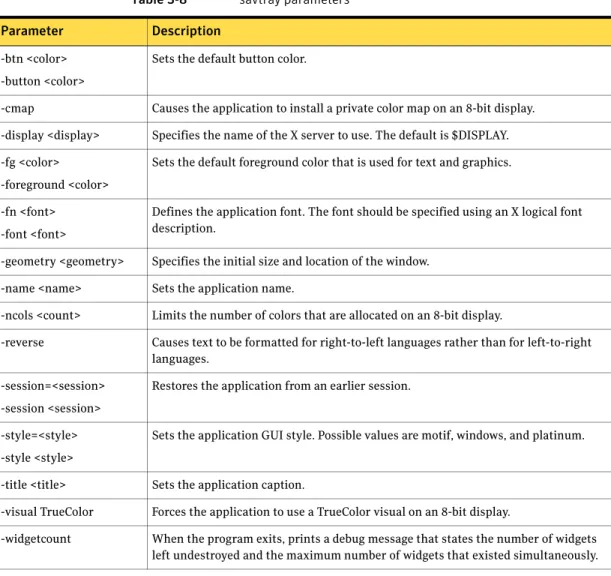
About the savtray program ... 52
About command-line syntax ... 52
About savtray parameters ... 52
About event notification ... 53
Chapter 4
Updating virus definitions on Linux
About updating virus definitions on Linux ... 55About the LiveUpdate Administration Utility ... 56
About LuAdmin files ... 57
About Java LiveUpdate ... 57
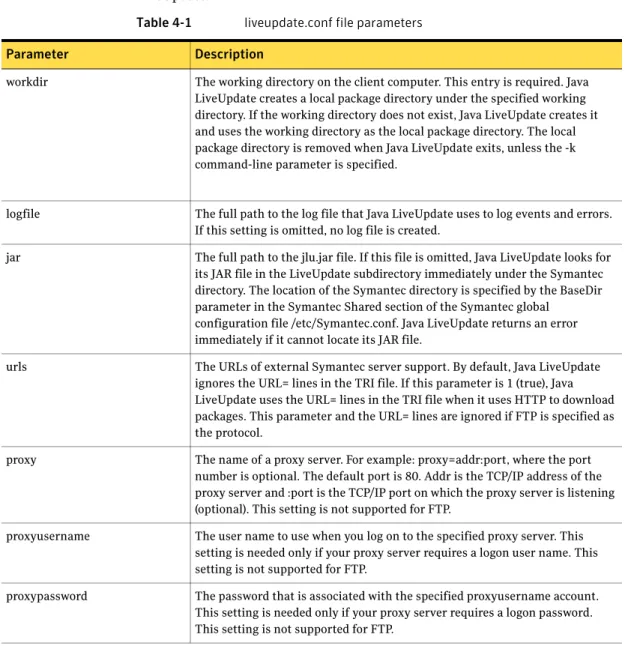
About the Java LiveUpdate configuration file ... 58
Sample liveupdate.conf file ... 60
About configuring proxy settings in Java LiveUpdate ... 61
Configuring Java LiveUpdate to use a Central LiveUpdate server ... 61
Wrapping a liveupdate.conf file in an RPM package ... 62
Enabling Java LiveUpdate logging on Linux servers ... 63
Configuring startup options ... 64
Updating definitions by using Intelligent Updater ... 67
Downloading and running the script ... 67
13 Contents
Chapter 5
Configuring Symantec AntiVirus for Linux
About configuring clients globally by using a GRC.DAT file ... 69
Configuration by using the Symantec System Center ... 70
Configuration by using the Configuration Editor tool ... 70
What you can configure on Linux by using a GRC.DAT file ... 70
About file exclusions ... 75
Using the Configuration Editor tool ... 76
Creating a configuration file ... 77
Loading and modifying an existing configuration file ... 78
Saving a configuration file ... 78
Returning settings to their default configuration ... 78
Deploying GRC.DAT files ... 79
Copying a GRC.DAT file ... 79
Wrapping a GRC.DAT file in an RPM package ... 79
Chapter
1
Introducing Symantec
AntiVirus for Linux
This chapter includes the following topics: ■ About Symantec AntiVirus for Linux ■ About using this guide effectively ■ System requirements
About Symantec AntiVirus for Linux
Symantec AntiVirus™ for Linux® includes real-time antivirus file protection through Auto-Protect scanning, and file system scanning via manual and scheduled scans. You can schedule periodic definitions file updates by using the sav command-line interface or by using the LiveUpdate™ Administration Utility and having your client computers retrieve the updates from a local server.
Note: Scanning for security risks is not enabled by default in Symantec AntiVirus for Linux, but may be enabled by using the GRC.DAT file. If enabled, security risks can be detected and logged, but Symantec AntiVirus cannot take any actions on them.
See“What you can configure on Linux by using a GRC.DAT file” on page 70.
Symantec AntiVirus supports Linux client distribution with RPM Package Manager (RPM) tools and configuration updates with GRC.DAT files. On Linux distributions, Auto-Protect protects files that are located on the following types of media:
16 Introducing Symantec AntiVirus for Linux About using this guide effectively
■ Removable media, such as CD ROM drives ■ Network file servers
All events that are generated are logged to the standard system log via syslog.
About using this guide effectively
To to use this guide effectively, you should already understand the following: ■ The basics of how to administer Linux computers, including tasks such as
setting your PATH and environment variables. ■ How to use the RPM Package Manager application.
■ How to download and install the Java™ Runtime Environment (JRE) on your computers, if it is not already installed.
■ If you want to use the client user interface, how to download and install X11, as well as a KDE™ or Gnome™ desktop environment, if this software is not already installed.
System requirements
Symantec AntiVirus requires specific kernels, software, and hardware to run on the Linux operating system.
All requirements for Symantec AntiVirus components are designed to work with the hardware and software recommendations for the supported computers. All Linux computers on which you are installing Symantec AntiVirus should meet or exceed the recommended system requirements for the operating system.
Hardware system requirements
Symantec AntiVirus for Linux requires the following hardware capabilities: ■ Intel™ Pentium™ II 266 MHz or higher processor
■ 256 MB RAM or higher ■ 80 MB free disk space
17 Introducing Symantec AntiVirus for Linux
System requirements
Software system requirements
Symantec AntiVirus supports the following Linux distributions: ■ Red Hat® Enterprise Linux 3.0 ES (RHEL3ES)
■ SuSE™ LINUX Enterprise Server 9 (SLES9) ■ Novell® Linux Desktop 9 (NLD9)
These distributions are supported on computers using Intel 486-, 586-, and 686-compatible CPUs.
Warning: Auto-Protect functionality is available only on supported kernels. Refer to the Readme file that accompanied your Symantec AntiVirus for Linux software for a list of the supported kernels.
The Java Runtime Environment (JRE) 1.4 or higher must be installed on your Linux computers to use the user interface. JRE is also required to run Java LiveUpdate.
X11 with a KDE or Gnome desktop environment is required to see the system tray icon, user status window, and event notifications.
18 Introducing Symantec AntiVirus for Linux System requirements
Chapter
2
Installing Symantec
AntiVirus for Linux
This chapter includes the following topics:
■ About installing Symantec AntiVirus for Linux ■ Installing Symantec AntiVirus for Linux locally
■ Installing Symantec AntiVirus for Linux from a remote server ■ Uninstalling Symantec AntiVirus for Linux
About installing Symantec AntiVirus for Linux
Symantec AntiVirus uses the RPM Package Manager format for installation. Symantec AntiVirus consists of several installation files, which use the following name format:
<package name>-<major version>.<minor version>.<crt release>-<build number>.<architecture>.rpm
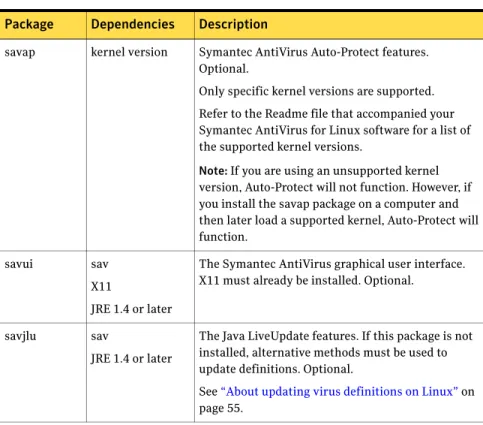
For example, a typical file name might be sav-1.0.0-94.i386.rpm. Table 2-1 describes the installation packages that are provided.
Table 2-1 Symantec AntiVirus for Linux installation packages
Package Dependencies Description
sav None The main Symantec AntiVirus program, which
20 Installing Symantec AntiVirus for Linux About installing Symantec AntiVirus for Linux
Installation scenarios for Symantec AntiVirus for Linux
Based on your company’s environment and needs, you may not want to install all Symantec AntiVirus Linux packages. This section describes some typical installation scenarios.
Note: Refer to the Readme file that accompanied your Symantec AntiVirus software for Linux for a list of the supported kernels.
You have a supported distribution and a supported kernel
version
You can install all files and use all the Symantec AntiVirus features, including manual and scheduled scanning, Auto-Protect, the X11-based graphical user interface, and Java LiveUpdate. To do this, your Linux computers must be using supported Linux distributions and supported kernel versions, and have X11 and JRE 1.4 or later installed.
savap kernel version Symantec AntiVirus Auto-Protect features. Optional.
Only specific kernel versions are supported. Refer to the Readme file that accompanied your Symantec AntiVirus for Linux software for a list of the supported kernel versions.
Note: If you are using an unsupported kernel version, Auto-Protect will not function. However, if you install the savap package on a computer and then later load a supported kernel, Auto-Protect will function.
savui sav
X11
JRE 1.4 or later
The Symantec AntiVirus graphical user interface. X11 must already be installed. Optional.
savjlu sav
JRE 1.4 or later
The Java LiveUpdate features. If this package is not installed, alternative methods must be used to update definitions. Optional.
See“About updating virus definitions on Linux” on page 55.
Table 2-1 Symantec AntiVirus for Linux installation packages
21 Installing Symantec AntiVirus for Linux About installing Symantec AntiVirus for Linux
The files can be installed in any order, as long as sav is installed before savui. If you install all files at once, the files are automatically installed in the
appropriate order.
You have a supported distribution, but an unsupported
kernel version
If you use a supported Linux distribution but use it with an unsupported kernel version, Auto-Protect functionality is not available. You can still use the Symantec AntiVirus manual and scheduled scanning capabilities and Java LiveUpdate to protect the computer.
Note: If you are using an unsupported kernel version, Auto-Protect will not function. However, if you install the savap package on a computer and then later load a supported kernel, Auto-Protect will function.
You should install the following packages: ■ sav
■ savui ■ savjlu
You have a supported distribution and a supported kernel
version, but do not use Java
If you use a supported distribution and a supported kernel version, but you do not run Java, then you cannot use Java LiveUpdate to update definitions. You will have to use an alternative method.
See“About updating virus definitions on Linux” on page 55. You should install the following packages:
■ sav ■ savui ■ savap
You have a supported distribution and a supported kernel
version, but do not use X11
If you use a supported distribution and a supported kernel version, but you do not run X11 in your environment, the Symantec AntiVirus user interface is not available on your Linux computers. You can use the sav command line tool to
22 Installing Symantec AntiVirus for Linux Installing Symantec AntiVirus for Linux locally
update definitions. You can use sav command line tool and the computer’s syslog to access status and alert messages.
You should install the following packages: ■ sav
■ savap ■ savjlu
You want to use a minimum amount of computing resources
You are running a supported distribution and want a minimal footprint that provides only manual and scheduled scanning. You can do this whether you are running a supported or an unsupported version of the kernel.You will need to use the sav command line tool and the computer’s syslog to access status and alert messages, and to update definitions without using Java LiveUpdate.
See“About updating virus definitions on Linux” on page 55. You should install only the base sav package.
Installing Symantec AntiVirus for Linux locally
The installation of Symantec AntiVirus for Linux is silent. If desired, you can use the RPM command-line parameter, -Uhv, to display the current percentage of the installation that is complete. A reboot after installation is not required. The rpm -U command line argument can be used to perform an initial installation or to update an existing installation of Symantec AntiVirus for Linux. Although you can also use the rpm -i command to install, Symantec™ recommends you use -U. The -i command will result in an error if a previous version of Symantec AntiVirus for Linux is already present.
You can install the packages separately or all at once, using wildcard characters, and they will install in the correct order.
To install each file separately
◆ On the command line, type the following:
23 Installing Symantec AntiVirus for Linux Installing Symantec AntiVirus for Linux from a remote server
Installing Symantec AntiVirus for Linux from a
remote server
RPM allows packages to be installed for the first time from a remote FTP or HTTP server. To do this, you need to supply the name of the remote server on the command line.
You can install from an HTTP server by replacing FTP in the following examples with HTTP, and replacing the <someserver.com> with an HTTP server instead of an FTP server.
To install Symantec AntiVirus for Linux from a remote server
◆ On the command line, type the following:
rpm –i ftp://<someserver.com/someshare/file name>.rpm
If you need to use login credentials for the remote server, type the following:
rpm –i ftp://<user name:[email protected]/someshare/file name>.rpm
Uninstalling Symantec AntiVirus for Linux
Uninstalling Symantec AntiVirus removes installed files from the computer and unregisters the package from the RPM database. If you attempt to uninstall a package that is not currently installed, Symantec AntiVirus returns a message that a package is not installed, but the uninstallation of the other packages still succeeds.
To uninstall Symantec AntiVirus for Linux
1 If you have all packages installed, on the command line, type the following:
rpm –e sav savap savui savjlu
2 Restart the computer to remove the Auto-Protect support.
Listing all Symantec AntiVirus packages
If you don’t remember the package names or which packages are installed, you can use the rpm -qa command to list the installed Symantec AntiVirus packages.
To list all Symantec AntiVirus packages
◆ On the command line, type the following:
24 Installing Symantec AntiVirus for Linux Uninstalling Symantec AntiVirus for Linux
About removing Symantec AntiVirus completely
After using the rpm -e command to uninstall Symantec AntiVirus, some directories and files still remain. If you need to completely remove Symantec AntiVirus from a computer, you can delete the following directories:
You can also safely delete any empty directories that are located under /opt/ Symantec.
The following directories may also remain, but should only be deleted if you are sure that there is no Symantec product on the computer that is currently using LiveUpdate:
■ /opt/Symantec/virusdefs ■ /opt/Symantec/LiveUpdate
The /etc/Symantec.conf file may also remain, but should only be deleted if you are sure that there are no other Symantec products installed on the computer.
/var/symantec alert logs and quarantined files
/opt/Symantec/symantec_antivirus technical support log files
Chapter
3
Using Symantec AntiVirus
for Linux
This chapter includes the following topics:
■ When to use the command-line interfaces, services, and tools ■ About the sav command-line interface
■ Using the sav CLI to interact with Symantec AntiVirus ■ About the symcfg command-line interface
■ Using the symcfg CLI to interact with the Symantec AntiVirus configuration database
■ About the symcfgd service
■ Using the symcfgd service parameters ■ About the rtvscand service
■ Using the rtvscand service parameters ■ About the savtray program
When to use the command-line interfaces, services,
and tools
Symantec AntiVirus provides several command-line interfaces (CLIs), services, and tools for configuring and interacting with Symantec AntiVirus when running on Linux.
26 Using Symantec AntiVirus for Linux
When to use the command-line interfaces, services, and tools
Note: You must have root privileges to use most of the Symantec AntiVirus for Linux service and command-line interface commands. The exceptions are the sav liveupdate -u and info -a,-d,-e, -p, and -s commands.
Table 3-1 describes the main command-line interfaces and tools and what they are used for.
Table 3-1 Symantec AntiVirus interfaces, services, and tools
Interface or tool Function
sav command-line interface This interface provides the primary method of interacting with the Symantec AntiVirus service. You should use this interface for the following tasks: ■ Enabling and disabling Auto-Protect
■ Starting and scheduling LiveUpdates and viewing the current LiveUpdate schedule
■ Starting and stopping manual scans
■ Creating, deleting, enabling, and disabling scheduled scans
■ Viewing a list of scheduled scans and detailed information about each scan ■ Displaying items and acting on items in the local Quarantine
■ Rolling back to a previous version of virus and security risk definitions ■ Using the latest version of local of virus and security risk definitions ■ Displaying general product information
symcfg command-line interface This interface provides client applications with access to a computer-specific, local configuration database that is used to store configuration data for Symantec AntiVirus for Linux.
Note: You should use this interface when you need to access Symantec AntiVirus configuration settings that are not accessible through the sav CLI. You should use this interface for the following tasks:
■ Displaying data in the configuration database ■ Adding data to the configuration database ■ Removing data from the configuration database
27 Using Symantec AntiVirus for Linux When to use the command-line interfaces, services, and tools
symcfgd service This service typically runs as a daemon process. This daemon is not typically run from the command line. It is started automatically by the system initialization scripts.
If necessary, you can use the parameters that are associated with this service for the following tasks:
■ Specifying the log facility to use when logging to syslog ■ Filtering events that are logged based on severity ■ Stopping the symcfgd daemon
■ Checking to see if the symcfgd service is currently running ■ Changing the working directory for symcfgd
■ Changing the file that holds the PID of the currently running copy of symcfgd
rtvscand service This service is the interface to rtvscan, the Symantec AntiVirus service that protects Linux client computers from viruses and other security risks. This daemon is not typically run from the command line. It is started automatically by the system initialization scripts.
If necessary, you can use the parameters that are associated with this service for the following tasks:
■ Specifying the log facility to use when logging to syslog ■ Filtering the events that are logged based on severity ■ Stopping the rtvscand daemon
■ Displaying help information
■ Checking to see if the rtvscand service is currently running ■ Changing the working directory for rtvscand
■ Changing the file that holds the PID of the currently running copy of rtvscand
savtray command-line interface This interface runs the Symantec AntiVirus graphical user interface for Symantec AntiVirus for Linux client computers. You should use this interface for the following tasks:
■ Launching the graphical interface with parameters for session management
■ Launching the graphical interface with parameters for controlling the appearance and graphical behavior of Symantec AntiVirus
Configuration Editor tool If you do not use the Symantec System Center to manage Symantec products in your environment, you can use this tool to create a GRC.DAT file to configure your Symantec AntiVirus Linux client computers.
See“Using the Configuration Editor tool” on page 76.
Table 3-1 Symantec AntiVirus interfaces, services, and tools
28 Using Symantec AntiVirus for Linux About the sav command-line interface
About the sav command-line interface
Symantec AntiVirus for Linux provides a command-line interface for
interacting with sav, the basic Symantec AntiVirus service. You can use the sav command-line interface to perform the following tasks:
■ enable and disable Auto-Protect, use LiveUpdate ■ start and stop manual scans
■ list information about scheduled scans ■ create and delete scheduled scans ■ enable and disable scheduled scans ■ manage the local Quarantine ■ manage virus definitions ■ display product information
The sav commands that produce output produce it in a format that can be parsed by third-party tools. There is no header information for the columns in this output.
About the sav command-line syntax
The general syntax for the sav command line is as follows: sav [--quiet] command parameter(s)
The --quiet parameter is the only global parameter for the sav command line. sav itself does not take wildcard characters, so any wildcard characters that are used on the sav command line are interpreted by the shell that you are using. You can perform only one action per command line invocation. For example, you cannot turn on Auto-Protect and initiate a LiveUpdate on the same command line.
By default, sav is located in /opt/Symantec/symantec_antivirus.
Note: You must have root privileges to use all of the sav CLI commands except sav liveupdate -u and sav info -a,-d,-e, -p, and -s.
29 Using Symantec AntiVirus for Linux About the sav command-line interface
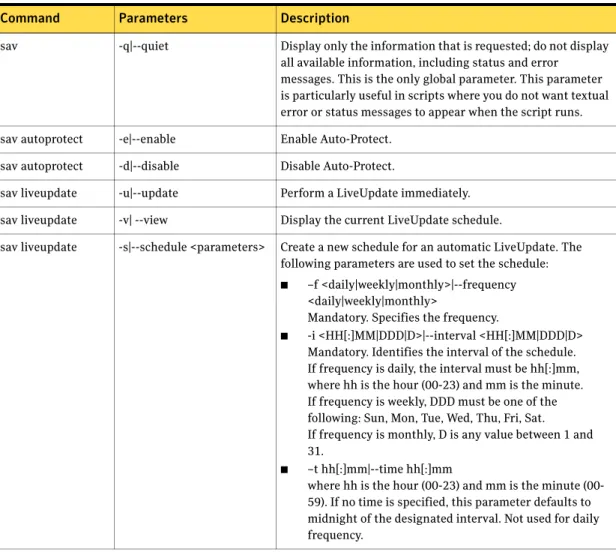
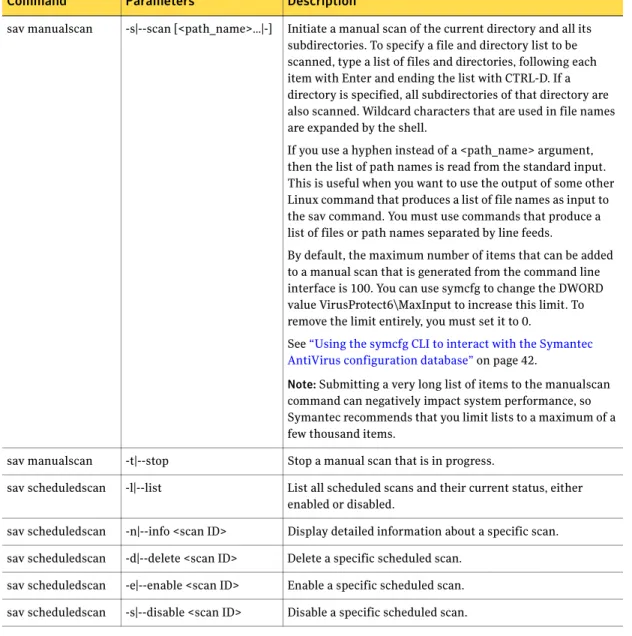
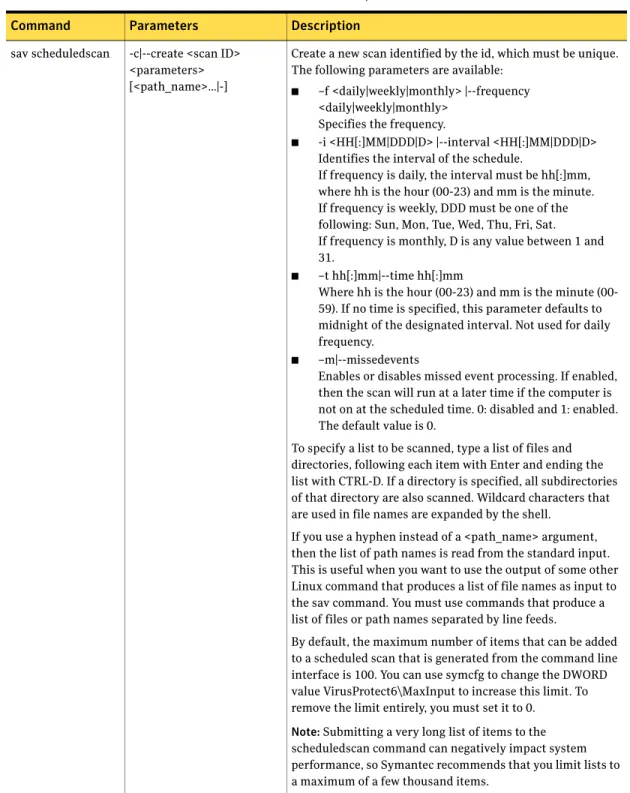
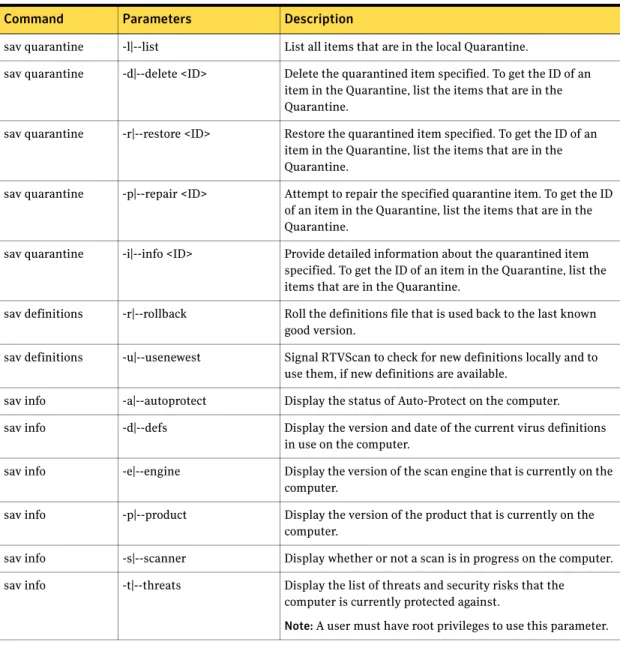
Table 3-2 describes the commands and parameters that are available in the sav command-line interface.
Table 3-2 sav commands and parameters
Command Parameters Description
sav -q|--quiet Display only the information that is requested; do not display all available information, including status and error messages. This is the only global parameter. This parameter is particularly useful in scripts where you do not want textual error or status messages to appear when the script runs. sav autoprotect -e|--enable Enable Auto-Protect.
sav autoprotect -d|--disable Disable Auto-Protect.
sav liveupdate -u|--update Perform a LiveUpdate immediately. sav liveupdate -v| --view Display the current LiveUpdate schedule.
sav liveupdate -s|--schedule <parameters> Create a new schedule for an automatic LiveUpdate. The following parameters are used to set the schedule: ■ –f <daily|weekly|monthly>|--frequency
<daily|weekly|monthly>
Mandatory. Specifies the frequency.
■ -i <HH[:]MM|DDD|D>|--interval <HH[:]MM|DDD|D> Mandatory. Identifies the interval of the schedule. If frequency is daily, the interval must be hh[:]mm, where hh is the hour (00-23) and mm is the minute. If frequency is weekly, DDD must be one of the following: Sun, Mon, Tue, Wed, Thu, Fri, Sat. If frequency is monthly, D is any value between 1 and 31.
■ –t hh[:]mm|--time hh[:]mm
where hh is the hour 23) and mm is the minute (00-59). If no time is specified, this parameter defaults to midnight of the designated interval. Not used for daily frequency.
30 Using Symantec AntiVirus for Linux About the sav command-line interface
sav manualscan -s|--scan [<path_name>…|-] Initiate a manual scan of the current directory and all its subdirectories. To specify a file and directory list to be scanned, type a list of files and directories, following each item with Enter and ending the list with CTRL-D. If a directory is specified, all subdirectories of that directory are also scanned. Wildcard characters that are used in file names are expanded by the shell.
If you use a hyphen instead of a <path_name> argument, then the list of path names is read from the standard input. This is useful when you want to use the output of some other Linux command that produces a list of file names as input to the sav command. You must use commands that produce a list of files or path names separated by line feeds.
By default, the maximum number of items that can be added to a manual scan that is generated from the command line interface is 100. You can use symcfg to change the DWORD value VirusProtect6\MaxInput to increase this limit. To remove the limit entirely, you must set it to 0.
See“Using the symcfg CLI to interact with the Symantec AntiVirus configuration database” on page 42.
Note: Submitting a very long list of items to the manualscan command can negatively impact system performance, so Symantec recommends that you limit lists to a maximum of a few thousand items.
sav manualscan -t|--stop Stop a manual scan that is in progress.
sav scheduledscan -l|--list List all scheduled scans and their current status, either enabled or disabled.
sav scheduledscan -n|--info <scan ID> Display detailed information about a specific scan. sav scheduledscan -d|--delete <scan ID> Delete a specific scheduled scan.
sav scheduledscan -e|--enable <scan ID> Enable a specific scheduled scan. sav scheduledscan -s|--disable <scan ID> Disable a specific scheduled scan.
Table 3-2 sav commands and parameters
31 Using Symantec AntiVirus for Linux About the sav command-line interface
sav scheduledscan -c|--create <scan ID> <parameters> [<path_name>…|-]
Create a new scan identified by the id, which must be unique. The following parameters are available:
■ –f <daily|weekly|monthly> |--frequency <daily|weekly|monthly>
Specifies the frequency.
■ -i <HH[:]MM|DDD|D> |--interval <HH[:]MM|DDD|D> Identifies the interval of the schedule.
If frequency is daily, the interval must be hh[:]mm, where hh is the hour (00-23) and mm is the minute. If frequency is weekly, DDD must be one of the following: Sun, Mon, Tue, Wed, Thu, Fri, Sat. If frequency is monthly, D is any value between 1 and 31.
■ –t hh[:]mm|--time hh[:]mm
Where hh is the hour 23) and mm is the minute (00-59). If no time is specified, this parameter defaults to midnight of the designated interval. Not used for daily frequency.
■ –m|--missedevents
Enables or disables missed event processing. If enabled, then the scan will run at a later time if the computer is not on at the scheduled time. 0: disabled and 1: enabled. The default value is 0.
To specify a list to be scanned, type a list of files and directories, following each item with Enter and ending the list with CTRL-D. If a directory is specified, all subdirectories of that directory are also scanned. Wildcard characters that are used in file names are expanded by the shell.
If you use a hyphen instead of a <path_name> argument, then the list of path names is read from the standard input. This is useful when you want to use the output of some other Linux command that produces a list of file names as input to the sav command. You must use commands that produce a list of files or path names separated by line feeds.
By default, the maximum number of items that can be added to a scheduled scan that is generated from the command line interface is 100. You can use symcfg to change the DWORD value VirusProtect6\MaxInput to increase this limit. To remove the limit entirely, you must set it to 0.
Note: Submitting a very long list of items to the scheduledscan command can negatively impact system performance, so Symantec recommends that you limit lists to a maximum of a few thousand items.
Table 3-2 sav commands and parameters
32 Using Symantec AntiVirus for Linux About the sav command-line interface
sav quarantine -l|--list List all items that are in the local Quarantine.
sav quarantine -d|--delete <ID> Delete the quarantined item specified. To get the ID of an item in the Quarantine, list the items that are in the Quarantine.
sav quarantine -r|--restore <ID> Restore the quarantined item specified. To get the ID of an item in the Quarantine, list the items that are in the Quarantine.
sav quarantine -p|--repair <ID> Attempt to repair the specified quarantine item. To get the ID of an item in the Quarantine, list the items that are in the Quarantine.
sav quarantine -i|--info <ID> Provide detailed information about the quarantined item specified. To get the ID of an item in the Quarantine, list the items that are in the Quarantine.
sav definitions -r|--rollback Roll the definitions file that is used back to the last known good version.
sav definitions -u|--usenewest Signal RTVScan to check for new definitions locally and to use them, if new definitions are available.
sav info -a|--autoprotect Display the status of Auto-Protect on the computer. sav info -d|--defs Display the version and date of the current virus definitions
in use on the computer.
sav info -e|--engine Display the version of the scan engine that is currently on the computer.
sav info -p|--product Display the version of the product that is currently on the computer.
sav info -s|--scanner Display whether or not a scan is in progress on the computer. sav info -t|--threats Display the list of threats and security risks that the
computer is currently protected against.
Note: A user must have root privileges to use this parameter.
Table 3-2 sav commands and parameters
33 Using Symantec AntiVirus for Linux Using the sav CLI to interact with Symantec AntiVirus
Using the sav CLI to interact with Symantec
AntiVirus
You can use the sav CLI to perform the following tasks: ■ enable and disable Auto-Protect
■ start and schedule LiveUpdates and view the current LiveUpdate schedule ■ start and stop manual scans
■ create, delete, enable, and disable scheduled scans
■ view a list of scheduled scans and detailed information about each scan ■ display items and act on items in the local Quarantine
■ roll back to a previous version of virus and security risk definitions ■ use the latest version of local virus and security risk definitions ■ display general product information
Note: You must have root privileges to use all of the sav CLI commands except liveupdate -u and info -a,-d,-e, -p, and -s.
Enabling and disabling Auto-Protect
You can use the sav autoprotect command to enable and disable Auto-Protect on a specific computer.
To enable Auto-Protect
◆ From the command line, type the following:
sav autoprotect --enable
To disable Auto-Protect
◆ From the command line, type the following:
sav autoprotect --disable
Using Java LiveUpdate
You can use the sav liveupdate command to initiate an update using Java LiveUpdate on a specific computer, to view the computer’s current LiveUpdate schedule, and to schedule automatic updates using Java LiveUpdate.
34 Using Symantec AntiVirus for Linux
Using the sav CLI to interact with Symantec AntiVirus
There is no managed process for distributing new definitions to clients from a central computer. However, you can do the following:
■ use the Intelligent Updater shell script from
http://securityresponse.symantec.com/ to update multiple computers. See“Updating definitions by using Intelligent Updater” on page 67. ■ use the LiveUpdate Administration Utility to set up a Central LiveUpdate
server on your network and configure Java LiveUpdate to point your clients to pick up definitions updates from that server.
See“About the LiveUpdate Administration Utility” on page 56.
See“Configuring Java LiveUpdate to use a Central LiveUpdate server” on page 61.
To start an immediate LiveUpdate
◆ From the command line, type the following:
sav liveupdate --update
To view the current LiveUpdate schedule
◆ From the command line, type the following:
sav liveupdate --view
To schedule an automatic LiveUpdate
◆ From the command line, type the following:
sav liveupdate --schedule -f <frequency> -i <interval> -t <time>
For example, to schedule an automatic LiveUpdate that runs every Friday at 11:30 P.M., type the following:
sav liveupdate --schedule -f weekly -i Fri -t 23:30
For example, to schedule an automatic LiveUpdate that runs only on the second day of the month at 3 A.M., type the following:
sav liveupdate --schedule -f monthly -i 2 -t 3:00
Starting and stopping manual scans
You can use the sav manualscan command to start and to stop a manual scan on a specific computer.
If you use a hyphen (-) as the <path_names> argument when starting a manual scan, the list of <path_names> is read from the standard input. This is useful if you want to use the output of another Linux command that produces a list of file names as input to sav. Use commands that produce a list with a line feed between each item.
35 Using Symantec AntiVirus for Linux Using the sav CLI to interact with Symantec AntiVirus
By default, the maximum number of items that can be added to a manual scan that is generated from the command line interface is 100. You can use symcfg to change the DWORD value VirusProtect6\MaxInput to increase this limit. To remove the limit entirely, you must set it to 0.
See“Using the symcfg CLI to interact with the Symantec AntiVirus configuration database” on page 42.
Note: Submitting a very long list of files to the manualscan command can negatively impact system performance, so Symantec recommends that you limit file lists to a maximum of a few thousand items.
To start a manual scan of a directory and its subdirectories
◆ From the command line, type the following:
sav manualscan --scan <path_name>
For example, to start a manual scan of user John’s directory in the /home directory, type the following:
sav manualscan --scan /home/john
To start a manual scan with input from another command
◆ From the command line, type the following:
<other command> | sav manualscan --scan -
Use commands that produce a list of items separated by line feeds. For example, to start scan of all files that have been modified within the last hour in or below a user's home directory, type the following:
find ~john -mmin -60 -type f -print | sav manualscan --scan -
To type a list of files and directories to be scanned
◆ From the command line, type the following:
sav manualscan --scan - <file name> ENTER
<path name> ENTER <path name> ENTER <filename> CTRL-D
To stop a manual scan that is in progress
◆ From the command line, type the following:
36 Using Symantec AntiVirus for Linux
Using the sav CLI to interact with Symantec AntiVirus
Creating and managing scheduled scans
You can create, enable and disable, list, and display detailed information about a particular scheduled scan from the command line.
By default, the maximum number of items that can be added to a scheduled scan that is generated from the command line interface is 100. You can use symcfg to change the DWORD value VirusProtect6\MaxInput to increase this limit. To remove the limit entirely, you must set it to 0.
Note: Submitting a very long list of files to the scheduledscan command when creating a scheduled scan can negatively impact system performance, so Symantec recommends that you limit lists to a maximum of a few thousand items.
Listing information about scheduled scans
If you list the scheduled scans on a computer, the output looks similar to the following:
The columns provide the following information:
■ Column 1 is the name that was given to the scan when the scan was created; also called the scan ID.
■ Column 2 is the frequency and time of the scan. ■ Column 3 is the scan status: Enabled or Disabled.
■ Column 4 reports the current state of the scan: Running, Done, or Never Run.
To list the scheduled scans on a computer
◆ From the command line, type the following:
sav scheduledscan --list
To list detailed information about a particular scan
◆ From the command line, type the following:
sav scheduledscan --info <scan ID>
SS01 Weekly: Mon Enabled Done SS02 Daily: 11:15 Disabled Never Run SS03 Monthly: 25 Disabled Never Run
37 Using Symantec AntiVirus for Linux Using the sav CLI to interact with Symantec AntiVirus
Creating and deleting a scheduled scan
You can use the scheduledscan command to create and delete a scheduled scan on a specific computer.
To create a scheduled scan
◆ From the command line, type the following:
sav scheduledscan --create <scan ID> -f <frequency> -i <interval> -t <time> -m <missed event processing value> <path name>...
For example, suppose you want to create a scheduled scan named myschedscan that scans the /usr directory, runs every Saturday at 11:01 P.M., and will not run when the computer is next turned on, if the computer is not on at the scheduled time. To create this scan, from the command line, type the following:
sav scheduledscan --create myschedscan -f weekly -i Sat -t 23:01 -m 0 /usr
To create a scheduled scan by using input from another command
◆ From the command line, type the following:
<other command> | sav scheduledscan --create <scan ID> -f <frequency> -i <interval> -t <time> -m <missed event processing value>
-Use commands that produce a list of items separated by line feeds. For example, to schedule a daily scan of all files that have been modified within the last eight hours in or below Steve's home directory, type the following:
find ~steve -mmin -480 -type f -print | sav scheduledscan --create stevescan -f daily -i 17:01 -m 0 -
To delete a scheduled scan
◆ From the command line, type the following:
sav scheduledscan --delete <scan ID>
where <scan ID> is the name you gave to the scan when you created it.
Enabling and disabling a scheduled scan
You can use the scheduledscan command to enable and disable a scheduled scan.
To enable a scheduled scan
◆ From the command line, type the following:
sav scheduledscan --enable <scan ID>
38 Using Symantec AntiVirus for Linux
Using the sav CLI to interact with Symantec AntiVirus
To disable a scheduled scan
◆ From the command line, type the following:
sav scheduledscan --disable <scan ID>
where <scan ID> is the name that you gave to the scan when you created it.
Managing the local Quarantine
You can use the sav quarantine command to do the following: ■ list the items in the Quarantine
■ display detailed information about an item in the Quarantine on a specific computer
■ delete and restore items from the Quarantine ■ attempt to repair an item in the Quarantine
To list the files in the local Quarantine
◆ From the command line, type the following:
sav quarantine --list
To display detailed information about a file in the local Quarantine
◆ From the command line, type the following:
sav quarantine --info <ID>
where <ID> is the ID of the item. Obtain the ID of a item by listing the items that are in the local Quarantine.
To delete a file in the local Quarantine
◆ From the command line, type the following:
sav quarantine --delete <ID>
where <ID> is the ID of the item. Obtain the ID of a item by listing the items that are in the local Quarantine.
To restore a file in the local Quarantine
◆ From the command line, type the following:
sav quarantine --restore <ID>
where <ID> is the ID of the item. Obtain the ID of a item by listing the items that are in the local Quarantine.
To repair a file in the local Quarantine
◆ From the command line, type the following:
39 Using Symantec AntiVirus for Linux Using the sav CLI to interact with Symantec AntiVirus
where <ID> is the ID of the item. Obtain the ID of a item by listing the items that are in the local Quarantine.
Managing virus definitions
You can use the sav definitions command to roll back the virus and security risk definitions to the last known good version or to have the computer check for and use the latest local version of definitions on a specific computer.
To roll back to the last known good version of definitions
◆ From the command line, type the following:
sav definitions --rollback
To use the latest local version of definitions
◆ From the command line, type the following:
sav definitions --usenewest
Displaying product information
You can use the sav info command to display general product information about a specific computer, including the following:
■ the status of Auto-Protect
■ the version and date of the current virus definitions ■ the product version that is in use
■ the version of the scan engine that is in use ■ whether or not a scan is in progress
■ the list of threats and security risks that the computer is currently protected against
To display the status of Auto-Protect
◆ From the command line, type the following:
sav info --autoprotect
To display the virus definitions version
◆ From the command line, type the following:
40 Using Symantec AntiVirus for Linux About the symcfg command-line interface
To display the current product version
◆ From the command line, type the following:
sav info --product
To display the current scan engine version
◆ From the command line, type the following:
sav info --engine
To determine if a scan is in progress
◆ From the command line, type the following:
sav info --scanner
To display the list of threats that the computer is protected from
◆ From the command line, type the following:
sav info --threats
About the symcfg command-line interface
symcfg is a command-line tool that provides client applications with access to a computer-specific, local configuration database that is used to store
configuration data for Symantec AntiVirus. Configuration settings are stored in a data file in binary format, not as text. The symcfg tool can be used to display, create, remove, and change the value of data that is stored in this database.
Command-line syntax
You cannot use multiple symcfg commands and their parameters as part of the same command line.
You must use the following syntax for the symcfg command lines: symcfg [-q|--quiet] [-r|--recursive]
symcfg [-q|--quiet] [-r|--recursive] add -k|--key key [-v|--value value -d|--data data -t|--type type]
symcfg [-q|--quiet] [-r|--recursive] delete -k|--key key [-v|--value value]
symcfg [-q|--quiet] [-r|--recursive] list -k|--key [key|*] [-v|--value [-v|--value]
41 Using Symantec AntiVirus for Linux About the symcfg command-line interface
By default, symcfg is located in /opt/Symantec/symantec_antivirus.
Note: You may need to enclose key names in single quotes to prevent the backslash from being interpreted as an escape character by the shell.
Table 3-3 describes the commands and parameters that are available for symcfg.
Table 3-3 symcfg commands and parameters
Command Parameters Description
symcfg -q [command]
--quiet [command]
Display only the information that is being requested; suppress error messages.
symcfg -r
--recursive
Apply the command that follows recursively.
symcfg add N/A Create new keys and values in the database, or overwrite existing ones. symcfg add -k key
--key key
The name of the key to add or overwrite. Mandatory.
Note: If no corresponding value is given, only the key is created. symcfg add -v value
--value value
The name of the value to add or overwrite.
symcfg add -d data --data data
The data to store for the value/data pair.
symcfg add -t type --type type
One of the following constants, representing the data type the following: ■ reg_sz (string)
■ reg_dword (32-bit unsigned integer) ■ reg_binary (arbitrary binary data) symcfg delete N/A Remove keys and values from the database. symcfg delete -k key
--key key
The name of the key to delete. Mandatory.
Note: If no corresponding value is given, the key and all of its values are deleted. If there are subkeys present, the delete fails.
symcfg delete -v value --value value
The name of the value to remove.
42 Using Symantec AntiVirus for Linux
Using the symcfg CLI to interact with the Symantec AntiVirus configuration database
Using the symcfg CLI to interact with the Symantec
AntiVirus configuration database
The symcfg CLI provides access to some configuration settings stored in the local configuration database that are not accessible through the sav CLI.
Note: You must have root privileges to use the symcfg command-line interface.
Listing the keys in the database
You can list all the keys that are stored in the database.
To list the keys in the database
◆ From the command line, type the following:
symcfg list -k <key> [-v <value>]
For example, to list all keys under the Storages node, you would type the following:
symcfg -r list -k ‘VirusProtect6\Storages’
Adding a key to the database
You can add keys and their corresponding values to the database to configure Symantec AntiVirus.
symcfg list -k key --key [key|*]
The name of the key to list. To list all keys from the root node, use an asterisk (*) instead of a key name. Mandatory.
If used without the --value parameter, all subkeys and values for this key are listed.
Note: You must escape an asterisk or enclose it in quotes to protect it from being expanded by the shell.
symcfg list -v value --value value
The name of the value to list. The value is displayed in the following format: \<key>\<subkey>\<value name> <value data> <value type>.
For example:
\VirusProtect6\Storages\FileSystem\ServiceStatus 1 REG_DWORD
Table 3-3 symcfg commands and parameters
43 Using Symantec AntiVirus for Linux
About the symcfgd service
To add a key to the database
◆ From the command line, type the following:
symcfg add -k <key> [-v <value>] [-d <data>] [-t <type>]
For example, to add a key to the database to exclude the /tmp/no_scan directory from Auto-Protect scans, you would type the following:
symcfg add --key
VirusProtect6\Storages\Filesystem\RealTimeScan\NoScanDir --value /tmp/no_scan --data 1 --type REG_DWORD
Deleting a key from the database
You can delete keys and their corresponding values from the database to configure Symantec AntiVirus.
To delete a key from the database
◆ From the command line, type the following:
symcfg delete -k <key> [-v <value>] [-d <data>] [-t <type>]
For example, to delete the scan1 from the database, you would type the following:
symcfg delete -k “VirusProtect6\Custom Tasks\scan1”
About the symcfgd service
symcfgd is the Symantec configuration service, which runs as a daemon process. This service is typically started automatically by the system initialization scripts. No changes to the default values should be required.
Note: This implementation uses a small number of kernel semaphores, which are shared among applications. Although unlikely, it is possible that Auto-Protect could experience problems if the operating system has an insufficient number of semaphores allocated for the computer. If the allocation of a semaphore fails, an event appears in the syslog. If necessary, you can increase the number of semaphores that are allocated for the operating system to alleviate the problem.
symcfgd service configuration parameters
The parameters available for interacting with the symcfgd are used by the /etc/ sysconfig/symcfgd file, but can also be used from the command line if special handling is required.