An update on the management of chronic hepatitis C:
Consensus guidelines from the Canadian Association
for the Study of the Liver
Robert P Myers MD MSc1, Alnoor Ramji MD2, Marc Bilodeau MD3, Stephen Wong MD MHSc4, Jordan J Feld MD MPH5
1Liver Unit, Division of Gastroenterology and Hepatology, University of Calgary, Calgary, Alberta; 2Department of Gastroenterology, University of British Columbia, Vancouver, British Columbia; 3Liver Unit, Department of Medicine, University of Montreal, Montreal, Quebec; 4Section of Hepatology, Department of Internal Medicine, University of Manitoba, Winnipeg, Manitoba; 5Toronto Western Hospital Liver Centre, University of Toronto, Toronto, Ontario
Correspondence: Dr Robert P Myers, Liver Unit, University of Calgary, 6D22, Teaching, Research and Wellness Building, 3280 Hospital Drive Northwest, Calgary, Alberta T2N 4Z6. Telephone 403-592-5049, fax 403-592-5090, email [email protected]
Received for publication March 22, 2012. Accepted April 7, 2012 PREAMBLE
The present guidelines were written to assist physicians and other health care professionals in the management of patients with chronic hepatitis C virus (HCV) infection. They were produced following a consensus conference of Canadian experts held in Toronto, Ontario, November 19 to 20, 2011. The meeting, which was organized by the Canadian Association for the Study of the Liver (CASL) with funding from the Canadian Liver Foundation, was open to all interested parties including health care professionals, patients, and representatives from government and the pharmaceutical industry. The information in the present guidelines represents a synthesis of the evidence presented at the meeting and available at the time of publication with supplemen-tation by the expert opinion of the authors. Any recommendations should be considered preferred approaches to care of the HCV-infected patient as opposed to strict standards of care. To more fully character-ize the quality of evidence supporting these recommendations, we have assigned a Class (reflecting benefit versus risk) and Level (assess-ing strength of certainty) of Evidence as adapted from the American College of Cardiology and the American Heart Association Practice Guidelines (1,2) and as used in similar practice guidelines of the American Association for the Study of Liver Diseases (3) (Table 1).
Since the most recent update of the CASL management guidelines for chronic hepatitis C in 2007 (4), two major advances have occurred: the development of direct-acting antiviral agents (DAAs) with dra-matically improved rates of virological clearance compared with stan-dard therapy (5-9); and the recognition of several single nucleotide polymorphisms (SNPs) associated with an increased probability of spontaneous and treatment-induced viral clearance (10-13). Presently, the impact of these advances is largely restricted to patients with HCV genotype 1. Therefore, the current consensus document was developed as an update to previous guidelines with a focus on the management of genotype 1-infected patients rather than an exhaustive review of hepa-titis C. Where preferred management approaches for other patient populations (eg, with non-1 genotypes) have changed, the relevant recommendations have been updated.
INTRODUCTION
Chronic hepatitis C remains a significant medical and economic burden in Canada (14). Although no large-scale serological surveys have been conducted to define the exact prevalence of hepatitis C, modelling studies suggest that approximately 0.8% of Canadians – cor-responding to nearly 245,000 individuals – were infected as of 2007
RP Myers, A Ramji, M Bilodeau, S Wong, JJ Feld. An update on the management of chronic hepatitis C: Consensus guidelines from the Canadian Association for the Study of the Liver. Can J Gastroenterol 2012;26(6):359-375.
Chronic hepatitis C remains a significant medical and economic bur-den in Canada, affecting nearly 1% of the population. Since the last consensus conference on the management of chronic hepatitis C, major advances have warranted a review of recommended manage-ment approaches for these patients. Specifically, direct-acting antiviral agents with dramatically improved rates of virological clearance com-pared with standard therapy have been developed, and several single nucleotide polymorphisms associated with an increased probability of spontaneous and treatment-induced viral clearance have been identi-fied. In light of this new evidence, a consensus development confer-ence was held in November 2011; the present document highlights the results of the presentations and discussions surrounding these issues. It reviews the epidemiology of hepatitis C in Canada, preferred diagnostic testing approaches and recommendations for the treatment of chronically infected patients with the newly approved protease inhibitors (boceprevir and telaprevir), including those who have pre-viously failed pegylated interferon and ribavirin therapy. In addition, recommendations are made regarding approaches to reducing the bur-den of hepatitis C in Canada.
Key Words: Antiviral; Boceprevir; Guideline; Hepatitis C; Interferon; Peginterferon; Protease inhibitor; Ribavirin; Telaprevir; Therapy; Treatment
Mise à jour sur la prise en charge de l’hépatite C
chronique : des lignes directrices consensuelles de
l’Association canadienne pour l’étude du foie
L’hépatite C chronique demeure un fardeau médical et économique important au Canada, qui touche près de 1 % de la population. Depuis la dernière conférence consensuelle sur la prise en charge de l’hépatite C, des progrès importants ont justifié une analyse des démarches de prise en charge recommandées pour ces patients. Plus précisément, on a mis au point des antiviraux à action directe aux taux de clairance virologique considérablement plus élevés que ceux des thérapies standards et on a découvert plusieurs polymorphismes à nucléotide unique associés à une augmentation de la probabilité de clairance virale spontanée et induite par un traitement. À la lumière de ces nouvelles données probantes, une conférence consensuelle a eu lieu en novembre 2011. Le présent document fait ressortir les résultats des présentations et des discussions sur le sujet. Il traite de l’épidémiologie de l’hépatite C au Canada, des approches favorisées à l’égard des tests diagnostiques et des recommandations pour le traitement des patients atteints d’une infection chronique au moyen des inhibiteurs de la protéase approuvés depuis peu (bocéprévir et télaprévir), y compris les patients qui n’avaient pas répondu à un traitement à l’interféron pégylé et à la ribavirine. En outre, il con-tient des recommandations sur les démarches pour réduire le fardeau de l’hépatite C au Canada.
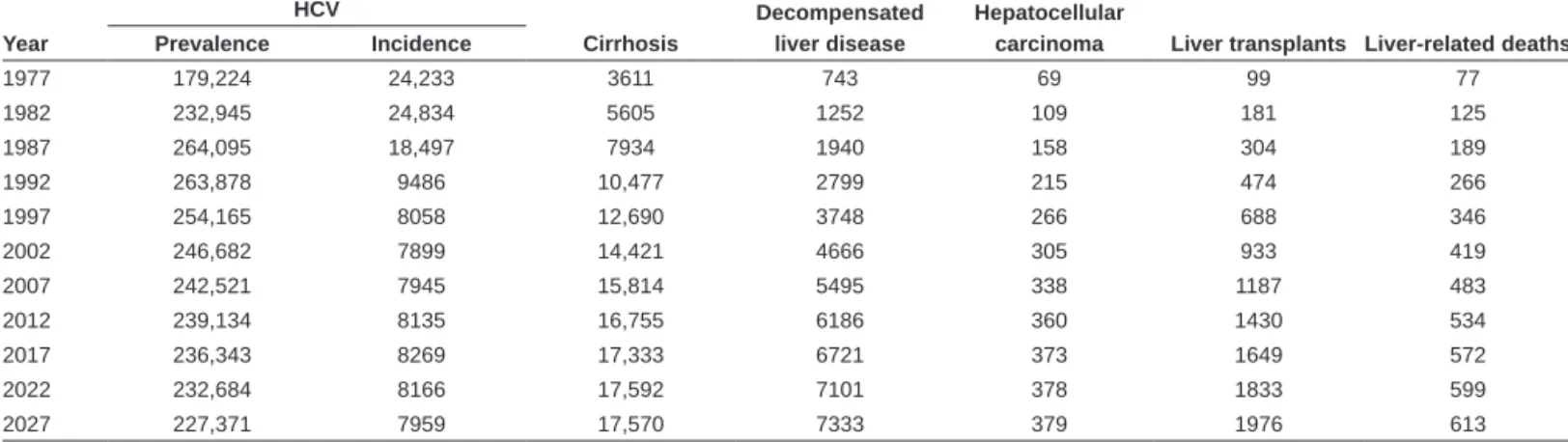
(Table 2) (15). Provincial and territorial estimates of HCV prevalence suggest substantial regional variation, ranging from 0.13% in Newfoundland to 3.9% in the Yukon. In Canada, approximately 60% of HCV cases are among current or former injection drug users (IDUs), 20% are among infected immigrants and 11% have received contam-inated blood products, including patients with hemophilia (Table 2). Of the nearly 8000 incident cases in Canada in 2007, approximately 80% are estimated to have occurred via sharing of injecting equipment among IDUs, and most of the remainder among immigrants from endemic countries. A significant number of the estimated cases in Canada remain undiagnosed, although the exact proportion is unclear (15). Modelling data suggest that the prevalence of hepatitis C has likely peaked in Canada, but the incidence of more advanced HCV-related sequelae (eg, decompensated liver disease, hepatocellular car-cinoma [HCC] and liver transplantations) are expected to rise for at least another decade (Table 3 and Figure 1) (15).
Given the alarming estimates of future disease burden, more accur-ate information regarding the incidence and prevalence of hepatitis C and its sequelae are required to inform health care planning and the allocation of resources. The identification of undiagnosed cases and the dissemination of effective antiviral therapies should be prioritized to reduce complications of this disease.
Recommendations:
1. A large, population-based seroprevalence survey should be conducted to accurately define the prevalence of hepatitis C in Canada. The design of the study should include populations with an increased risk of hepatitis C, particularly IDUs and immigrants from endemic countries (Class 2a, Level C). 2. To reduce the future burden of HCV-related morbidity and
mortality in Canada, strategies for case identification, harm reduction and disease management – including but not limited to antiviral therapy – should be developed and implemented (Class 2a, Level C).
ANTIVIRAL THERAPY
The primary objective of anti-HCV therapy is complete elimination of the virus, which is termed a sustained virological response (SVR).
SVR is defined as undetectable serum HCV RNA at least 24 weeks following the end of treatment (Table 4) (16). Recent data suggest that earlier assessment of serum HCV RNA at 12 weeks after treat-ment is sufficient to define this outcome (17). Once achieved, an SVR is considered to be a cure of HCV infection because late relapses (which may actually represent reinfections) are rare (18,19). Additional benefits of SVR include improvements in quality of life (20,21), extrahepatic manifestations of HCV (eg, cryoglobulinemic vasculitis) (22), liver histology (23,24), and liver-related morbidity and mortality (25-27).
The landscape of antiviral treatment for hepatitis C is changing rapidly (28). Until recently, the standard therapy was the combination of peginterferon-alpha (PEG-IFN) and ribavirin (RBV), usually admin-istered for 48 weeks in patients with genotype 1, 4, 5 and 6, and 24 weeks in those with genotypes 2 and 3 (4). Dual therapy achieves SVR rates of 40% to 50% in patients with genotype 1, and approxi-mately 80% in those with genotypes 2 and 3. Although a significant advance from previously available treatments, PEG-IFN and RBV ther-apy is costly, associated with numerous adverse events and has only been used in a minority of infected individuals (29,30). Moreover, the major-ity of patients in Canada have HCV genotype 1 and have a lower likeli-hood of achieving viral eradication with dual therapy. Therefore, the recent emergence of DAAs, which offer a substantial improvement in SVR rates and the option of abbreviated therapy for many genotype-1-infected patients, represents a major advance in the field.
The treatment of hepatitis C is complex and time-consuming. Anti-HCV therapies require multiple modes of administration, can have numerous side effects, and require careful monitoring of symptoms and laboratory tests. Treatment complexity is further exacerbated by comor-bid conditions that are more prevalent among HCV-infected patients, including mental health disorders (eg, depression) and addictions (eg, to alcohol and drugs). Therefore, the optimal management of hepatitis C requires a multidisciplinary approach that includes experienced phys-icians, nurses and allied health professionals (eg, psychologists, psychia-trists, addiction specialists and social workers). Currently in Canada, a relatively small number of physicians treat hepatitis C, leading in some cases to prolonged wait times for patients before being adequately evalu-ated and treevalu-ated. Moreover, public funding for treatment nurses – who are a vital component of the management team – is not universally available. To achieve a meaningful reduction in the future burden of this disease, it will be vital to expand treatment capacity via additional train-ing and fundtrain-ing of experienced personnel and enhanced access to pub-licly funded antiviral therapies (31).
Recommendations:
3. Increased resources are necessary to improve hepatitis C treatment capacity in Canada, including the training of expert treaters and public funding for treatment nurses (Class 2a, Level C).
Table 1
Grading system for recommendations Classification Description
Class of evidence
Class 1 Conditions for which there is evidence and/or general agreement that a given diagnostic evaluation procedure or treatment is beneficial, useful, and effective Class 2 Conditions for which there is conflicting evidence and/or a
divergence of opinion about the usefulness/efficacy of a diagnostic evaluation, procedure, or treatment Class 2a Weight of evidence/opinion is in favour of usefulness/
efficacy
Class 2b Usefulness/efficacy is less well established by evidence/ opinion
Class 3 Conditions for which there is evidence and/or general agreement that a diagnostic evaluation, procedure/ treatment is not useful/effective and in some cases may be harmful
Grade of evidence
Level A Data derived from multiple randomized clinical trials or meta-analyses
Level B Data derived from a single randomized trial, or nonrandomized studies
Level C Only consensus opinions of experts, case studies, or standard-of-care
Adapted from references 1-3
Table 2
Modelled hepatitis C virus (HCV) prevalence according to exposure category in Canada, 2007*
Risk group Population
HCV prevalence
rate, %
Prevalent cases, n
Proportion of Canadian
cases, %
IDU, total 268,200 52 140,000 58
Current IDU 84,400 62 52,500 22
Previous IDU 183,800 48 87,500 36
Transfusion 3,325,700 0.8 25,900 11
Hemophilia 2200 40 900 0.4
Other 27,624,300 0.27 75,800 31
Total 31,220,500 0.8 243,000 100
*Numbers rounded to the nearest 100. IDU Intravenous drug user. Data adapted from reference 15
INDICATIONS AND CONTRAINDICATIONS TO ANTIVIRAL TREATMENT
All patients with chronic hepatitis C who have compensated liver disease, are willing to undergo therapy and have no contraindica-tions, should be considered candidates for antiviral treatment. The decision regarding if and when to initiate therapy should be based on the balance between the perceived benefits and risks of treatment and the wishes of the individual patient. Factors to consider include the probability of SVR and the likelihood of progression to advanced liver disease without viral eradication, the patient’s anticipated tol-erability of treatment and the life expectancy of the patient (eg, considering comorbidities). Women of childbearing potential may elect to undergo antiviral therapy before having children to reduce the risk of vertical transmission. The prospect of novel therapies with expected benefits over currently available treatments should also be considered. There is no absolute fibrosis threshold that should be used to preclude antiviral therapy; however, prompt initia-tion of treatment should be considered in patients with advanced liver fibrosis (F3 or F4 according to the METAVIR classification [bridging fibrosis or cirrhosis]) (32). These patients are at the highest risk of HCV-related complications including liver failure and HCC. Treatment of patients with lesser degrees of fibrosis (F0 to F2) should also be considered because progression to more advanced stages is associated with a reduced likelihood of SVR (5,6,33) but needs to be discussed on an individualized basis. Patients with extrahepatic manifestations of chronic hepatitis C including cryoglobulinemic vasculitis, porphyria cutanea tarda and glomerulonephritis should be considered for treatment regardless of their underlying liver disease severity because these conditions typically respond to viral eradica-tion (22).
There are very few absolute contraindications to treatment with PEG-IFN and RBV-based therapy. As postmarketing experience with these medications has grown, many conditions previously regarded as absolute contraindications are now considered relative, and some may be present only temporarily (Table 5) (4). In most cases, treatment of these patients requires considerable expertise and, therefore, patients with relative contraindications should be treated in expert centres.
In some regions within Canada, public reimbursement for therapy is restricted to patients with elevated serum alanine aminotransferase (ALT) concentrations. Normal ALT is not a contraindication to treat-ment. These patients, which comprise approximately one-third of chronically infected individuals, respond as well to therapy as patients with elevated ALT levels (34). Moreover, approximately one-quarter of patients with persistently normal ALT levels have moderate to severe liver disease on biopsy (35).
Finally, patients who are incarcerated – a population with a high prevalence of HCV infection – should be considered for antiviral ther-apy as per nonincarcerated individuals. In appropriately selected
Table 3
Modelled burden of hepatitis C virus (HCV) and sequelae according to five-year intervals in Canada, 1977 to 2027* Year
HCV
Cirrhosis
Decompensated liver disease
Hepatocellular
carcinoma liver transplants liver-related deaths Prevalence Incidence
1977 179,224 24,233 3611 743 69 99 77
1982 232,945 24,834 5605 1252 109 181 125
1987 264,095 18,497 7934 1940 158 304 189
1992 263,878 9486 10,477 2799 215 474 266
1997 254,165 8058 12,690 3748 266 688 346
2002 246,682 7899 14,421 4666 305 933 419
2007 242,521 7945 15,814 5495 338 1187 483
2012 239,134 8135 16,755 6186 360 1430 534
2017 236,343 8269 17,333 6721 373 1649 572
2022 232,684 8166 17,592 7101 378 1833 599
2027 227,371 7959 17,570 7333 379 1976 613
Data presented as n. *Estimates are not mutually exclusive. Data adapted from reference 15
Figure 1) Modelled incidence of hepatitis C-related sequelae according to five-year intervals in Canada, 1967 to 2027. Estimates are not mutually exclusive. Reproduced with permission from reference 15. Decomp Decompensated liver disease; HCC Hepatocellular carcinoma
Table 4
Definitions of virological response to pegylated interferon
(PeG-IFN) and ribavirin (RbV)-based therapy Virological
response Definition
Rapid virological response
Undetectable HCV RNA at week 4 of therapy
Extended rapid virological response
Undetectable HCV RNA at weeks 4 and 12 of therapy in patients treated with telaprevir-based triple therapy Early virological
response
≥2 log10 decrease in HCV RNA at week 12 compared
with baseline End-of-treatment
virological response
Undetectable HCV RNA at the end of treatment
Sustained virological response
Undetectable HCV RNA at least 24 weeks following the end of treatment
Null response <2 log10 decrease in HCV RNA at week 12 compared
with baseline in patients treated with PEG-IFN and RBV
Partial response ≥2 log10 decrease in HCV RNA but still detectable at
week 12 in patients treated with PEG-IFN and RBV Virological
breakthrough
Reappearance of HCV RNA at any time during treatment after HCV RNA negativity has been achieved
Relapse Reappearance of HCV RNA following treatment discontinuation after an end of treatment virological response has been achieved
inmates, the ability to achieve an SVR with IFN-based therapy is similar to patients treated in the community (36,37). Treatment should be reserved for inmates deemed to be at low risk for HCV reinfection.
Recommendations:
4. All patients with chronic HCV infection should be considered candidates for antiviral therapy, particularly those with evidence of liver fibrosis (Class 1, Level A).
5. Patients with extrahepatic manifestations of HCV infection should be considered for antiviral therapy (Class 1, Level B). 6. Persistently normal ALT does not exclude significant liver
disease nor preclude the need for antiviral therapy (Class 1, Level A).
PRETREATMENT ASSESSMENT
Routine assessment
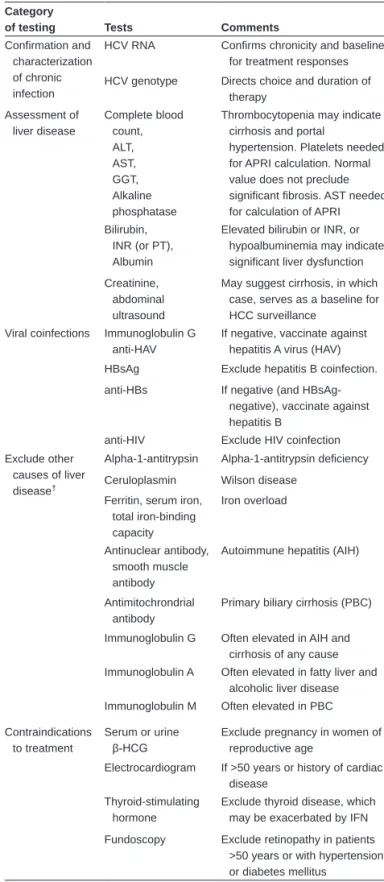
The routine assessment of patients with chronic hepatitis C should include risk factors for viral acquisition (eg, IDU, receipt of potentially contaminated blood products or tissues, and origin from a high preva-lence region), signs and symptoms of advanced liver disease (eg, jaun-dice, ascites, encephalopathy, portal hypertension-related hemorrhage), presence of cofactors that may accelerate disease progression (eg, alco-hol abuse, obesity, coinfections) and potential contraindications to IFN-based therapy (Table 5). Necessary laboratory testing includes virological tests to confirm and characterize HCV infection, liver biochemistry, abdominal ultrasound, and tests to rule out coinfections, direct vaccina-tion and identify contraindicavaccina-tions to treatment. In patients with abnor-mal liver biochemistry, serological tests to exclude coexisting liver diseases should be considered (Table 6).
Virological testing
Approximately one-quarter of patients who have been infected with HCV have cleared the virus spontaneously (38). Therefore, chronic HCV infection must be confirmed in all anti-HCV-positive individ-uals using a sensitive HCV RNA test. When contemplating therapy, HCV RNA should also be quantified to serve as a baseline for on-treatment monitoring of viral kinetics. HCV RNA detection and quantification using real-time polymerase chain reaction assays is stan-dard due to their sensitivity, specificity, accuracy and broad dynamic range. Assays should be calibrated to the WHO international stan-dard and results should be expressed in IU/mL. Quantitative assays with a lower limit of detection of approximately 10 IU/mL to 15 IU/mL are recommended. To facilitate management decisions, HCV RNA
test results should be available within a timely fashion (seven days or less). The rapid identification of failing antiviral therapy will reduce patient exposure to costly and potentially toxic therapies, and likely
Table 5
Contraindications to treatment with pegylated interferon and ribavirin
Absolute contraindication Pregnancy Strong but not absolute
contraindications
Alcohol abuse Hepatic decompensation Coronary artery disease
Solid organ transplantation (except liver) Relative contraindications Major depression
Major psychosis Autoimmune disease Renal failure (including dialysis) Patient characteristics that are
no longer considered to be contraindications
Normal alanine aminotransferase level Injection drug use
Stable methadone maintenance Neutropenia, anemia or thrombocytopenia Controlled seizure disorder
Older than 65 years of age Alcohol use
Table adapted with permission from reference 4
Table 6
Routine testing of patients with chronic hepatitis C virus (HCV)*
Category
of testing Tests Comments
Confirmation and characterization of chronic infection
HCV RNA Confirms chronicity and baseline for treatment responses HCV genotype Directs choice and duration of
therapy Assessment of
liver disease
Complete blood count, ALT, AST, GGT, Alkaline phosphatase
Thrombocytopenia may indicate cirrhosis and portal
hypertension. Platelets needed for APRI calculation. Normal value does not preclude significant fibrosis. AST needed for calculation of APRI Bilirubin,
INR (or PT), Albumin
Elevated bilirubin or INR, or hypoalbuminemia may indicate significant liver dysfunction Creatinine,
abdominal ultrasound
May suggest cirrhosis, in which case, serves as a baseline for HCC surveillance
Viral coinfections Immunoglobulin G anti-HAV
If negative, vaccinate against hepatitis A virus (HAV) HBsAg Exclude hepatitis B coinfection. anti-HBs If negative (and
HBsAg-negative), vaccinate against hepatitis B
anti-HIV Exclude HIV coinfection Exclude other
causes of liver disease†
Alpha-1-antitrypsin Alpha-1-antitrypsin deficiency Ceruloplasmin Wilson disease
Ferritin, serum iron, total iron-binding capacity
Iron overload
Antinuclear antibody, smooth muscle antibody
Autoimmune hepatitis (AIH)
Antimitochrondrial antibody
Primary biliary cirrhosis (PBC)
Immunoglobulin G Often elevated in AIH and cirrhosis of any cause Immunoglobulin A Often elevated in fatty liver and
alcoholic liver disease Immunoglobulin M Often elevated in PBC Contraindications
to treatment
Serum or urine
β-HCG
Exclude pregnancy in women of reproductive age
Electrocardiogram If >50 years or history of cardiac disease
Thyroid-stimulating hormone
Exclude thyroid disease, which may be exacerbated by IFN Fundoscopy Exclude retinopathy in patients
>50 years or with hypertension or diabetes mellitus
*Confirmed anti-HCV antibody positive; †Suggested tests only. Tailor testing to
individual case. Anti-HBs Hepatitis B surface antibody; ALT Alanine amin-otransferase;AST Aspartate aminotransferase; APRI AST/platelet ratio index; β-HCG Beta-human chorionic gonadotropin; GGT Gamma-glutamyltransferase; HBsAg Hepatitis B surface antigen; HCC Hepatocellular carcinoma; IFN Interferon; INR International normalized ratio; PT Prothrombin time
limit the development of antiviral-resistant variants (see below regarding discussion of futility rules).
The HCV genotype should also be assessed because it has import-ant implications for the decision to initiate treatment, the choice of treatment, the dosage of RBV and the duration of therapy. With PEG-IFN and RBV treatment, knowledge of only the main genotype (1 to 6) is necessary. However, with the advent of the first-generation DAAs (telaprevir and boceprevir), knowledge of the subtype may be useful due to differing genetic barriers to resistance between HCV subtypes 1a and 1b (39,40).
Recommendations:
7. HCV RNA and genotype testing are essential to the management of patients with chronic hepatitis C (Class 1, Level C).
8. HCV RNA testing should be performed using a sensitive quantitative assay (lower limit of detection of 10 IU/mL to 15 IU/mL or less) with a broad dynamic range. Standardized results should be expressed in IU/mL and be available within a maximum of seven days to facilitate management decisions (Class 1, Level C).
Assessment of liver disease severity
Assessment of the severity of hepatic fibrosis is vital for determining the necessity of antiviral treatment and determining the prognosis of patients with chronic hepatitis C. Identification of patients with cir-rhosis is particularly important due to their increased risk of hepatic complications (eg, HCC and end-stage liver disease), reduced respon-siveness to antiviral treatment, and their need for surveillance for HCC and esophageal varices. Although the diagnosis of cirrhosis is obvious in some cases based on routine tests (eg, a nodular shrunken liver, splenomegaly or portal hypertensive collaterals on ultrasound), liver biopsy has traditionally been the reference method for staging liver fibrosis, determining the severity of other histological lesions (eg, necroinflammation, steatosis) and ruling out coexistent liver diseases (eg, iron overload). Various scoring systems have been validated for use in chronic hepatitis C and demonstrated sufficient reproducibility and interobserver variability to justify clinical use. The most widely used include the METAVIR, Scheuer, Ishak index and Knodell’s Hepatic Activity Index classifications (41). However, liver biopsy has several limitations, most notably its invasiveness and the potential for serious complications including hemorrhage (approximately one in 1000) and death (approximately one in 10,000) (42,43). Other limita-tions include sampling error and variability in pathological interpreta-tion (both of which may limit the accuracy of its findings), high cost and the difficulty of repeating biopsies to monitor temporal changes in fibrosis. In light of these limitations, numerous noninvasive alterna-tives to biopsy have been developed including serum markers, transi-ent elastography (TE) and other imaging-based tools (44).
Serum marker panels that are available to stage fibrosis in patients with chronic hepatitis C can be categorized into three broad categories:
1. Panels based on routinely available biochemical and hematological parameters including ALT, aspartate
aminotransferase (AST) and platelets (eg, the AST/ALT ratio [45], the AST/platelet ratio index [46] and Forns’ index [47]); 2. Panels that include indirect markers of liver fibrosis such as
alpha-2-macroglobulin and haptoglobin (eg, FibroTest [48], Hepascore [49] and FibroMeter [50]); and
3. Panels that include direct markers of fibrosis such as hyaluronic acid and tissue inhibitor of matrix metalloproteinase-1 (eg, FibroSpect II [51] and Enhanced Liver Fibrosis test [52]).
TE (FibroScan, Echosens, France) is an ultrasound-based method that measures liver stiffness as a surrogate of liver fibrosis. Numerous studies have validated this tool for staging of fibrosis in patients with chronic hepatitis C and other liver conditions (53-55). To obtain
accurate TE results, it is important to consider factors that may influ-ence liver stiffness such as nonfibrotic histological lesions (eg, inflam-mation, vascular congestion and cholestasis) and obesity (55). In obese patients (body mass index [BMI] ≥30 kg/m2), it is advisable to use a specially designed probe (the FibroScan XL probe), which reduces the likelihood of TE failure compared with the standard M probe (56). Moreover, TE results must be interpreted cautiously when few valid measurements are obtained (ie, <10 valid shots or success rate <60%) or when the results are highly variable (ie, interquartile range of measurements over the median value >30%) (56-58).
Several additional imaging-based methods have been developed and hold promise for the noninvasive staging of liver fibrosis. These include acoustic radiation force impulse imaging, magnetic resonance (MR) elastography, diffusion-weighted MR imaging and MR spectros-copy (59,60). Although promising, the widespread adoption of these methods requires additional validation.
Although not universally available, a wealth of literature has now confirmed that serum biomarker panels and TE can be used instead of liver biopsy to stage HCV-related liver fibrosis with acceptable levels of accuracy and reproducibility. In general, these tests are highly accur-ate for diagnosing cirrhosis and have acceptable, but lower, perform-ance for moderate to severe fibrosis (≥F2). The identification of mild fibrosis (F1) and the differentiation between individual stages is poor; these limitations also apply to liver biopsy. The combination of two serum marker panels or TE with a serum marker panel can improve accuracy, although the added cost of this approach requires considera-tion (61,62). Emerging data have also demonstrated a correlaconsidera-tion between these tests and clinical outcomes of HCV (63,64) as well as responsiveness to successful viral eradication (65,66). Future studies are necessary to determine the minimal clinically important changes in these markers to facilitate serial monitoring of fibrosis.
Recommendations:
9. All patients with HCV should undergo an assessment for the severity of liver fibrosis. Acceptable methods include liver biopsy, elastography (eg, FibroScan) and serum biomarker panels (eg, AST/platelet ratio index, FibroTest, FibroMeter), either alone or in combination (Class 2a, Level B).
10. Alternatively, cirrhosis can be diagnosed in some patients with clear clinical or radiographic evidence (Class 2a, Level C).
Utility of interleukin-28B testing
Genome-wide association studies have identified SNPs near the inter-leukin 28B (IL28B) gene on chromosome 19 that are strongly associ-ated with both spontaneous and PEG-IFN- and RBV treatment-induced HCV clearance (10-13). Patients with the favourable CC genotype at rs12979860 have a more than twofold likelihood of spontaneous HCV clearance compared with heterozygotes (CT) and TT homozygotes (10). The CC genotype is also associated with a higher rate of SVR to PEG-IFN and RBV therapy. Caucasian patients with the CC IL28B genotype and HCV genotype 1 have an approximately 80% chance of SVR compared with just 40% among those with non-CC genotypes (11). There is marked ethnic variation in the prevalence of the IL28B genotypes. The CC genotype is highly prevalent in Asians, but rela-tively uncommon in Africans; Caucasians and Hispanics have an intermediate prevalence (11). Within ethnicities, the CC genotype is associated with an approximately twofold increase in SVR to PEG-IFN and RBV therapy compared with the unfavourable SNPs in patients with HCV genotype 1 (11). It is estimated that inter-racial differences in the prevalence of the IL28B genotypes account for approximately 50% of the ethnic variation in response rates to this therapy (11). Similar associations have been reported for the rs8099917 SNP, in which the favourable allele is coded with a T and the unfavourable allele with a G (13).
In patients with HCV genotype 1, the IL28B genotype is the strongest pretreatment predictor of response to PEG-IFN and RBV therapy (67). However, although patients with the favourable IL28B
CC genotype are likely to respond (approximately 80%), many patients with unfavourable genotypes will also respond (approximately 40%) (11). As such, the negative predictive value of the unfavourable genotypes is insufficient to preclude dual therapy in the individual patient. The impact of the IL28B genotype on treatment success is lower when treatment includes DAAs. Previously untreated patients with the favourable CC genotype are very likely to respond to com-bination therapy including DAAs, and the vast majority will qualify for shortened treatment. DAAs lead to a greater relative increase in SVR in non-CC patients (68,69). In treatment-experienced individ-uals, the IL28B genotype is of limited value (70); the outcome of DAA therapy in this population is largely dictated by the previous response to PEG-IFN and RBV, with prior relapsers showing two- to threefold higher SVR rates than null responders (8). The prior response is partly reflective of a patient’s IL28B genotype and, hence, few null respond-ers have the CC genotype. However, after stratification according to previous treatment response, there are no differences in rates of SVR to DAA-based therapy across IL28B genotypes (70). Similarly, on-treatment responses – to either dual or triple therapy – are better pre-dictors of outcome than the IL28B genotype (67,69,71). Although non-CC patients achieve a rapid virological response (RVR; Table 4) to PEG-IFN and RBV less frequently than patients with the CC geno-type, for those who do achieve an RVR, the rate of SVR is greater than that of CC patients who do not achieve RVR (71).
The mechanisms underlying the association of the IL28B genotype with antiviral treatment response are unknown. The SNPs lie in close proximity to – but not within – the IL28B gene, which codes for IL28B, also known as interferon (IFN) lambda. IFN-lambda is a type III IFN that signals similarly to type I IFNs (alpha or beta) but binds to a different receptor with a more limited tissue distribution (72). Because the IL28B genotype affects the response to IFN, it is most relevant in the least IFN-responsive HCV genotypes. Specifically, whereas the IL28B genotype is associated with SVR rates in genotypes 1 and 4 (73,74), its role in genotypes 2 and 3 is questionable (75,76).
In summary, IL28B genotyping may provide information regarding the likelihood of treatment response, but should not be used to deter-mine the need or eligibility for therapy, or to deterdeter-mine the type of therapy used. Although patients with the favourable CC genotype are more likely to achieve an RVR to PEG-IFN and RBV, and may not all benefit from the addition of a DAA due to their high likelihood of SVR with dual therapy alone, there are insufficient data to support altering treatment paradigms based on the IL28B genotype.
Recommendations:
11. The IL28B genotype may provide some information regarding the likelihood of SVR and the probability of qualifying for shortened treatment duration in previously untreated patients with HCV genotype 1 (Class 1, Level A).
12. The role of IL28B genotyping is limited in treatment-experienced patients and those with HCV genotypes other than 1 and 4 (Class 3, Level A).
13. A nonfavourable IL28B genotype does not preclude antiviral therapy (Class 2b, Level C).
DAA AGENTS
Multiple steps in the HCV life cycle represent attractive targets for novel pharmacological therapies. Particularly promising agents target the nonstructural (NS) 3/4A (NS3/4A) serine protease, the NS5B RNA-dependent RNA polymerase and the NS5A protein (28). Several host-targeted agents, including the cyclophilin inhibitors, are also in development. Currently, the only DAAs to receive approval from Health Canada and the United States Food and Drug Administration are the NS3/4A protease inhibitors (PIs) boceprevir and telaprevir. When combined with PEG-IFN and RBV, these drugs lead to markedly improved SVR rates and permit shortened therapy in a significant proportion of patients with HCV genotype 1 (5-9). Based on currently available data, these agents should not be used in patients with non-1 genotypes. Importantly, the PIs must be used in combina-tion with both PEG-IFN and RBV. If either of these medicacombina-tions is discontinued, the PI must also be discontinued.
TREATMENT-NAIVE PATIENTS WITH
HCV GENOTYPE 1
Boceprevir
Boceprevir was formally evaluated in the Serine Protease Inhibitor Therapy 2 (SPRINT-2)trial, a phase 3 study that compared three regi-mens in two cohorts (nonblack and black) of treatment-naive patients with HCV genotype 1 infection (77). All patients were first treated with PEG-IFN-alfa-2b (1.5 µg/kg/week) and RBV (600 mg/day to 1400 mg/day based on body weight) for a four-week lead-in period. After the lead-in period, the control arm received an additional 44 weeks of PEG-IFN and RBV dual therapy. In the ‘response-guided therapy’ (RGT) arm, patients received PEG-IFN, RBV and boceprevir for 24 weeks after the lead-in period. In patients with undetectable (<10 IU/mL) HCV RNA from weeks 8 through 24, treatment was terminated, but if HCV RNA was detectable at any point from week 8 up to but not including week 24, an additional 20 weeks of PEG-IFN and RBV was administered. In the third arm, patients in the ‘fixed-duration therapy’ (FIXED) group received boceprevir plus PEG-IFN and RBV for 44 weeks after the lead-in period. The dosage of boceprevir was 800 mg three times daily (taken orally every 7 h to 9 h with food). All patients with detectable HCV RNA at week 24 were discontinued from treatment due to futil-ity. A post hoc analysis has also identified that treatment continuation is futile in patients with HCV RNA ≥100 IU/mL at week 12 (Table 7) (78).
Overall, the rates of SVR in the SPRINT-2 trial were higher in boceprevir-treated patients (63% in the RGT arm and 66% in the FIXED arm) compared with those who received dual therapy (38%) (5). SVR rates in the nonblack patients were similar (RGT 67%; FIXED 68%; control 40%), whereas lower responses were observed among black patients (RGT 42%; FIXED 53%; control 23%). Treatment with a boceprevir-containing regimen was superior to dual therapy for most pretreatment factors including age, sex, race, viral load, body weight and BMI.
Forty-four per cent of boceprevir-treated patients had undetectable HCV RNA at treatment weeks 8 through 24 (early responders), com-pared with 12% of control patients, and would be eligible to shorten treatment to 28 weeks according to an RGT approach. In these patients, the SVR rates were 96%, 96% and 93% in the RGT, FIXED, and control groups, respectively (5). Overall, the SVR rates in the RGT and FIXED boceprevir arms were similar, supporting the use of RGT in most patients. In a subgroup analysis of the SPRINT-2 study, the SVR rate was superior in patients with cirrhosis (F4) in the FIXED arm (42%) compared with the RGT arm (31%). Although this differ-ence was not statistically significant, the small number of cirrhotic patients in this analysis (n=40) supports a conservative approach in this difficult-to-cure subgroup. Therefore, in patients with cirrhosis, a
Table 7
Futility rules in treatment-naive and previous treatment failure patients treated with boceprevir- or telaprevir-based triple therapy
boceprevir HCV RNa result* action
Week 12 ≥100 IU/mL Stop all therapy
Week 24 Detectable Stop all therapy
Telaprevir HCV RNa result* action
Week 4 >1000 IU/mL Stop all therapy Week 12 >1000 IU/mL Stop all therapy
Week 24 Detectable Stop all therapy
*Hepatitis C virus (HCV) RNA should be quantified using an assay with a lower limit of detection of no greater than 10 IU/mL to 15 IU/mL
fixed duration of treatment consisting of 44 weeks of triple therapy after the lead-in phase is recommended. Similarly, patients who have less than a 1 log10 decline in viral load from baseline to treatment week 4 during the lead-in period should receive an additional 44 weeks of triple therapy. While SVR rates among IFN-responsive patients in the SPRINT-2 trial were similar in the RGT and FIXED arms (approximately 80%), poorly responsive patients had a numerically higher SVR rate in the FIXED compared with the RGT arm (38% versus 28%) (5).
Recommendations (Figure 2):
14. Patients should receive a four-week lead-in period of PEG-IFN and RBV before the initiation of boceprevir (Class 2b, Level A). 15. Boceprevir is given at a dosage of 800 mg (4 × 200 mg
capsules) every 8 h with food (Class 1, Level A).
16. RGT (Table 8): In noncirrhotic patients with undetectable HCV RNA at treatment weeks 8 through 24 (ie, four and 20 weeks after starting boceprevir), all therapy may be discontinued at week 28 (Class 1, Level B).
17. In patients with detectable HCV RNA at treatment week 8, triple therapy should be continued until week 28. At this point, boceprevir should be discontinued and PEG-IFN and RBV should be continued for an additional 20 weeks (Class 1, Level B).
18. Patients with cirrhosis and those with <1 log10 decline in HCV RNA after the four-week lead-in period should receive triple therapy for 44 weeks following the lead-in period (Class 2a, Level B).
19. Futility rules(Table 7): All treatment should be discontinued in patients with HCV RNA ≥100 IU/mL at treatment week 12 or detectable HCV RNA at week 24 (Class 2a, Level B).
Telaprevir
Telaprevir has been evaluated in two phase 3 trials that included treatment-naive patients with HCV genotype 1 infection (6,7). In the A New Direction in HCV Care: A Study of Treatment-Naive Hepatitis C Patients with Telaprevir (ADVANCE)trial, patients were random-ized to one of three treatment groups. The control arm received PEG-IFN-alpha-2a (180 µg/week) and RBV (1000 mg/day to 1200 mg/day based on body weight) for 48 weeks (PR48), while two telaprevir-treated groups also received telaprevir for the first 8 (T8PR) or 12 weeks (T12PR) in addition to PEG-IFN and RBV (6). Telaprevir was
administered at a dose of 750 mg every 8 h with high fat content food (approximately 20 g). Patients in the T8PR and T12PR groups who achieved an extended RVR (eRVR), defined as undetectable HCV RNA (<10 IU/mL) at weeks 4 and 12 (Table 4), stopped all therapy at week 24 according to an RGT approach. The rates of SVR were higher in both telaprevir-treated arms (T12PR, 75% and T8PR, 69%) than in the PR48 arm (44%) (6). Although the study was underpowered to compare the T12PR and T8PR groups, trends toward improved efficacy
Figure 2) Algorithm for the management of treatment-naive patients with hepatitis C virus (HCV) genotype 1 treated with pegylated interferon (PEG-IFN), ribavirin (RBV) and boceprevir. A Early responders (defined as HCV RNA-negative at weeks 8 through 24) are eligible for response-guided therapy (RGT) (28 weeks total treatment). B Late responders defined as HCV RNA-positive at week 8 should not receive RGT (ie, treat for 48 weeks total). C Patients with cirrhosis (F4) or <1 log10 decrease in HCV RNA from baseline to week 4 after the lead-in phase should receive 48 weeks of treatment (ie, not RGT). *Indicates discontinuation of all treatment due to futility in patients with HCV RNA ≥100 IU/mL at treat-ment week 12 or detectable HCV RNA at week 24
Table 8
Duration of therapy using response-guided therapy guidelines in patients treated with boceprevir- or telaprevir-based triple therapy
boceprevir†
HCV RNa result*
action
Week 8 Week 24
Previously untreated patients
Undetectable Undetectable Stop boceprevir, PEG-IFN and RBV at treatment week 28. Treatment is completed. Detectable Undetectable Continue boceprevir, PEG-IFN and RBV until treatment week 28 and then administer
PEG-IFN and RBV until week 48. Previous treatment
failures (relapsers and partial responders)
Undetectable Undetectable Stop boceprevir, PEG-IFN and RBV at treatment week 36. Treatment is completed. Detectable Undetectable Continue boceprevir, PEG-IFN and RBV until treatment week 36 and then administer
PEG-IFN and RBV until week 48.
Telaprevir‡
HCV RNa result
action
Week 4 Week 12
Previously untreated patients and relapsers
Undetectable Undetectable Stop telaprevir at treatment week 12 and then continue PEG-IFN and RBV until week 24. Detectable§ Undetectable or
detectable§
Stop telaprevir at treatment week 12 and then continue PEG-IFN and RBV until week 48.
*Hepatitis C virus (HCV) RNA should be quantified using an assay with a lower limit of detection of no greater than 10 IU/mL to 15 IU/mL; †Response-guided therapy
to boceprevir is not recommended for patients with cirrhosis (F4), null responders to previous pegylated interferon (PEG-IFN ) and ribavirin (RBV) therapy, or patients with a less than 1 log10 decline in HCV RNA at treatment week 4 compared with baseline; ‡Response-guided therapy to telaprevir is not recommended for patients
with cirrhosis (F4) or previous partial or null responders to PEG-IFN and RBV therapy; §Detectable, but ≤1000 IU/mL. Higher values necessitate discontinuation of
in some difficult-to-cure subgroups (eg, genotype 1a, high viral load and advanced fibrosis) and reduced emergence of antiviral-resistant vari-ants were noted in the T12PR arm. Although 12-week dosing of telaprevir is likely preferable, the data suggest that if a patient must discontinue telaprevir prematurely due to adverse effects, high rates of SVR remain possible.
In addition to higher SVR rates, many patients were able to shorten treatment with the addition of telaprevir to PEG-IFN and RBV. Using an RGT approach, 57% to 58% of telaprevir-treated patients had an eRVR (compared with only 8% of PR patients) and were able to dis-continue therapy at 24 weeks. The SVR rate for those who achieved eRVR was 89% in the T12PR arm and 83% in the T8PR group (versus 97% in the PR group), indicating that eRVR is a very robust predictor of SVR (6). To validate RGT as an appropriate strategy, the Illustrating the Effects of Combination Therapy with Telaprevir (ILLUMINATE) trial randomly assigned patients achieving an eRVR after 12 weeks of telaprevir-based triple therapy to 24 or 48 weeks of total treatment (7). Of the 540 patients included, 65% achieved an eRVR and were random-ized. The SVR rates in patients with eRVR treated for 24 and 48 weeks were 92% and 88%, respectively, indicating that treatment can be shortened in patients who achieve an eRVR without a loss in the rate of SVR (7). However, RGT may not be the preferred strategy in patients with cirrhosis. In the ILLUMINATE trial, 61 patients (11%) had cirrhosis at baseline and 30 patients (49%) achieved an eRVR. Of these 30 patients, only 12 of the 18 (67%) randomly assigned to stop therapy at 24 weeks achieved SVR, compared with 11 of the 12 (92%) who were treated for a full 48 weeks (7). Based on these data, it is rec-ommended that all patients with cirrhosis receive 12 weeks of telaprevir-based triple therapy followed by an additional 36 weeks of PEG-IFN and RBV. Other predictors of poor IFN responsiveness, such as high viral load and black race, had smaller effects on treatment outcome and, hence, RGT is still recommended for these subgroups.
Patients treated with telaprevir who have HCV RNA levels >1000 IU/mL at weeks 4 or 12 should stop all treatment because no patients meeting these futility rules in the phase 3 trials achieved SVR (6-8,79,80). Notably, in almost all patients with viral levels exceeding 1000 IU/mL at weeks 4 or 12, the viral titre is rising rather than falling
due the presence of telaprevir resistance. Continuation of therapy in the presence of resistance may promote compensatory mutations in the resistant variants that will improve their replicative fitness over time (81). In addition, continuation of futile therapy adds to cost and the potential for adverse effects.
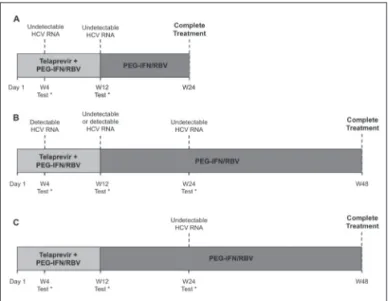
Recommendations (Figure 3):
20. Telaprevir should be started simultaneously with PEG-IFN and RBV and given for the initial 12 weeks of therapy (Class 1, Level A).
21. Telaprevir is given at a dosage of 750 mg (2 × 375 mg tablets) every 8 h with high-fat food (Class 1, Level A).
22. RGT(Table 8): In noncirrhotic patients with undetectable HCV RNA at treatment weeks 4 and 12 (eRVR), telaprevir should be discontinued at week 12 and PEG-IFN and RBV should be continued for an additional 12 weeks (Class 1, Level A).
23. In patients with detectable HCV RNA at weeks 4 or 12, telaprevir should be stopped at week 12 and PEG-IFN and RBV should be continued for an additional 36 weeks (Class 1, Level A).
24. Patients with cirrhosis should receive 12 weeks of triple therapy followed by an additional 36 weeks of PEG-IFN and RBV (Class 2a, Level B).
25. Futility rules(Table 7): All treatment should be discontinued in patients with HCV RNA >1000 IU/mL at treatment weeks 4 or 12, or detectable HCV RNA at week 24 (Class 1, Level A).
Dual therapy in patients with RVR to PEG-IFN and RBV
Genotype 1-infected patients with an RVR, defined as undetectable HCV RNA after 4 weeks of PEG-IFN and RBV therapy (Table 4), may not benefit from the addition of a PI. In the SPRINT-2 (5), ADVANCE (6) and Individualized Dosing Efficacy vs. Flat Dosing to Assess Optimal Pegylated Interferon Therapy (IDEAL)trials (33), 8% to 12% of treatment-naive patients who received PEG-IFN and RBV dual therapy achieved an RVR. The majority of these patients had the favourable IL28B genotype (CC). In patients who achieved RVR in these trials, dual therapy for 48 weeks led to an SVR in 86% to 97% of patients, similar to rates achieved with PI-based triple therapy (RGT and fixed duration). In the small subset of patients with RVR and low baseline viral load (<400,000 IU/mL), dual therapy for only 24 weeks yielded SVR rates comparable with 48 weeks of PEG-IFN and RBV treatment (82). The obvious benefits of avoiding a DAA in this patient subgroup include reduced exposure to PI-related adverse events, lower cost and the avoidance of emergent antiviral resistant variants in the small proportion of patients who subsequently fail this treatment. On the other hand, there are several hurdles to using this strategy. Notably, a lead-in strategy was used only in the phase 3 trials of boceprevir (not telaprevir) for treatment-naive patients. Although a lead-in approach could be adopted before use of either PI, the deci-sion to add a PI in patients who do not achieve an RVR would require rapid access to HCV RNA test results, which is not currently widely available. Second, whether this approach leads to comparable efficacy with PI-based triple therapy in all patient subgroups with RVR, includ-ing those with advanced fibrosis, is unclear. Before recommendinclud-ing this strategy, appropriately designed randomized trials, including short duration triple therapy (eg, 12 weeks) and cost-effectiveness analyses (from a Canadian perspective) are necessary.
PATIENTS WITH HCV GENOTYPE 1 AND PREVIOUS TREATMENT FAILURE
HCV-infected individuals who have failed to obtain an SVR to IFN-based treatment can be categorized into three groups IFN-based on viral kinetics during their previous course of therapy: relapsers, partial responders and null responders (Table 4). Because most treatment-experienced patients in Canada have failed dual therapy with
PEG-Figure 3) Algorithm for the management of treatment-naive patients with hepatitis C virus (HCV) genotype 1 treated with pegylated interferon (PEG-IFN), ribavirin (RBV) and telaprevir. A Patients with an extended rapid virological response (HCV RNA-negative at weeks 4 and 12) are eligible for response-guided therapy (RGT) (24 weeks total treatment). B Patients who do not achieve an extended rapid virological response should not receive RGT (ie, treat for 48 weeks total). C Patients with cirrhosis should receive 48 weeks of treatment (ie, not RGT). *Indicates discontinuation of all treatment due to futility in patients with HCV RNA >1000 IU/mL at treatment weeks 4 or 12, or detectable HCV RNA at week 24
IFN and RBV, the remainder of this discussion refers to this subgroup. Retreatment of treatment-experienced patients infected with HCV genotype 1 using either boceprevir or telaprevir, along with PEG-IFN and RBV, has been studied in two phase 3 trials (8,9).
Boceprevir
In the Retreatment with HCV Serine Protease Inhibitor Boceprevir and Pegintron/Rebetol 2 (RESPOND-2) trial (9), relapsers and partial responders were randomly assigned to one of three treatment groups; null responders were not included in this study. All patients were initially treated with a four-week lead-in period of PEG-IFN-alpha-2b and RBV. Patients in the control arm received an additional 44 weeks of PEG-IFN and RBV. In the RGT arm, individuals who achieved undetectable HCV RNA levels by week 8 and remained undetectable through week 12 (compared with week 24 in the treatment-naive study) were assigned triple therapy until week 36. Those with persis-tently detectable HCV RNA at week 8 received triple therapy to week 36 followed by an additional 12 weeks of PEG-IFN and RBV dual therapy. Finally, patients in the FIXED group received 44 weeks of triple therapy after the four-week lead-in period. All patients with detectable HCV RNA at treatment week 12 were discontinued from treatment due to futility. Of note, the Canadian product monograph for boceprevir recommends a different stopping rule to avoid missing individuals who may achieve an SVR (78,83). Specifically, all treat-ment should be discontinued in patients with HCV RNA ≥100 IU/mL at week 12 or detectable HCV RNA at week 24 (78).
In terms of efficacy, the overall SVR in the control group was 21% compared with 59% in the RGT arm and 66% in the FIXED arm (9). Boceprevir-treated patients were more likely to achieve SVR than those who received dual therapy; however, the difference between the RGT and FIXED arms was not statistically significant. SVR rates among previous relapsers were 29% in the control arm versus 69% and 75% in the RGT and FIXED boceprevir arms, respectively. Corresponding SVR rates among partial responders were 7%, 40% and 52%, respectively. Because null responders were not included in RESPOND-2, a subsequent study (PROVIDE) evaluated the success of triple therapy including boceprevir among 48 patients who failed to achieve at least a 2 log10 reduction in HCV RNA after 12 weeks of dual therapy from the control arms of SPRINT-2 and RESPOND-2 (84). In a preliminary report, an SVR was reported in 38% of patients; additional data are forthcoming. Based on these data, Health Canada and the United States Food and Drug Administration have approved boceprevir for the treatment of previous null responders.
Telaprevir
Telaprevir therapy for the retreatment of patients with HCV genotype 1 who failed to respond to dual therapy was evaluated in the Re-treatment of Patients with Telaprevir-based Regimen to Optimize Outcomes (REALIZE)phase 3 study (8). As in the RESPOND-2 trial, there were three treatment groups. The first group received a four-week lead-in period of PEG-IFN-alpha-2a and RBV, followed by 12 weeks of tri-ple therapy including telaprevir and an additional 32 weeks of dual therapy. The second group received 12 weeks of triple therapy followed by 36 weeks of dual therapy (ie, no lead-in), and the control arm received 48 weeks of dual therapy. RGT was not assessed in this study. Telaprevir was discontinued in patients with HCV RNA >100 IU/mL at weeks 4, 6 or 8; PEG-IFN and RBV were continued in this situation. All treatment was discontinued in individuals with <2 log10 decrease in HCV RNA level at week 12 in the telaprevir group with no lead-in (arm 2) and in the control group (arm 3); at week 16 in the telaprevir group that received a lead-in (group 1); and in all patients with detect-able HCV RNA at weeks 24 or 36. Of note, the stopping rules in this study differ from those listed in the Canadian product monograph for telaprevir, which recommends discontinuation of all therapy if HCV RNA exceeds 1000 IU/mL at week 4 or 12, or is detectable at week 24 (the same criteria recommended for treatment-naïve individuals) (80).
Overall, the SVR rate in the control group was 17% compared with 66% in telaprevir-treated patients who received a lead-in (group 1) and 64% in those who started telaprevir immediately (group 2). The response rates did not differ between the two telaprevir-containing regimens (8). In subgroup analyses according to previous treatment response, relaps-ers demonstrated excellent responses with an SVR observed in 86% of telaprevir-treated patients compared with 24% among controls. In partial responders, SVR rates were 57% with telaprevir and 15% among controls. Among previous null-responders, SVR rates were 31% with telaprevir compared with only 5% among controls.
Although RGT was not assessed in the REALIZE trial, data from phase 2 studies support this approach in previous relapsers treated with telaprevir (85,86). Specifically, 78% (52 of 67) of relapsers in these trials achieved eRVR with 12 weeks of telaprevir-based triple therapy, which was followed by PEG-IFN and RBV for 12 weeks. An SVR was observed in 94% (49 of 52) of these patients (87). For comparison, among relapsers with an eRVR in the REALIZE trial, an SVR rate of 96% (91 of 95) was observed with a regimen including 36 weeks of dual therapy after an initial 12 weeks of triple therapy (8).
Patients with cirrhosis
In the RESPOND-2 trial, 12% (n=39) of individuals treated with boceprevir had compensated cirrhosis (F4) (88). The rates of SVR among these individuals categorized according to previous treatment response are not available. However, cirrhotic patients treated with triple therapy for 48 weeks were more likely to experience an SVR (77%) than those treated with RGT (35%) (78). In patients with advanced fibrosis (F3 or F4), corresponding SVR rates were 68% and 44%, respectively. In the REALIZE study, 23% (n=137) of telaprevir-treated individuals had compensated cirrhosis at baseline (8). Compared with the control group, SVR rates among cirrhotic subjects who received telaprevir were 87% (48 of 55) versus 13% (two of 15) for relapsers, 34% (11 of 32) versus 20% (one of five) for partial responders, and 14% (seven of 50) versus 10% (one of 10) for null responders (80). In light of limitations in the available data, including the absence of an RGT arm in the REALIZE trial, retreatment of cir-rhotic individuals with either boceprevir or telaprevir should include 48 weeks of total therapy. Although data are limited, patients with bridging fibrosis (F3) may also benefit from prolonged therapy, particu-larly because many of these patients may actually have cirrhosis (due to the error of fibrosis assessment using biopsy and other tools).
Recommendations:
26. Noncirrhotic patients with HCV genotype 1 who have demonstrated relapse to previous PEG-IFN and RBV therapy should be offered retreatment with RGT including PEG-IFN, RBV, and boceprevir or telaprevir. Previous partial responders can be offered RGT with triple therapy including boceprevir or 48 weeks of total therapy (ie, non-RGT) including telaprevir (Class 1, Level A). Recommended management algorithms are as follows:
a. Boceprevir in relapsers and partial responders (Figures 4A and 4B): Use four weeks of lead-in therapy with PEG-IFN and RBV followed by the addition of boceprevir. If HCV RNA is undetectable at weeks 8 through 24, discontinue triple therapy at 36 weeks. If HCV RNA is detectable at week 8 and undetectable at week 24, discontinue triple therapy at 36 weeks and continue PEG-IFN and RBV dual therapy to week 48. b. Telaprevir in relapsers (Figure 5A and 5B): Use telaprevir,
PEG-IFN and RBV triple therapy. If HCV RNA is undetectable at weeks 4 and 12 (ie, eRVR), use triple therapy for a total of 12 weeks followed by PEG-IFN and RBV dual therapy for an additional 12 weeks (24 weeks total treatment). If HCV RNA is detectable at week 4 and/or 12, use triple therapy for 12 weeks followed by PEG-IFN and RBV dual therapy for an additional 36 weeks (48 weeks total treatment).
c. Telaprevir in partial responders (Figure 5C): Use telaprevir, PEG-IFN and RBV triple therapy for 12 weeks followed by PEG-IFN and RBV dual therapy for an additional 36 weeks (48 weeks total treatment).
27. Noncirrhotic patients with HCV genotype 1 who have demonstrated a null response to previous PEG-IFN and RBV therapy should be considered for triple therapy including PEG-IFN, RBV, and boceprevir or telaprevir (Class 1, Level B).
a. Boceprevir in null responders (Figure 4C): Use 4 weeks of lead-in therapy with PEG-IFN and RBV followed by an additional 44 weeks of triple therapy including boceprevir (48 weeks total treatment).
b. Telaprevir in null responders (Figure 5C): Use triple therapy for 12 weeks followed by PEG-IFN and RBV dual therapy for an additional 36 weeks (48 weeks total treatment). 28. Treatment-experienced patients with HCV genotype 1 and
cirrhosis should not be retreated with RGT (Class 3, Level B). Recommended management algorithms are as follows: a. Boceprevir (Figure 4C): Use four weeks of lead-in therapy
with PEG-IFN and RBV followed by an additional 44 weeks of triple therapy including boceprevir (48 weeks total treatment).
b. Telaprevir (Figure 5C): Use triple therapy for 12 weeks followed by PEG-IFN and RBV dual therapy for an additional 36 weeks (48 weeks total treatment).
29. In patients with HCV genotype 1 in whom the previous treatment response cannot be determined, the optimal management approach is unclear. In noncirrhotic patients, RGT as described for relapsers (see Recommendation 26) can be considered, although the risk of relapse may be increased compared with 48 weeks of treatment. Patients with cirrhosis should be treated for 48 weeks (Class 2b, Level C).
30. Futility rules(Table 7): Futility rules in patients with previous treatment failure are identical to those described for treatment-naïve patients (see Recommendations 19 and 25 above).
ADVERSE EVENTS OF TELAPREVIR AND BOCEPREVIR
Patients treated with PI-based combination therapy experience more adverse effects than those treated with PEG-IFN and RBV alone. There are no data to support switching from one PI to another as a strategy to manage toxicity.
The addition of boceprevir to PEG-IFN and RBV leads to an increased incidence of anemia. In the phase 3 trials, hemoglobin levels fell below 100 g/L in 49% of patients receiving boceprevir compared with 29% of those on dual therapy. Severe anemia (hemo-globin <85 g/L) was reported in 9% of boceprevir-treated patients and 3% required transfusions (5,88). Hemoglobin level typically reaches a nadir on average 10 g/L to 15 g/L lower than with dual therapy at four to eight weeks after starting boceprevir (and telaprevir) and resolves on discontinuation of therapy (78,89). In the phase 3 trials of bocepre-vir, anemia was managed with RBV dosage reduction (by 200 mg decrements) and/or erythropoietin supplementation. Erythropoietin (provided by the study sponsor) was used in 44% of boceprevir-treated patients compared with 24% of control subjects (5,88). SVR rates were higher among patients with a significant decline in hemoglobin
Figure 5) Algorithm for the management of previously treated patients with hepatitis C virus (HCV) genotype 1 treated with peginterferon (PEG-IFN), ribavirin (RBV) and telaprevir. A Patients with a previous relapse who achieve an extended rapid virological response (HCV RNA negative at weeks 4 and 12) are eligible for response-guided therapy (RGT) (24 weeks total treatment). B Patients with a previous relapse who do not achieve an extended rapid virological response should not receive RGT (ie, treat for 48 weeks total). C Patients with a previous partial response or null response, and those with cirrhosis (F4) regardless of previous response should receive 48 weeks of treatment (ie, not RGT). *Indicates discontinuation of all treatment due to futility in patients with HCV RNA >1000 IU/mL at treatment weeks 4 or 12 or detectable HCV RNA at week 24
Figure 4) Algorithm for the management of previously treated patients with hepatitis C virus (HCV) genotype 1 treated with pegylated interferon (PEG-IFN), ribavirin (RBV) and boceprevir. A Previous partial respond-ers and relapsrespond-ers who have an early response (defined as HCV RNA-negative at weeks 8 through 24) are eligible for response-guided treatment (RGT) (36 weeks total treatment). B Previous partial responders and relapsers who have a late response (defined as HCV RNA-positive at week 8) should not receive RGT (ie, treat for 48 weeks total). C Patients with a previous null response and those with cirrhosis (F4) regardless of previous response should receive 48 weeks of treatment (ie, not RGT). *Indicates discontinuation of all treatment due to futility in patients with HCV RNA ≥100 IU/mL at treatment week 12 or detectable HCV RNA at week 24