CyberArk Software, Ltd.
Privileged Account Security Solution v9.1
Security Target
Evaluation Assurance Level (EAL): EAL2+ Document Version: 1.8
Prepared for: Prepared by:
CyberArk Software, Ltd. Corsec Security, Inc. 57 Wells Avenue, Suite 20A
Table of Contents
1 INTRODUCTION ... 4
1.1 PURPOSE ... 4
1.2 SECURITY TARGET AND TOE REFERENCES ... 4
1.3 PRODUCT OVERVIEW ... 5
1.3.1 Privileged Account Security Solution Components ... 6
1.4 TOE OVERVIEW ... 8
1.4.1 TOE Environment ... 10
1.5 TOE DESCRIPTION ... 11
1.5.1 Physical Scope ... 11
1.5.2 Logical Scope ... 12
1.5.3 Product Physical/Logical Features and Functionality not included in the TOE ... 14
2 CONFORMANCE CLAIMS ... 15
3 SECURITY PROBLEM ... 16
3.1 THREATS TO SECURITY ... 16
3.2 ORGANIZATIONAL SECURITY POLICIES ... 17
3.3 ASSUMPTIONS ... 17
4 SECURITY OBJECTIVES ... 18
4.1 SECURITY OBJECTIVES FOR THE TOE ... 18
4.2 SECURITY OBJECTIVES FOR THE OPERATIONAL ENVIRONMENT ... 19
4.2.1 IT Security Objectives ... 19
4.2.2 Non-IT Security Objectives ... 19
5 EXTENDED COMPONENTS ... 20
5.1 EXTENDED TOE SECURITY FUNCTIONAL COMPONENTS ... 20
5.1.1 Class FPT: Protection of the TSF ... 20
5.2 EXTENDED TOE SECURITY ASSURANCE COMPONENTS ... 21
6 SECURITY REQUIREMENTS ... 22
6.1 CONVENTIONS ... 22
6.2 SECURITY FUNCTIONAL REQUIREMENTS ... 22
6.2.1 Class FAU: Security Audit ... 24
6.2.3 Class FCS: Cryptographic Support ... 26
6.2.4 Class FDP: User Data Protection ... 28
6.2.5 Class FIA: Identification and Authentication... 31
6.2.6 Class FMT: Security Management ... 32
6.2.7 Class FPT: Protection of the TSF ... 37
6.2.8 Class FRU: Resource Utilization ... 38
6.2.9 Class FTA: TOE Access ... 39
6.3 SECURITY ASSURANCE REQUIREMENTS ... 40
7 TOE SUMMARY SPECIFICATION ... 41
7.1 TOE SECURITY FUNCTIONS ... 41
7.1.1 Security Audit ... 42
7.1.2 Cryptographic Support ... 43
7.1.3 User Data Protection ... 44
7.1.4 Identification and Authentication... 44
7.1.5 Security Management ... 45
7.1.6 Protection of the TSF ... 45
7.1.7 Resource Utilization ... 45
7.1.8 TOE Access ... 46
8 RATIONALE ... 47
8.2 SECURITY OBJECTIVES RATIONALE ... 47
8.2.1 Security Objectives Rationale Relating to Threats ... 47
8.2.2 Security Objectives Rationale Relating to Assumptions ... 49
8.3 RATIONALE FOR EXTENDED SECURITY FUNCTIONAL REQUIREMENTS ... 50
8.4 RATIONALE FOR EXTENDED TOE SECURITY ASSURANCE REQUIREMENTS ... 50
8.5 SECURITY REQUIREMENTS RATIONALE ... 50
8.5.1 Rationale for Security Functional Requirements of the TOE Objectives ... 50
8.5.2 Security Assurance Requirements Rationale ... 54
8.5.3 Dependency Rationale ... 55
9 ACRONYMS ... 57
9.1 ACRONYMS ... 57
Table of Figures
FIGURE 1 TOE BOUNDARY 9List of Tables
TABLE 1 ST AND TOE REFERENCES ... 4TABLE 2 TOE MINIMUM REQUIREMENTS ... 10
TABLE 3 CC AND PP CONFORMANCE ... 15
TABLE 4 THREATS ... 16
TABLE 5 ASSUMPTIONS ... 17
TABLE 6 SECURITY OBJECTIVES FOR THE TOE... 18
TABLE 7 IT SECURITY OBJECTIVES ... 19
TABLE 8 NON-IT SECURITY OBJECTIVES ... 19
TABLE 9 TOE SECURITY FUNCTIONAL REQUIREMENTS ... 22
TABLE 10 CRYPTOGRAPHIC ALGORITHMS ... 26
TABLE 11 SAFE ACCESS CONTROL PERMISSIONS... 29
TABLE 12 MANAGEMENT OF VAULT SECURITY FUNCTION BEHAVIOR BY ROLE ... 32
TABLE 13 MANAGEMENT OF SAFE SECURITY FUNCTION BEHAVIOR BY ROLE ... 32
TABLE 14 MANAGEMENT OF VAULT SECURITY ATTRIBUTES ... 34
TABLE 15 MANAGEMENT OF SAFE SECURITY ATTRIBUTES ... 35
TABLE 16 EAL2 ASSURANCE REQUIREMENTS ... 40
TABLE 17 MAPPING OF TOE SECURITY FUNCTIONS TO SECURITY FUNCTIONAL REQUIREMENTS ... 41
TABLE 18 AUDIT RECORD CONTENTS ... 42
TABLE 19 THREATS: OBJECTIVES MAPPING ... 47
TABLE 20 ASSUMPTIONS: OBJECTIVES MAPPING ... 49
TABLE 21 OBJECTIVES: SFRS MAPPING ... 50
TABLE 22 FUNCTIONAL REQUIREMENTS DEPENDENCIES ... 55
1
Introduction
This section identifies the Security Target (ST), Target of Evaluation (TOE), and the organization of the ST. The TOE is the CyberArk Privileged Account Security Solution v9.1, and will hereafter be referred to as the TOE throughout this document.
The TOE is software-based solution for Privileged Account Security management in the enterprise. The Privileged Account Security (PAS) Solution enables organizations to secure, provision, control, and monitor all activities associated with privileged identities used in enterprise systems and applications.
1.1
Purpose
This ST is divided into nine sections, as follows:
Introduction (Section 1) – Provides a brief summary of the ST contents and describes the organization of other sections within this document. It also provides an overview of the TOE security functions and describes the physical and logical scope for the TOE, as well as the ST and TOE references.
Conformance Claims (Section 2) – Provides the identification of any Common Criteria (CC), Protection Profile, and Evaluation Assurance Level (EAL) package claims. It also identifies whether the ST contains extended security requirements.
Security Problem (Section 3) – Describes the threats, organizational security policies, and assumptions that pertain to the TOE and its environment.
Security Objectives (Section 4) – Identifies the security objectives that are satisfied by the TOE and its environment.
Extended Components (Section 5) – Identifies new components (extended Security Functional Requirements (SFRs) and extended Security Assurance Requirements (SARs)) that are not included in CC Part 2 or CC Part 3.
Security Requirements (Section 6) – Presents the SFRs and SARs met by the TOE.
TOE Summary Specification (Section 7) – Describes the security functions provided by the TOE that satisfy the security functional requirements and objectives.
Rationale (Section 8) – Presents the rationale for the security objectives, requirements, and SFR dependencies as to their consistency, completeness, and suitability.
Acronyms (Section 9) – Defines the acronyms used within this ST.
1.2
Security Target and TOE References
Table 1 below shows the ST and TOE references.
Table 1 ST and TOE References
ST Title CyberArk Software, Ltd. Privileged Account Security Solution v9.1 Security Target
ST Version Version 1.8
ST Author Corsec Security, Inc.
ST Title CyberArk Software, Ltd. Privileged Account Security Solution v9.1 Security Target
TOE Reference CyberArk Software, Ltd. Privileged Account Security Solution v9.1 Enterprise Password Vault v9.1; Build 9.10.0.141
Password Vault Web Access v9.1; Build 9.10.0.275 PrivateArk Client v8; Build 8.00.4.10
Privileged Session Manager v9.1; Build 9.10.0.30
Privileged Session Manager SSH Proxy v7.2.14; Build 7.20.140.29 Central Policy Manager v9.1; Build 9.10.0.98
On-Demand Privileges Manager v7.2.11; Build 7.20.110.8 Application Identity Manager v7.2.13; Build 7.2.130.10
FIPS1 140-2 Status FIPS 140-2 Validation Certificate #: 1747 and 1051
1.3
Product Overview
The Product Overview provides a high level description of the product that is the subject of the evaluation. The following section, TOE Overview, will provide the introduction to the parts of the overall product offering that are specifically being evaluated.
CyberArk’s PAS Solution v9.1 is a full, software-based solution for managing the most privileged accounts in the enterprise. The solution enables organizations to secure, provision, control, and monitor all activities associated with enterprise systems and applications. At the heart of the PAS Solution lies a Patented Digital Vault™ which is designed to meet the highest security requirements. The Digital Vault, also known as the Enterprise Password Vault (EPV), provides numerous security capabilities for authentication, encryption, tamper-proof audit, and data protection. The EPV provides secure storage and sharing of privileged account credentials, audit data, and recorded privileged account sessions, using multiple layers of encryption and security.
The EPV is run on a dedicated server and is protected by the Windows firewall, which only allows communication to and from the vault via CyberArk’s proprietary communications channel. Access to the PAS Solution can be controlled by one or more authentication methods including: LDAP2 authentication, PKI3 digital certificates, RSA4 SecurID tokens, two-way authentication, RADIUS5, USB6 tokens, and Windows Authentication. Once logged in, users will only see the privileged accounts they have permission to see, completely unaware of other privileged accounts.
The EPV uses multiple layers of encryption to provide maximum security of the contents of each safe. Each data7 file within a safe is encrypted with a unique file encryption key. Those file encryption keys are stored within the safe and encrypted with a safe encryption key unique to the safe. The safe encryption keys stored within the vault are encrypted with a unique vault encryption key. All of these keys are only delivered to those users with appropriate access control rights. Administrators can define access to safes and data within the safes so that users must be manually confirmed by a Safe Supervisor before they can access the safe and its contents.
1
FIPS – Federal Information Processing Standards
2
LDAP – Lightweight Directory Access Protocol
3
The Privileged Account Security Solution is comprised of multiple, standalone CyberArk products which help to protect, manage, and audit user and application credentials and monitor all privileged activity. Each product works together to provide a complete, secure solution to solve the different requirements for privileged account security. The PAS Solution is a plug-and-play, ready-to-use solution that implements its security features immediately after component installation. The following sections describe each of the products which make up the Privileged Account Security Solution.
1.3.1
Privileged Account Security Solution Components
The Privileged Account Security Solution provides a secure environment within an enterprise where all administrative passwords can be securely archived, transferred, and shared by authorized users (such as IT8 Staff, on-call administrators, and local administrators in remote locations). Access to and management of the PAS Solution is provided by a Windows client, a Web interface, and a variety of other APIs9. Each component of the PAS Solution solves the different requirements for privileged account security.
1.3.1.1 Enterprise Password Vault (EPV)
The EPV is deployed on a dedicated standalone server running a hardened version of Microsoft Windows Server. This ensures the most isolated and secure storage possible for EPV contents. The EPV may be deployed as a high-availability cluster, where the standby EPV will immediately take over if the production EPV fails to process requests. A Disaster Recovery instance of the EPV may also be used to replicate EPV data and immediately fail-over if the production EPV instances stop processing requests.
The Digital Vault secures privileged credentials based on the privileged account security policy, or Master Policy™, and controls who can access which passwords and when. The Master Policy Engine enables administrators to set, manage, and monitor a single privileged account security policy. This enables fast implementation and flexibility to set an enterprise-wide policy.
The EPV is designed to continually discover changes to the IT environment with its Discovery Engine. As new servers and workstations are added or removed, changes in the privileged accounts are automatically discovered and updated. The EPV is accessed and managed through the various Client interfaces. These interfaces include a Windows client-based interface (known as the PrivateArk Client) as well as a web-based Graphical User Interface (GUI) (known as the PrivateArk Web Client).
1.3.1.2 Password Vault Web Access (PVWA) Interface
The Password Vault Web Access Interface is a fully-featured web interface that provides a single console for requesting, accessing, and managing privileged account credentials passed throughout the enterprise by both end-users and administrators. The PVWA dashboard enables users to see an overview of activities in the PAS Solution, as well as statistics about all the activities that have taken place.
1.3.1.3 PrivateArk Client
The PrivateArk Client is a regular Windows application that is used as the administrative client for the PAS Solution. The Client can be installed on multiple remote computers and can access the EPV via LAN10, WAN11, or through the Internet via the Web version of the client. From this interface, users can define a vault hierarchy and create safes and users. Access to the EPV via the PrivateArk Client requires a user to be authenticated by the Digital Vault.
1.3.1.4 Privileged Session Manager (PSM)
The Privileged Session Manager enables an organization to secure, control, and monitor privileged access to a network device. The PSM acts as a gateway to facilitate the communication with remote devices. The
8 IT – Information Technology 9
API – Application Programming Interface
10
LAN – Local Area Network
11
PSM controls user access to privileged accounts and automatically initiates privileged sessions to third-party devices over a variety of connection protocols such as RDP12. The PSM separates the end-users from targets, enabling connections to privileged devices without having to divulge the passwords to the end-user. The PSM can record all activities that occur in a privileged session and can provide a playback of each recorded session to authorized auditors. Recorded sessions are securely stored and protected in the EPV. The PSM is integrated transparently and seamlessly into existing enterprise infrastructures.
1.3.1.5 Privileged Session Manager SSH Proxy (PSMP)
The PSMP is a Linux-based application similar to the PSM, but acts as a proxy for SSH13-enabled devices. PSMP controls access to privileged sessions and initiates SSH connections to remote devices on behalf of the user without the need to disclose SSH credentials. PSMP records text-based sessions which are stored in the EPV, later to be viewed by an authorized auditor. Unique to the PSMP are the Single Sign-On capabilities, which allow users to connect to target devices without being exposed to the privileged connection password.
1.3.1.6 Central Policy Manager (CPM)
The Central Policy Manager automatically enforces enterprise security policy by automatically changing passwords on remote machines and storing the new passwords in the EPV, all without any human interaction. The CPM is capable of generating new random passwords and replacing existing passwords on remote machines, and saving the new passwords in the EPV. Passwords monitored and generated by the CPM conform to the Master Policy created by the enterprise. Administrators will be notified via the PVWA when passwords are about to expire, are expired, or do not meet the Master Policy criteria. Administrators can also implement a one-time password policy, which requires a password to be changed each time a user logs in with the existing password.
1.3.1.7 On-Demand Privileges Manager (OPM)
The On-Demand Privileges Manager enables organizations to secure, control, and monitor access to privileged UNIX/Linux commands. Users can perform super-user tasks with their own personal account, all while maintaining the least-privilege concept.
1.3.1.8 Application Identity Manager (AIM)
The Application Identity Manager is a Windows- and Linux- based application that facilitates access to privileged passwords and eliminates the need to hard-code plaintext passwords in applications, scripts, or configuration files. As with all other credentials stored in the EPV, AIM passwords are stored, logged, and managed securely. AIM is separated into two components: a Provider, which securely retrieves and caches passwords and provides immediate access to the calling application; and the SDK, which provides a set of APIs for Java, .NET, COM14, CLI15, and C/C++. In the evaluated configuration, the AIM Provider for Windows and SDK are excluded.
1.3.1.9 PrivateArk Vault Command Line Interface (PACLI)
The PACLI enables users to access the PAS Solution from any location using automated scripts, in a command line environment. Users accessing the PAS solution via the PACLI have access to a limited interface for management, control, and audit features. The PACLI is not included in the evaluated configuration of the TOE.
1.4
TOE Overview
The TOE Overview summarizes the usage and major security features of the TOE. The TOE Overview provides a context for the TOE evaluation by identifying the TOE type, describing the product, and defining the specific evaluated configuration.
The TOE is software-based identity management solution for managing privileged accounts in the enterprise. The PAS Solution v9.1 is comprised of multiple standalone software and interfaces modules which enable organizations to secure, provision, control, and monitor all activities associated with enterprise systems and applications. The software components of which the TOE is comprised of are:
Enterprise Password Vault PrivateArk Client
Privileged Session Manager
Privileged Session Manager SSH Proxy Central Policy Manager
On-Demand Privileges Manager Application Identity Manager Password Vault Web Access
Each component of the TOE and its functionality is described in Section 1.3 (Product Overview) above. TOE components and the TOE boundary are represented in Figure 1 below.
Figure 1 TOE Boundary
The TOE includes all of the components and functionality described above and in section 1.3.1. The features and functionality listed below in Section 1.4.1 are not included in the TOE, but are vital for the complete functionality of the TOE. Section 1.4.1 identifies any major non-TOE hardware and software that is required by the TOE including the TOE minimum requirements.
1.4.1
TOE Environment
The Enterprise Password Vault is installed on a hardened16 version of Microsoft Windows Server. Access to and from the Windows server is available to only components of the Privileged Account Security Solution via a proprietary access protocol. Local storage for the password vault is provided by the Windows Server host device hardware. EPV contains its own LDAP client and can access a local LDAP server, which is used for TOE user authentication.
Access to the PrivateArk Web Client as well as access to the Password Vault Web Access requires the TOE user to have access to the Internet and a compatible web browser. Compatible web browsers that can be used to access these components are listed in Table 2 below. Access to the PrivateArk Web Client and PVWA also requires that they be installed on a machine with access to the network.
A TOE user can access the PSM through a remote desktop client such as Windows Remote Desktop Connection. The client must implement the RDP protocol. Access to the PSMP can be obtained by a TOE user either directly accessing the Linux Shell system or through a third-party Windows Shell application, such as Putty.
All other components of the TOE must be installed onto hardware devices running either a Windows or Red Hat Enterprise Linux Operating System (OS). All TOE components require access to the same network in which the EPV was installed order to interact with it. Remote devices wishing to use the PSM, PSMP, or CPM also require access to the network through a secure VPN17 session.
It is assumed that there will be no untrusted users or software on the TOE Server components. Access to the TOE environment OS’s must be limited to authorized users and secured with an authentication method. In addition, the TOE Server components are intended to be deployed in a physically secured cabinet, room, or data center with the appropriate level of physical access control and physical protection (e.g. badge access, fire control, locks, alarms, etc.).
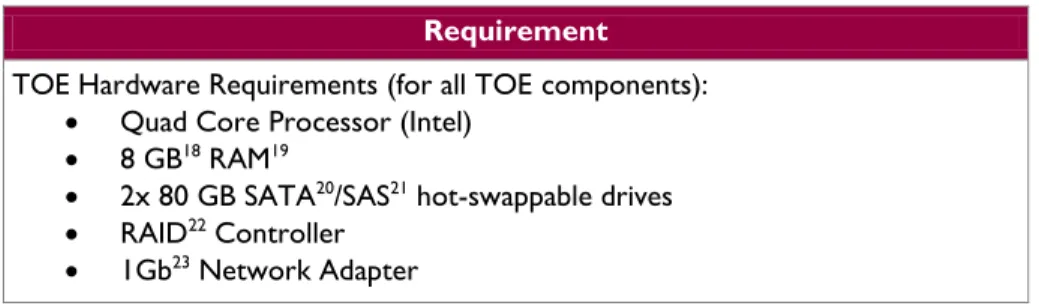
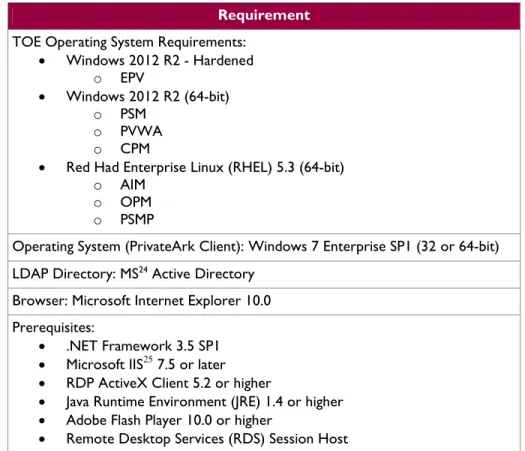
Table 2 defines the minimum system requirements and supported platforms for installing and accessing the PAS Solution v9.1.
Table 2 TOE Minimum Requirements
Requirement
TOE Hardware Requirements (for all TOE components): Quad Core Processor (Intel)
8 GB18 RAM19
2x 80 GB SATA20/SAS21 hot-swappable drives
RAID22 Controller
1Gb23 Network Adapter
16
Protected by a firewall which only allows remote communications from CyberArk applications via their proprietary communications protocol.
17
VPN – Virtual Private Network
18
GB – Gigabyte
19
RAM – Random Access Memory
20 SATA – Serial Advanced Technology Attachment 21
SAS – Serially Attached SCSI (Small Computer System Interface)
22
RAID – Redundant Array of Independent Disks
23
Requirement
TOE Operating System Requirements: Windows 2012 R2 - Hardened
o EPV
Windows 2012 R2 (64-bit)
o PSM
o PVWA
o CPM
Red Had Enterprise Linux (RHEL) 5.3 (64-bit)
o AIM
o OPM
o PSMP
Operating System (PrivateArk Client): Windows 7 Enterprise SP1 (32 or 64-bit) LDAP Directory: MS24 Active Directory
Browser: Microsoft Internet Explorer 10.0 Prerequisites:
.NET Framework 3.5 SP1 Microsoft IIS25 7.5 or later RDP ActiveX Client 5.2 or higher
Java Runtime Environment (JRE) 1.4 or higher Adobe Flash Player 10.0 or higher
Remote Desktop Services (RDS) Session Host
In the evaluated configuration, the EPV, PSM, PVWA, and CPM components are installed on Windows Server 2012 R2. The AIM, OPM, and PSMP components are installed on Red Hat Enterprise Linux 5.3. The PrivateArk Client is installed on Windows 7 Enterprise. The web browser used to access the PVWA is Internet Explorer 10.0. The authentication server used is Windows 2012 R2 Active Directory Domain Services.
1.5
TOE Description
This section primarily addresses the physical and logical components of the TOE included in the evaluation.
1.5.1
Physical Scope
Figure 1 in Section 1.4 illustrates the physical scope and the physical boundary of the overall solution and ties together all of the components of the TOE and the constituents of the TOE Environment.
The TOE is a software-only Privileged Account Security solution that runs on both Windows and Linux operating Systems. The Windows and Linux Operating Systems can be installed on any server hardware that meets the hardware criteria listed in Table 2 above. The EPV must be installed on its own, separate Windows server device. Each of the other TOE components are standalone software components and may be in installed onto the same sever appliance or separate server appliances. The servers must have access to the same network on which the EPV is installed.
to be TOE Software. The TOE Boundary specifically does not include any of the third party software that the TOE relies upon as described in Section 1.4.1. The TOE Boundary also does not include the third-party LDAP server, which stores authentication data for the TOE.
1.5.1.1 Guidance Documentation
The following guides are required reading and part of the TOE: Privileged Account Security Installation Guide Privileged Account Security End User Guide Privileged Account Security Implementation Guide Privileged Account Security Reference Guide Privileged Account Security System Requirements Privileged Account Security Release Notes
Application Identity Management Implementation Guide
1.5.2
Logical Scope
The logical boundary of the TOE will be broken down into the following security classes which are further described in sections 6 and 7 of this ST. The logical scope also provides the description of the security features of the TOE. The security functional requirements implemented by the TOE are usefully grouped under the following Security Function Classes:
Security Audit Cryptographic Support User Data Protection
Identification and Authentication Security Management
Protection of the TSF26 Resource Utilization TOE Access
Trusted Path/Channel 1.5.2.1 Security Audit
The Security Audit function provides the TOE with the functionality of generating audit records. Typical audit records that can be accessed by a user with the correct authorizations include Privileged Account Inventory, Safe Lists, User Lists, and User Activities. As TOE users access, manage, and configure the TOE, their activities are tracked. When an Auditor user (TOE user with the “View audit” authorization) generates an “Activity Log”, it will be saved locally. The Auditor will see the various activities performed by TOE users in an organized list. Once an Activity Log has been generated, the results can be filtered with general filters, filters by target system, activities, and history of the activity. Only users with the correct authorizations and permission are capable of accessing the contents of the safe. Unauthorized access, deletion, and modification of the records is not possible.
1.5.2.2 Cryptographic Support
The TOE implements FIPS 140-2 Approved cryptographic algorithms to support cryptographic activities such as encryption, decryption, and hashing. The cryptographic module within the TOE generates a unique AES27 256-bit key for each individual safe located in the EPV. Additionally, each account and file located within each safe is protected by a unique AES 256-bit key. AES, RSA, and HMAC28 are all used by the TOE when performing a TLS or SSH session with a remote machine. All AES, RSA, and HMAC keys are generated with an SP 800-90 DRBG29, or in some cases, ANSI30 X9.31.
26 TSF – TOE Security Functionality 27
AES – Advanced Encryption Standard
28
HMAC – (keyed-) Hash Message Authentication Code
29
Each of the cryptographic algorithms supported by the TOE have been tested and certified by the CAVP31. Each algorithm has been awarded a certificate number. The TOE performs FIPS 140-2 Approved methods for encryption, decryption, hashing, random number generation, and key transport. The TOE is responsible for destroying all ephemeral keying material generated within the TOE boundary.
1.5.2.3 User Data Protection
The TOE enforces two access control policies which limit access to the safes located on the EPV (Vault Access Control Policy) and further limit access to the accounts and files stored within the safes (Safe Access Control Policy). Access to the vault and safes are enforced by user account authorizations and permissions. Once granted access to the EPV, the users with the correct authorizations can manage the vault and the safes within the vault. This includes the creation of safes and the management of file types allowed within each safe.
In order for a user to access the contents within a safe, they must be added as a safe member by a safe member with the “Manage Safe Members” permission. Each safe member is given safe permissions which allow them to read, write, and remove accounts and files located within the safe.
1.5.2.4 Identification and Authentication
TOE users must provide the correct username and password associated an external LDAP account. The TOE must successfully identify users prior to allowing any actions on their behalf. The TOE identifies the user by passing the username and password combination to the LDAP server for validation.
1.5.2.5 Security Management
Management of the TOE can be defined as “granular”. Each TOE user that is granted access to the TOE is provided with a profile which defines the user’s access rights, management rights, and action rights within the TOE. When first creating a user in the vault and when providing them access to a safe, the TOE enforces restrictive default values by not providing the user with any authorizations or permissions. Security roles can also be defined for a TOE user based on a collection of vault authorizations and safe permissions given to the user.
1.5.2.6 Protection of the TSF
The TOE employs a multi-layered encryption scheme in order to protect the credentials stored within the EPV. The three layers of encryption employed by the EPV are the vault layer, safe layer, and account/file layer. All accounts, files, safes, and even the vault itself are encrypted with unique encryption keys. The PAS Solution v9.1 components all communicate with one another through CyberArk’s patented communications protocol, which employs AES-256 for confidentiality and HMAC SHA-1 for integrity. The TOE provides seamless switching between the main EPV and a back-up (Disaster Recovery) Vault if a failure to the main EPV occurs.
1.5.2.7 Resource Utilization
The TOE provides seamless switching between the main EPV and a back-up (Disaster Recovery) Vault if a failure to the main EPV occurs. Types of failures include physical and logical destruction of the EPV (or its host server) or loss of network connectivity. This transparent failover ensures that regular access to the TOE and its functions is maintained.
1.5.2.8 TOE Access
TOE users attempting to access the TOE through the PVWA or PrivateArk client will encounter a display banner prior to being able to log into the TOE. The banner provides access to an advisory warning
message regarding the unauthorized use of the TOE. Access to the TOE will be limited to users that provide the correct username and password combination. Restrictions can be placed on a TOE user which will deny them access to the TOE. Users must actively interact with the TOE in order to avoid session termination. If the user has not interacted with the TOE for 10 minutes via the PVWA, or for an administrator-defined inactivity period (default of 30 minutes) via the PrivateArk Client, the session will terminate and the user will be logged out of the TOE.
1.5.3
Product Physical/Logical Features and Functionality not
included in the TOE
Features/Functionality that are not part of the evaluated configuration of the TOE are: Supported Windows Operating Systems other than those listed in Table 2 CyberArk Events Notification Manager
AIM Provider for Windows AIM SDK32
Web Services (WS) API PACLI
CyberArk Remote Control Multiple PSM Implementations Multiple CPM Implementations Mobile PVWA
Local user authentication NT/Windows Authentication RADIUS Authentication
RSA SecurID Authentication (in PVWA) PKI Authentication (Personal Certificate) Oracle SSO33 (in PVWA)
High Availability mode
32
SDK – Software Development Kit
33
2
Conformance Claims
Table 3 provides the identification for any CC, Protection Profile (PP), and EAL package conformance claims. Rationale is provided for any extensions or augmentations to the conformance claims. Rationale for CC and PP conformance claims can be found in Section 8.1.
Table 3 CC and PP Conformance
Common Criteria (CC) Identification and Conformance
Common Criteria for Information Technology Security Evaluation, Version 3.1, Revision 4, September 2012; CC Part 2 extended; CC Part 3 conformant; PP claim (none); Parts 2 and 3 Interpretations of the CEM as of 2014/05/02 were reviewed, and no interpretations apply to the claims made in this ST.
PP Identification None
Evaluation
3
Security Problem
This section describes the security aspects of the environment in which the TOE will be used and the manner in which the TOE is expected to be employed. It provides the statement of the TOE security environment, which identifies and explains all:
Known and presumed threats countered by either the TOE or by the security environment Organizational security policies with which the TOE must comply
Assumptions about the secure usage of the TOE, including physical, personnel and connectivity aspects
3.1
Threats to Security
This section identifies the threats to the IT34 assets against which protection is required by the TOE or by the security environment. The threat agents are divided into four categories:
Attackers who are not TOE users: They have public knowledge of how the TOE operates and are assumed to possess a low skill level, limited resources to alter TOE configuration settings or parameters and no physical access to the TOE.
TOE users: They have extensive knowledge of how the TOE operates and are assumed to possess a high skill level, moderate resources to alter TOE configuration settings or parameters and physical access to the TOE. (TOE users are, however, assumed not to be willfully hostile to the TOE.)
TOE failure: The threat of the TOE failing in its operations or exhausting its resources which leads to a failure of TOE operations.
External IT Entities: External IT entities that are being used by malicious attackers to adversely affect the security of the TOE.
Both are assumed to have a low level of motivation. The IT assets requiring protection are the TSF35 and user data saved on or transitioning through the TOE and the hosts on the protected network. Removal, diminution and mitigation of the threats are through the objectives identified in Section 4 Security Objectives. The threats listed in Table 4 are applicable.
Table 4 Threats
Name Description
T.ADMIN_ERROR An administrator may incorrectly configure the TOE resulting in ineffective security mechanisms.
T.AUDIT_COMPROMISE A malicious user or process may view audit records, cause audit records to be lost or modified, or prevent future records from being recorded, thus masking a user’s actions.
T.DATA_COMPROMISE An unauthorized user may read, modify, delay, or destroy security critical TOE data stored on the TOE or being transmitted between physically separated parts of the TOE.
T.MASQUERADE A malicious user, process, or external IT entity may masquerade as an authorized entity to gain unauthorized access to data or TOE resources.
T.UNAUTHORIZED _ACCESS A user may gain unauthorized access (view, modify, delete) to user
34
IT – Information Technology
Name Description
data.
T.UNIDENTIFIED _ACTIONS The administrator may fail to notice potential security violations, thus preventing the administrator from taking action against a possible security violation.
T.DISASTER Operation or access to the TOE may suddenly fail, rendering the TOE
useless
3.2
Organizational Security Policies
An Organizational Security Policy (OSP) is a set of security rules, procedures, or guidelines imposed by an organization on the operational environment of the TOE. There are no OSPs defined for this ST.
3.3
Assumptions
This section describes the security aspects of the intended environment for the evaluated TOE. The operational environment must be managed in accordance with assurance requirement documentation for delivery, operation, and user guidance. Table 5 lists the specific conditions that are required to ensure the security of the TOE and are assumed to exist in an environment where this TOE is employed.
Table 5 Assumptions
Name Description
A.PHYSICAL Physical security, commensurate with the value of the TOE and the data it contains, is assumed to be provided by the environment.
A.PROTECT The TOE software will be protected from unauthorized modification.
A.TIMESTAMP The IT environment provides the TOE with the necessary reliable timestamps.
A.TRUSTED_ADMIN TOE Administrators are non-hostile and are trusted to follow and apply all administrator guidance.
A.HARDEN The EPV component of the TOE will be installed on a hardened instance of Windows
A.ACCESS Access to the TOE will be provided by a reliable network connection
A.INSTALL TOE components will be installed onto a compatible Operating
System
A.INTERNAL_SERVICES All LDAP and remote systems that the TOE communicates with should be located on the same internal network as the TOE. Users on this network are assumed to be non-hostile.
4
Security Objectives
Security objectives are concise, abstract statements of the intended solution to the problem defined by the security problem definition (see Section 3). The set of security objectives for a TOE form a high-level solution to the security problem. This high-level solution is divided into two part-wise solutions: the security objectives for the TOE, and the security objectives for the TOE’s operational environment. This section identifies the security objectives for the TOE and its supporting environment.
4.1
Security Objectives for the TOE
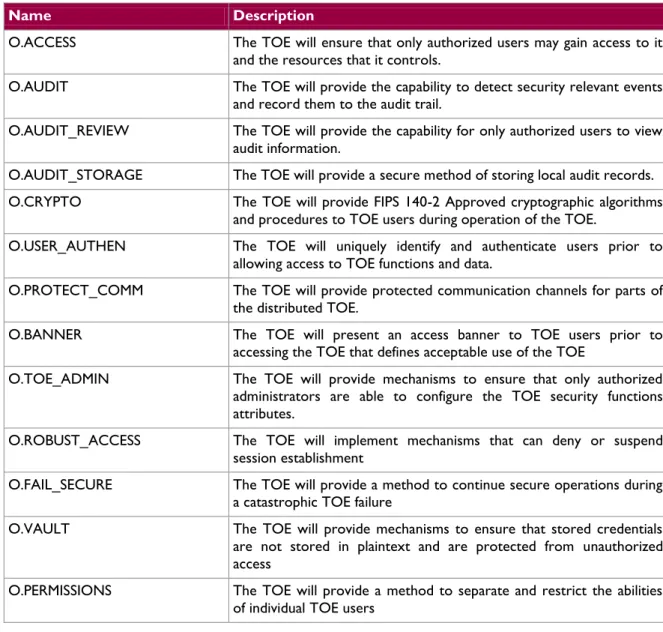
The specific security objectives for the TOE are listed in Table 6.
Table 6 Security Objectives for the TOE
Name Description
O.ACCESS The TOE will ensure that only authorized users may gain access to it
and the resources that it controls.
O.AUDIT The TOE will provide the capability to detect security relevant events
and record them to the audit trail.
O.AUDIT_REVIEW The TOE will provide the capability for only authorized users to view audit information.
O.AUDIT_STORAGE The TOE will provide a secure method of storing local audit records.
O.CRYPTO The TOE will provide FIPS 140-2 Approved cryptographic algorithms
and procedures to TOE users during operation of the TOE.
O.USER_AUTHEN The TOE will uniquely identify and authenticate users prior to allowing access to TOE functions and data.
O.PROTECT_COMM The TOE will provide protected communication channels for parts of the distributed TOE.
O.BANNER The TOE will present an access banner to TOE users prior to
accessing the TOE that defines acceptable use of the TOE
O.TOE_ADMIN The TOE will provide mechanisms to ensure that only authorized administrators are able to configure the TOE security functions attributes.
O.ROBUST_ACCESS The TOE will implement mechanisms that can deny or suspend session establishment
O.FAIL_SECURE The TOE will provide a method to continue secure operations during a catastrophic TOE failure
O.VAULT The TOE will provide mechanisms to ensure that stored credentials are not stored in plaintext and are protected from unauthorized access
O.PERMISSIONS The TOE will provide a method to separate and restrict the abilities of individual TOE users
4.2
Security Objectives for the Operational
Environment
4.2.1
IT Security Objectives
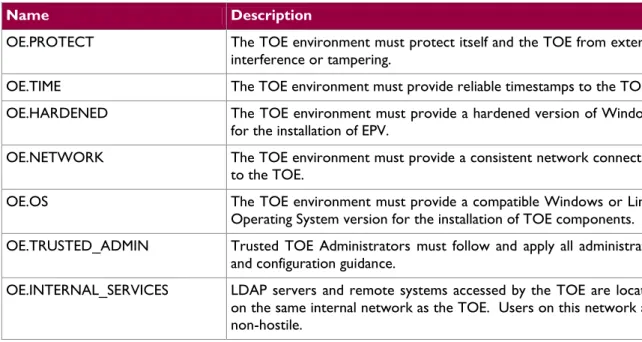
The IT security objectives listed in Table 7 are to be satisfied by the environment: Table 7 IT Security Objectives
Name Description
OE.PROTECT The TOE environment must protect itself and the TOE from external
interference or tampering.
OE.TIME The TOE environment must provide reliable timestamps to the TOE.
OE.HARDENED The TOE environment must provide a hardened version of Windows
for the installation of EPV.
OE.NETWORK The TOE environment must provide a consistent network connection
to the TOE.
OE.OS The TOE environment must provide a compatible Windows or Linux
Operating System version for the installation of TOE components. OE.TRUSTED_ADMIN Trusted TOE Administrators must follow and apply all administrator
and configuration guidance.
OE.INTERNAL_SERVICES LDAP servers and remote systems accessed by the TOE are located on the same internal network as the TOE. Users on this network are non-hostile.
4.2.2
Non-IT Security Objectives
The non-IT environment security objectives listed in Table 8 are to be satisfied without imposing technical requirements on the TOE. That is, they will not require the implementation of functions in the TOE hardware and/or software. Thus, they will be satisfied largely through application of procedural or administrative measures.
Table 8 Non-IT Security Objectives
Name Description
NOE.PHYSICAL The TOE environment must provide physical security commensurate
5
Extended Components
This section defines the extended SFRs and extended SARs met by the TOE. These requirements are presented following the conventions identified in Section 6.1.5.1
Extended
TOE
Security
Functional
Components
This section specifies the extended SFRs for the TOE.
5.1.1
Class FPT: Protection of the TSF
This class contains families of functional requirements that relate to the integrity and management of the mechanisms that constitute the TSF and to the integrity of TSF data.
5.1.1.1 FPT_APW_EXT Protection of Stored Credentials Family Behavior
The requirements of this family ensure that the TSF will protect credential data from disclosure. This family is not modeled after any families in Common Criteria Part 2. There is only one component in this family, FPT_APW_EXT.1. This component requires the TOE to store credentials in non-plaintext form and to prevent the reading of plaintext credentials.
Component Leveling
FPT_APW_EXT.1 Extended: This SFR describes the behavior of the TOE when it must store credentials – either credentials for administrative users or credentials for enterprise users. An explicit requirement was required as there is no equivalent requirement in the Common Criteria. This SFR is defined in the Standard Protection Profile for Enterprise Security Management Identity and Credential Management. The SFR was further modified from the Protection Profile to reflect the functionality of the TOE.
Management: FPT_APW_EXT.1
a) There are no management activities foreseen. Audit: FPT_APW_EXT.1
a) There are no audit activities foreseen.
FPT_APW_EXT.1 Protection of Stored Credentials
Hierarchical to: No other components. Dependencies: No other components.
FPT_APW_EXT.1.1
The TSF shall store credentials in non-plaintext form
FPT_APW_EXT.1.2
The TSF shall prevent the reading of plaintext credentials from unauthorized users.
5.2
Extended
TOE
Security
Assurance
Components
6
Security Requirements
This section defines the SFRs and SARs met by the TOE. These requirements are presented following the conventions identified in Section 6.1.6.1
Conventions
There are several font variations used within this ST. Selected presentation choices are discussed here to aid the Security Target reader.
The CC allows for assignment, refinement, selection and iteration operations to be performed on security functional requirements. All of these operations are used within this ST. These operations are performed as described in Part 2 of the CC, and are shown as follows:
Completed assignment statements are identified using [italicized text within brackets].
Completed selection statements are identified using [underlined text within brackets]. In keeping with these conventions, in the event an assignment is within a selection, it will be depicted as
italicized, underlined text.
Refinements are identified using bold text. Any text removed is stricken (Example: TSF Data) and should be considered as a refinement.
Extended Functional and Assurance Requirements are identified using “_EXT” at the end of the short name.
Iterations are identified by appending a number in parentheses following the component title. For example, FDP_ACC.1(1) Audit Data Generation would be the first iteration and FDP_ACC.1(2) Audit Data Generation would be the second iteration.
6.2
Security Functional Requirements
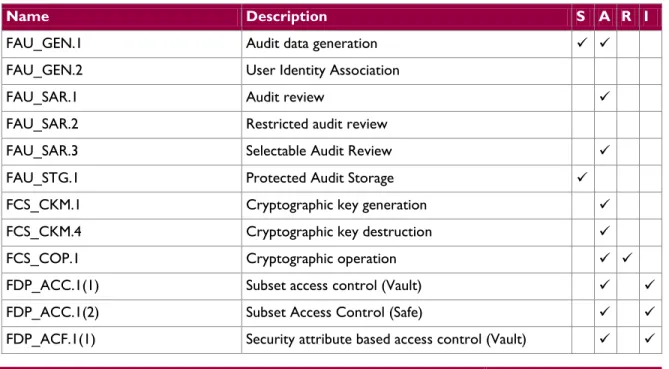
This section specifies the SFRs for the TOE. This section organizes the SFRs by CC class. Table 9 identifies all SFRs implemented by the TOE and indicates the ST operations performed on each requirement.
Table 9 TOE Security Functional Requirements
Name Description S A R I
FAU_GEN.1 Audit data generation
FAU_GEN.2 User Identity Association
FAU_SAR.1 Audit review
FAU_SAR.2 Restricted audit review
FAU_SAR.3 Selectable Audit Review
FAU_STG.1 Protected Audit Storage
FCS_CKM.1 Cryptographic key generation
FCS_CKM.4 Cryptographic key destruction
FCS_COP.1 Cryptographic operation
FDP_ACC.1(1) Subset access control (Vault)
FDP_ACC.1(2) Subset Access Control (Safe)
Name Description S A R I
FDP_ACF.1(2) Security attribute based access control (Safe)
FIA_UAU.2 User authentication before any action
FIA_UID.2 User identification before any action
FMT_MOF.1(1) Management of security function behavior (Vault)
FMT_MOF.1(2) Management of security function behavior (Safe)
FMT_MSA.1(1) Management of security attributes (Vault)
FMT_MSA.1(2) Management of security attributes (Safe)
FMT_MSA.3(1) Static attribute initialization (Vault)
FMT_MSA.3(2) Static attribute initialization (Safe)
FMT_SMF.1 Specification of management functions
FMT_SMR.1 Security roles
FPT_APW_EXT.1 Protection of Stored Credential
FPT_FLS.1 Failure with preservation of secure state
FPT_ITT.1 Basic Internal TSF Data Transfer Protection
FRU_FLT.1 Degraded Fault Tolerance
FTA_SSL.3 TSF-Initiated Termination
FTA_TAB.1 Default TOE Access Banner
FTA_TSE.1 TOE Sessions Establishment
6.2.1
Class FAU: Security Audit
FAU_GEN.1 Audit Data Generation
Hierarchical to: No other components.
Dependencies: FPT_STM.1 Reliable time stamps
FAU_GEN.1.1
The TSF shall be able to generate an audit record of the following auditable events: a) Start-up and shutdown of the audit functions;
b) All auditable events, for the [not specified] level of audit; and
c) [Privileged account access, approval workflow, privileged account management, privileged account auto-detection, safe management, member management, user login, user/group/location management, Vault system administration, reports management, file access, file management].
FAU_GEN.1.2
The TSF shall record within each audit record at least the following information:
a) Date and time of the event, type of event, subject identity (if applicable), and the outcome (success or failure) of the event; and
b) For each audit event type, based on the auditable event definitions of the functional components included in the PP/ST, [safe, target system, reason, alert].
Application Note: The TSF is comprised of several components that are registered as Windows services and therefore the start-up and shutdown events are captured in the Windows Event Log.
FAU_GEN.2 User identity association
Hierarchical to: No other components.
Dependencies: FAU_GEN.1 Audit data generation FIA_UID.1 Timing of identification
FAU_GEN.2.1
For audit events resulting from actions of identified users, the TSF shall be able to associate each auditable event with the identity of the user that caused the event.
FAU_SAR.1 Audit review
Hierarchical to: No other components.
Dependencies: FAU_GEN.1 Audit data generation
FAU_SAR.1.1
The TSF shall provide [users with the “View audit” safe authorization] with the capability to read [operational reports and audit/compliance reports] from the audit records.
FAU_SAR.1.2
The TSF shall provide the audit records in a manner suitable for the user to interpret the information.
FAU_SAR.2 Restricted audit review
Hierarchical to: No other components. Dependencies: FAU_SAR.1 Audit review
FAU_SAR.2.1
The TSF shall prohibit all users read access to the audit records, except those users that have been granted explicit read-access.
FAU_SAR.3 Selectable audit review
Hierarchical to: No other components. Dependencies: FAU_SAR.1 Audit review
The TSF shall provide the ability to apply [filters] of audit data based on [general filters, target systems, activities, and history].
FAU_STG.1 Protected Audit Storage
Hierarchical to: No other components.
Dependencies: FAU_GEN.1 Audit data generation
FAU_STG1.1
The TSF shall protect the stored audit records in the audit trail from unauthorized deletion.
FAU_STG1.2
The TSF shall be able to [prevent] unauthorized modifications to the stored audit records in the audit trail.
6.2.3
Class FCS: Cryptographic Support
FCS_CKM.1 Cryptographic key generation
Hierarchical to: No other components.
Dependencies: FCS_COP.1 Cryptographic operation FCS_CKM.4 Cryptographic key destruction
FCS_CKM.1.1
The TSF shall generate cryptographic keys in accordance with a specified cryptographic key generation algorithm [Hash DRBG, HMAC DRBG, CTR DRBG] and specified cryptographic key sizes [256-bit (AES), 2048-bit (RSA), 160-bit (SHA-1), and 128-bit (HMAC)] that meet the following: [SP 800-90].
FCS_CKM.4 Cryptographic key destruction
Hierarchical to: No other components.
Dependencies: FCS_CKM.1 Cryptographic key generation
FCS_CKM.4.1
The TSF shall destroy cryptographic keys in accordance with a specified cryptographic key destruction method [zeroization] that meets the following: [FIPS 140-2 zeroization requirements].
FCS_COP.1 Cryptographic operation
Hierarchical to: No other components.
Dependencies: FCS_CKM.1 Cryptographic key generation FCS_CKM.4 Cryptographic key destruction
FCS_COP.1.1
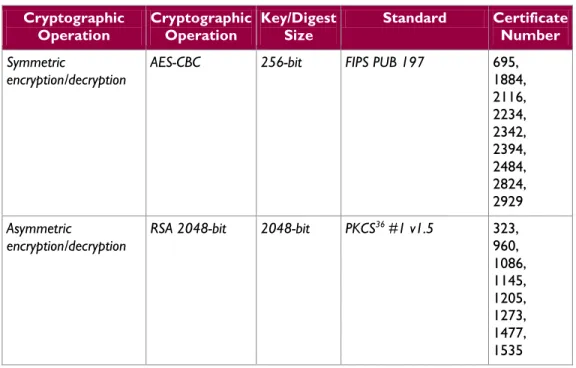
The TSF shall perform [the operations listed in Table 10 below] in accordance with a specified cryptographic algorithm [algorithms listed in Table 10 below] and cryptographic key sizes [key sizes listed in Table 10 below] that meet the following: [standards listed in Table 10 below]
Table 10 Cryptographic Algorithms
Cryptographic Operation
Cryptographic Operation
Key/Digest Size
Standard Certificate Number
Symmetric
encryption/decryption
AES-CBC 256-bit FIPS PUB 197 695,
1884, 2116, 2234, 2342, 2394, 2484, 2824, 2929 Asymmetric
encryption/decryption
RSA 2048-bit 2048-bit PKCS36 #1 v1.5 323,
960, 1086, 1145, 1205, 1273, 1477, 1535
36
Cryptographic
Operation Cryptographic Operation Key/Digest Size Standard Certificate Number
Hashing SHA-1 160-bit FIPS PUB 180-4 723,
1655, 1840, 1923, 2019, 2056, 2102, 2368, 2465
Message authentication HMAC SHA-1 160-bit FIPS PUB 198-1 373,
1126, 1288, 1363, 1451, 1485, 1526, 1768, 1856 Random number
generation Hash DRBG, HMAC DRBG,
CTR DRBG (AES)
N/A NIST SP 800-90 157,
229, 264, 292, 316, 342, 485, 540 ANSI X9.31
(AES) 128-bit, 192-bit, 256-bit
6.2.4
Class FDP: User Data Protection
FDP_ACC.1(1) Subset access control (Vault)
Hierarchical to: No other components.
Dependencies: FDP_ACF.1 Security attribute based access control
FDP_ACC.1(1).1
The TSF shall enforce the [Vault Access Control Policy] on [ Subjects: users accessing EPV
Objects: safes
Operations: view, create].
FDP_ACC.1(2) Subset access control (Safe)
Hierarchical to: No other components.
Dependencies: FDP_ACF.1 Security attribute based access control
FDP_ACC.1(2).1
The TSF shall enforce the [Safe Access Control Policy] on [
Subjects: users accessing an EPV-hosted safe (safe members)
Objects: accounts/passwords, files
Operations: read, write, and remove].
FDP_ACF.1(1) Security attribute based access control (Vault)
Hierarchical to: No other components.
Dependencies: FDP_ACC.1 Subset access control
FMT_MSA.3(1) Static attribute initialization (Vault)
FDP_ACF.1(1).1
The TSF shall enforce the [Vault Access Control Policy] to objects based on the following: [ Subject attributes (users)
o User ID o Password o Access type o Authorization o Location o Access time
o Vault user account expiration date
Object attributes (safes) o Name
o File types].
FDP_ACF.1(1).2
The TSF shall enforce the following rules to determine if an operation among controlled subjects and controlled objects is allowed: [
Access to view the safes can be limited to users based on
o The IP37 address (location) which they are accessing the vault from o The time of day that they are accessing the vault from
o The expiration date of the account
Users with the “Add safes” authorization can view and create safes from the vault
Users with the “Manage Server File Categories” can view the file types allowed within a safe
FDP_ACF.1(1).3
The TSF shall explicitly authorize access of subjects to objects based on the following additional rules: [
37
Users that supply the correct UserID and password combination and have the correct vault authorizations can view safes in the vault
Users with the following access types can view safes in the vault o EPVUser
o PVWA o PSM o PSMUser o PSMPServer o CPM o ENE38 o AIMAccount o AppProvider o OPMProvider o OPMUser o PIMProvider o POCAdmin].
FDP_ACF.1(1).4
The TSF shall explicitly deny access of subjects to objects based on the [ IP address (location) on which they are attempting to access the vault
time of day on which they are attempting to access the vault
the expiration date of the account when attempting to access the vault].
FDP_ACF.1(2) Security attribute based access control (Safe)
Hierarchical to: No other components.
Dependencies: FDP_ACC.1 Subset access control
FMT_MSA.3(2) Static attribute initialization (Safe)
FDP_ACF.1(2).1
The TSF shall enforce the [Safe Access Control Policy] to objects based on the following: [ Subject attributes (safe members)
o User ID o Permissions
Object attributes (accounts/passwords and files) o account name
o value/data o access rules].
FDP_ACF.1(2).2
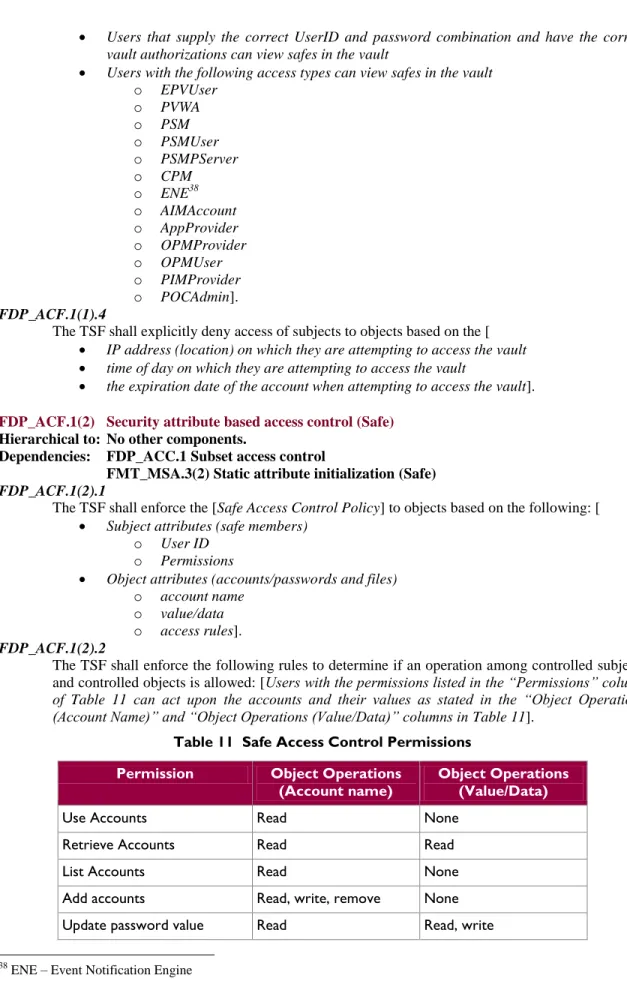
The TSF shall enforce the following rules to determine if an operation among controlled subjects and controlled objects is allowed: [Users with the permissions listed in the “Permissions” column
of Table 11 can act upon the accounts and their values as stated in the “Object Operations (Account Name)” and “Object Operations (Value/Data)” columns in Table 11].
Table 11 Safe Access Control Permissions
Permission Object Operations (Account name)
Object Operations (Value/Data)
Use Accounts Read None
Retrieve Accounts Read Read
List Accounts Read None
Permission Object Operations
(Account name) Object Operations (Value/Data)
Update password properties Read None
Initiate CPM password
management operations Read Read, write
Specify next password value Read Read, write
Rename Accounts Read, write None
Delete Accounts Read, remove None
Unlock Accounts Read, write None
Manage Safe Read, write, remove None
Manage Safe Members Read None
Backup Safe Read None
Move accounts/folders Read None
FDP_ACF.1(2).3
The TSF shall explicitly authorized access of subjects to objects based on the following additional rules: [users must supply the correct UserID and password in order to access the contents of the safe].
FDP_ACF.1(2).4
The TSF shall explicitly deny access of subjects to objects based on the [the UserID and explicit access rules for each account/password given to that UserID].
6.2.5
Class FIA: Identification and Authentication
FIA_UAU.2 User authentication before any action
Hierarchical to: FIA_UAU.1 Timing of authentication Dependencies: FIA_UID.1 Timing of identification
FIA_UAU.2.1
The TSF shall require each user to be successfully authenticated before allowing any other TSF-mediated actions on behalf of that user.
FIA_UID.2 User identification before any action
Hierarchical to: FIA_UID.1 Timing of identification Dependencies: No dependencies
FIA_UID.2.1
The TSF shall require each user to be successfully identified before allowing any other TSF-mediated actions on behalf of that user.
6.2.6
Class FMT: Security Management
FMT_MOF.1(1) Management of security function behaviors (Vault)
Hierarchical to: No other components. Dependencies: FMT_SMR.1 Security Roles
FMT_SMF.1 Specification of Management Functions
FMT_MOF.1(1).1
The TSF shall restrict the ability to [determine the behavior of, disable, enable, modify the behavior of] the functions [listed under the ‘Security Functions Behavior Permissions’ column of Table 12] to [the authorizations listed under the ‘Authorizations’ column of Table 12].
Table 12 Management of Vault Security Function Behavior by Role
Authorizations Security Function Behavior Permissions
Add Safes Add safes to the vault
Audit Users Track user activities in the vault
Add/Update Users Add and update users, manage network areas, manage locations Reset Users’ Passwords Reset a user’s password
Activate Users Activate or deactivate trusted network areas for users
Add Network Areas Add, update, and remove network areas that specify where the vault can be accessed
Manage Directory
Mapping Add, update, and remove directory maps that manage users transparently Manage Server File
Categories Add, update, and remove file categories Backup All Safes Run backup procedures
Restore All Safes Run restore procedures
FMT_MOF.1(2) Management of security function behaviors (Safe)
Hierarchical to: No other components. Dependencies: FMT_SMR.1 Security Roles
FMT_SMF.1 Specification of Management Functions
FMT_MOF.1(2).1
The TSF shall restrict the ability to [determine the behavior of, disable, enable, modify the behavior of] the functions [listed under the ‘Security Functions Behavior Permissions’ column of Table 13] to [the permissions listed under the ‘Permissions’ column of Table 13].
Table 13 Management of Safe Security Function Behavior by Role
Permissions Security Function Behavior Permissions
Use Accounts Access and use the accounts saved within a safe
Retrieve Accounts Access and use the accounts saved within a safe; View the plaintext version of a password associated with the account; Save files to the safe; Open files located in the safe
List Accounts View the accounts and files located on the safe; Cannot access the account or file
Permissions Security Function Behavior Permissions
Add Accounts Add accounts and associated passwords to the safe; Update account properties
Update Password Value Change the password associated with an account; Undelete an account; Save files to the safe;
Update Password
Properties Update account properties (does not include password) Initiate CPM Password
Management Operations
Initiate password management operations through the CPM – includes changing, verifying, and reconciling passwords
Specify Next Password
Value Specify the next password to be used when the CPM changes the password value Rename Accounts Rename existing accounts in the safe
Delete Accounts Remove existing accounts in the safe Unlock Accounts Unlock existing accounts and files in the safe Manage Safe Update, recover, and remove a safe from the vault
Manage Safe Members Add, remove, and update members of the safe; Manage account permissions
Backup Safe Create a backup of a safe and its contents
View Audit Log View account and user activity in the safe; Does not have permissions to view or use accounts
View Safe Members View members of the safe and their permissions Authorize Password
Request
Give confirmation to a user requesting access to the safe; View the accounts and files located on the safe;
Access Safe without
Confirmation Access a safe without being a member of the safe and no need to request permission Create Folders Create folders on the safe
Delete Folders Delete folders on the safe
Move accounts/folders Move accounts and folders in the safe
FMT_MSA.1(1) Management of security attributes (Vault)
Hierarchical to: No other components.
Dependencies: FDP_ACC.1 Subset access control
FMT_SMF.1 Specification of management functions FMT_SMR.1 Security roles
FMT_MSA.1(1).1
The TSF shall enforce the [Vault Access Control Policy] to restrict the ability to [selection: query, modify, delete,create] the security attributes [security attribute listed in the “Attributes” column
of Table 14] to [the users with the authorizations listed in the “Authorizations” column of Table
Table 14 Management of Vault Security Attributes
Operation Attributes Authorizations
Query UserID Audit Users
Add/Update Users Access type
Authorization Location Access time
Account expiration date
Modify Password Audit Users
Reset Users’ Passwords Activate Users
Account expiration date
Modify Access type Add/Update Users
Authorization Access time
Account expiration date
Modify Location Add Network Areas
Modify Safe file type Manager Server File Categories
Delete UserID Add/Update Users
Create Safe name Add Safes
FMT_MSA.1(2) Management of security attributes (Safe)
Hierarchical to: No other components.
Dependencies: FDP_ACC.1 Subset access control
FMT_SMF.1 Specification of management functions FMT_SMR.1 Security roles
FMT_MSA.1(2).1
The TSF shall enforce the [Safe Access Control Policy] to restrict the ability to [selection: query, modify, delete,create] the security attributes [security attribute listed in the “Attributes” column
Table 15 Management of Safe Security Attributes
Operation Attributes Permissions
Query User ID Manage Safe Members
View Safe Members User Permissions
Query Account name Use Accounts
Retrieve Accounts List Accounts Add Accounts
Update Password Value Update Password Properties
Initiate CPM Password Management Operations
Rename Accounts Delete Accounts Unlock Accounts Move Accounts/Folders
Query Value/Data Retrieve Accounts
Update Password Value
Initiate CPM Password Management Operations
Query/Modify Permissions Manage Safe Members
Access rules
Modify Account name Rename Accounts
Modify Value/Data Update Password Value
Initiate CPM Password Management Operations
Delete Account name Delete Accounts
Manage Safe Value/Data
Delete User ID Manage Safe Members
Create User ID Manage Safe Members
Create Account name Add Accounts
Create Value/Data Add Accounts
Specify Next Password Value