Tao Han and Xiaohu Ge (corresponding author) are with Huazhong Uni-versity of Science and Technology.
Yang Yang is with Shang-haiTech University. Guoqiang Mao is with University of Technology Sydney.
M
OBILE
C
ONVERGED
N
ETWORKS
I
NTRODUCTION
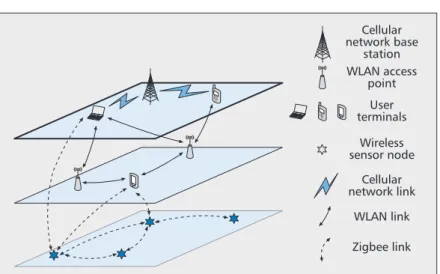
Currently, wireless communication networks are widely deployed in every scenario of human soci-ety, which includes short-distance transmission (e.g., Bluetooth communications in wireless mice), long -distance transmission (e.g., space transmission between the Earth and Mars), and so on. Although the above networks and applica-tion scenarios are quite different, multi-mode communications have adopted more and more communication standards and technologies into a common user terminal. For instance, a smart mobile phone usually supports a cellular net-work, a wireless local area network (WLAN), Bluetooth and near field communication, and so on. Based on multi-mode communications, dif-ferent types of wireless heterogeneous networks can be converged into a uniform mobile network (i.e., the mobile converged network) [1, 2]. A typ-ical mobile converged network is illustrated by Fig. 1, in which the cellular network, WLAN, and wireless sensor network (WSN) are converged.
Studying mobile converged networks has attracted much attention in recent years, espe-cially the topic of converged mobile cellular net-works and WSNs. Han proposed an authentication and key agreement protocol that efficiently reduces the overall computational and communication costs in the next generation con-verged network [3]. A system architecture and application requirement for converged mobile cellular networks and WSNs was introduced, and then the joint optimization of converged
net-works for machine-to-machine communications was discussed in [4]. An energy-efficient data collection scheme in a converged WSN and mobile cellular network was proposed for improving energy efficiency [5]. A quality of ser-vice (QoS)-guaranteed resource scheduling algo-rithm and a railway resource grab mechanism in a high-speed environment was presented to ensure QoS for users and timely transmission of railway signals in mobile converged networks [6]. Bae proposed a new concept of converged ser-vice based on digital multimedia broadcast and wireless networks [7]. After considering the net-work operation cost, the performance trade-off between the network QoS and the network oper-ation cost for intersystem soft handover in the converged digital video broadcasting for hand-helds and a Universal Mobile Telecommunica-tions System network was modeled using a stochastic tree [8]. A framework combining clouds and distributed mobile networks was pre-sented [9], of which mobile converged networks can take advantage. An efficient network selec-tion mechanism was presented to guarantee that mobile users select the most appropriate wireless network to connect from heterogeneous wireless networks using the theory of games [10].
In all the aforementioned mobile converged network studies, modeling and performance analysis for detail scenarios were discussed, and most mobile converged networks consisted of two types of wireless networks. However, there is not a general framework of mobile converged networks that covers multi-tier wireless hetero-geneous networks. Motivated by the above gaps, we propose a new framework of mobile con-verged networks that not only covers the main characteristics of mobile converged networks but also includes different types of wireless hetero-geneous networks.
The remainder of this article is outlined as follows. A new framework of mobile converged networks is proposed to support multi-tier het-erogeneous networks. Moreover, two algorithms are developed to improve the performance of mobile converged networks. Based on the pre-sented results, future challenges for mobile con-verged networks are given, followed by conclusions drawn in the last section.
T
AOH
AN, Y
ANGY
ANG, X
IAOHUG
E,
ANDG
UOQIANGM
AOA
BSTRACT
In this article, a new framework of mobile converged networks is proposed for flexible resource optimization over multi-tier wireless heterogeneous networks. Design principles and advantages of this new framework of mobile converged networks are discussed. Moreover, mobile converged network models based on interference coordination and energy efficiency are presented, and the corresponding optimiza-tion algorithms are developed. Furthermore, future challenges of mobile converged networks are identified to promote the study in modeling and performance analysis of mobile converged networks.
M
OBILE
C
ONVERGED
N
ETWORKS
: F
RAMEWORK
,
A F
RAMEWORK OF
M
OBILE
C
ONVERGED
N
ETWORKS
To converge different types of wireless commu-nication technologies into a mobile network, two problems have to be solved. First, a converged scheme should be presented by investigating the characteristics of different types of wireless com-munication technologies to avoid potential tech-nology conflicts. Second, the performance evaluation of mobile converged networks is another issue that involves the selection of eval-uation subjects, evaleval-uation approaches, valida-tion of evaluavalida-tions, the analysis of evaluavalida-tion data, and so on.Based on the aggregation of each tier model of a heterogeneous network, the mobile con-verged network framework can be directly built by defining the multi-association node relation-ship in multi-tier heterogeneous networks. How-ever, it is difficult to analyze and optimize the resource schedule of mobile converged networks when many variables are involved in the aggre-gation of each tier model of heterogeneous net-works. Moreover, it becomes impossible to optimize the resource schedule in mobile con-verged networks when the calculation complexity obviously increases with increased network sizes. Therefore, it is a critical problem to build a new framework for mobile converged networks with limited complexity and enough flexibility for future wireless heterogeneous networks.
In order to reduce the number of variable types in converged heterogeneous networks, vari-able mapping is considered as an important approach to build a framework of mobile con-verged networks. For example, transmitters in dif-ferent tiers of wireless heterogeneous networks usually have different transmission power. To evaluate the impact of transmission power from different tier wireless heterogeneous networks on the mobile converged networks, locations of transmitters can be scaled into a framework of a mobile converged network by accounting for path loss effect over wireless channels. In the new framework of mobile converged networks, the transmission power from difference tiers of wire-less heterogeneous networks is normalized, and locations of transmitters are scaled to ensure that the signal-to-interference-plus-noise ratio (SINR) at receivers in a mobile converged network are equivalent to the SINR at receivers in multi-tier wireless heterogeneous networks. As a conse-quence, a new framework of mobile converged networks can be presented by variable mapping in wireless heterogeneous networks. Moreover, based on the allocation, the interaction of differ-ent tiers of wireless heterogeneous networks is classified as the non-conflict and conflict domains in the framework of mobile converged networks for optimizing the resource schedule. A conflict domain includes multi-tier heteroge-neous networks with interference between each other, and a non-conflict domain includes multi-tier heterogeneous networks without interfer-ence between each other.
The network topology of wireless heteroge-neous networks is affected by wireless access methods, infrastructures, mobility, and relay of
user terminals. Therefore, all the above factors should be included in the new framework of mobile converged networks by mapping a uni-form network topology. Based on the random network topology mapping approach, a uniform network topology of a mobile converged network is illustrated in Fig. 2. First, even for nodes that have multi-mode capability, different links of a mode node are mapped into virtual multi-tier wireless heterogeneous networks as multiple links which are separated into multiple mapped single-mode nodes with different transmission locations. Then, using virtual infinite-bandwidth inter-node links to connect them, these single-mode nodes at virtual multi-tier wireless hetero-geneous networks are mapped as a functional single node into a uniform network topology of a mobile converged network.
In the uniform network topology of a mobile converged network, all infrastructure stations and user terminals are normalized as mobile converged network nodes, and all wireless links of wireless heterogeneous networks are normal-ized as mobile converged network links. There-fore, the uniform network topology of mobile converged networks is formulated as (FC, LC),
where FCis the node set of mobile converged
networks and LCis the link set of mobile
con-verged networks. Compared to aggregated multi-tier wireless heterogeneous networks, the
Figure 1.A typical mobile converged network.
Cellular network base
station
Cellular network link WLAN access
point
WLAN link
Zigbee link User terminals
Wireless sensor node
Figure 2.A random network topology of a mobile converged network. Infrastructure stations in
a mobile converged network User terminals in a mobile converged network
Communication link in a mobile converged network
performance analysis of mobile converged net-works is simplified by a uniform network topology.
For example, considering the downlinks in K -tier heterogeneous cellular networks, the base sta-tions (BSs) in tier khave transmit power Pkand
the distribution of BSs follows a point process [11] FkBS. Without loss of generality, a mobile station
(MS) MSyis assumed to be located at the origin
coordinate O, the signal power PBSxMSyreceived by the MS MSyfrom a BS BSx located at xis
PBSxMSy= Pk||x– O||–a= 1 · (Pk–(1/a)||x– O||)–a
= 1 · ||Pk–(1/a)· x– O||–a (1)
where 1 is the normalized transmission power, ais the path loss factor from BSxto MSyat origin O,
and ||·|| is the distance operator.
Equation 1 means that the signal power received by MSyat the origin is exactly equal to
the signal power transmitted from a virtual BS with transmit power 1 and located at Pk–(1/a)· x, where Pk–(1/a)is the scaling law used for the distance from
origin Oto BSx. Centered with origin O, which we
call the transmission power normalized center, the point process FkBScan be scaled to the point
pro-cess FkBS¢= Pk–(1/a)· FkBS, in which the virtual BSs
with transmission power 1 transmit the same signal power (or interference power) to the origin MS as the original BSs in FkBSdo. We scale the point
pro-cesses in all tiers to normalize the transmit power to 1, and then combine them into a point process FC= »
k=1K Pk–(1/a)· FkBS, while keeping the
link set LCthe same as the network links before
scaling. In the end, the uniform network topology of mobile converged networks is given.
However, there are still many issues in building the new framework for mobile converged net-works. Two main issues are summarized as follows: • The uniform description issue of different wire-less access methods. It is well known that the wireless access method has great impact on
wire-less link management, interference coordina-tion, transmission rate, spectrum efficiency, and energy efficiency in wireless networks. It is difficult to analyze the impact of different wireless access methods on the performance of mobile converged networks by one parameter. • The location issue of the transmission power
normalized center. In the view of statistics, the transmission power normalized center of mobile converged networks can be located at an arbitrary point without any impact of sig-nal/interference analysis on the mobile con-verged network. However, different locations of the transmission power normalized center will affect the random network topology and network router models. Consequently, location optimization of the transmission power nor-malized center is another key issue in the framework of mobile converged networks.
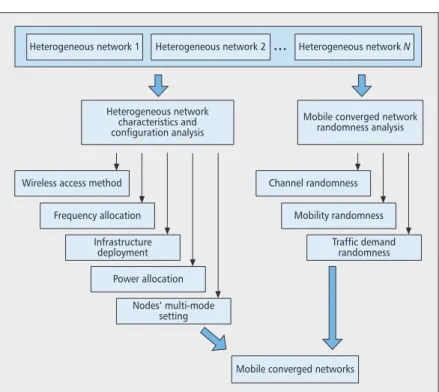
Motivated by the above gaps, we propose a new framework of mobile converged networks to cover multi-tier wireless heterogeneous networks in Fig. 3. The new framework for mobile con-verged networks is divided into two parts: one part of the framework is the characteristics and configurations of wireless heterogeneous net-works, including wireless access methods, fre-quency allocation, infrastructure deployment, power allocation, and configuration of multi-mode nodes; the other part of the framework is about the randomness of wireless heterogeneous networks, including wireless channel randomness, mobility randomness, and traffic demand random-ness.
MODELING OF
MOBILE
CONVERGED
NETWORKS
BASED ON
INTERFERENCE
COORDINATION
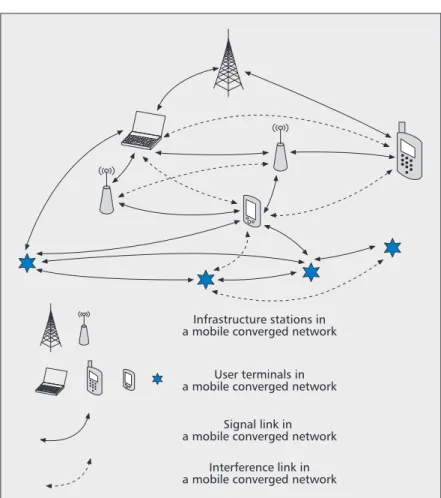
Interference coordination is always an important challenge for wireless communication systems. It is well known that interference coordination is relat-ed to the capacity, transmission rate, spectrum effi-ciency, and energy efficiency in wireless networks. Based on the proposed framework for mobile con-verged networks, we explore building a mobile converged network model accounting for co-chan-nel interference among multi-tier wireless hetero-geneous networks.Based on the proposed framework for mobile converged networks, multi-tier wireless heteroge-neous networks are mapped into a mobile con-verged network with a uniform network topology. However, the uniform network topology is just based on links in wireless heterogeneous networks. The links affected by co-channel interference of mobile converged networks are not mapped into the uniform network topology. For the mobile con-verged network model based on interference coor-dination, node links of mobile converged networks are adjusted by relationships between interfering transmitters and receivers. Furthermore, the coor-dinate locations of the transmitters in mobile con-verged networks are scaled by considering the transmission power of interfering transmitters and distances between the interfering transmitters and receivers. The random topology of mobile con-verged networks based on interference coordina-tion is illustrated in Fig. 4, where solid lines denote desired signal links and dashed lines denote inter-ference links.
Figure 3.The new framework for mobile converged networks.
Heterogeneous network 1 Heterogeneous network 2 Heterogeneous network N
Heterogeneous network characteristics and configuration analysis
Mobile converged network randomness analysis
Channel randomness
...
Wireless access method
Mobility randomness
Traffic demand randomness Frequency allocation
Infrastructure deployment
Power allocation
Nodes’ multi-mode setting
Considering interference coordination, a uni-form network topology with desired signal links and interference links is derived for mobile con-verged networks. Furthermore, cross-tier routing algorithms can be developed by utilizing the relay capability of multi-mode nodes to minimize co-channel interference in mobile converged networks. The main idea of cross-tier routing algorithms is to maximize distances between interfering transmitters and receivers. To satisfy this requirement, data traffic is relayed by multi-mode nodes with different frequency bands in a mobile converged network. In this case, the co-channel interference could be minimized with guaranteed throughput. Therefore, the joint optimization solution involves the frequency, spatial, and temporal dimensionalities of mobile converged networks. However, the mobile con-verged network model based on interference coordination is an open question considering the challenges listed below.
Time-variant wireless channels.Time-variant wireless channels affect the capacity and bit error rate of wireless links, and even interrupt wireless links in mobile converged networks. In this case, the topology of the networks is affect-ed by time-variant wireless channels. According-ly, the interference model should support the dynamic network topology affected by time-vari-ant wireless channels.
Spatial randomness of interfering transmit-ters.In mobile converged networks, the associat-ing relationship among multi-mode nodes is flexible for minimizing co-channel interference. However, it is a complex problem to build the interference conflicting model when the network topology is changed by relationships between multi-mode nodes and user terminals.
Mobility randomness of user terminals.In mobile converged networks, user terminal loca-tions are usually assumed to follow a random process. Moreover, the mobility model of user terminals also follows another random process. However, it is very difficult to model the mobili-ty of user terminals because the mobilimobili-ty model and the location model follow different random processes.
Based on the mobile converged network model with interference coordination, the inter-ference minimizing algorithm of mobile con-verged networks is presented in Algorithm 1.
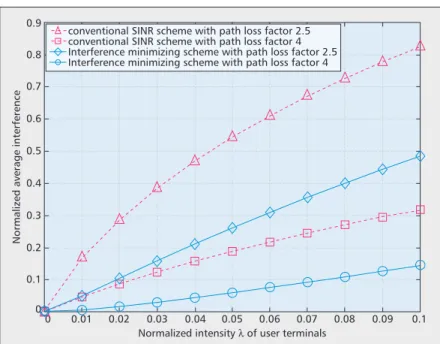
In the conventional SINR scheme of mobile converged networks, user terminals are associat-ed with infrastructure stations basassociat-ed on the max-imal SINR value received at the user terminal. In this case, every user terminal just associates with an infrastructure station based on its own SINR performance without considering interfer-ence at other user terminals. As a consequinterfer-ence, one user terminal may obtain the most optimal performance, but the average interference of mobile converged networks is obviously increased. Contrary to the conventional SINR scheme, Algorithm 1 tries to decrease the aver-age interference at user terminals to improve the total performance of mobile converged net-works. In every loop of interference optimiza-tion, the cross-tier route for transmission detours to the tier in which the least interference is gen-erated and the most interference tolerance
remains. Based on Algorithm 1, simulation results of the interference minimizing and con-ventional SINR schemes are compared in Fig. 5. In the simulations of Fig. 5, a three-tier wireless heterogeneous network is configured with corre-sponding infrastructure station density denoted by 1:0.1:0.01, and the intensity of user terminals is also normalized by these densities of tiers. User terminals are governed by a Poisson point process with intensity land their mobility sub-ject to a Gaussian-Markov mobility model [12], and every user terminal can access one tier of wireless heterogeneous networks based on dif-ferent association schemes. From the curves in Fig. 5, the normalized average interference of mobile converged networks with the interference minimizing scheme is less than the normalized average interference with the conventional SINR scheme under different path loss factors. Figure 5 illustrates that the normalized average interfer-ence increases with increasing normalized inten-sity of user terminals, because the shorter distance of user terminals is conducive to higher interference.
MODELING OF
MOBILE
CONVERGED
NETWORKS
BASED ON
ENERGY
EFFICIENCY
The energy efficiency of wireless networks is defined as how many bits can be transmitted by consuming 1 J energy in wireless networks. Because mobile converged networks have char-acteristics of multi-network spatial overlay and
Figure 4.Network topology of mobile converged networks based on inter-ference coordination.
Infrastructure stations in a mobile converged network
User terminals in a mobile converged network
Signal link in a mobile converged network
Interference link in a mobile converged network
multi-mode configuration in transmitters, they are recommended as one potential solution to improve energy efficiency in future wireless net-works. The heterogeneous characteristics of mobile converged networks provide many degrees of freedom to optimize the energy effi-ciency of data transmission [13].
When multi-tier wireless heterogeneous net-works are mapped into a uniform network topol-ogy, weighting vectors are added into links of the
uniform network topology to build a directed graph. On the other hand, we can also configure the maximal power consumption threshold in specified nodes of mobile converged networks. It is necessary to build the maximal network flow model considering multi-dimensionality random-ness. Furthermore, the energy efficiency opti-mization solution is based on the trade-off of the energy consumption and network flow in the fre-quency, spatial, and temporal dimensions [14]. Algorithm 2 is the energy efficiency optimization algorithm of mobile converged networks, in which energy consumption of every possible cross-tier link is evaluated to maximize the ener-gy efficiency of mobile converged networks.
To evaluate the performance of the proposed energy efficiency optimization algorithm, simula-tion results are compared between the conven-tional SINR scheme and the energy efficiency optimization scheme in Fig. 6. The system model and simulation parameters in Fig. 6 are config-ured the same as in Fig. 5. Based on curves in Fig. 6, the normalized energy efficiency with the energy efficiency optimization scheme is larger than that with the conventional SINR scheme under different path loss factors. Figure 6 shows that the normalized average energy efficiency decreases with increased normalized intensity of user terminals, because the higher interference is conducive to lower capacity and lower energy efficiency.
The interference coordination and energy efficiency models originate from the proposed framework of mobile converged networks. Based on the different constraint metrics, the interfer-ence coordination model can be used for inter-ference optimization, and the energy efficiency model can be used for energy optimization. Moreover, based on other resource optimization constraints in the framework of mobile con-verged networks, many models can be built for performance analysis.
F
UTURE
C
HALLENGES
It is always a great challenge to build a compre-hensive system model of mobile converged net-works to cover different types of characteristics in multi-tier wireless heterogeneous networks. Such a characteristic usually cannot be repre-sented by a single system parameter. In addition, accuracy and effectiveness are equally important for a comprehensive system model; otherwise, the computational complexity of such a model will increase dramatically and cannot be tackled by typical performance evaluation approaches. Hence, what the key trade-offs between accura-cy, effectiveness, and complexity are is an inter-esting question for future research. For a particular system model, there remain many open research issues, such as design and deploy-ment of multi-tier network architecture, node position optimization, and resource optimization across multiple networks in the analysis of sys-tem performance under realistic network condi-tions.
Based on the proposed framework and com-prehensive system model, new algorithms can be developed to improve the performance of mobile converged networks. Besides interference
coor-Algorithm 1.The interference minimizing algorithm of mobile converged networks.
1: Input initial configuration parameters in mobile converged networks, such as locations of nodes, transmission power, and resource allocation 2: Conflicting evaluation in frequency, spatial, and temporal domains of
mobile converged networks; 3: WhileTrue do
4: Evaluate conflicting distribution in multi-domains; 5: Calculate the aggregated interference IC;
6: repeat 7: IOPT¨IC
8: Search the region with the maximal co-channel interference; 9: Check the interference tolerance in every tier of wireless
heterogeneous network, and then adjust the cross-tier routing into the tier of the network with the maximal interference tolerance; 10: Evaluate the new conflicting distribution in frequency, spatial, and
temporal domains;
11: Calculate the new aggregated interference IC;
12: untilIC≥ IOPT
13: Revise the configuration parameters based on nodes mobility; 14:end while
Figure 5.Normalized average interference of mobile converged networks with the interference minimizing and conventional SINR schemes.
Normalized intensity λ of user terminals 0.01
0 0.1
0
N
o
rm
a
li
ze
d
a
ve
ra
g
e
i
n
te
rf
e
re
n
ce
0.2 0.3 0.4 0.5 0.6 0.7 0.8 0.9
0.02 0.03 0.04 0.05 0.06 0.07 0.08 0.09 0.1 conventional SINR scheme with path loss factor 2.5
conventional SINR scheme with path loss factor 4 Interference minimizing scheme with path loss factor 2.5 Interference minimizing scheme with path loss factor 4
dination and energy efficiency, different applica-tions and user behaviors, such as audio/video streaming, interactive games, and online news, and the corresponding QoS provisioning and resource allocation will also affect the whole sys-tem performances. Therefore, new resource optimization algorithms considering throughput, delay, and link reliability should be further developed and analyzed accounting for different application types and scenarios.
Although there are some obstacles for opera-tors and researchers to evaluating the perfor-mance of mobile converged networks considering the different standards and commerce security, this is not an excuse not to converge multi-tier wireless heterogeneous networks into a mobile converged network. To ensure this outcome, the standards of mobile converged networks mea-surement and estimation should be made a mat-ter of regulation and enforcement by the regulatory authorities.
C
ONCLUSION
The convergence of different types of heteroge-neous networks has become one of the main research directions in future wireless networks. In this article, we propose a new framework for mobile converged networks to cover different types of heterogeneous networks. A uniform framework for mobile converged networks would be helpful to design and evaluate performance in a single model. Furthermore, considering objec-tives of interference coordination and energy efficiency, two models of mobile converged net-works and corresponding algorithms are devel-oped. However, there are still many issues to converge different types of heterogeneous net-works, such as modeling, resource optimization, and performance evaluation of mobile con-verged networks. If these are done, a veritable challenge would indeed emerge in the next round of the telecommunications revolution.
ACKNOWLEDGMENTS
The corresponding author of this article is Prof. Xiaohu Ge. The authors would like to acknowl-edge the support from the International Science and Technology Cooperation Program of China (Grant No. 2014DFA11640, 2012DFG12250 and 0903), the National Natural Science Foundation of China (NSFC) (Grant No. 61471180, 61271224 and 61301128), the NSFC Major Inter-national Joint Research Project (Grant No. 61210002), the Hubei Provincial Science and
Technology Department (Grant No.
2013BHE005), the Fundamental Research Funds for the Central Universities (Grant No. 2011QN020, 2013ZZGH009 and 2014QN155), and EU FP7-PEOPLE-IRSES (Contract/Grant No. 247083, 318992 and 610524). Yang’s work has been partially supported by the NSFC under grant 61231009, the Ministry of Science and Technology 863 program under grant 2014AA01A707, and the National Science and Technology Major Projects under grant 2014ZX03005001. This research is also support-ed by Australian Research Council Discovery projects DP110100538 and DP120102030.
R
EFERENCES[1] D.-E. Meddour et al., “Completing the Convergence Puzzle: A Surveyand a Roadmap,” IEEE Wireless Com-mun., vol. 16, no. 3, 2009, pp. 86–96.
[2] J. Zhang et al., “Mobile Cellular Networks and Wireless Sensor Networks: Toward Convergence,” IEEE Commun. Mag., vol. 50, no. 3, 2012, pp. 164–69.
[3] K. Han et al., “Efficient Sensor Node Authentication in Third Generation-Wireless Sensor Networks Integrated Net-works,” IET Commun., vol. 5, no. 12, 2011, pp. 1744–54. [4] L. Shan, Z. Li, and H. Hu, “Converged Mobile Cellular
Networks And Wireless Sensor Networks For Machine-to-Machine Communications,” KSII Trans. Internet and
Algorithm 2.The energy efficiency optimization algorithm of mobile con-verged networks.
1: Input initial configuration parameters in mobile converged networks, such as locations of nodes, transmission power, and resource allocation; 2: Calculate the energy efficiency and the network flow in frequency, spatial,
and temporal dimensionalities of mobile converged networks; 3: whileTrue do
4: Calculate the network flow FCand the energy efficiency EC;
5: repeat 6: EOPT¨EC
7: Search the minimal energy efficiency region in a mobile converged network;
8: Analyze the network flow in multi-tier heterogeneous networks and the corresponding energy efficiency;
9: Adjust the network flow by cross-tier routing algorithms to maximize the energy efficiency;
10: Calculate the new energy efficiency ECin the specified region;
11: untilEC≥ EOPT
12: Change the network topology based on the mobility of user terminals; 13:end while
Figure 6.Normalized average energy efficiency of mobile converged net-works with the energy-efficient and conventional SINR schemes.
Normalized intensity λ of user terminals 0.01
0 0.1
0
N
o
rm
a
li
ze
d
a
ve
ra
g
e
e
n
e
rg
y
e
ff
ic
ie
n
cy
0.2 0.3 0.4 0.5 0.6 0.7 0.8 1
0.9
0.02 0.03 0.04 0.05 0.06 0.07 0.08 0.09 0.1
conventional SINR scheme with path loss factor 2.5 conventional SINR scheme with path loss factor 4 Energy optimizing scheme with path loss factor 2.5 Energy optimizing scheme with path loss factor 4
Info. Systems, vol. 6, no. 1, 2012, pp. 147–61. [5] J. Xiao et al., “Energy-Efficient Data Collection in WSN-MCN
Convergence Architecture,” Proc. IEEE 14th Int’l Conf. Commun. Technology ’12, Nov. 9–11, 2012, pp. 524–30. [6] H. Gao et al., “A QoS-Guaranteed Resource Scheduling
Algorithm in High-Speed Mobile Convergence Net-work,” Proc. 2013 IEEE Wireless Commun. and Net-working Conf. Wksps. ’13, Apr. 7–10, 2013, pp. 45–50. [7] B. Bae et al., “Hybrid DMB Services Based on Mobile Broadcast/Communication Converged Networks,” Proc. 8th IEEE Int’l. Symp. Broadband Multimedia Sys. and Broadcasting, BMSB 2013, June 4–7, 2013, pp. 1–4. [8] X. Yang and T. J. Owens, “Intersystem Soft Handover
for Converged DVB-H and UMTS Networks,” IEEE Trans. Vehic. Tech., vol. 57, no. 3, 2008, pp. 1887–98. [9] T. Taleb and A. Ksentini, “Follow Me Cloud:
Interwork-ing Federated Clouds and Distributed Mobile Net-works,” IEEE Network, vol. 27, no. 5, 2013, pp. 12–19. [10] P. Han et al., “Network Selection in Heterogeneous
Wireless Networks Using Learning Automata,” Proc. Int’l. Conf. Wireless Commun. and Signal Processing ’12, Oct. 25–27, 2012, pp. 1–6.
[11] D. Stoyan, W. S. Kendall, and J. Mecke, Stochastic Geometry and Its Applications, Wiley, 1995.
[12] B. Liang and Z. J. Haas, “Predictive Distance-Based Mobility Management for Multidimensional PCS Net-works,” IEEE/ACM Trans. Networking, vol. 11, no. 5, 2003, pp. 718–32.
[13] X. Ge et al., “Spectrum and Energy Efficiency Evalua-tion of Two-Tier Femtocell Networks with Partially Open Channels,” IEEE Trans. Vehic. Tech., vol. 63, no. 3, 2014, pp. 1306–19.
[14] L. Xiang et al., “Energy Efficiency Evaluation of Cellular Networks Based on Spatial Distributions of Traffic Load and Power Consumption,” IEEE Trans. Wireless Com-mun., vol. 12, no. 3, 2013, pp. 961–73.
BIOGRAPHIES
TAOHAN[M’13] ([email protected]) received his Ph.D. degree in communication and information engineering from Huazhong University of Science and Technology (HUST), Wuhan, China, in December 2001. He is currently an associate professor with the Department of Electronics and Information Engineering, HUST. His research interests include wireless communications, multimedia communica-tions, and computer networks.
YANGYANGis currently a professor with the School of Infor-mation Science and Technology, Shanghai Tech University, and director of the Shanghai Research Center for Wireless Communications (WiCO). Prior to that, he was a professor at Shanghai Institute of Microsystem and Information Technology (SIMIT), Chinese Academy of Sciences; a senior lecturer in the Department of Electronic and Electrical Engi-neering at University College London (UCL), United King-dom; a lecturer in the Department of Electronic and Computer Engineering at Brunel University, United King-dom; and an assistant professor in the Department of Information Engineering at the Chinese University of Hong Kong. His research interests include wireless ad hoc and sensor networks, wireless mesh networks, next generation mobile cellular systems, intelligent transport systems, and wireless testbed development and practical experiments. XIAOHUGE[M’09, SM’11] ([email protected]) is currently a professor with the Department of Electronics and Informa-tion Engineering at HUST. He received his Ph.D. degree in communication and information engineering from HUST in 2003. In January 2013, he was named a Huazhong Schol-arship Professor. He serves as an Associate Editor for IEEE Access, the Wireless Communications and Mobile Comput-ing Journal, and so on.
GUOQIANGMAO[S’98, M’02, SM’08] received his Ph.D. in telecommunications engineering in 2002 from Edith Cowan University. He currently holds the position of pro-fessor of wireless networking and director of the Center for Real-Time Information Networks at the University of Tech-nology, Sydney, Australia. His research interest includes intelligent transport systems, applied graph theory and its applications in networking, wireless multihop networks, wireless localization techniques, and network performance analysis.