i
MINNESOTA ARMY NATIONAL GUARD STATE OF MINNESOTA
REGULATION NUMBER 200-21 DEPARTMENT OF MILITARY AFFAIRS
OFFICE OF THE ADJUTANT GENERAL
ST. PAUL JANUARY 2000
Environment
INTEGRATED SPILL MANAGEMENT
BY ORDER OF THE GOVERNOR:
EUGENE R. ANDREOTTI Major General, MN ANG The Adjutant General OFFICIAL:
JAMA M. DAVIDSON MAJ, SC, MNARNG
Facilities Management Officer
Summary: This regulation provides guidance for preventing the
discharge of Petroleum, Oil and Lubricants (POL) and other hazardous substances into the environment and for responding appropriately in the event of a spill.
Applicability: This regulation applies to all Minnesota Army
National Guard personnel, organizations, activities and all other organizations, units and activities when utilizing MNARNG property.
Suggested Improvements: The proponent agency for this
regulation is, State of Minnesota, Department of Military Affairs, Office of the Adjutant General, ATTN: MNAG-FMO-E, 15000 Highway 115, Little Falls, MN 56345-4173. Users are invited to send comments and suggested improvements on DA Form 20809 (Recommended Changes to Publications and Blank Forms) directly to the proponent.
Distribution: "A" (Army)
CHANGES: This regulation supersedes Ch. 10, MNGR 200-3,
ii
TABLE OF CONTENTS
CHAPTER 1 - INTRODUCTION AND RESPONSIBILITIES
Paragraph Page
Purpose . . . 1-1 . . 1
References and Glossary . . 1-2 . . 1
Statutory Authority . . . 1-3 . . 1
Plans . . . 1-4 . . 1
Facilities Management Officer 1-5 . . 2
Camp Ripley Commander . . 1-6 . . 3
Unit/Activity Commanders . 1-7 . . 3
Facility Environmental Coordinator 1-8 . . 4
Environmental Compliance Officer 1-9 . . 4
All Personnel . . . . 1-10 . . 5
Hazmat Transport Personnel . 1-11 . . 5
Responsibilities Checklist . 1-12 . . 5
CHAPTER 2 - PRE-SPILL PREPARATIONS
Facilities . . . . 2-1 . . 6
Local Emergency Responders . 2-2 . . 6
Transportation/Fueling Operations 2-3 . . 6
Personnel Training . . . 2-4 . . 7
Facility Spill Prevention Measures 2-5 . . 8
Spill Kit(s) . . . . 2-6 . . 8
Figure 2-1 Spill Response Guide
(Statewide except Camp Ripley) . . 9
Figure 2-2 Spill Response Guide (Camp Ripley) . 11
Figure 2-3 Spill Response Guide (Outside MN). . 13
Figure 2-4 Notification of Local Authorities. . 15
CHAPTER 3 - SPILL CONTINGENCY PLANS
Facilities . . . 3-1 . . 16
Transportation and Fueling Operations 3-2 . . 16
Plan Maintenance . . . . 3-3 . . 16
Implementation of Plan . . . 3-4 . . 18
Figure 3-1 Spill Response . . . 19
Figure 3-2 Facility Hazard Response Systems . 21
Figure 3-3 Facility Site Diagram . . . . 22
Figure 3-4 Health and Environmental
Risk Assessment . . . 23
Figure 3-5 Area Diagram . . . 24
Figure 3-6 Hazardous Substance Information List 25
Figure 3-7 Monthly Facility Inspection Checklist 26
iii
Figure 3-10 Hazardous Substance Information List
(Transportation) . . . 29
Figure 3-11 Spill Report . . . 30
Figure 3-12 Response to POL and antifreeze
Spills . . . 31
Figure 3-13 Response to Flammable Liquid Spills . 32
Figure 3-14 Response to Acid Spills . . . 33
Figure 3-15 Response to Caustic Spills . . . 34
Figure 3-16 Response to Pesticide Spills . . 35
CHAPTER 4 - SPILL CONTROL SUPPLIES
Facility Requirements . . . 4-1 . . 36
Fuel Transport Requirements . . 4-2 . . 36
Use of Kit Components . . . 4-3 . . 36
Procurement of Spill Control Products
and Systems . . . 4-4 . . 37
Disposal . . . 4-5 . . 37
Table 4-1 Facility/Unit/Activity Requirements . 38
Table 4-2 Kit Contents . . . 44
APPENDICES
APPENDIX A - COMPLIANCE RECORDS . . . 48
Facility Spill Contingency Plan Tab 1
Transportation Spill Contingency Plan Tab 2
Camp Ripley Spill Control Policy #54 Tab 3
Correspondence with Local Emergency Service
Providers Tab 4
Responsibilities Checklist Tab 5
Spill Reports Tab 6
APPENDIX B - CAMP RIPLEY SPILL RESPONSE
Camp Ripley Spill Contingency Plan B-1 . . 49
Camp Ripley Spill Prevention, Control
and Countermeasure Plan . . B-2 . . 49
Camp Ripley Risk Management Plan . B-3 . . 50
Plan Maintenance . . . . B-4 . . 50
APPENDIX C - SPILL PREVENTION AND RESPONSE TRAINING
All Personnel . . . C-1 . . 51
POL/HAZMAT Transport Personnel . C-2 . . 51
iv
Respirator Training . . . . C-4 . . 53
Training Records . . . . C-5 . . 53
Figure C-1 Training Requirements Chart . . 54
Figure C-2 Record of Employee Training . . 55
APPENDIX D - EMERGENCY SPILL RESPONSE SYSTEM
Scope . . . D-1 . . 56
Implementation at Facilities Statewide
(Except Camp Ripley) . . . D-2 . . 56
Implementation within Camp Ripley . D-3 . . 57
Personnel . . . D-4 . . 58
Required Equipment and Supplies . D-5 . . 58
Response Team Training . . . D-6 . . 59
Camp Ripley Response Team Procedures D-7 . . 59
1 SECTION 1 - INTRODUCTION
1-1. PURPOSE:
In accordance with MNGR 200-1, this regulation provides guidance for developing spill prevention and contingency plans.
1-2. REFERENCES AND GLOSSARY:
Required and related publications and a glossary of terms and abbreviations are located in Appendix E.
1-3. STATUTORY AUTHORITY:
Statutory authority for this regulation is derived from Titles 29, 33 and 42 of the United States Code, the Oil Pollution Act, Minnesota Statutes 115 and 115B-E.
1-4. PLANS:
a. Each MNARNG facility where hazardous substances are used, stored or generated
must be covered by a Facility Spill Contingency Plan in accordance with the guidance provided by this regulation (See Ch. 3).
b. Each unit/activity that transports hazardous substances must have a Transportation Spill Contingency Plan (See Ch. 3).
c. The Facilities Management Office (FMO) will prepare and maintain the Camp Ripley Spill Prevention, Control and Countermeasure Plan (SPCCP) and the Camp Ripley Spill Contingency Plan (See Appendix B). The Camp Ripley Commander has issued the Camp Ripley Spill Control Policy, #54. Each unit/activity stationed or training at Camp Ripley will maintain a copy of the Camp Ripley Spill Control Policy in Appendix A, Tab 3 of this regulation.
d. FMO-E will prepare a Transportation Spill Prevention, Control and Countermeasure Plan which identifies regulated materials being transported by MNARNG vehicles/equipment. It also identifies the measures required to prevent and contain any accidental discharge. This plan will be maintained at FMO-E.
e. The FMO will prepare a Risk Management Plan which addresses accidental releases and response at the Camp Ripley Propane-Air Peak Shaving Plant. This plan will be maintained at FMO.
2
f. The Army Aviation Support Facility at Holman Field will maintain a copy of the Metropolitan Airport Commission Emergency Plan in addition to their own FSCP.
SECTION II – RESPONSIBILITIES
1-5. FACILITIES MANAGEMENT OFFICER
The Facilities Management Officer is responsible to the Adjutant General for the development and execution of the MNARNG Spill Prevention and Response program.
The FMO Environmental Section (FMO-E) will:
a. Develop MNGR 200-21, Integrated Spill Management.
b. Coordinate the spill prevention and response program for the MNARNG.
c. Provide technical assistance.
d. Notify appropriate agencies in the event of a spill.
e. Submit spill reports as required by state and federal regulations.
f. Provide training and/or training material.
g. Coordinate training and funding needs.
h. Coordinate with FMO-M to procure emergency response contractors for statewide coverage.
i. Develop and maintain the MNARNG Transportation Spill Prevention, Control and Countermeasure Plan.
j. Develop and maintain the Camp Ripley Spill Prevention, Control and Countermeasure Plan and the Camp Ripley Spill Contingency Plan.
k. Develop and maintain the Camp Ripley Risk Management Plan.
The Division of Public Works Director will:
a. Appoint an Environmental Coordinator for each facility assigned to DPW. (Ref. MNGR 200-1, Ch.1)
3
d. Ensure that the Camp Ripley Response Team is equipped in accordance with Appendix D of this regulation.
e. Provide a medical monitoring program for personnel on the Camp Ripley Response Team.
The Division of Public Works will:
f. Manage spill response at Camp Ripley and facilities outside Camp Ripley.
g. Notify FMO-E in the event of a reportable spill
h. Submit Spill Reports to FMO-E.
i. Ensure that adequate spill response supplies and equipment are available for Camp Ripley Training Site.
1-6. CAMP RIPLEY COMMANDER The Camp Ripley Commander will:
a. Emphasize spill prevention in training site operations.
b. Ensure that training site personnel receive spill awareness and response training.
c. Ensure that all users of the Camp Ripley and Twin Cities training sites are informed of and follow the spill reporting and clean-up policy.
d. Issue a spill control policy for Camp Ripley and the Arden Hills Training Center in coordination with the FMO.
1-7. UNIT/ACTIVITY COMMANDERS All Unit/Activity Commanders will:
a. Emphasize spill prevention.
4
c. Ensure that the Spill Response Guide Kit is carried in each MNARNG tactical vehicle. (See Ch. 2)
d. Ensure that the Facility Spill Contingency Plan (See Ch. 3) is followed at home station.
For units which transport POL and/or hazardous substances:
e. Ensure that the Transportation Spill Contingency Plan (See Ch. 3) is followed while training or operating away from home station.
1-8. FACILITY ENVIRONMENTAL COORDINATOR (FEC) Facility Environmental Coordinators will:
a. Coordinate with FMO-E to insure that the Spill Contingency Plan for the facility is prepared and maintained in accordance with this regulation.
b. Maintain facility spill kit(s).
c. Ensure operability and accessibility of facility emergency response equipment listed in the FSCP.
d. Perform monthly facility inspections required by FSCP.
1-9. ENVIRONMENTAL COMPLIANCE OFFICER (ECO) All Environmental Compliance Officers will:
a. Implement the FSCP in the event of a spill.
b. Provide Spill Awareness/Prevention training to unit personnel and maintain environmental training records.
c. Ensure that each tactical vehicle assigned to the unit has a Transportation Spill Response Guide Kit (Form MNGR 200-21-12).
d. Prepare Spill Report in the event of a spill and submit to DPW.
e. Determine the level of PPE required if unit personnel will conduct the cleanup.
5
g. Dispose of contaminated material in accordance with MNGR 200-3.
For units which transport POL or other hazardous substances: h. Prepare a Transportation Spill Contingency Plan (TSCP).
i. Implement the TSCP in the event of a transportation-related spill.
j. Maintain Vehicle Spill Kit(s).
1-10. ALL PERSONNEL All personnel will:
a. Practice spill prevention.
b. Follow FSCP spill response procedures.
c. Attend initial Spill Awareness/Prevention training and annual refresher training.
d. Notify the Environmental Compliance Officer when spill kit supplies are expended.
1-11.HAZMAT TRANSPORT PERSONNEL Hazmat transport personnel will:
a. Attend initial Hazardous Material Transportation Training and biennial refresher training. (Reference MNGR 55-8)
b. Follow unit Transportation Spill Contingency Plan.
c. Notify unit Environmental Compliance Officer when vehicle spill kit supplies are expended.
1-12.RESPONSIBILITIES CHECKLIST: The responsibilities listed above are summarized in Appendix A, Tab 5. The summary also contains the references for the sections within the regulations where these responsibilities are defined.
MNGR 200-21 (ARMY) JANUARY 2000
6 CHAPTER 2
PRE-SPILL PREPARATION 2-1. FACILITIES
a. Operation of facilities: All facilities will be maintained and operated to minimize the
possibility of fire, explosion, or any unplanned release of any hazardous substance into the environment.
b. Testing and maintenance of equipment: All emergency equipment must be tested, maintained and verified operable and complete on an annual basis and recorded on Form MNGR 200-21-02 (Figure 3-2), Facility Hazard Response Systems.
2-2. LOCAL EMERGENCY RESPONDERS
a. The Facility Environmental Coordinator will make the following arrangements. A cover letter is provided at Figure 2-4.
(1) Provide local police and fire departments with a current FSCP. If desired by emergency responders, provide a tour of the facility.
(2) Provide the local hospital(s) with Material Safety Data Sheets for all hazardous substances handled at the facility.
b. A copy of arrangement letters and replies will be maintained in Appendix A, Tab 4 of this regulation. Forward a copy to FMO-E.
2-3. TRANSPORTATION/FUELING OPERATIONS
a. Operation of equipment: All equipment will be maintained and operated to minimize the possibility of an unplanned release of any hazardous substance into the environment.
b. Each MNARNG vehicle must carry a Transportation Spill Response Guide Kit (MNGR Form 200-21-12) in the vehicle Equipment Record Folder. This packet shall contain a:
(1) Statewide (Except Camp Ripley) Spill Response Guide and Flowchart (Form MNGR-200-21-13, Figure 2-1)
(2) Camp Ripley Spill Response Guide and Flowchart (Form MNGR-200-21-14, Figure 2-2)
7
(4) Transportation Spill Contingency Plan if transporting POL or HAZMAT. See Ch. 3.
(5) Spill Report (Form MNGR-200-21-11, Figure 3-11)
c. Additional copies of MNGR Forms 200-21-12 thru 15 may be obtained from the Publications Office at Camp Ripley, (320) 632-7328.
d. Testing and maintenance of equipment: All emergency equipment must be tested, maintained and verified operable and complete on an annual basis and recorded on Form MNGR 200-21-08 (Figure 3-8), Vehicle Hazard Response Equipment.
2-4. PERSONNEL TRAINING (See Appendix C, Spill Prevention and Response Training) a. All personnel shall have annual Spill Awareness/Prevention Training.
b. Fuel truck drivers and Camp Ripley bulk tank farm personnel shall have Hazardous Material Transportation training as prescribed in MNGR 55-8.
c. The Camp Ripley Spill Response Team shall have Hazardous Waste Operations and
Emergency Response (HAZWOPER) training (First Responder Operations Level) and annual refresher training.
d. Camp Ripley Response Team supervisors shall have HAZWOPER supervisor training.
e. All personnel will receive an annual refresher of their initial awareness/prevention training within the first quarter of each FY.
f. Personnel handling hazardous substances shall have adequate job training to competently perform tasks.
g. Each unit/activity Environmental Compliance Officer shall evaluate the potential for
spills to occur, the potential magnitude of possible spills and the hazards involved with a spill and shall brief unit personnel.
h. Facility Environmental Coordinators shall conduct a yearly test of unit/activity spill
response readiness. The test may be conducted in conjunction with the annual spill awareness/prevention training. The test shall consist of the following:
MNGR 200-21 (ARMY) JANUARY 2000
8
(2) Unit/activity personnel will by randomly chosen and asked to describe: (a) Who to notify
(b) How to use the spill kit
(c) Personal protective measures when working with spilled material
(3) Notifying DPW.
(4) Completing a spill report (Form MNGR 200-21-11).
(5) Review of the FSCP for accuracy.
(6) Annotation on the FSCP that the plan has been reviewed and the annual test conducted.
2-5. FACILITY SPILL PREVENTION MEASURES: Environmental Coordinators shall inspect their facility to determine the need for the following. Requests for the items will be routed through FMO:
a. Approved storage for hazardous substances .
b. Impermeable secondary containment for hazardous substances.
c. Drain covers or plugs for floor drains.
2-6. SPILL KIT(s)
a. FEC’s will insure that spill kits are accessible and that all personnel know where kit(s) is located.
b. Units should take the spill kit with them when training away from home station. FEC’s at facilities with multiple units are responsible for issuing the kit to units training away from home station.
MNGR 200-21 (ARMY) JANUARY 2000
(Form MNGR 200-21-13) 9
SPILL RESPONSE GUIDE (Statewide except Camp Ripley) 1. Stop the leak. Contain the spill. REMEMBER, SAFETY FIRST!
2. If possible, keep the spill from entering drains or water bodies.
3. If a large quantity of flammable material has spilled, notify the local fire department.
4. Notify FMO-DPW at 1-800-657-3668.
a. Record when and to whom report was made (on the Spill Report).
b. Provide the following information and record it on the Spill Report:
(1) Your name, location and how you can be contacted.
(2) Location of spill.
(3) Type of material.
(4) Amount spilled.
(5) Actions taken to contain the spill.
(6) Possible hazards.
(7) Distance and direction to storm drains or surface water, if known.
5. If possible, clean-up the spill using the spill kit materials and transport the contaminated material back to your home station. Contact FMO-E for disposal instructions.
6. If unable to clean-up, FMO-E will arrange for contracted clean-up.
7. If outside MN, see the “Surrounding States Response Guide.”
8. Complete the Spill Report Form and submit to FMO-E.
9. DO NOT PLACE YOURSELF OR OTHERS IN DANGER BY ATTEMPTING TO CONTROL A SITUATION WHICH EXCEEDS YOUR RESOURCES. SECURE THE AREA AND MAKE YOUR CALLS.
FIGURE 2-1 (cont.)
MNGR 200-21 (ARMY) JANUARY
2000
(Form MNGR 200-21-13) 10
Act Immediately to Stop/Contain the Spill. Remember
Safety First.
Does Spill Threaten Surface Water or
Create a Safety Hazard?
Notify the local Fire Department
Notify your Environmental Compliance Officer
Notify FMO-DPW at
1-800-657-3668 Place Contaminated Soil
in Container(s) and Dispose of as Directed by
FMO-E. Is there less than a drum (55 gallons) of
contaminated soil?
FMO-E will contract for clean-up.
Complete Spill Report and Submit Copies to FMO
and Higher HQ. YES
YES
NO NO
MNGR 200-21 (ARMY) JANUARY 2000
(Form MNGR 200-21-14) 11
SPILL RESPONSE GUIDE (Camp Ripley)
1. Stop the leak. Contain the spill. REMEMBER, SAFETY FIRST! 2. If possible, keep the spill from entering drains or water bodies. 3. Contact Range Control (If Range Control is unavailable, contact Post Security). Also request that DPW be notified.
a. Record when and to whom report was made (on the Spill Report). b. Provide the following information and record it on the Spill Report. (1) Your name, location and how you can be contacted.
(2) Location of spill. (3) Type of material. (4) Amount spilled.
(5) Actions taken to contain the spill. (6) Possible hazards.
(7) Distance and direction to storm drains or surface water, if known.
4. If there is less contaminated material than would fill a 55 gallon drum, containerize it (bag, drum, box, etc.) and transport it to the Transfer Station located near Range Control.
5. DPW personnel will respond and clean-up larger spills. 6. Complete the Spill Report Form and submit to Range Control. 7. DO NOT PLACE YOURSELF OR OTHERS IN DANGER BY ATTEMPTING TO CONTROL A SITUATION WHICH EXCEEDS YOUR RESOURCES. SECURE THE AREA AND MAKE YOUR CALLS.
FIGURE 2-2 (cont.)
MNGR 200-21 (ARMY) JANUARY 2000
(Form MNGR 200-21-14) 12
Is there less than a drum (55 gallons) of contaminated soil?
Camp Ripley Spill Response Team will deploy to the site and
clean up the spill.
Place Contaminated Soil in Container(s) and take to the Transfer Station.
Complete Spill Report and Submit Copies to Range Control and higher HQ. NO
YES Report all spills to Range control. Call
Security if Range Control is unavailable Act Immediately to
Stop/Contain the Spill. Remember,
MNGR 200-21 (ARMY) JANUARY 2000
(Form MNGR 200-21-15) 13
SPILL RESPONSE GUIDE (Outside Minnesota)
1. Stop the leak. Contain the spill. REMEMBER, SAFETY FIRST!
2. If possible, keep the spill from entering drains or water bodies.
3. If a large quantity of flammable material has spilled, notify the local fire department.
4. After reporting the spill as outlined on the reverse, call FMO-DPW at
1-800-657-3668.
a. Record when and to whom report was made (on the Spill Report).
b. Provide the following information and record it on the Spill Report:
(1) Your name, location and how you can be contacted.
(2) Location of spill.
(3) Type of material.
(4) Amount spilled.
(5) Actions taken to contain the spill.
(6) Possible hazards.
(7) Distance and direction to storm drains or surface water, if known.
5. If possible, clean-up the spill using the spill kit materials and transport the contaminated material back to your home station. Contact FMO-E for disposal instructions.
6. If unable to clean-up, FMO-E will arrange for contracted clean-up.
7. Complete the Spill Report Form and submit to FMO-E.
8. DO NOT PLACE YOURSELF OR OTHERS IN DANGER BY ATTEMPTING TO CONTROL A SITUATION WHICH EXCEEDS YOUR RESOURCES. SECURE THE AREA AND MAKE YOUR CALLS.
FIGURE 2-3 (cont.)
MNGR 200-21 (ARMY) JANUARY 2000
(Form MNGR 200-21-15) 14
1. North Dakota: (Report all spills)
a. Notify ND State Radio Communications...1-800-472-2121 Request that the Div. of Emergency Mgmt. be notified. b. Provide the following information:
(1) Name and Location (2) Type of spill and quantity
(3) Phone number where you can be reached c. Record and follow their instructions.
2. South Dakota: (>25 gallons of POL or any amount of HAZMAT)
a. Notify SD State Radio Communications...(605) 773-3536 b. Provide the following information:
(1) Name and Location (2) Type of spill and quantity
(3) Phone number where you can be reached c. Record and follow their instructions.
3. Iowa: (Report all spills)
a. Notify the Iowa Highway Patrol...1-800-525-5555 b. Provide the following information:
(1) Name and Location (2) Type of spill and quantity
(3) Phone number where you can be reached c. Record and follow their instructions.
4. Wisconsin: (>5 gallons of POL or any amount of HAZMAT)
a. Notify the WI Spill Reporting Hotline...1-800-943-0003 b. Provide the following information:
(1) Name and Location (2) Type of spill and quantity
(3) Phone number where you can be reached c. Record and follow their instructions.
5. Other states: (Report all spills)
a. Notify the State Police/Highway Patrol b. Provide the following information:
(1) Name and Location (2) Type of spill and quantity
(3) Phone number where you can be reached c. Record and follow their instructions.
15 FIGURE 2-4
NOTIFICATION OF LOCAL AUTHORITIES
Date: ___________________
TO: _________________________________
_________________________________
_________________________________
FROM: NAME: ________________________
FACILITY: ________________________
________________________
TELEPHONE NO: ________________________
The Environmental Protection Agency and the Minnesota Pollution Control Agency have instituted regulations that require all businesses which require spill contingency plans to notify local emergency response personnel that may be called upon to provide services. This notification is meant to establish cooperation in minimizing hazards to human health or to the environment from any unplanned release of hazardous material or petroleum product that may require your emergency services.
So you may be prepared to properly respond to an emergency at this site, we are enclosing a Facility Spill Contingency Plan with the following information:
a. Facility Plot Plan/Site Diagram. b. Facility evacuation routes.
c. A list of materials used at the facility and their hazardous characteristics. d. Emergency equipment on-site.
e. Response to Emergencies Notification List.
We appreciate your assistance in this matter and look forward to any comments you may have on our Spill Contingency Plan.
Sincerely,
MNGR 200-21 (ARMY) JANUARY 2000
16 CHAPTER 3
SPILL CONTINGENCY PLANS
3-1. FACILITIES: In coordination with FMO-E, each Facility Environmental Coordinator shall prepare and maintain a Facility Spill Contingency Plan. Facilities with multiple units require a unit specific FSCP for each unit. The Facility Environmental Coordinator is responsible for coordinating facility spill prevention and response efforts among the units. The plan shall consist of the following:
a. Spill Response, (Figure 3-1)
b. Facility Hazard Response Systems, (Figure 3-2)
c. Facility Site Diagram, (Figure 3-3)
d. Health and Environmental Risk Assessment, (Figure 3-4)
e. Area Diagram, (Figure 3-5)
f. Hazardous Substance Information List, (Figure 3-6). This list must be unit/activity specific.
g. Monthly Inspection Checklist, (Figure 3-7). After completing the monthly inspection, the FEC will distribute a copy of the completed checklist to the Environmental Compliance Officer(s) of the facility unit(s). Checklists will be maintained at Appendix A, Tab 5, for 3 years.
3-2. TRANSPORTATION AND FUELING OPERATIONS: The Environmental
Compliance Officer for units conducting hazmat transport or refueling operations shall prepare and maintain a Transportation Spill Contingency Plan. The plan shall consist of the following:
a. Spill Response, (Figure 3-1). This is a copy of the unit specific Spill Response form prepared for the FSCP.
b. Vehicle Hazard Response Equipment, (Figure 3-8)
c. Transport and Fueling Spill Prevention Measures, (Figure 3-9)
d. Hazardous Substance Information List (Transportation), (Figure 3-10)
17
a. A copy of the current Facility Spill Contingency Plan must be: (1) Maintained in Appendix A, Tab 1 of this regulation.
(2) Submitted to local police and fire departments that serve the facility.
(3) Submitted to FMO-E.
b. A copy of first two pages (Spill Response, Fig. 3-1) of the FSCP must be conspicuously posted near the facility telephone(s) used to summon emergency assistance and notify DPW of spills.
c. The FSCP must be reviewed and amended whenever:
(1) The plan fails in an emergency.
(2) The facility changes in design or operation.
(3) The Facility Environmental Coordinator(s) or Environmental Compliance Officer(s) change.
(4) The list of emergency equipment changes.
d. The FSCP must be reviewed annually by the Facility Environmental Coordinator. Enter the date document was revised or reviewed on the front page of the FSCP and initial.
e. A copy of the Transportation Spill Contingency Plan must be:
(1) Maintained at Appendix A, Tab 2.
(2) Maintained in the vehicle Transportation Spill Response Guide Packet of the vehicle transporting hazardous material.
(3) Submitted to FMO-E.
f. The TSCP must be reviewed and amended whenever:
(1) The plan fails in an emergency.
(2) The Environmental Compliance Officer(s) changes.
MNGR 200-21 (ARMY) JANUARY 2000
18
g. The TSCP must be reviewed annually by the Environmental Compliance Officer. Enter the date document was revised or reviewed on the front page of the TSCP and initial.
3-4. IMPLEMENTATION OF PLAN
The provisions of the plan must be carried out immediately whenever there is a fire, explosion or release of material.
a. If any release to the environment occurs, responsive actions will be taken to:
(1) Stop the flow if this can be done safely.
(2) Report the spill as directed by the Spill Contingency Plan.
(3) Contain the spill.
b. Leaks and spills that cause a health and safety hazard or which enter waterways must be reported to DPW immediately.
c. Other leaks and spills (over 5 gallons of POL) must be reported to DPW within 2 hours of discovery.
d. Leaks and minor spills (less than 5 gallons of POL), which are contained and cleaned up by the personnel at the scene, must be reported to DPW by the next workday.
e. Written Spill Reports (Fig. 3-11) must be submitted to DPW within 48 hours of oral report.
f. Copies of submitted spill reports will be maintained in Appendix A, Tab 6, for 3 years.
g. Figures 3-12 through 3-16 contain specific guidance for various hazardous substances. Include the appropriate guide(s) in the SCP for the type(s) of substances used/stored by the unit/activity.
(Form MNGR 200-21-01)
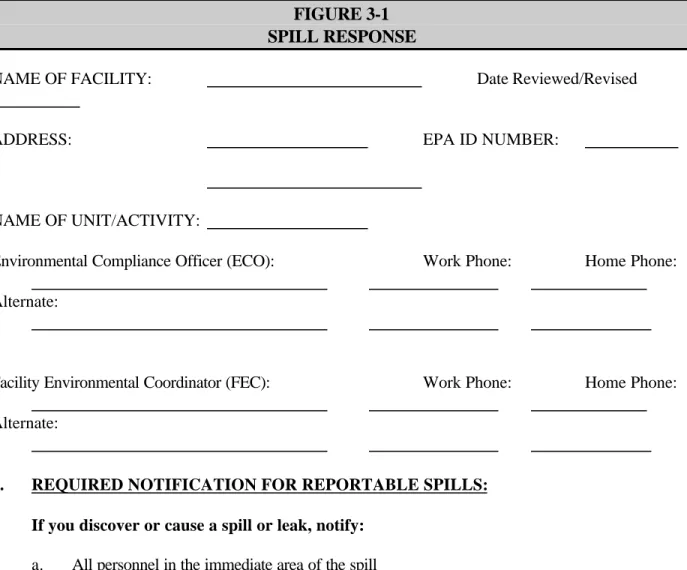
19 FIGURE 3-1 SPILL RESPONSE
NAME OF FACILITY: Date Reviewed/Revised
ADDRESS: EPA ID NUMBER:
NAME OF UNIT/ACTIVITY:
Environmental Compliance Officer (ECO): Work Phone: Home Phone: Alternate:
Facility Environmental Coordinator (FEC): Work Phone: Home Phone: Alternate:
1. REQUIRED NOTIFICATION FOR REPORTABLE SPILLS:
If you discover or cause a spill or leak, notify: a. All personnel in the immediate area of the spill b. Your Environmental Compliance Officer or alternate The ECO or designee must notify:
a. (For a spill at any facility statewide), the Facility Environmental Coordinator or alternate.
b. (For fire, explosion or spills to public water drainage systems), Emergency Response:
(Outside Camp Ripley): 911 or local emergency response #_ ;
(Camp Ripley): *911
c. (For spills outside Camp Ripley), the DPW Regional Supervisor:
Cell Phone________________ Work Phone_________________ d. If the Regional Supervisor is unavailable, call the DPW Hotline at: 1-800-657-3668
e. (For spills at Camp Ripley), Range Control: 7298 or 7398
Be prepared to provide the following information: a. Unit contact name and phone number.
b. Location of spill (address) c. Date and time of incident.
d. Type of surface (dirt, concrete, blacktop, water, etc.) e. Type of material.
f. Quantity of material involved.
MNGR 200-21 (ARMY) JANUARY 2000
(Form MNGR 200-21-01)
20 h. Disposition of any recovered materials.
2. RESPONSE ACTIONS FOR TYPICAL SPILLS:
a. Safety First! Facility and fuel truck spill kits are designed for minor, non-emergency
(non-health threatening) spills. Gloves should be worn when handling contaminated material. The goggles, dust respirators and coveralls should be worn if the possibility exists for splashes and/or blowing, dusty conditions.
For all spills:
(1) Make appropriate notifications.
(2) Block off entrances to nearby storm and sanitary sewer drains using spill kit material, dirt, etc.
(3) Block flow from entering ditches, gutters, etc.
(4) Do not operate equipment, tools in the vicinity of the spill which may cause sparks. (5) Use spill kit absorbents for standing liquids.
(6) Contact Gopher State One Call (1-800-252-1166) prior to digging outside Camp Ripley. (7) Contact DPW prior to digging within Camp Ripley.
(8) Place contaminated material in disposal bags, drums, etc. Large spills will probably require clean-up assistance from outside contractors. FMO will arrange for contracting.
(9) Contact FMO-E for disposal instructions.
b. Vehicle fluid leak:
(1) Place drip pan under leak.
(2) Plug hole, ruptured seam, etc. with repair putty from spill kit. (3) Obtain needed repairs.
b. Leaking drum, container or tank:
(1) If you don’t know what the product is, stay away from it.
(2) If possible, turn drum or container so that area of leak is at high point of the container. (3) If possible, place a drip pan under the leak.
(4) Plug hole, ruptured seam, etc. with repair putty from spill kit. (5) Transfer contents to another container.
d. Leaking propane tank:
(1) Notify local fire department. Follow their instructions. (2) Obtain professional repair assistance.
e. Overflow during material transfer:
(1) Stop transfer
f. Acid spill
(1) Stop spill or leak. Place leaking battery or acid container inside disposal bag. (2) Neutralize spilled acid.
3. REPORTS: Complete Spill Report, MNGR Form 200-21-11 (Fig. 3-11) and submit to
(Form MNGR 200-21-02)
21 FIGURE 3-2
FACILITY HAZARD RESPONSE SYSTEMS
Verified Operable (DATE)_________________
1. Internal Communication or Alarm System - notifies employees of a hazard.
You must have one of the following:
(Check those present) (Location) (Initials)
_____ Phone _______________________ _________
_____ Intercom _______________________ _________
_____ Alarm _______________________ _________
_____ Other (describe) _______________________ _________
2. External Communication System - summons assistance from local authorities.
You must have one of the following:
(Check those present) (Location) (Initials)
_____ Phone _______________________ _________
_____ 2-Way Radio _______________________ _________
_____ Alarm _______________________ _________
_____ Other (describe) _______________________ _________
3. Hazard Response Equipment
(Location) (Initials)
a. Fire Extinguishers _______________________ _________
_______________________ _________ b. Spill Control Equipment
_____ spill kit(s) _______________________ _________
_____ floor dry _______________________ _________
_____ shovel _______________________ _________
_____ other (describe) _______________________ _________ c. Decontamination Equipment
_____ shower _______________________ _________
_____ eye-wash _______________________ _________
_____ sink _______________________ _________
_____ other (describe) _______________________ _________ d. Safety Equipment
_____ electrical grounding during _______________________ _________ transfer of flammables _______________________ _________ _____ other (describe) _______________________ _________ _____ Emergency Lighting _______________________ _________
4. Water Supply
(Initials) _____ fire hose
Location of nearest hydrant ___________________ _________
_____ foam producing equipment _________
_____ automatic sprinklers _________
MNGR 200-21 (ARMY) JANUARY 2000
22 (Form MNGR 200-21-03)
FIGURE 3-3
FACILITY SITE DIAGRAM
DATE: SITE DIAGRAM FOR
Include the following:
a. Location(s) of hazardous substances b. Location(s) of spill kits
c. Location of floor drains and outside storm drains, ditches, etc. d. Location of vehicle parking
23 (Form MNGR 200-21-04)
FIGURE 3-4
HEALTH AND ENVIRONMENTAL RISK ASSESSMENT A. Sensitive Sites (0 - 1000 ft. Radius)
Schools and Hospitals Residential Businesses
Parks, Refuges, Surface Water, etc.
B. Potential for Spills to Impact Sensitive Sites
________________________________________________________________________
________________________________________________________________________
________________________________________________________________________
C. Spill History (Include cause and disposal method(s) under remarks)
Date Material Amount Remarks
________________________________________________________________________
________________________________________________________________________
________________________________________________________________________
MNGR 200-21 (ARMY) JANUARY 2000
24 (Form MNGR 200-21-05)
FIGURE 3-5 AREA DIAGRAM
AREA DIAGRAM FOR DATE:____________
When sketching area layout, include the following (within 1000 ft.):
a. Location of sensitive sites such as schools, hospitals, malls, etc. b. Road network to include traffic patterns or restrictions
c. Location of environmentally sensitive areas such as parks, refuges, etc. d. Location of wells.
FIGURE 3-6
HAZARDOUS SUBSTANCE INFORMATION LIST
Fill in blanks as follows: a. Substance Type: List by common name (motor oil, JP-8, sulfuric acid,
etc
.)
b. Hazardous Property:
Flammable, toxic, explosive,
etc
.
c. Quantity:
Amount normally stored at facility
d. Storage Location:
Where product is normally stored
e. Use Location:
Where product is normally used
f. Turn-over:
Amount used per month
SUBSTANCE TYPE
HAZARDOUS PROPERTY
QUANTITY
STORAGE LOCATION
USE LOCATION
TURN-OVER
(Form MNGR 200-21-06)
MNGR 200-21 (ARMY) JANUARY 2000
(Form MNGR 200-21-07)
26 FIGURE 3-7
MONTHLY FACILITY INSPECTION CHECKLIST
Place a check mark in the space provided under the date of inspection if the item is OK. If not OK, write NF for “Negative finding” in the blank and describe the problem and solution in para. C, Comments. Contact FMO-E for guidance in correcting negative findings, if needed. If the item can be fixed on the spot, fix it and check OK.
DATE: A. FACILITY:
1. Floor drain covers or plugs are in place? 2. Drip pans are in place under leaking equipment? 3. Repair order(s) have been issued to repair
leaking equipment? 4. Valves, fittings, hoses, etc. on bulk storage
containers are in good shape? 5. Spill kit(s) are in place and fully stocked? 6. Shelves/racks for bulk product are in good
condition and firmly attached to building? 7. Impermeable surfaces and curbing in product
storage and transfer areas are in good condition? 8. Bulk containers >55 gallons have secondary
containment in good condition? 9. Other ? B. HAZARDOUS SUBSTANCE CONTAINERS:
1. Containers are compatible with the material
being kept in them? 2. Containers have covers and covers are firmly
fastened to containers? 3. Containers are in good condition? 4. Other ? C. COMMENTS (indicate paragraph and line number)
27 (Form MNGR 200-21-08)
FIGURE 3-8
VEHICLE HAZARD RESPONSE EQUIPMENT
Verified Operable (DATE)_________________
(Location on Vehicle) (Initials)
a. Fire Extinguishers
b. Spill Control Equipment (See Ch. 4)
_____ Spill Kit _____ Shovel _____ Drip Pan _____ other (describe)
c. Fire Control Equipment
_____ electrical grounding during transfer of flammables _____ other (describe)
MNGR 200-21 (ARMY) JANUARY 2000
(Form MNGR 200-21-09) 28 FIGURE 3-9
TRANSPORT AND REFUELING SPILL PREVENTION MEASURES
Spill Prevention Measures
1. Do not park fuel trucks near storm sewer inlets, ditches, surface waters, etc.
2. If field training requires the use of fuel trucks, then an impermeable surface barrier and a spill kit is required in the fueling area. Units/activities doing refueling from military fuel trucks or fuel bladders require the spill supplies specified for refueling operations in Ch. 4 of this regulation.
3. Units/Activities doing refueling at Camp Ripley may obtain the required supplies from Camp Ripley Supply Branch, Bldg. 2-207. Follow normal Camp Ripley support request procedures.
4. Fuel trucks may not be placed in temporary or long-term storage with fuel in the storage tank(s). Units/activities with operational requirements for filled fuel trucks at their facilities must coordinate with FMO-E to obtain fixed or portable secondary containment.
5 Double-check all valves and fittings prior to and after filling the bulk tank on the truck. Driver is responsible for ensuring that tank is not overfilled.
6. Double-check all valves and fittings prior to refueling other vehicles or filling fuel bladders from the tanker.
7. Spread a plastic ground sheet in the refueling area weighted with soil. Plastic sheeting is available at Supply and Services, Camp Ripley.
8. Double-check all valves and fittings prior to refueling from the bladder.
FIGURE 3-10
HAZARDOUS SUBSTANCE INFORMATION LIST (TRANSPORTATION)
SUBSTANCE TYPE
HAZARDOUS PROPERTY
QUANTITY
STORAGE LOCATION
USE LOCATION
TURN-OVER
Form MNGR 200-21-11 January 1999
30
MNGR 200-21 (ARMY) FIGURE 3-11 JANUARY 2000 MINNESOTA ARMY NATIONAL GUARD
SPILL REPORT
(Reference MNGR 200-21) Spill #________ (FMO use only)
TO: Facilities Management Officer, MNAG-FMO-Z FROM: (Reporting Unit or Facility) ATTN: MNAG-FMO-E
15000 Highway 115, Bldg. 11-1, Camp Ripley Little Falls, MN 56345-4173
1. RECORD OF NOTIFICATION:
a. Person making report:
(Rank, full name, unit or facility and phone #) b. Time and date report was made:
c. Person receiving report:
(Full name, Organization, Phone #)
d. Organization(s) notified: ___Emergency Duty Office ___CR Range Control (CR Security) ___Other (________)
(1-800-422-0798)
2. DESCRIPTION OF INCIDENT: Be specific and detailed. Use reverse of form if necessary.
What (include amount spilled): Where:
When:
Names of individuals involved (Name, Rank, SSN, Unit): Why:
3. CLAIMS: In the opinion of individual making this report, may a claim against the MNARNG arise from this incident?
Yes No If yes, explain.
4. RECOMMENDATIONS/ADDITIONAL COMMENTS AND
DISPOSITION OF CONTAMINATED MATERIAL:
5. SIGNATURE OF PERSON MAKING REPORT: 6. SIGNATURE OF COMMANDER OR REPRESENTATIVE:
Name: Name:
Rank & Branch: Rank & Branch:
Title: Title:
Phone #: Phone #:
DISTRIBUTION:
Original: MNAG-FMO-E
Copy: AGO MN, MNAG-DPT-MS
31
1. SPILL CONTAINMENT: Enclose spilled liquid with a dike of solid absorbent (oil dry, sawdust, sand, soil, sweeping compound, etc.) or other accessible material to stop the flow. Close off the entrance to any nearby surface-water drainage ditches or sewer intakes.
2. WASTE CONTAINER: Metal or plastic container.
3. CLEANUP: Since some materials are flammable, avoid all sources of ignition. Provide
adequate ventilation. Scoop up spent absorbent and/or contaminated soil with a non-sparking shovel or scoop with a long handle. Soak up any pooled product with absorbent.
4. DISPOSAL: See MNGR 200-3, Hazardous and Special Waste Management.
5. PERSONAL PROTECTIVE EQUIPMENT: Use protective gloves and goggles or face shield. 6. FIRE EXTINGUISHERS: Use carbon dioxide or dry chemical type. In case of fire call the Fire
Department.
7. EMERGENCY PROCEDURES:
a. Skin Contact. All clothing contaminated with fluids should be removed and the skin washed.
b. Taken Internally. Transport the employee to the local medical facility.
c. Eyes. Irrigate the eyes and transport the employee to the local medical facility.
8. NOTIFICATION: Notification shall be conducted in accordance with the FSCP/TSCP. FIGURE 3-12
RESPONSE PROCEDURES FOR MOTOR OIL, ANTIFREEZE, BRAKE, HYDRAULIC AND TRANSMISSION FLUID SPILLS
MNGR 200-21 (ARMY) JANUARY 2000
32
1. SPILL CONTAINMENT: Enclose spilled liquid with a dike of solid absorbent (oil dry, sawdust, sand, soil, sweeping compound, etc.) or other accessible material to stop the flow. Close off the entrance to any nearby surface-water drainage ditches or sewer intakes.
2. WASTE CONTAINER: Heavy-duty plastic bag.
3. CLEANUP: Avoid all sources of ignition or sparking. Provide adequate ventilation. Scoop up spent solid sorbent and/or contaminated soil with a non-sparking shovel or scoop with a long handle. Soak up any pooled product with absorbent.
4. DISPOSAL: See MNGR 200-3, Hazardous and Special Waste Management.
5. PERSONAL PROTECTIVE EQUIPMENT: Vapors heavier than air tend to accumulate in low places. Employees involved in cleaning up a spill must use the following protective clothing and equipment or their equivalent:
a. Rubber or neoprene 18" gauntlet gloves.
b. Rubber or neoprene apron or disposable coveralls.
c. Rubber hightop boots or overshoes.
6. FIRE EXTINGUISHERS: Use carbon dioxide and dry chemical type. In case of fire, call the Fire Department. Cool nearby drums with a stream of water to prevent ignition and the possibility of pressure increase in the containers.
7. EMERGENCY PROCEDURES:
a. Skin contact: All clothing contaminated with chemicals must be removed at once, including rubber footwear and should be thoroughly washed with plenty of water for at least fifteen minutes. The skin should be washed with soap and water, and the employee transported to the local medical treatment facility.
b. Inhalation or taken internally. Transport the employee to the local medical facility immediately.
c. Eyes. Irrigate the eyes for 15 minutes and transport the employee to the local medical facility.
8. NOTIFICATION: Notification shall be conducted in accordance with the FSCP/TSCP. FIGURE 3-13
RESPONSE PROCEDURES FOR FLAMMABLE AND COMBUSTIBLE LIQUID SPILLS
33
1. SPILL CONTAINMENT: Enclose spilled acid with absorbent socks included in the Battery Spill Kits or a clay type absorbent such as Floor Dry. Close off the entrances to any sewer intakes or surface water ditches.
2. WASTE CONTAINER: Plastic or rubber.
3. CLEANUP: Add Neutralizer from Kit or baking soda. Scoop up acid/neutralizer mixture with a non-sparking shovel or scoop with a long handle. Place the waste in plastic or plastic-lined container.
4. DISPOSAL: See MNGR 200-3, Hazardous and Special Waste Management.
5. PERSONAL PROTECTIVE EQUIPMENT: Employees involved in cleaning up an acid spill must use the following protective clothing and equipment:
a. Nitrile gloves.
b. Tyvek coveralls.
c. Goggles.
d. Long sleeve shirt.
e. Examine all clothing for damage after use, and have reusable clothing cleaned before reuse.
f. Respirator approved for mists and fumes, NIOSH approved. Use a Supplied Air Respirator, if possible.
6. FIRE EXTINGUISHERS: Use halogen, dry chemical, or carbon dioxide extinguishers. 7. EMERGENCY PROCEDURES:
a. If an employee ingests an acid or breathes the acid fumes, transport the member to the local medical facility.
b. If an employee has acid spilled on him/her, provide immediate treatment by using eyewash or shower and take off any clothing that acids have contaminated. Transport to the local medical facility.
c. Be prepared to tell the doctor what acids are involved.
8. NOTIFICATION: Notification shall be conducted in accordance with the FSCP/TSCP. FIGURE 3-14
MNGR 200-21 (ARMY) JANUARY 2000
34
1. SPILL CONTAINMENT: Enclose spilled caustic with a dike of solid absorbent (Floor Dry, vermiculite, etc.). Close off any sewer intakes or surface water ditches.
2. WASTE CONTAINER: Plastic or plastic-lined container.
3. CLEANUP: Add more absorbent if necessary. Scoop up spent solid absorbent material with a non-sparking shovel or scoop with a long handle. Place spent waste in the appropriate container.
4. DISPOSAL: See MNGR 200-3, Hazardous and Special Waste Management.
5. PERSONAL PROTECTIVE EQUIPMENT: Spilled caustics are very slippery so care must be taken to avoid falls. Employees involved in cleaning up spills must wear the following protective clothing and equipment or their equivalent.
a. Nitrile gloves.
b. Long sleeve shirt.
c. Tyvek suit.
d. Goggles.
e. Respirator approved for mists and fumes, NIOSH approved. Use a Supplied Air Respirator, if possible.
6. FIRE EXTINGUISHERS: Use halogen, dry chemical, or carbon dioxide extinguishers.
7. EMERGENCY PROCEDURES:
a. Remove contaminated clothing. Wash skin for 15 minutes under an emergency shower. Transport the employee to a local medical treatment facility.
b. If a chemical gets in an employee's eyes, flush the eyes for 20 minutes using an eye lavage. Transport to a local medical treatment facility.
c. Be prepared to tell the doctor what chemicals are involved.
8. NOTIFICATION: Notification shall be conducted in accordance with the FSCP/TSCP. FIGURE 3-15
35
1. SPILL CONTAINMENT: Enclose liquid spills with a dike of solid absorbent (Spill kit materials, floor dry, vermiculite, etc.). Close off entrance to sewer intakes or surface water ditches.
2. WASTE CONTAINER: Metal can lined with plastic liner.
3. CLEANUP: Use loose absorbent and/or absorbent pads to soak up any pooled liquid. Scoop up used absorbent and place in proper waste container. Spills of powdered or granular pesticide should be scooped up and used for its intended purpose if uncontaminated.
4. DISPOSAL: See MNGR 200-3, Hazardous and Special Waste Management.
5. PERSONAL PROTECTIVE EQUIPMENT: The following protective clothing and equipment must be worn:
a. Apron, Chemical resistant. b. Boots, Rubber.
c. Cap, cotton. d. Gloves, Neoprene. e. Goggles, Unvented.
f. For other than ULV pesticides, use respirator, pesticide cartridge.
g. Full faceshield for use when a full face respirator is not worn while working with open pesticides.
6. FIRE EXTINGUISHERS: None. Evacuate and call Fire Department.
7. EMERGENCY PROCEDURES:
a. Remove contaminated clothing. Wash skin for 15 minutes and report to local medical facility. b. If pesticides are spilled in the eyes, wash in an eye lavage for 15 minutes and report to the local
medical facility.
c. If there are any signs of dizziness, upset stomach, etc., report to the medical facility. d. When going to the medical facility, take the names of the pesticides you have been using.
8. NOTIFICATION: Notification shall be conducted in accordance with FSCP/TSCP. FIGURE 3-16
MNGR 200-21 (ARMY) JANUARY 2000
36 CHAPTER 4
SPILL CONTROL SUPPLIES 4-1. FACILITY REQUIREMENTS
a. Each Facility Environmental Coordinator is responsible for ordering and maintaining the required supplies. MN law requires that sufficient supplies of response material be available at each unit/activity to effectively respond to the most probable spill and to have contingency plans in place for the worst case scenario.
b. Table 4-1 lists the required spill kit and supplies for each unit/activity.
c. Table 4-2 lists individual spill kit replacement items.
d. Use of the spill kit is taught during the Spill Prevention and Spill Control/Response (Skill Level 1, Awareness) training. Directions for use are also provided in each kit.
e. Kits at facilities shall be placed in convenient locations at or near probable spill sites.
Environmental Coordinators must ensure that all personnel are familiar with the location of the kit as well as ensuring ease of access.
f. The kits include a bagged, loose cellulose product for spill absorption. If preferred, the use of Floor-Dry is also authorized.
g. Drains in garage and maintenance areas, boiler rooms and other areas containing POL/Hazmat must be covered. Contact the respective FMO-DPW Building Maintenance Supervisor to obtain drain cover(s).
4-2. FUEL TRANSPORT REQUIREMENTS
a. A Vehicle Spill Kit must be carried in each vehicle transporting fuel. The kits contain sufficient supplies for responding to minor leaks and spills.
b. Tables 4-1 and 4-2 describe kit requirements for transport and refueling activities and list kit components.
4-3. USE OF KIT COMPONENTS
a. All the products labeled “GP” (including “Floor-Dry”) are general purpose absorbents for all liquids. The loose, bagged material, the pads and the pillows are designed for clean up while the socks are intended to limit the spread of the spill. These products are intended for spill
37
containment and clean up on land.
b. Products labeled “W” won’t absorb water. The loose, bagged material, the pads and the pillows are designed for clean up while the socks and booms are intended to limit the spread of the spill. These products are intended for spill containment and clean up on water.
c. Personal protection items: gloves, coveralls, boot covers, goggles and masks are
intended for use in situations where the possibility exists for spilled material to come in contact with the body or clothing. As a minimum, gloves should always be worn when dealing with spills.
d. The repair putty is an epoxy type material for the repair of leaking containers. It does not require surface preparation. Putty must be annually inspected and replaced when no longer pliable.
4-4. PROCUREMENT OF SPILL CONTROL PRODUCTS AND SYSTEMS a. Environmental Coordinators/Compliance Officers should contact FMO-E for
assistance in determining which products and/or construction is necessary for their particular situation. The FSCP and/or TSCP will describe the particular needs of the unit(s)/activity.
b. Request initial issue of required kits through FMO-E.
c. Replacement kit supplies may be obtained through local purchase following authorization from DOL.
d. The kits contain a contents list for help in re-ordering kit components.
e. Send work requests to FMO-DPW for spill prevention measures that require
construction such as impermeable surfaces, curbing, diking, etc. Tip-proof shelving and racks that require attachment to the building also require work requests to DPW.
4-5. DISPOSAL: Disposal of contaminated material (soil, Floor-Dry, absorbents, etc.) shall be in accordance with MNGR 200-3.
TABLE 4-1
FACILITY/UNIT/ACTIVITY ITEM QUANTITY Model # NSN # Supplier
TACC’s Unit Spill Kit GP 1 MA-600 Minnesota Absorption Corp.
(Units in multiple unit facilities
may share a spill kit) Floor-Dry 50 lbs. 7930-00-269-1272 MNAG-LOG
Drain Cover 1/drain Rubber matting Initial: FMO-DPW
(Not for trench drains) Replacement: Local Purchase
All OMS’s Shop Spill Kit 1* MA-800 Minnesota Absorption Corp.
(OMS 8 requires 2)
Floor-Dry 100 lbs. 7930-00-269-1272 MNAG-LOG
Drain Cover 1/drain Rubber matting Initial: FMO-DPW
(Not for trench drains) Replacement: Local Purchase
AASF Shop Spill Kit 2 MA-800 Minnesota Absorption Corp.
Floor-Dry 200 lbs. 7930-00-269-1272 MNAG-LOG
Drain Cover 1/drain Rubber matting Initial: FMO-DPW
(Not for trench drains) Replacement: Local Purchase
Battery Rooms Battery Station Spill Kit 1 7A-30743 Lab Safety Supply
Clean-up Kit 1 MA-1200 Minnesota Absorption Corp.
Drain Cover 1/drain Rubber matting Initial: FMO-DPW
Replacement: Local Purchase
MNGR 200-21 (ARMY)
JANUARY 2000
Military Vehicles
Wheeled Spill/Leak Tub 1/vehicle Local Purchase
Tracked Spill/Leak Tub 2/vehicle Local Purchase
POL/Hazmat Transport Vehicle Spill Kit 1/vehicle MA-900 Minnesota Absorption Corp.
Refueling Operations Plastic ground liner 1/vehicle or fuel bladder Local purchase
Spill/Leak Tub 2/vehicle Local purchase
Hazwaste Drum, 25 gal. 1/vehicle or fuel bladder Local purchase
Bldg. 2-203 (CR) Shop Spill Kit 1 MA-800 Minnesota Absorption Corp.
Floor-Dry 100 lbs. 7930-00-269-1272 MNAG-LOG
Drain Cover 1/drain Rubber matting Initial: FMO-DPW
(Not for trench drains) Replacement: Local Purchase
Bldg. 2-223 (CR) Unit Spill Kit GP 1 MA-600 Minnesota Absorption Corp.
Floor-Dry 50 lbs. 7930-00-269-1272 MNAG-LOG
Drain Cover 1/drain Rubber matting Initial: FMO-DPW
(Not for trench drains) Replacement: Local Purchase
FACILITY/UNIT/ACTIVITY ITEM QUANTITY Model # NSN # Supplier
Bldg. 2-271, (CR) Pesticide Spill Kit 1 Special Order Minnesota Absorption Corp.
Clean-up Kit 1 MA-1200 Minnesota Absorption Corp.
Floor-Dry 50 lbs. 7930-00-269-1272 MNAG-LOG
Drain Cover 1/drain Rubber matting Initial: FMO-DPW
(Not for trench drains) Replacement: Local Purchase
Bldg. 2-272 (CR) Shop Spill Kit 1 MA-800 Minnesota Absorption Corp.
Floor-Dry 100 lbs. 7930-00-269-1272 MNAG-LOG
Drain Cover 1/drain Rubber matting Initial: FMO-DPW
(Not for trench drains) Replacement: Local Purchase
Bldg. 11-62 (CR) SpillKart 1 7A-18731 6850-00-X27-6119 Lab Safety Supply
Floor-Dry 100 lbs. 7930-00-269-1272 MNAG-LOG
Drain Cover 1/drain Rubber matting Initial: FMO-DPW
(Not for trench drains) Replacement: Local Purchase
Bldg. 11-160 (CR) Unit Spill Kit GP 1 MA-600 Minnesota Absorption Corp.
Floor-Dry 50 lbs. 7930-00-269-1272 MNAG-LOG
Drain Cover 1/drain Rubber matting Initial: FMO-DPW
(Not for trench drains) Replacement: Local Purchase
CSMS (CR) Unit Spill Kit GP 1 MA-600 Minnesota Absorption Corp.
Master Spill Kit 1 MA-1000 Minnesota Absorption Corp.
Floor-Dry 200 lbs. 7930-00-269-1272 MNAG-LOG
Drain Cover 1/drain Rubber matting Initial: FMO-DPW
(Not for trench drains) Replacement: Local Purchase
MATES (CR) Unit Spill Kit GP 2 MA-600 Minnesota Absorption Corp.
Master Spill Kit 2 MA-1000 Minnesota Absorption Corp.
Floor-Dry 200 lbs. 7930-00-269-1272 MNAG-LOG
Drain Cover 1/drain Rubber matting Initial: FMO-DPW
(Not for trench drains) Replacement: Local Purchase
Paint Shop (CR) Unit Spill Kit GP 1 MA-600 Minnesota Absorption Corp.
Floor-Dry 50 lbs. 7930-00-269-1272 MNAG-LOG
Drain Cover 1/drain Rubber matting Initial: FMO-DPW
(Not for trench drains) Replacement: Local Purchase
RTSM (CR) Shop Spill Kit 1 MA-800 Minnesota Absorption Corp.
Floor-Dry 100 lbs. 7930-00-269-1272 MNAG-LOG
Drain Cover 1/drain Rubber matting Initial: FMO-DPW
(Not for trench drains) Replacement: Local Purchase
FACILITY/UNIT/ACTIVITY ITEM QUANTITY Model # NSN # Supplier
Tank Farm (CR) Shop Spill Kit 1 MA-800 Minnesota Absorption Corp.
Floor-Dry 100 lbs. 7930-00-269-1272 MNAG-LOG
Drain Cover 1/drain Rubber matting Initial: FMO-DPW
(Not for trench drains) Replacement: Local Purchase
Range Control Vehicle Spill Kit 1/vehicle MA-900 Minnesota Absorption Corp.
Security (CR) Vehicle Spill Kit 1/vehicle MA-900 Minnesota Absorption Corp.
Bridging and Vehicle Swimming Water Ops Spill Kit 1 MA-1100 Minnesota Absorption Corp.
Camp Ripley Response Team Vehicle Spill Kit 3 MA-900 Minnesota Absorption Corp.
Unit Spill Kit W 1 MA-700 Minnesota Absorption Corp.
Containment Boom 3 7A-29227 Lab Safety Supply
Mesh Boom, 8”x10’ 5 51024 Minnesota Absorption Corp.
Mesh Pillow, 17”x17” 144 52022 Minnesota Absorption Corp.
Cotton Sock, 4”x4’ 180 53002 Minnesota Absorption Corp.
Absorbent Pads W 100 54602 Minnesota Absorption Corp.
FACILITY/UNIT/ACTIVITY ITEM QUANTITY Model # NSN # Supplier
Response Team (cont.) Spill Sorb, 20 lb. bag 50 40032 Minnesota Absorption Corp.
Disposal Bag, 17”x30” 100 7A-17-911 Lab Safety Supply
Combustion/Oxygen Meter 1 7A-22011 Lab Safety Supply
Organic Vapor Meter 1 FMO-E
Overpack Drum 1 7A-7507 Lab Safety Supply
SCBA Gear 8 FMO-DPW
Respirator, Full-face 3 Lab Safety Supply
Respirator, Half-face 3 Lab Safety Supply
Level C Suit 6 7A-26744 Lab Safety Supply
PVC Boots 6 pr. 7A-16202 Lab Safety Supply
Silvershield Gloves 10 pr. 7A-7094 Lab Safety Supply
Nitrile Gloves 10 pr. 7A-9889 Lab Safety Supply
MNGR 200-21 (ARMY) JANUARY 2000
44 TABLE 4-2
Kit Contents Quantity Model # Supplier
Unit Spill Kit, GP MA-600 MAS*
Storage Container, 26”x18”x17” 1 MAS
Absorbent Socks, 3”x8’ 2 33033 MAS
Absorbent Socks, 3”x4’ 2 33032 MAS
Absorbent Pads, 16”x20”x1/4” 10 34602 MAS
Spill Sorb, 20 lb. bag 1 40032 MAS
Plug-n-Dike, 1 lb. 1 N/A MAS
Disposal bags, 17”x30” 3 7A-17-911 LSS*
Tyvek Coverall, Polycoated, XL 2 N/A MAS
Disposable Gloves, Pair 4 N/A MAS
Goggles, Safety 2 N/A MAS
Dust Pan 1 N/A MAS
Brush, Bench 1 N/A MAS
Unit Spill Kit, W MA-700 MAS
Storage Container, 26”x18”x17” MAS
Absorbent Booms, 4”x10’ 2 51021 MAS
Absorbent Socks, 4”x4’ 2 53002 MAS
Absorbent Pads, 16”x20”x1/4” 10 54602 MAS
Particulate, 10 qt. bag 2 50002 MAS
Plug-n-Dike, 1 lb. 1 N/A MAS
Disposal bags, 17”X30” 3 7A-17-911 LSS
Gloves, Nitrile, Pair 3 7A-9889 LSS
PVC Boots, Pair, Size 11 1 7A-16202 LSS
Tychem 7500 Suit, XL 2 7A-26744 LSS
Dust Pan 1 N/A MAS
Brush, Bench 1 N/A MAS
Shop Spill Kit MA-800 MAS
Container, Wheeled, 50 gal. 1 MAS
Absorbent Socks, 3”x8’ 4 33033 MAS
Absorbent Socks, 3”x4’ 2 33032 MAS
Spill Sorb, 20 lb. bag 1 40032 MAS
Absorbent Pads, 16”x20”x1/4” 10 34602 MAS
Plug-n-Dike, 1 lb. 1 N/A MAS
Disposal bags, 17”x30” 4 7A-17-911 LSS
Gloves, Disposable, Pair 2 N/A MAS
Masks, Particle 2 N/A MAS
Goggles, Safety 2 N/A MAS
Tyvek Coveralls, Polycoated, XL 2 N/A MAS
Shovel, 2-piece 1 7A-11814 LSS
Broom 1 N/A MAS
45
Kit Contents Quantity Model # Supplier
Vehicle Spill Kit MA-900 MAS
Bag, Nylon 1 N/A MAS
Absorbent Socks, 3”x8’ 2 33033 MAS
Absorbent Particulate, 10 qt. bag 1 30002 MAS
Absorbent Pads, 16”x20”x1/4” 4 34602 MAS
Plug-n-Dike, 1 lb. 1 N/A MAS
Disposal bags, 17”x30” 3 7A-17-911 LSS
Gloves, Disposable, Pair 1 N/A MAS
Shovel, Benchtop 1 7A-7679 LSS
Brush, Bench 1 N/A MAS
SpillKART 1 7A-18730 LSS
Spill Control Pillows 30 7A-18718 LSS
Disposal Bags 2 7A-17-911 LSS
VBS Sheets 20 7A-4443 LSS
Hg Absorb Powder, Bottle 1 7A-20756 LSS
Neutrasorb, Box 1 7A-3260-2 LSS
Neutracit, Box 1 7A-3263-2 LSS
Chemop 1 7A-17-887 LSS
Chemsponges 6 7A-17-888 LSS
Spill Squeegee, Floor 1 7A-23690 LSS
Spill Squeegee, Bench 1 7A-23689 LSS
Mop 1 7A-1821 LSS
Broom 1 7A-1817 LSS
Brush, Bench 1 7A-1819 LSS
Dust Pan 1 7A-1818 LSS
Kimtex Towels, Roll 1 7A-10708 LSS
Sponge, Cellulose 1 7A-1822 LSS
Liquid Cleaner 1 7A-29746 LSS
Clorox, Jug 1 7A-2052 LSS
pH Paper 1 7A-2153 LSS
Barricade Tape, Roll 1 7A-1948-3 LSS
Tape, Stretchable, Roll 1 7A-5474bl LSS
Flashlight 1 7A-2156E LSS
Tongs 1 7A-1823 LSS
Mop Bucket 1 7A-31615Y LSS
Floor Sign 1 7A-28961 LSS
Glass Disposal Box 1 7A-17-729SR LSS
Tyvek Coverall 2 7A-2744XL LSS
Gloves, Nitrile 2 7A-14655-10 LSS
Gloves, Polyethylene 1 7A-1358LDP LSS
Goggles, Splash 2 7A-11567 LSS
Bags, Polyethylene, 16”x24” 2 7A-ASB LSS
MNGR 200-21 (ARMY) JANUARY 2000
46
Kit Contents Quantity Model # Supplier
Master Spill Kit MA-1000 MAS
Cart, 1 BH-121 MAS
Absorbent Sock, 3”x8’ 4 33033 MAS
Absorbent Sock, 3”x4’ 4 33032 MAS
Absorbent Pad, 16”x20”x1/4” 20 34602 MAS
Spill Sorb, 20 lb. bag 1 40032 MAS
Plug-n-Dike, 1 lb. 1 N/A MAS
Neutrasorb 1 7A-3260-2 LSS
Neutracit 1 7A-3263-2 LSS
Disposal bags, 17”x30” 5 7A-17-911 LSS
Tyvek Coverall, Polycoated, XL 2 N/A MAS
Gloves, Nitrile 2 7A-9889 LSS
Goggles, Splash 2 N/A MAS
Masks, Particle 4 N/A MAS
Shovel, 2-piece 1 7A-11814 LSS
Brush, Bench 1 N/A MAS
Squeegee,Floor 1 7A-23690 LSS
Battery Station Spill Kit 7A-30743 LSS
Cart, Wheeled 1 LSS
NeutraAcid Neutralizer, 1 gal. 2 7A-25902 LSS
Body Flush System, 32 oz. bottle 1 7A-11745-2 LSS
Spill Socks, 3"x4’ 4 7A-18711 LSS
Spill Pads, 7”x10” 24 N/A LSS
Spill Blankets, 20”x21” 4 N/A LSS
Disposal Bags 4 N/A LSS
Goggles, Splash 1 N/A LSS
Gloves, Nitrile, Pair 1 7A-14655-10 LSS
Tyvek QC Coverall 1 7A-2744XL LSS
Clean-Up Kit MA-1200 MAS
Squeegee, Bench 1 7A-23689 LSS
Brush, Bench 1 N/A MAS
Dust Pan 1 N/A MAS
Pesticide Spill Kit
Spill Cabinet 1 7A-11397 LSS
Salvage Drum, 55 gal. 1 7A-14463R LSS
Gloves, Neoprene, pair 4 7A-35505 LSS
Goggles, Unvented 2 7A-11568 LSS
Respirator, Pesticide cartridge 2 FMO-DPW
Apron, chemical resistant 2 7A-6181 LSS
Boots, rubber, pair 2 7A-24259XL LSS
Coverall, cotton 2 7A-24888L LSS
Shovel, 2-piece 1 7A-11814 LSS
Disposal bags, 17”x30” 12 7A-17-911 LSS
Pushbroom 1 7A-14428 LSS
47
Kit Contents Quantity Model # Supplier
Bleach, liquid, gallon 3 FMO-M
Wrench, bung 1 7A-7657 LSS
Spigot, drum, 2” opening 1 7A-11329 LSS
Spigot, drum, 3/4” opening 1 7A-13572 LSS
Wrench, open-end, 1-3/8” 1 FMO-M
Pump, drum, manual 1 7A-23235 LSS
Hose, garden, 3/4” x25’ 1 FMO-M
Bung, 2-1/2” 1 FMO-M
Bung, 3/4” 1 FMO-M
Labels, blank 10 FMO-M
Water Ops Spill Kit MA-1100 MAS
Cart, 1 BH-121 MAS
Containment Boom, 50’ 3 7A-29227 LSS
Boom, Mesh, 8”x10’ 10 51024 MAS
Absorbent Pads 50 54602 MAS
Absorbent Particulate, 50 qt. 10 50001 MAS
Tyvek Coverall, Polycoated, XL 2 N/A MAS
Gloves, Nitrile 2 7A-9889 LSS
Goggles, Splash 2 N/A MAS
Masks, Particle 4 N/A MAS
Shovel, 2-piece 1 7A-11814 LSS
Disposal bags, 17”x30” 5 7A-17-911 LSS
*MAS - Minnesota Absorption Corp. 2010 E. Hennepin Ave.
Minneapolis, MN 55413 (651) 482-1011
*LSS - Lab Safety Supply P. O. Box 1368 Janesville, WI 53547
MNGR 200-21 (ARMY) JANUARY 2000
48 APPENDIX A
COMPLIANCE RECORDS
Tab 1 . . . Facility Spill Contingency Plan
Tab 2 . . . Transportation Spill Contingency Plan
Tab 3 . . . Camp Ripley Spill Control Policy #54
Tab 4 . . . Emergency Service Providers correspondence
Tab 5 . . . Responsibilities Checklist