r^
^BRASlfl
I
I
CORNELL
UNIVERSITY
LIBRARY
Cornell UniversityLibrary TJ1280.A16
Abrasive" grindingwheels.CatalogueNo.
The
original
of this
book
is
in
the
Cornell University
Library.
There
are
no
known
copyright
restrictions
in
the
United States
on
the
use
of
the
text.
Shop Motto
REMEMBER,
Men,
j'ouare
l)uilding
a
wheel
of-
Quality.
Do
your
Best,
no
matter
how
small
your
part
init,to
the
Best
ofyour
ability,so
that
each
wheel
made
willProve
you
have
done
so.You
can
bring
this
about
by
doing
your
best
at
All
Times.
One
ofthe
greatest
enjoyments
of lifecomes
from doing
things
Well.
The above is posted in every manufacturing departmentof theAbrasive Works. Thesentiment expressedisreflectedinthe ultimateattainmentofa qualityproduct.
Incorporated underthelawsofPennsylvania,January,1894
Abrasive
Grinding
Wheels
Manufactured by
Abrasive
Company
Philadelphia, Pa.
ChicagoBranch
555West WashingtonBlvd. Gable Address "Abrasive"
U.S.A.
MainOfficeandWorksTacony andFraley Streets Bridesburg,Philadelphia Lieber'sandWesternUnionCodes Used
Catalogue No.
7Borolon
Electrolon
REG. U.S. AND FOREIGN REG- U.S.AND FOREIGNCOUNTRIES
COUNTRIES
Board
ofDirectors
Frederick S. Dickson
Lawrence
J. MorrisC. S.
W.
Packard C. RossGrubb
Robert
Holmes
Page Louis T. ByersSamuel
P. Byers J. Harvey ByersSamuel
B. LewisExecutive
OfficersFrederick S. Dickson Louis T. Byers
President Sec.-Cen. Mgr.
Lawrence
J. MorrisSamuel
P. ByersVice-President Treasurer
J. Harvey Byers
WorksManajier
Abrasive
Products
Borolon Grinding Wheels
Electrolon Grinding Wheels
Borolon
Rubbing
BricksElectrolon
Rubbing
BricksBorolon Sticks
Electrolon Sticks
Borolon Grain
ff^W^
h ! J
R
H
Abrasive Grinding
Wheels
A"
BRASIVE
Grinding
Wheels
are
made
ofBorolon
orElectrolon.
C,Both
Borolon
and
Electrolon are
products
ofthe
elec-tricfurnace,
but
are
radically different inchem-P
icalcomposition,
different instructure
and
,; j
character
offracture
ofthe
grain. C.Borolon
isthe
most
efficientcutting material
known
on
materials
ofhigh
tensilestrength,
such
as allkinds
of steel,but
is suitable,however,
forgrinding
many
other
kinds
ofmetal.
C
Electro-lon
isbest
adapted
forgrinding
materials
oflow
tensile
strength,
such
ascast
or chilled iron,brass,
bronze,
granite,marble,
etc,CWith
|j]the
use
ofthe
above
abrasives
we
are
prepared
tofurnish
wheels
for practicallyevery
class ofgrinding.
C,Grinding
wheels
are
made
with
each
ofthese abrasive materials
by
four
differentprocesses
ofmanufacture,
namely.
Vitrified, Silicate, Elasticand
Rubber.
.^1
<^^mi"'i,
%%
^J"^
^
Borolon
BOROLON
is Oxide ofAluminum
AlA)a
in crystallineforma-tion. It is
produced
by
fusing Bauxiteinthe intense heat ofItheelectricfurnace
by what
isknown
asthe arc process.The
richest
and
best Bauxite only is used in themanufacture
ofBorolon.
The
purity of the material usedand
the process of itsmanu-facture
and
control of crystallizationmake
Borolon superior inquality, haidness,sharpness, uniformity
and
temper.The
temper
ofthis material can be varied accordingto the kindofgrinding it is
re-quiredtodo. Itsphysicalformationissuchthatitleavessharpcutting
points
when
fractured. Thischaracteristicmakes
itmost
efficientforgrinding all kinds of steel
and
materials ofhigh tensile strength.It possesses the property of resisting heat
and
can be usedsuccessfully inthe
manufacture
ofmany
kinds of refractories.Bauxite,
from
which
this material ismade,
was
consideredinfusible until the arc process
was adopted
in electric furnace work.Under
the influence of this great heat this material is meltedand
flows like water.
The
heat generated is estimated atabout
2100°Centigrade, or
about
3800° Fahrenheit.Any
iron impurities in thematerialarevaporized
and
suchimpuritiesare,therefore,eliminatedinthe fused material. Afterthe coolingoperation the material is ready
to be crushed into various size grains for
manufacture
into wheels.Electrolon
Exnazuna
ELECTROLON
is Carbide of Silicon in crystalline formation.It is
made
of coke, sand, saltand
sawdust, very carefully selectedand
proportioned. This mixture is heated inan
electric furnace of the resistance type to a temperature
approximately
2200° C.By
using the purest materialand emplojdng
scientific methods,a wonderfully fast cutting abrasive material is produced.
Electrolon is in reality the hardest
known
abrasive.However,
it possesses the characteristic property of brittleness,
which
makes
it
very
efficient for grinding materials of low tensile strength.Wheels
made
of Electrolon arerecommended
for grinding castiron, brass, bronze, marble, granite, etc.
When
the material is takenfrom
the furnace it is crushed,graded
and
screened to the various grain sizes.It is necessary to specially prepare Electrolon grain before it
can be
used in themanufacture
ofgrinding wheels.Such
treatmentVitrified
Wheels
THE
majority oi' llu' wheelswhich
we
iiianufaeture aremade
Ijy the vitrified process.The
ahiasive materialsand
lionds aremixed
in siiecialh' designed machines. Thismaterial is then
drawn
into forms ormolds
of the re(|uired size,after
which
the}' are suhjected to a drying opeiationwhich
enablesthem
to heformed
or sliap<Ml to size. It is then necessarytofurtherdry them, after
which
they are suhjected to heats of a vei-y hifihtemperature, the tempei-a(ui-e at
which
the l.)0iid in the wheelvitri-fies. This is accomplished
hy
means
of speciallyd(>sifi;ned kilns.The
time required to complete this stage of th(>manufacture
is
from
ten to twelveclays.After vitrification in the kilns the wheels are ready for the
finishing- operation.
They
are trued on the sidesand
)X'ri|)hery toproper dimensions. This
woik
isdone
l)ymeans
of spcM'iallydesignedtools
and
machinery.They
are then liushed to hoic icriuired,graded, lialanced, tested
and
inspect<>d.Silicate
Wheels
WHILE
the vitrihed wheels cover the genei-al fiekl ofgrinding satisfactorily, there are special cases
where
acloser
bonded
wheel is needed.Wheels
of this kind aremade
by what
isknown
as thetamping
process.The
abrasivematerials
and
l)onds are thoidughlymixed
liymeans
of speciallyconstructed
machines
until they are in a pei'fect condition formamifacture. This niatei-ial is then
tamped
firmly into molds.After the wheels are foinied, they are then placed in sjiecially
designed ovens,
and
under the influence of heat thebond
sets.This process recjuirc's l)Ut a, short time,
and
we
ar(> prepared tomake
prompt
delivery on this class of wheel.The
grade of hardness of silicate wheels isdesigna.ti'dhy
lettersof the alphabet, the
same
as vitrified wheelsshown
onPage
IIbut with letter S added.
<)n worlv such as tool gi'inding, knife sharpening
and
surfacingwork, wlieels
made
l)y this piocess will give excellent I'csults.On
account of the coniparati\'el>' low degree of heat required, this class
of wheel can be furnished with a wireweb, if recpiired.
V/,--\[{{:.,
Elastic
Wheels
ELASTIC
or shellac wheels aremade
in molds, the largeand
heavier sizes beingformed
iiiulerheavy
pressure.After being
formed
they are placed in speciall.y constructedovens
and
leaked similarlj' to silicate wheels.They
can bemade
as thin as
A
inchup
to 8 inches diameter,and
» inchup
to 12 inchesdiameter.
These
wheelshave
some
valual^le ciualities notattain-able in
any
other wheels.As
theirname
implies,theyhave
a highdegree of elasticity,
making
them
valuable forwork
requiring thinwheels.
They
will resist side pressure to a considerable extent,and
easily withstand centrifugal strain thatwould
burst ordinarywheels.The
l)ond is not harsh, but is elasticand
resilient,making
thewheel well suited to
work
requiring a fine finish.These
wheels maj' be run in water, caustic soda or di'y.Their high factor of safety
makes
them
very popular for alarge variety of light grinding operations, such as
saw
gumming,
planer-knife grinding, grinding
between
the teeth of cast gears, die, cutter,reamer
and
roll grinding.They
are also usedadvantage-ously for cutting off small stock, such as thin steel
and
l)rassstrips,brass tubing, steel wire,
and
also for slotting purposes.A
great variety of special wheels for the shoe trade aremade
by
this process.Elastic wheels are also largelj- used in cutlery manufacturing.
o
H
Rubber Wheels
RUBBER
wheels, as theirname
implies, are bontled withI'ubber. After being
foimed
to shapeby
specialmachinery
^ they are vulcanized.They
can bemade
as thin as«
inchup
to 6 inches diameter,and
re inchup
to 12 inches diameter.These
wheelshave
verj^ valuable qualities not attainable inany
other wheels.They
have
a high degree of elasticity, are verytough,
and
possess a very high tensile strength,making
them
verysafe to operate, especially
on
work
requiring thin wheels.They
resist side pressure to a considerable extentand
easilywithstand centrifugal strain that
would
l)ursf wheelsmade
by
other processes.
Tlu'V can he iiiatk' in liardcr Ki'adcs than llic clastic process wheel. In Ihin sizes,
we
si;eneiail>' I'lirnisii this process wheel, wlienit is luit possible to
make
wheels of sutticient hai'dnesshy
the elasticprocess. Mein.t;"
bonded
with ruhhei-, (lie wheels ai'e not harsh hutresilient, niakinii
them
well suitetl to woi'k re(|uirint2; ahne
finish.Theirhitih factor ofsalety
makes
th(an \'a!ual)le h)rslottin,;; ])urposes,jJiiiidinp;
between
<;;car teethand
work
of such nature. '^h(\^- aresometimes
usedby
loundries for snaiiginii' ))urposes,'rhe\- are
manufactured
intwo
i;;rades, 9and
II. \\'licnmade
of I^^lcctrolon the lctt(>rE
follows the i.:,radcmunber,
as 9K.When
Borolon, till' letter H, as 9B.
What
is
Meant
by
Grain
and
Grade
Grain
THI']
size ornumber
of abrasive used is termed the wheel's des>;i'C(> of coai'seness or fineness.The
abrasi\'e materialaftei- Ijcini;; crushed is (graded to different sizes.
These
numbers
are determinedby
the sieve or screen through whichthe matcM'ial passes. No. 20, for instance, is that which passes thi'ough a sie\'(>
which
hastwenty meshes
to (he lineai' inch;No.
30, thirty meshes; No. GO, sixty meshes, etc. I'he de2;rce of
coai'se-ness usually runs from
about
No.
8 to aboutNo.
200.Finer fii'atles ai'e
known
as Flours, but these areseldom
usedin wheels, bein"; used mostly foi' rubbinji;
and
sharpcMiins stones forvery fine work.
Grade
GKAI.)!']
means
the hai'dness of the wheel or the resistanceof the cuttin<i; particles
under
f;'i'imli'>ir ])res8ure.A
soft wliei'l is onewhere
the cuttint>: particles Ijreakaway
veryI'ajiidly
under
siindinj;' pressiu'(\A
hard wheel will retain itscut-ting; particles longer.
The
various steps or dcRi-ees of hardnessfrom
soft to liard are designated l)y letters. (See oui' i^i'ade list onfollowino- ijage.)
The
ideal wheel forany work
is one that furnishes a ne-^v cutting face as fast as the particles in iisebecome
dull; inother words, the iii'o])er -^vheel will not sla^e, '>»<
wiH
I'cmain .sharp.T
Abrasive
Grade
List
HE
followino- jiradc list is used in designatiiis;,' hardness,and
also serves as a
comparison
of grade Ijetwoen wheelsmade
by
the various processes:V.
1 1 I
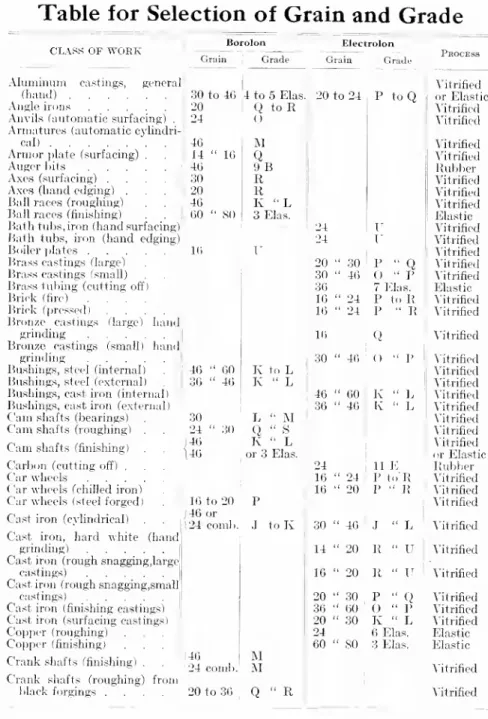
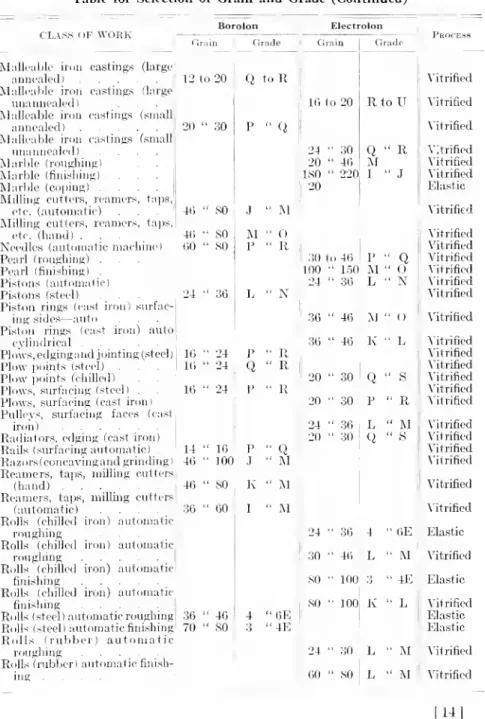
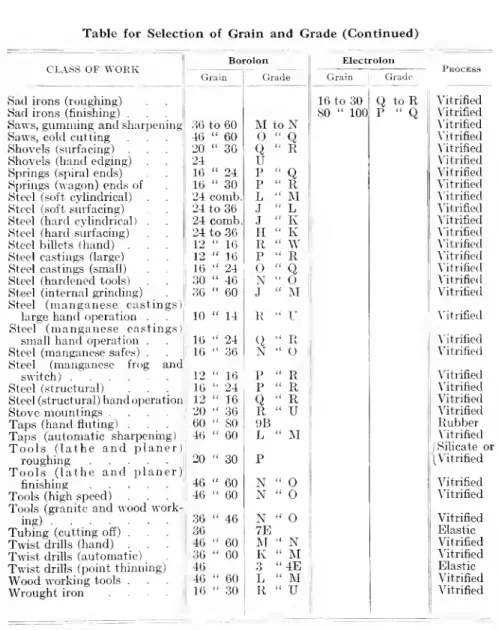
--Table for Selection of Grain
and Grade
(Continued)Testing
for
Safety
THE
systemadopted
l\vthe Al)iasive (Vjmi:)anyforthe testingof giiiuUiiii; wheels is
most
thorough. Ever}' possiblepre-eaution is taken to deteet flaws, cracks, etc. Besides close
inspections, the wheel is subjected to severe centrifugal strains on
specially constructed testing machines, such tests exerting double
the strain given
when
the wheel is operated at anormal
speed.These
special testingmachines
are eciuijiiied with tachometers,which
accurately register the numl)er of revolutions atwhich
eachwheel is tested.
The number
of re\'olutions each wheel is to betested is mai'ked on the
manufacturing
order. After each wheel istested theoix-ratorsignshisinitialsantldate on such order
and marks
the wheel as being tested.
He
alsomakes
record of such teston
s|)ecial
form
(c()py ofwhich
issliown on the following page) towhich
he sweai's.
When
inspection ismade
of the wheels the tester'smark
must
show. This is furtlier guarantee tliat the wheel has beentested. Recoi'ds of test are kept for reference. Th(>se records contain dimensions of the wheel, grain, grade, factory order
number:
also state the numlier of revolutions wheel
was
testetl. Afterwheels
have
been subjected to such testsand
inspections, it can f)eassumed
they are s(jundand
safe for operation.Wheels
do notbreak on account of inherent
weakness
or defects, l:)ut ratherfrom
rough handling in transit,
nnproper
mounting, allowing the wheelto run athigh speeds
when
out of true, or catching thework between
rest
and
wheel.Instructions regarding the use
and
care of wheels, onPages
24 to 26, will help
you
to avoid accitlents.Booklet entitled "Safety
Code
for theUse and Care
ofCirind-ing
Wheels,"
as adoptedby
the GrindingWheel
Alanufacturers inthe United States, will be sent
upon
I'cciuest.Laboratories
A
chemical laboratory is maintained liy the A))rasiveCom-pany
for the testing of all materials used. Close chemicaland
phys-ical examinations of all
raw
nraterials insure us a uniform product.We
are constantly doing research woi'k,which
is of valuableassistance to our customers
and
serves to constantlyimprove
all of our products.Facsimile
of
Testing
Sheet
Report
ofwheels
tested 19I
hereby
certifythat
Ihave
personally
revolved
the
wheels
listedbelow
at
the
number
ofrevolu-tions
shown
thereon,
same
having
withstood
the
testwithout
developing
any weakness
or
defect.Tester
cl6
Order
To
ABRASIVE
COMPANY
Date
Philadelphia, Pa.
Charge to OrderNo.
Address
For OrderNo.
Shipto
Send
ViaAddress
Price
Terms
Letter
Salesman'sOrderNo. Refer Report
REMARKS
whenselection ofgrain and gradeistobe made byfactory,givecomplete
descrip-tion ofoperationinspacebeloworonseparate reportform. Tfiismustinclude kindof
material; size and shape of pieces; whether off hand, with or without steady rest,
cylindrical or surfacing; wet or dry; make and type of machine; spindle speed and
speed of work; amountof material to beremoved andfinish desired; give grainand
grade of competing wheel, with results; and when possible send sample piece of
satisfactorywheel.
Salesman
((
Ti
Ordering
HE
outlineon
oppositepage
is a facsimile of tlie orderblank
we
have adopted and
isrecommended
to ourcustomersand
the trade in general.To
enable us to fillan
orderintelligentlyit is necessary for us to
have
the informationcalledfor intheblank,
and
if properlygiven, aidsus verymaterially."Wheel
Speeds"
and
"Work
Speeds"
are of vitalimportance
in cjdindrical grinding. Differences of speeds cause big differences
in the
working
of wheels.Speed
is a very important factor ingrinding.
When
we
know
actual conditionswe
are in a position torecommend
the speed atwhich
a wheel should be run to give best results.We
often receive orders for wheels, giving only diameterand
thickness, noteven
giving size hole required,and no
descriptionof the work, simply stating "for iron."
We
do
notknow
whether
]
the wheel is required for grinding pistons, burring castings or
sur-f'^ facing plates, all of
which
could bemade
of ironand
each recjuiring",''
I
a different grade of wheel. Different wheels are required for
dif-t j I ferent operations,
and
it is a matter of vital importance for us tohave
as full a description of thework
as possible.WHEN
ORDERING
PLEASE STATE
Quantity
required.Diameter
of wheels.'^' Thickness
of wheels. If
cup
wheels, state width over all,thickness of
rim
and
thickness ofback
or base. If cylinders, statewidth
over alland
thickness of rim.Diameter
of arlDor hole.Shape
of wheel. If irregular in shape enclose sketchshowing
all dimensions. If no shape is stated
and
only dimensions given arediameter, thickness
and
arbor hole, it is understood plain, straightwheels with flat sides
and
square face are desired.Whether
the wheels are to grind flat surfaces or edges.Whether
the wheels are to be usedon
amachine which
holds thework
rigidly to the wheel oron one where
thework
is held tothe
wheel
by hand
or spring pressure.Whether
the wheels are to be used with or without water orother fluid.
Description of
work
to be ground; nature of the metal to beground, wrought, cast or malleable iron,
hard
or soft steel, brass,etc., also shapes
and
weights of piecesand whether
a fine finish isdesired or not.
Speed
ofspindle, i.e.,number
ofrevolutions it turns per minute.Whether
thework
is to be revolved,and
if so, atwhat
speed.Remove
the grade tagson
wheelsand
retainthem
for future reference.-Mounting
Thiscutshowstho proper
way
a \\licclshould be
mounted
Thebearino;ison Ilie
outer ('d<ii' of the
flan.ncK. Flanges
should be slightly
recessedsoas toleave
ample
clearance.We
neverI'econi-mend
the use of straight, flat flanges.Do
notmountwheelswithout flanges. If
mountedwitlisunply
a mil it is halile to crawl and break the wheel.
Do
notscrewnut too tight, just
enough to ])revent
slipping.
Do
notcrow
dw
heel on arbor,thewheelmay
be crackedorthrown
out of balance.
Do
^
CLEARANCE
BLOTTER -^ BEARING
notmountunlessif is
found to be an easy
fit. Always tap a
wheel lightly with a
hammer
Ijeforemounting, and if it
doesnot "ring clear"
donot useit.
Use some soft jiad
oneachside ofwheel. .A.BR.\sivE wheelsare labelledwithblotters
which are sufficient. It is wise to have
one
man
mount allthe wheels,keeprests ])roperlyadjusted,oil
the
machines and
keep wheelstrue.Useahoodfor pro-tectionwherever
pos-sible. Wheel should run towardthe oper-ator.
Minimum
Sizes ofMachine
Spindles
inInches
forVarious
Diameters
and
Thicknesses
ofGrinding
Wheels
Diameterin Inches 6 7 10 12 14 16 18 20 24 26 30 36 1 1"
n
Thicknessof Wheelin Inches
1 1.;
n
1:]' 2 l2ii2i'2f'
3 3;}
3^
4 :4i; 51
u
i;n
n
V.n n
n n
If If 3 4\/a'--The
Machine
USE
heavy machines and have
them
firmlyseton
sohdfounda-tions. Users of wheels are particularly cautioned not to
run
them
on shaky machines
noron machines
inwhich
thespindles
have
become
looseinthe bearingsfrom
wear. Vibrationis wastefulof both wheel
and
power.Keep
the grinder clean. Dirt, oil or grease on themachine
means
a dirty wheel.Collars or flanges should be at least one-thhxl the diameter of
the wheel. Smaller ones
do
not hold wheel firmly or safely.Use
recessed flanges sothattheouter edgesofthe flangescome
incontactwith the wheel.
Spindles should be
amply
large. Holes arerecommended
.005inch full.
Too
light a spindle will springand
prevent true running.Use
rests strongand
rigidand
keepthem
close to the wheel,otherwise the
work
may
drop
between
the wheeland
restand
cause the
wheel
to break.We
feel safe in saying that seventy-fiveper cent of breakages are
due
towork
being caught in thismanner.
Keep
bearings well oiled.Heating
and
consequent expansionof spindles
have
caused breaking ofwheels.Protection
Flanges
for
Safeguarding
Grinding
Wheels
WHEN
grinding operationsdo
not permit the use ofpro-tection hoods,
we
recommend
the single or double taperedside wheel, ])rotected
hy concaved
flanges.These
flangesshould be recessetl at the center. Sec
accompanying
table.They
should l>e
made
of steel if over 10 inches in diameter; less than 10inches
may
bemade
of cast iron.We
recommend
that they bemade
i^4 inch taper to the foot. This offers
ample
protection in caseofwheel breakage. All flanges should be accuratelj^ turned, correct
to dimen.sions
and
in Ijalance.Both
flanges in contact with thewheel should be of the
same
diametei-.As
the wheel wearsdown
indiameter the flanges should be
changed
toconform
with the sizewlieel
—
as given in tal)le l)eIow.Table
ofDimensions
ofTapered Flanges
and Tapered
Side
Wheels
Where
Hoods
are
Not Used
A
—
Maximum
flatspotat centerof flange.B
—
Flat spot at centerofwheel.C
—
Minnnum
diameterof flange.D
—
Minimum
thicknessofflange at bore.E
—
Minimum
diameterofrecessintaperflanges.F
—
Mimmum
thicknessofeach flange for singletajjerat bore. iametor ofWheel;' ^ )
((<
"( '_
> 1
i I
Protection
Hoods
for
Safeguarding
Grinding
Wheels
PROTECTION
HOODS
shoulil be usedwherever
possiblewith wheels not provided with protection flanges.
Hoods
should be designed
and
consti'ucted of a material sufficientlystrong to retain allpieces ofa broken grinding wheel.
Hoods
shouldconform
as nearh' as possible to the periphery of the wheeland
should be so designed as to leave exposed the least portion of the
wheel
compatiljle with the work,and
should be of the adjustabletypeorprovided with a slidingtongue, or similardevice, ora
method
of contracting the rim for the piu'pose of closing the opening in the
hood
as the wheel is reduced in diameter, to affordmaximum
pro-tection at all times. Protection
hoods
should be securely fastenedto the grinding
machine
or floor.Protruding ends of the wheel arbors
and
their nuts should beguarded.
Although
rigid inspection ismade
of all AbrasiveCompany's
products before leaving the factory, nevertheless there exists
the possibility of wheels being
broken
by
accident; thereforewe
strongly
recommend
the use of protection hoods.Table
ofDimensions
ofStraight
Flanges
tobe
Used
inConnection
with
Straight
Wheels and
Protection
Hoods
C
D
Use
and Care
of
Wheels
USERS
of wheelssometimes complain
of theii' beingunsat-isfactory without investigating speed at
which
they are operated.A
wheel will appear toohard
and
glaze if runat excessive speed, while at proper speed it
may
be satisfactory.Again, if run at a very low sjjeed, it
may
appear too soft. Speed,therefore, is a very important factor.
When
above
conditions arise,change
the speedand
it will often give satisfactory results.If a wheel is unsuited for the work,
do
not use it; allow us toexchange
it forone that isadapted
to thework. In such cases, giveus full information
why
it is notsatisfactory.Avoid
heavy
pressureagainst the wheel
and
be sure tokeep ittrue.For
this purposehave
a dresser ready to use
when
needed.Do
not try to do all kinds ofgrinding with the one wheel.
One
size of twist drill will not boreallsize holes; neither will one kind ofa grinding wheel do all classes of
work
satisfactorily. It iseconomy
tochange
wheelsand
use propergrades that suit the woi'k.
A
wheel thatthumps
does not cuton
its entire peiiphery,and
it is possible to
have
a wheel so badly out of true that it will lose avery large percentage of its cutting power.
It is wise to use a wheel for each class of work.
The
"generaluse"
wheelmay
be handy, but it is like thatman
who
is"Jack-of-all-trades
and master
of none."Incr-ease the speetl as a wheel decreases in diameter, otherwise;
it
may
appear soft towards the center.Do
notcrowd
the wheel.Iftoo soft, it will
wear
away
fast without doingany
more
work.Never
use a wheel at a higher speed than the manufactur(>rrecommends.
A
surfacespeedof .5000feetperminute
isrecommended
as a safe grinding speed for grinding in general. See that the speed does not vary. It is
sometimes
not thesame
at all hours.Don't
blame
the wheel for everything.Sometimes something
else
may
l)e wrong. Don't tell themanufacturer
a wheel is"no
good."He
can helpyou
much
more
ifyou
say whj' itis
no
good.Don't w(jrk
on
anew
wheel untilyou
are sure it runs true.Never
"hack"
wheels, as it is liable to break or crack them.Use
a dresserfor this pui-pose.I
' ;1
The
usermust
realize that a grinding wheelwhich
is requiredto cut fast, consequently to
wear away,
cannot possibly bemade
as strong as iron or steel. It, therefore,
must
be handledaccord-inglj^ with care
and
precaution.The
most
common
causes of accidents are—
catching thework
between
the wheeland
rest; heatingand
expansion of arbor; usingflanges too small; screwing
them
too tightand
not havingthem
properly recessed so that they bear
on
the outer edge; not usingany
flanges,but
simply screwing a nut against the wheel, allowingthe arbor to
become
loose in boxesfrom
wear;and
running wheelson
shaky
machines. Against all these conditionswe
particularlycaution all users of wheels.
The
stresson
the wheel at a speed of 9000 surface feet perminute
isabout
250pounds
per square inch,and
as the stresson
awheel
running at5000
surface feet perminute
isabout
80pounds
it will be seen that
when
wheels are tested at a speed of9000
feetper minute, they are subjected to
more
than
three times the strainthey
would
receive atrecommended
running speed.Wheels
should not be run in excess ofrecommended
speeds.As
the centrifugal force of abody moving
with different velocities in thesame
circle is proportional to the square of the velocity, itwill be seen that if the velocity is doulsled, the centrifugal force
would
be four times as great, hence theimportance
of not runningwheels at a faster speed
than
isrecommended
by
the manufacturer.The same
peripheral speed should be maintained as the wheeldecreases in diameter. In other words, the speed of the spindle
should be increased correspondingly as the diameter of the wheel is
decreased.
The
increase of the peripheral speed as the wheel wearsaway
can be accomplishedby
means
of a variable speedcounter-shaft or cone pulley
on
the grinder, or bj^ transferringfrom
a largergrinder to a smaller one as the wheels
wear away.
The
lastsystem
has decidedadvantage
and
is highlyrecom-mended
whenever
there is sufficientamount
of grinding towarrant
the use of
more
than
one
machine.These
grinders should thenhave but
one pulleyon
the spindle,which
removes
all possibility ofstarting a
new
wheel,when
full diameter, at the higher speed.When
the single pulley S3rstem is notemployed,
great careand
precaution should be taken to always start a
new
wheelon
the lowspeed.
Don't start the grinder until
you
Icnow the speed is right—
not"near
enough," but right.Even
a slight variation in sj^eedmay
bethe cause of success or failure of
any
wheel. Failure issometimes
turned into success
by
merety
changingthespeed ofeitherthewheelor the work.
Do
not use a grinding wheel like a piece of cast iron. It ismeant
for work, Ijut not alnise.Do
not use hard wheels because they last longer.A
fast-cutting wheel is themost
economical inthe end, even if it does weai-
away more
rapidly. ()utputdeter-mines
economv.
General
Remarks About
Wheels
^Scompared
withany
other cutting tool, the successfulgrind-ing wheel possesses one interesting characteristic peculiar
to itself
—
that of sharpening itself while it works.When
properly
made
and
selected, the grains on the surface of the wheel,as they
become
dulled, are either l:)roken or pulled outunder
thestress of the work, thus continually presenting new, sharp cutting
points.
A
wheel is, therefore,more
efficientwhen
softenough
tocut freely
and
yet not hardenough
to glaze.The
use ofmodern
grinding wheels has been extendedfrom
grinding a comparatively few metals to practically all metals.
They
are also used to grind such materials as bone, horn, pearl,rubber, marble, bronze, stone, wood, etc.; in fact, almost
any
material.Increasing the surface sjieed of a grinding wheel decreases its
tendency
towear
away,
and
conversely, decreasing the surfacespeed increases its
tendency
towear
away.Grinding wheel manufacturers occasionally hear the complaint
that the wheel has "soft spots." If the user will
mark
the wheelwhei-e he thinks the "soft spot" is
and
then "true thewheel"
and
grind with it again, he will invariably find that the "softspot" has
moved
alongto another pointon
the wheel.Such
com-plaints aremost
likelydue
to the wheel running out of true orout of balance.
I
.
't : , * -'-- '
Rules
for
Calculating
Speeds
and
Diameters
of
Pulley
Proposed
speed of g-rinding spindle being given, to find properspeed of countershaft.
Rule: Multiply the
number
of revolutions perminute
of thegrindingspindle
by
thediameterofits pulley,and
dividethe productby
the diameter of the driving pulleyon
the countershaft.Example:
The
driving pulleyon
the countershaft is 20 inchesdiameter, the pulley
on
the grinding spindle is 8 inches diameterand
makes
800
R. P.M.
How
many
R. P.M.
does thecounter-shaft
make?
800X8-20=320
R. P.M.
Speed
of countershaft given, to find diameter of pulley to drive grinding .spindle.Rule: Multiply the
number
of revolutions perminute
of thegrindingspindle
by
thediameterofitspulley,and
dividetheproductby
thenumber
of revolutions perminute
of the countershaft.Example:
The
pullej'on
thewheel spindle is 6 inchesdiameterand
shouldmake
1400 R. P.M.
The
countershaft runs at a speedof650 R. P.
M.
How
largeshould the driving pulleyon
thecounter-shaft be?
1400X6-^650 =
13 inches diameterof driving pulleyon
counter-shaft.
Proposed
speed of countershaft given, to find the diameter of pulley for the line shaft.Rule: Multiply the
number
of revolutions perminute
of thecountershaft
by
the diameter of the tightand
loose pulleys,and
divide the product
by
thenumber
of revolutions perminute
of theline shaft.
Example:
A
line shaft I'unning 231 R. P.M.
is to drive acountershaft 660 R. P.
M.
The
driven pulley on the countershaftis 7 inches diameter.
What
diameter should the driving pulleyon
the line shaft be?
7X660 =
231=
20 inches diameter of pulley on line shaft.General Principle Used to
Determine
Speedsand
DiametersThediameterofanydrivenpullej'multipliedbyits speed in feet per minute always equals the diameter of the driving pulley multiplied by its speed in feet per minute.
Rules
for
Obtaining
Surface
Speeds
To
find surface speed in feet perminute
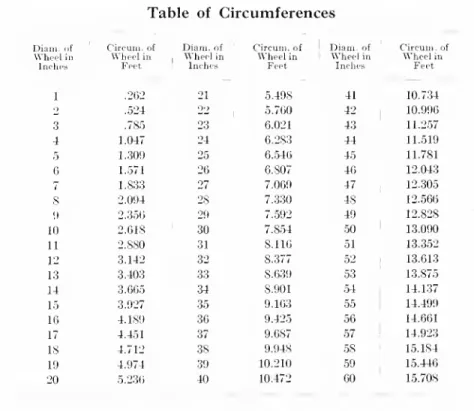
ofa wheel:Rule: jNIultiply the circumference (seetable below) bj' its revo-lutions perminute.
Example:
A
wheel,20 inchesdiameter, makes9.55R. P. I\I.What
is the surfacespeed infeetperminute?5.236X955=.5000feetsurfacesjieed.
Surface speed
and
diameter of wheel Ijeing given to findnumber
ofrevolutions ofwheel spindle.
Rule: Divide surface speed in feet per
minute
by
thecirciunfer-ence. (See table below.)
Example:
A
wheel, 14 inches diameter,is to be run6000 feetsurfacespeed per minute.How
many
revolutions should thewheelmake?6000-h3.665=1637,number of R. P. M. wheel shouldmake.
Table
ofCircumferences
Diani..if
Wheelill
A
-5.V--Table
of
Grinding
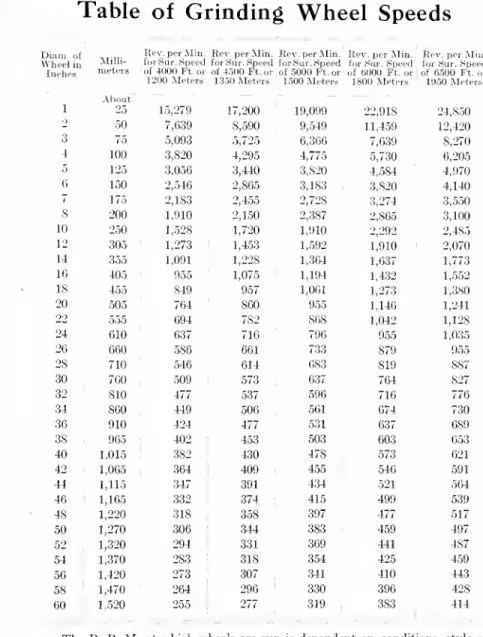
Wheel
Speeds
Diam.of
Wheelin
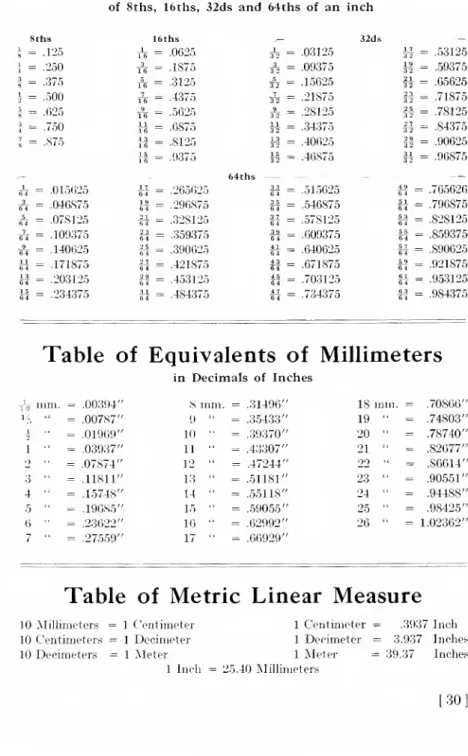
Table
of
Decimal
Equivalents
of 8ths, 16ths, 32ds
and
64ths of an inchm>'p-,•1 r i(
y
!
Straight
Wheels
Rules for Calculating List Prices
Diameter
—
Wheels
with diameters less than 1 inch take thelist of a 1-inch wheel.
Wheels
with diameters representedby
odd
inches or fractional parts of inches, intermediate to diametersshown
in list, take thelist of the next larger diameter.
Example:
A
wheel 5i" diameter takes the list of a 6" wheel, andawheelI25" diameter,or 13" diameter, takes thelistofa14"wheel.
r)\ '
Thickness
—
Wheels
thinner than one-quarter of
an
inch takethe list of a
wheel
one-ciuarter inch thick.Wheels
with thickness intermediate to thoseshown
in listtake the list of the next thicker wheel.
Example:
A
wheel 2|"thick takes the hstofa2j"wheel.Wheels
thicker than 4 inches are figured proportionately to the4-inch thickness; thickness to increase
from
4 inchesby
cjuarterinches,
and
intermediate fractional parts of inches to be figured atnext higher quarter of
an
inch.Example: Tofindthelistprice of a'SO"x7f"wheel, take thelistofa .30" x 4",whichis.$174.00,dividethisbyfourand
multiplybyTJ", whichmakesa listprice of .1326.25.
Hole
—
An
allowance ismade
of one-third the list value of awheel represented
by
the diameter of a hole 12 inchesand
larger.For
holes lessthan
12 inches in diameter, orfor countersinks ofany
size,no
allowance ismade.
Example:
To
findtheprice of a 24x 2 x 14"wheel, take thelistofa24X 2",whichis .$.59.00,deductfromthisone-third the price of a 14 x2", or one-thirdof .$21.20, whichis $7.05. $7.05deducted from.$59.00givesthelistprice fora24x 2 x14" wheelas.$51.95.If the diameter iif a, hole is represented l)y
odd
iiieh(\s or frac-tional parts of inches notshown
in list, the next smaller diameteris taken as representing the diameterof a wheelfor
which
allowanceis
made,
the thickness of such a wheel to be thesame
as the wheelfrom
list ofwhich
the ileductionismade.
Exniiiiih: Tilfind the list (it:il!4x 21x 15:J"wheel, take
tile list of a 24 X 2\" wheel, or -St )").(Ml. Take fi-oiii this
one-thii-d the ])i-ici> of a 14 x 21" wlic(4, or one-third of .12:5. .50,
which is $7.,sr). .ST.S.'i deducted from $6.5.(10 ^ivcs the li.st
|)rice of a 24 x 2^ x 1.5:|" wheel as .So?.15.
Straight wheels with raised dovetails take the list of a straisht
wheel based
on
thickness at the face.Taper-Side
Wheels
Wheels
tapered onboth sides, either \ inch or f inch to thefoot,take the list prices of taper-side wheels
shown
on Pages 37and
3S.For
wluH'ls with taper on one side onh', either \ inch or i inchto the foot,
add
one-half of the difi'ei'encebetween
the list price of .straio'ht wheelsand
taper-side wheelsshown
in taper-sitle ])i'ice list.Exfiniplr:
\
24 x 2" wheel ta|)ered one siile only, :{" to theloot,takes alistprice of (jne-half the difference tjetween a 24 x 2" straightwheel, .1.59.00, and a 24 x2"taper-sidewheel(\" tothefootj $74.00, or.'I7..50addedto $59.00,making.166.50 list price.
A
wheel with sides tapered less thtui s incli i)erfoot will take tlielistof a wheel with \ inch per foot tapered sides, while a wheel with
sidestapered
more
than h inch per foot will take the list ofa wheeltapered i inch per foot.
li I
Price
List—
Straight
Wheels
Diani. in Inches 10 12 14 16 18 20 22 24 26 28 30 32 34 36 38 40 42 44 46 48 50 52 54 56 58 60
Subject to Discount
40 60 80| lo' 50' 90 30 70 10 60 2o; 90 70 60 1.50 .75 1.00 1.40 1.90 2.40 2.95 3.55 4.15 4.90 6.00 7.20 8.70 10.30 12.30
Thickness ofWheels in Inches
$.60 .90 1.20 1.65 2.25| 2.90 3.60 4.40; 5.20 6.20 7.80, 9.60 11.60 14.00, 16.80 20.10 24.00 1 $.70 1.00 1.45 1.95 2.65 3.40 4.30 5.20 6.30 7.50 9.50
Price
List—
Straight
Wheels
Subject to Discount
;\./((C.-:;C
[i '.
Price
List—
Straight
Wheels
Subject to Discount
Diam. ] Thicknessof
Whe!;;i.s in In<;'hes
in '
__
^"'^''^
[ 4i Ai_ 4| : 5 5i 5^ 5J ; 6
12 $32.85 $34.75 $36.70 $38.05 140.55 $42 50 $44.40 $46.35 14
Price
List—
Straight
Wheels
Subject to Discount
Diaiii,
(
' ( *
n
^7~er^efperf^.Price
List—
Tapered
Wheels
-inch Taper,
Two
Sides Subject to DiscountDr.\METER
In. Mm. ' I"-'4
AI 111.-h $5.10
0.20 7.90 10.20 12.60 10
o
^Taperper/i*.Price
List^Tapered
Wheels
/^-inch Taper,
Two
Sides Subject to Discount'-.I
Method
of
Calculating
List
Price
of
Rubber
Wheels
Diameter
WHEELS
with diameters less than 1 inch take the hst ofa 1 inch
wheel
Wheels
with diameters represented b}' fractional partsof inches, intermediate to diameters
shown
on list, takethe list of the next larger diameter.
Thickness
Wheels
thinner than I ofan
inch take the list of a wheel I inchthick.
Wheels
with thickness intermediate to thoseshown
in list takethe list of the next thicker wheel.
Wheels
thicker than 4 inches are figured proportionately to the4 inchthickness;thickness to increase
from
4inchesby
quarterinches,and
intermediate fractional parts of inches to be figvu'ed at nexthigher i of
an
inch.Hole
An
allowanceismade
ofone-half the listprice of a wheelrepre-sented
by
the diametci- of the hole 6 inchesand
larger.For
holesless than 6 inches in diameter, or for countersinks of
any
size, noallowance is
made.
If the diametci' of a hole is represented
by odd
inches, orfrac-tional parts of inches not
shown
in list, the next smaller diameteris taken as representing the diameterof a wheelfor which allowance
is
made,
the thickness of such a wheel to be thesame
as the wheelfrom
list ofwhich
the deduction ismade.
Inthe caseofarubber wheel
mounted
on anironcenteranallow-ance is
made
in the list price of the wheel (as above) for a hole thesize of the iron center, lugs
and
dovetails not included.The
price ofrubbercup
wheelsis figured in thesame
manner
asvitiified
cup
wheels.The
price of rubber cylinder wheels is figured in thesame
manner
as vitrified cylinder wheels.Price
List
—
Rubber Wheels
Cup
Wheels
THICKNESS RIM
THICKNESS BACK
Cup
Wheels
Rules for (calculating List Prices
The
cup\\'h<H>l piicclisl isbased on cup.s with tliesame
hackaiulrim thickness.
A
wheel S inciies ormore
outside diamet<'i', 4 inches ormore
inheight, with an inside
cup
diameter of not less than 6 inches,and
arim thickness not exceechng 4 inches isfigured as a
cup
wlieeh (Aipswith <)utsi(k' projections, or ta])ered rims, take tlie hst of the
maxi-mum
(hamet(n'and
maximum
thickn(>ss of rim.Eiiniiple: \ cup 24"diameteraf to)), 7"high,witharim o" tliiekat thetop and having an outside projection of |"at the bottom, li.sts a.s a 2t; x 7xSi" cup wheel at $18(5.60.
Example:
A
taper imp 14121" diameter, 7" in height,witlirim tapering Ij"atfoj)to25"atthebottom,take.slistof a cu]) 14 X 7 X 25" rim and back, $5,S.0.5.
Cup
wheels with diameters intei'mediate to thoseshown
inlist take the list ofthe next larger diameter.
Cup
wheels with heights intermediate to thoseshown
in listtak(> the hst of the next high(>r cup.
E.raitiplr: Cup fij" higli H.stsas 7".
Cup
wheels with rim thickness intermediate to thoseshown
inlist take the list of the next thicker rim.
E.rainpU': \\" rim takes list of 1.1"rim.
Cup
wheelsmore
than S inches in height are figiu'edproportion-ately to the S-inch height for
any
listed diametei'.Heights of cups increase
by
1 inchfrom
S inches,and
interme-diate heights take the list of the next higher inch.
Exiiiiiple: A cup 2.S"diameter, S"liigh,witli -i"rim, lists
at S240.9.5.
A
cup of same diameter and rim thickness, but 9"high,wouldtakeanadditionallistofiof.$240.95or $30.10,makinga totallistforthecup 28"diameter, 9"high,3"rimof $271.05.
Backs
—
A
price per inch or fractional piirt ofan
incli is sliownin listfollowing
"Back
per Inch," for figuring the list piicc of acup
wheel
withback and
rim of different thickness.Cup
wheels with backs varying in thicknessfrom
that of theirrims to the extent of fractional parts of inches take the list of the
next higher inch in thickness.
Example: The list of an S" cup wheel, 4" high, with 1"
rimand 1" back, is$16,211. Priceper inchforbacksofgreater orlessthickness is .1.6.5. If a Ij" or 2" backisdesired, add
•S.65to the list price for awheel with 1", making list .$16.8.5.
Example: The list of a 16"cupwheel, 7" high, with 2J"
rim,and 2^" backis$74.0.5. Priceper inchforbacksofgreater or less thickne.ss is $2.25. If a 1" or II" back is desired,
deduct $2.25 from the li.st price for wheels with 2^" back,
makinglist$71.80.
For cup
wheelsmore
than 8 inches in height, with thickness ofthe
back
varjdngfrom
that of rim, calculate first the list for heightand
thenmake
proper additions or deductions for back.Example:
A
cup 14"diameter, 9"high, 2"rim, 3"back.Thelist price ofthecup 8"highand 2" backis$63.60.
Add
one-eighthor .17.95, which amounts to $71.55, plus $1.85 for the extrathickne.ss ofback,whichmakes theprice$73.40. Ittheback were 1"thick, $1.85would bededucted from$71..55.
If the back were between 1"and 2" thickness, no allowance
woidd bemade.
The
back
of acup
wheel is representedby
any
projection insidethe cup,
whether
it isin theform
ofa small shoulder, ]-aised dovetailor complete back.
For
backs lessthan
1 inch deductionsfrom
listdown
to 1 inchonly are allowed,
and
made
only in full inches.No
allowance ismade
for holes in backs of cup wheels,regard-less of diameter.
Price
List—
Cup
Wheels
1^^.ect to
iscount
Diameter
in
Inrhes
Baek Height
10
12
14
Bacli
16
Baek
18
30
Thickness of Him and Hack in Inches
Cylinders
^'"'"'it
I,, i^J THICKNESSRIM
mi
Cylinder
Wheels
Rules for Calculating List Prices
A
wheel S inches ormore
outside (liainetci', 4 inches or luorc iniieishl, wilh a hole n(jt less than 6 inches in diameter, rim thickness
not exceeding 4 inches
and
without inside projections, is figuredas a c\dinder.
A
wheel of (his type with inside projections is a cuj) wheel.A
cylinder with outside projections or with tajjered rims takesthe list i^rice of the
maximum
diani(>terand
theniaxhuum
thicknessof rim.
Exiiinplc:
\
taper cylincicr 12" U)" (liaiiiclcr, d" inhciiiiit, with a rim taper 1" at top to IV' at l)ott(]in, takes a
list ofVI X (iX i;" wlieel,$:-;l».10.
Exiiniph:
\
eyliiider Hi"indiameterat top,.5"high,witlia rim '1" thicl< at the top, and with an oidside
iji'ojection at tlie Ijottoni of one-half an iiieli, lists as an IS x .0 x 2'," rim,
or.$.59.70,
(
'ylinder wheels with diametei's interme(liate t(j those
shown
on list take the list of the next lari^er ditinieter.E.miiiiilc: .\ eyliniler II" (jiaiijeter takes tltelist ])rieeof
a 12".
<'>'hnilers with lieisjhts iniermediate to those
shown
in list takethe list of tlie next hiu;hei' c>-linder.
Exiiiii/ilf: .\ cyllndei' >]" in height takes 6" list.
('ylinder wheels witl) rim thicknesses interuK^diate to thosi'
shown
in list take the list of the next thicker rim.Ex(im/il(': \ pyiinder with 1]" rim takes the list priei"of a 1V' rim.
(
'ylinders nKjre than S in(4res in lieight are figured
propor-tionately to the S-inch height for ;uiy listed diameter. Heights of
cylinders mcrease l)y 1 inch
from
8 inches,and
intermediate lieighlstake the ]:)rice of the next higher inch.
Exniiiple: .\ cyhiider2(1" in diameter, S" in lu-ight, witfi
2" rim,listsas.'iflOO.!)').
A
cylinderofthesamediameterwith rim lieig'ht 9" would take an additional list of one-eighth of $166.9.5 or*2r).S."),makingtotallist foreyhndei-26x 9 x2"rim, $187. SO.Price
List—
Cylinders
Subject toDiscount
Special
Shaped
Wheels
THE
differentmakes
of special grindingmachines
rec|uire specialshaped
grinding wheelswhich
are classifiedand
illustrated
on
the following pages. Intlex to these willbe
found
on Pages 12-iand
125. Practically all of the diffei-entspecial shapes
shown
are modifications of straight wheels, cups, cylinders or saucersand
the list prices are figured according to the respective class.In aiklition to the various sizes
and
shapes shown,we
areprepared to furnish grinding wheels of almost
any
size or shapefrom
4S inches diameterto 10 inches thick forany
make
of grinding machine.Inquiries for price of special wheels not sh(nvn should be
ac-companied
by
sketch .showing shapeand
dimensions recpiired,and
include full information icgarding type of machine, kind ofmaterial to be ground,
amount
ofstock to l)e remo\'e(l, finish desired,
speed of wheel spindle,
and
speed (if work."Abrasive"
Wheels
are furnished intwo
kinds of abrasive materials—
Borolon or Electrolon.Each
is matle inmany
differentcombinations of grain
and
grade, selected to suit the particularconditions
under
which
it is to l)e used.Wheels
forNorton
Plain
Grinding
Machines
Machine
D
6 Inch 14
6 " 14
10 " IS
10 " IS
14 ' 20
18 " 24
15 "
Gap
24 .SurfaceGrinder 15x15 inches 14T
2 1H
5 5 5 5 5 5Code
Nordland Nordpol Nordwest Norther Nosegay Nostril Novelty .Noward List Price $21.20 11.90 32.50 17.70 39.60 59.00 30.60 30..50 IS-InchGap
D
24T
31H
5 Nourished 113.00
44-InchSteam CarWheelGrinder
D
24H
5 Noxious 78.00
Wheels
forNorton
Surface Grinding
Machines
SurfaceGrinder 15 x 15Inches 14 " " 15X 15Inches 14 15X 15 Inches 14
Wheels
forNorton
Plain
Grinding
Machines
-D-M\(HixE
D
T
H
(.'ode ListPkk-e44-Inch Street CarWheel (iriiuler 24 2| 5 Nugget STS.OO
Wheels
forNorton
Crankshaft Grinding
Machines
Wheels
forNorton
Crankshaft Grinding
Machines
(Continued)
Shape
D
Norton S4 24 85 24 86 26 87 26 88 26 89 26 90 26 91 26 92 26 93 26 94 26 95 26 96 26 97 26 98 26 99 28 100 28 101 28 102 28 103 28 104 28 105 28 106 28 107 28 108 28 109 28 110 30
1 I I
111 112 30 30 113 30 114 30 115 30 116 30 117 118 30 30 119 30 120 30 121 122 30 30 123 30 124 30
T
J13. ^32 2i 21 2f 2J 3i 31 3i 31 3! •Js 4 2^ 91 3 31 3i 31 31 31 3 1 31 4 3i 31 3^ 3t 3f 31 4 41 41 41 4i 41 4f^
5H
12 12 15 15 15 15 15 15 15 15 15 15 15 15 15 15 15 15 15 15 15 15 15 15 15 15 20 20 20 20 20 20 20 20 20 20 20 20 20 20 20K
Code
1^-^1fi
1ii J32 125 -1-3 2
lA
lA
lA
A16 i16 113. J^16 A16lA
lA
lA
lA
-L16 i16 ^16 1^-iH
IIm
iin
n
n
n
n
iin
n
n
n
141 141 17i 171 17i 171 171 17i^ 17-1 17^ 171 17| 171 17^ 171 171 17| 171 171 171 171 17i 171 171 171 22J: 221 221 221 221 221 221 221 221 221 221 221 22' 221 991 Notoriety Notorious Nouement Nourish Nourishing Nourrisson Nourriture Nouveaute Novacuhte Novice Novelador Nustle Nutation Nutbrown Nutcracker Nutgall NuthatchNutmeg
Nutpecker Nutrient Nutrifical Nutriments Nutshell Nutting Nymphlike Nursling Nimbleness Nimiety Ninada Ninepins Nigira Ninny Nipper Nippingly Nitouche Nitrify Nigidie Nitrous Nivelar NoblenessNobody
List Price $89.90 96.30 76.40 83.60 83.60 90.85 90.85 98.05 98.05 105.30 105.30 112.50 112.50 119.75 119.75 92.60 100.85 100.85 109.05 109.05 117.30 117.30 126.50 126.50 134.75 134.75 122.15 130.65 130.65 140.15 140.15 148.65 148.65 157.95 157.95 167.25 167.25 176.55 176.55 185.85 185.85 i .51Wheels
forBrown
&
Sharpe
Grinding
Machines
»K-J.^
Wheels
forBrown
&
Sharpe Grinding
Machines
Shape
B
&
S 'AF,B
&
S :!(>B A-S 37
D
li li 1|
H
Code
ListPriceAhiUment $1.85
Ablution 1.85
Wheels
forBrown
&
Sharpe
Grinding
Machines
Shape
B &
S48Code
List PriceD
B
&
S 51 7B &
S 52 7B
&
S54 7D
B &
S 99 4iB &
S 100 Z\B &
S 101 31G.90 6.90
6.90
Wheels
forBrown
&
Sharpe Grinding
Machines
8hapk
D
B &
S .56 SB
CodeAbolir
ListPrice
$11.15
B
&
S.50 4 \blaturi 2.5.5B&S47
Ablatos 2.30f
L
Wheels
forLandis Grinding
Machines
—
D7-7
7
Wheels
forLandis Grinding
Machines
Wheels
forLandis
Grinding
Machines
Shape Landis 385 386 " 387 388 391 392 393 405 405D
18 14 20 20 24 14 14 24 24 4 5i Oilu
^^ 21 3 (Continued)Hi
71Hi
111 lOf 71 7i 10! lOfCode
Libonoti Libouret Librabis Libracao Liriope Lirismo Lirista Lirocone Lirfulia List Price $54.60 21.20 76.00 104.50 78.00 14.20 25.80 85.00 85.00 c: i }Wheels
forModern
Tool
Grinding
Machines
Machine
1
D
!''I"! ''' 'i\
\\i:
Wheels
forModern
Tool Grinding
Machines
(Continued)
Wheels
forModern
Tool
Grinding Machines
Wheels
forCincinnati Grinding
Machines
(CJontinued)
Machine
Universal and Plain (irindcr
Wheels
forWalker
Grinding
Machines
Shape
Walker 1
W
32
W
3^3
W
4^" 10
W,
coarse 6 " 30W,
fine 611
CuDK
WastuilWailfully
Wainage
Waltz
Whcatear
ListPrick
$1.00 1.40 1.90 2.90 2.90
Walker8
W
Wheels
forWalker
Grinding
Machines
Wheels
forWalker
Grinding
Machines
(Continued)
Wheels
forCincinnati
Universal
C.and
T.Grinding
Machines
Machine
Shai'E No. 1 Cincinnati 1No. 2 Cineirmati II)
No. 2 Cincinnati 11
No. 2 Cincinnati 12
Code Li> Cifjarettc Civility Clacking Clamber T Price .s ..so 1.1(1 2.40 4.'.ID No. 1 No. 2 Cincinnati<i Cincinnati'.I
D
H
Circus Civilian .40 .40 No. 1 No. 1 Cincinnati .5 Cincinnati 7D
6 8H
Circuit Citron 1.90 2.70No. 1 Cincinnati 2
Nrj.2 Cincinnatil.'i
No.2 Cincinnati14
When
so (jnlered, we furnish Nos. 1, 10.mounted on ste(4 l)usliings at anextra charge
^r\/'^^
iWheels
forCincinnati
Universal
C.and
T.Grinding
Machines
(Continued)
Machixe
ShapeNo. 1 Cincinnati 3
No. 2 Cincinnati 16
D
6
H
Code List Pricei Cimolite S2,90
J Clawing 3.40
Xo. 1 Cincinnati 4
D
tt'H
R
B
•-> ^2
2 16 16 45° Cinderv 3.40
D
\VH
R
B
Y
X(j. 1 Cincinnati 8 4
U
j } i 45° Civerunt 2.55Xo.2 Cincinnati 15 4 1; f i i ^5° Classic 2.55
tt'hen so ordered, «'e furnish the above wheels mounted on steel bushings at anextra chargeof 15centseach.
Wheels
forBath
Grinding
Machines
D Bath 1 10 11 25 42D
12 12 10 8 6 6 6 3 12 10 5 1? II 1? ItCODK
Besoin Biberist Binary Binding Biographer Birch Bitumen Bivalve Betray Basplv ListPrice 17.80 6.00 4.90 3.55 2.40 2.40 1.90 .80 9.50 (5.20 BathD
8H
It Binomial 2.70
BathS
D
6
H
1^ Birthday 2.40
Bath!)
D
6
H
H
Birthriglit 2.40Wheels
forBath
Grinding
Machines
(Continued)
Wheels
forBath
Grinding
Machines
(Continued)Shape
D
Bath 22 :;;
W
i;
li ('(11)10 ListI'uice
l~R -,
Wheels
forLeBlond
Cutter
and
Tool
Grinding
Machines
-, D ^
Shape
LeBlond 1
D
AA'M
R
B
Y
Code ListPrice5 l-i \
A
rs 45° Levigate S.3.40-^^^S^^^^^^^^^«
l< R'LeBlond2
LeBlond3
D
t)
H
B
Lf
Yt, J^fMIU(Ur
LeBlond4
5
Lewdly Lewdness
L85
;.40
2.40 ,80
When
soordered,wefurnishtheabovewheelsmountedonsteel bushingsatanextra charge of 15cents each.