
Dynamic Slicing of Aspect-Oriented Programs
Durga Prasad Mohapatra Department of CSE
National Institute of Technology Rourkela-769008, India
E-mail: [email protected]
Madhusmita Sahu Department of MCA
C V Raman Computer Academy Bhubaneswar-752054,India E-mail: [email protected]
Rajeev Kumar and Rajib Mall Department of CSE
Indian Institute of Technology Kharagpur-721302, India
E-mail: {rkumar, rajib}@cse.iitkgp.ernet.in
Keywords: program slice, aspect-oriented programming, AspectJ, dynamic aspect-oriented dependence graph (DADG), dynamic dependence slicing tool (DDST), trace file based dynamic slicing (TBDS) algorithm
Received:July 2, 2007
Program slicing is a decomposition technique which has many applications in various software engineering activities such as program debugging, testing, maintenance etc. Aspect-oriented programming (AOP) is a new programming paradigm that enables modular implementation of cross-cutting concerns such as exception handling, security, synchronization, logging etc. The unique features of AOP such asjoin-point,
advice, aspect, introduction etc. pose difficulties for slicing of AOPs. We propose a dynamic slicing algorithm for aspect-oriented programs. Our algorithm uses a dependence-based representation called
Dynamic Aspect-Oriented Dependence Graph(DADG) as the intermediate program representation. The DADG is an arc-classified digraph which represents various dynamic dependences between the statements of the aspect-oriented program. We have used a trace file to store the execution history of the program. We have developed a tool calledDynamic Depenedence Slicing Tool(DDST) to implement our algorithm. We have tested our algorithm on many programs for 40-50 runs. The resulting dynamic slice is precise as we create a node in the DADG for each occurrence of the statement in the execution trace.
Povzetek: Opisana je modularna gradnja objektno orientiranih programov.
1 Introduction
The concept of a program slice was first introduced by Weiser [26]. Program slicing [38] is a decomposition tech-nique which extracts program statements related to a par-ticular computation from a program. A program slice is constructed with respect to a slicing criterion. A slicing criterion is a tuple< s, v >wheresis a statement in a program and v is a variable used or defined ats. A pro-gram slice can bestaticordynamic. Astaticslice consists of all statements of a program that might affect the value of a variable at a program point of interest forevery possible inputs to the program. In contrast, adynamicslice consists of only those statements that actually affect the value of a variable at a program point of interest for aparticularset
of inputs to the program.
Aspect-oriented programming (AOP) is a new program-ming paradigm that enables modular implementation of cross-cutting concerns [17] such as exception handling, se-curity, synchronization, logging. This concept was pro-posed by Gregor Kiczales et al. [16]. Expressing such cross-cutting concerns using standard language constructs produces poorly structured code since these concerns are tangled with the basic functionality of the code. This increases the system complexity and makes maintenance considerably more difficult.
separately.
Aspect-oriented programming languages present unique opportunities and problems for program analysis schemes. For example, to perform program slicing on aspect-oriented software, specific aspect-aspect-oriented features such as join-point,advice,aspect,introductionmust be handled ap-propriately. Although these features provide great strengths to model the cross-cutting concerns in an aspect-oriented program, they introduce difficulties to analyze the program. A major aim of any slicing technique is to realize as small a slice with respect to a slicing criterion as possible since smaller slices are found to be more useful for differ-ent applications. Much of the literature on program slic-ing is concerned with improvslic-ing the algorithms for slicslic-ing in terms of reducing the size of the slice and improving the efficiency of the slicing algorithm. Now-a-days, many programs are aspect-oriented. These aspect-oriented pro-grams are quite large and complex. It is much difficult to debug and test these products. Program slicing tech-niques have been found to be useful in applications such as program understanding, debugging, testing, software maintenance and reverse engineering etc. [12, 27, 29, 31]. Particularly dynamic program slicing is used in interac-tive applications such as debugging and testing of pro-grams. Therefore the dynamic slicing techniques need to be efficient. This requires to develop efficient slicing al-gorithms as well as suitable intermediate representations for aspect-oriented programs. Researchers have developed many representations for procedural and object-oriented programs [11, 21, 24, 27, 28, 29, 33, 39], but very few work has been carried out for representation of aspect-oriented programs [22, 25]. Due to the specific features of aspect-oriented programming language, existing slicing algorithms for procedural or object-oriented programming languages cannot be applied directly to aspect-oriented programs. Therefore, there is a pressing necessity to de-vise suitable intermediate representations and efficient al-gorithms for dynamic slicing of aspect-oriented programs.
With this motivation for developing techniques for dy-namic slicing of aspect-oriented programs, we identify the following objective. The main objective of our research work is to develop an efficient dynamic slicing algorithm. To address this broad objective, we identify the following goals:
– to develop a suitable intermediate representation for aspect-oriented programs on which the slicing algo-rithm can be applied.
– to develop a dynamic slicing algorithm for aspect-oriented programs, using the proposed intermediate representation.
In this paper, we propose a new intermediate tation for aspect-oriented programs. We call this represen-tation asDynamic Aspect-Oriented Dependence Graph
(DADG). Then, we propose a dynamic slicing algorithm
for aspect-oriented programs. We have used a trace file
to store the execution history of the source code. So, we have named our algorithmTrace file Based Dynamic Slic-ing (TBDS) algorithm. Our algorithm computes precise dynamic slices as we create a node in the DADG for each occurrence of the statement in the execution trace.
The rest of the paper is organized as follows. In Sec-tion 2, we discuss some related works. In SecSec-tion 3, we present a brief introduction to Aspect-Oriented Program-ming (AOP). In Section 4, we describe some notions of dynamic slices of aspect-oriented programs. Section 5 discusses the dynamic aspect-oriented dependence graph (DADG) for aspect-oriented programs and also describes the construction of DADG. In Section 6, we discuss the computation of dynamic slices of aspect-oriented programs using DADG. In Section 7, we present the implementation details of our work. Section 8 concludes the paper.
2 Related work
Horwitz et al. [33] developed a system dependence graph (SDG) as an intermediate program representation for pro-cedural programs with multiple procedures. They proposed a two-phase graph reachability algorithm on the SDG to compute inter-procedural slice. The slice consists of the union of vertices marked in both the phases.
Later, Larsen and Harrold [24] extended the SDG of Horwitz et al. [33] to represent object-oriented pro-grams. Their [24] extended SDG incorporates many object-oriented features such as classes, objects, inheri-tance, polymorphism etc. After constructing the SDG, Larsen and Harrold [24] used the two-phase algorithm to compute the static slice of an object-oriented program. Later, Liang and Harrold [11] developed a more effi-cient intermediate representation of object-oriented pro-grams which is an extension to the SDG of Larsen and Harrold [24]. Their [11] SDG represents objects that are used as parameters or data members in other objects, the ef-fects of polymorphism on parameters and parameter bind-ings. The data members for different objects can be distin-guished using this approach. Later many researchers have extended the work on static slicing of object-oriented pro-grams [11, 39]. But they [11, 39] have not considered the aspect-oriented features.
Also dynamic slicing of OOPs have been addressed by several researchers [21, 27, 28, 29]. Korel and Laski [7] in-troduced the concept of dynamic program slicing. Agrawal and Horgan [19] presented the first algorithm for finding dynamic slices of procedural programs using dependence graphs.
slices of object-oriented programs.
Song et al. [36] proposed a method to compute forward dynamic slices of object-oriented programs usingdynamic object relationship diagram(DORD). They computed the dynamic slices for each statement immediately after the statement is executed. The dynamic slices of all executed statements have been obtained after the execution of the last statement.
Xu et al. [9] extended their earlier work [39] to dynam-ically slice object-oriented programs. Their method uses object program dependence graph(OPDG) and other static information to reduce the information to be traced during execution and computes dynamic slices combining static dependence information and dynamic execution of the pro-gram.
Wang et al. [37] proposed a new algorithm for dynamic slicing of Java programs which operates on compressed bytecode traces. According to their approach, first, the bytecode stream corresponding to an execution trace of a Java program is compactly represented. Then, a backward traversal of the compressed program trace is performed to compute data/control dependences on-the-fly. The slice is updated as these dependences are encountered during trace traversal.
Mohapatra et al. [29, 30] have developed edge-marking and node-marking dynamic slicing techniques for object-oriented programs. Their algorithms are based on mark-ing and unmarkmark-ing the edges (nodes) of the graph appro-priately, as and when dependences arise and cease. Many researchers [8, 21, 28, 31] have extended the work on dy-namic slicing of object-oriented programs. But, none of the researchers [8, 21, 28, 29, 30, 31] have considered the aspect-oriented features.
Zhao [22] was the first to develop the aspect-oriented system dependence graph (ASDG) to represent aspect-oriented programs. The ASDG is constructed by com-bining the SDG for non-aspect code, the aspect depen-dence graph (ADG) for aspect code and some additional dependence arcs used to connect the SDG and ADG. Then, Zhao [22] used the two-phase slicing algorithm proposed by Larsen and Harrold [24] to compute static slice of aspect-oriented programs.
Braak [34] extended the ASDG proposed by Zhao [22, 23] to include inter-type declarations in the graph. Each inter-type declaration was represented in the form of a field or a method as a successor of the particular class. Then, Braak [34] used the two-phase slicing algorithm of Hor-witz et al. [33] to find the static slice of an aspect-oriented program. Braak [34] has not addressed the dynamic slicing aspects.
We have proposed an approach for computation of dy-namic slice using a dependence graph based intermediate representation calleddynamic aspect-oriented dependence graph(DADG). We have used a trace file to store the exe-cution history of the aspect-oriented program. Our DADG correctly represents the aspect-oriented features such as pointcuts, advices etc. Also, weaving process is correctly
represented in the DADG. The TBDS algorithm computes precisedynamic slices as we create separate vertices in the DADG for each occurrence of the statement in the execu-tion trace.
3 Aspect-oriented programming
In this section, we first discuss the basic concepts of aspect-oriented programming. Then, we briefly describe As-pectJ: an aspect-oriented programming language. Next, we present some features of AspectJ.
3.1 Basic concepts
Gregor Kiczales et al. [16] introduced the concept of Aspect-Oriented Programming (AOP) at Xerox Palo Alto Research Center (PARC) in 1996. Anaspectis anarea of concernthat cuts across the structure of a program. Con-cernis defined as some functionality or requirement nec-essary in a system, which has been implemented in a code structure [4, 6, 17, 35]. Examples of aspects are data stor-age, user interface, platform-specific code, security, distri-bution, logging, class structure, threading etc.
The strength of aspect-oriented programming is the en-abling of a better separation of concerns, by allowing the programmer to create cross-cutting concerns as program modules. Cross-cutting concernsare those parts, or as-pects, of the program that are scattered across multiple pro-gram modules, and tangled with other modules in standard design.
} }
tx.rollback(); catch(Exception e){
systemLog.logOperation(OP_TRANSFER,fromAccount,toAccount,amount); tx.commit();
toAccount.deposit(amount); fromAccount.withdraw(amount); try{
Transaction tx=database.newTransaction(); throw new InsufficientFundsException(); if (fromAccount.getBalance()<amount){
throw new NegativeTransferException(); if (amount<0){
throw new SecurityException();
if (!getCurrentUser().canPerform(OP_TRANSFER)){
void transfer(Account fromAccount, Account toAccount, int amount){
}
} } }
Figure 1: An example program
one account to another in a banking application. In this ex-ample, various cross-cutting concerns such as transactions, security, logging etc. are tangled with the basic function-ality (sometimes called as thebusiness logic concern). If there is a need to change the security considerations for the application, then it would require a major effort since security-related operations appear scattered across numer-ous methods. This means that the cross-cutting concerns do not get properly encapsulated in their own modules and this increases the system complexity.
The goal of aspect-oriented programming (AOP) is to make it possible to deal with cross-cutting aspects of a system’s behavior as separately as possible. Although the hierarchical modularity of object-oriented languages is extremely useful, they are inherently unable to modular-ize cross-cutting concerns in complex systems. Aspect-oriented programming provides language mechanisms to explicitly capture the cross-cutting structure.
To better support the expression of cross-cutting design decisions, AOP uses a component language to describe the basic functionality of the system and aspect languages to describe the different cross-cutting properties. The com-ponents and the aspects are then combined into a system using anaspect weaver[10]. Theaspect weavermakes it possible for an adviceto be activated at appropriate join pointsduring run-time. Thus, a source code is modified by inserting aspect-specific statements at join points.
3.2 AspectJ: an aspect-oriented
programming language
Several different Aspect-oriented programming systems have been built, including AML (Aspect Markup Lan-guage), an environment for sparse matrix computation [20], RG (Reverse Graphics), an environment for creating image processing systems [5] etc. The most popular AOP lan-guage is AspectJ. An AspectJ program is divided into two parts: base code or non-aspect code and aspect code. The base code includes classes, interfaces and other standard Java constructs. The aspect code implements the cross-cutting concerns in the program. Other aspect-oriented frameworks include COOL (COOrdination Language) for expressing synchronization concerns [13], RIDL (Remote Invocation Data transfer Language) for expressing distribu-tion concerns [13], JBOSS, Spring AOP, AspectWerkz [10, 15] etc.
AspectJ was created by Chris Maeda [16] at Xerox Palo Alto Research Center (PARC). This is an aspect-oriented extension to Java programming language. In other words, we can say that AspectJ is compatible with current Java platform [14]. There are four types of compatibility:
– Upward compatibility- all legal Java programs must be legal AspectJ programs.
– Platform compatibility- all legal AspectJ programs must run on standard Java virtual machines.
– Tool compatibility- it must be possible to extend ex-isting tools to support AspectJ in a natural way; this includes IDEs, documentation tools, and design tools.
– Programmer compatibility- Programming with As-pectJ must feel like a natural extension of program-ming with Java.
3.3 Features of AspectJ
AspectJ adds some new features to Java. These features includejoin points, pointcut,advice,aspect,introduction orinter-type declaration. We explain these features below.
– Join Points- These are well-defined points in the ex-ecution of a program, such as, method call (a point where method is called), method execution (a point where method is invoked) and method reception join points (a point where a method received a call, but this method is not executed yet).
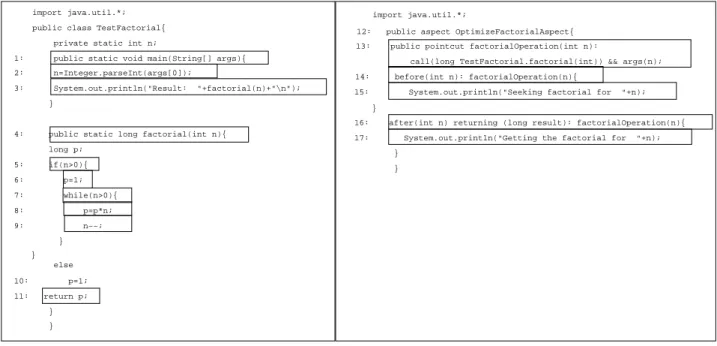
– Pointcut- This is a means of referring to collections of join points and certain values at those join points. AspectJ defines several primitivepointcut designators that can identify all types of join points. For example, in Figure 2, the pointcutfactorialOperationat state-ment 13 picks out join points i.e. the pointcut facto-rialOperationpicks out each call to the method facto-rial()of an instance of the classTestFactorial, where anintis being passed as an argument and it makes the value of that argument to be available to the enclosing advice or pointcut.
– Advice- It is a method-like construct which is used to define cross-cutting behavior at join points. This is used to define some code that is executed when a pointcut is reached. Advice brings together a pointcut (to pick out join points) and a body of code (to run at each of those join points). There are three types of advice in AspectJ:after,before,around.
(i)After-After adviceon a particular join point runs after the program proceeds with that join point. For example,afteradvice on a method call join point runs after the method body has run, just be-fore control is returned to the caller. For exam-ple, in Figure 2, theafteradvice at statement 16 runs just after each join point picked out by the pointcutfactorialOperationand before the con-trol is returned to the calling method.
(iii)Around-Around advice on a join point runs as the join point is reached, and has explicit control over whether the program proceeds with the join point.
Additionally, there are two special cases of after ad-vice: after returningandafter throwing, correspond-ing to the two ways a sub-computation can return through a join point.
(i)After returning-After returningadvice runs just after each join point picked out by the pointcut, but only if it returns normally. The return value can be accessed. After the advice runs, the re-turn value is rere-turned. For example, in Figure 2, the after returningadvice at statement 16 runs just after each join point picked out by the point-cutfactorialOperation, but only if it returns nor-mally. The return value can be accessed and it is namedresult in Figure 2 at statement 16. After the advice runs, the return value is returned. (ii)After throwing-After throwingadvice runs just
after each join point picked out by the pointcut, but only when it throws an exception. The ad-vice re-raises the exception after it is done.
– Aspect- These are units of modular cross-cutting im-plementations composed of pointcuts, advices, and or-dinary JAVA member declarations. An aspect is a cross-cutting type, defined by the aspect declaration. Aspects are defined by aspect declarations, which have a similar form of class declarations. For exam-ple, in Figure 2, there is one aspect named Optimize-FactorialAspectat statement 12.
– Introduction or Inter-Type Declaration- It allows an aspect to add methods, fields or interfaces to existing classes. It can bepublicorprivate. An introduction declared asprivatecan be referred or accessedonlyby the code in the aspect that declared it. An introduction declared aspubliccan be accessed byanycode.
– Pointcut Designator- It is a formula that specifies the set of join points to which a piece of advice is applicable. A pointcut designator identifies all types of join points. A pointcut designator simply matches certain join points at runtime. For example, in Figure 2, the pointcut designator
call (long TestFactorial.factorial(int))
at statement 13 matches all method calls to fac-torialfrom an instance of the classTestFactorial. Pointcuts can be combined using logical operators and (&&), or (k) and not (!). For example, in Figure 2, the compound pointcut designator
call (long TestFactorial.factorial(int))&&args(n)
at statement 13 refers to all method calls to fac-torial() of an instance of TestFactorial, where the argument of type int is passed to the method factorial().
User-defined pointcut designators are defined with pointcut declaration. For example, in Figure 2, the declaration
public pointcut factorialOperation(int n):
call (long TestFactorial.factorial(int))&&args(n)
at statement 13 defines a new pointcut designa-tor, factorialOperation, that specifies a call to the methodfactorial()of an instance ofTestFactorialand the argument passed to the method to be of typeint.
For example, Figure 2 shows an AspectJ program for finding the factorial of a number. The program is divided into two parts: the base code or non-aspect code contains the classTestFactorialand the aspect code OptimizeFacto-rialAspectcontains the advices and pointcuts. Any AspectJ implementation ensures that both the codes i.e., aspect code and base code run together in a properly coordinated fash-ion. Such type of process is calledaspect weaving. The key component for this process isaspect-weaverwhich makes the applicable advices to run at the appropriate join points.
4 Dynamic slicing of aspect-oriented
programs
In this section, we present the basic concepts and the definitions which will be used in our algorithm.
Definition 1 (Digraph): A digraph is an ordered
pair (V, A), where V is a finite set of elements called verticesandAis a finite set of elements callededgesand A⊆V ×V.
Definition 2 (Arc-classified digraph): An arc-classified
digraph is an n-tuple (V, A1, A2, . . . , An−1) such
that every(V, Ai),(i = 1,2, . . . , n−1)is a digraph and Ai∩Aj=∅fori= 1,2, . . . , n−1andj= 1,2, . . . , n−1 andi6=j.
Definition 3 (Path): A path from vertexuto vertexvin a
digraph(V, A)is a sequence of verticesu, i1, i2, . . . , ik, v
inV such that(u, i1),(i1, i2), . . . ,(ik, v)are edges inA.
Definition 4 (Flow graph): Theflow graphof an
aspect-oriented program is a quadruple (V, A, Start, Stop) where (V, A) is a digraph, Start ∈ V is a distinguished node of in-degree 0 called thestart node, Stop∈V is a distinguished node of out-degree 0 called the stop node, there is a path fromStartto every other node in the graph, and there is a path from every other node in the graph to Stop.
Non−aspect Code (Base Code) Aspect Code }
}
17: System.out.println("Getting the factorial for "+n); 16: after(int n) returning (long result): factorialOperation(n){
}
15: System.out.println("Seeking factorial for "+n); 14: before(int n): factorialOperation(n){
call(long TestFactorial.factorial(int)) && args(n); 13: public pointcut factorialOperation(int n):
12: public aspect OptimizeFactorialAspect{ import java.util.*;
} } 11: return p; 10: p=1;
} else } 9: n−−; 8: p=p*n; 7: while(n>0){ 6: p=1; 5: if(n>0){ long p;
4: public static long factorial(int n){ }
3: System.out.println("Result: "+factorial(n)+"\n"); 2: n=Integer.parseInt(args[0]);
1: public static void main(String[] args){ private static int n;
public class TestFactorial{ import java.util.*;
Figure 2: An example AspectJ program
2 {
3 int x, y, prod;
9 ++ x; }
12 cout<< prod; 13 }
4 cin>> x;
7 while(x < 5) { 6 prod = 1; 5 cin>> y;
8 prod=prod*y;
11 prod = y; 1 main()
10 cout<< prod;
Figure 3: An example program
V represent the set of statements of a program P. The control flow graphof the programP is the flow graphG = (V1, A, Start, Stop)whereV1 = V ∪ {Start, Stop}.
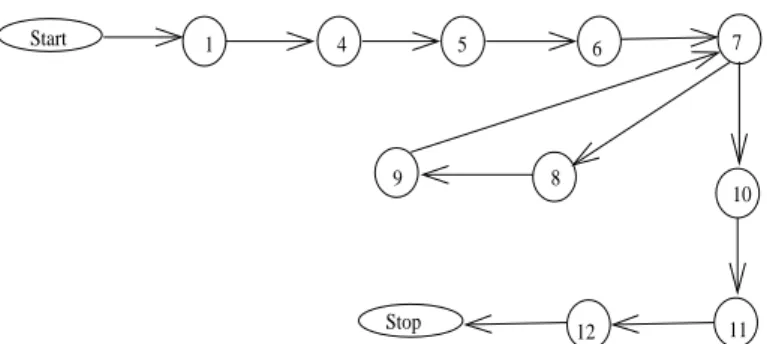
An edge(m, n)∈Aindicates the possible flow of control from the nodemto the noden. Note that the existence of an edge(x, y)in the control flow graph means that control must transfer from x to y during program execution. Figure 4 represents the CFG of the example program given in Figure 3.
Definition 6 (Dominance): If x and y are two nodes
in a flow graphGthenxdominatesy iff every path from Starttoypasses through x. ypost-dominates xiff every path fromxtoStoppasses throughy.
Letxandybe nodes in a flow graphG. Nodexis said to be immediate post-dominator of nodeyiffxis a post-dominator ofy,x6=yand each post-dominatorz6=xofy
12 11
10
9 8
7 6
5 4
1
Stop Start
Figure 4: The CFG of the example program given in Fig-ure 3
post-dominatesx. The post-dominator tree of a flow graph Gis the tree that consists of the nodes ofG, has the root Stop, and has an edge (x, y)iffxis the immediate post-dominator ofy.
Consider the flow graph of the example program of Fig-ure 3, which is given in FigFig-ure 4. In the flow graph, each of the nodes 4, 5 and 6 dominates 7. Node 8 does not dom-inate node 10. Node 10 post domdom-inates each of the nodes 4, 5, 6, 7, 8 and 9. Node 9 post dominates node 8. Node 9 post dominates none of the nodes 4, 5, 6, 7, 10, 11 and 12. Node 6 is the immediate post dominator of node 5. Node 10 is the immediate post dominator of node 7.
Definition 7 (Execution trace): An execution traceis a
path that has actually been executed for some input data. For example, for the input data argv[0]= 4, the order of execution of the statements of the program given in Fig-ure 2 is 1, 2, 3, 13, 14, 15, 4, 5, 6, 7, 8, 9, 7, 8, 9, 7, 8, 9, 7, 8, 9, 7, 16, 17, 11. Thisexecution traceis given in Figure 5.
the programP. A vertexuof the DADG ofPis said to be aDef(var)vertex ifurepresents a definition (assignment) statement that defines the variablevar.
In the DADG given in Figure 6, vertices 6 and 8 are the Def(p)vertices.
Definition 9 (DefSet(var)): The set DefSet(var)denotes
the set of allDef(var)vertices.
In the DADG given in Figure 6,DefSet(p)={6, 8}.
Definition 10 (Use(var)): Letvar be a variable in a class
in the program P. A vertexuof the DADG ofP is said to be aUse(var)vertex ifurepresents a statement that uses the variablevar.
In the DADG given in Figure 6, vertices 8 and 11 are the Use(p)vertices.
Definition 11 (UseSet(var)): The setUseSet(var)denotes
the set of allUse(var)vertices.
In the DADG given in Figure 6,UseSet(p)={8, 11}.
5 The dynamic aspect-oriented
dependence graph (DADG)
In this section, we describe the definition and construc-tion of the dynamic aspect-oriented dependence graph (DADG).
The DADG is anarc-classified digraph (V, A), where V is the set of vertices that correspond to the statements and predicates of the aspect-oriented programs, andA is the set of arcs between vertices inV representing dynamic dependence relationships that exist between statements. In the DADG of an aspect-oriented program, following types of dependence arcs may exist.
– control dependence arc
– data dependence arc
– weaving arc
Control dependencesrepresent the control flow
relation-ships of a program i.e., the predicates on which a statement or an expression depends during execution.
Data dependences represent the relevant data flow
rela-tionships of a program i.e., the flow of data between state-ments and expressions.
For example, in the DADG given in Figure 6, there is a data dependency between vertex 6 and 8, because vertex 6 isDef(p)vertex and vertex 8 isUse(p)vertex.
Weaving arcs reflect the joining of aspect code and
non-aspect code at appropriate join points.
For example, in Figure 6 there is an weaving arc from ver-tex 13 to verver-tex 3 to connect verver-tex 13 to verver-tex 3 at the corresponding join point because, there is a function call at statement 3 and the corresponding pointcut at statement 13 captures that function call. Statement 14 represents a beforeadvice. This means that theadviceis executed be-fore control flows to the corresponding function i.e., to the functionfactorial(). So, we add aweaving arcfrom ver-tex 4 to verver-tex 15. Similarly, statement 16 represents an
after advice. This means that theadviceis executed after the functionfactorial()has been executed and before con-trol flows to the calling function i.e., the function main(). That’s why we add a weaving arc from vertex 16 to vertex 7. After the execution ofafteradvice at statement 17, con-trol transfers to statement 11 where it returns a value i.e., the value ofpto the calling functionmain(). So, a weaving arc is added from vertex 11 to vertex 17.
Our construction of dynamic aspect-oriented depen-dence graph of an aspect-oriented program is based on dy-namic analysis of control flow and data flow of the pro-gram. The DADG of the program in Figure 2 correspond-ing to the execution trace in Figure 5 is given in Figure 6. In this figure, circles represent program statements, dotted lines represent data dependence arcs, solid lines represent control dependence arcs and dark dashed lines represent weaving arcs.
6 Computation of dynamic slices of
aspect-oriented programs
Dynamic slicing of aspect-oriented programs is similar to that of object-oriented programs. However, due to the pres-ence of pointcuts and advices, the tracing of dependpres-ences becomes much more complex.
Here, we formally define some notions of dynamic slic-ing of aspect-oriented programs. Let P be an aspect-oriented program andG= (V, A)be the DADG ofP. We compute the dynamic slice of an aspect-oriented program with respect to a slicing criterion.
– Aslicing criterionfor an aspect-oriented program is of the form< p, q, e, n >, wherepis a statement,qis a variable used atpandeis an execution trace of the program with inputn.
– Adynamic sliceof an aspect-oriented program for a given slicing criterion < p, q, e, n > consists of all the statements that have actually affected the value of the variableqat statementp.
LetDSG be the dynamic slice ofGon a given slicing criterion < p, q, e, n >. Then, DSG is a subset of ver-tices of G i.e., DSG(p, q, e, n) ⊆ V, such that for any p0 ∈ V,p0 ∈ DSG(p, q, e, n)if and only if there exists a path fromp0topinG. Since we have used a trace file to store the execution history of the aspect-oriented program, we have named our algorithm Trace file Based Dynamic Slicing(TBDS) algorithm for AOPs.
In this section, we present the TBDS algorithm in pseudo-code form to compute the dynamic slice of an aspect-oriented program.
Algorithm: TBDS algorithm
public class TestFactorial private static int n;
13(1): public pointcut factorialOperation(int n): call(long TestFactorial.factorial(int)) && args(n); 14(1): before(int n): factorialOperation(n)
15(1): System.out.println("Seeking factorial for "+n); 4(1): public static long factorial(int n)
11(1): return p;
17(1): System.out.println("Getting the factorial for "+n); 16(1): after(int n) returning(long result): factorialOperation(n) 7(5): while(n>0)
8(4): p=p*n; 9(4): n−−; 7(4): while(n>0) 9(3): n−−; 8(3): p=p*n; 7(3): while(n>0) 9(2): n−−; 8(2): p=p*n; 7(2): while(n>0) 9(1): n−−; 8(1): p=p*n; 7(1): while(n>0) 6(1): p=1; 5(1): if(n>0)
3(1): System.out.println("Result: "+factorial(n)+"\n"); 2(1): n=Integer.parseInt(args[0]);
1(1): public static void main(String[ ] args)
Figure 5: Execution trace of the program given in Figure 2 for argv[0] = 4
7
9 8
7
9 8
7
9 8
7
17 16
15 14
13
11 9
8 7
6 5
4
3 2
1
Control Dependence Arc
Data Dependence Arc
Weaving Arc
Starting Point
(a)For a given input, execute the program and store each statementsin the order of exe-cution in a file after it has been executed. (b) If the program contains loops, then store
each statementsinside the loop in the trace file after each time it has been executed.
2. Construction of DADG:To Construct the DADG of the aspect-oriented program P with respect to the trace file, do the following:
(a)For each statementsin the trace file, create a vertex in the DADG.
(b)For each occurrence of a statementsin the trace file, create a separate vertex.
(c) Add all control dependence edges, data dependence edges and weaving edges to these vertices.
3. Computation of dynamic slice: To compute the dy-namic slice over the DADG, do the following:
(a)Perform the breadth-first or depth-first graph traversal over the DADG taking any vertex corresponding to the statement of interest as the starting point of traversal.
4. Mapping of the slice:To obtain the dynamic slice of the aspect-oriented programP, do the following:
(a) Define a mapping function f : DSG(p, q, e, n)→P.
(b)Map the resulting slice obtained in Step 3(a) over the DADG to the source codeP using fsince the slice may contain multiple occur-rences of the same vertex.
Working of the algorithm: We illustrate the working of
the TBDS algorithm with the help of an example. Consider the example AspectJ program given in Figure 2. Now, for the input data argv[0]= 4, the program will execute the statements 1, 2, 3, 13, 14, 15, 4, 5, 6, 7, 8, 9, 7, 8, 9, 7, 8, 9, 7, 8, 9, 7, 16, 17, 11 in order. These statements are stored in a trace file. Figure 5 shows the corresponding execution trace file. Then, theDynamic Aspect-Oriented Dependence Graph(DADG) is constructed with respect to this trace file in accordance with the step 2 of the TBDS algorithm. Fig-ure 6 shows the DADG of the example program given in Figure 2 with respect to the trace file given in Figure 5. Since, for the input dataargv[0]= 4, the statements 8 and 9 are executed four times and statement 7 is executed five times, separate vertices are created for each occurrence of these statements.
Now, let us suppose that we have to compute the dy-namic slice for the slicing criterion < 11, p >. Starting from the vertex 11, we can perform either the breadth-first search algorithm or depth-breadth-first search algorithm on the DADG. The breadth-first search algorithm yields the ver-tices 11, 17, 8, 16, 7, 8, 9, 7, 13, 5, 9, 7, 8, 9, 9, 3, 2, 4, 7, 8,
9, 1, 15, 7, 6, 14 and the depth-first search algorithm yields the vertices 11, 8, 9, 9, 9, 4, 15, 14, 2, 1, 7, 5, 7, 7, 8, 8, 8, 6, 7, 17, 16, 13, 3, 7, 9. The traversed vertices are shown as shaded vertices in Figure 6. Using the mapping functionf, we can find the statements corresponding to these vertices. This gives us the required dynamic slice which is shown in rectangular boxes in Figure 7.
6.1 Complexity analysis
In the following, we discuss the space and time complexity of our DADG algorithm.
Space complexity: Let P be an aspect-oriented
pro-gram andSbe the length of execution ofP. Each executed statement will be represented by a single vertex in the DADG. Thus, it can be stated that there areS number of vertices in the DADG corresponding to all executed state-ments of programP. Also, S numbers of statements are stored in the execution trace file. So, the space complexity of the trace file based algorithm isO(S).
Time complexity: Let P be an aspect-oriented
pro-gram andSbe the length of execution ofP. The total time complexity is due to four components:
1. time required to store each executed statement in a trace file which isO(S).
2. time required to construct the DADG with respect to the execution trace file which isO(S).
3. time required to traverse the DADG and to reach at the specified vertex which isO(S2).
4. time required to map the traversed vertices to source programPwhich isO(S).
So, the time complexity of the trace file based algorithm is O(S2).
7 Implementation
In this section, we briefly describe the implementation of our algorithm. We have named our dynamic slicing tool dy-namic dependence slicing tool(DDST) for aspect-oriented programs. First, we present an overview of our slicing tool and then, we discuss briefly the implementation of the slic-ing tool. Next we present some experimental results and then we compare our work with existing work.
7.1 Overview of DDST
Non−aspect Code (Base Code) Aspect Code }
}
17: System.out.println("Getting the factorial for "+n); 16: after(int n) returning (long result): factorialOperation(n){
}
15: System.out.println("Seeking factorial for "+n); 14: before(int n): factorialOperation(n){
call(long TestFactorial.factorial(int)) && args(n); 13: public pointcut factorialOperation(int n):
12: public aspect OptimizeFactorialAspect{ import java.util.*;
} } 11: return p; 10: p=1;
} else } 9: n−−; 8: p=p*n; 7: while(n>0){ 6: p=1; 5: if(n>0){ long p;
4: public static long factorial(int n){ }
3: System.out.println("Result: "+factorial(n)+"\n"); 2: n=Integer.parseInt(args[0]);
1: public static void main(String[] args){ private static int n;
public class TestFactorial{ import java.util.*;
Figure 7: The dynamic slice of the program given in Figure 2 for the slicing criterion (11,p)
Lexical Analyzer
Slicer Dynamic Slice
Parser and
Program Analysis Semantic Analyzer
The Attributes Program Code
Trace File Execution Execution Trace
Information (ASI)
DADG and DADG Constructor
A program written in AspectJ is given as input to DDST. The overall control for the slicer is done through a coor-dinatorwith the help of agraphical user interface(GUI). The coordinatortakes user input from the GUI, interacts with other relevant components to extract the desired re-sults and returns the output back to the GUI.
The execution trace component creates an execution trace file for a particular execution of the program. This component takes the user input from the coordinator, stores each executed statement for that input in a file and outputs that file back to the coordinator. This file is calledexecution trace file.
The lexical analyzer component reads the execution trace file and breaks it into tokens for the grammar ex-pressed in the parser. When the lexical analyzer compo-nent encounters a useful token in the program, it returns the token to the parser describing the type of encountered token.
Theparser and semantic analyzercomponent functions as a state machine. The parser takes the token given by the lexical analyzer and examines it using the grammatical rules laid for the input programs. The semantic analyzer component captures the following important information of the program.
– For each vertexuof the program
– the lexical successor and predecessor vertices ofu,
– the sets of variables defined and used at vertexu,
– the type of the vertex: assignment or test or method call or return etc.
The lexical component, parser and semantic analyzer component provide the necessary program analysis infor-mation to theDADG constructor component. TheDADG constructor component first constructs the CFG and the post-dominator tree of the program using the basic infor-mation provided by the lexical and semantic analyzer com-ponents. The inter-statement control dependences are cap-tured using the CFG and the post-dominator tree. Then, it constructs the DADG of the program with respect to the trace file along with all the required information to compute slices and stores it in appropriate data structures.
Theslicercomponent traverses the DADG. It takes the user input from thecoordinatorand outputs the computed information back to the coordinator. The graphical user interface (GUI) functions as a front end to the slicing tool.
7.2 Implementation of the slicing tool
We have implemented our algorithm in Java. We have used the compiler writing tool ANTLR(Another Tool for Lan-guage Recognition) [1, 32] for Lexical Analyzer, Parser andSemantic Analyzercomponents of our slicer. ANTLR is a tool that lets one define language grammars in EBNF (Extended Backus-Naur Form) like notations. ANTLR is more than just a grammar definition language. However, the tools provided allow one to implement the ANTLR
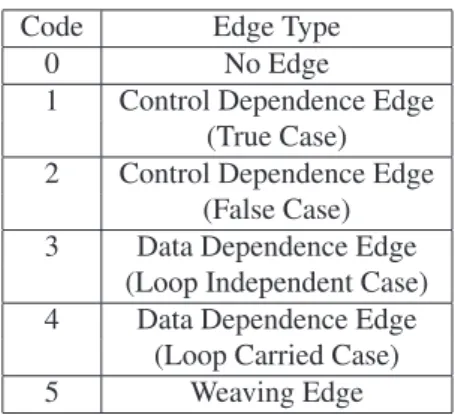
Table 1: Encoding used for different types of edges of DADG
Code Edge Type
0 No Edge
1 Control Dependence Edge (True Case) 2 Control Dependence Edge
(False Case) 3 Data Dependence Edge
(Loop Independent Case) 4 Data Dependence Edge
(Loop Carried Case)
5 Weaving Edge
defined grammar by automatically generating lexers and parsers in Java or other supported languages. ANTLR is a language tool that provides a framework for construct-ing recognizers, compilers, and translators from grammat-ical descriptions containing programming languages such as C++, Java, AspectJ etc. ANTLR is a LL(k) based recog-nition tool.
The sample AspectJ program is executed for a given in-put. The executed statements are stored in a trace file. This trace file is given as input to the ANTLR program. The lexer part of the ANTLR extracts program tokens and stores the data in a data structure called statement_info. The DADG of the AspectJ program is automatically con-structed by taking input from theparserandsemantic an-alyzer component. For constructing the DADG, we have used many flags such asif_flagto check whether the state-ment is an if statestate-ment or not,while_flagto check whether the statement is a while statement or not etc.
We have used an adjacency matrixdadg[][]to store the DADG of the given AspectJ programP. This matrix is of the following type:
typedef struct edge { int exist, type; } edge;
– The attribute exist has value 0 or 1.
dadg[i][j].exist is 1 if there is an edge
between node numberiandj, otherwise 0.
– The data membertypespecifies the type of the edge. The codes used for this are given in Table 1.
We store the following additional information along with the DADG:
– The setDef(var)for each variablevar in the aspect-oriented programP.
– The setUse(var)for each variablevarin the aspect-oriented programP.
7.3 Experimental results
With different slicing criteria, the algorithm has been tested on many programs for 40-50 runs. The sample programs contain loops and conditional statements. Table 2 sum-marizes theaverage run-time requirementsof the trace file based algorithm for several programs. Since we have com-puted the dynamic slices at different statements of a pro-gram, we have calculated the average run-time require-ments of our trace file based algorithm. The program sizes are small since right now the tool accepts only a subset of AspectJ constructs. However, the results indicate the over-all trend of the performance of the trace file based algo-rithm.
Table 2: Average runtime
Sl No. Prg. Size Trace file Based (# stmts) Algorithm (in Sec.)
1 17 0.48
2 43 0.71
3 69 0.92
4 97 1.14
5 123 1.36
6 245 2.46
7 387 3.96
8 562 5.52
The results in Table 2 indicate that the run-time require-ment for the trace file based algorithm increases gradu-ally. This is due to the fact that separate vertices are cre-ated in the DADG during run-time for different executions of the same statement. This is followed by a depth-first or breadth-first graph traversal on DADG to compute the dynamic slice. Thus, average run-time requirement be-comes high since considerable time is required to perform the traversal on DADG. Furthermore, the algorithm uses a trace file to store the execution history. The time required to read the data from a trace file is significant and is added to the average run-time while computing dynamic slice. All these result in the increase of average run-time requirement gradually.
7.4 Comparison with existing work
Very few work has been done on slicing of aspect-oriented programs [22, 23]. Zhao [22] has proposed an intermediate representation calledAspect-Oriented System Dependence Graph (ASDG). The ASDG for the example program of Figure 2 as proposed by Zhao [22] is shown in Figure 9. In this ASDG, thepointcutsare not represented. But, our DADG correctly represents the pointcuts.
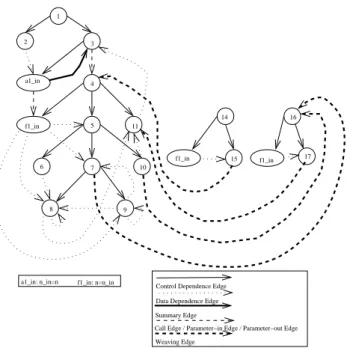
Zhao and Rinard [23] developed an algorithm to con-struct the SDG for aspect-oriented programs. Figure 10 shows the SDG of the program given in Figure 2 as pro-posed by Zhao and Rinard [23]. But, the drawback of this
Control Dependence Edge
17 16
15 14
f1_in f1_in
f1_in a1_in
11
9 8
10 7
6
5 4 3 2
1
a1_in: n_in=n f1_in: n=n_in
Data Dependence Edge Summary Edge
Call Edge / Parameter−in Edge / Parameter−out Edge Weaving Edge
Figure 9: ASDG of the program given in Figure 2 as pro-posed by Zhao [22]
SDG is that the weaving processis not represented cor-rectly. For example, there should be a weaving edge be-tween vertices 15 and 4, beacause, after the execution of before adviceat statement 14, the actual execution of the methodfactorial()at statement 4 will be started. The use of this SDG to compute dynamic slice results in missing of some statements. So, we cannot use this approach to compute dynamic slice of an aspect-oriented program cor-rectly. Also, they [23] have not considered the dynamic slicing aspects. But in our approach, we have considered the weaving process by adding weaving edges at the ap-propriate join points in the DADG. Again our algorithm computes precisedynamicslices.
8 Conclusion
We proposed an algorithm for dynamic slicing of aspect-oriented programs. First, we have constructed a dependence-based intermediate representation for aspect-oriented programs. We named this representationDynamic Aspect-Oriented Dependence Graph (DADG). Then, we have developed an algorithm to compute dynamic slices of AOPs using the DADG. We have used a trace file to store the execution history. So, we have named our algo-rithmTrace file Based Dynamic Slicing(TBDS) algorithm for AOPs. The resulting dynamic slice in our approach is precise since we create a node in the DADG for each oc-currence of a statement in the execution trace. We have de-veloped a tool called Dynamic Depenedence Slicing Tool (DDST) to implement our algorithm.
Control Dependence Edge
17 16
15 14
13
f1_in f1_in
a1_in f1_in
a1_in
11
9 8
10 7
6
5 4 3 2
1
a1_in: n_in=n f1_in: n=n_in
Data Dependence Edge
Summary Edge
Call Edge / Parameter−in Edge / Parameter−out Edge Weaving Edge
Figure 10: SDG of the program given in Figure 2 as pro-posed by Zhao and Rinard [23]
slices of concurrent AOPs and distributed AOPs running on different machines connected through a network. The algorithm can also be extended to compute conditioned sliceswith respect to a given condition. Although we have presented the approach for AspectJ, this approach can be easily extended to other aspect-oriented languages such as AspectWerkz, AML, RIDL etc. Our tool can be used to develop efficient debuggers and test drivers for large scale aspect-oriented programs.
References
[1] Antlr. www.antlr.org.
[2] Aspect-Oriented Programming. www.wikipedia.org.
[3] AspectJ. www.eclipse.org/aspectj.
[4] Introduction to AOP. www.media.wiley.com.
[5] Mendhekar A., Kiczales G., and Lamping J. RG: A Case-Study for Aspect-Oriented Programming. Tech-nical report, Xerox Palo Alto Research Center, Febru-ary 1997.
[6] Dufour B., Goard C., Hendren L., Verbrugge C., Moor O. D., and Sittampalam G. Measuring the Dy-namic Behaviour of AspectJ Programs. Technical re-port, McGill University, School of Computer Science, Sable Research Group and Oxford University, Com-puting Laboratory, Programming Tools Group, March 2004.
[7] Korel B. and Laski J. Dynamic Program Slicing. In-formation Processing Letters, 29(3):155–163, 1988.
[8] Mund G. B., Mall R., and Sarkar S. Computation of Interprocedural Dynamic Program Slices. Journal of Information and Software Technology, 45(8):499– 512, June 2003.
[9] Xu B. and Chen Z. Dynamic Slicing Object-Oriented Programs for Debugging. In Proceedings of 2nd IEEE International Workshop on Source Code Anal-ysis amd Manipulation (SCAM’02), pages 115–122, 2002.
[10] Murphy G. C., Walker R. J., and Baniassad E. L. A. Evaluating Emerging Software Development Tech-nologies: Lessons Learned from Assessing Aspect-Oriented Programming. IEEE Transactions on Soft-ware Engineering, 25(4):438–455, July-Aug 1999.
[11] Liang D. and Harrold M. J. Slicing Objects Using System Dependence Graph. In Proceedings of the International Conference on Software Maintenance, IEEE, pages 358–367, November 1998.
[12] Tip F. A Survey of Program Slicing Techniques. Jour-nal of Programming Languages, 3(3):121–189, 1995.
[13] Cugola G., Ghezzi C., and Monga M. Coding Dif-ferent Design Paradigms for Distributed Applications with Aspect-Oriented Programming. InProceedings of Workshop on System Distribution: Algorithm, Ar-chitecture and Language, WSDAAL. Italy, 1999.
[14] Kiczales G., Hilsdale E., Hugunin J., Kersten M., Palm J., and Griswold W. G. An Overview of As-pectJ. InProceedings of the European Conference on Object-Oriented Programming. Budapest,Hungary, 18-22 June 2001.
[15] Kiczales G., Hilsdale E., Hugunin J., Kersten M., Palm J., and Grisworld W. G. Report on An Overview of Aspectj. Notes by Tai Hu, CMSC631 Fall 2002.
[16] Kiczales G., Irwin J., Lamping J., Loingtier J. M., Lopes C. V., Maeda C., and Mendhekar A. Aspect-Oriented Programming. In Proceedings of the Eu-ropean Conference on Object-Oriented Programming (ECOOP), Finland, June 1997. Springer-Verlag.
[17] Kiczales G. and Mezini M. Aspect-Oriented Pro-gramming and Modular Reasoning. InProceedings of the 27th International Conference on Software En-gineering, ICSE’05, May 2005.
[19] Agrawal H. and Horgan J. R. Dynamic Program Slic-ing. InProceedings of the ACM SIGPLAN’90 Con-ference on Programming Languages Design and Im-plementation, SIGPLAN Notices, Analysis and Verifi-cation, volume 25, pages 246–256, 1990.
[20] Irwin J., Loingtier J. M., Gilbert J. R., Kicza-les G., Lamping J., Mendhekar A., and Shpeisman T. Aspect-Oriented Programming of Sparse Matrix Code. InProceedings of International Scientific Com-puting in Object-Oriented Parallel Environments (IS-COPE), Marina del Rey, CA. Springer-Verlag, De-cember 1997.
[21] Zhao J. Dynamic Slicing of Object-Oriented Pro-grams. Technical report, Information Processing So-ciety of Japan, May 1998.
[22] Zhao J. Slicing Aspect-Oriented Software. In Pro-ceedings of 10th International Workshop on Program Comprehension, pages 251–260, June 2002.
[23] Zhao J. and Rinard M. System Dependence Graph Construction for Aspect-Oriented Programs. Tech-nical report, Laboratory for Computer Science, Mas-sachusetts Institute of Technology, USA, March 2003.
[24] Larsen L. and Harrold M. J. Slicing Object-Oriented Software. InProceedings of 18th International Con-ference on Software Engineering, pages 495–505, March 1996.
[25] Sahu M. and Mohapatra D. P. A Node Marking Tech-nique for Dynamic Slicing of Aspect-Oriented Pro-grams. InProceedings of the 10th International Con-ference on Information Technology (ICIT’07), pages 155–160, 2007.
[26] Weiser M. Programmers Use Slices When Debug-ging. Communications of the ACM, 25(7):446–452, July 1982.
[27] Mohapatra D. P.Dynamic Slicing of Object-Oriented Programs. PhD thesis, Indian Institute of Technology, Kharagpur, May 2005.
[28] Mohapatra D. P., Mall R., and Kumar R. Dynamic Slicing of Concurrent Object-Oriented Programs. In Proceedings of International Conference on Informa-tion Technology: Progresses and Challenges (ITPC), pages 283–290. Kathamandu, May 2003.
[29] Mohapatra D. P., Mall R., and Kumar R. An Edge Marking Technique for Dynamic Slicing of Object-Oriented Programs. InProceedings of the 28th An-nual International Computer Software and Applica-tions Conference (COMPSAC’04), 2004.
[30] Mohapatra D. P., Mall R., and Kumar R. A Node-Marking Technique for Dynamic Slicing of Object-Oriented Programs. InProceedings of Conference on Software Design and Architecture (SODA’04), 2004.
[31] Mohapatra D. P., Mall R., and Kumar R. An Overview of Slicing Techniques for Object-Oriented Programs.Informatica, 30:253–277, 2006.
[32] Levine J. R. Mason T. and Brown D. Lex and Yacc. O’REILLY, 3rd edition, 2002.
[33] Horwitz S., Reps T., and Binkley D. Inter-Procedural Slicing Using Dependence Graphs. ACM Trans-actions on Programming Languages and Systems, 12(1):26–60, January 1990.
[34] Braak T. T. Extending Program Slicing in Aspect-Oriented Programming with Inter-Type Declarations. 5th TSConIT Program, June 2006.
[35] Ishio T., Kusumoto S., and Inoue K. Program Slicing Tool for Effective Software Evolution Using Aspect-Oriented Technique. InProceedings of Sixth Interna-tional Workshop on Principles of Software Evolution, pages 3–12. IEEE Press, September 2003.
[36] Song Y. T. and Huynh D. T. Forward Dynamic Object-Oriented Program Slicing. InProceedings of IEEE Symposium on Application Specific Systems and Software Engineering and Technology (ASSET’99), pages 230–237, Richardson, TX, USA, 03/24/1999-03/27/1999 1999.
[37] Wang T. and Roychoudhury A. Using Compressed Bytecode Traces for Slicing Java Programs. In Pro-ceedings of 26th International Conference on Soft-ware Engineering (ICSE’04), pages 512–521, 23-28 May 2004.
[38] Binkley D. W. and Gallagher K. B. Program Slicing. Advances in Computers, 43, 1996. Academic Press, San Diego, CA.
![Figure 5: Execution trace of the program given in Figure 2 for argv[0] = 4](https://thumb-us.123doks.com/thumbv2/123dok_us/8045847.2130497/8.892.109.725.572.1083/figure-execution-trace-program-given-figure-argv.webp)
![Figure 10: SDG of the program given in Figure 2 as pro- pro-posed by Zhao and Rinard [23]](https://thumb-us.123doks.com/thumbv2/123dok_us/8045847.2130497/13.892.94.426.125.412/figure-sdg-program-given-figure-posed-zhao-rinard.webp)
