Research Article
Journal of Medical Research and Health Sciences
ISSN: (Print) 2589-9023 | (Online) 2589-9031
www.http://jmrhs.info
Received: 01 September 2019 Accepted: 26 September 2019
Relation between elevated uric acid and Lipid panel
Ahmad M. Tabash¹, Wesam M. Afana², AsmaaHejazi1, Ayman M. AbuMustafa3* 1
El-NajarHospital, Ministry of Health, Gaza Strip,
2
European Gaza Hospital, Ministry of Health, Gaza Strip, Palestine.
3
Palestine College of Nursing, Khan Younis, Gaza Strip, Palestine
*
Corresponding author: Dr. Ayman M. AbuMustafa, Palestine College of Nursing, Khan Younis, Gaza Strip, Palestine
Email: [email protected]
Abstract: Background: Hyperuricemia is a very common metabolic disorder. Recently, A high uric acid noted that is associated with the risk of atherosclerotic cardiovascular diseases, inflammation and diabetes mellitus. The present study aimed to Relation between elevated uric acid and Lipid panel Materials and Methods:
A case-control study has been conducted on 70 hyperuricemia males with gout disease and 70vnormal uric acid males as control aged between 41-70 years. Lipid profile was measured, statistically analyzed and compared with control.
Results: The results revealed significant differences between cases and control. The average levels of total cholesterol, triglycerides and LDL were significantly higher in cases compared to controls while HDL was significantly lower in cases compared to control. Pearson correlation showed that the ae positive significant correlation between uric acid and cholesterol (r=0.935, P<0.001), triglycerides (r=0.915, P<0.001) and LDL (r=0.914, P<0.001) while the results showed that there is a positive significant correlation between uric acid and HDL (r= -0. 834, P<0.001).
Conclusions: Hyperuricemia should be treated because it has closed link with dyslipidemia disorder, therefore, both hyperuricemia and dyslipidemia will enhance the risk for cardiovascular disease. In the clinical filed, the more comprehensive strategic management to decrease hyperuricemia and dyslipidemia among adult males and deserves further investigation.
Key Words: hyperuricemia, lipid profile, adult males, Gaza Strip. Introduction
The prevalence of hyperuricemia is progressively increasing in the international communities; emerging evidence shows that hyperuricemia is now more frequent in the developing nations [1]. Serum uric acid is a strong predictor of cardiovascular disease and metabolic syndrome. However, the vital role of uric acid in the obesity and hyperlipidemia is still the subject of debate and discussion because it is always accompanied with other risk factors such as stress, diets and coronary heart diseases [2,3]. Hyperuricemia is the consequence of increased uric acid production or and decreased excretion. It is also associated with glucose intolerance, hypertension, and dyslipidemia, a cluster of metabolic and hemodynamic disorders which
characterize the so-called metabolic syndrome [4]. The serum uric acid level was found to be increased in most nonalcoholic fatty liver disease (NAFLD) patients which were an independent risk factor for NAFLD [5,6]. In fact, data had confirmed the strong relationship between NAFLD and metabolic syndrome [7,8].
Materials and methods
1. Study population and Experimental design
Dr. Ayman M. AbuMustafa et.al / Relation between elevated uric acid and Lipid panel
individuals of the same population matched for age were used as a control group). The study was conducted by using collecting research data in the main public hospitals in Gaza strip: Nasser Hospital, European Hospital, El-Shifa Hospital and A l- Najar Hospital. The study data was collected during the period of June 2018 to April 2019.
2. Inclusion criteria:
Inclusion criteria were between 41–70 years of age who had high uric acid
3. Exclusion criteria:
Exclusion criteria were patients with a history of smoke use, hypertension, diabetes mellitus, a cardiovascular disease, myeloproliferative disorder, in therapy with cytotoxic drugs, renal or hepatic disorders and those on antigout therapy, the individuals who were less than 41 years and more than 70 years.
4. Ethical considerations and permissions:
Consent form to participate in the study was obtained from participants and freely participates in the study. Every participant had been provided with a full explanation of the intended study.
5. Data collection:
An interview was used for filling in questionnaires. All interviews were conducted face to face by the researchers
6. Blood Collection:
All blood samples were collected in and sent to the laboratory for analysis. Serum uric acid (UA) was determined quantitatively using DiaSys reagent kits regarding lipid profile. Cholesterol (Ch) and triglycerides (TG) were measured by the cholesterol oxidase/POD method and by the glycerol phosphate oxidase/POD method, respectively, using the BioSystems kit, Spain [9,10].
High-density lipoprotein cholesterol (HDL-C) was determined by the precipitating method using Labkit kit, Spain [11]. Low-density lipoprotein cholesterol (LDL-C) was calculated using the empirical relationship of [12].
Expected Values for total cholesterol: Desirable less than 200mg/dl, borderline 200-240mg/dl and high risk more than 240mg/dl
Expected Values for triglyceride:Desirable: < 200 mg/dL (fasting), borderline high: 200 – 400 mg/dL and elevated > 400 mg/dL
Expected Values for HDL-C:>35 mg/dL
Expected Values for LDL-C:Desirable£130 mg/dl, borderline high risk 130 – 160 mg/dL and high risk > 160 mg/dL.
7. Statistical Analysis
Data were analyzed using SPSS version 23. Chi-square (X²) was necessary to compare the relationship between categorical variables, independent sample t-test (two-tailed) was done to assess the differences between case and control and Interrelationships between baseline variables and uric acid were assessed by Pearson’s correlation coefficient test. The values in tables were presented as mean ± standard deviation otherwise noted. P-value of < 0.05 was considered statistically significant.
Results
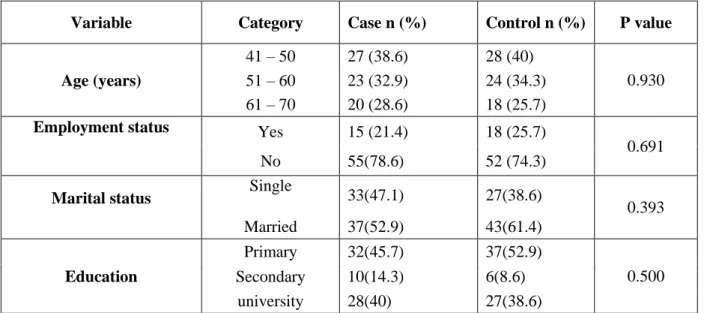
3.1. Distribution of studied sample according to socio-demographic data
Dr. Ayman M. AbuMustafa et.al / Relation between elevated uric acid and Lipid panel
Table (1): Distribution of studied sample according to socio-demographic data
Variable Category Case n (%) Control n (%) P value
Age (years)
41 – 50 27 (38.6) 28 (40)
0.930
51 – 60 23 (32.9) 24 (34.3)
61 – 70 20 (28.6) 18 (25.7)
Employment status Yes 15 (21.4) 18 (25.7)
0.691
No 55(78.6) 52 (74.3)
Marital status Single 33(47.1) 27(38.6)
0.393
Married 37(52.9) 43(61.4)
Education
Primary 32(45.7) 37(52.9)
0.500
Secondary 10(14.3) 6(8.6)
university 28(40) 27(38.6)
The significance of difference was checked by chi-square test (compare study group and control), significant at P <0.05.
3.2. Distribution of lipid profile parameters among the study population.
Table 2 shows the distribution of lipid profile parameters among the study population. The results showed that there are higher statistically significant in cases compared to controls for cholesterol (273±14.31vs167±15.09), TG(270±30.43vs127±7.93), LDL-C (184±15.57vs 97±15.59), respectively (P<0.001). In contrast, the results showed that there are lower statistically significant in cases compared to controls for HDL-C (35±2.68vs45±2.93; P<0.001).
Table (2): Comparison of lipid profile between the two groups
P value* % mean different
Control (N =70) Mean±SD Case (N = 70) Mean±SD
Lipid profile level (mg/dl)
<0.001 63.5
167±15.09 273±14.31
Cholesterol
<0.001 112.6
127±7.93 270±30.43
Triglyceride
<0.001 -22.2
45±2.93 35±2.68
HDL
<0.001 89.7
97±15.59 184±15.57
LDL
HDL; high density lipoprotein, LDL; low density lipoprotein, TC; total cholesterol.
Values expressed as mean ± standard deviation (SD) of 140 participants. *independent t-test
3. Correlation between uric acid and lipid profile among the study population
Correlation between uric acid and lipid profile among the study population pointed out in table 3. Pearson correlation showed that the positive significant correlation between uric acid and cholesterol (r=0.935, P<0.001), triglycerides (r=0.915, P<0.001) and LDL (r=0.914, P<0.001) while the results showed that there is a positive significant correlation between uric acid and HDL (r= -0. 834, P<0.001).
Table (3): correlation between uric acid and lipid profile among the study population Uric acid (mg/d) Lipid profile
level (mg/dl) r P-value
<0.001 0.935
Cholesterol
<0.001 0.915
Triglyceride
<0.001 0.914
LDL
<0.001 -0.345
Dr. Ayman M. AbuMustafa et.al / Relation between elevated uric acid and Lipid panel
Discussion
To date, there is no published study on hyperuricemia among adult males in Gaza Strip. In the present study is the first to assess of association between hyperuricemia and lipid profile among adult males in Gaza Strip. In our study the results showed that there is an association between uric acid and elevated of cholesterols, TG, LDL-C while has lower levels. Also, UA levels were positively negative with serum TG, TC, LDL cholesterol while HDL negative correlation with uric acid. This results agree with other repotted study that showed
the agreement of dyslipidemia and
hyperuricemiahas been reported in a few studies. In India, a significant association was found between UA and lipid profile in the adult population [13]. By same away in Italy, Lippi et al., (2010) were illustrated the same results [14]. Peng et al., (2015) illustrated that there is a significant positive correlation between serum LDL-C, TG, total cholesterol and they showed that strongly positive correlation between cholesterol, TG, HDL with serum uric acid levels, whereas serum HDL-C levels were a significant inverse correlation with UA [15]. Our results are in line with previous studies that showed pathogenesis overlap among hyperuricemia and dyslipidemia [14,15,16]. Also, the previous study showed that UA levels were positively associated with serum TG, TC, LDL cholesterol [17,18] and these results demonstrated that serum uric acid associated with CVD risk additionally to lipid elevated and HDL-C may be a protective factor for CVD. Our study showed strong A linear correlation was found between lipid profile and UA and this agreement with some previous studies and are also in agreement with the results of the present study [19,20]. The previous study reported that elevated UA increases the risk of
developing high LDL-C, as well as
hypertriglyceridemia [21]. A vast number of clinical studies have reported a positive association of UA with circulating levels of triglyceride, cholesterol, and uric acid [22]. In brief, the result showed the strong agreement of elevated lipid profile with hyperuricemia, it is urgent to develop good guidelines to treatment hyperuricemia such as modification in diet and lifestyle and improve to found the new pharmacologic strategy to improving hyperuricemia in order to prevent CVD occurrence.
Conclusion: The present study showed a strong association between UA and lipid profile among adult males in Gaza strips. Early prevention of hyperuricemia and dyslipidemia can reduce the
incidence of associated CVD among Gazan adult males.
Reference
1. Kim, Y., Kang, J., & Kim, G. T. (2018). Prevalence of hyperuricemia and its associated factors in the general Korean population: an analysis of a population-based nationally representative sample. Clinical rheumatology,
37(9), 2529-2538.
2. El Din, U. A. S., Salem, M. M., &Abdulazim, D. O. (2017). Uric acid in the pathogenesis of metabolic, renal, and cardiovascular diseases: A review. Journal of advanced research, 8(5), 537-548.
3. Fathy, S. A., Abdel Hamid, F. F., Zabut, B. M., Jamee, A. F., Ali, M. A., & Abu Mustafa, A. M. (2015). Diagnostic utility of BNP, corin and furin as biomarkers for cardiovascular complications in type 2 diabetes mellitus patients. Biomarkers, 20(6-7), 460-469.
4. . Kumar, S., Banerjee, A., Mahto, M., Ranjan, A., Singh, M., &Takhelmayum, R. (2018).
Evaluation of relationship between
hyperuricemia and lipid profile. Evaluation, 4(6).
5. Sirota, J. C., McFann, K., Targher, G., Johnson, R. J., Chonchol, M., & Jalal, D. I. (2013). Elevated serum uric acid levels are associated with non-alcoholic fatty liver disease independently of metabolic syndrome features in the United States: Liver ultrasound data from the National Health and Nutrition Examination Survey. Metabolism, 62(3), 392-399.
6. . Lee, Y. J., Lee, H. R., Lee, J. H., Shin, Y. H., & Shim, J. Y. (2010). Association between serum uric acid and non-alcoholic fatty liver disease in Korean adults. Clinical chemistry and laboratory medicine, 48(2), 175-180.
7. Lonardo, A., Ballestri, S., Marchesini, G., Angulo, P., &Loria, P. (2015). Nonalcoholic fatty liver disease: a precursor of the metabolic syndrome. Digestive and Liver Disease, 47(3), 181-190.
8. Radwan, M., Elsous, A., Al-Sharif, H., & Abu Mustafa, A. (2018). Glycemic control among primary care patients with type 2 diabetes mellitus in the Gaza Strip, Palestine.
Therapeutic advances in endocrinology and
metabolism, 9(1), 3-14.
9. Meiattini F, Prencipe L, Bardelli F, Giannini G,
Tarli P. The 4-hydroxybenzoate/4
Dr. Ayman M. AbuMustafa et.al / Relation between elevated uric acid and Lipid panel
the enzymic determination of serum cholesterol. ClinChem (1978) 24:2161–5.
10.Bucolo G, David H. Quantitative determination of serum triglycerides by use of enzymes. ClinChem (1973) 19:476–82.
11.Grove TH. Effect of reagent pH on determination of HDL cholesterol by precipitation with sodium phosphotungstate-magnesium. ClinChem (1979) 25:560–4.
12.Friedewald WT, Levy RI, Fredrickson DS. Estimation of the concentration of LDL-C in plasma without use of the preparative ultracentrifuge. ClinChem (1972) 18:499–502. 13.Sarmah, D., & Sharma, B. (2013). A correlative
study of uric acid with lipid profile. . Asian Journal of Medical Sciences,, 4(2), 8-14.
14. Lippi, G., Montagnana, M., Luca Salvagno, G., Targher, G., &CesareGuidi, G. (2010). Epidemiological association between uric acid concentration in plasma, lipoprotein (a), and the traditional lipid profile.Clinical cardiology, 33(2), E76-E80.
15.. Peng, T. C., Wang, C. C., Kao, T. W., Chan, J. Y. H., Yang, Y. H., Chang, Y. W., & Chen, W. L. (2015). Relationship between hyperuricemia and lipid profiles in US adults. . BioMed research international, 2015.
16.AbuMustafa, A. M., & Yassin, M. M. (2017). Clinical and biochemical aspects associated with diabetic nephropathy among type 2 diabetic males in Gaza strip. Clinical and biochemical aspects associated with diabetic nephropathy
among type 2 diabetic males in Gaza strip, 5.
17.Ali, N., Rahman, S., Islam, S., Haque, T., Molla,
N.H., Sumon, A.H., Kathak, R.R.,
Asaduzzaman, M., Islam, F., Mohanto, N.C. and Hasnat, M.A. (2019). The relationship between serum uric acid and lipid profile in Bangladeshi adults.BMC cardiovascular disorders, 19(1), 42. 18.El-Khair, M. A., AbuMustafa, A. M., & Zabut,
B. M. (2019). Clinical and Dietary Assessment of Poor Glycemic Control Among Type 2 Diabetic Patients in Gaza Strip, Palestine. J Dia
Endo Meta: JDEM-104.
19.Conen, D., Wietlisbach, V., Bovet, P., Shamlaye, C., Riesen, W., Paccaud, F., &Burnier, M. (2004). Prevalence of hyperuricemia and relation of serum uric acid with cardiovascular risk factors in a developing country. BMC public health,, 4(1), 9.
20.AbuMustafa, A. M. (2017). clinical and Biochemical associations with Diabetic retinopathy in Male Patients in the gaza strip.
Frontiers in endocrinology, 8, 302.
21.Kuwabara, M., Borghi, C., Cicero, A.F., Hisatome, I., Niwa, K., Ohno, M., Johnson, R.J. and Lanaspa, M.A. (2018). Elevated serum uric acid increases risks for developing high LDL cholesterol and hypertriglyceridemia: A five-year cohort study in Japan. International journal of cardiology, 261, 183-188.