VOLUME 16 ISSUE 2 (2018), Page 236 - 245
MAQASID AL-SYARIAH & HUMAN WELL-BEING: A STUDY ON MELAKA’S PUBLIC HOUSING
Syafiee Shuid1 & Muhammad Faid Mohd Zamin2 1,2Kulliyyah of Architecture and Environmental Design,
INTERNATIONAL ISLAMIC UNIVERSITY MALAYSIA
Abstract
The need for proper housing for the people is an undeniable necessity that should be constantly monitored and researched. Housing opportunities should be made available for every individual, regardless of their income as it can be considered as one of the basic necessities for human life. In Islam, it preaches on a just, ethical, non-discriminatory (Qayyim, 1347 C.E.) and efficient protection of its follower’s well-being, especially in providing social necessities such as housing. The relationship between the function of Maqasid al-Syariah and the public housing would be examined in this paper to determine the effectiveness of the Maqasid al-Syariah in the protection of human well-being. In order to analyze the relationship, a set of questionnaires pertaining on the satisfaction level of the society towards the housing market is distributed to 400 respondents equally divided among the three districts in Melaka. The study also concerns itself with the public housing community, as the focus of this research is aimed at the bottom 40% social group in Melaka. Under the Maqasid al-Syariah, the three domains which are the darurriyat (needs), hajiyyat (necessities), and tahsiniyyat (luxuries) are analysed based on the homeownership, housing condition, financial capacity and physical environment.
INTRODUCTION
In recent years, Islam has taken the centre stage of every known media available, ranging from newspapers to social media, and has been portrayed as a backwards, outdated, war-loving religion that tramples over human-rights. A simple search on the internet could lead to a thousand articles repeating the same stigma of which had been imposed on the holy religion Islam. The gravity of this situation has become greater and greater as the hatred towards organized religions grow ever stronger. Though it is hard to fathom the concrete facts of what had become of Islam today, the search for peace and protection of well-being, be it inter or intra religion should be pursued relentlessly.
In order to digest what a religion is all about, one must take a look at what the religion is preaching to its followers, and the best example to analyze those is from its laws; the Syariah. Ibn al-Qayyim (1347 CE) mentions that Syariah is founded on the wholly on wisdom which aims to ensure the protection of the well-being of people in this life and the next. Any actions or rulings that do not correspond to the foundation of justice, mercy, wisdom and good are therefore discarded and disregarded from Syariah, even if they are claimed to be so according to some interpretation. Hence, Islam, in its most simplistic nature, advocates the caretaking of welfare of the whole population, not just its followers, as often misunderstood by the people.
In this research, a relationship was critically analysed between the implementation of Maqasid al-Syariah with the protection of human well-being, namely involving the supply of affordable houses in Melaka. It is assumed that the current situation would be illuminated through the completion of the research, where satisfaction and perception of the residents regarding the matter would be recorded and analysed.
OVERVIEW OF MAQASID AL-SYARIAH
In essence, Maqasid al-Syariah can be loosely interpreted as wisdom behind a ruling, and acts as a principle that caters to the questions above (Auda, 2007). For example, the reasoning behind the ban on alcohol and intoxicants can be explained through the Maqasid that aims to preserve people’s mind and souls. In addition, Ibn Ashur (1946) defines Maqasid al-Syariah as the general aspect which is the purpose and wisdom behind the enactment of all or most of the Syariah ruling. In literal terms, maqsid (plural: maqasid) can be defined as a purpose, objective, principle, intent, goal, or end (Auda, 2007). Hence, Maqasid al-Syariah is the abstract form of moral concepts of which the Syariah is based and becomes the direct link between the Syariah and todays notions of human rights, development, and civility.
into several classifications which are preservation of religion, life, dignity or lineage, intellect and property (Afridi, 2016). It is agreed amongst many scholars that these necessities are the key reasoning behind every revealed law as they were considered essential for human well-being itself while the needs and luxuries are considered to be less essential and only acts as an enhancement of an individual’s life. Hence the dimensions are interrelated with one another, with the ‘needs’ acting as a ‘shield of protection’ to the level of ‘necessities’ (Auda, 2007). Auda (2007) further elaborates that he “find the levels of necessity reminiscent of the twentieth century’s Abraham Maslow’s hierarchy of human (rather than ‘divine’) objectives or ‘basic goals,’ which he called, the ‘hierarchy of needs’” (p.32).
WELL- BEING
Well-being or quality of life (QOL) is indeed a multi-faceted concept which is widely used globally although it is lacking a precise definition. According to Mohit (2013), the definition of QOL greatly varies between its authors who lived in different regions with their own perspectives which is mostly influenced by their own cultures, social environment and the level of economic development of each specific region. Mulligan, Carruthers and Cahill (2004) broadly interpret QOL as the “satisfaction that a person receives from surrounding human and physical conditions that are scale-dependent and can affect the behaviour of individual people, groups such as households and economic units such as firms” (as cited in Marans and Stimson, 2011).
Furthermore, Shucksmith, Cameron, Merridew and Pichler (2009) argue that “...well-being reflects not only living, but also the ways in which people respond and feel about their lives in those domains”. The concept explains that the QOL is based on three main characteristics that are interrelated to each other. Firstly, the QOL focuses on individuals’ life situations and their perceptions rather than a whole nation’s. Secondly, it covers large dimensions and those dimensions vary greatly with each other but at the same time they co-exist with one another. Examples of such dimensions comprises of; housing conditions, education, employment and others. Finally, it brings together objective information on living conditions with subjective views and attitudes to provide a picture of overall well-being in society (Shucksmith et al., 2009).
METHODOLOGY
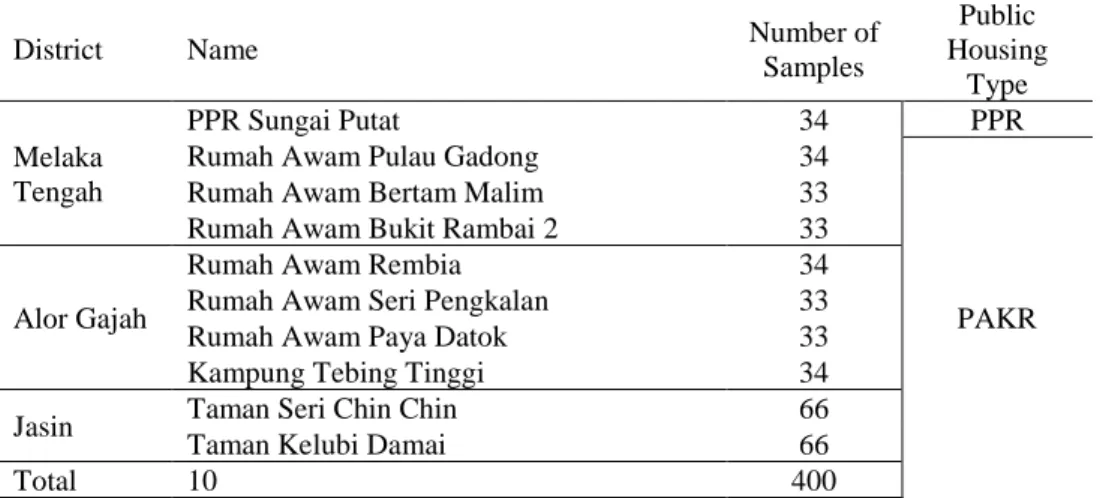
The research instrument used for the research is primarily based on questionnaire survey among 400 respondents that were distributed equally in the 3 districts in Melaka. The sample size was determined using a formula by Yamane (1967). For the sampling method, two methods were chosen, namely the stratified and convenience sampling. The list of public housing area in the study area was retrieved by using online sources acquired through the secondary data as well as from respective government departments.
These questionnaires were formulated based on the aspects of Maqasid al-Syariah, which falls under the three domains of Maqasid al-Syariah, which are the Necessities, Needs and Luxuries. In order to analyze the implementation of these domains towards the protection of human well-being, a set of questions were formulated, which includes:
i. Homeownership
ii. Challenges in owning a property iii. Housing condition
iv. Financial capacity v. Physical environment
The homeownership and challenges in owning a property falls under the necessities domains, where an analysis was made in order to evaluate the homeownership rate and challenges in owning a property in Melaka. It is understood that the sample were mainly from the low-income group from the public housing community, hence this analysis is conducted to determine the effectiveness of the government in providing affordable housing to the population, as in line with the Maqasid al-Syariah. As for the needs domain, which is a complementary interest that would ease the hardship of the population, was measured by aspects of housing condition and financial capacity to determine the effectiveness of the implementation of Maqasid al-Syariah. Lastly, the luxuries domain was analysed through the physical environment which includes the quality of physical environment and social services.
FINDINGS AND ANALYSIS
Table 1: List of public housing selected as samples in Melaka
District Name Number of
Samples
Public Housing
Type
Melaka Tengah
PPR Sungai Putat 34 PPR
Rumah Awam Pulau Gadong 34
PAKR
Rumah Awam Bertam Malim 33
Rumah Awam Bukit Rambai 2 33
Alor Gajah
Rumah Awam Rembia 34
Rumah Awam Seri Pengkalan 33
Rumah Awam Paya Datok 33
Kampung Tebing Tinggi 34
Jasin Taman Seri Chin Chin 66
Taman Kelubi Damai 66
Total 10 400
Source: Lembaga Perumahan Melaka
Table 2: Respondents’ economic capacity and residential profile
Categories Frequency Percentage (%)
Average Monthly Household Income
RM1,000 and below 26 6.8
RM1,001 – RM2,000 59 15.5
RM2,001 – RM3,000 123 32.4
RM3,001 – RM4,000 87 22.9
RM4,001 – RM5,000 52 13.7
RM5,001 – RM6,000 25 6.6
RM6,001 – RM7,000 4 1.1
RM7,001 – RM8,000 1 0.3
RM8,001 – RM9,000 3 0.8
Total 400 100.0
Mean RM2,790.00
Type of House
Terrace 383 95.8
Flat 17 4.3
Total 400 100.0
House Price at Purchase
RM50,000 and below 298 75.4
RM50,001 – RM100,000 52 13.2
RM100,001 – RM150,000 24 6.1
RM150,001 – RM200,000 21 5.3
Total 395 100.0
Mean RM49,773.90
Home Ownership
Own 355 88.8
Total 400 100.0
For the average monthly household income, the findings showed that the mean amounted to RM2,790.00 per month, which was significantly lesser than the national average of RM3,626 per month in 2012 (Institut Rakyat, 2014). To a certain degree, it showed that the respondents were made up from the bottom 40 percent household income group. In terms of housing type, it was identified that the types were divided into two categories, which were terrace houses and flats. The majority of the respondents were living in landed public housing with the percentage of 95.8% while the remaining resided in flats.
In addition, the mean housing price at purchase identified is RM49,773.90, which was extremely affordable although most of the houses purchased decades ago. To compare, the median market price for houses of all housing types in Melaka in the year 2014 was RM181,044 (Khazanah Research Institute, 2015).
It was also observed that 11.3% of the respondents rented the houses they were residing while the majority of the respondents own their properties (88.8%). In light of this, it was identified that though the housing market was considered affordable in Melaka, a portion of the population preferred or had to rent a house to reside in.
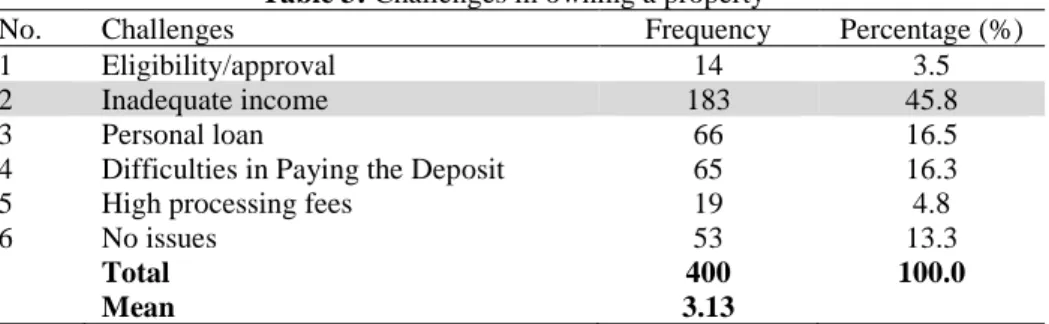
Table 3: Challenges in owning a property
No. Challenges Frequency Percentage (%)
1 Eligibility/approval 14 3.5
2 Inadequate income 183 45.8
3 Personal loan 66 16.5
4 Difficulties in Paying the Deposit 65 16.3
5 High processing fees 19 4.8
6 No issues 53 13.3
Total 400 100.0
Mean 3.13
With the current housing affordability in Melaka, and the number of public houses supplied, it could be assumed that the government’s efficiency in providing public housing were quite commendable and reliable. Furthermore, based on the Melaka Housing Institute, numerous affordable housing projects are currently underway to ease the demand of affordable housing in Melaka.
However, as Table 3 suggests, the main concern was more focused towards the inadequate income that were shrouding the majority of the respondents. As the objective of the Maqasid al-Syariah is practically to ensure that the human well-being is rightfully protected, several measures should be proposed and monitored to tackle the issue of income inadequacy.
Nevertheless, the provision of affordable housing was quite well taken-cared off in Melaka, which is in line with the purpose of Maqasid al-Syariah, particularly under the domain of necessities (darurriyat).
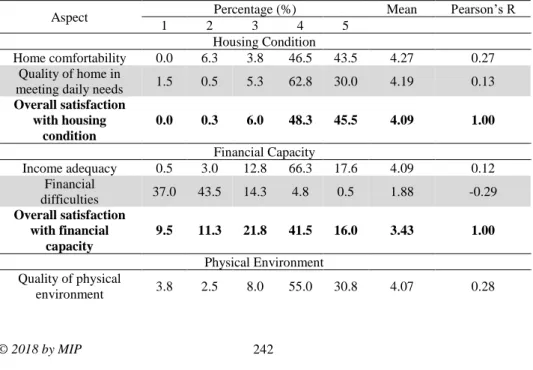
With regards to the results shown in Table 4, it was identified that the majority of the respondents (93.8%) were satisfied with their current housing condition that includes the aspects of comfortability of home and its quality in meeting their daily needs. In addition, the quality of home in meeting daily needs had a higher relationship towards the satisfaction level in comparison with comfort based on the Pearson’s r score, though both scores are considered to be weak relationships.
For financial capacity, the respondent’s perception on their overall satisfaction were between average and satisfied with a mean score of 3.43. It was identified that the respondents were more affected with the financial difficulties that they were facing instead of adequacy of income.
Table 4: Housing condition, financial capacity, and physical environment
Aspect Percentage (%) Mean Pearson’s R
1 2 3 4 5
Housing Condition
Home comfortability 0.0 6.3 3.8 46.5 43.5 4.27 0.27 Quality of home in
meeting daily needs 1.5 0.5 5.3 62.8 30.0 4.19 0.13 Overall satisfaction
with housing condition
0.0 0.3 6.0 48.3 45.5 4.09 1.00
Financial Capacity
Income adequacy 0.5 3.0 12.8 66.3 17.6 4.09 0.12
Financial
difficulties 37.0 43.5 14.3 4.8 0.5 1.88 -0.29
Overall satisfaction with financial
capacity
9.5 11.3 21.8 41.5 16.0 3.43 1.00
Physical Environment Quality of physical
Wariness on noise
pollution 29.5 43.5 6.0 15.5 5.5 2.24 -0.64
Quality of surrounding
social services 0.0 2.8 5.3 56.3 35.8 4.25 0.27
Safety and security of
the environment 1.5 1.0 2.5 24.5 70.5 4.62 0.53
Overall satisfaction with physical environment
0.0 0.5 13.8 46.8 39.0 4.24 1.00
In terms of physical environment, most of the respondents felt that the quality of their physical environment were very good and were satisfied. Furthermore, 95% of the respondents felt safe and secure in regards to the home environment while 92.1% are happy with the quality of social services available in the area.
Hence, in terms of the domains of needs and luxuries, it was identified that majority of the respondents, as per Table 4, were satisfied with their housing condition and physical environment, although the financial aspects being a lesser out of the three. There were no hardcore issues identified based on the respondents, and majority of the respondents were satisfied with the current condition of their lives.
CONCLUSION
Based on the findings, it is identified that overall, the respondents enjoyed an affordable housing market, as majority of them (88.8%) own their property with an average household monthly income of RM2,790.00. This suggests that the provision of housing which is considered as a basic necessity of every individual is properly taken care of both by the government, even though there are still a group of minorities who are still not able to own a house. These situations occur most probably due to the income inadequacy as stated by the challenges that was felt by the respondents during the home owning process.
Be that as it may, majority of the respondents are satisfied with their housing condition, financial capacity as well as their current physical environment that encompasses safety and social services. There are no severe issues identified by the respondents, and majority of them are currently happy with their current state of affairs.
However, there are still improvements to be made to ensure that the dimensions of Maqasid al-Syariah are thoroughly implemented to achieve the goal to protect humans well-being. A better employment opportunity as well as financial assistances to the hard core-poor from the welfare organization should be sufficient in order to elevate the respondent’s quality of life.
REFERENCES
Afridi, M. A. K. (2016). Maqasid al-shari'ah and preservation of basic rights: Under the theme "Islam and its perspectives on global & loca contemporary challenges".
Journal of Education and Social Sciences, 4, 274-285.
Auda, J. (2007). Maqasid al-shariah as philosophy of Islamic law (A systems approach). London: The International Institute of Islamic Thought.
Ibn al-Qayyim (1347 C.E.).
Ibn Ashur, M. a.-T. (1946). Treatise on maqasid al-shariah. London: International Institute of Islamic Thought.
Institut Rakyat. (2014). Key statistics. Institut Rakyat.
Khazanah Research Institute. (2015). Making Housing Affordable. Kuala Lumpur: Author.
Marans, R. W. & Stimson, R. J. (2011). Investigating quality of urban life: Theory,
methods and empirical research. Dordrecht: Springer.
Mohit, M. A. (2013). Quality of life in natural and built environment - An introductory analysis. Procedia - Social and Behavioral Sciences, 101, 33-43.
Mulligan, G., Carruthers, J., & Cahill, M. (2004). Urban quality of life and public policy: A survey. Contributions to Economic Analysis, 266, 729-802.
Shucksmith, M., Cameron, S., Merridew, T., & Pichler, S. (2009). Urban-rural differences in quality of life across the European Union. Regional Studies, 43(10), 1275-1289.