
Browse Title Index
20
0
0
Full text
(2) Faizah Ahmad, Ibrahim Mohd., Syra Lawrance Maidin, Rosilawati Zainol & Norzailawati Mohd Noor Malaysian Development Plan System: Issues and Problems, One Decade after its Reform (2001-2011). INTRODUCTION Statutory development plans play an essential role in the development control system. These plans are a type of blueprint or backcloth against which an application for planning permission is determined. Development plans act as the main tool in leading the future development as well as translating government policies into action (Baharom and Yusof, 2001). Despite voluminous literature on planning laws (Collins, 1951; Haar, 1984; Yadav, 1986; Cardew &Cuddy, 1987; Mata, 1991; Salet 2002; Allmendiger, 2002; Bruton, 2007; Norton, 2007 and Hoetjes, 2009) there is not much literature within the field of planning theory that explicitly links development planning to policies assessment. The relationship between development planning and legislative context, in particular, demands more attention from international planning theory (Salet, 2002). Devas and Rakodi (1993) argued that, despite several weaknesses, a development planning approach continues to dominate the urban planning systems of many developing countries. The weaknesses identified by Devas and Rakodi include professional training and ideology of planners, vested interests of consultants, professionals, administrators, city managers, and politicians; and inappropriate legislative basis for planning in terms of plan preparation and implementation. Key impediments identified relate to excessive delays in plan preparation and approval process, weak institutional set up, lack of coordination among government departments, inadequate financial resources, legal lacunas, lack of dissemination of plans, and above all lack of political will. Against this background, there is growing interest in the systematic evaluation of the quality of plans (Zhenghong and Brody, 2009; Berke and Godschalk, 2009; Laurien et. al., 2010). Thus, this study aims to identify issues and problems encountered by municipalities in the preparation and implementation of development plans outlined in Act 172. The methodology offers an objective and straightforward tool for studying plan quality and guiding plan preparation. With the purpose of understanding the interpretation of law in actual practice –and hence how the statutory development plans are being prepared and implemented – this study looked at the literature on the connection between development plans and legislative provision. The study focuses mainly on the Malaysian system, but discussions of tension between flexibility and legal certainty, and between development plans and legislative provision are widespread.. © 2013 by MIP. 2.
(3) PLANNING MALAYSIA Journal of the Malaysia Institute of Planners (2013). SPATIAL PLANNING SYSTEM (1976 – 2012) Although Malaysian urban planning is rooted from and modeled after the British planning system, there are some differences in the spatial planning framework. In Malaysia, spatial planning is implemented by three tiers of government system consisting of the federal government, the state governments (a region is an area situated in two or more states), and local authorities (city, municipal, and district councils). Each local authority is the local planning authority for its territory and is responsible to organize, plan and develop all land within the local plan boundary (Collins, 1951; Meng, 1991; Saleh, 2002; Baharom &Yusof, 2001). As of September 2012, there are 13 states (11 of which are in Peninsular Malaysia, the other 2 are in Borneo), 151 local authorities (comprised of 12 city councils, 39 municipal councils, 98 district councils and 5 modified local authorities). The Town and Country Planning Act 1976 (Act 172) was enacted in 1976 pursuant to clause (4) of article 76 of the Federal Constitution. Act 172 comprised of 9 parts with 59 sections and it was subsequently amended four times between 1993 and 2007. The main features of planning legislation in Malaysia are: i. ii. iii. iv. v. vi. vii.. viii.. The duty on the state and local planning authorities to prepare development plans A comprehensive legal definition of development A requirement to obtain planning permission for that development The right of appeal against refusal of planning permission by the local planning authority The power to remove unauthorized development Powers of the government in respect of dealing with planning applications and making or amending development plans Role of National Government: National Physical Planning Council (NPPC) sets the general policies and the overall policy framework, but overall responsibility for land-use planning lies with the relevant State Authorities Role of the Local Planning Authority (LPA): day to day administration and implementation.. The Act was amended in 2001 through the Town and Country Planning Act 1976 (Amendment) 2001 (Act A1129) to make provision for an improved system of statutory development plans in Malaysia. These amendments also aimed to address problems in the property sector and the role of federal government in town planning affairs. There were assertions that the previous 3. © 2013 by MIP.
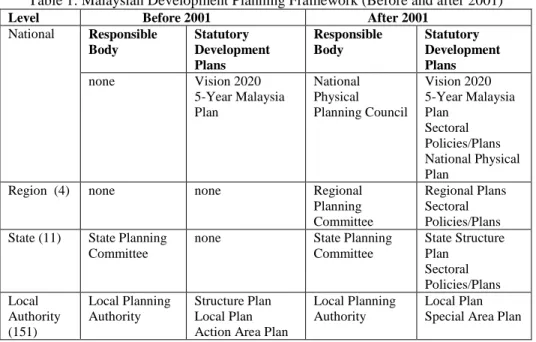
(4) Faizah Ahmad, Ibrahim Mohd., Syra Lawrance Maidin, Rosilawati Zainol & Norzailawati Mohd Noor Malaysian Development Plan System: Issues and Problems, One Decade after its Reform (2001-2011). structure planning system was inefficient in facilitating physical development due to small areas covered and unrealistic projections due to overlapping figures used in technical analyses (Bruton, 2007). Some of the adopted plans caused development constraints to housing developers of which had led to increase house prices (Ibrahim, et al 2007). With the enactment of the Town and Country Planning Act 1976 (Amendment) 2001 (Act A1129), the planning system in Malaysia underwent radical reform. The key principles of the reform were: (1) The development of regional planning and an emphasis on the regional tier of the planning system; (2) The development of federal authority in spatial planning through formation of the National Physical Planning Council. The 2001 amendment demonstrated the government‟s commitment to the well-established principle of a plan-led system and further emphasized the planning system and planning control (Dasimah & Leh, 2009; Mustafa, 2010 and Yaakup 2010). The statutory development plan will continue to be the starting point for consideration of planning applications for the development of use of land (Section 18 of the Act). The changes in development plan system as a result of the amendment are shown by Table 1. Table 1: Malaysian Development Planning Framework (Before and after 2001) Level National. Before 2001 Responsible Statutory Body Development Plans none Vision 2020 5-Year Malaysia Plan. Region (4). none. none. State (11). State Planning Committee. none. Local Authority (151). Local Planning Authority. Structure Plan Local Plan Action Area Plan. After 2001 Responsible Statutory Body Development Plans National Vision 2020 Physical 5-Year Malaysia Planning Council Plan Sectoral Policies/Plans National Physical Plan Regional Regional Plans Planning Sectoral Committee Policies/Plans State Planning State Structure Committee Plan Sectoral Policies/Plans Local Planning Local Plan Authority Special Area Plan. This development planning framework now involves all three levels of Government. At the national level, spatial planning is guided by the Five-Year Malaysia Plans (FYMP), the National Physical Plan (NPP) and sectoral policies/plans. These plans address the strategic issues of national importance © 2013 by MIP. 4.
(5) PLANNING MALAYSIA Journal of the Malaysia Institute of Planners (2013). and provide the overall framework for subsequent drawing up of the other more detailed development plans. Contextually, development planning in the country operates within the stated goals outlined in Vision 2020 (the year 2020 at which Malaysia is intended to achieve a developed country status) and the Third Outline Perspective Plan 2001-2010. These plans are subsequently interpreted into the State (Five-Year) Plan and Structure Plan respectively. Here, the Ministry of Housing and Local Government and Housing (MHLG) is the main institution working on issues such as urban planning, housing, and local government. The MHLG consists of the Department of Town and Country Planning, Department of Local Government, the Department of Housing and others. The Department of Town and Country Planning (DTCP) is charged with the responsibility of promoting orderly, coordinated and sustainable urban planning, and balanced regional development. The role of the MHLG is mainly that of policy making and supervision. Planning and regulation of actual development at city level is the responsibility of local authorities: City Councils, Municipal Councils and District Councils, with support from state authorities.. MALAYSIAN DEVELOPMENT PLAN SYSTEM As mentioned in Section 2.0, Malaysia practices a plan-led development system that consists of National Physical Plan (NPP) prepared by the National Physical Planning Council (NPPC); Structure Plan (SP) prepared by each state planning authority (SA); Local Plan (LP) prepared by state planning authorities or the local planning authority (LPA); Special Area Plan (SAP) prepared by state planning authorities/the local planning authority (LPA). The relationship between all of these plans as specified by the Act 172 is shown by Figure 1.. 5. © 2013 by MIP.
(6) Faizah Ahmad, Ibrahim Mohd., Syra Lawrance Maidin, Rosilawati Zainol & Norzailawati Mohd Noor Malaysian Development Plan System: Issues and Problems, One Decade after its Reform (2001-2011). S6B. NATIONAL PHYSICAL PLAN. S7 - 11. STRUCTURE PLAN. S12 - 16A. LOCAL PLAN. S16B. Negotiated with State Authority (SA) Approved by NPPC Prepared by DG of FTCP. Approved by State Planning Committee Assented by the SA Prepared by State Director of TCP. Approved by SPC Assented by the SA Prepared by LPA. Approved by SPC Assented by SA Prepared by State Director/LPA. SPECIAL AREA PLAN. Figure 1: Development plan hierarchy in Malaysia according to Sections of Act 172 Source: Government of Malaysia, 1976 (revised 2001). a). NATIONAL PHYSICAL PLAN (NPP). The National Physical Plan (NPP) concept was introduced as a result of amendments to the Town and Country Planning Act in 2001. The Act defined NPP as a written statement formulating strategic policies for the purpose of determining the general directions and trends of the physical development of the nation. NPP is developed out of a collaborative process between the federal government and the states. The Federal Department of Town and Country Planning is responsible for drafting the plan. The NPP is formulated in accordance with the objectives of urbanization and other relevant sectoral policies. The first NPP was approved in 2005 and it covers the period from 2006 to 2020. Pursuant to the Sub-section 6B (4) of the Town and Country Planning Act 1976, NPP must be reviewed every five years in tandem with the review of the Five Year Malaysia Plan (Government of Malaysia, 2010). The Second National Physical Plan (NPP-2) was approved by the National Physical Planning Council on August 13th 2010. The goal of NPP-2 is the establishment of an efficient, equitable and sustainable national spatial framework to guide the. © 2013 by MIP. 6.
(7) PLANNING MALAYSIA Journal of the Malaysia Institute of Planners (2013). overall development of the country towards achieving developed and highincome nation status by 2020. Additional policies and measures formulated in NPP-2 include matters regarding climate change, protection of biodiversity, green and new technology, as well as sustainable tourism. Also included in NPP-2 are outline measures to achieve goals of six National Key Result Areas (NKRAs) such as reduction of crime rate, widening access to affordable and quality education, raising the living standard of the poor, improving infrastructure in rural areas and improving public transport, which were set out in the course of introducing an outcome-based approach into public sector programs. NPP-2 sets out a national spatial strategy for Peninsular Malaysia known as “Concentrated Decentralization”. Its key strategies are to: (1) focus development along potential growth corridors (e.g. urban and industrial development, agriculture, tourism, transportation network, infrastructure and urban services); (2) focus urban development in selected urban conurbations and key urban areas; (3) spread development to lagging and non-urbanized regions; and (4) provide access to ecotourism and agricultural resources. b). STATE STRUCTURE PLAN (SSP). Section 8(3) of the Act defines a structure plan for the state as a written statement formulating the policy and general proposals of the State Authority in respect of the development and use of land in that State, including measures for the improvement of the physical living environment, the improvement of communications, the management of traffic, the improvement of socioeconomic well-being and the promotion of economic growth, and for facilitating sustainable development. Structure Plans distribute the expectation of development within each state and propose major economic and infrastructure projects for the states. The time perspective for Structure Plans is 20 years commensurate with the time perspective of Vision 2020. Structure plans are drafted by each state with that state as the fundamental unit, while regional plans entail projects involving two or more states, and are prepared for areas that have priority development issues of an interstate nature that need to be addressed.. 7. © 2013 by MIP.
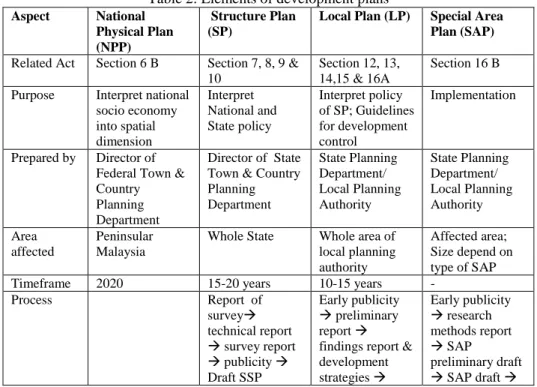
(8) Faizah Ahmad, Ibrahim Mohd., Syra Lawrance Maidin, Rosilawati Zainol & Norzailawati Mohd Noor Malaysian Development Plan System: Issues and Problems, One Decade after its Reform (2001-2011). c). LOCAL PLANS (LP) AND SPECIAL AREA PLAN (SAP). The state structure plans serve as the framework for spatial planning at the local level, in the form of a local plan or a special area plan. Section 12(3) of the Act defines local plan as a detailed land use plan (map) supported by written statements explaining proposals for the development and use of land in the area. The local plans can be prepared by the local planning authorities or the state planning department at any time during the preparation of, or upon the coming into effect of a structure plan. Similarly, special area plans can be prepared by the local planning authorities or the state planning department at any time during the preparation of, or upon the coming into effect of a structure plan or a local plan. A special area plan is a development plan prepared for the purpose of implementation, which is a Development Action Plan in the form of Layout Plan or Management Plan. The Plan is supported by a Detailed Development Specification and Development Action Schedule. The following table summarizes the main elements of the four statutory development plans. Table 2: Elements of development plans Aspect. Related Act Purpose. Prepared by. Area affected Timeframe Process. © 2013 by MIP. National Physical Plan (NPP) Section 6 B Interpret national socio economy into spatial dimension Director of Federal Town & Country Planning Department Peninsular Malaysia 2020. Structure Plan (SP). Local Plan (LP). Special Area Plan (SAP). Section 7, 8, 9 & 10 Interpret National and State policy. Section 12, 13, 14,15 & 16A Interpret policy of SP; Guidelines for development control State Planning Department/ Local Planning Authority. Section 16 B. Whole area of local planning authority 10-15 years Early publicity preliminary report findings report & development strategies . Affected area; Size depend on type of SAP Early publicity research methods report SAP preliminary draft SAP draft . Director of State Town & Country Planning Department Whole State. 15-20 years Report of survey technical report survey report publicity Draft SSP. 8. Implementation. State Planning Department/ Local Planning Authority.
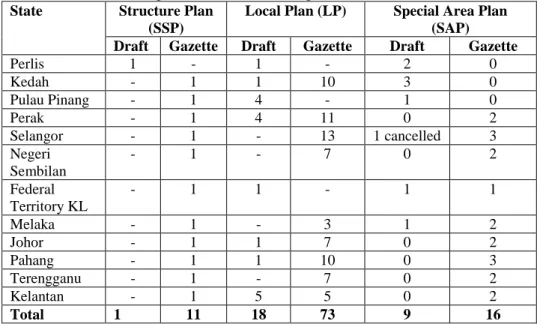
(9) PLANNING MALAYSIA Journal of the Malaysia Institute of Planners (2013). publicity SSP approval and gazette Main output (plan). Indicative Plan 2020. Explanation. Written statement summarizing strategic policy and direction of national physical planning. Publicity. No publicity, only negotiations with State. Main diagram covering whole state, indicate components clearly Written statement, explain policies and state strategic planning.. Survey report and Draft SP, not less than 4 weeks. Draft LP publicity LP approval and gazette Proposed plan: land use detail ; subject plans; accompanying plans Proposed detail land use plans supported by written statements explaining the proposals. publicity SAP approval and gazette Development Action Plan:Layout Plan/ Management Plan or both Detailed planning for implementation. The public can get involved during the preliminary survey, draft LP/SAP and target group discussions. Not less than 4 weeks Source: Town and Country Planning Act 1976. These statutory development plans, therefore, provide the essential framework for planning decisions. Any development of land and buildings requires planning approval from the Local Planning Authority (LPA). Planning permission will be granted if the proposal is in conformity with the statutory Local Plan, fulfills technical agencies requirements and receives no objection from the neighbours.. THE IMPLEMENTATION OF DEVELOPMENT PLANS As mentioned in Section 3.0, the first NPP was approved in 2005 and it covers the period from 2006 to 2020. The NPP-1 was reviewed and subsequently the Second National Physical Plan (NPP-2) was approved by the National Physical Planning Council on August 13th 2010. The following Table 3 summarizes the implementation status of Structure Plans, Local Plans and Special Area Plans from since 2001 until February 2012. The Table 3 shows that all states except Perlis have successfully prepared and implemented their respective state structure plans. These plans were completed between the years of 2007 to 2011, whilst the duration for structure plan preparation and implementation range between five to ten years from the year the act came into force in 2001. A total of 93 local plans was planned to be implemented in all 11 states and 1 federal territory, but only 73 9. © 2013 by MIP.
(10) Faizah Ahmad, Ibrahim Mohd., Syra Lawrance Maidin, Rosilawati Zainol & Norzailawati Mohd Noor Malaysian Development Plan System: Issues and Problems, One Decade after its Reform (2001-2011). plans had been completed and gazetted by 2011. A total of 23 special area plans were also planned to be implemented in all 11 states but only 16 plans had been gazetted, with gazette years ranging from 2009 to 2011. Special area plans are now in place in all states except Kedah, Perlis and Penang. As seen in the Table 3, the implementation of the statutory development plans has encountered serious problems in terms of time taken to prepare the plans and the process of adopting them. This has led, in turn, to development delays. There are also delays in the approval process since state authority consents are required before implementing the plan. While the development plan seeks to deliver the latest information to all, moreover, there have been problems and delays in bringing together the data held by various agencies, leading to longer waiting time and increased operating costs during the plan preparation. These problems are partly due to ineffective utilization of Information Technology (IT) tools for data management amongst the agency staffs (Tan, 2005; Mohd Ramzi & Foziah, 2010). The alternative of simply disseminating the available data could lead to inconsistencies through the use of different time-sets and out of date data which could jeopardize the implementation of the plan. But the delays in the preparation of a development plan can also lead to it being shelved as an out of date plan. Table 3: Status of Preparation and Implementation of Structure Plan, Local Plan and Special Area Plan as of September 2012 State Structure Plan Local Plan (LP) Special Area Plan (SSP) (SAP) Draft Gazette Draft Gazette Draft Gazette Perlis 1 1 2 0 Kedah 1 1 10 3 0 Pulau Pinang 1 4 1 0 Perak 1 4 11 0 2 Selangor 1 13 1 cancelled 3 Negeri 1 7 0 2 Sembilan Federal 1 1 1 1 Territory KL Melaka 1 3 1 2 Johor 1 1 7 0 2 Pahang 1 1 10 0 3 Terengganu 1 7 0 2 Kelantan 1 5 5 0 2 Total 1 11 18 73 9 16 Source: Department of Town and Country Planning, 2012. © 2013 by MIP. 10.
(11) PLANNING MALAYSIA Journal of the Malaysia Institute of Planners (2013). METHODOLOGY OF STUDY The literature identifies a set of inter-relationship between the development plans, planning controls and the land development which provides the basis for designing survey instruments. Secondary data that cover various types of publications, reports and documents will demonstrate the secondary evidence of the outcomes of these inter-relationships. Primary data at the preparation and the implementation stages, obtained through postal questionnaires from selected local authorities in each state of Peninsular Malaysia, were analyzed to reveal empirical evidence of the factors that affect outcomes of the inter-relationships between the planning system, the planning controls and land development. A total of 50 sets of questionnaires were analyzed from a total of 150 sets sent out to town planners in the public sector (federal, state and local government levels). The Mean Score for each investigated item was based on a likert scale of 5 points, ranging from “strongly disagree” to “strongly agree”. The analysis of the findings from these questionnaire indicate answers to the questions about key implementation factors driving effective or ineffective planning system since the TCP Act 172 was amended in 2001.. FINDINGS AND DISCUSSION This section reveals and discusses issues in the preparation and implementation of development plan with regard to legal, administration and financial, human resources and technical aspects. Issues and Problems at the Plan Preparation Stage Generally four main aspects have been successfully analyzed at the preparation stage consisting of legal, administration and finance, human resource and technical aspects. Only items with a mean score of more than 3 are reported in this section. Legal Aspects The legal aspects were categorized into 4 main issues. As the Table 4 shows, the mean points for legal aspect were ranged from point 3 to point 5. This suggests that all respondents tended to agree that the four investigated aspects were significant in the preparation of the development plans. The mean score of more than 4.5 relating to the delay in gazetting development plans indicated that this is the major issue in the preparation of all development plans.. 11. © 2013 by MIP.
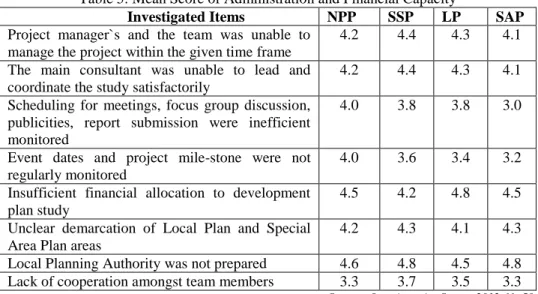
(12) Faizah Ahmad, Ibrahim Mohd., Syra Lawrance Maidin, Rosilawati Zainol & Norzailawati Mohd Noor Malaysian Development Plan System: Issues and Problems, One Decade after its Reform (2001-2011). With respect to issues of the compatibility of higher level plans with the lower level plans and the interpretation of the plans functions, as shown in the second row of Table 4, the mean score was ranging from 2.8 to 3.5 which indicate the nearly neutrality of respondents regarding these issues. Table 4: Mean Score of Legal Aspects Investigated Items NPP SSP Difficulties in interpreting the function of 3 3.2 development plans based on TCP Act 172 and A1129 Policies in higher level development plans are 2.8 3.0 not relevant to the lower level The public were unable to express their needs 4.8 3.8 and values Delay in gazetting the development plan 4.6 4.6. LP 3.2. SAP 3.1. 3.5. 3.2. 3.2. 3.8. 4.5. 4.5. Source: Questionnaire Survey 2012, N=50. Administration and Financial Capacity The administration and financial capacity were categorized into 8 issues as shown by Table 5. Table 5: Mean Score of Administration and Financial Capacity Investigated Items NPP SSP LP Project manager`s and the team was unable to 4.2 4.4 4.3 manage the project within the given time frame The main consultant was unable to lead and 4.2 4.4 4.3 coordinate the study satisfactorily Scheduling for meetings, focus group discussion, 4.0 3.8 3.8 publicities, report submission were inefficient monitored Event dates and project mile-stone were not 4.0 3.6 3.4 regularly monitored Insufficient financial allocation to development 4.5 4.2 4.8 plan study Unclear demarcation of Local Plan and Special 4.2 4.3 4.1 Area Plan areas Local Planning Authority was not prepared 4.6 4.8 4.5 Lack of cooperation amongst team members 3.3 3.7 3.5. SAP 4.1 4.1 3.0. 3.2 4.5 4.3 4.8 3.3. Source: Questionnaire Survey 2012, N=50. The mean score of more than 4.5 points was given to the item “Local Planning Authority was not prepared” across all four development plan levels, followed by the capacity of the main consultant to prepare the plans, the © 2013 by MIP. 12.
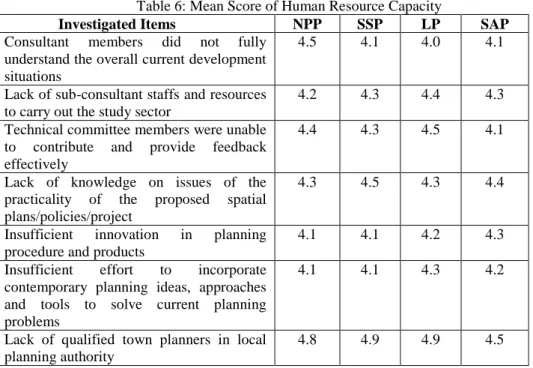
(13) PLANNING MALAYSIA Journal of the Malaysia Institute of Planners (2013). capacity of project‟s managers to manage the project, demarcation of the coverage area for the LP and SAP. Insufficient financial allocation is also an issue at the LP and SAP with the mean score point of more than 4. Human Resource/Planning Staffs Capacity The human resource aspects were categorized into the following 7 main issues as shown by Table 6. Of all the issues, lack of qualified town planners in the local planning authority was seen as the main issue since the mean score for this issue is more than 4.5, followed by the issue of lack of capacity of technical committee members to contribute and provide feedback effectively to further enhance the development plan, lack of capacity of sectoral consultant to carry out and contribute effectively to produce the development plan, insufficient innovations in planning procedure and/or plans produced and insufficient effort to incorporate contemporary planning ideas, approaches and tools to solve current planning problems in the study area. Table 6: Mean Score of Human Resource Capacity Investigated Items NPP SSP LP Consultant members did not fully 4.5 4.1 4.0 understand the overall current development situations Lack of sub-consultant staffs and resources 4.2 4.3 4.4 to carry out the study sector Technical committee members were unable 4.4 4.3 4.5 to contribute and provide feedback effectively Lack of knowledge on issues of the 4.3 4.5 4.3 practicality of the proposed spatial plans/policies/project Insufficient innovation in planning 4.1 4.1 4.2 procedure and products Insufficient effort to incorporate 4.1 4.1 4.3 contemporary planning ideas, approaches and tools to solve current planning problems Lack of qualified town planners in local 4.8 4.9 4.9 planning authority. SAP 4.1. 4.3 4.1. 4.4. 4.3 4.2. 4.5. Source: Questionnaire Survey 2012, N=50. Technical Support Capacity The technical capacity was categorized into 7 main issues as shown by Table 7. Based on the issues listed under the technical aspects, “the problems of 13. © 2013 by MIP.
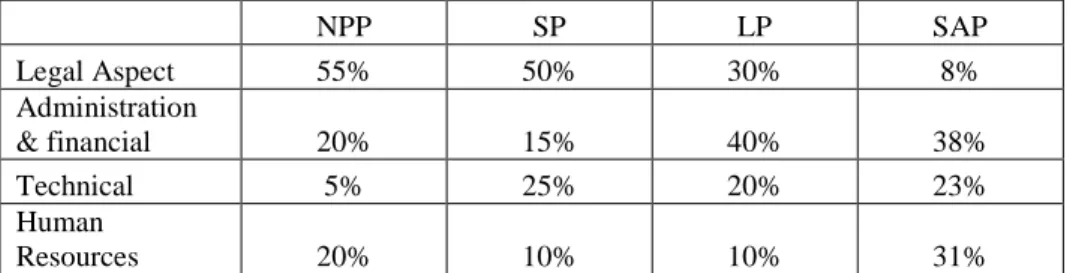
(14) Faizah Ahmad, Ibrahim Mohd., Syra Lawrance Maidin, Rosilawati Zainol & Norzailawati Mohd Noor Malaysian Development Plan System: Issues and Problems, One Decade after its Reform (2001-2011). acquiring and/or collecting data for the study and the incorporations of local values and needs into the development plan” received a mean score of more than 4.5 and followed by other issues that have the mean score between 3 - 4.4 that refer to the lack of understanding and interpreting the current economic and social development, and the existing development policies. Table 7: Mean Score of Technical Capacity Investigated Items NPP SSP Difficulties in interpreting existing 3.3 3.3 development policies into study area Difficulties in translate existing development 3.7 3.1 policies into the study area Difficulties in understanding & interpreting 3.3 4.4 current economic development in study area Difficulties in understanding & interpreting 4.2 4.4 current social development in study area Difficulties in understanding & interpreting 4.1 4.3 current spatial development in study area There were problems in acquiring and/or 4.6 4.8 collecting data for the study Local needs and values were difficult to be 4.6 4.6 incorporated in development plan proposals. LP 3.1. SAP 3.5. 3.4. 3.8. 4.2. 4.1. 4.3. 3.7. 4.1. 4.0. 4.8. 4.8. 4.6. 4.8. Source: Questionnaire Survey 2012, N=50. IMPLEMENTATION OF DEVELOPMENT PLAN The implementation of development plans has been examined in 4 aspects of legal, administration &finance, human resource and technical. The data obtained by the survey are summarized in Table 8. Table 8: Issues at the Implementation Stage of Development Plans. Legal Aspect Administration & financial Technical Human Resources. NPP 55%. SP 50%. LP 30%. SAP 8%. 20% 5%. 15% 25%. 40% 20%. 38% 23%. 20%. 10%. 10%. 31%. Source: Questionnaire Survey 2012, N=50.. The survey found issues in the implementation of development plans in relation to all four reviewed aspects. Table 8 shows that legal aspect scored the. © 2013 by MIP. 14.
(15) PLANNING MALAYSIA Journal of the Malaysia Institute of Planners (2013). highest with 55% and 50% at the level of NPP and SP respectively while a much lower score for SAP of 8 %. This result shows that issues related to the legal aspect were more apparent at the higher level plans of NPP and SP, in which the broader strategies, objectives and policies were formulated. At the local level, i.e., LP and SAP, legal issues seem not significant but issues related to the administration and financial aspects, instead, scored higher percentages for LP and SP with 40% and 38% respectively. This result suggests that at the local implementation stage, the administration and financial aspects are the main hurdles in ensuring successful implementation of the plans. Table 8 also shows that, there were fewer technical issues at the NPP level, but these were more important at the SP, LP and SAP levels. Human resource aspects were noted as more important at the SAP and NPP, indicating a relative lack of skilled and semi-skilled workers in the implementation of development plan at the highest level and the lowest level. This result implies that there is a lack of skilled town planners at those particular levels. Technical issues were not important at the NPP level, but were at the SP level, LP and SAP.. (Percentage). The overall results of the survey demonstrate the impression of the respondents with regards to issues and problems in the preparation and implementation of development plans throughout Peninsula Malaysia. Figure 2 shows the summated results highlighting the main issues in the preparation and implementation of all development plans according to the four aspects studied.. Figure 2: Summary of issues of development plans‟ implementation Source: Questionnaire survey 2012, N=50. 15. © 2013 by MIP.
(16) Faizah Ahmad, Ibrahim Mohd., Syra Lawrance Maidin, Rosilawati Zainol & Norzailawati Mohd Noor Malaysian Development Plan System: Issues and Problems, One Decade after its Reform (2001-2011). Legal aspects were identified as the main issues in implementing the development plan as indicated by Figure 2 above. Legal aspect (LA) attained the highest percentage among the four aspects studied, followed by human resources, technical and administration and financial aspects. Results revealed that there are many factors required for implementation, including: creating a comprehensive terms of reference, educating staff on planning principles, working with a planning consultant, involving a variety of stakeholders in the process, having the plan available to the public, and creating a method for reviewing and updating the plan.. CONCLUSION AND OUTLOOK The enactment of the Town and Country Planning Act 1976 (Act 172) established in essence a well-structured hierarchy of development plans for Malaysia. The Malaysian development plan system is rooted in the earlier British planning system and was enhanced with the amendment of the Act 172 in year 2001. The formulation of a planning system, particularly with regard to a development planning system, must be practical from the stage of preparation until its implementation. However, the preparation and implementation of the plans can face delays within the development plan process (Cullingworth and Nadin, 2006), caused by, amongst other things, a lack of skilled town planners to interpret and formulate development policies (Mohd Razali, 2002), and by a lack of financial resources (Devas and Rakodi, 1993; Goh, 1997). Weaknesses of the development planning approach identified by Devas and Rakodi (1993) pertaining to legislative basis for planning are evident in this study where the empirical data demonstrate that most of the issues and problems in the preparation and implementation of development plans at each level of the plans are primarily legal in origin. Although the development plan system stipulated under the Act 172 clearly demarcated the hierarchy of plans that should be prepared by levels of government agencies, the effectiveness of implementation of the development plan system relies on the capability of the local level to interpret higher level policies and legal requirement in development plans towards a more humanistic and livable environment. The study also found that the planning process should include: thoughtfulness when creating the terms of reference, extensive public consultation, effective staff consultation, frequent council input, consultation with a recreation planner, and a method for updating and reviewing the plan. Malaysia is one of the developing countries in which the planning system was strongly influenced by the colonial ruler, but it is imperative that the © 2013 by MIP. 16.
(17) PLANNING MALAYSIA Journal of the Malaysia Institute of Planners (2013). development plan system should consider the local institutional set-up pertaining to legal, administrative, financial, human resources and technical capacity. In order for plan-making procedures and techniques to be more effective in Malaysia, the training or education of professionals (government officials and consultants) to make the best use of plan-making procedures and techniques and the security of sufficient financial resources must be given top priority. The capacity of different government and private agencies to effectively discharge their responsibilities should be enhanced through adequate training and sharing of information and knowledge of good practice. The professional courses conducted by Malaysian Institute of Planners (MIP) can be a good platform for this purpose which can be attended by all (government officials and consultants) who involve in spatial planning including planners in the academic line who can improve the teaching curriculum of urban planning courses. Land use planning through the development planning system is a complex process involving geographic, social and economic questions which can be affected by jurisdictional frameworks and planners‟ values and experiences (Forrester, 1984). The ability of local planning authority to produce effective and pragmatic plans to guide and to grant approval for development in the fastest possible time would be much appreciated by the public (Allmendinger, 2002). Therefore, the amendment of the act itself would not be sufficed to ensure efficient implementation of the plans on the ground. Lack of coordination among government departments and technical agencies as identified by Devas and Rakodi (1993) which is also evident in this study should be given serious attention by the Ministry of Urban Wellbeing, Housing and Local Government perhaps to establish a coordination unit/agency as similar as One Stop Center (OSC) and improving the availability of up-to-date online information through efforts to increase of „IT‟ literacy rate among staffs of government departments and technical agencies (Tan, 2005; Mohd Ramzi & Foziah, 2010). This study has enriched the rational planning theory by indicating the need to build higher competency level of planning staffs and the theory of pragmatism by suggesting the need for more regular plan-updating procedures to achieve practical, consistent, and systematic development planning process that can eventually improve the quality of the plan. To this end, town planners should look forward toward attaining stronger collaborations with players in sustainable development especially from all bodies involve in urban development such as Department of Environment (DoE), Public Work Department, Real Estate and Housing Developers Association (REHDA), public transport providers, professional institutions, etc. In addition, further researches 17. © 2013 by MIP.
(18) Faizah Ahmad, Ibrahim Mohd., Syra Lawrance Maidin, Rosilawati Zainol & Norzailawati Mohd Noor Malaysian Development Plan System: Issues and Problems, One Decade after its Reform (2001-2011). are needed especially to study the relationship between the development planning system and national economic planning in order to ensure that the implementation of development plan proposals are in-line with the Five-year National Plans.. ACKNOWLEDGEMENT The authors greatly acknowledge all officers of Local Authorities and Town and Country Planning Department for providing valuable data and cooperation. Thanks also due to the University of Malaya Kuala Lumpur for providing financial support to this research (RG085/10SUS).. REFERENCES Allmendinger, P (2002). Planning theory. New York: Palgrave. Baharom, A. & Yusof, I. M. (2001). GIS applications in development control process: Local government in Malaysia. Middle states division of the Association of American Geographers annual meeting, Brookville, New York. Berke, Philip. Godschalk, D (2009), Searching for the Good Plan a Meta-Analysis of Plan Quality Studies, Journal of Planning Literature, 23(3), 227-240 Booth, P., (2007). The control of discretion: planning and the common-law tradition. Planning Theory. Vol. 6 (2); 127–145. Bruton, M.J (2007) Malaysia: the Planning of a Nation, Kuala Lumpur, PERSADA Buitelaar, E., Galle, M, Sorel, N. (2011). "Plan-led planning systems in developmentled practices: an empirical analysis into the (lack of) institutionalization of planning law". Environment and Planning A. 43(4); 928 – 941 Cardew, R. and Cuddy, M.C. (1987). A comparison of the land authority for Wales (UK) and the land commission of new south Wales (Australia), Habitat International, Vol.11; 97-111. Collins, B.J (1951). Development Plans Explained. United Kingdom: Her Majesty` Stationery Office (HMSO). Cullingworth, B. and Nadin, V. (2006). Town and Country Planning in the UK (14 th edition), Routledge Dasimah, O & Leh O.L.H (2009). Malaysian Development Planning System: Kuala Lumpur Structure Plan and Public Participation, Asian Social Science, Vol. 5, no.3; 30-36. Devas, N and C. Rakodi, (1993). Managing Fast Growing Cities: New Approaches to Urban Planning and Management in the Developing World, England: Longman Group UK Ltd. Government of Malaysia (2002). Town and Country Planning Act 1976 (Act 172). Kuala Lumpur: International Law Book Services. Government of Malaysia, (2010). National Physical Plan 2. Kuala Lumpur: Federal Department of Town and Country Planning. © 2013 by MIP. 18.
(19) PLANNING MALAYSIA Journal of the Malaysia Institute of Planners (2013). Government of Malaysia, (2004). Development planning in Malaysia, Putrajaya: Economic Planning Unit. Haar, C.M. (1984). Cities, Law and Social Policy. Lexington Books, Lexington, MA. Hoetjes, B.J.S (2009). Trends and issues in municipal twinnings from the Netherlands. Habitat international. Vol. 33; 157-164. Ibrahim Mohd @ Ahmad, Ezrin Arbi, Ahmad Ramly (2007). Urban Housing Development: Town Planning Issues; Planning Malaysia, Journal of the Malaysian Institute of Planners. Vol. 5; 43-60. Laurian L., Crawford J., Day M., Kouwenhoven, P., Mason G., Ericksen, N. Beattie, L., 2010, "Evaluating the outcomes of plans: theory, practice, and methodology". Environment and Planning B: Planning and Design. 37(4) 740 – 757 Likert, R. (1932). A Technique for the Measurement of Attitudes. New York: Archives of Psychology. Mata, E. (1991). Relations between Planning Legislation and National Ideology in Mozambique, paper presented to the International Conference on Planning Legislation in Africa. Mattingly, M. (1988). From town planning to development planning: A transition through training. Habitat International. 12 (2), 97–109. Meng, L.L. (1991). Town planning law in Malaysia Politics, Right and Jealousies. Habitat International. 10 (4); 135-146. Meng, L.L., Mohamed Jamil Ahmad (2000). Local Authority Networked Development Approval System. Planning Digital Conference, Pulau Pinang, Malaysia, 2829 March 2000 Mohd Ramzi M. H; Foziah Johar (2010). The Socio-Technical Factors in the Use of GIS at the Planning Department of the Kuala Lumpur City Hall. Planning Malaysia, Journal of the Malaysian Institute of Planners. Vol. 8; 67 – 100. Mustafa, M.(2010). Environmental Law in Malaysia. Netherlands: Kluwer Law International. Norton, R.K (2007). Using content analysis to evaluate local master plans and zoning codes. Land Use Policy. Vol. 25 (3); 432-454 Rakodi, C. (2001). Forget Planning, put politic first? Priorities for urban management in Developing Countries. JAG- Volume 3-Issue; 3 209-223. Rakodi, C (1987). Urban plan preparation in Lusaka. Habitat International. Vol. 11(4). 95 - 111 Saleh, M.A.E (2002). A vision for directing future planning efforts: The case of villages of southwestern Saudi Arabia. Habitat International. Vol. 26, 51-72. Salet W., Faludi, A (Eds) (2000). The revival of strategic spatial planning, KNAW Amsterdam. Salet, W.G.M., (2002). Evolving Institutions: An International Exploration into Planning and Law. Journal of Planning Education and Research. Vol. 22; 26– 35. Talen, Emily (1999) Do plans get implemented: A review of evaluation in planning, Journal of Planning Literature, Vol. 10(3); 248-259 Tan Thean Siew (2005). Electronic Local Authority Management System. Planning Malaysia, Journal of the Malaysian Institute of Planners. Vol. 3; 27 – 46.. 19. © 2013 by MIP.
(20) Faizah Ahmad, Ibrahim Mohd., Syra Lawrance Maidin, Rosilawati Zainol & Norzailawati Mohd Noor Malaysian Development Plan System: Issues and Problems, One Decade after its Reform (2001-2011). Yaakup, A., Johar, F., Sulaiman, S., and Ibrahim, A.R (2003) GIS and development control system for local authority in Malaysia. Habitat International. Vol. 27 ; 683-696. Yadav, C.S (1986).Urban Planning and Policies: Part A: Reorientation of Policy. Naurang Rai. New Delhi, India. Zakiah Ponrahono, Che Musa Che Omar, Ahmad Makmom Abdullah and Azizi Muda (2011) Matrix Sustainable Strategies Compatibility Analysis of Malaysia‟s Sustainable Development Strategies in Three-Tier Development Plan System, World Applied Sciences Journal 14 (Exploring Pathways to Sustainable Living in Malaysia: Solving the Current Environmental Issues): 22-30, 2011 Zhenghong Tang, Samuel D. Brody (2009) Linking planning theories with factors influencing local environmental-plan quality. Environment and Planning B: Planning and Design. Vol. 36; 522–537. © 2013 by MIP. 20.
(21)
Figure

+5

Related documents
Though, Roberts (2009), revealed that medical staff are not aware of their obligation to autopsies and the processes involved in getting consent from families of deceased miners
Ideas, language, even the phrase ‘each other’ doesn’t make sense any more. Beyond our ideas of right-doing and wrong-doing, there is
CPT Code Modifiers - “…indicate that a service or procedure that has been performed has been altered by some specific circumstance but not changed in its definition or code.”
• Wal-Mart supercenters at $2.79 per gallon are lower priced than the three leaders, Stop & Shop, Shaw’s, and Big Y, but they are not the lowest priced supermarket chain in
However, the disappearance of Assyrian control also made possible ex- tension west and especially north, into the territory of those Assyrian provinces that had earlier been taken
Summer term 2008 32 Technique/Application interval selector code view, second layer code view, main layer. version
The data reported here for this long-term Phase 2b study in patients with established RA and an inadequate response to MTX dem- onstrate the consistent safety and sus- tained
An important feature that emerge from the table is that annual per capita net real income (combining all forest sources – NTFPs, forestry wage and timber forest products –
