Computer-aided
Document Indexing System
Mladen Kolar, Igor Vukmirovi´c, Bojana Dalbelo Ba
si´c and Jan
ˇ
Snajder
ˇ
Faculty of Electrical Engineering and Computing, University of Zagreb, CroatiaAn enormous number of documents is being produced that have to be stored, searched and accessed. Do-cument indexing represents an efficient way to tackle this problem. Contributing to the document indexing process, we developed the Computer-Aided Document Indexing System (CADIS) that applies controlled
vo-cabulary keywords from the EUROVOC thesaurus. The main contribution of this paper is the introduction of the special CADIS internal data structure that copes with the morphological complexity of the Croatian language. CADIS internal data structure ensures efficient statistical analysis of input documents and quick visual feedback generation that helps indexing documents more quickly, accurately and uniformly than by manual indexing.
Keywords: information retrieval, document indexing, text statistics, EUROVOC.
1. Introduction
In the modern world overwhelmed by compu-ters, huge storage spaces and widely acces-sible Internet, information is no longer a desired wealth. It is a cumbersome requirement that has to be dealt with efficiently.
Official documents have to be collected and neatly stored, at the same time providing quick access and search by means of indexing, a pro-cess of assigning keywords to documents. A kind of indexing is keyword assignment, identi-fication of appropriate keywords from the con-trolled vocabulary of a reference list (a
the-saurus)10]. Lacking good automated systems,
one had to go through every single legal docu-ment and assign the keywords manually. Obvi-ously, the need existed to relieve human index-ers of this long, tedious and, above all, expen-sive work.
Challenged by this, we started designing and implementing a Computer-Aided Document In-dexing System(CADIS), presented here.
The main motive to develop the system was the fact that official documents have to be indexed according to multilingual EUROVOC thesaurus. It covers the fields in which the European Com-munities are active. Its form of a controlled and structured list provides a means of indexing the documents in the documentation systems of the European institutions and of their users 2]. It
organizes over 6,000 descriptors(classes)from
21 different fields (e.g. politics, finance,
sci-ence, social questions, organizations, foodstuff, etc.) hierarchically into a maximum of 8 levels.
Due to the multilingual nature of EUROVOC, it is very suitable for applications such as cross-lingual document similarity calculation, multi-lingual clustering and categorization, and cross-lingual document retrieval and information ac-cess10].
From the beginning, CADIS was designed with EUROVOC in mind, but not limited to it, mak-ing it possible to use the statistical output of the system for other purposes too.
CADIS does not perform automatic document indexing, it helps humans to make the process of standard intellectual indexing easier, by provid-ing results of built-in statistical and natural lan-guage processing techniques. CADIS speeds up indexing and ensures building a set of uniformly indexed documents.
abstraction of the object model and problems tackled during implementation, while Section 5 describes multilingual aspects of the system. In Section 6 conclusion and future work are given.
2. Related Work
Automatic document indexing (or
classifica-tion) is an old problem, already described in
1961. Maron examined a technique for clas-sifying documents automatically, according to their subject contents7].
Automated document indexing using EURO-VOC thesaurus is a problem that occupies many scientists. In 1997, Ferber 4] built an
appli-cation which used a multilingual thesaurus for the retrieval of English documents using search terms in other non-English languages. A more recent example of such application was built by Steinberger and Pouliquen who introduced statistical methods for cross-lingual indexing
10, 13, 14]. An automatic indexing system
that could work in a language- independent en-vironment was developed. JRC workshop on EUROVOC5]brought some ideas and progress
on automated indexing.
Montejo-Raez in his papers 8] describes the
use of information retrieval for indexing tech-niques. Our own approach to the problem is multi-monolingual. The CADIS system can deal with several languages, but the results will always be displayed in the same language as the text. It does not support automated index-ing, due to the lack of a substantial learning set of pre-indexed documents in Croatian. Its pur-pose is to help human indexers, using statistical processing on text, to index documents that will form a learning set for building an automated document indexer.
3. Functionality
3.1. System Input
XML 3], the selected format for information
interchange has many favorable characteristics for this system. As it is an industry standard, there are good reasons to believe that some of the input will already comply with this format. On the other hand, existing documents in other
formats (HTML, PDF etc.) can be converted
to XML in a more or less simple procedure. Furthermore, XML enables the coding of addi-tional information to the text itself, such as title, source, paragraphs, formatting etc. needed for visual reconstruction of documents within the CADIS.
From the document received as the input, an internal data structure, representing the XML document, is built and a sequence of statistical and lexical analyses is carried out.
3.2. Statistics and Visual Feedback
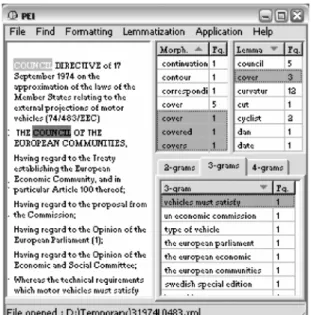
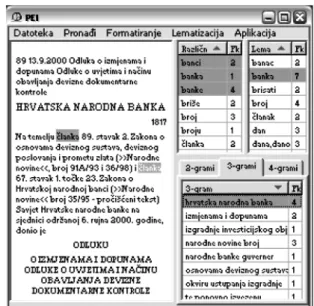
An example of the CADIS user interface is shown in Fig. 1. After the initial processing, a visual representation of the XML document currently being indexed is shown on the left hand side of the user interface. The visual rep-resentation is generated by the PEI program in RTF format11]using formatting and paragraph
information provided in the XML document. Primarily intended for documents in Croatian, during the design of CADIS special attention had to be paid to the morphological complexity of the language. Certain Croatian words, such as nouns and adjectives, can have a number of different morphological forms, depending on the number, gender, degree etc. However, sta-tistically, each of these forms is treated as one occurrence of the word in its basic form, also called the lemma16].
Lemmatization process was implemented for Croatian and English. Automatically acquired morphological lexica was used for Croatian
15], for lemmatization of English Porter’s
stem-ming algorithm was used9].
The output of the statistical analysis of the text consists of two lists: the list with all morpho-logical forms found in the document with their frequencies and the list that contains only lem-mas of these words and their frequencies. Both of these lists enable sorting according to words or frequencies and locating the occurrences of any word or lemma within the document by a double-click. The same functionality is avail-able throughout the menu.
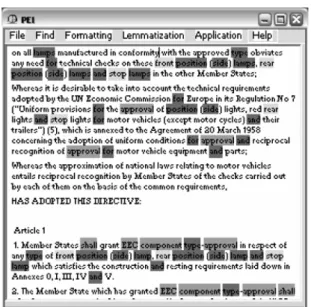
The statistical analysis of the text provides a solid ground for the visual feedback mentioned above. With each search a red background colo-ring visually emphasizes all the occurrences of the sought word or lemma, while the selec-tion jumps from one occurrence to the other. The system also enables visual emphasizing of the most frequent lemmas in the document(an
example shown in Fig. 2.), as well as hiding
irrelevant information from the text, such as stop-words, words with minimal semantic mean-ing (e.g. conjunctions etc.) 12]. This makes
it easier for the indexer to browse through the document, paying attention only to statistically relevant parts of the document.
Fig. 2.Visual feedback example.
3.3. N-grams
Another relevant information for document in-dexation is the occurrences of grams. An N-gram is a sequence of N tokens. We define token as a word delimited by space or a single punc-tuation mark. Especially interesting N-grams are those sequences of words that tend to appear next to each other in a text more often than what we would consider random. Such occurrences of two or more words that we use as a conven-tional way to say things are calledcollocations
1]. Collocations carry much information that
is usually different from information we would gain when looking at the words separately. We could say that collocations have added mean-ing to the combination of words. Idioms and phrases are the most extreme examples of such added meaning. For example, machine and
learninghave different meanings when looked separately from the collocationmachine learn-ing.
CADIS provides statistical information on col-location. Lists with 2-grams, 3-grams or 4-grams and their frequencies are presented to the user. All of these lists can be sorted accord-ing to collocations or their frequencies. Only N-grams appearing in the corpus and identified as collocations are shown. The input to our system consists only of collocations that were found using statistical methods over the corpus. Collocations can appear in different morpho-logical forms, but all of them are mapped to one in the list. The most frequent morpholog-ical form of a collocation represents a group of collocations in the list with their frequencies summed up.
4. Implementation
4.1. CADIS Internal Data Structure
This extra effort is needed to keep the visual feedback under control as much as possible. Some implemented functions would require modifying certain text attributes of the original document, so generating the entire RTF inside the system is faster and more accurate.
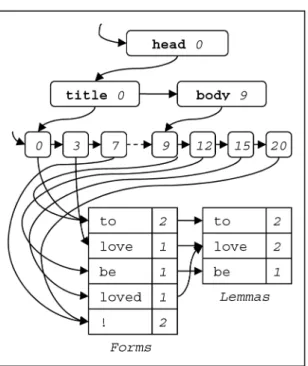
Internal representation of the input document is very important for the efficiency of the sys-tem. Setting the speed of traversal and low me-mory consumptions as priorities, we designed the CADIS internal data structure of the docu-ment that serves as the base of the whole system. A simple XML document is shown in Fig. 3 and graphic abstraction of the internal data structure representing the document is shown in Fig. 4. The XML format itself is represented as a stan-dard first child — next sibling tree, the root node representing the root tag of the document. The leaf nodes on the lowest level, represent-ing the very text of the document, are of great interest. Instead of keeping the words,
punc-Fig. 3.An XML input example.
Fig. 4.Abstraction of CADIS internal data structure built from the XML example in Fig. 3.
tuation etc. in the nodes of the tree, a table is created of all the morphological forms found in the document. The leaf nodes point to records in this table, saving space due to frequently ap-pearing words. During the creation of the tree, the number of occurrences of each form is being counted.
4.2. Benefits of the CADIS Data Structure
Due to morphological complexity of the lan-guage, a quick, but efficient way of retrieving lemmas of every word encountered in the do-cument had to be designed. This information is required for the basic statistical function — the lemma count. The straightforward way was to build a database of a substantial number of lem-mas of Croatian words together with all the mor-phological forms. The goal was accomplished by executing a simple string search through this database.
Lemmas are kept in a similar table. Each word found in the document points to its lemma in this table. As shown in the example, different morphological forms of the same word point to the same lemma. Thus, we know that the lemma “love” occurred twice in the document, although only once actually in the form “love”.
The remaining features to be explained are cru-cial for the speed of generating the visual feed-back in the form of RTF format. Firstly, all leaves in the tree are connected in one linked list. This enables an easy traversal search of the nodes representing the very text of the do-cument, ignoring for a moment the XML struc-ture. Furthermore, for every element of the structure (tag, word, punctuation etc.) the
in-formation of its distance from the beginning of the document is kept. Due to specific charac-teristics of the programming environment, the word at a certain distance from the beginning of the document has to be found quickly. This redundant information in the structure makes time complexity of this search O(d n), where
4.3. Capturing N-grams
N-grams do not necessarily consist of continu-ous tokens. N-grams at a distance are captured by the collocation window. Suppose that we have a collocation window of size M and we are capturing N-grams of size N. We combine every N tokens from this window to create N-grams. Because of the morphological complexity of the language, one collocation can be represented by two or more different N-grams. When captured, each token in the N-gram is replaced by a set of its lemmatized forms.
Due to outer homography(the case when two
different words have the same word-form)each
word can be lemmatized to several lemmas. If each set of a lemmatized N-gram contains a word from the collocation retrieved from the corpus, it is considered as an occurrence of the collocation. Collocations found are stored in a container, and with each repetition, its fre-quency is increased.
For capturing N-grams, modification of algo-rithm given by Mladenic et al. 6] was
imple-mented. Modifications were necessary due to the homography described above. N-grams are captured by traversing nodes in a linked list. Time complexity of search for all collocations isO(l m), wherelrepresents the length of text,
Fig. 5. Graphic abstraction of capturing an occurrence of collocation “winter sport”.
andmrepresents the number of collocations in the corpus, assuming that two strings can be compared in constant time.
5. Multilingual Aspects of CADIS
Document indexing using the EUROVOC the-saurus is a continuous task for all member coun-tries of the European Union, as well as those as-piring for membership. Knowing that no similar system was designed previously and that each of these countries would benefit significantly from it, CADIS is designed to be fully func-tional multilingually, in three different aspects. Firstly, the EUROVOC itself is a multilingual thesaurus, published currently in 16 official lan-guages of the European Union and a number of other European languages.
Secondly, input documents can be written in a number of different languages. The key prob-lem here lies in the fact that words in the doc-uments have to be lemmatized in order for the system to function properly. The process of lemmatization is completely language-specific, but CADIS could be easily modified to accept inputs from any language. The lemmatization module keeps the vocabulary of the language, as well as the list of stop words in an extern file. This file can be generated for any language, thus making it possible for the system to work with
documents in different languages without mo-difying the inner structure. To date, this concept has been implemented for Croatian and English
9, 15].
Finally, the third aspect of interest is the user interface. In order to make CADIS easily adapt-able to different languages, specific elements of the user interface system, such as captions, la-bels, user messages etc., are kept in an extern file.
6. Conclusion and Future Work
Computer-Aided Document Indexing System
(CADIS)that provides different statistical and
visual information, supporting an efficient and uniform indexing process is described in the pa-per.
Some problems tackled during the design and implementation of the CADIS include the mor-phological complexity of Croatian language, strongly connected with implemented statistical functions of word and lemma count and collo-cation finding.
Space and speed efficiency demanded imple-mentation of a proprietary data structure. Multilingual aspects of the system include a multilingual thesaurus, a simple user interface translation and an independent lemmatization algorithm.
Several independent evaluations showed that the process of automatic descriptor assignment does not reach the quality of human indexa-tion 13]. Even the existing automatic
index-ing systems4, 10]serve mainly as a first step
in the process of keyword assignment, offer-ing descriptors’ suggestions which will then be verified by a human indexer. Having this in mind, CADIS comes close to the functionality of an automatic system and is especially valu-able in circumstances where no machine learn-ing methods are applicable due to the lack of a learning set.
Ultimately, CADIS will help to generate a sub-stantial number of documents indexed by EUROVOC descriptors in a more uniform way, at the same time saving human and financial re-sources. The obtained set of indexed documents will then be used to train automatic descrip-tor assignment systems using machine learning
methods. Automatically found EUROVOC de-scriptors will be included as an extra option to CADIS.
7. Acknowledgments
We would like to thank the team from the Fac-ulty of Electrical Engineering and Computing, Croatian Information Documentation Referral Agency, and the Department of Linguistics, Faculty of Philosophy for outstanding work on the project Text Mining System (2003–082)
funded by the Ministry of Science, Education and Sports of the Republic of Croatia.
References
1] BRIDGET T. MCINNES, Extending the Log
Like-lihood Measure to Improve Collocation Identifi-cation, Master thesis, University of Minnesota, December 2004.
2] EUROVOC thesaurus. European Union
publica-tions office.
http://europa.eu.int/celex/eurovoc/ 02/12/2005].
3] Extensible Markup Language (XML). Version
1.0 Specification. World Wide Web Consortium, 2004 http://www.w3.org/TR/2004/REC-xml-20040204/ 02/13/2005].
4] R. FERBER, Automated Indexing with Thesaurus
Descriptors: A Co-occurrence based Approach to Multilingual Retrieval. In: Research and Advanced Technology for Digital Libraires. Proceedings of European Conference of Digital Libraries1997.
5] Joint Research Center, Workshop on
EU-ROVOC - Addressing the Language Barrier Prob-lem http://www.jrc.cec.eu.int/langtech/ Eurovoc/Eurovoc-Workshop Sept2004.html 02/22/2005].
6] D. MLADENIC, M. GROBELNIK, (1998) Word
se-quences as features in text-learning. Proceedings of the Seventh Electrotechnical and Computer Sc. Conference ERK’98, Ljubljana, Slovenia: IEEE section, 1998, pp. 145–148.
7] M. E. MARON, Automatic indexing: An
Experi-mental inquiry. In: Journal of the ACM, Volume 8, 1961.
8] A. MONTEJO-RAEZ, Toward conceptual indexing
using automatic assignment of descriptors. In: Pro-ceedings of the AM 2002 Workshop on Personaliza-tion Techniques in Electronig Publishing, Malaga, Spain, May 2002.
9] M. F. PORTER, An algorithm for suffix stripping. In:
10] B. POULIQUEN, R. STEINBERGER, C. IGNAT,
Auto-matic Annotation of Multilingual Text Collections with a Conceptual Thesaurus. In: Proceedings of the Workshop Ontologies and Information Ex-traction Summer School The Semantic Web and Language Technology — Its Potential and Practi-calities. Bucharest, Romania, 28. July — 8. August 2003.
11] Rich Text Format (RTF) Specification. Microsoft
Corporation,
1999. http://msdn.microsoft.com/library/
default.asp?url=/library/en-us/dnrtfspec/html/rtfspec.asp.
12] T. SKOPAL, ACB Compression Method and Query
Preprocessing in Text Retrieval Systems. In: Pro-ceedings of DATESO2002, Desna, Czech Republic.
13] R. STEINBERGER, Cross-lingual Keyword
Assign-ment. In:Proceedings of the XVII Conference of the Spanish Society for Natural Language Processing, Jaen, Spain, 12–14 September 2001.
14] R. STEINBERGER, B. POULIQUEN, Cross-lingual
In-dexing. Final Report for the IPSC Exploratory Research Project.JRC Internal Note, October 2003.
15] J.SˇNAJDER, Rule-based automatic acquisition of
large-coverage morphological lexicons for infor-mation retrieval. Tech. Report, MZOS. 2003–082,ˇ ZEMRIS, FER, University of Zagreb; 2005.
16] M. TADIC´, B. BEKAVAC, Preparation of POS tagging
of Croatian using ClaRK System. In: Proceedings of RANLP2003 Conference, Borovtes, Bulgaria, 2003.
Recived:June, 2005.
Accepted:October, 2005.
Contact address:
Mladen Kolar Faculty of Electrical Engineering and Computing
University of Zagreb Unska 3 10000 Zagreb Croatia
Igor Vukomirovi´c Faculty of Electrical Engineering and Computing
University of Zagreb Unska 3 10000 Zagreb Croatia
Bojana Dalbelo Baˇsi´c Faculty of Electrical Engineering and Computing
University of Zagreb Unska 3 10000 Zagreb Croatia
JanSnajderˇ Faculty of Electrical Engineering and Computing
University of Zagreb Unska 3 10000 Zagreb Croatia
MLADENKOLARis a fifth year student of computing at the Faculty
of Electrical Engineering and Computing, University of Zagreb. He is currently writing a diploma thesis at the Department of Electronics, Microelectronics, Computer and Intelligent Systems at the same fac-ulty. His research interests lay in the field of machine learning and its application on text analysis.
IGORVUKMIROVIC´is a fifth year student of computing at the Faculty of Electrical Engineering and Computing, University of Zagreb. He is currently writing a diploma thesis at the Department of Electronics, Mi-croelectronics, Computer and Intelligent Systems at the same faculty. His research interests lay in the field of machine learning, especially in Hidden Markov Models and its application in bioinformatics.
BOJANADALBELOBASIˇC´received her B.Sc. degree in mathematics from the Faculty of Sciences, University of Zagreb, in 1982 and the M.Sc. and PhD degrees in computer science from the Faculty of Electrical Engineering and Computing, University of Zagreb, in 1993 and 1997, respectively. She has published more than forty papers, mostly con-cerning applied multivariate statistics, fuzzy temporal reasoning and intelligent systems. Currently, she is associate professor at the Faculty of Electrical Engineering and Computing, University of Zagreb. Her currrent research interests include machine learning and applications to data and text mining.