Facilitating Con
fi
gurability by
Separation of Concerns in the
Source Code
Zoltan Fazekas
Faculty of Informatics and Information Technologies, Slovak University of Technology, Bratislava, Slovakia
Producing configurations of a software product, e.g. designed for different operating systems, using different database technologies or serving different groups of users is undoubtedly a time-consuming and error-prone process. In this paper we propose an approach facili-tating the configurability of software using separation of concerns, which helps to eliminate unwanted parts of the source code whenever the corresponding requirements change without manual intervention and without the risk of corrupting the program. A prototype imple-mentation provided with the approach demonstrates its powerfulness in the practice.
Keywords: concerns, separation of concerns, configura-tion construcconfigura-tion, software configuraconfigura-tion management.
1. Introduction
Everybody who has ever dealt with program-ming has probably faced the following situa-tion. You implement the code strictly according to the specification, however, the requirements change in the meantime, e.g. the customer does not want some features any more. In addition to the changed requirements, some features of the program are not complete yet, i.e. they also have to be excluded from the configuration to be delivered. You try to remove the correspond-ing parts of the program, i.e. components as well as client code using them, however you recognize in the middle, that the configuration does not work properly because parts of the pro-gram that should remain in place depend on the parts you removed. In the end, after remov-ing all unnecessary parts of the program, you get a working configuration that corresponds to the current requirements. However, you have
invested plenty of time and energy to accom-plish this. In this paper we propose an approach to reconfiguring programs, i.e. eliminating un-wanted parts from them, whenever the corre-sponding requirements change, without manual coding effort and without the risk of corrupting the program.
A software product can exist in several config-urations, each having a slightly different source code. Each of these configurations can sup-port different operating systems, run on differ-ent application servers, use differdiffer-ent database or communication technologies, provide differ-ent user interfaces, support differdiffer-ent (human)
languages, have different regional specificities or different capabilities for different kinds of users and so on and so forth. Configurations are assembled from versions of configuration items, i.e. components, of the software prod-uct. Each of the configuration items contributes to some characteristics of the software prod-uct, e.g. implements some capabilities and runs on some operating system. The goal of assem-bling configurations is to select all configuration items that contribute to the required characteris-tics, but have nothing to do with the other ones. Unfortunately, characteristics that a particular version of a configuration item contributes to are not always transparent. This makes assem-bling of configurations a non-trivial task. A heuristic approach to selecting the right com-ponents and their versions to be included in the configuration have been presented in11].
An-other popular model had been introduced earlier in the work on Adele 15]. Furthermore,
to more than one characteristic, each of which can be required or just undesired in a config-uration. On the other hand, several character-istics are scattered along multiple configuration items. Consequently, it is not always possible to combine arbitrary characteristics in a configu-ration, since there might be configuration items that contribute to required, as well as undesired ones.
To come around these shortcomings, we ex-plored if existing approaches to separation of concerns could be used to separate different characteristics of versions of configuration items from each other on the level of source code. The principle of separation of concerns is essential for any scientific discipline1]since it helps to
manage complexity and handle changes, which facilitates parallel work. The common basic concept of these approaches, the concern, refers to “those interests which pertain to the sys-tem’s development, its operation or any other aspects that are critical or otherwise important to one or more stakeholders.” 3] Indeed,
ex-isting approaches to separation of concerns fa-cilitate the maintainability of software. Some of them, like AspectJ4]or Composition Filters 9], let the programmer modularize otherwise
dispersed crosscutting concerns in order to ease their maintenance and compose them later into the execution flow of programs. Some of them, like Hyper/J 5], even enable the coexistence
of multiple decompositions of a program along different kinds of concerns. A useful appli-cation of these approaches in change manage-ment — representation of changes as aspects — is discussed in2]. However, since the use of
these approaches requires a fundamental shift in the way of designing and implementing sys-tems and introduces a further level of complex-ity (see e.g. the notion of scattering in 24]),
they are not always practicable. Another group of approaches provides dynamic view capabil-ities similar to those in Desert17] and Sheets 16] to visualize concerns in source code (
re-ferred to as visual separation of concerns in
24]) instead of isolating concerns from each
other. Its representatives, including Stellation
24](formerly Coven6]), Software Plans14],
CME 21], FEAT 19], SNIAFL 20], JQuery 22], the Aspect Browser 18] and the Aspect
Mining Tool13]enable the programmer to
de-marcate manually discovered concerns in the source code, or localize concerns, using static and dynamic code analysis techniques and not
(least) visualize them, e.g. by highlighting, or
view them as virtual modules to ease their com-prehension and maintenance. A good overview of further research results facilitating the loca-tion of concerns in the source code using dif-ferent techniques is presented in13],20] and 22]. The main difference between these
ap-proaches and ours is that while they focus on facilitating discovery of concerns in the code
(i.e. defining of their scope) with a precision
not enabling their removal from the program in a non-invasive way, our approach emphasizes precise (i.e. token-level) concern location
en-abling seamless concern removal for the price of more manual effort invested into concern lo-cation. Despite numerous advantages, all ap-proaches and implementations we investigated showed to be insufficient for constructing con-figurations based on concerns. The majority of them was not able to represent concerns in the source code with a precision enabling their non-invasive removal without substantial man-ual effort necessary for fixing the resulting code. In addition, all of these approaches considered units of the program, such as member functions and methods, as the smallest unit of concerns. In particular cases, however, concerns mani-fest themselves only in a few important tokens such as the name of a class to be instantiated in order to initialize the corresponding database driver before its first use. Therefore, we for-mulated the hypothesis, that it would be neces-sary for the seamless construction of concern-based configurations to track concerns in the source code on the granularity level of single tokens. So unlike other approaches, ours estab-lished the association of concerns with elements of the program on various levels of granularity, from larger modules through smaller units down to single tokens. Under some circumstances the association of concerns to tokens could be automated using custom search rules and pat-terns. Additionally, tokens could be associated to concerns, representing units of the program they were part of, programmers who worked on them as well as timestamps of their creation and removal without manual effort. The rest of the concerns needed to be associated with portions of the source code manually. As next, we defined configuration items as a collection of tokens contributing to the same set of con-cerns(except the creation and removal time of
Versions(revisions)of configuration items valid
at a particular point in time could be computed dynamically, based on the concerns associated with them, necessarily including their creation and removal time instead of being stored ex-plicitly. We hoped to be able to assemble bitrary configurations, i.e. the ones having ar-bitrary combinations of characteristics. This way, however, we soon recognized, that their syntactical correctness could only be assured if the source code had been written in a particular form and had been associated with concerns in a way fulfilling certain requirements. We also found out, that for particular combinations of concerns it did not make sense to be associated with the same token or to be present in the same configuration. Such cases required that seman-tic consistency of configurations be expressed in form of relationships between concerns. To use the strengths of other approaches to separa-tion of concerns too, we designed our approach in such a way that it could be used on top of any existing programming paradigm including e.g. aspect-oriented programming 12]. In
or-der to prove that our theory worked, we cre-ated a prototype implementation of it integrcre-ated into the Eclipse development environment. To mention at least one of the shortcomings too, our approach, just like many other approaches, still lacks a rational solution to the problem of logically handling a large amount of concerns arising already in relatively simple systems. The rest of this paper is structured as follows. The second section introduces our approach in more details and provides some practical ex-amples. The third section consists of a brief overview of the prototype implementation. Fi-nally, in section four we draw some conclusions.
2. Concern-Based Configurations
“Reconfiguring the software modules compris-ing a system to add or to delete a feature typi-cally requires substantial effort. This lack of flexibility increases the costs of building vari-ants of a system, amongst other problems.”
8] To come around this, we propose a new
approach to configuration management, using lightweight separation of concerns. Why light-weight? Our approach relies on conventional programming paradigms and extends them by
keeping track of concerns in the source code as it evolves 10] and generating its arbitrary
configurations based on these concerns. Since portions of the source code contributing to dif-ferent concerns are not isolated explicitly, we do not need to bother about their composition. De-spite all insufficiencies of its implementations in Hyper/J, CME and Stellation(Coven)with
re-spect to concern-based configuration construc-tion, the main principle of multidimensional separation of concerns proved to be helpful to our problem. Its adaptation enabled us to or-ganize changes in the program, i.e. insertions and removals of tokens, into versions along any concerns even different from the conventional ones such as the computing unit and the time of change. Here, changes were performed on a particular computing unit in a single step, i.e. between checking out the unit from and check-ing it in back into the source code management system, and got bundled in a version. Contrary to other known approaches to separation of con-cerns, we assign source code to concerns on the level of single tokens. Thereby, modifications performed within the extent of a token such as the deletion of characters do not affect already existing assignments of the token to concerns. There is a variety of concerns appropriate for characterizing software configurations. Some of them are generic, i.e. suitable for any kind of software, others are specific to a particular domain or technology. Some typical kinds of concerns that proved to be suitable are:
— structural program elements such as pack-ages, classes, modules, functions, units etc., depending on the programming language be-ing used
— business-relevant information such as cus-tomer, address, account, stock, vehicle, gas pressure etc., depending on the problem do-main
— business processes, services or functions such as creation of the balance of an account, computation of the optimal gas pressure, se-lection of customers for a marketing cam-paign, simulation of chemical reactions etc., depending on the problem domain
— technical computations such as opening a session, committing a transaction, reading a database record, cleaning up a buffer, trans-forming text to a number, sorting records, authorizing access etc.
— any kinds of requirements such as use cases and features, e.g. user login, password au-thentication, 7 24 availability etc.
— decisions concerning programming para-digms, languages and techniques, design patterns, architectural metaphors, coding conventions, communication protocols, com-putation methods and algorithms and many more
— compatibility aspects such as operating sys-tem, software and hardware platforms, tech-nologies and products being integrated — owners and authors of the code, such as a
person, group, project team or an organiza-tion
— customers, user groups and user profiles, source code licensing policies, etc.
— software delivery items, such as products, product suites, their versions, major and mi-nor releases, updates, patches, etc.
— validity and expiration of source code, i.e. creation and removal time, time of promo-tion in terms of the development process,e.g. from the coding stage to the testing stage, etc.
These are all concerns of especial interest for configuration construction. A more general purpose model of concern classification can be found in Cosmos23].
We illustrate the usage of our approach on the example of the Customer Registration System
(CRS), a simple Java application used for
reg-istering the contact addresses of customers or-dering products through a hotline.
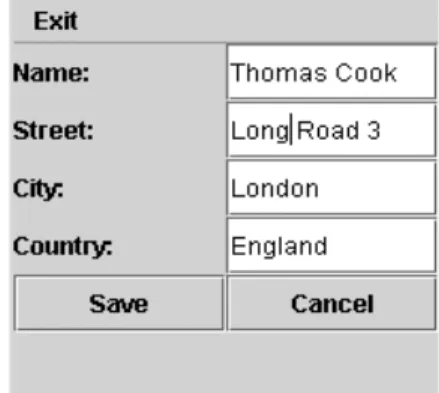
Let us assume that CRS is used by several re-seller companies, so it is delivered in different configurations. For instance, one configuration has been designed for companies operating in-ternationally, but only outside the US(see Fig.
2.), so customer data incorporate the country,
but not thestate. Companies having customers in the US too required another configuration considering the state as part of the customer address(see Fig. 1.).
Fig. 1.CRS configuration for US companies operating internationally.
Fig. 2.CRS configuration for non-US companies operating internationally.
Some other companies operating in one coun-try outside the US only preferred a configura-tion of CRS considering neither thecountrynor
the state as part of the customer address. To
model their needs we first defined the concerns used for representing different requirements of these customers. We defined a concern cov-ering the requirements of companies operating in US and called it simply“ US-specific”(the
underscore is a naming convention used to dis-tinguish custom concerns from automatically recognized ones more easily), and another one
above, concerns like the kind of customers being considered are only one of the aspects that can contribute to the variety of configuration. Some others that we do not address in this example for the sake of simplicity could be e.g. differ-ent operating systems or underlying database technologies.
The architecture of CRS follows the MVC de-sign pattern. Themodel.CustomerModel class implements the model which represents a tomer contacting the call center. Each cus-tomer has, besides the attributesname,address, etc., a unique identifier (id), which gets
gen-erated when the customer object is created. The list of already reserved ids is stored in the static variablereservedIds. The customers’ data are persisted in files using the object se-rialization mechanism of Java. In order to ac-celerate searching for them, customers are in-dexed according to their attributes. The static variablesnames, streets, etc. contain index ta-bles mapping the values of the corresponding attributes to ids of customers. We will need these details about the model.CustomerModel class later, for reasoning about the implementa-tion of the above introduced concerns. Program elements such as the address and the state at-tributes involved in the implementation of those concerns occur also in many other classes of the CRS application, e.g. theview.AppletViewclass which implements the user interface displaying a customer in a Java applet and the
control-ler.AbstractController,
controller.Registration-Controllerandcontroller.ViewControllerclasses
coordinating the interaction between the view and the model. These issues will not be further discussed in this paper.
2.1. Meaningfulness of Configurations
If we claim to allow for non-invasive elimina-tion of concerns from the source code, we must reason about the consequences such operations could have on the semantics of the program. Since concerns are usually not completely in-dependent, i.e. some of them contradict or are prerequisites of each other, it is not appropriate to eliminate any of them. Semantic dependen-cies(also called relationships or predicates)
be-tween concerns have to be taken into account during the assignment of tokens to concerns, as
well as during the selection of concerns to be in-cluded in a configuration. Otherwise the result-ing assignment or configuration could become inconsistent or produce undesired behaviour at run-time. For instance, if there is a concern assigned to portions of the source code imple-menting trace messages about events occurring during the execution of the program, and an-other concern assigned to portions of the source code dealing with the optimisation of the per-formance of the application, they should neither be assigned to the same token nor be included in the same configuration, since tracking and per-formance are contradicting requirements. An-other example could be a concern assigned to portions of the source code dealing with persis-tence, and another concern assigned to portions of the source code producing and handling ex-ceptions. The persistence concern cannot exist without exception handling mechanisms, there-fore each configuration that contains the persis-tence concern should also include the exception handling concern. Originally, we introduced concern relationships to prevent that one of the concerns requiring each other get excluded from a configuration and the others not, or that contra-dicting concerns get assigned to the same token or get included in the same configuration. How-ever, concern relationships can also be used to automate the assignment of concerns to tokens. For instance, a concern relationship can make sure that each token belonging to a program unit (e.g. a method like getName()) gets
au-tomatically (i.e. without manual intervention)
assigned to the concerns related to this program unit(e.g. thenameconcern). In the rest of this
section, we introduce some common types of concern relationships:
— Assumption is an explicit relationship. It is set by the programmer between two con-cerns, if the inclusion of the first concern in a configuration of the program assumes(
re-quires)the inclusion of the second concern
in the configuration.
— Implication is an explicit relationship. It is set by the programmer between two con-cerns, if the assignment of any token to the first concern implies the assignment of the same token to the second concern.
con-cerns, if any token can be assigned to at most one of these concerns.
Some of the concern relationships, such as the assumption and implication, are transitive and can be derived automatically, based on already existing ones.
In this simple model we have only included con-cern relationships that proved to be particularly useful for our purposes. More general purpose models of concern relationships are discussed in21]and23].
2.2. Assignment of Tokens to Concerns
Manual assignment is the most common way of assigning portions of the source code to con-cerns. Code segments assigned to a particu-lar concern are sometimes whole units like the method shown in Fig. 3., whole statements like the declarations in Fig. 4. or just a few tokens like in Fig. 5.
Fig. 3.A whole method assigned to the“ US-specific”
concern.
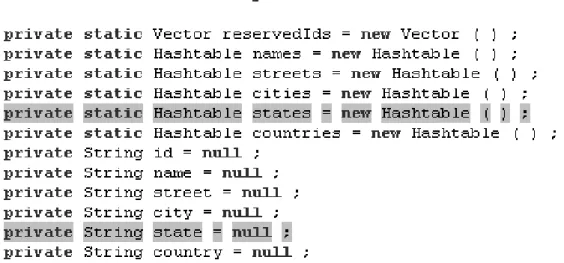
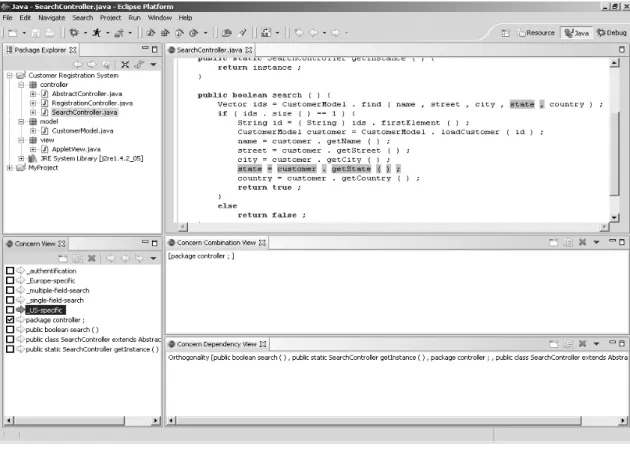
In the example depicted in Fig. 4., the high-lighted tokens are assigned to the concern called
“ US-specific”, because both thestateattribute
of the customer, as well as thestatesindex table, are required only in the variant desired for the US-market.
The assignment of tokens to concerns is best performed on the fly as tokens are being created; otherwise the quality of assignments might get negatively affected.
Manual identification and assignment of con-cerns to tokens consumes costly time of the programmer. To come around this, we use au-tomatic recognition of concerns in the source
Fig. 4.The highlighted variable declarations are assigned to the“ US-specific”concern.
code. Unfortunately, this is only partially im-plemented in the current version of our proto-type.
The pattern-matching approach is similar to the mechanism used by other approaches to sep-aration of concerns for specifying join points. It matches code segments according to regu-lar expressions specified by the programmer. Parts of the regular expressions associated with some concerns cause the corresponding parts of the matched code segments to be assigned to those concerns. For instance, all references to a particular attribute likestatecan be found eas-ily, using a trivial regular expression consisting of its exact name. Using wildcards, all other program elements, associated with thestate at-tribute like the states variable, can be found. The validity of concerns recognized this way is always temporary: they have to be re-evaluated each time the source code goes through changes. The relationship-based approach uses existing concern relationships for deriving new assign-ments of tokens to concerns. For instance, if there is an abstract “ customer management” concern grouping everything that has to do with customers and a more concrete“ US-specific” concern related by an implication relationship, whenever the programmer assigns a token to
the “ US-specific” concern, it gets
automati-cally assigned to the“ customer management” concern as well. Concerns derived this way are only valid as long as the manual assignment of concerns does not change. Then, however, they have to be re-evaluated.
Some concerns can get recognized and assigned to tokens automatically, without the use of rules. Such concerns are usually derived from facts and events provided by the development envi-ronment. For example, they can represent pro-gram unit(s)the token belongs to, the
program-mer the token was created, modified or removed by, as well as the token’s creation and removal time.
2.3. Construction of Configurations
We define configuration items as virtual col-lections of tokens associated with the same set of concerns. Configuration items defined this way are actually completely independent of the physical storage of the program. The whole
source code can just be stored in the traditional way, in files representing units or even in one piece containing all tokens that have ever been created together with information about their as-sociation with concerns. The programmer gets to see only a subset of the source code consist-ing of tokens not yet removed. Although we defined the creation and removal time of tokens as concerns too, they are not used to character-ize configuration items. Instead, they are used for the construction of versions (revisions) of
configuration items. The version of a configu-ration item(which consists of tokens valid at the
given point time), is computed dynamically by
filtering out tokens from the configuration item that were created after the given point in time or were removed before it. Consequently, each token is by default part of exactly one configura-tion item, but can possibly belong to its multiple versions. Using this approach, we overcome re-dundant storage of source code in versions. According to the definition above, for each set of concerns there is exactly one configuration item containing all tokens that contribute to all of the concerns contained in that set, but no others. Given a set of desired concerns, the corresponding configuration comprises all con-figuration items characterized by some subset of this set. This configuration, however, does not know the versions of the configuration items it contains. Just after it has been complemented by a point in time, configuration items contained in the configuration can be replaced by their version valid at the given point in time. If no other point in time is specified, the configura-tion corresponding to the current point in time is constructed.
the default one. For each single token the pro-grammer can define arbitrary number of subsets of concerns already assigned to it, which de-termine the configuration items the token gets included in.
There are some special cases that have to be treated very carefully by the programmer. A typical example is presented in Fig. 6. The first of the last two formal parameters,state, is assigned to the“ US-specific”concern, the sec-ond one,country, to the“ international” con-cern. To assure that the comma between them gets removed properly, it has to be assigned to both concerns and it should be included both in the configuration item characterized by both concerns as well as in the configuration item characterized by the“ international” con-cern only. Let us assume, that there would be an“ intercity”concern assigned tocity, the third formal parameter from the end. Then the comma between the city and the state formal parameters would have to be assigned both to
the” intercity”concern as well as to the”
US-specific”concern, but it would only have to be
included in the configuration item characterized by both concerns.
This problem can be generalized in the fol-lowing way. Let us consider a list of n ele-mentsE1,E2,:::,En separated byn;1
com-mas, one between each two adjacent elements Ei and Ei+1. Let us define the function f :
Bn ! B
n;1
which computes for each n-tuple P= (P1P2:::Pn)wherePi 2 BandPi = 1
if and only ifEiis present in a given sublist of
the original list of elements, an (n;1)-tuple (f1(P) f2(P)::: fn
;1
(P)) where fi(P) 2 B
and fi(P) = 1 if and only if the i-th
sepa-rator (i.e. the comma between Ei and Ei +1
)
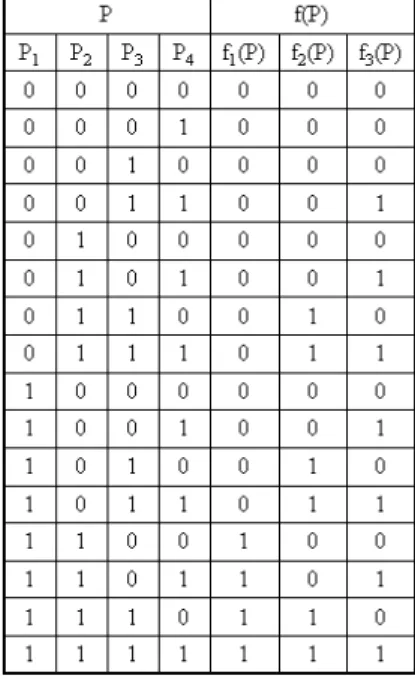
Fig. 7.The truth table of the presence functionf
for four parameters.
should be present in the concerned sublist. We call the function f(P)the presence function of
the list of n elements and its i-th component fi(P) the presence function of the i-th
sepa-rator. A possible truth table of the function f for a four-element list is shown in Fig. 7. It is important to notice, that for the 4-tuples
(0101), (1001), (1010), (1011)
and(1101)we have more alternatives to
de-fine the value of the functionf. For instance, for
(1001) we could choose between (100), (010)and(001). We decided to follow the
principle that each two elements that were not adjacent in the original list should be separated in the sublist by the comma directly
preced-Fig. 6.Tokens assigned to the“ US-specific”(light-colored background)and the“ international”(dark-colored
ing the second one, so we chose(001). We
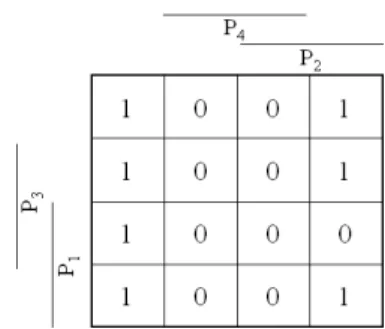
use Carnaugh maps shown in Fig. 8., Fig. 9. and Fig. 10. to find the appropriate normal
dis-Fig. 8.The Carnaugh map of the presence functionf of the first separator in a list of four elements.
Fig. 9.The Carnaugh map of the presence functionf of the second separator in a list of four elements.
Fig. 10.The Carnaugh map of the presence functionf
of the third separator in a list of four elements.
junctive forms of the components f1(P), f2(P)
and f3(P). It is easy to discover that f1(P) =
P1 ^P2, f2(P) = (P1 ^P3)_(P2^P3) and
f3(P)=(P1^P4)_(P2^P4)_(P3^P4).
Gen-eralized fornelements this means, thatfi(P)= (P1^Pi
+1
)_(P2^Pi +1
)_:::_(Pi^Pi +1
)
for each 1in;1.
It is often necessary to revise the assignment of tokens to concerns if their adjacency goes through changes. Fig. 6. shows a good ex-ample for this situation too. If a further formal parameter were appended to the end of the pa-rameter list, the concerns assigned to the comma between thestateand thecountryformal param-eters would have to be revised.
After this modification to the code, the comma would only have to be included in the config-uration item characterized by both the “
US-specific”concern and the“ international”
con-cern, but not in the configuration item character-ized by the “ international”concern only any more.
Our experiments have shown that it is less time-consuming and error-prone to choose which concerns should be missing from the config-uration than to specify all concerns that should be included in it. Therefore, we propose a con-figuration specification strategy that by default includes all concerns into the configuration and lets the programmer select which ones should be omitted.
To stay with the example from Fig. 6, the con-figuration of the source code not including the
“ US-specific”concern, but including all other
concerns would look like as shown in Fig. 11. The same source code segment of another con-figuration that contains neither the“ US-specific” nor the “ international” concern would look like as shown in Fig. 12.
Fig. 12.The sample code segment without the“ US-specific”and“ international”concerns.
2.4. Assuring Removability of Concerns
In order to apply the above described practices properly, sometimes it is necessary to take some constraints on writing the source code and as-signing it to concerns into account. In general, programs written in almost any high-level pro-gramming language like C, C++or Java,
con-sist of some kinds of modules(e.g. functions or
objects and their member functions), which in
turn consist of declarations and statements com-plemented by reserved symbols and words for the sake of syntactical correctness. Although this intuitive model of programs is quite ab-stract, it provides a helpful basis for the follow-ing consideration. Declarations and statements consist of expressions and reserved symbols and words like= representing value assignment or
; representing the separator between statements in the Java language. Expressions consist of one or more constants and identifiers referenc-ing declared elements of the program(e.g.
vari-ables, functions)combined by reserved symbols
and words(e.g. operators like+, -, *). Let us
take a deeper look into what happens when por-tions of the program get omitted because of the exclusion of a concern from the configuration. In general, statements can be removed without the risk of violating the syntax of the program. On the other hand, reserved symbols and words normally cannot be removed safely, unless the whole statement containing them is removed. Removal of declarations is possible, but more difficult than the removal of statements, because it requires the removal of all references to the de-clared elements from the program too. The lat-ter one can actually be classified as removal of an expression. Removal of an expression from the program usually results in syntax violation, because e.g. an argument of an operation will be missing. However, there is a workaround for this problem: a special way of construct-ing expressions. Expressions always belong to
an abstract data type like boolean, integer or object. For each abstract data type, there is a constant value, which all variables of the given type contain right after their creation, before they are assigned a value. For integers this is 0, for real numbers 0.0 and for objects null. Let us call this constant value the default ele-ment of the abstract data type. There are also operations defined on each abstract data type, like + for integer and real numbers or & for
booleans representing the logical AND opera-tor. For the abstract data types and operators originating from mathematics like integers and the +operator, there is a neutral value, in this
case 0. In some cases the programmer has even multiple choices of the operation and the neu-tral element, e.g. for integers it could be the +
operation with 0 as the neutral element or the * operation (multiplication)and 1 as the neutral
element. Expressions that are subject to re-moval, i.e. are assigned to some concern, have to be extended in the following way. IfEis such an expression andEis of the abstract data type for which there is an operation, e.g. +, with a
neutral element, e.g. 0,Eshould be replaced by E+0. IfEis assigned to some concerns, the+
operator has to be assigned to those concerns as well. IfEbelongs to an abstract data type with-out an operation having a neutral element, the statementS(E)containing the expressionEhas
to be modified as follows. Ifdis the default ele-ment of the abstract data type ofE, the statement S(d)has to be inserted in front of the statement
S(E)in a syntactically correct way. Instead of
assigningE within the statementS(E)to some
concerns, the whole statement S(E) has to be
by the value 0 or the valued, depending on the abstract data type of E. Of course, the rest of the program relying on the value of E has to be robust enough to be able to process 0 andd instead of the original value of the expression ofE.
Fig. 13.Return expression gets extended by a neutral element.
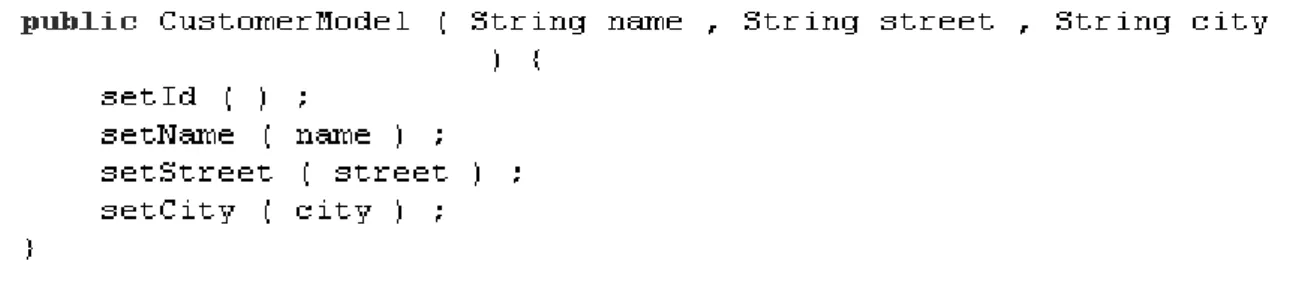
An example illustrating the necessary adaption of expressions described above is shown in Fig. 13. Let us suppose the+,getName, (and)
to-kens are assigned to some concern. If this con-cern were not included in the configuration, the above named tokens would disappear causing the source code to be syntactically incorrect. On the other hand, it is not possible to assign the whole return statement to the concern, be-cause that would result in syntactically incorrect source code if the concern were missing from the configuration. In order to come around this
problem, the returned expression has to be ex-tended by the neutral element, in this case “ ”, using the operation+.
3. Prototype Implementation
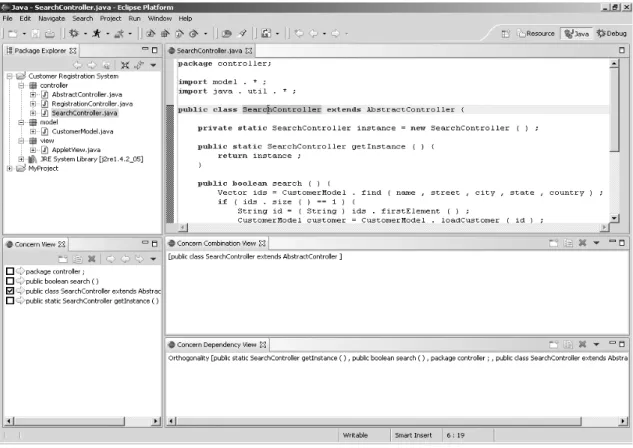
The described approach will only be accepted by programmers if it is supported by easy-to-use tools closely integrated with the programming environment the programmers are used to. In order to prove the practical applicability of our approach, we implemented a prototype exten-sion of an existing software development envi-ronment (see Fig. 14.) that supports the most
concepts introduced in the preceding sections. The software development environment we ex-tended is Eclipse 3, an open integrated devel-opment environment. Using the plug-in facility we added new views for highlighting tokens in the source code, assigning concerns to them, selecting concerns to be included into the con-figuration, generating configuration items cor-responding to the specified selection of con-cerns and, last but not least, defining semantic
Fig. 15.The Java Source Editor highlighting the token pointed to by the cursor.
dependencies between concerns. In the rest of this chapter we introduce these and other useful features in more detail.
3.1. The Java Source Editor
The Java Source Editor (see Fig. 15.) is an
editor for Java source code based on the editor provided by Eclipse.
It uses the JavaCC 3.2 parser compiler and a grammar, which currently supports version 1.1 of the Java language specification, for recogniz-ing tokens in the source code. The positions of tokens are traced also when the source code be-comes unparsable. After restoring the parsabil-ity of the source code, it gets reparsed and the old tokens get matched against the newly parsed ones according to their positions.
3.2. The Concern View
The Concern View serves, among the rest, for displaying concerns(see Fig. 16.). This view
contains a list of custom concerns defined by the programmer, as well as of automatically recognized concerns representing units of the program, i.e. packages, classes and methods. When defining new concerns, the programmer has to give the new concern a name, which has to be unique among all concerns. The Con-cern View is also used for assigning conCon-cerns to tokens. If a single token is highlighted in the Java Source Editor, the concerns assigned to it will be shown with checked state in the
Fig. 16.The Concern View displaying custom as well as automatically recognized concerns.
Concern View. The concern representing the unit of the finest possible granularity, the source code which includes the token, gets automati-cally assigned to each token. This assignment cannot be modified by the programmer. Other concerns can be assigned to the highlighted to-ken by the programmer setting them in checked state. If one or more tokens are selected in the Java Source Editor, the tokens that are assigned to all of them are displayed with checked state in the Concern View. If the user sets some other concerns’ state to be checked, they get assigned to all tokens that fall into the selected range. If no dependency is selected in the Concern Dependency View (see 3.4. The Concern
De-pendency View)and no combination is selected
Fig. 17.Highlighting portions of the source code corresponding to concerns selected in the Concern View(on the
left)in the Java Source Editor(on the right).
Concern Combinaton View), but at least one
concern is selected in the Concern View, the tokens assigned to the selected concerns are highlighted in the Java Source Editor using the colour representing the corresponding concern
(see Fig. 17.).
The Concern View also shows which concerns are currently included in the configuration of the program. If the arrow icon of a concern is directed to the right, the concern is included in the configuration, otherwise not. The program-mer can turn any concern on or off by double-clicking on it. Then the source code in the Java Source Editor gets modified automatically to show only the tokens that are part of the corre-sponding configuration.
3.3. The Concern Combination View
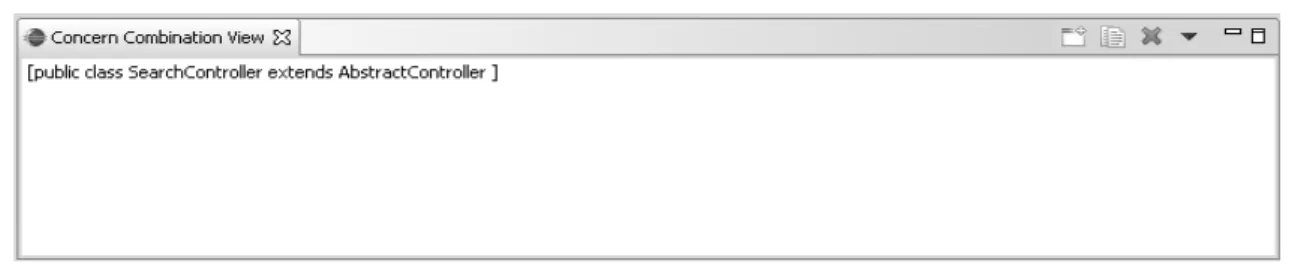
Tokens become part of the configuration if there is any combination of concerns they are as-signed to, that is fully included in the selected configuration. One combination of concerns
gets defined for each token automatically. This contains all concerns the token is assigned to. If there is no other combination defined by the programmer for this token, it will be included in the selected configuration only if all concerns it is assigned to are included in the configura-tion. However, the programmer can define arbi-trary combinations of concerns — subsets of the concerns assigned to the token — additionally to the default combination. The programmer has to select some of the concerns in the Con-cern View, which are assigned to the currently highlighted token. Then he has to choose to cre-ate a new concern combination in the Concern Combination View (see Fig. 18.). The created
after-Fig. 18.The Concern Combination View shows for each token the combinations of concerns that determine which configuration items it will be included in.
Fig. 19. The Concern Dependency View shows semantic relationships between concerns.
wards. The programmer can remove concern combinations, except the automatically defined one.
3.4. The Concern Dependency View
The Concern Dependency View(see Fig. 19.)
displays concern dependencies, also called se-mantic concern relationships. Some of these dependencies such as the orthogonality between concerns representing units of the program can be recognized automatically. This is added to the Concern Dependency View automatically and updated each time the set of units of the program change.
The programmer can define further custom de-pendencies by selecting one or more concerns in the Concern View and choosing the depen-dency type from a drop-down list. If the number of selected concerns is not required by the type of the dependency, the Concern Dependency View displays the dependency as invalid. If the programmer selects a dependency in the Con-cern Dependency View, the conCon-cerns constitut-ing the dependency get selected in the Concern View. The programmer can then add or remove concerns from the selected dependency by mod-ifying the selection of concerns in the Concern View. The programmer can remove any depen-dencies from the Concern Dependency View, but the automatically generated ones.
4. Conclusion
We have proposed an approach to automated generation of software configurations based on separation of concerns. As our experiments have shown, existing approaches to separation of concerns are not suitable for generating such configurations, because they consider concerns in the source code on a too coarse level of granu-larity. Our approach associates each token of the source code to concerns used as the basis for de-scribing software configurations. Furthermore, we have proposed to use semantic relationships between concerns to assure semantic correct-ness(i.e. meaningfulness)of the generated
con-figurations. We have developed a method for writing source code in a way that enables us to re-configure it flexibly without the risk of cor-rupting its syntax. Our approach has, among others, the advantage, that it lets the program-mer work with conventional code (e.g.
object-oriented in Java) and does not introduce any
new paradigm. With appropriate tool support like the one we developed for demonstration purposes, the overhead produced by activities necessary for designing and maintaining con-cerns is not significantly higher than the time needed to document the source code. In return, the time needed to(re)produce an arbitrary
works correctly and does exactly what is speci-fied in the means of concerns, takes only a few seconds.
Acknowledgement
The work reported here was partially supported by Slovak Scientific Agency, project No. VG 1/0162/03.
References
1] E.W. DIJKSTRA, A Discipline of Programming,
Prentice-Hall, 1976.
2] P. DOLOG, V. VRANIC, M. BIELIKOVA, Representing
Change by Aspect,ACM SIGPLAN Notices, 36(1),
December 2001.
3] IEEE Std 1471-2000,IEEE Recommended Practice
for Architectural Description of Software-Intensive Systems. IEEE, 2000.
4] J. IRWIN, G. KICZALES, J. LAMPING, J.-M. LO
-INGTIER, C.V. LOPES, C. MAEDA, A. MENDHEKAR,
Aspect-Oriented Programming, Published in Pro-ceedings of the European Conference on Object-Oriented Programming(ECOOP), Springer Verlag,
1997.
5] P. TARR, H. OSSHER,Hyper/J
TMUser and
Installa-tion Manual, IBM Corporation, 2000.
6] M.C. CHU-CARROLL, Separation of Concerns in
Software Configuration Management, ICSE 2001 Workshop on Advanced Separation of Concerns, March 2001.
7] E.L.A. BANIASSAD, G.C. MURPHY, C. SCHWAN
-NINGER, Determining the “Why” of Concerns, Pub-lished inProceedings for Advanced Separation of Concerns Workshopat the23rd International Con-ference on Software Engineeringin Toronto, Canada 2001.
8] A. LAI, G.C. MURPHY, M.P. ROBILLARD, R.J.
WALKER, Separating Features in Source Code: An
Exploratory Study,IEEE 0-7695-1050-7/01, 2001.
9] M. AKSIT, L. BERGMANS, Solving the Evolution
Problems Using Composition Filters,ECOOP 2001 tutorial, TRESE e-tutorial series 02, TRESE Group, University of Twente 2001.
10] Z. FAZEKAS, Concern-Based Software Evolution,
Published in Proceedings of SOFSEM 2005, 31st Annual Conference on Current Trends in Theory and Practice of Informatics, January 2005, Liptovsky Jan, Slovak Republic.
11] M. BIELIKOVA, P. NAVRAT, Approach to improving
software configuration management, InFifth Euro-pean Conference on Software Quality, pp. 374–383, Trinity College, Dublin, Ireland, 1996.
12] K. CZARNECKI, U.W. EISENECKER, Generative
Programming: Methods, Tools and Applica-tions, Addison-Wesley, Boston(2000), Chapter 7:
Aspect-Oriented Decomposition and Composition, pp. 189–250.
13] J. HANNEMANN, G. KICZALES, Overcoming the
Prevalent Decomposition in Legacy Code, Work-shop on Advanced Separation of Concerns (Pro-ceedings), International Conference on Software Engineering, May 2001, Toronto, Canada.
14] D. COPPIT, B. COX, Software Plans for
Separa-tion of Concerns, Proceedings of the Third AOSD Workshop on Aspects, Components, and Patterns for Infrastructure Software, March 22, 2004. Held in conjunction with the Third International Con-ference on Aspect-Oriented Software Development
(AOSD 2004), Lancaster, UK.
15] J. ESTUBLIER, R. CASALLAS,The Adele Confi
gura-tion Manager, Configuration Management, Edited by Tichy, John Wiley & Son Ltd, 1994.
16] R. STOCKTON, N. KRAMER,The Sheets Hypercode
Editor, Tech. Rep. 0820, CMU Department of Computer Science, 1997.
17] S.P. REISS, Simplifying Data Integration: The
De-sign of the Desert Software Development Environ-ment, In theProceedings of the 18th International Conference on Software Engineering, Berlin, Ger-many, 1996.
18] W.G. GRISWOLD, Y. KATO, J.J. YUAN, Aspect
Browser: Tool Support for Managing Dispersed Aspects, Technical Report CS99-0640, Department of Computer Science and Engineering, University of California, San Diego, December 1999.
19] M.P. ROBILLARD, G.C. MURPHY,Evolving
Descrip-tions of Scattered Concerns, Technical Report SOCS-TR-2005.1, School of Computer Science, McGill University, Canada, January 2005.
20] W. ZHAO, L. ZHANG, Y. LIU, J. SUN, F. YANG,
SNI-AFL: Towards a Static Non-Interactive Approach to Feature Location, Proceedings of the 26th In-ternational Conference on Software Engineering, Volume 00, pp. 293–303, 2004.
21] W. HARRISON, H. OSSHER, S.M. SUTTON, P. TARR,
Concern Modeling in the Concern Manipulation Environment, IBM Research Report RC23344, IBM Thomas J. Watson Research Center, York-town Heights, NY, September 2004.
22] D. JANZEN, K. DEVOLDER, Navigating and
Query-ing Code Without GettQuery-ing Lost,Proceedings of the 2nd International Conference on Aspect-oriented Software Development, Boston, Massachusetts, pp. 178–187, 2003.
23] S.M. SUTTON, I. ROUVELLOU, Modeling of
24] M.C. CHU-CARROLL, J. WRIGHT, A.T.T. YING,
Vi-sual separation of concerns through multidimen-sional program storage,Proceedings of the 2nd In-ternational Conference on Aspect-oriented Software Development, Boston, Massachusetts, pp. 188–197, 2003.
Received:August, 2004 Revised:March, 2005 Accepted:May, 2005
Contact address: Zoltan Fazekas Faculty of Informatics and Information Technologies Slovak University of Technology Ilkovicova 3ˇ
842 16 Bratislava Slovakia e-mail:[email protected]
ZOLTANFAZEKASreceived his Mgr.(MSc.)in 2001 and his